SYNOPSIS
The objective of my study is the study of airlines industry in India as an oligopoly market
The India airline industry today is arguably an oligopoly. An oligopoly exists when a
market is controlled by a small group of firms, often because the barrier to entry is
significant enough to discourage potential competitors. As of 2017, there are four major
domestic airlines i.e air india , jet airways , vistara , indigo– which fly about 80% of all
domestic passengers.
I have chosen this topic because of the reason that the airlines industry has always
been projected as oligopoly market. recently it had been in news as well so I took this
as my topic of study
I went to the offices of jet airways and DGCA and they have helped me a lot in finishing
my project so far
My observation are that the demand for air travel is indeterminate. One cannot
determine the demand for this. The airlines offer many non monetary benefits and
spend a lot on the advertisement and promotions. They undertake many promotional
activities such as lucky draw , free air tickets etc and also provide the consumers with
many facilities such as the lounge , free food and beverages .
Owing to this there is a lot of promotional expenditure incurred by the airlines.
Oligopoly
An oligopoly is a market form wherein a market or industry is dominated by a small
number of large sellers (oligopolists). Oligopolies can result from various forms of
collusion which reduce competition and lead to higher prices for consumers. Oligopoly
has its own market structure.[1]
With few sellers, each oligopolist is likely to be aware of the actions of the others.
According to game theory, the decisions of one firm therefore influence and are
influenced by decisions of other firms. Strategic planning by oligopolists needs to take
into account the likely responses of the other market. Entry Barriers: High investment
required. Strong consumer loyality for existing brand. Economics of scale.
Characteristics[edit]
Profit maximization conditions
An oligopoly maximizes profits.
Ability to set price
Oligopolies are price setters rather than price takers.[2]
Entry and exit
Barriers to entry are high.[3] The most important barriers are government
licenses, economies of scale, patents, access to expensive and complex
technology, and strategic actions by incumbent firms designed to discourage or
destroy nascent firms.
Number of firms
"Few" – a "handful" of sellers.[3] There are so few firms that the actions of one
firm can influence the actions of the other firms.[5]
Long run profits
Oligopolies can retain long run abnormal profits. High barriers of entry prevent
sideline firms from entering market to capture excess profits.
Product differentiation
Product may be homogeneous (steel) or differentiated (automobiles).[4]
Perfect knowledge
Assumptions about perfect knowledge vary but the knowledge of various
economic factors can be generally described as selective. Oligopolies have
perfect knowledge of their own cost and demand functions but their inter-firm
information may be incomplete. Buyers have only imperfect knowledge as to
price,[3] cost and product quality.
Interdependence
The distinctive feature of an oligopoly is interdependence.[6] Oligopolies are
typically composed of a few large firms. Each firm is so large that its actions
affect market conditions. Therefore, the competing firms will be aware of a firm's
market actions and will respond appropriately.
Non-Price Competition
Oligopolies tend to compete on terms other than price. Loyalty schemes,
advertisement, and product differentiation are all examples of non-price
competition.
AVIATION INDUSTRY
Aviation is the practical aspect or art of aeronautics, being the design, development,
production, operation and use of aircraft, especially heavier-than-air aircraft. The
word aviation was coined by French writer and former naval officer Gabriel La Landelle
in 1863,[1] from the verb avier itself derived from the Latin word avis ("bird") .
VARIOUS CATEGORIES OF AIRLINES
Types of Airlines
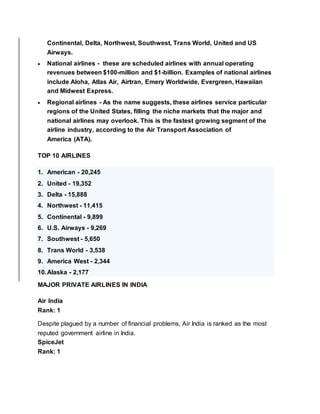
 Major airlines - A major airline is defined as an airline that generates more
than $1-billion in revenue annually. There were 12 major airlines as of 2000:
Alaska, America West, American, American Eagle, American Trans Air,
Continental, Delta, Northwest, Southwest, Trans World, United and US
Airways.
 National airlines - these are scheduled airlines with annual operating
revenues between $100-million and $1-billion. Examples of national airlines
include Aloha, Atlas Air, Airtran, Emery Worldwide, Evergreen, Hawaiian
and Midwest Express.
 Regional airlines - As the name suggests, these airlines service particular
regions of the United States, filling the niche markets that the major and
national airlines may overlook. This is the fastest growing segment of the
airline industry, according to the Air Transport Association of
America (ATA).
TOP 10 AIRLINES
1. American - 20,245
2. United - 19,352
3. Delta - 15,888
4. Northwest - 11,415
5. Continental - 9,899
6. U.S. Airways - 9,269
7. Southwest - 5,650
8. Trans World - 3,538
9. America West - 2,344
10.Alaska - 2,177
MAJOR PRIVATE AIRLINES IN INDIA
Air India
Rank: 1
Despite plagued by a number of financial problems, Air India is ranked as the most
reputed government airline in India.
SpiceJet
Rank: 1
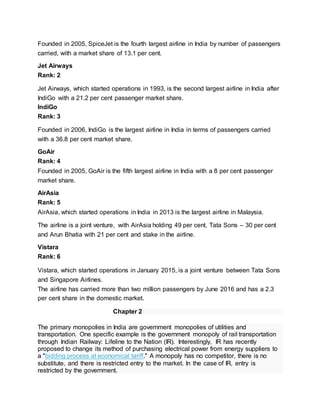
Founded in 2005, SpiceJet is the fourth largest airline in India by number of passengers
carried, with a market share of 13.1 per cent.
Jet Airways
Rank: 2
Jet Airways, which started operations in 1993, is the second largest airline in India after
IndiGo with a 21.2 per cent passenger market share.
IndiGo
Rank: 3
Founded in 2006, IndiGo is the largest airline in India in terms of passengers carried
with a 36.8 per cent market share.
GoAir
Rank: 4
Founded in 2005, GoAir is the fifth largest airline in India with a 8 per cent passenger
market share.
AirAsia
Rank: 5
AirAsia, which started operations in India in 2013 is the largest airline in Malaysia.
The airline is a joint venture, with AirAsia holding 49 per cent, Tata Sons – 30 per cent
and Arun Bhatia with 21 per cent and stake in the airline.
Vistara
Rank: 6
Vistara, which started operations in January 2015, is a joint venture between Tata Sons
and Singapore Airlines.
The airline has carried more than two million passengers by June 2016 and has a 2.3
per cent share in the domestic market.
Chapter 2
The primary monopolies in India are government monopolies of utilities and
transportation. One specific example is the government monopoly of rail transportation
through Indian Railway: Lifeline to the Nation (IR). Interestingly, IR has recently
proposed to change its method of purchasing electrical power from energy suppliers to
a "bidding process at economical tariff." A monopoly has no competitor, there is no
substitute, and there is restricted entry to the market. In the case of IR, entry is
restricted by the government.
A monopolistic competition is represented by the synthetic fiber production market in
India. While there are many firms that manufacture synthetic fiber, such as Sky
Industries and Sumeet Ind, Zenith Fibres Ltd is the only one to produce "Polypropylene
Staple Fibre (PPSF) used as raw material in 100% PP Yarn. ... and they are the only
manufacturer of this product in India with 100% market share" (Rajesh Bihani). This
exclusivity of product positions Zenith in a monopolistic competition.
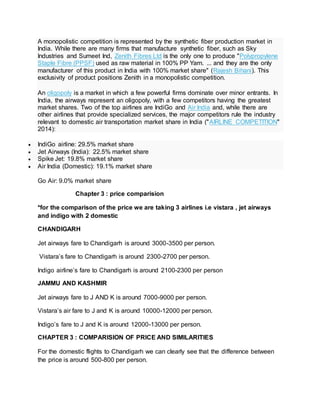
An oligopoly is a market in which a few powerful firms dominate over minor entrants. In
India, the airways represent an oligopoly, with a few competitors having the greatest
market shares. Two of the top airlines are IndiGo and Air India and, while there are
other airlines that provide specialized services, the major competitors rule the industry
relevant to domestic air transportation market share in India ("AIRLINE COMPETITION"
2014):
 IndiGo airline: 29.5% market share
 Jet Airways (India): 22.5% market share
 Spike Jet: 19.8% market share
 Air India (Domestic): 19.1% market share
Go Air: 9.0% market share
Chapter 3 : price comparision
*for the comparison of the price we are taking 3 airlines i.e vistara , jet airways
and indigo with 2 domestic
CHANDIGARH
Jet airways fare to Chandigarh is around 3000-3500 per person.
Vistara’s fare to Chandigarh is around 2300-2700 per person.
Indigo airline’s fare to Chandigarh is around 2100-2300 per person
JAMMU AND KASHMIR
Jet airways fare to J AND K is around 7000-9000 per person.
Vistara’s air fare to J and K is around 10000-12000 per person.
Indigo’s fare to J and K is around 12000-13000 per person.
CHAPTER 3 : COMPARISION OF PRICE AND SIMILARITIES
For the domestic flights to Chandigarh we can clearly see that the difference between
the price is around 500-800 per person.
For the domestic flights to jammu and Kashmir we can clearly see the difference of
price from 2000-2500. It is so because that the Srinagar airport is a defense airport and
flights to same costs more
CHAPTER 4 : SERVICES OFFERED
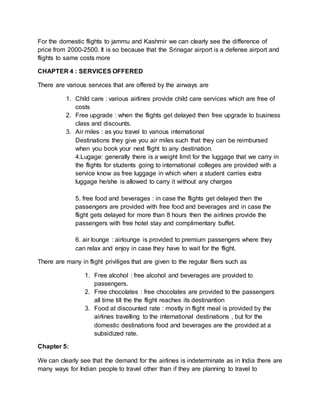
There are various services that are offered by the airways are
1. Child care : various airlines provide child care services which are free of
costs
2. Free upgrade : when the flights get delayed then free upgrade to business
class and discounts.
3. Air miles : as you travel to various international
Destinations they give you air miles such that they can be reimbursed
when you book your next flight to any destination.
4.Lugage: generally there is a weight limit for the luggage that we carry in
the flights for students going to international colleges are provided with a
service know as free luggage in which when a student carries extra
luggage he/she is allowed to carry it without any charges
5. free food and beverages : in case the flights get delayed then the
passengers are provided with free food and beverages and in case the
flight gets delayed for more than 8 hours then the airlines provide the
passengers with free hotel stay and complimentary buffet.
6. air lounge : airlounge is provided to premium passengers where they
can relax and enjoy in case they have to wait for the flight.
There are many in flight priviliges that are given to the regular fliers such as
1. Free alcohol : free alcohol and beverages are provided to
passengers.
2. Free chocolates : free chocolates are provided to the passengers
all time till the the flight reaches its destinantion
3. Food at discounted rate : mostly in flight meal is provided by the
airlines travelling to the international destinations , but for the
domestic destinations food and beverages are the provided at a
subsidized rate.
Chapter 5:
We can clearly see that the demand for the airlines is indeterminate as in India there are
many ways for Indian people to travel other than if they are planning to travel to
international destinations. It’s one of the major reason for its indeterminate demand is
because of the geo logical location of the India. For domestic travel people use various
types of transport such as land ways such as car bus etc.
An airlines price as they schedule the flights 6 months before and take the booking for
the same a year before the date of travel. Using this the competitiors make there airfare
and aircharts, due to this advancement there is a price rigidity in the same. Hence they
must adhere to the schedule and airfare.
The fixed cost of an airline are also high such as license aviation fuel, investment in the
infra structure of the airport etc.
CONCLUSION
 From my study of the airfare and air prices I can conclude saying that the
demand for air travel is indeterminate. One cannot determine the demand for
this. The airlines offer many non monetary benefits and spend a lot on the
advertisement and promotions. They undertake many promotional activities such
as lucky draw , free air tickets etc and also provide the consumers with many
facilities such as the lounge , free food and beverages .
 we can clearly see that if the price of any airlines changes there is a change in
the same of the other airlines fare. Although jet airways costs more it is because
of the facilities and their goodwill in the market.Owing to this there is a lot of
promotional expenditure incurred by the airlines.
 In my findings I have also seen that more than 45% people prefer to use the Jet
airways because of its facilities and top class services.
 Also there is a non price competition which prevails in the market. Jet airways
has been consistently provided with the best services in India and abroad.
Sources
Fortune 500
Wikipedia
Google

Economics project OLIGOPY

  • 1.
    SYNOPSIS The objective ofmy study is the study of airlines industry in India as an oligopoly market The India airline industry today is arguably an oligopoly. An oligopoly exists when a market is controlled by a small group of firms, often because the barrier to entry is significant enough to discourage potential competitors. As of 2017, there are four major domestic airlines i.e air india , jet airways , vistara , indigo– which fly about 80% of all domestic passengers. I have chosen this topic because of the reason that the airlines industry has always been projected as oligopoly market. recently it had been in news as well so I took this as my topic of study I went to the offices of jet airways and DGCA and they have helped me a lot in finishing my project so far My observation are that the demand for air travel is indeterminate. One cannot determine the demand for this. The airlines offer many non monetary benefits and spend a lot on the advertisement and promotions. They undertake many promotional activities such as lucky draw , free air tickets etc and also provide the consumers with many facilities such as the lounge , free food and beverages . Owing to this there is a lot of promotional expenditure incurred by the airlines. Oligopoly An oligopoly is a market form wherein a market or industry is dominated by a small number of large sellers (oligopolists). Oligopolies can result from various forms of collusion which reduce competition and lead to higher prices for consumers. Oligopoly has its own market structure.[1] With few sellers, each oligopolist is likely to be aware of the actions of the others. According to game theory, the decisions of one firm therefore influence and are influenced by decisions of other firms. Strategic planning by oligopolists needs to take into account the likely responses of the other market. Entry Barriers: High investment required. Strong consumer loyality for existing brand. Economics of scale. Characteristics[edit] Profit maximization conditions An oligopoly maximizes profits. Ability to set price Oligopolies are price setters rather than price takers.[2] Entry and exit
  • 2.
    Barriers to entryare high.[3] The most important barriers are government licenses, economies of scale, patents, access to expensive and complex technology, and strategic actions by incumbent firms designed to discourage or destroy nascent firms. Number of firms "Few" – a "handful" of sellers.[3] There are so few firms that the actions of one firm can influence the actions of the other firms.[5] Long run profits Oligopolies can retain long run abnormal profits. High barriers of entry prevent sideline firms from entering market to capture excess profits. Product differentiation Product may be homogeneous (steel) or differentiated (automobiles).[4] Perfect knowledge Assumptions about perfect knowledge vary but the knowledge of various economic factors can be generally described as selective. Oligopolies have perfect knowledge of their own cost and demand functions but their inter-firm information may be incomplete. Buyers have only imperfect knowledge as to price,[3] cost and product quality. Interdependence The distinctive feature of an oligopoly is interdependence.[6] Oligopolies are typically composed of a few large firms. Each firm is so large that its actions affect market conditions. Therefore, the competing firms will be aware of a firm's market actions and will respond appropriately. Non-Price Competition Oligopolies tend to compete on terms other than price. Loyalty schemes, advertisement, and product differentiation are all examples of non-price competition. AVIATION INDUSTRY Aviation is the practical aspect or art of aeronautics, being the design, development, production, operation and use of aircraft, especially heavier-than-air aircraft. The word aviation was coined by French writer and former naval officer Gabriel La Landelle in 1863,[1] from the verb avier itself derived from the Latin word avis ("bird") . VARIOUS CATEGORIES OF AIRLINES Types of Airlines  Major airlines - A major airline is defined as an airline that generates more than $1-billion in revenue annually. There were 12 major airlines as of 2000: Alaska, America West, American, American Eagle, American Trans Air,
  • 3.
    Continental, Delta, Northwest,Southwest, Trans World, United and US Airways.  National airlines - these are scheduled airlines with annual operating revenues between $100-million and $1-billion. Examples of national airlines include Aloha, Atlas Air, Airtran, Emery Worldwide, Evergreen, Hawaiian and Midwest Express.  Regional airlines - As the name suggests, these airlines service particular regions of the United States, filling the niche markets that the major and national airlines may overlook. This is the fastest growing segment of the airline industry, according to the Air Transport Association of America (ATA). TOP 10 AIRLINES 1. American - 20,245 2. United - 19,352 3. Delta - 15,888 4. Northwest - 11,415 5. Continental - 9,899 6. U.S. Airways - 9,269 7. Southwest - 5,650 8. Trans World - 3,538 9. America West - 2,344 10.Alaska - 2,177 MAJOR PRIVATE AIRLINES IN INDIA Air India Rank: 1 Despite plagued by a number of financial problems, Air India is ranked as the most reputed government airline in India. SpiceJet Rank: 1
  • 4.
    Founded in 2005,SpiceJet is the fourth largest airline in India by number of passengers carried, with a market share of 13.1 per cent. Jet Airways Rank: 2 Jet Airways, which started operations in 1993, is the second largest airline in India after IndiGo with a 21.2 per cent passenger market share. IndiGo Rank: 3 Founded in 2006, IndiGo is the largest airline in India in terms of passengers carried with a 36.8 per cent market share. GoAir Rank: 4 Founded in 2005, GoAir is the fifth largest airline in India with a 8 per cent passenger market share. AirAsia Rank: 5 AirAsia, which started operations in India in 2013 is the largest airline in Malaysia. The airline is a joint venture, with AirAsia holding 49 per cent, Tata Sons – 30 per cent and Arun Bhatia with 21 per cent and stake in the airline. Vistara Rank: 6 Vistara, which started operations in January 2015, is a joint venture between Tata Sons and Singapore Airlines. The airline has carried more than two million passengers by June 2016 and has a 2.3 per cent share in the domestic market. Chapter 2 The primary monopolies in India are government monopolies of utilities and transportation. One specific example is the government monopoly of rail transportation through Indian Railway: Lifeline to the Nation (IR). Interestingly, IR has recently proposed to change its method of purchasing electrical power from energy suppliers to a "bidding process at economical tariff." A monopoly has no competitor, there is no substitute, and there is restricted entry to the market. In the case of IR, entry is restricted by the government.
  • 5.
    A monopolistic competitionis represented by the synthetic fiber production market in India. While there are many firms that manufacture synthetic fiber, such as Sky Industries and Sumeet Ind, Zenith Fibres Ltd is the only one to produce "Polypropylene Staple Fibre (PPSF) used as raw material in 100% PP Yarn. ... and they are the only manufacturer of this product in India with 100% market share" (Rajesh Bihani). This exclusivity of product positions Zenith in a monopolistic competition. An oligopoly is a market in which a few powerful firms dominate over minor entrants. In India, the airways represent an oligopoly, with a few competitors having the greatest market shares. Two of the top airlines are IndiGo and Air India and, while there are other airlines that provide specialized services, the major competitors rule the industry relevant to domestic air transportation market share in India ("AIRLINE COMPETITION" 2014):  IndiGo airline: 29.5% market share  Jet Airways (India): 22.5% market share  Spike Jet: 19.8% market share  Air India (Domestic): 19.1% market share Go Air: 9.0% market share Chapter 3 : price comparision *for the comparison of the price we are taking 3 airlines i.e vistara , jet airways and indigo with 2 domestic CHANDIGARH Jet airways fare to Chandigarh is around 3000-3500 per person. Vistara’s fare to Chandigarh is around 2300-2700 per person. Indigo airline’s fare to Chandigarh is around 2100-2300 per person JAMMU AND KASHMIR Jet airways fare to J AND K is around 7000-9000 per person. Vistara’s air fare to J and K is around 10000-12000 per person. Indigo’s fare to J and K is around 12000-13000 per person. CHAPTER 3 : COMPARISION OF PRICE AND SIMILARITIES For the domestic flights to Chandigarh we can clearly see that the difference between the price is around 500-800 per person.
  • 6.
    For the domesticflights to jammu and Kashmir we can clearly see the difference of price from 2000-2500. It is so because that the Srinagar airport is a defense airport and flights to same costs more CHAPTER 4 : SERVICES OFFERED There are various services that are offered by the airways are 1. Child care : various airlines provide child care services which are free of costs 2. Free upgrade : when the flights get delayed then free upgrade to business class and discounts. 3. Air miles : as you travel to various international Destinations they give you air miles such that they can be reimbursed when you book your next flight to any destination. 4.Lugage: generally there is a weight limit for the luggage that we carry in the flights for students going to international colleges are provided with a service know as free luggage in which when a student carries extra luggage he/she is allowed to carry it without any charges 5. free food and beverages : in case the flights get delayed then the passengers are provided with free food and beverages and in case the flight gets delayed for more than 8 hours then the airlines provide the passengers with free hotel stay and complimentary buffet. 6. air lounge : airlounge is provided to premium passengers where they can relax and enjoy in case they have to wait for the flight. There are many in flight priviliges that are given to the regular fliers such as 1. Free alcohol : free alcohol and beverages are provided to passengers. 2. Free chocolates : free chocolates are provided to the passengers all time till the the flight reaches its destinantion 3. Food at discounted rate : mostly in flight meal is provided by the airlines travelling to the international destinations , but for the domestic destinations food and beverages are the provided at a subsidized rate. Chapter 5: We can clearly see that the demand for the airlines is indeterminate as in India there are many ways for Indian people to travel other than if they are planning to travel to
  • 7.
    international destinations. It’sone of the major reason for its indeterminate demand is because of the geo logical location of the India. For domestic travel people use various types of transport such as land ways such as car bus etc. An airlines price as they schedule the flights 6 months before and take the booking for the same a year before the date of travel. Using this the competitiors make there airfare and aircharts, due to this advancement there is a price rigidity in the same. Hence they must adhere to the schedule and airfare. The fixed cost of an airline are also high such as license aviation fuel, investment in the infra structure of the airport etc. CONCLUSION  From my study of the airfare and air prices I can conclude saying that the demand for air travel is indeterminate. One cannot determine the demand for this. The airlines offer many non monetary benefits and spend a lot on the advertisement and promotions. They undertake many promotional activities such as lucky draw , free air tickets etc and also provide the consumers with many facilities such as the lounge , free food and beverages .  we can clearly see that if the price of any airlines changes there is a change in the same of the other airlines fare. Although jet airways costs more it is because of the facilities and their goodwill in the market.Owing to this there is a lot of promotional expenditure incurred by the airlines.  In my findings I have also seen that more than 45% people prefer to use the Jet airways because of its facilities and top class services.  Also there is a non price competition which prevails in the market. Jet airways has been consistently provided with the best services in India and abroad. Sources Fortune 500 Wikipedia Google