Environment protection act
           &
        Air act

             PRESENTED BY

                  PADMAPRIYA.G
Environment protection

• Environmental protection is a practice of
  protecting the environment, on individual,
  organizational or governmental levels, for the
  benefit of the natural environment and (or)
  humans.
• Protection of the environment is needed due
  to various human activities.
Environmental
  Pollutants
Burning fossil fuel
• Burning fossil fuels in cars
  and power stations
  releases so2 and other
  green house gases.


• So2 dissolve in rain – acid rain.
Acid rain
• Acid rain damages trees
  and pollutes rivers and
  lakes

• Results in erosion of
  buildings and statues.
Pesticides


             Deforestation
• Academic institutions now offer courses, such
  as

     oEnvironment studies
     oEnvironment management
     oEnvironment engineering
• The ACTS formulated by the government,
  devote to environment protection and
  development.
Environment protection act
        (1986)
•      An Act to provide for the protection and
    improvement of environment.

•      Whereas the decisions were taken at the
    United Nations Conference on the Human
    Environment held at Stockholm in June, 1972,
    in which India participated, to take
    appropriate steps for the protection and
    improvement of human environment.
•      The Environment (Protection) Act 1986
    was introduced after the Bhopal   gas tragedy
    during Rajiv Gandhi was the Prime Minister
    of our country.
Objective
• Providing for the protection and
  improvement of the environment

• Preventing environmental pollution in all its
  forms

• To tackle specific environmental problems that
  are peculiar to different parts of the country.
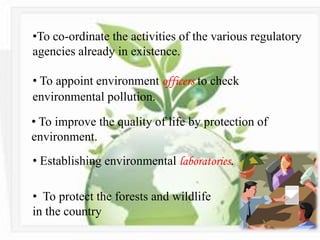
•To co-ordinate the activities of the various regulatory
agencies already in existence.

• To appoint environment officers to check
environmental pollution.

• To improve the quality of life by protection of
environment.
• Establishing environmental laboratories.

• To protect the forests and wildlife
in the country
Alternative energy sources
• Conserve our rapidly diminishing fossil fuel
  reserves by using Alternative energy sources.
Biological control of pests
• Using natural predators to eat pests instead of
  pesticides.
• Set aside lands for animals to prevent over
  grazing and destruction.
Planning and execution of a nation-wide
program for the prevention, control and
abatement of environmental pollution.
• Laying down standards for emission or
  discharge of environmental pollutants from
  various sources whatsoever.
•       Restriction of areas in which any
    industries, operations or processes shall not
    be carried out or shall be carried out subject
    to certain safeguards.
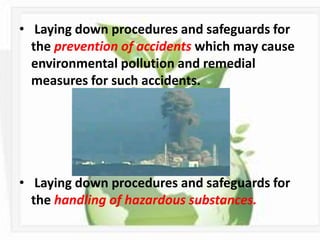
• Laying down procedures and safeguards for
  the prevention of accidents which may cause
  environmental pollution and remedial
  measures for such accidents.


• Laying down procedures and safeguards for
  the handling of hazardous substances.
• Establishment or recognition of
  environmental laboratories and institutes to
  carry out the functions entrusted to such
  environmental laboratories and institutes
  under this Act.
SUGGESTIONS

Solar Power System For Your Home,

Reducing the use of Electric power,

Recycling,
Raise Awareness,

Reduce waste,

Choose Energy Efficient Appliances.
Air (prevention and control of
     pollution ) act, 1981
• This law specifically states that:

    “the prevention and control of air pollution at its
    source is the primary responsibility of State and
    local governments.”
Objectives
• Protect and enhance the quality of air
  resources.
• Protect public health and welfare while
  fostering a beneficial productive capacity.
• Prevention, control and abatement of air
  pollution .
• Gives power to board for ensuring that there
  are proper systems for prevention of air
  pollution.
• Amendments created features to let industries
  make choices on the best way to reach
  pollution cleanup goals.

• Raw material…
• Gasoline refiners can get credits for producing
  cleaner gasoline than required and they use
  those credits when their gasoline doesn’t
  achieve cleanup requirements.
• Maximum achievable control technology to
  be adopted for both new and existing sources.

• Waste water treatment plants and air
  pollution control equipment.
• The Act provides that the State Government,
  in consultation with the State Board, is
  empowered to declare any area or areas
  within the jurisdiction of the concerned State
  an “Air Pollution Control Area”.
Penalty


Contravention : shall be punishable with
    Imprisonment for a term which may
    extend to three months or with fine
     which may extend to ten thousand rupees
    or with both.
If we think right now we can minimize the pollution….
Environment protection act

Environment protection act

  • 1.
    Environment protection act & Air act PRESENTED BY PADMAPRIYA.G
  • 2.
    Environment protection • Environmentalprotection is a practice of protecting the environment, on individual, organizational or governmental levels, for the benefit of the natural environment and (or) humans. • Protection of the environment is needed due to various human activities.
  • 3.
  • 4.
    Burning fossil fuel •Burning fossil fuels in cars and power stations releases so2 and other green house gases. • So2 dissolve in rain – acid rain.
  • 5.
    Acid rain • Acidrain damages trees and pollutes rivers and lakes • Results in erosion of buildings and statues.
  • 6.
    Pesticides Deforestation
  • 8.
    • Academic institutionsnow offer courses, such as oEnvironment studies oEnvironment management oEnvironment engineering
  • 9.
    • The ACTSformulated by the government, devote to environment protection and development.
  • 10.
  • 11.
    An Act to provide for the protection and improvement of environment. • Whereas the decisions were taken at the United Nations Conference on the Human Environment held at Stockholm in June, 1972, in which India participated, to take appropriate steps for the protection and improvement of human environment.
  • 12.
    The Environment (Protection) Act 1986 was introduced after the Bhopal gas tragedy during Rajiv Gandhi was the Prime Minister of our country.
  • 13.
    Objective • Providing forthe protection and improvement of the environment • Preventing environmental pollution in all its forms • To tackle specific environmental problems that are peculiar to different parts of the country.
  • 14.
    •To co-ordinate theactivities of the various regulatory agencies already in existence. • To appoint environment officers to check environmental pollution. • To improve the quality of life by protection of environment. • Establishing environmental laboratories. • To protect the forests and wildlife in the country
  • 15.
    Alternative energy sources •Conserve our rapidly diminishing fossil fuel reserves by using Alternative energy sources.
  • 16.
    Biological control ofpests • Using natural predators to eat pests instead of pesticides.
  • 17.
    • Set asidelands for animals to prevent over grazing and destruction.
  • 18.
    Planning and executionof a nation-wide program for the prevention, control and abatement of environmental pollution.
  • 19.
    • Laying downstandards for emission or discharge of environmental pollutants from various sources whatsoever.
  • 20.
    Restriction of areas in which any industries, operations or processes shall not be carried out or shall be carried out subject to certain safeguards.
  • 21.
    • Laying downprocedures and safeguards for the prevention of accidents which may cause environmental pollution and remedial measures for such accidents. • Laying down procedures and safeguards for the handling of hazardous substances.
  • 22.
    • Establishment orrecognition of environmental laboratories and institutes to carry out the functions entrusted to such environmental laboratories and institutes under this Act.
  • 23.
    SUGGESTIONS Solar Power SystemFor Your Home, Reducing the use of Electric power, Recycling, Raise Awareness, Reduce waste, Choose Energy Efficient Appliances.
  • 24.
    Air (prevention andcontrol of pollution ) act, 1981
  • 25.
    • This lawspecifically states that: “the prevention and control of air pollution at its source is the primary responsibility of State and local governments.”
  • 26.
    Objectives • Protect andenhance the quality of air resources. • Protect public health and welfare while fostering a beneficial productive capacity. • Prevention, control and abatement of air pollution . • Gives power to board for ensuring that there are proper systems for prevention of air pollution.
  • 27.
    • Amendments createdfeatures to let industries make choices on the best way to reach pollution cleanup goals. • Raw material…
  • 28.
    • Gasoline refinerscan get credits for producing cleaner gasoline than required and they use those credits when their gasoline doesn’t achieve cleanup requirements.
  • 29.
    • Maximum achievablecontrol technology to be adopted for both new and existing sources. • Waste water treatment plants and air pollution control equipment.
  • 30.
    • The Actprovides that the State Government, in consultation with the State Board, is empowered to declare any area or areas within the jurisdiction of the concerned State an “Air Pollution Control Area”.
  • 31.
    Penalty Contravention : shallbe punishable with Imprisonment for a term which may extend to three months or with fine which may extend to ten thousand rupees or with both.
  • 32.
    If we thinkright now we can minimize the pollution….

Editor's Notes

  • #8 GLOBAL WARMING
  • #33 While you are thinking about yourself, Think about our environment and GO GREEN