Environment
Protection Act
Dr G K Sathishkumar
Introduction
India has worlds largest democracy with population of 1.1 billion.
It is diverse country with number of languages, religions, cultures etc.
During the past decades the economic and industrial growth of the
country has been extremely fast.
Increasingly serious environmental degradation events during the last
century have given a strong impetus to the need for taking effective
steps of environmental protection
Introduction
An Act to provide for the protection and improvement of
environment was needed.
Whereas the decisions were taken at the United Nations Conference
on the Human Environment held at Stockholm (Sweden) in June,
1972, (in which India participated) to take appropriate steps for the
protection and improvement of human environment.
The Environment (Protection) Act was introduced after the
Bhopal gas tragedy 1986
Introduction
Constitution of India has a number of provisions demarcating the
responsibility of the central and state/governments
towards ‘environmental protection’. The constitution of india
makes provision for environmental protection in the chapters on:
Fundamental Rights
Directive Principles of State Policy
Fundamental Duties
Various Acts
The parliament of India has passed several acts
ands laws in order to protect the environment, like…
The Factories Act, 1948
The Insecticide Act, 1968
The Forest (Conservation) Act, 1980
The Wild life (protection) Act, 1972
What do you mean by Environment ?
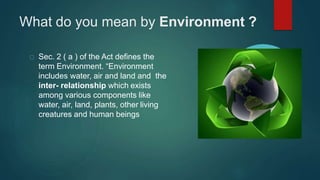
Sec. 2 ( a ) of the Act defines the
term Environment. “Environment
includes water, air and land and the
inter- relationship which exists
among various components like
water, air, land, plants, other living
creatures and human beings
What do you mean by
Environmental Pollution ?
Sec. 2 (c) defines
environmental pollution:
"environmental pollution"
means the presence (in the
environment of any) of
environmental pollutant
What do you mean by
Environment Pollutant ?
Sec. 2 (b) defines
Environmental Pollutant:
“environmental pollutant"
means any solid, liquid or
gaseous substance’s presence
in such concentration as may be,
or tend to be, injurious to
environment.
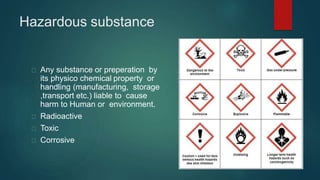
Hazardous substance
Any substance or preperation by
its physico chemical property or
handling (manufacturing, storage
,transport etc.) liable to cause
harm to Human or environment.
Radioactive
Toxic
Corrosive
Features and objectives of the EP Act
The Environment (Protection) Act, 1986 (passed in March 1986
and came into force on 19 Nov. 1986).
The E.P. Act was enacted under Art.253 of the Constitution of
India.
The Act seeks to supplement the existing laws on control of
Pollution by enacting a general legislation for environmental
protection
Features and objectives of the EP Act
The Act makes the central government, the repository of
wide powers. (whereas the Water (Prevention and Control of
Pollution) Act, 1974 and the Air (Prevention and Control) Act, 1981
entrust the task of control of pollution on agencies created by the statute
namely state and central pollution control boards.)
Rule making power of the Central Govt. is the main
feature of this Act.
Implement decision taken by UN
Besides prevention and control, the Act aims at
protection and improvement of the Environment.
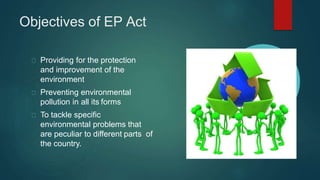
Objectives of EP Act
Providing for the protection
and improvement of the
environment
Preventing environmental
pollution in all its forms
To tackle specific
environmental problems that
are peculiar to different parts of
the country.
Objectives of EP Act
To co-ordinate the activities of the
various regulatory agencies already in
existence.
To appoint environment officers to
check environmental pollution.
To improve the quality of life by
protection of environment.
Establishing environmental laboratories.
To protect the forests and wildlife in the
country
Objectives of EP Act
Conserve our rapidly
diminishing fossil fuel
reserves by using
Alternative energy sources
Objectives of EP Act
Biological control of
pests
Using natural predators
to eat pests instead of
pesticides
Objectives of EP Act
Prevent Environment
Set aside lands for
animals to prevent over
grazing and destruction.
Objectives of EP Act
Pollution control
Laying down standards for
emission or discharge of
environmental pollutants from
various sources whatsoever.
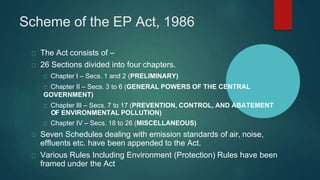
Scheme of the EP Act, 1986
The Act consists of –
26 Sections divided into four chapters.
Chapter I – Secs. 1 and 2 (PRELIMINARY)
Chapter II – Secs. 3 to 6 (GENERAL POWERS OF THE CENTRAL
GOVERNMENT)
Chapter III – Secs. 7 to 17 (PREVENTION, CONTROL, AND ABATEMENT
OF ENVIRONMENTAL POLLUTION)
Chapter IV – Secs. 18 to 26 (MISCELLANEOUS)
Seven Schedules dealing with emission standards of air, noise,
effluents etc. have been appended to the Act.
Various Rules Including Environment (Protection) Rules have been
framed under the Act
General Powers assigned to
Central Government
To take all necessary measures for prevention, control
and abatement of environmental pollution. Sec. 3(1) such
measures are enlisted in sec. 3(2)
Authorities can be constituted . Sec. 3(3)
Appointment of Officers. Sec. 4
To issue Directions and orders. Sec. 5
Section 3 - POWER OF CENTRAL
GOVERNMENT TO TAKE MEASURES
TO PROTECT AND IMPROVE
ENVIRONMENT
(1) Subject to the provisions of this Act, the Central
Government, shall have the power to take all such
measures as it deems necessary or expedient for the
purpose of protecting and improving the quality of the
environment and preventing, controlling and abating
environmental pollution.
Contd…
(2) In particular, such measures may include measures with
respect to all or any of the following matters, namely:--
(i) co-ordination of actions by the State Governments, officers and
other authorities-
(a) under this Act, or the rules made thereunder, or
(b) under any other law for the time being in force which is relatable to the
objects of this Act;
(ii) planning and execution of a nation-wide programme for the
prevention, control and abatement of environmental pollution;
Contd…
(iii) laying down standards for the quality of environment in
its various aspects;
(iv) laying down standards for emission or discharge of
environmental pollutants from various sources
whatsoever;
(v) restriction of areas in wchich any industries
,operations or processesor class of industries ,opertaions or
processes shall not be carried out or shall be carried out
subject to certain safeguard;
Contd …
(vi) laying down procedures and safeguards for the prevention of
accidents which may cause environmental pollution and remedial
measures for such accidents;
(vii) laying down procedures and safeguards for the handling of
hazardous substances;
(viii) examination of such manufacturing processes, materials and
substances as are likely to cause environmental pollution;
(ix) carrying out and sponsoring investigations and research
relating to problems of environmental pollution;
Thank you

Environment protection act.pptx

  • 1.
  • 2.
    Introduction India has worldslargest democracy with population of 1.1 billion. It is diverse country with number of languages, religions, cultures etc. During the past decades the economic and industrial growth of the country has been extremely fast. Increasingly serious environmental degradation events during the last century have given a strong impetus to the need for taking effective steps of environmental protection
  • 3.
    Introduction An Act toprovide for the protection and improvement of environment was needed. Whereas the decisions were taken at the United Nations Conference on the Human Environment held at Stockholm (Sweden) in June, 1972, (in which India participated) to take appropriate steps for the protection and improvement of human environment. The Environment (Protection) Act was introduced after the Bhopal gas tragedy 1986
  • 4.
    Introduction Constitution of Indiahas a number of provisions demarcating the responsibility of the central and state/governments towards ‘environmental protection’. The constitution of india makes provision for environmental protection in the chapters on: Fundamental Rights Directive Principles of State Policy Fundamental Duties
  • 5.
    Various Acts The parliamentof India has passed several acts ands laws in order to protect the environment, like… The Factories Act, 1948 The Insecticide Act, 1968 The Forest (Conservation) Act, 1980 The Wild life (protection) Act, 1972
  • 6.
    What do youmean by Environment ? Sec. 2 ( a ) of the Act defines the term Environment. “Environment includes water, air and land and the inter- relationship which exists among various components like water, air, land, plants, other living creatures and human beings
  • 7.
    What do youmean by Environmental Pollution ? Sec. 2 (c) defines environmental pollution: "environmental pollution" means the presence (in the environment of any) of environmental pollutant
  • 8.
    What do youmean by Environment Pollutant ? Sec. 2 (b) defines Environmental Pollutant: “environmental pollutant" means any solid, liquid or gaseous substance’s presence in such concentration as may be, or tend to be, injurious to environment.
  • 9.
    Hazardous substance Any substanceor preperation by its physico chemical property or handling (manufacturing, storage ,transport etc.) liable to cause harm to Human or environment. Radioactive Toxic Corrosive
  • 10.
    Features and objectivesof the EP Act The Environment (Protection) Act, 1986 (passed in March 1986 and came into force on 19 Nov. 1986). The E.P. Act was enacted under Art.253 of the Constitution of India. The Act seeks to supplement the existing laws on control of Pollution by enacting a general legislation for environmental protection
  • 11.
    Features and objectivesof the EP Act The Act makes the central government, the repository of wide powers. (whereas the Water (Prevention and Control of Pollution) Act, 1974 and the Air (Prevention and Control) Act, 1981 entrust the task of control of pollution on agencies created by the statute namely state and central pollution control boards.) Rule making power of the Central Govt. is the main feature of this Act. Implement decision taken by UN Besides prevention and control, the Act aims at protection and improvement of the Environment.
  • 12.
    Objectives of EPAct Providing for the protection and improvement of the environment Preventing environmental pollution in all its forms To tackle specific environmental problems that are peculiar to different parts of the country.
  • 13.
    Objectives of EPAct To co-ordinate the activities of the various regulatory agencies already in existence. To appoint environment officers to check environmental pollution. To improve the quality of life by protection of environment. Establishing environmental laboratories. To protect the forests and wildlife in the country
  • 14.
    Objectives of EPAct Conserve our rapidly diminishing fossil fuel reserves by using Alternative energy sources
  • 15.
    Objectives of EPAct Biological control of pests Using natural predators to eat pests instead of pesticides
  • 16.
    Objectives of EPAct Prevent Environment Set aside lands for animals to prevent over grazing and destruction.
  • 17.
    Objectives of EPAct Pollution control Laying down standards for emission or discharge of environmental pollutants from various sources whatsoever.
  • 18.
    Scheme of theEP Act, 1986 The Act consists of – 26 Sections divided into four chapters. Chapter I – Secs. 1 and 2 (PRELIMINARY) Chapter II – Secs. 3 to 6 (GENERAL POWERS OF THE CENTRAL GOVERNMENT) Chapter III – Secs. 7 to 17 (PREVENTION, CONTROL, AND ABATEMENT OF ENVIRONMENTAL POLLUTION) Chapter IV – Secs. 18 to 26 (MISCELLANEOUS) Seven Schedules dealing with emission standards of air, noise, effluents etc. have been appended to the Act. Various Rules Including Environment (Protection) Rules have been framed under the Act
  • 19.
    General Powers assignedto Central Government To take all necessary measures for prevention, control and abatement of environmental pollution. Sec. 3(1) such measures are enlisted in sec. 3(2) Authorities can be constituted . Sec. 3(3) Appointment of Officers. Sec. 4 To issue Directions and orders. Sec. 5
  • 20.
    Section 3 -POWER OF CENTRAL GOVERNMENT TO TAKE MEASURES TO PROTECT AND IMPROVE ENVIRONMENT (1) Subject to the provisions of this Act, the Central Government, shall have the power to take all such measures as it deems necessary or expedient for the purpose of protecting and improving the quality of the environment and preventing, controlling and abating environmental pollution.
  • 21.
    Contd… (2) In particular,such measures may include measures with respect to all or any of the following matters, namely:-- (i) co-ordination of actions by the State Governments, officers and other authorities- (a) under this Act, or the rules made thereunder, or (b) under any other law for the time being in force which is relatable to the objects of this Act; (ii) planning and execution of a nation-wide programme for the prevention, control and abatement of environmental pollution;
  • 22.
    Contd… (iii) laying downstandards for the quality of environment in its various aspects; (iv) laying down standards for emission or discharge of environmental pollutants from various sources whatsoever; (v) restriction of areas in wchich any industries ,operations or processesor class of industries ,opertaions or processes shall not be carried out or shall be carried out subject to certain safeguard;
  • 23.
    Contd … (vi) layingdown procedures and safeguards for the prevention of accidents which may cause environmental pollution and remedial measures for such accidents; (vii) laying down procedures and safeguards for the handling of hazardous substances; (viii) examination of such manufacturing processes, materials and substances as are likely to cause environmental pollution; (ix) carrying out and sponsoring investigations and research relating to problems of environmental pollution;
  • 24.