Essay Writing
In-text citations
a.k.a. parenthetical citationsor internal documentation
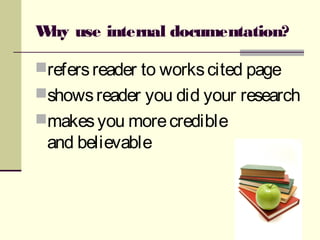
Why use internal documentation?
refersreader to workscited page
showsreader you did your research
makesyou morecredible
and believable
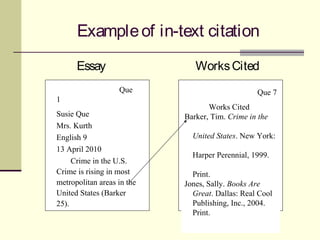
Exampleof in-text citation
Essay WorksCited
Que
1
Susie Que
Mrs. Kurth
English 9
13 April 2010
Crime in the U.S.
Crime is rising in most
metropolitan areas in the
United States (Barker
25).
Que 7
Works Cited
Barker, Tim. Crime in the
United States. New York:
Harper Perennial, 1999.
Print.
Jones, Sally. Books Are
Great. Dallas: Real Cool
Publishing, Inc., 2004.
Print.
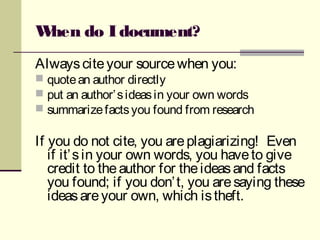
When do Idocument?
Alwaysciteyour sourcewhen you:
 quotean author directly
 put an author’sideasin your own words
 summarizefactsyou found from research
If you do not cite, you areplagiarizing! Even
if it’sin your own words, you haveto give
credit to theauthor for theideasand facts
you found; if you don’t, you aresaying these
ideasareyour own, which istheft.
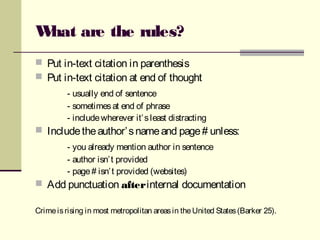
What are the rules?
 Put in-text citation in parenthesis
 Put in-text citation at end of thought
- usually end of sentence
- sometimesat end of phrase
- includewherever it’sleast distracting
 Includetheauthor’snameand page# unless:
- you already mention author in sentence
- author isn’t provided
- page# isn’t provided (websites)
 Add punctuation afterinternal documentation
Crimeisrising in most metropolitan areasin theUnited States(Barker 25).
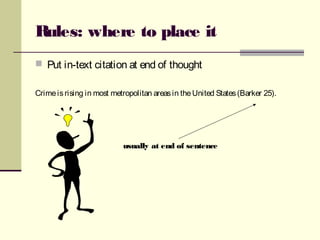
Rules: where to place it
 Put in-text citation at end of thought
Crimeisrising in most metropolitan areasin theUnited States(Barker 25).
usually at end of sentence
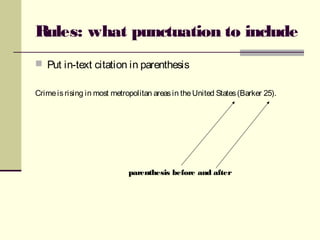
Rules: what punctuation to include
 Put in-text citation in parenthesis
Crimeisrising in most metropolitan areasin theUnited States(Barker 25).
parenthesis before and after
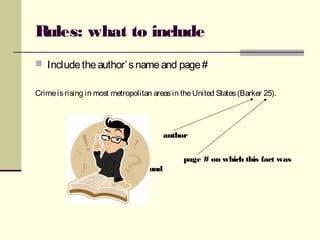
Rules: what to include
 Includetheauthor’snameand page#
Crimeisrising in most metropolitan areasin theUnited States(Barker 25).
page # on which this fact was
found
author
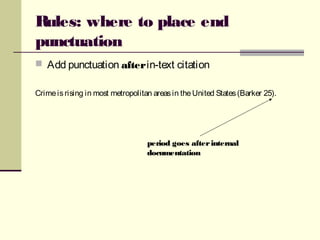
Rules: where to place end
punctuation
 Add punctuation afterin-text citation
Crimeisrising in most metropolitan areasin theUnited States(Barker 25).
period goes afterinternal
documentation
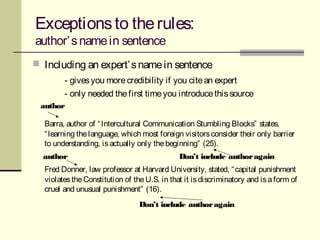
Exceptionsto therules:
author’snamein sentence
 Including an expert’snamein sentence
- givesyou morecredibility if you citean expert
- only needed thefirst timeyou introducethissource
Barra, author of “Intercultural Communication Stumbling Blocks” states,
“learning thelanguage, which most foreign visitorsconsider their only barrier
to understanding, isactually only thebeginning” (25).
Fred Donner, law professor at Harvard University, stated, “capital punishment
violatestheConstitution of theU.S. in that it isdiscriminatory and isaform of
cruel and unusual punishment” (16).
author
author
Don’t include authoragain
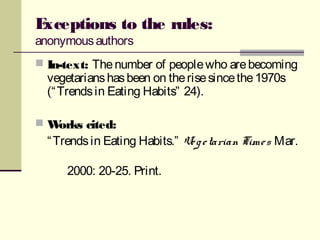
Exceptions to the rules:
anonymousauthors
 In-text: Thenumber of peoplewho arebecoming
vegetarianshasbeen on therisesincethe1970s
(“Trendsin Eating Habits” 24).
 Works cited:
“Trendsin Eating Habits.” Vegetarian Times Mar.
2000: 20-25. Print.
Exceptions to the rules:
electronic sources
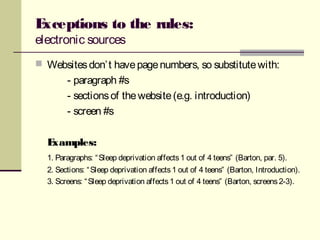
 Websitesdon’t havepagenumbers, so substitutewith:
- paragraph #s
- sectionsof thewebsite(e.g. introduction)
- screen #s
Examples:
1. Paragraphs: “Sleep deprivation affects1 out of 4 teens” (Barton, par. 5).
2. Sections: “Sleep deprivation affects1 out of 4 teens” (Barton, Introduction).
3. Screens: “Sleep deprivation affects1 out of 4 teens” (Barton, screens2-3).
Exceptions to the rules:
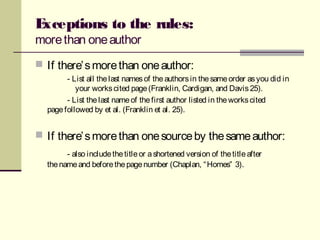
morethan oneauthor
 If there’smorethan oneauthor:
- List all thelast namesof theauthorsin thesameorder asyou did in
your workscited page(Franklin, Cardigan, and Davis25).
- List thelast nameof thefirst author listed in theworkscited
pagefollowed by et al. (Franklin et al. 25).
 If there’smorethan onesourceby thesameauthor:
- also includethetitleor ashortened version of thetitleafter
thenameand beforethepagenumber (Chaplan, “Homes” 3).
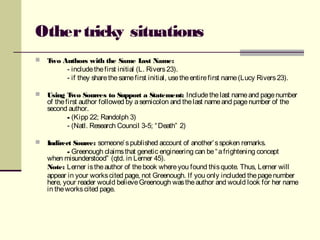
Othertricky situations
 Two Authors with the Same Last Name:
- includethefirst initial (L. Rivers23).
- if they sharethesamefirst initial, usetheentirefirst name(Lucy Rivers23).
 Using Two Sources to Support a Statement: Includethelast nameand pagenumber
of thefirst author followed by asemicolon and thelast nameand pagenumber of the
second author.
- (Kipp 22; Randolph 3)
- (Natl. Research Council 3-5; “Death” 2)
 Indirect Source: someone’spublished account of another’sspoken remarks.
- Greenough claimsthat genetic engineering can be“afrightening concept
when misunderstood” (qtd. in Lerner 45).
Note: Lerner istheauthor of thebook whereyou found thisquote. Thus, Lerner will
appear in your workscited page, not Greenough. If you only included thepagenumber
here, your reader would believeGreenough wastheauthor and would look for her name
in theworkscited page.

In-Text Citations (essay-writing)

  • 1.
    Essay Writing In-text citations a.k.a.parenthetical citationsor internal documentation
  • 2.
    Why use internaldocumentation? refersreader to workscited page showsreader you did your research makesyou morecredible and believable
  • 3.
    Exampleof in-text citation EssayWorksCited Que 1 Susie Que Mrs. Kurth English 9 13 April 2010 Crime in the U.S. Crime is rising in most metropolitan areas in the United States (Barker 25). Que 7 Works Cited Barker, Tim. Crime in the United States. New York: Harper Perennial, 1999. Print. Jones, Sally. Books Are Great. Dallas: Real Cool Publishing, Inc., 2004. Print.
  • 4.
    When do Idocument? Alwaysciteyoursourcewhen you:  quotean author directly  put an author’sideasin your own words  summarizefactsyou found from research If you do not cite, you areplagiarizing! Even if it’sin your own words, you haveto give credit to theauthor for theideasand facts you found; if you don’t, you aresaying these ideasareyour own, which istheft.
  • 5.
    What are therules?  Put in-text citation in parenthesis  Put in-text citation at end of thought - usually end of sentence - sometimesat end of phrase - includewherever it’sleast distracting  Includetheauthor’snameand page# unless: - you already mention author in sentence - author isn’t provided - page# isn’t provided (websites)  Add punctuation afterinternal documentation Crimeisrising in most metropolitan areasin theUnited States(Barker 25).
  • 6.
    Rules: where toplace it  Put in-text citation at end of thought Crimeisrising in most metropolitan areasin theUnited States(Barker 25). usually at end of sentence
  • 7.
    Rules: what punctuationto include  Put in-text citation in parenthesis Crimeisrising in most metropolitan areasin theUnited States(Barker 25). parenthesis before and after
  • 8.
    Rules: what toinclude  Includetheauthor’snameand page# Crimeisrising in most metropolitan areasin theUnited States(Barker 25). page # on which this fact was found author
  • 9.
    Rules: where toplace end punctuation  Add punctuation afterin-text citation Crimeisrising in most metropolitan areasin theUnited States(Barker 25). period goes afterinternal documentation
  • 10.
    Exceptionsto therules: author’snamein sentence Including an expert’snamein sentence - givesyou morecredibility if you citean expert - only needed thefirst timeyou introducethissource Barra, author of “Intercultural Communication Stumbling Blocks” states, “learning thelanguage, which most foreign visitorsconsider their only barrier to understanding, isactually only thebeginning” (25). Fred Donner, law professor at Harvard University, stated, “capital punishment violatestheConstitution of theU.S. in that it isdiscriminatory and isaform of cruel and unusual punishment” (16). author author Don’t include authoragain Don’t include authoragain
  • 11.
    Exceptions to therules: anonymousauthors  In-text: Thenumber of peoplewho arebecoming vegetarianshasbeen on therisesincethe1970s (“Trendsin Eating Habits” 24).  Works cited: “Trendsin Eating Habits.” Vegetarian Times Mar. 2000: 20-25. Print.
  • 12.
    Exceptions to therules: electronic sources  Websitesdon’t havepagenumbers, so substitutewith: - paragraph #s - sectionsof thewebsite(e.g. introduction) - screen #s Examples: 1. Paragraphs: “Sleep deprivation affects1 out of 4 teens” (Barton, par. 5). 2. Sections: “Sleep deprivation affects1 out of 4 teens” (Barton, Introduction). 3. Screens: “Sleep deprivation affects1 out of 4 teens” (Barton, screens2-3).
  • 13.
    Exceptions to therules: morethan oneauthor  If there’smorethan oneauthor: - List all thelast namesof theauthorsin thesameorder asyou did in your workscited page(Franklin, Cardigan, and Davis25). - List thelast nameof thefirst author listed in theworkscited pagefollowed by et al. (Franklin et al. 25).  If there’smorethan onesourceby thesameauthor: - also includethetitleor ashortened version of thetitleafter thenameand beforethepagenumber (Chaplan, “Homes” 3).
  • 14.
    Othertricky situations  TwoAuthors with the Same Last Name: - includethefirst initial (L. Rivers23). - if they sharethesamefirst initial, usetheentirefirst name(Lucy Rivers23).  Using Two Sources to Support a Statement: Includethelast nameand pagenumber of thefirst author followed by asemicolon and thelast nameand pagenumber of the second author. - (Kipp 22; Randolph 3) - (Natl. Research Council 3-5; “Death” 2)  Indirect Source: someone’spublished account of another’sspoken remarks. - Greenough claimsthat genetic engineering can be“afrightening concept when misunderstood” (qtd. in Lerner 45). Note: Lerner istheauthor of thebook whereyou found thisquote. Thus, Lerner will appear in your workscited page, not Greenough. If you only included thepagenumber here, your reader would believeGreenough wastheauthor and would look for her name in theworkscited page.