DEPARTMENT OF MATERIALS SCIENCE AND ENGINEERING
The Phase Field Method: Mesoscale
Simulation Aiding Material Discovery
Michael R Tonks
Materials Science and Engineering, University of Florida
Larry Aagasen
Idaho National Laboratory
In press (July 2019), Annual Review of
Materials Research
DEPARTMENT OF MATERIALS SCIENCE AND ENGINEERING
Model Development
 Creation or improvement of a
modeling capability
 Verification
 Validation
Materials Discovery
 Use of the model to learn something
new about a material
Computational materials science research can be
generalized into two categories
DEPARTMENT OF MATERIALS SCIENCE AND ENGINEERING
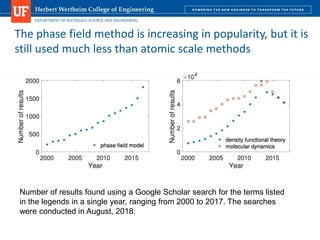
The phase field method is increasing in popularity, but it is
still used much less than atomic scale methods
Number of results found using a Google Scholar search for the terms listed
in the legends in a single year, ranging from 2000 to 2017. The searches
were conducted in August, 2018.
DEPARTMENT OF MATERIALS SCIENCE AND ENGINEERING
 I conducted a search in all Science publications
 “Density functional theory”: 832 Results
 “Molecular dynamics”: 1600 results
 “Phase field model”: 9 results
 I also searched in Nature Materials
 “Density functional theory”: 392 Results
 “Molecular dynamics”: 275 results
 “Phase field model”: 13 results
 Finally, I did a Google scholar search for a method type and “Nature Materials”
compared to a search for just the method type:
 “Density functional theory”: Fraction of 0.066
 “Molecular dynamics”: Fraction of 0.046
 “Phase field model”: Fraction of 0.033
The majority of phase field research is focused on model
development, not materials discovery
DEPARTMENT OF MATERIALS SCIENCE AND ENGINEERING
 Paper outline
 Summarize the PF method
 Examples of the PF method used for materials discovery
 Factors that impede its use
 Lessons that can be learned from the examples
The purpose of this paper is to discuss the use of the
phase field method for material discovery
DEPARTMENT OF MATERIALS SCIENCE AND ENGINEERING
1. Carmack JM, Millett PC. 2015. Numerical simulations of bijel morphology in thin
films with complete surface wetting. J. Chem. Physics 143:154701
2. Zhang W, Yu HC, Wu L, Liu H, Abdellahi A, et al. 2018. Localized concentration
reversal of lithium during intercalation into nanoparticles. Sci. Adv. 4:eaao2608
3. Damodaran AR, Clarkson JD, Hong Z, Liu H, Yadav AK, et al. 2017. Phase
coexistence and electric-field control of toroidal order in oxide superlattices. Nat.
Mater. 16:1003–1009
4. Gránásy L, Pusztai T, Borzsonyi T, Warren JA, Douglas JF. 2004. A general
mechanism of polycrystalline growth. Nat. Mater. 3:645–650
5. Wheeler D, Warren JA, Boettinger WJ. 2010. Modeling the early stages of reactive
wetting. Phys. Rev. E 82:051601
6. Mitchell NP, Koning V, Vitelli V, Irvine WT. 2017. Fracture in sheets draped on
curved surfaces. Nat. Mater. 16:89
7. Huang FT, Xue F, Gao B, Wang LH, Luo X, et al. 2016. Domain topology and domain
switching kinetics in a hybrid improper ferroelectric. Nat. Comm. 7:11602
We selected seven examples that used the PF method for
materials discovery
DEPARTMENT OF MATERIALS SCIENCE AND ENGINEERING
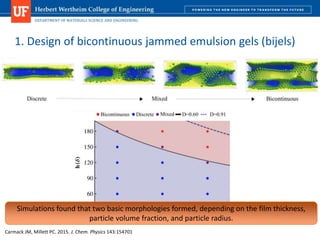
1. Design of bicontinuous jammed emulsion gels (bijels)
Carmack JM, Millett PC. 2015. J. Chem. Physics 143:154701
Simulations found that two basic morphologies formed, depending on the film thickness,
particle volume fraction, and particle radius.
DEPARTMENT OF MATERIALS SCIENCE AND ENGINEERING
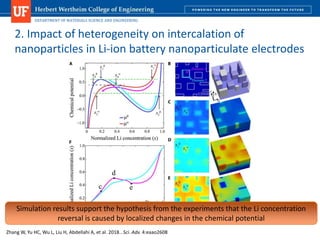
2. Impact of heterogeneity on intercalation of
nanoparticles in Li-ion battery nanoparticulate electrodes
Zhang W, Yu HC, Wu L, Liu H, Abdellahi A, et al. 2018.. Sci. Adv. 4:eaao2608
Simulation results support the hypothesis from the experiments that the Li concentration
reversal is caused by localized changes in the chemical potential
DEPARTMENT OF MATERIALS SCIENCE AND ENGINEERING
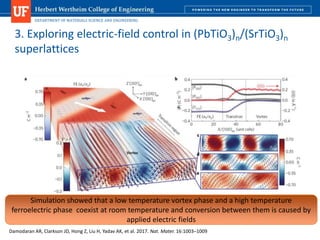
3. Exploring electric-field control in (PbTiO3)n/(SrTiO3)n
superlattices
Damodaran AR, Clarkson JD, Hong Z, Liu H, Yadav AK, et al. 2017. Nat. Mater. 16:1003–1009
Simulation showed that a low temperature vortex phase and a high temperature
ferroelectric phase coexist at room temperature and conversion between them is caused by
applied electric fields
DEPARTMENT OF MATERIALS SCIENCE AND ENGINEERING
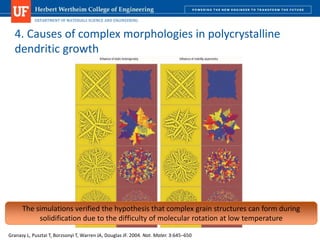
4. Causes of complex morphologies in polycrystalline
dendritic growth
Granasy L, Pusztai T, Borzsonyi T, Warren JA, Douglas JF. 2004. Nat. Mater. 3:645–650
The simulations verified the hypothesis that complex grain structures can form during
solidification due to the difficulty of molecular rotation at low temperature
DEPARTMENT OF MATERIALS SCIENCE AND ENGINEERING
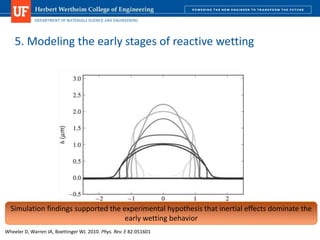
5. Modeling the early stages of reactive wetting
Wheeler D, Warren JA, Boettinger WJ. 2010. Phys. Rev. E 82:051601
Simulation findings supported the experimental hypothesis that inertial effects dominate the
early wetting behavior
DEPARTMENT OF MATERIALS SCIENCE AND ENGINEERING
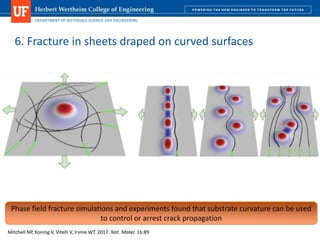
6. Fracture in sheets draped on curved surfaces
Mitchell NP, Koning V, Vitelli V, Irvine WT. 2017. Nat. Mater. 16:89
Phase field fracture simulations and experiments found that substrate curvature can be used
to control or arrest crack propagation
DEPARTMENT OF MATERIALS SCIENCE AND ENGINEERING
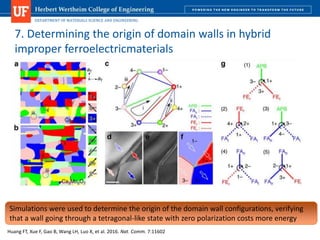
7. Determining the origin of domain walls in hybrid
improper ferroelectricmaterials
Huang FT, Xue F, Gao B, Wang LH, Luo X, et al. 2016. Nat. Comm. 7:11602
Simulations were used to determine the origin of the domain wall configurations, verifying
that a wall going through a tetragonal-like state with zero polarization costs more energy
DEPARTMENT OF MATERIALS SCIENCE AND ENGINEERING
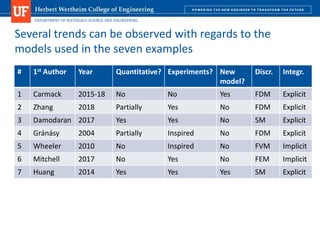
Several trends can be observed with regards to the
models used in the seven examples
# 1st Author Year Quantitative? Experiments? New
model?
Discr. Integr.
1 Carmack 2015-18 No No Yes FDM Explicit
2 Zhang 2018 Partially Yes No FDM Explicit
3 Damodaran 2017 Yes Yes No SM Explicit
4 Gránásy 2004 Partially Inspired No FDM Explicit
5 Wheeler 2010 No Inspired No FVM Implicit
6 Mitchell 2017 No Yes No FEM Implicit
7 Huang 2014 Yes Yes Yes SM Explicit
DEPARTMENT OF MATERIALS SCIENCE AND ENGINEERING
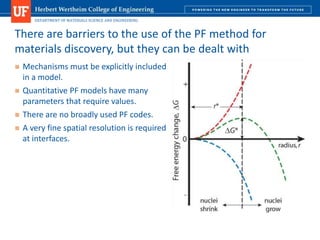
 Mechanisms must be explicitly included
in a model.
 Quantitative PF models have many
parameters that require values.
 There are no broadly used PF codes.
 A very fine spatial resolution is required
at interfaces.
There are barriers to the use of the PF method for
materials discovery, but they can be dealt with
DEPARTMENT OF MATERIALS SCIENCE AND ENGINEERING
 DFT and MD can be used to discover mechanisms, but the PF method has to
have them built in
 Mitigation strategies:
 Hypothesized mechanisms can be implemented in a PF model and the results can be
compared with experiments to test hypothesis
 PF methods can be used to evaluate the relative importance of different mechanisms
Mechanisms must be explicitly included in a phase field
model
DEPARTMENT OF MATERIALS SCIENCE AND ENGINEERING
 There are lots of parameters and we need values for all of them to run a
simulation
 Mitigation strategies:
 You can make simplifying assumptions
 Physical accuracy can be sacrificed to reduce the number of parameters
 Sensitivity analyses can be used to determine which parameter values matter
Quantitative PF models have many parameters that
require values
DEPARTMENT OF MATERIALS SCIENCE AND ENGINEERING
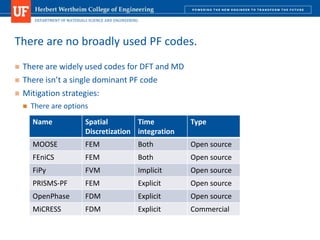
 There are widely used codes for DFT and MD
 There isn’t a single dominant PF code
 Mitigation strategies:
 There are options
There are no broadly used PF codes.
Name Spatial
Discretization
Time
integration
Type
MOOSE FEM Both Open source
FEniCS FEM Both Open source
FiPy FVM Implicit Open source
PRISMS-PF FEM Explicit Open source
OpenPhase FDM Explicit Open source
MiCRESS FDM Explicit Commercial
DEPARTMENT OF MATERIALS SCIENCE AND ENGINEERING
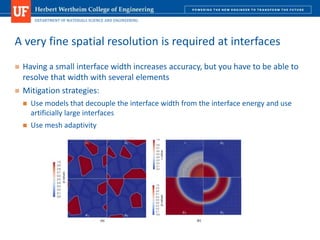
 Having a small interface width increases accuracy, but you have to be able to
resolve that width with several elements
 Mitigation strategies:
 Use models that decouple the interface width from the interface energy and use
artificially large interfaces
 Use mesh adaptivity
A very fine spatial resolution is required at interfaces
DEPARTMENT OF MATERIALS SCIENCE AND ENGINEERING
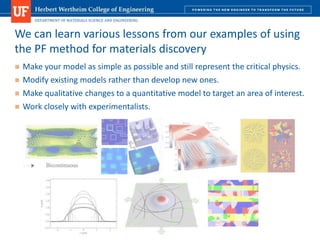
 Make your model as simple as possible and still represent the critical physics.
 Modify existing models rather than develop new ones.
 Make qualitative changes to a quantitative model to target an area of interest.
 Work closely with experimentalists.
We can learn various lessons from our examples of using
the PF method for materials discovery
DEPARTMENT OF MATERIALS SCIENCE AND ENGINEERING
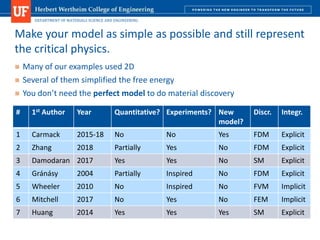
 Many of our examples used 2D
 Several of them simplified the free energy
 You don’t need the perfect model to do material discovery
Make your model as simple as possible and still represent
the critical physics.
# 1st Author Year Quantitative? Experiments? New
model?
Discr. Integr.
1 Carmack 2015-18 No No Yes FDM Explicit
2 Zhang 2018 Partially Yes No FDM Explicit
3 Damodaran 2017 Yes Yes No SM Explicit
4 Gránásy 2004 Partially Inspired No FDM Explicit
5 Wheeler 2010 No Inspired No FVM Implicit
6 Mitchell 2017 No Yes No FEM Implicit
7 Huang 2014 Yes Yes Yes SM Explicit
DEPARTMENT OF MATERIALS SCIENCE AND ENGINEERING
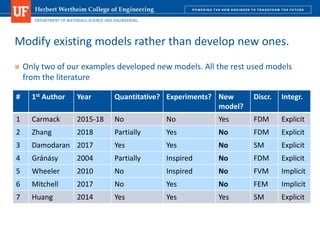
 Only two of our examples developed new models. All the rest used models
from the literature
Modify existing models rather than develop new ones.
# 1st Author Year Quantitative? Experiments? New
model?
Discr. Integr.
1 Carmack 2015-18 No No Yes FDM Explicit
2 Zhang 2018 Partially Yes No FDM Explicit
3 Damodaran 2017 Yes Yes No SM Explicit
4 Gránásy 2004 Partially Inspired No FDM Explicit
5 Wheeler 2010 No Inspired No FVM Implicit
6 Mitchell 2017 No Yes No FEM Implicit
7 Huang 2014 Yes Yes Yes SM Explicit
DEPARTMENT OF MATERIALS SCIENCE AND ENGINEERING
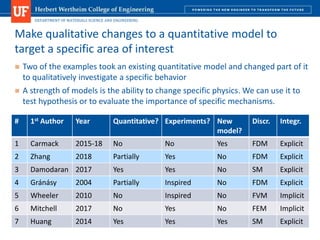
 Two of the examples took an existing quantitative model and changed part of it
to qualitatively investigate a specific behavior
 A strength of models is the ability to change specific physics. We can use it to
test hypothesis or to evaluate the importance of specific mechanisms.
Make qualitative changes to a quantitative model to
target a specific area of interest
# 1st Author Year Quantitative? Experiments? New
model?
Discr. Integr.
1 Carmack 2015-18 No No Yes FDM Explicit
2 Zhang 2018 Partially Yes No FDM Explicit
3 Damodaran 2017 Yes Yes No SM Explicit
4 Gránásy 2004 Partially Inspired No FDM Explicit
5 Wheeler 2010 No Inspired No FVM Implicit
6 Mitchell 2017 No Yes No FEM Implicit
7 Huang 2014 Yes Yes Yes SM Explicit
DEPARTMENT OF MATERIALS SCIENCE AND ENGINEERING
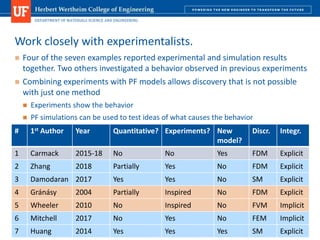
 Four of the seven examples reported experimental and simulation results
together. Two others investigated a behavior observed in previous experiments
 Combining experiments with PF models allows discovery that is not possible
with just one method
 Experiments show the behavior
 PF simulations can be used to test ideas of what causes the behavior
Work closely with experimentalists.
# 1st Author Year Quantitative? Experiments? New
model?
Discr. Integr.
1 Carmack 2015-18 No No Yes FDM Explicit
2 Zhang 2018 Partially Yes No FDM Explicit
3 Damodaran 2017 Yes Yes No SM Explicit
4 Gránásy 2004 Partially Inspired No FDM Explicit
5 Wheeler 2010 No Inspired No FVM Implicit
6 Mitchell 2017 No Yes No FEM Implicit
7 Huang 2014 Yes Yes Yes SM Explicit
DEPARTMENT OF MATERIALS SCIENCE AND ENGINEERING
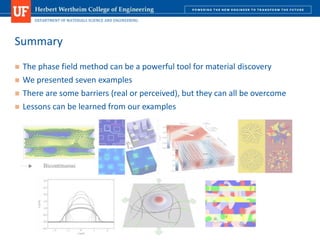
 The phase field method can be a powerful tool for material discovery
 We presented seven examples
 There are some barriers (real or perceived), but they can all be overcome
 Lessons can be learned from our examples
Summary
DEPARTMENT OF MATERIALS SCIENCE AND ENGINEERING
Tonks Research Group

The Phase Field Method: Mesoscale Simulation Aiding Materials Discovery

  • 1.
    DEPARTMENT OF MATERIALSSCIENCE AND ENGINEERING The Phase Field Method: Mesoscale Simulation Aiding Material Discovery Michael R Tonks Materials Science and Engineering, University of Florida Larry Aagasen Idaho National Laboratory In press (July 2019), Annual Review of Materials Research
  • 2.
    DEPARTMENT OF MATERIALSSCIENCE AND ENGINEERING
  • 3.
    DEPARTMENT OF MATERIALSSCIENCE AND ENGINEERING Model Development  Creation or improvement of a modeling capability  Verification  Validation Materials Discovery  Use of the model to learn something new about a material Computational materials science research can be generalized into two categories
  • 4.
    DEPARTMENT OF MATERIALSSCIENCE AND ENGINEERING The phase field method is increasing in popularity, but it is still used much less than atomic scale methods Number of results found using a Google Scholar search for the terms listed in the legends in a single year, ranging from 2000 to 2017. The searches were conducted in August, 2018.
  • 5.
    DEPARTMENT OF MATERIALSSCIENCE AND ENGINEERING  I conducted a search in all Science publications  “Density functional theory”: 832 Results  “Molecular dynamics”: 1600 results  “Phase field model”: 9 results  I also searched in Nature Materials  “Density functional theory”: 392 Results  “Molecular dynamics”: 275 results  “Phase field model”: 13 results  Finally, I did a Google scholar search for a method type and “Nature Materials” compared to a search for just the method type:  “Density functional theory”: Fraction of 0.066  “Molecular dynamics”: Fraction of 0.046  “Phase field model”: Fraction of 0.033 The majority of phase field research is focused on model development, not materials discovery
  • 6.
    DEPARTMENT OF MATERIALSSCIENCE AND ENGINEERING  Paper outline  Summarize the PF method  Examples of the PF method used for materials discovery  Factors that impede its use  Lessons that can be learned from the examples The purpose of this paper is to discuss the use of the phase field method for material discovery
  • 7.
    DEPARTMENT OF MATERIALSSCIENCE AND ENGINEERING 1. Carmack JM, Millett PC. 2015. Numerical simulations of bijel morphology in thin films with complete surface wetting. J. Chem. Physics 143:154701 2. Zhang W, Yu HC, Wu L, Liu H, Abdellahi A, et al. 2018. Localized concentration reversal of lithium during intercalation into nanoparticles. Sci. Adv. 4:eaao2608 3. Damodaran AR, Clarkson JD, Hong Z, Liu H, Yadav AK, et al. 2017. Phase coexistence and electric-field control of toroidal order in oxide superlattices. Nat. Mater. 16:1003–1009 4. Gránásy L, Pusztai T, Borzsonyi T, Warren JA, Douglas JF. 2004. A general mechanism of polycrystalline growth. Nat. Mater. 3:645–650 5. Wheeler D, Warren JA, Boettinger WJ. 2010. Modeling the early stages of reactive wetting. Phys. Rev. E 82:051601 6. Mitchell NP, Koning V, Vitelli V, Irvine WT. 2017. Fracture in sheets draped on curved surfaces. Nat. Mater. 16:89 7. Huang FT, Xue F, Gao B, Wang LH, Luo X, et al. 2016. Domain topology and domain switching kinetics in a hybrid improper ferroelectric. Nat. Comm. 7:11602 We selected seven examples that used the PF method for materials discovery
  • 8.
    DEPARTMENT OF MATERIALSSCIENCE AND ENGINEERING 1. Design of bicontinuous jammed emulsion gels (bijels) Carmack JM, Millett PC. 2015. J. Chem. Physics 143:154701 Simulations found that two basic morphologies formed, depending on the film thickness, particle volume fraction, and particle radius.
  • 9.
    DEPARTMENT OF MATERIALSSCIENCE AND ENGINEERING 2. Impact of heterogeneity on intercalation of nanoparticles in Li-ion battery nanoparticulate electrodes Zhang W, Yu HC, Wu L, Liu H, Abdellahi A, et al. 2018.. Sci. Adv. 4:eaao2608 Simulation results support the hypothesis from the experiments that the Li concentration reversal is caused by localized changes in the chemical potential
  • 10.
    DEPARTMENT OF MATERIALSSCIENCE AND ENGINEERING 3. Exploring electric-field control in (PbTiO3)n/(SrTiO3)n superlattices Damodaran AR, Clarkson JD, Hong Z, Liu H, Yadav AK, et al. 2017. Nat. Mater. 16:1003–1009 Simulation showed that a low temperature vortex phase and a high temperature ferroelectric phase coexist at room temperature and conversion between them is caused by applied electric fields
  • 11.
    DEPARTMENT OF MATERIALSSCIENCE AND ENGINEERING 4. Causes of complex morphologies in polycrystalline dendritic growth Granasy L, Pusztai T, Borzsonyi T, Warren JA, Douglas JF. 2004. Nat. Mater. 3:645–650 The simulations verified the hypothesis that complex grain structures can form during solidification due to the difficulty of molecular rotation at low temperature
  • 12.
    DEPARTMENT OF MATERIALSSCIENCE AND ENGINEERING 5. Modeling the early stages of reactive wetting Wheeler D, Warren JA, Boettinger WJ. 2010. Phys. Rev. E 82:051601 Simulation findings supported the experimental hypothesis that inertial effects dominate the early wetting behavior
  • 13.
    DEPARTMENT OF MATERIALSSCIENCE AND ENGINEERING 6. Fracture in sheets draped on curved surfaces Mitchell NP, Koning V, Vitelli V, Irvine WT. 2017. Nat. Mater. 16:89 Phase field fracture simulations and experiments found that substrate curvature can be used to control or arrest crack propagation
  • 14.
    DEPARTMENT OF MATERIALSSCIENCE AND ENGINEERING 7. Determining the origin of domain walls in hybrid improper ferroelectricmaterials Huang FT, Xue F, Gao B, Wang LH, Luo X, et al. 2016. Nat. Comm. 7:11602 Simulations were used to determine the origin of the domain wall configurations, verifying that a wall going through a tetragonal-like state with zero polarization costs more energy
  • 15.
    DEPARTMENT OF MATERIALSSCIENCE AND ENGINEERING Several trends can be observed with regards to the models used in the seven examples # 1st Author Year Quantitative? Experiments? New model? Discr. Integr. 1 Carmack 2015-18 No No Yes FDM Explicit 2 Zhang 2018 Partially Yes No FDM Explicit 3 Damodaran 2017 Yes Yes No SM Explicit 4 Gránásy 2004 Partially Inspired No FDM Explicit 5 Wheeler 2010 No Inspired No FVM Implicit 6 Mitchell 2017 No Yes No FEM Implicit 7 Huang 2014 Yes Yes Yes SM Explicit
  • 16.
    DEPARTMENT OF MATERIALSSCIENCE AND ENGINEERING  Mechanisms must be explicitly included in a model.  Quantitative PF models have many parameters that require values.  There are no broadly used PF codes.  A very fine spatial resolution is required at interfaces. There are barriers to the use of the PF method for materials discovery, but they can be dealt with
  • 17.
    DEPARTMENT OF MATERIALSSCIENCE AND ENGINEERING  DFT and MD can be used to discover mechanisms, but the PF method has to have them built in  Mitigation strategies:  Hypothesized mechanisms can be implemented in a PF model and the results can be compared with experiments to test hypothesis  PF methods can be used to evaluate the relative importance of different mechanisms Mechanisms must be explicitly included in a phase field model
  • 18.
    DEPARTMENT OF MATERIALSSCIENCE AND ENGINEERING  There are lots of parameters and we need values for all of them to run a simulation  Mitigation strategies:  You can make simplifying assumptions  Physical accuracy can be sacrificed to reduce the number of parameters  Sensitivity analyses can be used to determine which parameter values matter Quantitative PF models have many parameters that require values
  • 19.
    DEPARTMENT OF MATERIALSSCIENCE AND ENGINEERING  There are widely used codes for DFT and MD  There isn’t a single dominant PF code  Mitigation strategies:  There are options There are no broadly used PF codes. Name Spatial Discretization Time integration Type MOOSE FEM Both Open source FEniCS FEM Both Open source FiPy FVM Implicit Open source PRISMS-PF FEM Explicit Open source OpenPhase FDM Explicit Open source MiCRESS FDM Explicit Commercial
  • 20.
    DEPARTMENT OF MATERIALSSCIENCE AND ENGINEERING  Having a small interface width increases accuracy, but you have to be able to resolve that width with several elements  Mitigation strategies:  Use models that decouple the interface width from the interface energy and use artificially large interfaces  Use mesh adaptivity A very fine spatial resolution is required at interfaces
  • 21.
    DEPARTMENT OF MATERIALSSCIENCE AND ENGINEERING  Make your model as simple as possible and still represent the critical physics.  Modify existing models rather than develop new ones.  Make qualitative changes to a quantitative model to target an area of interest.  Work closely with experimentalists. We can learn various lessons from our examples of using the PF method for materials discovery
  • 22.
    DEPARTMENT OF MATERIALSSCIENCE AND ENGINEERING  Many of our examples used 2D  Several of them simplified the free energy  You don’t need the perfect model to do material discovery Make your model as simple as possible and still represent the critical physics. # 1st Author Year Quantitative? Experiments? New model? Discr. Integr. 1 Carmack 2015-18 No No Yes FDM Explicit 2 Zhang 2018 Partially Yes No FDM Explicit 3 Damodaran 2017 Yes Yes No SM Explicit 4 Gránásy 2004 Partially Inspired No FDM Explicit 5 Wheeler 2010 No Inspired No FVM Implicit 6 Mitchell 2017 No Yes No FEM Implicit 7 Huang 2014 Yes Yes Yes SM Explicit
  • 23.
    DEPARTMENT OF MATERIALSSCIENCE AND ENGINEERING  Only two of our examples developed new models. All the rest used models from the literature Modify existing models rather than develop new ones. # 1st Author Year Quantitative? Experiments? New model? Discr. Integr. 1 Carmack 2015-18 No No Yes FDM Explicit 2 Zhang 2018 Partially Yes No FDM Explicit 3 Damodaran 2017 Yes Yes No SM Explicit 4 Gránásy 2004 Partially Inspired No FDM Explicit 5 Wheeler 2010 No Inspired No FVM Implicit 6 Mitchell 2017 No Yes No FEM Implicit 7 Huang 2014 Yes Yes Yes SM Explicit
  • 24.
    DEPARTMENT OF MATERIALSSCIENCE AND ENGINEERING  Two of the examples took an existing quantitative model and changed part of it to qualitatively investigate a specific behavior  A strength of models is the ability to change specific physics. We can use it to test hypothesis or to evaluate the importance of specific mechanisms. Make qualitative changes to a quantitative model to target a specific area of interest # 1st Author Year Quantitative? Experiments? New model? Discr. Integr. 1 Carmack 2015-18 No No Yes FDM Explicit 2 Zhang 2018 Partially Yes No FDM Explicit 3 Damodaran 2017 Yes Yes No SM Explicit 4 Gránásy 2004 Partially Inspired No FDM Explicit 5 Wheeler 2010 No Inspired No FVM Implicit 6 Mitchell 2017 No Yes No FEM Implicit 7 Huang 2014 Yes Yes Yes SM Explicit
  • 25.
    DEPARTMENT OF MATERIALSSCIENCE AND ENGINEERING  Four of the seven examples reported experimental and simulation results together. Two others investigated a behavior observed in previous experiments  Combining experiments with PF models allows discovery that is not possible with just one method  Experiments show the behavior  PF simulations can be used to test ideas of what causes the behavior Work closely with experimentalists. # 1st Author Year Quantitative? Experiments? New model? Discr. Integr. 1 Carmack 2015-18 No No Yes FDM Explicit 2 Zhang 2018 Partially Yes No FDM Explicit 3 Damodaran 2017 Yes Yes No SM Explicit 4 Gránásy 2004 Partially Inspired No FDM Explicit 5 Wheeler 2010 No Inspired No FVM Implicit 6 Mitchell 2017 No Yes No FEM Implicit 7 Huang 2014 Yes Yes Yes SM Explicit
  • 26.
    DEPARTMENT OF MATERIALSSCIENCE AND ENGINEERING  The phase field method can be a powerful tool for material discovery  We presented seven examples  There are some barriers (real or perceived), but they can all be overcome  Lessons can be learned from our examples Summary
  • 27.
    DEPARTMENT OF MATERIALSSCIENCE AND ENGINEERING Tonks Research Group

Editor's Notes

  • #9 Two basic morphologies formed, bicontinuous or discrete, dependent on the film thickness, particle volume fraction, and particle radius as shown in Fig. 2. Further simulations varying the thin film thickness and composition found a large range of structurally unique morphologies that could have interesting applications (25). Later work (26) showed that coarse to fine tuning of the bijel structures can be obtained using applied electric fields.
  • #10 The PF model predicted that the average Li concentration fully within α displayed a pronounced reversal, while that in a larger region containing some α and some β regions did not. The predicted concentration reversal in the small domain is in agreement with that observed experimentally, as is the dependence of the reversal on the size of the sampling domain. Thus, the simulation results support the hypothesis that the Li concentration reversal is caused by localized changes in the chemical potential.
  • #11 First, they could create phase coexistence between an emergent, low-temperature vortex phase with electric toroidal order and a high-temperature ferroelectric a1/a2 phase (see Fig. 4). At room temperature, these coexisting phases form a fiber-textured hierarchical superstructure. The vortex phase possesses a gyrotropic electrotoroidal state. They also found that applied electric fields caused conversion between the two phases resulting in large changes in piezoelectric and nonlinear optical responses.
  • #12 The transition from single crystal to disordered dendrites to the seaweed morphology was observed as the density of impurities in the initial conditions was increased (see 1st column in Fig. 5). A similar morphological transition was observed as the ratio of rotational to interfacial mobility was decreased, corresponding to higher undercooling (see 3rd column in Fig. 5).
  • #13 The PF model predicted the evolution of the water droplet’s morphology over time. Their findings supported the experimental hypothesis that inertial effects dominate the early wetting behavior.
  • #14 Simulation results indicated that curvature in the substrate can cause cracks to bow or kink. They also showed that curvature can arrest crack propagation, where the final crack length decreases with increasing curvature. Finally, it was found that curvature can direct the path, protecting curved regions of the material, as shown in Fig. 7.