
Live Webinar
Rethinking Monitoring in the Era of IT-Ops-as-a-Service
The emergence of IT-ops-as-a-service
OpsRamp webinar
April 26, 2018
Nancy Gohring, senior analyst, app & infrastructure performance
Development, DevOps and IT Ops Group
@ngohring, Nancy_gohring@451research.com
4
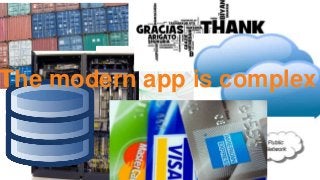
The modern app is complex
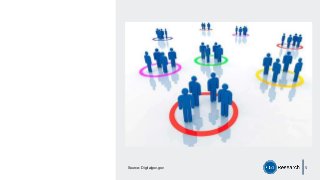
5Source: Digitalgov.gov
6
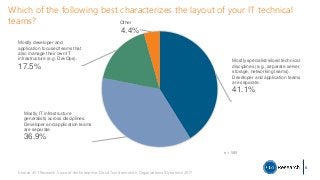
Source: 451 Research, Voice of the Enterprise: Cloud Transformation, Organizational Dynamics 2017
Which of the following best characterizes the layout of your IT technical
teams?
Mostly specialist/siloed technical
disciplines (e.g., separate server,
storage, networking teams).
Developer and application teams
are separate.
41.1%
Mostly IT infrastructure
generalists across disciplines.
Developer and application teams
are separate.
36.9%
Mostly developer and
application focused teams that
also manage their own IT
infrastructure (e.g. DevOps).
17.5%
Other
4.4%
n = 593
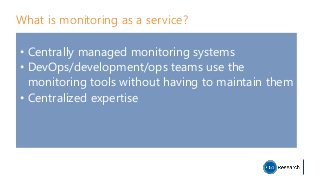
What is monitoring as a service?
• Centrally managed monitoring systems
• DevOps/development/ops teams use the
monitoring tools without having to maintain them
• Centralized expertise
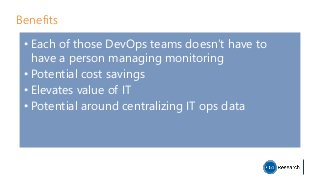
Benefits
• Each of those DevOps teams doesn’t have to
have a person managing monitoring
• Potential cost savings
• Elevates value of IT
• Potential around centralizing IT ops data
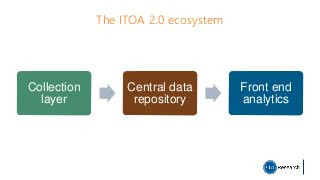
The ITOA 2.0 ecosystem
Collection
layer
Central data
repository
Front end
analytics
ITOA 2.0 Benefits
• Enables high-level, company-wide dashboards
• View of performance across all company apps
• Insight into customer experience
• Cloud spend across apps
• Revenue from apps
That change can be painful
“We actually tend to have specialists, which is a problem
in and of itself…They’ve built their career around that special whatever that item is…I need to
take someone who’s done AIX [Advanced Interactive eXecutive] for 15, 20, maybe 30 years, and I need to
retrain them to get them to think about, ‘Okay, now, you’re going to not only switch to Linux, but you’re also
going to switch to cloud.’…So the fact that we do have specialists and we’re trying to, in some cases,
transform them into generalists even within their technology stack, it becomes a bit
difficult. There’s a learning curve. Through attrition, we
address that.”
-1,000-9,999 employees, $10bn+, Finance, Mid-Level Management
Source: 451 Research, Voice of the Enterprise: Cloud Transformation, Organizational Dynamics, Q2 2017
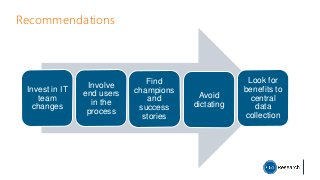
Recommendations
Invest in IT
team
changes
Involve
end users
in the
process
Avoid
dictating
Find
champions
and
success
stories
Look for
benefits to
central
data
collection
Thank you!
Nancy Gohring
@ngohring
nancy.gohring@451research.com
Monitoring as a service is an opportunity to elevate
the value of IT, drive better application performance
and gain efficiencies.
Rethinking Monitoring in the Era
of IT Operations as a Service
15
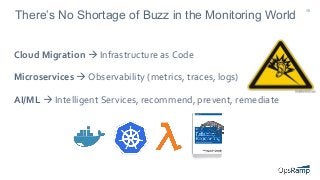
There’s No Shortage of Buzz in the Monitoring World
Cloud Migration  Infrastructure as Code
Microservices  Observability (metrics, traces, logs)
AI/ML  Intelligent Services, recommend, prevent, remediate
16
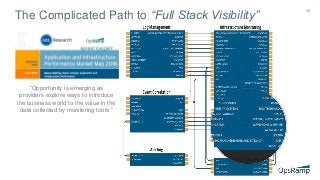
The Complicated Path to “Full Stack Visibility”
“Opportunity is emerging as
providers explore ways to introduce
the business world to the value in the
data collected by monitoring tools.”
17
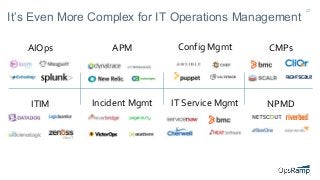
It’s Even More Complex for IT Operations Management
AIOps APM Config Mgmt CMPs
ITIM Incident Mgmt IT Service Mgmt NPMD
18
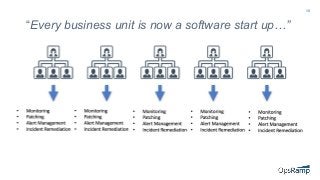
Services are currently redundant across lines of business.
“Every business unit is now a software start up…”
“In an Increasingly Dynamic, Multi-Cloud World…
Are you the first to know?
20
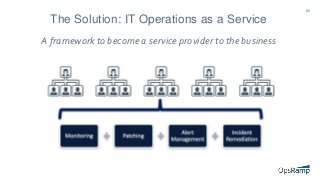
The Solution: IT Operations as a Service
A framework to become a service provider to the business
21
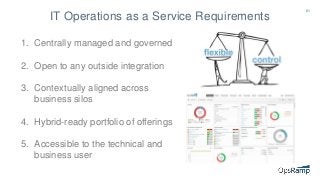
IT Operations as a Service Requirements
1. Centrally managed and governed
2. Open to any outside integration
3. Contextually aligned across
business silos
4. Hybrid-ready portfolio of offerings
5. Accessible to the technical and
business user
2222
1400+ CUSTOMERS 100+ PARTNERS LEADING INVESTORS
The OpsRamp Platform: Powering IT Ops As a Service
More Workloads. Less Work.
“OpsRamp takes the chaos out of
infrastructure.”
VP of Infrastructure, Epsilon
23
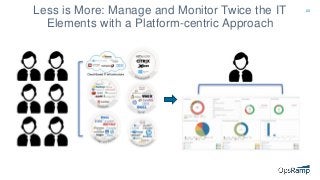
Less is More: Manage and Monitor Twice the IT
Elements with a Platform-centric Approach
24
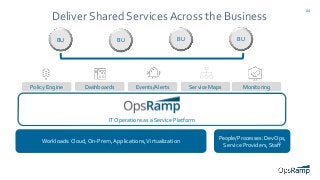
IT Operations as a Service Platform
Deliver Shared Services Across the Business
Workloads: Cloud, On-Prem, Applications,Virtualization
People/Processes: DevOps,
Service Providers, Staff
BU BU BU BU
Policy Engine Dashboards Events/Alerts Service Maps Monitoring
25
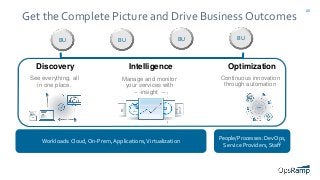
Get the Complete Picture and Drive Business Outcomes
Workloads: Cloud, On-Prem, Applications,Virtualization
People/Processes: DevOps,
Service Providers, Staff
BU BU BU BU
Discovery Intelligence Optimization
See everything, all
in one place.
Manage and monitor
your services with
insight
Continuous innovation
through automation
26
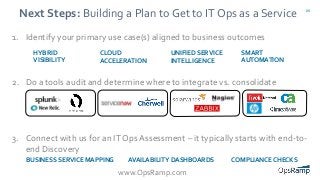
Next Steps: Building a Plan to Get to IT Ops as a Service
1. Identify your primary use case(s) aligned to business outcomes
2. Do a tools audit and determine where to integrate vs. consolidate
3. Connect with us for an IT Ops Assessment – it typically starts with end-to-
end Discovery
HYBRID
VISIBILITY
CLOUD
ACCELERATION
SMART
AUTOMATION
UNIFIED SERVICE
INTELLIGENCE
AVAILABILITY DASHBOARDS COMPLIANCE CHECKS
www.OpsRamp.com
BUSINESS SERVICE MAPPING
THANK YOU

Rethinking Monitoring In The Era of IT-Ops-as-a-Service

  • 1.
    Live Webinar Rethinking Monitoringin the Era of IT-Ops-as-a-Service
  • 2.
    The emergence ofIT-ops-as-a-service OpsRamp webinar April 26, 2018 Nancy Gohring, senior analyst, app & infrastructure performance Development, DevOps and IT Ops Group @ngohring, Nancy_gohring@451research.com
  • 4.
    4 The modern appis complex
  • 5.
  • 6.
    6 Source: 451 Research,Voice of the Enterprise: Cloud Transformation, Organizational Dynamics 2017 Which of the following best characterizes the layout of your IT technical teams? Mostly specialist/siloed technical disciplines (e.g., separate server, storage, networking teams). Developer and application teams are separate. 41.1% Mostly IT infrastructure generalists across disciplines. Developer and application teams are separate. 36.9% Mostly developer and application focused teams that also manage their own IT infrastructure (e.g. DevOps). 17.5% Other 4.4% n = 593
  • 7.
    What is monitoringas a service? • Centrally managed monitoring systems • DevOps/development/ops teams use the monitoring tools without having to maintain them • Centralized expertise
  • 8.
    Benefits • Each ofthose DevOps teams doesn’t have to have a person managing monitoring • Potential cost savings • Elevates value of IT • Potential around centralizing IT ops data
  • 9.
    The ITOA 2.0ecosystem Collection layer Central data repository Front end analytics
  • 10.
    ITOA 2.0 Benefits •Enables high-level, company-wide dashboards • View of performance across all company apps • Insight into customer experience • Cloud spend across apps • Revenue from apps
  • 11.
    That change canbe painful “We actually tend to have specialists, which is a problem in and of itself…They’ve built their career around that special whatever that item is…I need to take someone who’s done AIX [Advanced Interactive eXecutive] for 15, 20, maybe 30 years, and I need to retrain them to get them to think about, ‘Okay, now, you’re going to not only switch to Linux, but you’re also going to switch to cloud.’…So the fact that we do have specialists and we’re trying to, in some cases, transform them into generalists even within their technology stack, it becomes a bit difficult. There’s a learning curve. Through attrition, we address that.” -1,000-9,999 employees, $10bn+, Finance, Mid-Level Management Source: 451 Research, Voice of the Enterprise: Cloud Transformation, Organizational Dynamics, Q2 2017
  • 12.
    Recommendations Invest in IT team changes Involve endusers in the process Avoid dictating Find champions and success stories Look for benefits to central data collection
  • 13.
    Thank you! Nancy Gohring @ngohring nancy.gohring@451research.com Monitoringas a service is an opportunity to elevate the value of IT, drive better application performance and gain efficiencies.
  • 14.
    Rethinking Monitoring inthe Era of IT Operations as a Service
  • 15.
    15 There’s No Shortageof Buzz in the Monitoring World Cloud Migration  Infrastructure as Code Microservices  Observability (metrics, traces, logs) AI/ML  Intelligent Services, recommend, prevent, remediate
  • 16.
    16 The Complicated Pathto “Full Stack Visibility” “Opportunity is emerging as providers explore ways to introduce the business world to the value in the data collected by monitoring tools.”
  • 17.
    17 It’s Even MoreComplex for IT Operations Management AIOps APM Config Mgmt CMPs ITIM Incident Mgmt IT Service Mgmt NPMD
  • 18.
    18 Services are currentlyredundant across lines of business. “Every business unit is now a software start up…”
  • 19.
    “In an IncreasinglyDynamic, Multi-Cloud World… Are you the first to know?
  • 20.
    20 The Solution: ITOperations as a Service A framework to become a service provider to the business
  • 21.
    21 IT Operations asa Service Requirements 1. Centrally managed and governed 2. Open to any outside integration 3. Contextually aligned across business silos 4. Hybrid-ready portfolio of offerings 5. Accessible to the technical and business user
  • 22.
    2222 1400+ CUSTOMERS 100+PARTNERS LEADING INVESTORS The OpsRamp Platform: Powering IT Ops As a Service More Workloads. Less Work. “OpsRamp takes the chaos out of infrastructure.” VP of Infrastructure, Epsilon
  • 23.
    23 Less is More:Manage and Monitor Twice the IT Elements with a Platform-centric Approach
  • 24.
    24 IT Operations asa Service Platform Deliver Shared Services Across the Business Workloads: Cloud, On-Prem, Applications,Virtualization People/Processes: DevOps, Service Providers, Staff BU BU BU BU Policy Engine Dashboards Events/Alerts Service Maps Monitoring
  • 25.
    25 Get the CompletePicture and Drive Business Outcomes Workloads: Cloud, On-Prem, Applications,Virtualization People/Processes: DevOps, Service Providers, Staff BU BU BU BU Discovery Intelligence Optimization See everything, all in one place. Manage and monitor your services with insight Continuous innovation through automation
  • 26.
    26 Next Steps: Buildinga Plan to Get to IT Ops as a Service 1. Identify your primary use case(s) aligned to business outcomes 2. Do a tools audit and determine where to integrate vs. consolidate 3. Connect with us for an IT Ops Assessment – it typically starts with end-to- end Discovery HYBRID VISIBILITY CLOUD ACCELERATION SMART AUTOMATION UNIFIED SERVICE INTELLIGENCE AVAILABILITY DASHBOARDS COMPLIANCE CHECKS www.OpsRamp.com BUSINESS SERVICE MAPPING
  • 27.