Global developments of genome
editing in agriculture
Agnès Ricroch, PhD, HDR
OECD CONFERENCE ON GENOME EDITING: APPLICATIONS IN AGRICULTURE – IMPLICATIONS FOR HEALTH, ENVIRONMENT AND REGULATION
28-29 June 2018, at the OECD Conference Centre, Paris
Ethical considerations in agriculture
 Global food production needs to increase as much as 70 per cent
to support the growing population in the world (10 billion in 2050).
 It is important to consider whether and how genome editing
technologies can contribute improving the efficiency of food/feed
distribution and reducing waste.
 The safety of food for human consumption is a key concern.
 In the case of animals, there are also concerns about the welfare
of farmed animals.
• Will they lead to the faster development of new crop
varieties and animal breeds at a lower cost?
• Could they present any new health and environmental
safety considerations?
• Can they impact sustainable development?
• What are the potential consequences for farmers?
• Are there impacts for consumers, society, and the
environment?
Over the years, several editing tools have been
developed, and key questions can be addressed.
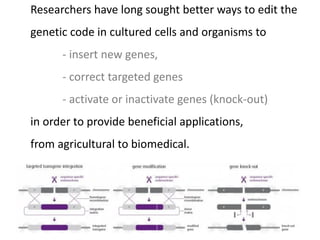
Researchers have long sought better ways to edit the
genetic code in cultured cells and organisms to
- insert new genes,
- correct targeted genes
- activate or inactivate genes (knock-out)
in order to provide beneficial applications,
from agricultural to biomedical.
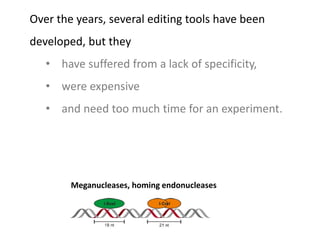
Meganucleases, homing endonucleases
Over the years, several editing tools have been
developed, but they
• have suffered from a lack of specificity,
• were expensive
• and need too much time for an experiment.
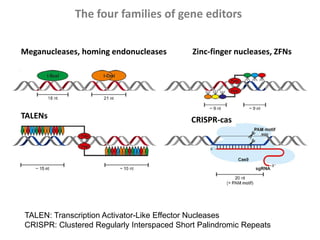
Zinc-finger nucleases, ZFNsMeganucleases, homing endonucleases
TALENs CRISPR-cas
The four families of gene editors
TALEN: Transcription Activator-Like Effector Nucleases
CRISPR: Clustered Regularly Interspaced Short Palindromic Repeats
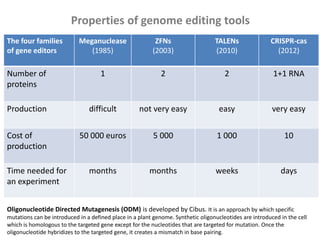
Properties of genome editing tools
The four families
of gene editors
Meganuclease
(1985)
ZFNs
(2003)
TALENs
(2010)
CRISPR-cas
(2012)
Number of
proteins
1 2 2 1+1 RNA
Production difficult not very easy easy very easy
Cost of
production
50 000 euros 5 000 1 000 10
Time needed for
an experiment
months months weeks days
Oligonucleotide Directed Mutagenesis (ODM) is developed by Cibus. It is an approach by which specific
mutations can be introduced in a defined place in a plant genome. Synthetic oligonucleotides are introduced in the cell
which is homologous to the targeted gene except for the nucleotides that are targeted for mutation. Once the
oligonucleotide hybridizes to the targeted gene, it creates a mismatch in base pairing.
Among the recent genome editing technologies,
CRISPR-based methods are promising owing to
• their relative efficiency,
• ease of use (kits can be bought online),
• the prospect of making edits at multiple sites in the
genome in a single procedure
• and the low cost compared to other techniques.
CRISPR-based methods cut down the time needed for
genetic experiments.
Genome editing tools are a democratic method.
The low cost and the fast production allow
not only private companies and multinationals to
develop new biotech crops and animals,
but also public-private consortia with non-profit
ends.
They could open up the field to smaller companies.
Now already it is in use by thousands of State
laboratories.
Researchers can now work with the native DNA and
enhance what natural evolution has provided.
With the system ‘cut and paste’ and ‘find and replace’:
sites of the genome linked to specific traits can now
be precisely edited.
It is precision breeding.
Applications
The recent applications of genome editing
technology will change our everyday lives.
In Plants
The need to produce crops
• resistant to pest and diseases,
• tolerant to abiotic stress (drought),
• with nutritional quality
• or with industrial and pharmaceutical applications
has led scientists to apply these new, convenient
and fast techniques.
Ricroch et al. 2015
Ricroch and Damave, 2015
Ricroch, Clairand & Harwood 2017
Ricroch, in press, 2018
Genome editing could significantly speed up the
progress of breeding programmes: benefits to all.
from 7-25 years to as few as 2-3 years since its
target-specificity effectively bypasses the need to go
through a number of plant generations to achieve a
particular genetic combination.
Pests and diseases, and weeds can cause vast
economic losses and threatened food safety if not
controlled.
Depending on the severity of the attack, a percentage
or even an entire harvest can be lost, thus strong
efforts are being led to develop crops with innate
biotic stress resistance.
Pest and disease control: benefits for farmers and
consumers
Biotic stress resistance is one of the most needed application for gene
editing in agriculture.
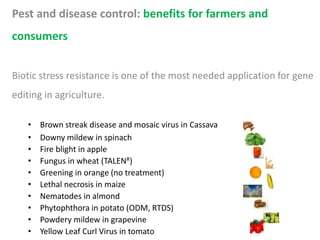
• Brown streak disease and mosaic virus in Cassava
• Downy mildew in spinach
• Fire blight in apple
• Fungus in wheat (TALENR)
• Greening in orange (no treatment)
• Lethal necrosis in maize
• Nematodes in almond
• Phytophthora in potato (ODM, RTDS)
• Powdery mildew in grapevine
• Yellow Leaf Curl Virus in tomato
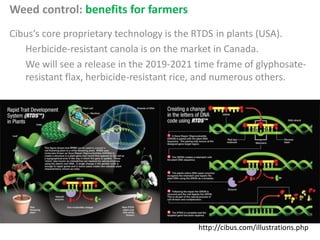
http://cibus.com/illustrations.php
Weed control: benefits for farmers
Cibus‘s core proprietary technology is the RTDS in plants (USA).
Herbicide-resistant canola is on the market in Canada.
We will see a release in the 2019-2021 time frame of glyphosate-
resistant flax, herbicide-resistant rice, and numerous others.
Plants resistant to abiotic stress: benefits for farmers
Among the years one of the most concerning problems
related to environment for the scientists has proven to
be climate change, which brings drought, floods,
salinity and extreme temperatures, all challenging
growing conditions directly impacting crop yield.
Tolerance to abiotic stress (drought, cold, high
salinity, water, nitrogen deficiency): benefits for
farmers
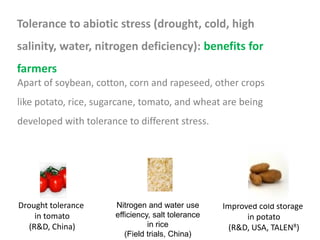
Drought tolerance
in tomato
(R&D, China)
Apart of soybean, cotton, corn and rapeseed, other crops
like potato, rice, sugarcane, tomato, and wheat are being
developed with tolerance to different stress.
Improved cold storage
in potato
(R&D, USA, TALENR)
Nitrogen and water use
efficiency, salt tolerance
in rice
(Field trials, China)
Pests and disease control and abiotic stress tolerance:
benefits for organic farmers
Edited crops, thanks to their potential to increase
sustainable farming practices, could be cultivated by
organic farmers and therefore could fall within the
ethos of organic.
Quality: benefits for consumers and industy
On April 18, 2016, DuPont Pioneer, the first big-ag
company to license CRISPR technology, has
announced its first CRISPR-edited crop will be waxy
corn, expected within 4 years.
https://www.pioneer.com/CMRoot/Pioneer/About_Global/Non_Searchable/15-352-01_air_response_signed.pdf
While normal corn kernels contain 75% amylopectin and 25% amylose, a
deletion in the waxy gene results in waxy corn kernels in which the starch
consists of 100% amylopectin starch.
The particular properties of the starch are used in a wide range of products including:
• thickening fruit pies
• smoothness and creaminess of canned food and dairy products
• making glues (adhesives for bottle labels and envelope adhesives)
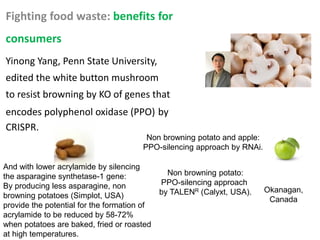
Fighting food waste: benefits for
consumers
Yinong Yang, Penn State University,
edited the white button mushroom
to resist browning by KO of genes that
encodes polyphenol oxidase (PPO) by
CRISPR.
And with lower acrylamide by silencing
the asparagine synthetase-1 gene:
By producing less asparagine, non
browning potatoes (Simplot, USA)
provide the potential for the formation of
acrylamide to be reduced by 58-72%
when potatoes are baked, fried or roasted
at high temperatures.
Non browning potato and apple:
PPO-silencing approach by RNAi.
Okanagan,
Canada
Non browning potato:
PPO-silencing approach
by TALENR (Calyxt, USA).
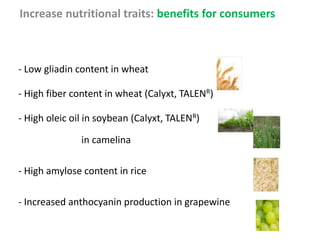
Increase nutritional traits: benefits for consumers
- Low gliadin content in wheat
- High fiber content in wheat (Calyxt, TALENR)
- High oleic oil in soybean (Calyxt, TALENR)
in camelina
- High amylose content in rice
- Increased anthocyanin production in grapewine
23
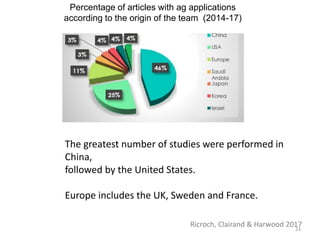
The greatest number of studies were performed in
China,
followed by the United States.
Europe includes the UK, Sweden and France.
Ricroch, Clairand & Harwood 2017
Percentage of articles with ag applications
according to the origin of the team (2014-17)
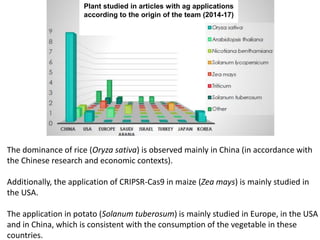
The dominance of rice (Oryza sativa) is observed mainly in China (in accordance with
the Chinese research and economic contexts).
Additionally, the application of CRIPSR-Cas9 in maize (Zea mays) is mainly studied in
the USA.
The application in potato (Solanum tuberosum) is mainly studied in Europe, in the USA
and in China, which is consistent with the consumption of the vegetable in these
countries.
Plant studied in articles with ag applications
according to the origin of the team (2014-17)
• Rice is the most studied plant for genome
editing.
• Strong rise of edited potatoes and tomatoes
with CRISPR technology.
• Wheat started being edited with CRISPR due
to its hexaploid genome.
Ricroch, Clairand & Harwood 2017
In Animals
Gene editing in animals has not merely accelerated
research (African swine fever) but has made possible
research that was previously unfeasible (PRR virus).
The genome editing has been used in pig, sheep, cattle,
and chicken:
• to increase disease resistance
• to make livestock better adapted to farming or
environmental conditions
• to improve fertility and growth
• to enhance animal welfare
Ricroch, Clairand & Harwood 2017
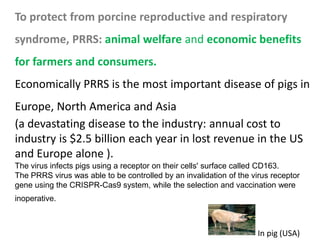
To protect from porcine reproductive and respiratory
syndrome, PRRS: animal welfare and economic benefits
for farmers and consumers.
Economically PRRS is the most important disease of pigs in
Europe, North America and Asia
(a devastating disease to the industry: annual cost to
industry is $2.5 billion each year in lost revenue in the US
and Europe alone ).
The virus infects pigs using a receptor on their cells' surface called CD163.
The PRRS virus was able to be controlled by an invalidation of the virus receptor
gene using the CRISPR-Cas9 system, while the selection and vaccination were
inoperative.
In pig (USA)
• Researchers at the Roslin Institute - the University of
Edingburgh - used gene editing techniques to remove
a small section of the CD163 gene. They focused on
the section of the receptor that the virus attaches to,
leaving the rest of the molecule intact.
• The team at the Roslin Institute collaborated with
Genus PLC, a leading global animal genetics
company, to produce pigs with the specific DNA
change.
https://www.ed.ac.uk/roslin/news-events/latest-news/gene-edited-pigs-
resistant-billion-dollar-virus
To edit pig immune-system genes involved in the reaction to the
haemorrhagic virus that causes African swine fever
Scientists, the University of Edinburgh’s Roslin Institute, are taking genes from
warthogs resistant to African swine fever and inserting them into swine.
African swine fever is contaminating hog herds in a number of countries.
There are pigs in Africa that are naturally resistant to this disease.
The gene that confers this resistance is known.
It is therefore possible by successive crosses to transfer the resistance gene to
animals in developed countries. Such a project was not undertaken because it
would have required at least a decade of conventional breeding.
Replacing the gene with the African gene allele using the TALEN, ZFN, CRISPR
systems resulted in resistant pigs in a single operation.
In pig (UK)
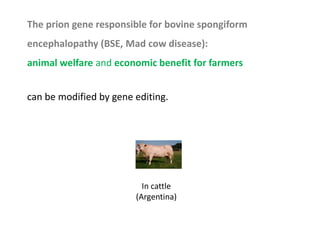
The prion gene responsible for bovine spongiform
encephalopathy (BSE, Mad cow disease):
animal welfare and economic benefit for farmers
can be modified by gene editing.
In cattle
(Argentina)
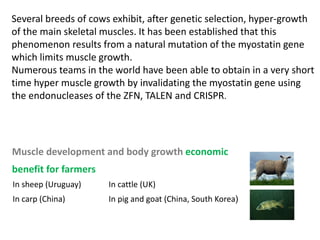
Several breeds of cows exhibit, after genetic selection, hyper-growth
of the main skeletal muscles. It has been established that this
phenomenon results from a natural mutation of the myostatin gene
which limits muscle growth.
Numerous teams in the world have been able to obtain in a very short
time hyper muscle growth by invalidating the myostatin gene using
the endonucleases of the ZFN, TALEN and CRISPR.
Muscle development and body growth economic
benefit for farmers
In sheep (Uruguay) In cattle (UK)
In carp (China) In pig and goat (China, South Korea)
Better food production: benefits for
farmers and consumers
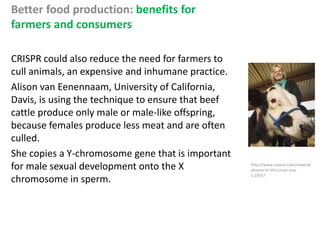
CRISPR could also reduce the need for farmers to
cull animals, an expensive and inhumane practice.
Alison van Eenennaam, University of California,
Davis, is using the technique to ensure that beef
cattle produce only male or male-like offspring,
because females produce less meat and are often
culled.
She copies a Y-chromosome gene that is important
for male sexual development onto the X
chromosome in sperm.
http://www.nature.com/news/w
elcome-to-the-crispr-zoo-
1.19537
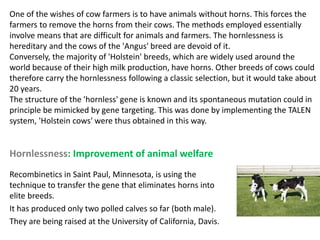
Hornlessness: Improvement of animal welfare
Recombinetics in Saint Paul, Minnesota, is using the
technique to transfer the gene that eliminates horns into
elite breeds.
It has produced only two polled calves so far (both male).
They are being raised at the University of California, Davis.
One of the wishes of cow farmers is to have animals without horns. This forces the
farmers to remove the horns from their cows. The methods employed essentially
involve means that are difficult for animals and farmers. The hornlessness is
hereditary and the cows of the 'Angus' breed are devoid of it.
Conversely, the majority of 'Holstein' breeds, which are widely used around the
world because of their high milk production, have horns. Other breeds of cows could
therefore carry the hornlessness following a classic selection, but it would take about
20 years.
The structure of the 'hornless' gene is known and its spontaneous mutation could in
principle be mimicked by gene targeting. This was done by implementing the TALEN
system, 'Holstein cows' were thus obtained in this way.
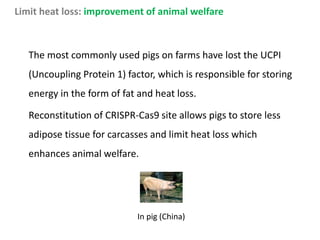
Limit heat loss: improvement of animal welfare
The most commonly used pigs on farms have lost the UCPI
(Uncoupling Protein 1) factor, which is responsible for storing
energy in the form of fat and heat loss.
Reconstitution of CRISPR-Cas9 site allows pigs to store less
adipose tissue for carcasses and limit heat loss which
enhances animal welfare.
In pig (China)
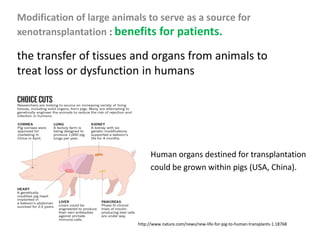
Modification of large animals to serve as a source for
xenotransplantation : benefits for patients.
the transfer of tissues and organs from animals to
treat loss or dysfunction in humans
http://www.nature.com/news/new-life-for-pig-to-human-transplants-1.18768
Human organs destined for transplantation
could be grown within pigs (USA, China).
Addressing sustainability for society
 Biosafety protocols are required, especially for novel
technologies. But the protocols should be adapted to each
trait, be flexible (dynamically scalable), and revisable.
 Furthermore, ex ante risk assessment should, whenever
possible, be gradually replaced by the adoption and
monitoring of good agricultural practices, as well as
implementing precision agriculture.
 The implementation of good agricultural practices
(GAP) will be crucial. GAP help improve food,
environmental and occupational health and safety,
and are a key factor in sustainable agriculture.
 Farmers should be adequately informed and
prepared to use edited crops or animals more
efficiently and sustainably, which could help reduce
the use of pesticides, herbicides, fertilizers or
antibiotics.
Ricroch, Ammann & Kuntz 2016
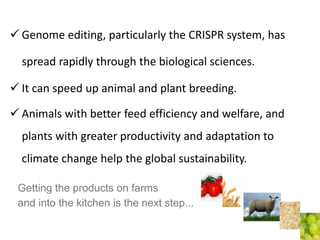
 Genome editing, particularly the CRISPR system, has
spread rapidly through the biological sciences.
 It can speed up animal and plant breeding.
 Animals with better feed efficiency and welfare, and
plants with greater productivity and adaptation to
climate change help the global sustainability.
Getting the products on farms
and into the kitchen is the next step...
Thank you for your kind attention.
agnes.ricroch@agroparistech.fr
in press

Global developments of genome editing in agriculture

  • 1.
    Global developments ofgenome editing in agriculture Agnès Ricroch, PhD, HDR OECD CONFERENCE ON GENOME EDITING: APPLICATIONS IN AGRICULTURE – IMPLICATIONS FOR HEALTH, ENVIRONMENT AND REGULATION 28-29 June 2018, at the OECD Conference Centre, Paris
  • 2.
    Ethical considerations inagriculture  Global food production needs to increase as much as 70 per cent to support the growing population in the world (10 billion in 2050).  It is important to consider whether and how genome editing technologies can contribute improving the efficiency of food/feed distribution and reducing waste.  The safety of food for human consumption is a key concern.  In the case of animals, there are also concerns about the welfare of farmed animals.
  • 3.
    • Will theylead to the faster development of new crop varieties and animal breeds at a lower cost? • Could they present any new health and environmental safety considerations? • Can they impact sustainable development? • What are the potential consequences for farmers? • Are there impacts for consumers, society, and the environment? Over the years, several editing tools have been developed, and key questions can be addressed.
  • 4.
    Researchers have longsought better ways to edit the genetic code in cultured cells and organisms to - insert new genes, - correct targeted genes - activate or inactivate genes (knock-out) in order to provide beneficial applications, from agricultural to biomedical.
  • 5.
    Meganucleases, homing endonucleases Overthe years, several editing tools have been developed, but they • have suffered from a lack of specificity, • were expensive • and need too much time for an experiment.
  • 6.
    Zinc-finger nucleases, ZFNsMeganucleases,homing endonucleases TALENs CRISPR-cas The four families of gene editors TALEN: Transcription Activator-Like Effector Nucleases CRISPR: Clustered Regularly Interspaced Short Palindromic Repeats
  • 7.
    Properties of genomeediting tools The four families of gene editors Meganuclease (1985) ZFNs (2003) TALENs (2010) CRISPR-cas (2012) Number of proteins 1 2 2 1+1 RNA Production difficult not very easy easy very easy Cost of production 50 000 euros 5 000 1 000 10 Time needed for an experiment months months weeks days Oligonucleotide Directed Mutagenesis (ODM) is developed by Cibus. It is an approach by which specific mutations can be introduced in a defined place in a plant genome. Synthetic oligonucleotides are introduced in the cell which is homologous to the targeted gene except for the nucleotides that are targeted for mutation. Once the oligonucleotide hybridizes to the targeted gene, it creates a mismatch in base pairing.
  • 8.
    Among the recentgenome editing technologies, CRISPR-based methods are promising owing to • their relative efficiency, • ease of use (kits can be bought online), • the prospect of making edits at multiple sites in the genome in a single procedure • and the low cost compared to other techniques. CRISPR-based methods cut down the time needed for genetic experiments.
  • 9.
    Genome editing toolsare a democratic method. The low cost and the fast production allow not only private companies and multinationals to develop new biotech crops and animals, but also public-private consortia with non-profit ends. They could open up the field to smaller companies. Now already it is in use by thousands of State laboratories.
  • 10.
    Researchers can nowwork with the native DNA and enhance what natural evolution has provided. With the system ‘cut and paste’ and ‘find and replace’: sites of the genome linked to specific traits can now be precisely edited. It is precision breeding.
  • 11.
    Applications The recent applicationsof genome editing technology will change our everyday lives.
  • 12.
    In Plants The needto produce crops • resistant to pest and diseases, • tolerant to abiotic stress (drought), • with nutritional quality • or with industrial and pharmaceutical applications has led scientists to apply these new, convenient and fast techniques. Ricroch et al. 2015 Ricroch and Damave, 2015 Ricroch, Clairand & Harwood 2017 Ricroch, in press, 2018
  • 13.
    Genome editing couldsignificantly speed up the progress of breeding programmes: benefits to all. from 7-25 years to as few as 2-3 years since its target-specificity effectively bypasses the need to go through a number of plant generations to achieve a particular genetic combination.
  • 14.
    Pests and diseases,and weeds can cause vast economic losses and threatened food safety if not controlled. Depending on the severity of the attack, a percentage or even an entire harvest can be lost, thus strong efforts are being led to develop crops with innate biotic stress resistance.
  • 15.
    Pest and diseasecontrol: benefits for farmers and consumers Biotic stress resistance is one of the most needed application for gene editing in agriculture. • Brown streak disease and mosaic virus in Cassava • Downy mildew in spinach • Fire blight in apple • Fungus in wheat (TALENR) • Greening in orange (no treatment) • Lethal necrosis in maize • Nematodes in almond • Phytophthora in potato (ODM, RTDS) • Powdery mildew in grapevine • Yellow Leaf Curl Virus in tomato
  • 16.
    http://cibus.com/illustrations.php Weed control: benefitsfor farmers Cibus‘s core proprietary technology is the RTDS in plants (USA). Herbicide-resistant canola is on the market in Canada. We will see a release in the 2019-2021 time frame of glyphosate- resistant flax, herbicide-resistant rice, and numerous others.
  • 17.
    Plants resistant toabiotic stress: benefits for farmers Among the years one of the most concerning problems related to environment for the scientists has proven to be climate change, which brings drought, floods, salinity and extreme temperatures, all challenging growing conditions directly impacting crop yield.
  • 18.
    Tolerance to abioticstress (drought, cold, high salinity, water, nitrogen deficiency): benefits for farmers Drought tolerance in tomato (R&D, China) Apart of soybean, cotton, corn and rapeseed, other crops like potato, rice, sugarcane, tomato, and wheat are being developed with tolerance to different stress. Improved cold storage in potato (R&D, USA, TALENR) Nitrogen and water use efficiency, salt tolerance in rice (Field trials, China)
  • 19.
    Pests and diseasecontrol and abiotic stress tolerance: benefits for organic farmers Edited crops, thanks to their potential to increase sustainable farming practices, could be cultivated by organic farmers and therefore could fall within the ethos of organic.
  • 20.
    Quality: benefits forconsumers and industy On April 18, 2016, DuPont Pioneer, the first big-ag company to license CRISPR technology, has announced its first CRISPR-edited crop will be waxy corn, expected within 4 years. https://www.pioneer.com/CMRoot/Pioneer/About_Global/Non_Searchable/15-352-01_air_response_signed.pdf While normal corn kernels contain 75% amylopectin and 25% amylose, a deletion in the waxy gene results in waxy corn kernels in which the starch consists of 100% amylopectin starch. The particular properties of the starch are used in a wide range of products including: • thickening fruit pies • smoothness and creaminess of canned food and dairy products • making glues (adhesives for bottle labels and envelope adhesives)
  • 21.
    Fighting food waste:benefits for consumers Yinong Yang, Penn State University, edited the white button mushroom to resist browning by KO of genes that encodes polyphenol oxidase (PPO) by CRISPR. And with lower acrylamide by silencing the asparagine synthetase-1 gene: By producing less asparagine, non browning potatoes (Simplot, USA) provide the potential for the formation of acrylamide to be reduced by 58-72% when potatoes are baked, fried or roasted at high temperatures. Non browning potato and apple: PPO-silencing approach by RNAi. Okanagan, Canada Non browning potato: PPO-silencing approach by TALENR (Calyxt, USA).
  • 22.
    Increase nutritional traits:benefits for consumers - Low gliadin content in wheat - High fiber content in wheat (Calyxt, TALENR) - High oleic oil in soybean (Calyxt, TALENR) in camelina - High amylose content in rice - Increased anthocyanin production in grapewine
  • 23.
    23 The greatest numberof studies were performed in China, followed by the United States. Europe includes the UK, Sweden and France. Ricroch, Clairand & Harwood 2017 Percentage of articles with ag applications according to the origin of the team (2014-17)
  • 24.
    The dominance ofrice (Oryza sativa) is observed mainly in China (in accordance with the Chinese research and economic contexts). Additionally, the application of CRIPSR-Cas9 in maize (Zea mays) is mainly studied in the USA. The application in potato (Solanum tuberosum) is mainly studied in Europe, in the USA and in China, which is consistent with the consumption of the vegetable in these countries. Plant studied in articles with ag applications according to the origin of the team (2014-17)
  • 25.
    • Rice isthe most studied plant for genome editing. • Strong rise of edited potatoes and tomatoes with CRISPR technology. • Wheat started being edited with CRISPR due to its hexaploid genome. Ricroch, Clairand & Harwood 2017
  • 26.
    In Animals Gene editingin animals has not merely accelerated research (African swine fever) but has made possible research that was previously unfeasible (PRR virus). The genome editing has been used in pig, sheep, cattle, and chicken: • to increase disease resistance • to make livestock better adapted to farming or environmental conditions • to improve fertility and growth • to enhance animal welfare Ricroch, Clairand & Harwood 2017
  • 27.
    To protect fromporcine reproductive and respiratory syndrome, PRRS: animal welfare and economic benefits for farmers and consumers. Economically PRRS is the most important disease of pigs in Europe, North America and Asia (a devastating disease to the industry: annual cost to industry is $2.5 billion each year in lost revenue in the US and Europe alone ). The virus infects pigs using a receptor on their cells' surface called CD163. The PRRS virus was able to be controlled by an invalidation of the virus receptor gene using the CRISPR-Cas9 system, while the selection and vaccination were inoperative. In pig (USA)
  • 28.
    • Researchers atthe Roslin Institute - the University of Edingburgh - used gene editing techniques to remove a small section of the CD163 gene. They focused on the section of the receptor that the virus attaches to, leaving the rest of the molecule intact. • The team at the Roslin Institute collaborated with Genus PLC, a leading global animal genetics company, to produce pigs with the specific DNA change. https://www.ed.ac.uk/roslin/news-events/latest-news/gene-edited-pigs- resistant-billion-dollar-virus
  • 29.
    To edit pigimmune-system genes involved in the reaction to the haemorrhagic virus that causes African swine fever Scientists, the University of Edinburgh’s Roslin Institute, are taking genes from warthogs resistant to African swine fever and inserting them into swine. African swine fever is contaminating hog herds in a number of countries. There are pigs in Africa that are naturally resistant to this disease. The gene that confers this resistance is known. It is therefore possible by successive crosses to transfer the resistance gene to animals in developed countries. Such a project was not undertaken because it would have required at least a decade of conventional breeding. Replacing the gene with the African gene allele using the TALEN, ZFN, CRISPR systems resulted in resistant pigs in a single operation. In pig (UK)
  • 30.
    The prion generesponsible for bovine spongiform encephalopathy (BSE, Mad cow disease): animal welfare and economic benefit for farmers can be modified by gene editing. In cattle (Argentina)
  • 31.
    Several breeds ofcows exhibit, after genetic selection, hyper-growth of the main skeletal muscles. It has been established that this phenomenon results from a natural mutation of the myostatin gene which limits muscle growth. Numerous teams in the world have been able to obtain in a very short time hyper muscle growth by invalidating the myostatin gene using the endonucleases of the ZFN, TALEN and CRISPR. Muscle development and body growth economic benefit for farmers In sheep (Uruguay) In cattle (UK) In carp (China) In pig and goat (China, South Korea)
  • 32.
    Better food production:benefits for farmers and consumers CRISPR could also reduce the need for farmers to cull animals, an expensive and inhumane practice. Alison van Eenennaam, University of California, Davis, is using the technique to ensure that beef cattle produce only male or male-like offspring, because females produce less meat and are often culled. She copies a Y-chromosome gene that is important for male sexual development onto the X chromosome in sperm. http://www.nature.com/news/w elcome-to-the-crispr-zoo- 1.19537
  • 33.
    Hornlessness: Improvement ofanimal welfare Recombinetics in Saint Paul, Minnesota, is using the technique to transfer the gene that eliminates horns into elite breeds. It has produced only two polled calves so far (both male). They are being raised at the University of California, Davis. One of the wishes of cow farmers is to have animals without horns. This forces the farmers to remove the horns from their cows. The methods employed essentially involve means that are difficult for animals and farmers. The hornlessness is hereditary and the cows of the 'Angus' breed are devoid of it. Conversely, the majority of 'Holstein' breeds, which are widely used around the world because of their high milk production, have horns. Other breeds of cows could therefore carry the hornlessness following a classic selection, but it would take about 20 years. The structure of the 'hornless' gene is known and its spontaneous mutation could in principle be mimicked by gene targeting. This was done by implementing the TALEN system, 'Holstein cows' were thus obtained in this way.
  • 34.
    Limit heat loss:improvement of animal welfare The most commonly used pigs on farms have lost the UCPI (Uncoupling Protein 1) factor, which is responsible for storing energy in the form of fat and heat loss. Reconstitution of CRISPR-Cas9 site allows pigs to store less adipose tissue for carcasses and limit heat loss which enhances animal welfare. In pig (China)
  • 35.
    Modification of largeanimals to serve as a source for xenotransplantation : benefits for patients. the transfer of tissues and organs from animals to treat loss or dysfunction in humans http://www.nature.com/news/new-life-for-pig-to-human-transplants-1.18768 Human organs destined for transplantation could be grown within pigs (USA, China).
  • 36.
    Addressing sustainability forsociety  Biosafety protocols are required, especially for novel technologies. But the protocols should be adapted to each trait, be flexible (dynamically scalable), and revisable.  Furthermore, ex ante risk assessment should, whenever possible, be gradually replaced by the adoption and monitoring of good agricultural practices, as well as implementing precision agriculture.
  • 37.
     The implementationof good agricultural practices (GAP) will be crucial. GAP help improve food, environmental and occupational health and safety, and are a key factor in sustainable agriculture.  Farmers should be adequately informed and prepared to use edited crops or animals more efficiently and sustainably, which could help reduce the use of pesticides, herbicides, fertilizers or antibiotics. Ricroch, Ammann & Kuntz 2016
  • 38.
     Genome editing,particularly the CRISPR system, has spread rapidly through the biological sciences.  It can speed up animal and plant breeding.  Animals with better feed efficiency and welfare, and plants with greater productivity and adaptation to climate change help the global sustainability. Getting the products on farms and into the kitchen is the next step...
  • 39.
    Thank you foryour kind attention. agnes.ricroch@agroparistech.fr in press