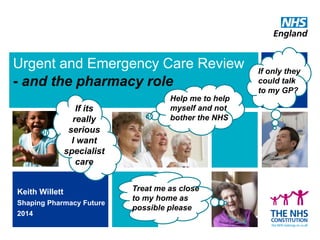
Urgent and Emergency Care Review - and the pharmacy role 
Keith Willett 
Shaping Pharmacy Future 
2014 
If its really serious 
I want specialist care 
Treat me as close to my home as possible please 
Help me to help myself and not bother the NHS 
If only they could talk to my GP?
www.england.nhs.uk 
UEC Review Vision 
For those people with urgent but non-life threatening needs: 
• 
We must provide highly responsive, effective and personalised services outside of hospital, and 
•Deliver care in or as close to people’s homes as possible, minimising disruption and inconvenience for patients and their families 
For those people with more serious or life threatening emergency needs: 
•We should ensure they are treated in centres with the very best expertise and facilities in order to maximise their chances of survival and a good recovery
Current provision of urgent and emergency care services 
3 
>100 million calls or visits to urgent and emergency services annually: 
•438 million health-related visits to pharmacies (2008/09) 
Self-care and self management 
•24 million calls to NHS 
•urgent and emergency care telephone services 
Telephone care 
•300 million consultations in general practice (20010/11) 
Face to face care 
•7 million emergency ambulance journeys 
999 services 
•14.9 million attendances at major / specialty A&E departments (2012/13) 
•6.9 million attendances at Minor Injury Units, Walk in Centres etc (2013/13) 
A&E departments 
•5.3 million emergency admissions to England’s hospitals (2012/13) 
Emergency admissions
www.england.nhs.uk 
UECR: The Why? – Care closer to home
Helping people help themselves 
Self care: 
• 
Better and easily accessible information about self-treatment options 
– patient and specialist groups, NHS Choices, pharmacies 
• 
Accelerated development of advance care planning 
• 
Right advice or treatment first time - enhanced NHS 111 - the “smart call” to make: 
• 
Improve patient information for call responders (SCR, care plan) 
• 
Comprehensive Directory of Services 
• 
Improve levels of clinical input (mental health, dental heath, paramedic, pharmacist, GP) 
• 
Booking systems for GPs, into UCC or A&E, dentist, pharmacy 
5
NHS 111 Call Volume – front end to urgent care 
Patients are predominately referred to lower urgency settings 
6 
www.england.nhs.uk 
Referral 
Caller dials 111 
Demo- graphics taken 
Pathways triage 85% 
Call handler answers 
Clinician takes transfer 
transfer 
21% 
999 Ambulance 
A&E / UCC 
GP OOH 
GP in hours 
Pharmacy 
Community service 
Dental 
1% 
7% 
1% 
14% 
National 
11% 
7% 
62% 
Dispositions callers 
(where callers are referred to) 
111
Summary Care Record: Creating the records 
• 
SCRs are an electronic record containing key information from the patient’s GP practice 
• 
As a minimum SCRs contain medication, allergies and adverse reactions 
• 
Improved functionality coming soon to make it easier for GPs to create SCRs with additional information for those patients that need them most. 
45m 
SCRs 
created 
(80%) 
2m SCRs created last month 
Close to 
To find out more or enable SCR: scr.comms@hscic.gov.uk or @NHSSCR
Highly responsive urgent care service close to home, outside of hospital 
8 
• 
Faster, convenient, enhanced service: 
• 
Same day, every day access to general practice services, primary care and community services 
• 
Harness the skills and accessibility of community pharmacy 
• 
24/7 clinical decision-support for GPs, paramedics, community teams from (hospital) specialists – no decision in isolation 
• 
Support the co-location of community-based urgent care services in Urgent Care Centres and Ambulatory Care centres. 
• 
Develop 999 ambulances so they become mobile urgent community treatment services, not just urgent transport services
Ambulance Services 
• 
Transport  Treatment: Community-based provider of mobile urgent and emergency healthcare, fully integrated within Urgent Care Networks. Principles to underpin this transformation would include: 
• 
Emphasis on supported treatment in community settings 
• 
Single consistent triage system, DoS and universal referral rights 
• 
Successful “hear and treat” - closer integration with 111, timely access to relevant patient information and care plans, support of interdisciplinary clinical hub (current low 3.4% high 10%) 
• 
“see and treat”, inter-disciplinary working across traditional organisational and professional boundaries, with guaranteed timely access to primary care, mental health provision, social care and specialist clinical advice 24/7 (current low 27.4% high 51.5%) 
• 
Development of the ambulance workforce, education programmes coupled with changes to organisational culture, will be essential to long-term success 9
Urgent Care Centres 
• 
Community-based primary care facilities providing access to urgent care for a local population. 
• 
To encompass Walk-in Centres, Minor Injuries Units, “Darzi” Centres etc, including those currently designated as “Type 3 A&E Departments”. 
• 
A consistent nomenclature should be accompanied by a consistent service, so that patients are clear about what they can expect from all Urgent Care Centres 
• 
To achieve this it is suggested that two important principles underpin the development of Urgent Care Centres: 
• 
access to a full range of urgent care services 
• 
part of the Urgent Care Network 
• 
Access to the clinical advice hub 
10
Serious and life threatening conditions – expertise and facilities 
11 
• 
Identify available services in hospital based emergency centres 
• 
Emergency hospital Centres* - capable of assessing and initiating treatment for all patients 
• 
Specialist Emergency hospital Centres* - capable of assessing and initiating treatment for all patients, and providing specialist services (direct, transfer or bypass) (- estimated 40-70 larger units) 
• 
Emergency Care Networks 
• 
Connecting all services together into a cohesive network so the overall system becomes more than just the sum of its parts 
• 
Strategic and Operational
Urgent Care Networks 
• 
Networks would focus on: 
• 
effective, pathways of care across boundaries for physical and mental health irrespective of entry portal 
• 
all patients managed to agreed pathways mutual trust in system 
• 
no clinical decision made in isolation 
• 
Networks would function at two levels: 
1. 
Operational Urgent Care Networks would describe local communities of clinicians (System Resilience Group) who work together to achieve the best outcomes for patients within the urgent care system 
2. 
Strategic Urgent Care Networks would operate over large populations encompassing specialist provision, all severity and complexity, all relevant stakeholders to plan, oversee and monitor network performance 
12
www.england.nhs.uk 
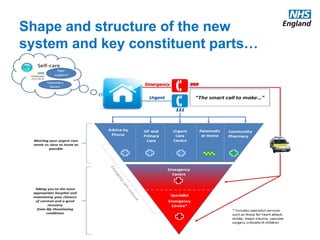
Shape and structure of the new system and key constituent parts…
Progress update 
14 
• 
Continue to “build in public” 
•8 Work Programmes: 
•WHOLE SYSTEM PLANNING AND PAYMENT, COMMISSIONING AND ACCOUNTABILITY 
•PRIMARY CARE ACCESS – NHSE strategy 
•111 service specification and standards 
•DATA, INFORMATION AND CARE PLANNING 
•COMMUNITY PHARMACIES – Call for Action 
•EMERGENCY DEPARTMENTS and EMERGENCY CARE NETWORKS 
•AMBULANCE TREATMENT SERVICE 
•WORKFORCE (HEE) 
I 
T 
E 
R 
A 
T 
I 
V 
E
www.england.nhs.uk 
UECR: What – Big Tickets
16
Progress: from design to delivery 
• 
Implementation phase of the Review: Now convert the work done so far into a national framework to guide commissioning of UEC services: Update report 
• 
Delivery Group own and describe the key national products from the Stage 1 Report – give primacy to out-of-hospital 
• 
Regional roadshows June-Sept 2014 
• 
Working with System Resilience Groups, CCG and NHSE Ops Teams as they develop 2 and 5 year operational and strategic plans 
• 
Working through the NHS Commissioning Assembly to co-produce commissioning guidance and specifications (throughout 2014/15) 
• 
Release guidance, standards and outcome metrics for Commissioners regarding UEC Networks, centres, and clinical models and for Ambulance Services (after 5 year Forward View) 
17
Consulting and testing 
• 
Design to Delivery: 
• 
NHSIQ mapping support/pilots testing ideas and models (Integration Pioneers, PM Challenge, 111 pilots and 7DS early adopters) 
• 
New Commissioning Standards for NHS 111: 
• 
Clinician access to relevant patient’s medical and care information 
• 
Access and treat to specific care plan where available 
• 
Increased clinical advice to support call handlers 
• 
to book appointments with urgent or emergency care providers 
• 
Developing new system metrics – credible to public, clinicians, providers and commissioners 
18
www.england.nhs.uk 
Future payment options for UEC 
• 
Proposal suggests that the way forward could be a single, consistent payment approach for every type of service in the system, made up of 3 elements and linked to quality metrics and part of 3-5 year contracts: 
• 
Core capacity element: substantial and fixed in-year, to reflect the ‘always on’ nature of urgent and emergency care: 
• 
Facilities and service standards 
• 
Volume-based and variable, to limit the impact of unpredictable fluctuations in demand on individual providers across the system; 
• 
Process measures – formative not summative 
• 
Incentives and sanctions: Using provider-specific and system-wide quality metrics as eligibility criteria for different rates of fixed and volume-based funding, and as the basis for bonuses and penalties, to support service change and promote quality improvement: 
• 
Patient outcome measures (transfers of care, residence, PROMs) 
• 
Patient safety and experience measures (mortality, SAEs, PREMs)
The greatest challenges 
1. 
Payment system reform 
2. 
Information sharing 
3. 
Workforce and skills shift 
20
The role of pharmacy beyond winter pressures 
Part of the General Practice team 
Supporting 999 dispatch and 111 call centre 
Pharmacist in A&E, MAUs, ACS 
Part of Network Clinical Advice hub 
Minor Ailment Service 
Direct 
Professional care
Urgent and Emergency Care Review 
Progress: 
DEFINITELY . . . . BUT 
ONLY THROUGH YOU 
I’m alive cos I had specialist care really fast 
I feel so much better for not having to go all the way to hospital 
It’s great to share and learn so much with this group 
It’s like everyone knows all about me

Keith Willet: Pharmacy's role in the urgent and emergency care review

  • 1.
    Urgent and EmergencyCare Review - and the pharmacy role Keith Willett Shaping Pharmacy Future 2014 If its really serious I want specialist care Treat me as close to my home as possible please Help me to help myself and not bother the NHS If only they could talk to my GP?
  • 2.
    www.england.nhs.uk UEC ReviewVision For those people with urgent but non-life threatening needs: • We must provide highly responsive, effective and personalised services outside of hospital, and •Deliver care in or as close to people’s homes as possible, minimising disruption and inconvenience for patients and their families For those people with more serious or life threatening emergency needs: •We should ensure they are treated in centres with the very best expertise and facilities in order to maximise their chances of survival and a good recovery
  • 3.
    Current provision ofurgent and emergency care services 3 >100 million calls or visits to urgent and emergency services annually: •438 million health-related visits to pharmacies (2008/09) Self-care and self management •24 million calls to NHS •urgent and emergency care telephone services Telephone care •300 million consultations in general practice (20010/11) Face to face care •7 million emergency ambulance journeys 999 services •14.9 million attendances at major / specialty A&E departments (2012/13) •6.9 million attendances at Minor Injury Units, Walk in Centres etc (2013/13) A&E departments •5.3 million emergency admissions to England’s hospitals (2012/13) Emergency admissions
  • 4.
    www.england.nhs.uk UECR: TheWhy? – Care closer to home
  • 5.
    Helping people helpthemselves Self care: • Better and easily accessible information about self-treatment options – patient and specialist groups, NHS Choices, pharmacies • Accelerated development of advance care planning • Right advice or treatment first time - enhanced NHS 111 - the “smart call” to make: • Improve patient information for call responders (SCR, care plan) • Comprehensive Directory of Services • Improve levels of clinical input (mental health, dental heath, paramedic, pharmacist, GP) • Booking systems for GPs, into UCC or A&E, dentist, pharmacy 5
  • 6.
    NHS 111 CallVolume – front end to urgent care Patients are predominately referred to lower urgency settings 6 www.england.nhs.uk Referral Caller dials 111 Demo- graphics taken Pathways triage 85% Call handler answers Clinician takes transfer transfer 21% 999 Ambulance A&E / UCC GP OOH GP in hours Pharmacy Community service Dental 1% 7% 1% 14% National 11% 7% 62% Dispositions callers (where callers are referred to) 111
  • 7.
    Summary Care Record:Creating the records • SCRs are an electronic record containing key information from the patient’s GP practice • As a minimum SCRs contain medication, allergies and adverse reactions • Improved functionality coming soon to make it easier for GPs to create SCRs with additional information for those patients that need them most. 45m SCRs created (80%) 2m SCRs created last month Close to To find out more or enable SCR: scr.comms@hscic.gov.uk or @NHSSCR
  • 8.
    Highly responsive urgentcare service close to home, outside of hospital 8 • Faster, convenient, enhanced service: • Same day, every day access to general practice services, primary care and community services • Harness the skills and accessibility of community pharmacy • 24/7 clinical decision-support for GPs, paramedics, community teams from (hospital) specialists – no decision in isolation • Support the co-location of community-based urgent care services in Urgent Care Centres and Ambulatory Care centres. • Develop 999 ambulances so they become mobile urgent community treatment services, not just urgent transport services
  • 9.
    Ambulance Services • Transport  Treatment: Community-based provider of mobile urgent and emergency healthcare, fully integrated within Urgent Care Networks. Principles to underpin this transformation would include: • Emphasis on supported treatment in community settings • Single consistent triage system, DoS and universal referral rights • Successful “hear and treat” - closer integration with 111, timely access to relevant patient information and care plans, support of interdisciplinary clinical hub (current low 3.4% high 10%) • “see and treat”, inter-disciplinary working across traditional organisational and professional boundaries, with guaranteed timely access to primary care, mental health provision, social care and specialist clinical advice 24/7 (current low 27.4% high 51.5%) • Development of the ambulance workforce, education programmes coupled with changes to organisational culture, will be essential to long-term success 9
  • 10.
    Urgent Care Centres • Community-based primary care facilities providing access to urgent care for a local population. • To encompass Walk-in Centres, Minor Injuries Units, “Darzi” Centres etc, including those currently designated as “Type 3 A&E Departments”. • A consistent nomenclature should be accompanied by a consistent service, so that patients are clear about what they can expect from all Urgent Care Centres • To achieve this it is suggested that two important principles underpin the development of Urgent Care Centres: • access to a full range of urgent care services • part of the Urgent Care Network • Access to the clinical advice hub 10
  • 11.
    Serious and lifethreatening conditions – expertise and facilities 11 • Identify available services in hospital based emergency centres • Emergency hospital Centres* - capable of assessing and initiating treatment for all patients • Specialist Emergency hospital Centres* - capable of assessing and initiating treatment for all patients, and providing specialist services (direct, transfer or bypass) (- estimated 40-70 larger units) • Emergency Care Networks • Connecting all services together into a cohesive network so the overall system becomes more than just the sum of its parts • Strategic and Operational
  • 12.
    Urgent Care Networks • Networks would focus on: • effective, pathways of care across boundaries for physical and mental health irrespective of entry portal • all patients managed to agreed pathways mutual trust in system • no clinical decision made in isolation • Networks would function at two levels: 1. Operational Urgent Care Networks would describe local communities of clinicians (System Resilience Group) who work together to achieve the best outcomes for patients within the urgent care system 2. Strategic Urgent Care Networks would operate over large populations encompassing specialist provision, all severity and complexity, all relevant stakeholders to plan, oversee and monitor network performance 12
  • 13.
    www.england.nhs.uk Shape andstructure of the new system and key constituent parts…
  • 14.
    Progress update 14 • Continue to “build in public” •8 Work Programmes: •WHOLE SYSTEM PLANNING AND PAYMENT, COMMISSIONING AND ACCOUNTABILITY •PRIMARY CARE ACCESS – NHSE strategy •111 service specification and standards •DATA, INFORMATION AND CARE PLANNING •COMMUNITY PHARMACIES – Call for Action •EMERGENCY DEPARTMENTS and EMERGENCY CARE NETWORKS •AMBULANCE TREATMENT SERVICE •WORKFORCE (HEE) I T E R A T I V E
  • 15.
  • 16.
  • 17.
    Progress: from designto delivery • Implementation phase of the Review: Now convert the work done so far into a national framework to guide commissioning of UEC services: Update report • Delivery Group own and describe the key national products from the Stage 1 Report – give primacy to out-of-hospital • Regional roadshows June-Sept 2014 • Working with System Resilience Groups, CCG and NHSE Ops Teams as they develop 2 and 5 year operational and strategic plans • Working through the NHS Commissioning Assembly to co-produce commissioning guidance and specifications (throughout 2014/15) • Release guidance, standards and outcome metrics for Commissioners regarding UEC Networks, centres, and clinical models and for Ambulance Services (after 5 year Forward View) 17
  • 18.
    Consulting and testing • Design to Delivery: • NHSIQ mapping support/pilots testing ideas and models (Integration Pioneers, PM Challenge, 111 pilots and 7DS early adopters) • New Commissioning Standards for NHS 111: • Clinician access to relevant patient’s medical and care information • Access and treat to specific care plan where available • Increased clinical advice to support call handlers • to book appointments with urgent or emergency care providers • Developing new system metrics – credible to public, clinicians, providers and commissioners 18
  • 19.
    www.england.nhs.uk Future paymentoptions for UEC • Proposal suggests that the way forward could be a single, consistent payment approach for every type of service in the system, made up of 3 elements and linked to quality metrics and part of 3-5 year contracts: • Core capacity element: substantial and fixed in-year, to reflect the ‘always on’ nature of urgent and emergency care: • Facilities and service standards • Volume-based and variable, to limit the impact of unpredictable fluctuations in demand on individual providers across the system; • Process measures – formative not summative • Incentives and sanctions: Using provider-specific and system-wide quality metrics as eligibility criteria for different rates of fixed and volume-based funding, and as the basis for bonuses and penalties, to support service change and promote quality improvement: • Patient outcome measures (transfers of care, residence, PROMs) • Patient safety and experience measures (mortality, SAEs, PREMs)
  • 20.
    The greatest challenges 1. Payment system reform 2. Information sharing 3. Workforce and skills shift 20
  • 21.
    The role ofpharmacy beyond winter pressures Part of the General Practice team Supporting 999 dispatch and 111 call centre Pharmacist in A&E, MAUs, ACS Part of Network Clinical Advice hub Minor Ailment Service Direct Professional care
  • 22.
    Urgent and EmergencyCare Review Progress: DEFINITELY . . . . BUT ONLY THROUGH YOU I’m alive cos I had specialist care really fast I feel so much better for not having to go all the way to hospital It’s great to share and learn so much with this group It’s like everyone knows all about me