Human Resource Management
NIXON JOHNY
1
What is Human Resource Management?
2
Human Resources Management
• “HRM is the function performed in
organizations that facilitates the most effective
use of people to achieve organizational and
individual goals.”
▫ Ivancevich and Glueck
• The HRM process consists of planning,
attracting, developing, and retaining the human
resources (employees) of an organization.
3
• According to Adi Godrej,
“all corporate strengths are
dependent on people.”
4
Scope of HR Management
• HRM in Personnel Management: This is
typically direct manpower management that
involves manpower planning, hiring
(recruitment and selection), training and
development, induction and orientation,
transfer, promotion, compensation, layoff and
retrenchment, employee productivity.
5
• HRM in Employee Welfare: This particular
aspect of HRM deals with working conditions
and amenities at workplace.
• HRM in Industrial Relations: Since it is a
highly sensitive area, it needs careful
interactions with labor or employee unions,
addressing their grievances and settling the
disputes effectively in order to maintain peace
and harmony in the organization.
6
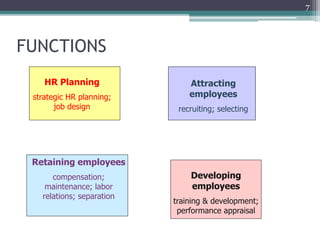
HR Planning
strategic HR planning;
job design
FUNCTIONS
Attracting
employees
recruiting; selecting
Developing
employees
training & development;
performance appraisal
Retaining employees
compensation;
maintenance; labor
relations; separation
7
HR Planning
• Planning for the future personnel needs of an
organization,
• taking into account both internal activities and
factors in the external environment
8
HR Planning
• Job Design
▫ usually done prior to recruitment
▫ the process of describing the work that needs
to be done by an employee and
▫ specifying the requirements needed in
fulfilling the job
9
Attracting Employees
• Recruitment
▫ development of a pool of job candidates in
accordance with a human resource plan
▫ its purpose is to provide mgmt. with enough
candidates from which they can select
qualified employees
10
Attracting Employees
• Selection
▫ the mutual process whereby the organization
decides to make a job offer and the candidate
decides whether or not to accept it.
11
12
Developing Employees
• Orientation
▫ a program designed to help employees fit
smoothly into an organization
13
Developing Employees
• Training
▫ a process designed to maintain or improve
current employee performance
• Development
▫ a process designed to develop skills and
attitudes necessary for future work
14
Developing Employees
• Performance Appraisal
▫ process of providing feedback to subordinates
regarding their performance on the job.
▫ Informal versus Formal
15
Developing Employees
• A formalized appraisal process is used for:
▫ rating work performance
▫ identifying those deserving raises or
promotions
▫ identifying those in need of further
training
16
Retaining Employees
Compensation
• the adequate and equitable remuneration of
personnel for their contribution in the
achievement of organization objectives.
17
Retaining Employees
Labor relations
• entails recognizing the validity of unions,
negotiating for the collective bargaining
agreement, and being able to handle strikes and
other forms of mass action.
18
Retaining Employees
Maintenance
• the process of providing the following
services to employees:
▫ career counselling
▫ safety & health programs
• Also involves the minimization of
absenteeism and tardiness
19
Retaining Employees
Separation
• employee separation can be just as important
as employee retention
▫ Organizations pursuing differentiation rely on
highly skilled employees who have specialized
knowledge and ability.
▫ An employee who is not capable of providing
skilled inputs does not contribute, making
termination of nonperforming employees critical
for organizations that seek to produce premium
goods and services
REFERENCE
•https://en.wikipedia.org/wiki/Human_resource_manage
ment
•http://www.whatishumanresource.com/Human-
Resource-Management-functions
•http://www.managementstudyguide.com/human
resource-management.htm
20

Human resource management

  • 1.
  • 2.
    What is HumanResource Management? 2
  • 3.
    Human Resources Management •“HRM is the function performed in organizations that facilitates the most effective use of people to achieve organizational and individual goals.” ▫ Ivancevich and Glueck • The HRM process consists of planning, attracting, developing, and retaining the human resources (employees) of an organization. 3
  • 4.
    • According toAdi Godrej, “all corporate strengths are dependent on people.” 4
  • 5.
    Scope of HRManagement • HRM in Personnel Management: This is typically direct manpower management that involves manpower planning, hiring (recruitment and selection), training and development, induction and orientation, transfer, promotion, compensation, layoff and retrenchment, employee productivity. 5
  • 6.
    • HRM inEmployee Welfare: This particular aspect of HRM deals with working conditions and amenities at workplace. • HRM in Industrial Relations: Since it is a highly sensitive area, it needs careful interactions with labor or employee unions, addressing their grievances and settling the disputes effectively in order to maintain peace and harmony in the organization. 6
  • 7.
    HR Planning strategic HRplanning; job design FUNCTIONS Attracting employees recruiting; selecting Developing employees training & development; performance appraisal Retaining employees compensation; maintenance; labor relations; separation 7
  • 8.
    HR Planning • Planningfor the future personnel needs of an organization, • taking into account both internal activities and factors in the external environment 8
  • 9.
    HR Planning • JobDesign ▫ usually done prior to recruitment ▫ the process of describing the work that needs to be done by an employee and ▫ specifying the requirements needed in fulfilling the job 9
  • 10.
    Attracting Employees • Recruitment ▫development of a pool of job candidates in accordance with a human resource plan ▫ its purpose is to provide mgmt. with enough candidates from which they can select qualified employees 10
  • 11.
    Attracting Employees • Selection ▫the mutual process whereby the organization decides to make a job offer and the candidate decides whether or not to accept it. 11
  • 12.
    12 Developing Employees • Orientation ▫a program designed to help employees fit smoothly into an organization
  • 13.
    13 Developing Employees • Training ▫a process designed to maintain or improve current employee performance • Development ▫ a process designed to develop skills and attitudes necessary for future work
  • 14.
    14 Developing Employees • PerformanceAppraisal ▫ process of providing feedback to subordinates regarding their performance on the job. ▫ Informal versus Formal
  • 15.
    15 Developing Employees • Aformalized appraisal process is used for: ▫ rating work performance ▫ identifying those deserving raises or promotions ▫ identifying those in need of further training
  • 16.
    16 Retaining Employees Compensation • theadequate and equitable remuneration of personnel for their contribution in the achievement of organization objectives.
  • 17.
    17 Retaining Employees Labor relations •entails recognizing the validity of unions, negotiating for the collective bargaining agreement, and being able to handle strikes and other forms of mass action.
  • 18.
    18 Retaining Employees Maintenance • theprocess of providing the following services to employees: ▫ career counselling ▫ safety & health programs • Also involves the minimization of absenteeism and tardiness
  • 19.
    19 Retaining Employees Separation • employeeseparation can be just as important as employee retention ▫ Organizations pursuing differentiation rely on highly skilled employees who have specialized knowledge and ability. ▫ An employee who is not capable of providing skilled inputs does not contribute, making termination of nonperforming employees critical for organizations that seek to produce premium goods and services
  • 20.