What is Grievance ?
• Grievance is “any discontent
or dissatisfaction, whether
expressed or not, whether
valid or not, arising out of
anything connected with the
company which an employee
thinks, believes or even feels
to be unfair, unjust or
inequitable.”
CAUSES for Grievance
1. Promotions
2. Continuity of Services
3. Fines
4. Compensation
5. Increments
6. Disciplinary action
7. Wages
8. Transfer
9. Safety appliance
10.Victimization
11.Conditions of work.
12.Amenities
Need for Grievance Procedure
1. Management can know the employees’ feelings and opinions
about the company’s policies and practices.
2. It keeps a check on the supervisor’s attitude and behavior towards
their subordinates.
3. Employee gets a chance to ventilate his feelings
4. Build good morale, maintains code of discipline.
5. Brings uniformity in handling grievances.
6. It develops faith of employees.
7. Reduces personality conflicts.
8. Provides judicial protection to the employees.
Processing of Grievance
• Primary Stage (Supervisor)
• Intermediate Stage (Group head)
• Organization Level (Management head)
• Third Party Mediation (Legal
authorities)
Errors in processing of Grievance
1. Stopping too soon in the search of facts
2. Expressing a management opinion prior to the
time when all pertinent facts have been
discovered
3. Failing to maintain proper records
4. Resorting to executive fiat or orders instead of
discussion and conference to change minds
5. Setting the wrong grievance a mistake which may
in turn produce a second new grievance.
Objectives of a Grievance Handling
Procedure
a) To enable the employee to air his/her grievance.
b) To clarify the nature of the grievance.
c) To investigate the reasons for dissatisfaction.
d) To obtain, where possible, a speedy resolution to the
problem.
e) To take appropriate actions and ensure that promises
are kept.
f) To inform the employee of his or her right to take the
grievance to the next stage of the procedure, in the
event of an unsuccessful resolution.
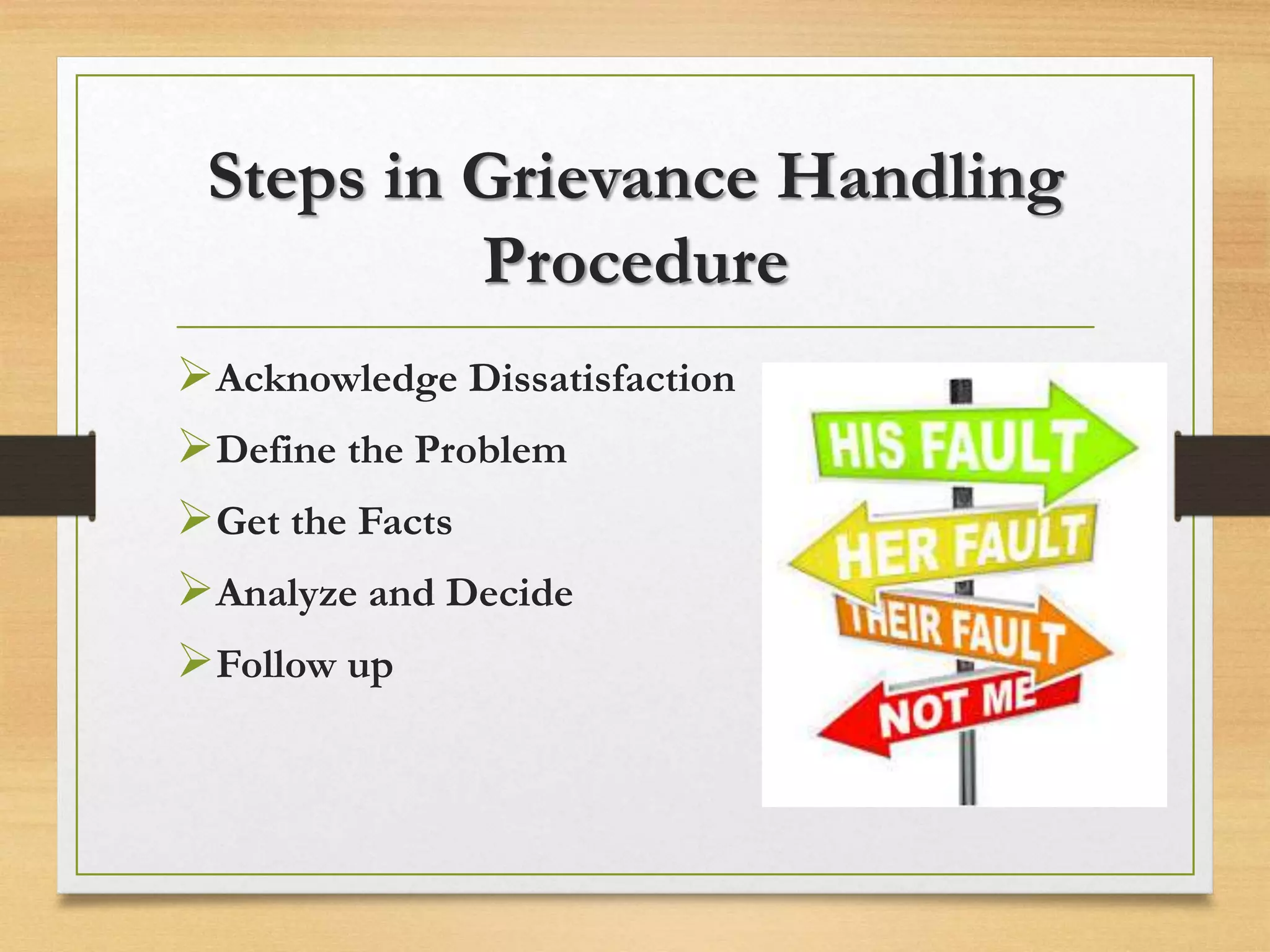
Steps in Grievance Handling
Procedure
Acknowledge Dissatisfaction
Define the Problem
Get the Facts
Analyze and Decide
Follow up
Benefits of a Grievance Handling
Procedure
1. It encourages employees to raise concerns without
fear of reprisal.
2. It provides a fair and speedy means of dealing with
complaints.
3. It prevents minor disagreements developing into more
serious disputes.
4. It saves employers time and money as solutions are
found for workplace problems
Organization Incident
• When: On 23rd September 1983
• How many: A few hundred employees
• Of: Taj (Bombay)
• Did what: expressed their unhappiness
• By: setting fire to a few sofas in the lobby, breaking
furniture and shouting anti-management slogans.
• Owner: J.R.D. Tata
• Reason: Management communications problem
Organization Incident (contd.)
• HR team: Provided an effective, internal channel
for grievance anticipation and counseling.
• Effects: Employee attrition reduced and customer
satisfaction improved.
• J.R.D: “I agree with your diagnosis. One lesson I have
learnt through 50 years of working with people is that there
are no union problems…only management problems.”
Grievance-handling
Grievance-handling

Grievance-handling

  • 2.
    What is Grievance? • Grievance is “any discontent or dissatisfaction, whether expressed or not, whether valid or not, arising out of anything connected with the company which an employee thinks, believes or even feels to be unfair, unjust or inequitable.”
  • 3.
    CAUSES for Grievance 1.Promotions 2. Continuity of Services 3. Fines 4. Compensation 5. Increments 6. Disciplinary action 7. Wages 8. Transfer 9. Safety appliance 10.Victimization 11.Conditions of work. 12.Amenities
  • 4.
    Need for GrievanceProcedure 1. Management can know the employees’ feelings and opinions about the company’s policies and practices. 2. It keeps a check on the supervisor’s attitude and behavior towards their subordinates. 3. Employee gets a chance to ventilate his feelings 4. Build good morale, maintains code of discipline. 5. Brings uniformity in handling grievances. 6. It develops faith of employees. 7. Reduces personality conflicts. 8. Provides judicial protection to the employees.
  • 5.
    Processing of Grievance •Primary Stage (Supervisor) • Intermediate Stage (Group head) • Organization Level (Management head) • Third Party Mediation (Legal authorities)
  • 6.
    Errors in processingof Grievance 1. Stopping too soon in the search of facts 2. Expressing a management opinion prior to the time when all pertinent facts have been discovered 3. Failing to maintain proper records 4. Resorting to executive fiat or orders instead of discussion and conference to change minds 5. Setting the wrong grievance a mistake which may in turn produce a second new grievance.
  • 7.
    Objectives of aGrievance Handling Procedure a) To enable the employee to air his/her grievance. b) To clarify the nature of the grievance. c) To investigate the reasons for dissatisfaction. d) To obtain, where possible, a speedy resolution to the problem. e) To take appropriate actions and ensure that promises are kept. f) To inform the employee of his or her right to take the grievance to the next stage of the procedure, in the event of an unsuccessful resolution.
  • 8.
    Steps in GrievanceHandling Procedure Acknowledge Dissatisfaction Define the Problem Get the Facts Analyze and Decide Follow up
  • 9.
    Benefits of aGrievance Handling Procedure 1. It encourages employees to raise concerns without fear of reprisal. 2. It provides a fair and speedy means of dealing with complaints. 3. It prevents minor disagreements developing into more serious disputes. 4. It saves employers time and money as solutions are found for workplace problems
  • 10.
    Organization Incident • When:On 23rd September 1983 • How many: A few hundred employees • Of: Taj (Bombay) • Did what: expressed their unhappiness • By: setting fire to a few sofas in the lobby, breaking furniture and shouting anti-management slogans. • Owner: J.R.D. Tata • Reason: Management communications problem
  • 11.
    Organization Incident (contd.) •HR team: Provided an effective, internal channel for grievance anticipation and counseling. • Effects: Employee attrition reduced and customer satisfaction improved. • J.R.D: “I agree with your diagnosis. One lesson I have learnt through 50 years of working with people is that there are no union problems…only management problems.”