Nutrition and liver
diseases
Presented by
Dr.P.Nazni
Reader & Head i/c
Department of Food Science
Periyar University
Salem 636 011, Tamilnadu, India
Liver
 The liver is located in the
upper right-hand portion of
the abdominal cavity,
beneath the diaphragm, and
on top of the stomach, right
kidney, and intestines.
Shaped like a cone, the liver
is a dark reddish-brown
organ that weighs about 3
pounds.
Why it’s called a “Liver”
 Synthesizes
 Clotting factor
 Albumin
 Glycogen
 Stores
 Glycogen
 Albumin
 Fat soluble
Vitamins
 Metabolizes
 Medications
 Toxins
 Amino acids
Functions of the Liver:
A Brief Overview
 Largest organ in body, integral to most
metabolic functions of body, performing over
500 tasks
 Only 10-20% of functioning liver is required to
sustain life
 Removal of liver will result in death within 24
hours
Functions of the Liver
 Main functions include:
 Metabolism of CHO, protein, fat
 Storage/activation vitamins and minerals
 Formation/excretion of bile
 Steroid metabolism, detoxifier of drugs/alcohol
 Action as (bacteria) filter and fluid chamber
 Conversion of ammonia to urea
 Gastrointestinal tract significant source of ammonia
 Generated from ingested protein substances that are
deaminated by colonic bacteria
 Ammonia enters circulation via portal vein
 Converted to urea by liver for excretion
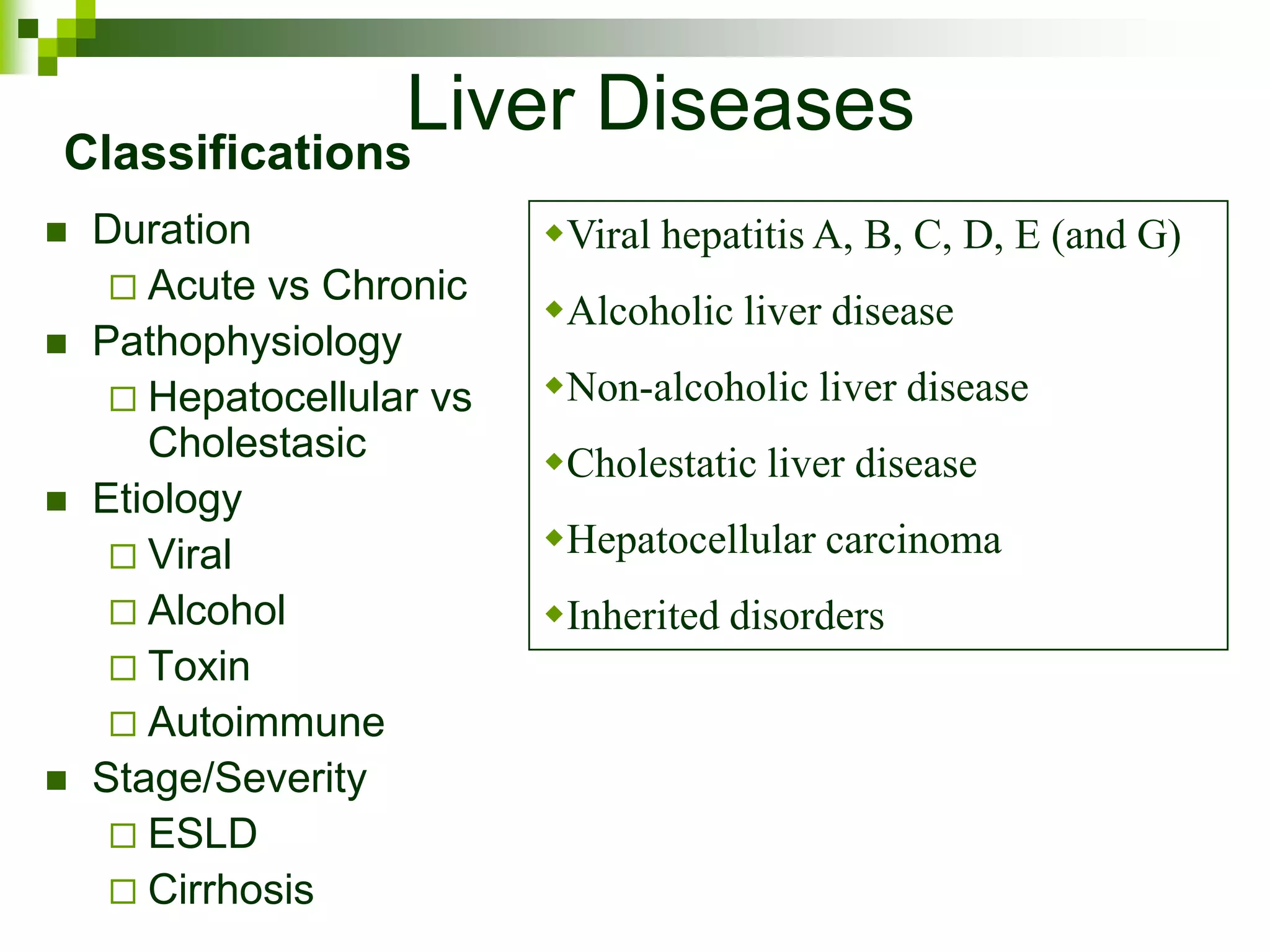
Liver Diseases
 Duration
 Acute vs Chronic
 Pathophysiology
 Hepatocellular vs
Cholestasic
 Etiology
 Viral
 Alcohol
 Toxin
 Autoimmune
 Stage/Severity
 ESLD
 Cirrhosis
Viral hepatitis A, B, C, D, E (and G)
Alcoholic liver disease
Non-alcoholic liver disease
Cholestatic liver disease
Hepatocellular carcinoma
Inherited disorders
Classifications
Cirrhosis is common
end result of many
chronic liver disorders
 Severe damage to structure &
function of normal cells
 Inhibits normal blood flow
 Decrease in # functional hepatocytes
 Results in portal hypertension &
ascites
 Portal systemic shunting
Blood bypasses the liver via shunt,
thus bypassing detoxification
Toxins remain in circulating blood
Neurtoxic substances can precipitate
hepatic encephalopathy
www.gutfeelings.com/ CRLIVER.JPG
www.gicare.com/ pated/gifs/elv0004.gif
Fatty liver
Normal healthy liver, surface is smooth
and uniform
Sever cirrhosis, surface is very nodular
www.gihealth.com/ newsletter/34/two_livers.jpg
Complications of liver cirrhosis
 Portal hypertension
 Esophageal varices (EV)
 Ascites
 Hyperammonaemia
 Hepatic encephalopathy (HE)
 Hepatorenal syndrome
www.murrasaca.com/ Hepaticirrosis.htm
 Malnutrition is an early and typical aspect
of hepatic cirrhosis.
 70% of p’t with cirrhosis have signs of
PT/Cal malnutrition.
Way to lead malnutrition
 food intake (anorexia, nausea, drugs)
 malabsorption
 energy and PT requirement
 paracenthesis induced PT loss
 complications
Nutrition in the complications of liver
cirrhosis
 Calories (Cal)
 Fat
 Protein (PT)
 Carbohydrate (CHO)
 Sodium (Na)
 Fluid
 Vitamins
 Total Cal=30 kcal/kg
 Fat=30-35% of total Cal
 PT=1g/kg/d
CHO=remainder of the Cal requirement
 Na : not exceed 2g(88mmol)/d
 Daily sodium intake :
130 (mmol/kg) * wt change (kg/d) + 24h urinary
Na (mmol/d) – 10 (mmol/d)
 Na free diet : energy, PT, lean body mass
 Na intake should be restricted before fluid
 Fluid : no need to restrict at the beginning
 Vitamins : supplement water and fat solutable vit.(B1,
B12, folate, A, D, E, K)
Jaundice
 Jaundice is not a disease but rather a sign that can occur in many
different diseases. Jaundice is the yellowish staining of the skin
and sclerae
Yellow coloration of the eyes, skin,
tongue and urine.
Loss of appetite.
Dull pain in the liver region.
Nausea,
severe constipation,
extreme weakness.
Fever,
headache and undue fatigue.
Symptoms of Jaundice
Causes of jaundice
 Blockage in the bile ducts
 Gallstones.
 Hepatitis virus,
 Typhoid, cancer, malaria, and anemia.
 Improper or short flow of the blood in
the liver
 Tuberculosis, and yellow fever.
 It can be inborn.
 Red blood corpuscles in able to
function properly.
 There is problem in the functioning of
liver.
Jaundice Diet
 Barley water, fruit juices are
effective.
 Do not give fatty foods and also
avoid foods which agitate stomach.
 Do not give cereals and pulses.
 In case of fever give fruit diet and
fresh fruit juices to drink and to take
good rest.
 Grapes, black soya beans, nuts,
sweet potatoes are effective fruits for
jaundice patients.
Barley water
fruit juices
Natural treatment for Jaundice
 Take half to one teaspoon of papaya leaves paste and add
half to one tablespoon of honey and mix it well. Eat this
regularly for one-two week.
 Take 10-15 basil leaves (tulsi leaves) and make its paste;
add this in a half glass of freshly made radish juice.
 Amla
 Drink lemon juice
 Take 7-10 leaves (dry) of snake gourd and boil in a cup of
water. Boil 10-15 coriander seeds in half liter water.
mixture of snake gourd along with coriander solution three
times a day.
 Orange juice
Hepatitis
 Hepatitis (plural hepatitides) implies inflammation of the liver
characterized by the presence of inflammatory cells in the tissue of
the organ.
Types of hepatitis
Hepatitis A - This is caused by eating infected food or water
 Hepatitis B - This is an STD (sexually transmitted disease). It is caused by
the virus HBV (Hepatitis B Virus)
-Unprotected sexual intercourse
-Using a syringe that was used by an infected person
-A baby can become infected through his mother's milk if
she is infected.
- Being bitten by someone who is infected.
Hepatitis C - Hepatitis C is usually spread through direct contact with
the blood of a person who has the disease.
Hepatitis D - Only a person who is already infected with Hepatitis B.
Hepatitis E - A person can become infected by drinking water that
contains HEV (Hepatitis E Virus).
Hepatitis X - Hepatitis of an unknown virus.
Hepatitis G - This is a type of hepatitis caused by the Hepatitis G virus
(HGV).
Signs and Symptoms of Hepatitis?
 The acute phase of hepatitis
Diarrhea
 Fatigue
 Loss of appetite
 Mild fever
 Muscle or joint aches
 Nausea
 Slight abdominal pain
 Vomiting
 Weight loss
 The acute phase is not usually
dangerous,
Diet therapy
 Hydration
 No alcohol
 Low fat, moderate protein, high CHO diet,
high calorie
 Small frequent meals
 Vit B, C, K
Thank You!

Nutrition and liver diseases by Dr.P.Nazni

  • 1.
    Nutrition and liver diseases Presentedby Dr.P.Nazni Reader & Head i/c Department of Food Science Periyar University Salem 636 011, Tamilnadu, India
  • 2.
    Liver  The liveris located in the upper right-hand portion of the abdominal cavity, beneath the diaphragm, and on top of the stomach, right kidney, and intestines. Shaped like a cone, the liver is a dark reddish-brown organ that weighs about 3 pounds.
  • 3.
    Why it’s calleda “Liver”  Synthesizes  Clotting factor  Albumin  Glycogen  Stores  Glycogen  Albumin  Fat soluble Vitamins  Metabolizes  Medications  Toxins  Amino acids
  • 4.
    Functions of theLiver: A Brief Overview  Largest organ in body, integral to most metabolic functions of body, performing over 500 tasks  Only 10-20% of functioning liver is required to sustain life  Removal of liver will result in death within 24 hours
  • 5.
    Functions of theLiver  Main functions include:  Metabolism of CHO, protein, fat  Storage/activation vitamins and minerals  Formation/excretion of bile  Steroid metabolism, detoxifier of drugs/alcohol  Action as (bacteria) filter and fluid chamber  Conversion of ammonia to urea  Gastrointestinal tract significant source of ammonia  Generated from ingested protein substances that are deaminated by colonic bacteria  Ammonia enters circulation via portal vein  Converted to urea by liver for excretion
  • 6.
    Liver Diseases  Duration Acute vs Chronic  Pathophysiology  Hepatocellular vs Cholestasic  Etiology  Viral  Alcohol  Toxin  Autoimmune  Stage/Severity  ESLD  Cirrhosis Viral hepatitis A, B, C, D, E (and G) Alcoholic liver disease Non-alcoholic liver disease Cholestatic liver disease Hepatocellular carcinoma Inherited disorders Classifications
  • 7.
    Cirrhosis is common endresult of many chronic liver disorders  Severe damage to structure & function of normal cells  Inhibits normal blood flow  Decrease in # functional hepatocytes  Results in portal hypertension & ascites  Portal systemic shunting Blood bypasses the liver via shunt, thus bypassing detoxification Toxins remain in circulating blood Neurtoxic substances can precipitate hepatic encephalopathy
  • 8.
  • 9.
    Normal healthy liver,surface is smooth and uniform Sever cirrhosis, surface is very nodular www.gihealth.com/ newsletter/34/two_livers.jpg
  • 10.
    Complications of livercirrhosis  Portal hypertension  Esophageal varices (EV)  Ascites  Hyperammonaemia  Hepatic encephalopathy (HE)  Hepatorenal syndrome
  • 11.
  • 12.
     Malnutrition isan early and typical aspect of hepatic cirrhosis.  70% of p’t with cirrhosis have signs of PT/Cal malnutrition.
  • 13.
    Way to leadmalnutrition  food intake (anorexia, nausea, drugs)  malabsorption  energy and PT requirement  paracenthesis induced PT loss  complications
  • 14.
    Nutrition in thecomplications of liver cirrhosis  Calories (Cal)  Fat  Protein (PT)  Carbohydrate (CHO)  Sodium (Na)  Fluid  Vitamins
  • 15.
     Total Cal=30kcal/kg  Fat=30-35% of total Cal  PT=1g/kg/d CHO=remainder of the Cal requirement  Na : not exceed 2g(88mmol)/d  Daily sodium intake : 130 (mmol/kg) * wt change (kg/d) + 24h urinary Na (mmol/d) – 10 (mmol/d)  Na free diet : energy, PT, lean body mass  Na intake should be restricted before fluid  Fluid : no need to restrict at the beginning  Vitamins : supplement water and fat solutable vit.(B1, B12, folate, A, D, E, K)
  • 16.
    Jaundice  Jaundice isnot a disease but rather a sign that can occur in many different diseases. Jaundice is the yellowish staining of the skin and sclerae Yellow coloration of the eyes, skin, tongue and urine. Loss of appetite. Dull pain in the liver region. Nausea, severe constipation, extreme weakness. Fever, headache and undue fatigue. Symptoms of Jaundice
  • 17.
    Causes of jaundice Blockage in the bile ducts  Gallstones.  Hepatitis virus,  Typhoid, cancer, malaria, and anemia.  Improper or short flow of the blood in the liver  Tuberculosis, and yellow fever.  It can be inborn.  Red blood corpuscles in able to function properly.  There is problem in the functioning of liver.
  • 18.
    Jaundice Diet  Barleywater, fruit juices are effective.  Do not give fatty foods and also avoid foods which agitate stomach.  Do not give cereals and pulses.  In case of fever give fruit diet and fresh fruit juices to drink and to take good rest.  Grapes, black soya beans, nuts, sweet potatoes are effective fruits for jaundice patients. Barley water fruit juices
  • 19.
    Natural treatment forJaundice  Take half to one teaspoon of papaya leaves paste and add half to one tablespoon of honey and mix it well. Eat this regularly for one-two week.  Take 10-15 basil leaves (tulsi leaves) and make its paste; add this in a half glass of freshly made radish juice.  Amla  Drink lemon juice  Take 7-10 leaves (dry) of snake gourd and boil in a cup of water. Boil 10-15 coriander seeds in half liter water. mixture of snake gourd along with coriander solution three times a day.  Orange juice
  • 20.
    Hepatitis  Hepatitis (pluralhepatitides) implies inflammation of the liver characterized by the presence of inflammatory cells in the tissue of the organ. Types of hepatitis Hepatitis A - This is caused by eating infected food or water  Hepatitis B - This is an STD (sexually transmitted disease). It is caused by the virus HBV (Hepatitis B Virus) -Unprotected sexual intercourse -Using a syringe that was used by an infected person -A baby can become infected through his mother's milk if she is infected. - Being bitten by someone who is infected. Hepatitis C - Hepatitis C is usually spread through direct contact with the blood of a person who has the disease. Hepatitis D - Only a person who is already infected with Hepatitis B. Hepatitis E - A person can become infected by drinking water that contains HEV (Hepatitis E Virus). Hepatitis X - Hepatitis of an unknown virus. Hepatitis G - This is a type of hepatitis caused by the Hepatitis G virus (HGV).
  • 21.
    Signs and Symptomsof Hepatitis?  The acute phase of hepatitis Diarrhea  Fatigue  Loss of appetite  Mild fever  Muscle or joint aches  Nausea  Slight abdominal pain  Vomiting  Weight loss  The acute phase is not usually dangerous,
  • 22.
    Diet therapy  Hydration No alcohol  Low fat, moderate protein, high CHO diet, high calorie  Small frequent meals  Vit B, C, K
  • 23.