Presented by-
Nayan Gupta
M.G.M Medical college, Indore
 India has the third largest HIV epidemic in the world.
 In India (2016)
 Approx. 2.5 million people living with HIV.
 0.3% adult HIV prevalence.
 86,000 new HIV infections.
 HIV prevention in India- NACO is the body responsible for
prevention and control of the HIV epidemic in INDIA.
 Current programme, NACP-IV (2012-2017) , aims to reduce the
HIV infections by 50%.
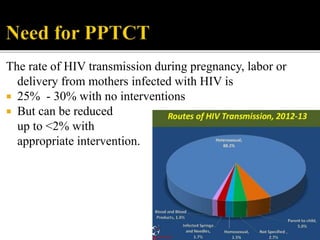
The rate of HIV transmission during pregnancy, labor or
delivery from mothers infected with HIV is
 25% - 30% with no interventions
 But can be reduced
up to <2% with
appropriate intervention.
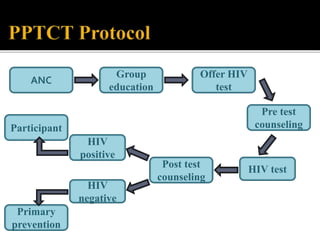
ANC
Group
education
Offer HIV
test
Pre test
counseling
HIV testPost test
counseling
HIV
positive
HIV
negative
Primary
prevention
Participant
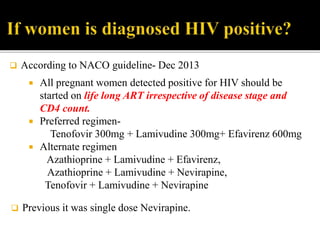
 All pregnant women detected positive for HIV should be
started on life long ART irrespective of disease stage and
CD4 count.
 Preferred regimen-
Tenofovir 300mg + Lamivudine 300mg+ Efavirenz 600mg
 Alternate regimen
Azathioprine + Lamivudine + Efavirenz,
Azathioprine + Lamivudine + Nevirapine,
Tenofovir + Lamivudine + Nevirapine
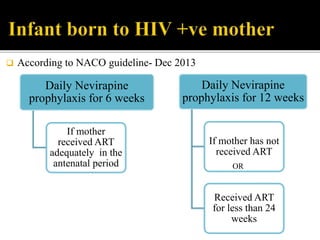
 According to NACO guideline- Dec 2013
 Previous it was single dose Nevirapine.
Daily Nevirapine
prophylaxis for 6 weeks
If mother
received ART
adequately in the
antenatal period
Daily Nevirapine
prophylaxis for 12 weeks
If mother has not
received ART
Received ART
for less than 24
weeks
OR
 According to NACO guideline- Dec 2013
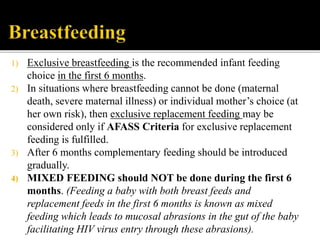
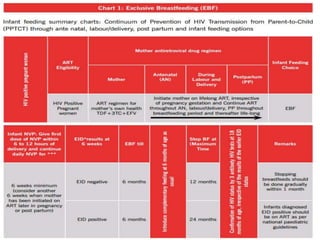
1) Exclusive breastfeeding is the recommended infant feeding
choice in the first 6 months.
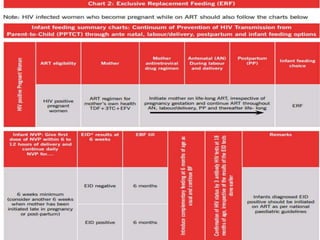
2) In situations where breastfeeding cannot be done (maternal
death, severe maternal illness) or individual mother’s choice (at
her own risk), then exclusive replacement feeding may be
considered only if AFASS Criteria for exclusive replacement
feeding is fulfilled.
3) After 6 months complementary feeding should be introduced
gradually.
4) MIXED FEEDING should NOT be done during the first 6
months. (Feeding a baby with both breast feeds and
replacement feeds in the first 6 months is known as mixed
feeding which leads to mucosal abrasions in the gut of the baby
facilitating HIV virus entry through these abrasions).
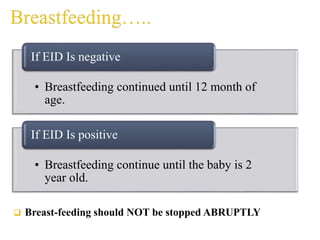
• Breastfeeding continued until 12 month of
age.
If EID Is negative
• Breastfeeding continue until the baby is 2
year old.
If EID Is positive
 Breast-feeding should NOT be stopped ABRUPTLY
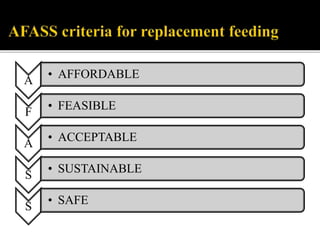
A
• AFFORDABLE
F
• FEASIBLE
A
• ACCEPTABLE
S
• SUSTAINABLE
S
• SAFE
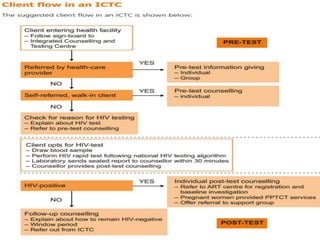
Integrated Counselling
and Testing Centres
 An ICTC is a place where a person is counseled and tested
for HIV, on his/her own will (self- initiated) or as advised
by a medical provider (provider- initiated).
 Functions of ICTC
 Early detection of HIV
 provide basic information on modes of transmission and
prevention of HIV for promoting behavioural changes
and reducing vulnerability.
 Linking PLHIV with other HIV prevention, care and
treatment services.
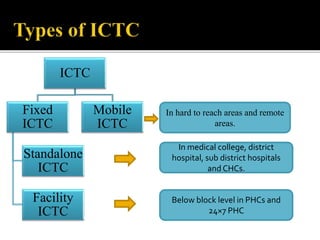
ICTC
Fixed
ICTC
Standalone
ICTC
Facility
ICTC
Mobile
ICTC
In hard to reach areas and remote
areas.
In medical college, district
hospital, sub district hospitals
and CHCs.
Below block level in PHCs and
24×7 PHC
 Public private partner (PPP) ICTC- These are
established in private facilities (NGOs, community
based organizations, federation of Self-Help Groups
(SHGs), hospitals, nursing homes, clinics and
laboratories)
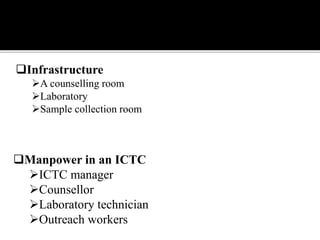
Manpower in an ICTC
ICTC manager
Counsellor
Laboratory technician
Outreach workers
Infrastructure
A counselling room
Laboratory
Sample collection room
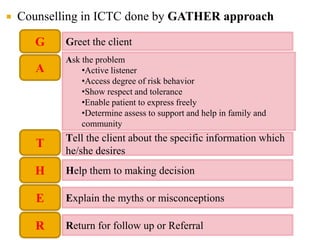
 Counselling in ICTC done by GATHER approach
G
A
T
H
E
R
Greet the client
Ask the problem
•Active listener
•Access degree of risk behavior
•Show respect and tolerance
•Enable patient to express freely
•Determine assess to support and help in family and
community
Tell the client about the specific information which
he/she desires
Help them to making decision
Explain the myths or misconceptions
Return for follow up or Referral
PPTCT and ICTC

PPTCT and ICTC

  • 1.
    Presented by- Nayan Gupta M.G.MMedical college, Indore
  • 2.
     India hasthe third largest HIV epidemic in the world.  In India (2016)  Approx. 2.5 million people living with HIV.  0.3% adult HIV prevalence.  86,000 new HIV infections.  HIV prevention in India- NACO is the body responsible for prevention and control of the HIV epidemic in INDIA.  Current programme, NACP-IV (2012-2017) , aims to reduce the HIV infections by 50%.
  • 4.
    The rate ofHIV transmission during pregnancy, labor or delivery from mothers infected with HIV is  25% - 30% with no interventions  But can be reduced up to <2% with appropriate intervention.
  • 6.
    ANC Group education Offer HIV test Pre test counseling HIVtestPost test counseling HIV positive HIV negative Primary prevention Participant
  • 7.
     All pregnantwomen detected positive for HIV should be started on life long ART irrespective of disease stage and CD4 count.  Preferred regimen- Tenofovir 300mg + Lamivudine 300mg+ Efavirenz 600mg  Alternate regimen Azathioprine + Lamivudine + Efavirenz, Azathioprine + Lamivudine + Nevirapine, Tenofovir + Lamivudine + Nevirapine  According to NACO guideline- Dec 2013  Previous it was single dose Nevirapine.
  • 8.
    Daily Nevirapine prophylaxis for6 weeks If mother received ART adequately in the antenatal period Daily Nevirapine prophylaxis for 12 weeks If mother has not received ART Received ART for less than 24 weeks OR  According to NACO guideline- Dec 2013
  • 9.
    1) Exclusive breastfeedingis the recommended infant feeding choice in the first 6 months. 2) In situations where breastfeeding cannot be done (maternal death, severe maternal illness) or individual mother’s choice (at her own risk), then exclusive replacement feeding may be considered only if AFASS Criteria for exclusive replacement feeding is fulfilled. 3) After 6 months complementary feeding should be introduced gradually. 4) MIXED FEEDING should NOT be done during the first 6 months. (Feeding a baby with both breast feeds and replacement feeds in the first 6 months is known as mixed feeding which leads to mucosal abrasions in the gut of the baby facilitating HIV virus entry through these abrasions).
  • 10.
    • Breastfeeding continueduntil 12 month of age. If EID Is negative • Breastfeeding continue until the baby is 2 year old. If EID Is positive  Breast-feeding should NOT be stopped ABRUPTLY
  • 11.
    A • AFFORDABLE F • FEASIBLE A •ACCEPTABLE S • SUSTAINABLE S • SAFE
  • 15.
  • 16.
     An ICTCis a place where a person is counseled and tested for HIV, on his/her own will (self- initiated) or as advised by a medical provider (provider- initiated).  Functions of ICTC  Early detection of HIV  provide basic information on modes of transmission and prevention of HIV for promoting behavioural changes and reducing vulnerability.  Linking PLHIV with other HIV prevention, care and treatment services.
  • 17.
    ICTC Fixed ICTC Standalone ICTC Facility ICTC Mobile ICTC In hard toreach areas and remote areas. In medical college, district hospital, sub district hospitals and CHCs. Below block level in PHCs and 24×7 PHC
  • 18.
     Public privatepartner (PPP) ICTC- These are established in private facilities (NGOs, community based organizations, federation of Self-Help Groups (SHGs), hospitals, nursing homes, clinics and laboratories)
  • 19.
    Manpower in anICTC ICTC manager Counsellor Laboratory technician Outreach workers Infrastructure A counselling room Laboratory Sample collection room
  • 20.
     Counselling inICTC done by GATHER approach G A T H E R Greet the client Ask the problem •Active listener •Access degree of risk behavior •Show respect and tolerance •Enable patient to express freely •Determine assess to support and help in family and community Tell the client about the specific information which he/she desires Help them to making decision Explain the myths or misconceptions Return for follow up or Referral