ICTC Team Training
1
Prevention of Parent to Child
Transmission (PPTCT)
Starter Quiz
Exclusive breastfeeding is defined by WHO as giving
an infant only breastmilk. The ONLY other things also
allowed are
 Chocolates
 Drops or syrups containing vitamins, mineral
supplements, or medicines
 Masoor Dal water
 Bottle feeds made by companies like Amul and
Cerelac
ICTC Team Training
2
Starter Quiz
When the mother chooses replacement feeds (instead of
breastfeeding), all these are good reasons to choose cup
feeding over bottle feeding EXCEPT for
 Cups are safer because they are easier to clean with
soap and water than bottles.
 Cups are less likely than bottles to be carried around for
a long time, giving bacteria a chance to increase.
 Cups come in different designs and colours which can be
used to stimulate mental growth in the child.

 Cup feeding requires the person feeding the child to hold
the child and this increases physical and social contact.
ICTC Team Training
3
Starter Quiz
All the following are reasons why a woman infected with
HIV/AIDS may choose to breastfeed her newborn child
instead of giving a breastmilk substitute. The ONLY
EXCEPTION is
 To reduce her expenses because replacement feeding is
expensive.
 To avoid accidentally disclosing her HIV status to others.
 To avoid stigma.
 To delay accepting her HIV status
 To bond with her child physically and socially.
 To improve her child’s future job prospects.
ICTC Team Training
4
Starter Quiz
Name the two tests that can detect HIV infection in an
infant:
 An HIV antibody test (ELISA or a rapid test)
conducted at 3 months after birth
 An HIV antibody test (ELISA or a rapid test)
conducted at 18 months after birth
 An HIV antigen test like the PCR test 6 weeks after
birth
 A urine test
ICTC Team Training
5
Starter Quiz
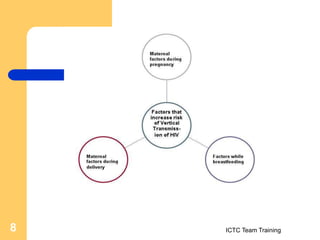
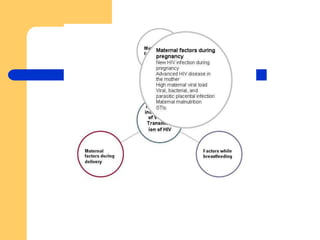
Maternal factors that may increase the risk of
HIV transmission during pregnancy include
 New HIV infection during pregnancy
 Starting a new job during pregnancy
 Advanced HIV disease or AIDS in the mother
 High maternal viral load
 Viral, bacterial, and parasitic infection of the placenta
(especially malaria)
 Maternal malnutrition (indirect cause)
 STIs ICTC Team Training
6
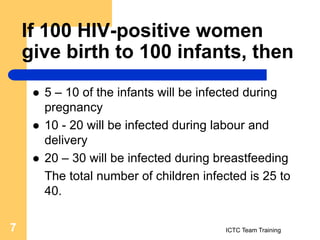
If 100 HIV-positive women
give birth to 100 infants, then
 5 – 10 of the infants will be infected during
pregnancy
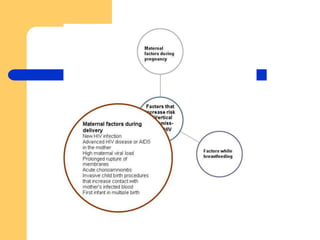
 10 - 20 will be infected during labour and
delivery
 20 – 30 will be infected during breastfeeding
The total number of children infected is 25 to
40.
ICTC Team Training
7
ICTC Team Training
8
ICTC Team Training
12
ICTC Team Training
13
ICTC Team Training
14
ICTC Team Training
15
ICTC Team Training
16
PPTCT as a Case of Provider-
Initiated Testing
 ICTC provides opportunity to interact with
pregnant patients.
 ICTC team to actively generate referrals from
private and public maternity services
 Educate women about how knowing their
HIV status can help
 Encourage men to bring their female
partners for testing and services
ICTC Team Training
17
Advantages of PPTCT
Mother
 Decreased chance of
HIV transmission to
her child
 Post partum care
 Infant feeding support
Child
 Decreased chance of being
infected with HIV
 Proper nutritional guidance
– breastfeeding vs
replacement feeding
 Prevention & treatment of OI
– Proper immunization
– Cotrimoxazole prophylaxis
 ART when required
ICTC Team Training
18
Routine Antenatal Care
ICTC Team Training
19
 Client history
 Physical exam and vital signs
 Abdominal exam
 Lab diagnostics
 Tetanus toxoid immunizations
 Nutritional assessment and counselling
 STI screening
 Anti-malarials
 Counselling on infant feeding
 Counselling on pregnancy danger signs
 Partners and family
 Effective contraception plan
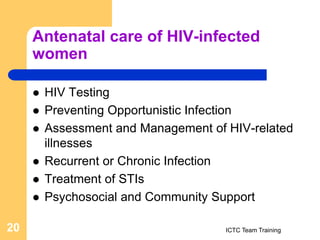
Antenatal care of HIV-infected
women
 HIV Testing
 Preventing Opportunistic Infection
 Assessment and Management of HIV-related
illnesses
 Recurrent or Chronic Infection
 Treatment of STIs
 Psychosocial and Community Support
ICTC Team Training
20
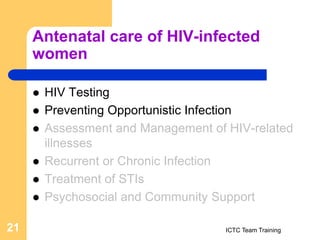
Antenatal care of HIV-infected
women
 HIV Testing
 Preventing Opportunistic Infection
 Assessment and Management of HIV-related
illnesses
 Recurrent or Chronic Infection
 Treatment of STIs
 Psychosocial and Community Support
ICTC Team Training
21
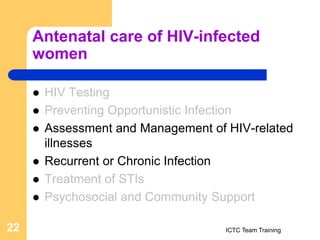
Antenatal care of HIV-infected
women
 HIV Testing
 Preventing Opportunistic Infection
 Assessment and Management of HIV-related
illnesses
 Recurrent or Chronic Infection
 Treatment of STIs
 Psychosocial and Community Support
ICTC Team Training
22
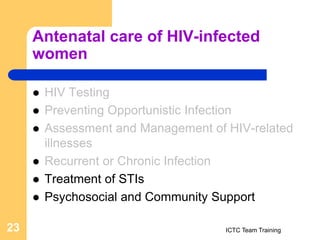
Antenatal care of HIV-infected
women
 HIV Testing
 Preventing Opportunistic Infection
 Assessment and Management of HIV-related
illnesses
 Recurrent or Chronic Infection
 Treatment of STIs
 Psychosocial and Community Support
ICTC Team Training
23
Partner involvement in PPTCT
Counselling should include, where
possible, the male partner of the
pregnant woman in order to
acknowledge his role in protecting
the child.
ICTC Team Training
24
ARV Treatment and Prophylaxis
ARV prophylaxis: drugs to prevent primary
infection in the infant
ARV treatment: drugs to limit the effect of HIV
in the woman.
Prophylaxis does not provide long-term
protection for the infant.
ICTC Team Training
25
NACO recommended regimen for
prophylaxis
 200 mg oral tablet of Nevirapine given
to the mother at the beginning of
labour.
 Newborn babies should receive 2 mg/
kg NVP in suspension within 72 hours
of birth.
ICTC Team Training
26
Management of Labour & Delivery
of Women Infected with HIV
 ARV Prophylaxis
 Universal Precautions
 Minimising Cervical Examinations
 Avoiding Prolonged Labour
 Avoiding Prolonged Membrane Rupture and Routine
Artificial Rupture of Membranes
 Avoiding Unnecessary Trauma during Childbirth
 Minimising the Risk of Postpartum Haemorrhage
 Safe Transfusions
ICTC Team Training
27
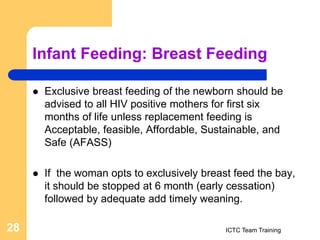
Infant Feeding: Breast Feeding
 Exclusive breast feeding of the newborn should be
advised to all HIV positive mothers for first six
months of life unless replacement feeding is
Acceptable, feasible, Affordable, Sustainable, and
Safe (AFASS)
 If the woman opts to exclusively breast feed the bay,
it should be stopped at 6 month (early cessation)
followed by adequate add timely weaning.
ICTC Team Training
28
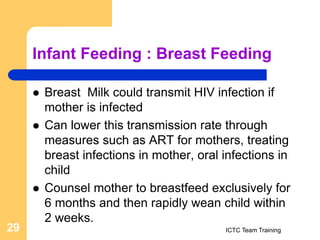
Infant Feeding : Breast Feeding
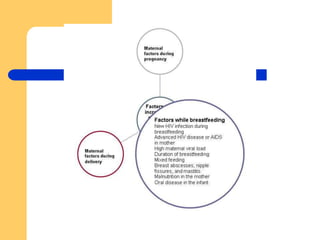
 Breast Milk could transmit HIV infection if
mother is infected
 Can lower this transmission rate through
measures such as ART for mothers, treating
breast infections in mother, oral infections in
child
 Counsel mother to breastfeed exclusively for
6 months and then rapidly wean child within
2 weeks.
ICTC Team Training
29
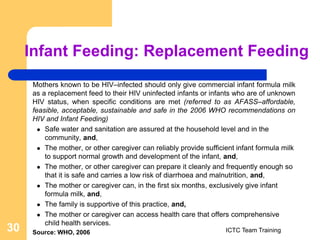
Infant Feeding: Replacement Feeding
Mothers known to be HIV–infected should only give commercial infant formula milk
as a replacement feed to their HIV uninfected infants or infants who are of unknown
HIV status, when specific conditions are met (referred to as AFASS–affordable,
feasible, acceptable, sustainable and safe in the 2006 WHO recommendations on
HIV and Infant Feeding)
 Safe water and sanitation are assured at the household level and in the
community, and,
 The mother, or other caregiver can reliably provide sufficient infant formula milk
to support normal growth and development of the infant, and,
 The mother, or other caregiver can prepare it cleanly and frequently enough so
that it is safe and carries a low risk of diarrhoea and malnutrition, and,
 The mother or caregiver can, in the first six months, exclusively give infant
formula milk, and,
 The family is supportive of this practice, and,
 The mother or caregiver can access health care that offers comprehensive
child health services.
Source: WHO, 2006 ICTC Team Training
30
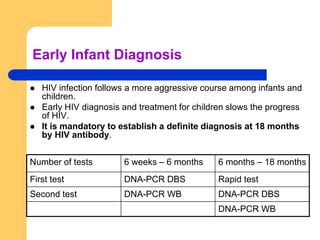
Early Infant Diagnosis
 HIV infection follows a more aggressive course among infants and
children.
 Early HIV diagnosis and treatment for children slows the progress
of HIV.
 It is mandatory to establish a definite diagnosis at 18 months
by HIV antibody.
Number of tests 6 weeks – 6 months 6 months – 18 months
First test DNA-PCR DBS Rapid test
Second test DNA-PCR WB DNA-PCR DBS
DNA-PCR WB
Exposed Baby Care
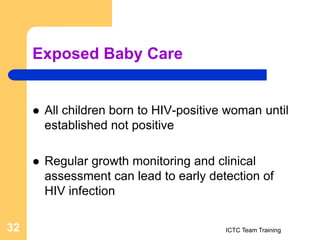
 All children born to HIV-positive woman until
established not positive
 Regular growth monitoring and clinical
assessment can lead to early detection of
HIV infection
ICTC Team Training
32
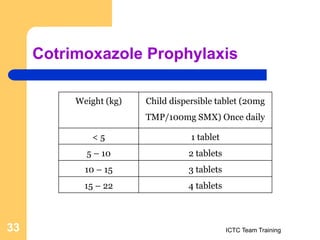
Cotrimoxazole Prophylaxis
ICTC Team Training
33
Weight (kg) Child dispersible tablet (20mg
TMP/100mg SMX) Once daily
< 5 1 tablet
5 – 10 2 tablets
10 – 15 3 tablets
15 – 22 4 tablets
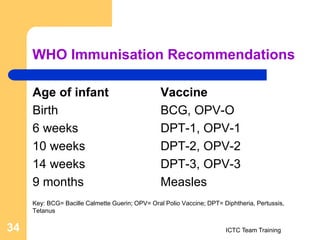
WHO Immunisation Recommendations
Age of infant Vaccine
Birth BCG, OPV-O
6 weeks DPT-1, OPV-1
10 weeks DPT-2, OPV-2
14 weeks DPT-3, OPV-3
9 months Measles
Key: BCG= Bacille Calmette Guerin; OPV= Oral Polio Vaccine; DPT= Diphtheria, Pertussis,
Tetanus
ICTC Team Training
34
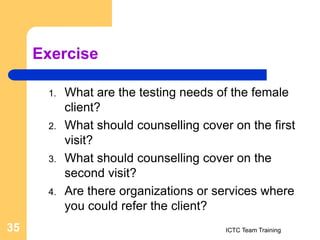
Exercise
1. What are the testing needs of the female
client?
2. What should counselling cover on the first
visit?
3. What should counselling cover on the
second visit?
4. Are there organizations or services where
you could refer the client?
ICTC Team Training
35
ICTC Team Training
36
ICTC Team Training
37
ICTC Team Training
38
ICTC Team Training
39
ICTC Team Training
40
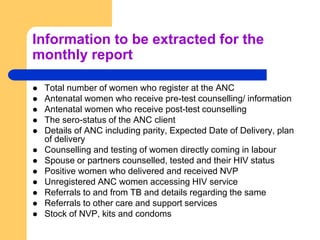
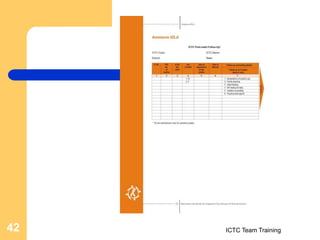
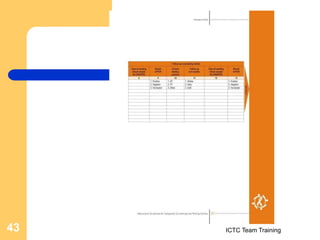
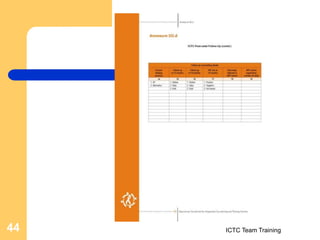
Information to be extracted for the
monthly report
 Total number of women who register at the ANC
 Antenatal women who receive pre-test counselling/ information
 Antenatal women who receive post-test counselling
 The sero-status of the ANC client
 Details of ANC including parity, Expected Date of Delivery, plan
of delivery
 Counselling and testing of women directly coming in labour
 Spouse or partners counselled, tested and their HIV status
 Positive women who delivered and received NVP
 Unregistered ANC women accessing HIV service
 Referrals to and from TB and details regarding the same
 Referrals to other care and support services
 Stock of NVP, kits and condoms
ICTC Team Training
42
ICTC Team Training
43
ICTC Team Training
44

7 PPTCT.ppt

  • 1.
    ICTC Team Training 1 Preventionof Parent to Child Transmission (PPTCT)
  • 2.
    Starter Quiz Exclusive breastfeedingis defined by WHO as giving an infant only breastmilk. The ONLY other things also allowed are  Chocolates  Drops or syrups containing vitamins, mineral supplements, or medicines  Masoor Dal water  Bottle feeds made by companies like Amul and Cerelac ICTC Team Training 2
  • 3.
    Starter Quiz When themother chooses replacement feeds (instead of breastfeeding), all these are good reasons to choose cup feeding over bottle feeding EXCEPT for  Cups are safer because they are easier to clean with soap and water than bottles.  Cups are less likely than bottles to be carried around for a long time, giving bacteria a chance to increase.  Cups come in different designs and colours which can be used to stimulate mental growth in the child.  Cup feeding requires the person feeding the child to hold the child and this increases physical and social contact. ICTC Team Training 3
  • 4.
    Starter Quiz All thefollowing are reasons why a woman infected with HIV/AIDS may choose to breastfeed her newborn child instead of giving a breastmilk substitute. The ONLY EXCEPTION is  To reduce her expenses because replacement feeding is expensive.  To avoid accidentally disclosing her HIV status to others.  To avoid stigma.  To delay accepting her HIV status  To bond with her child physically and socially.  To improve her child’s future job prospects. ICTC Team Training 4
  • 5.
    Starter Quiz Name thetwo tests that can detect HIV infection in an infant:  An HIV antibody test (ELISA or a rapid test) conducted at 3 months after birth  An HIV antibody test (ELISA or a rapid test) conducted at 18 months after birth  An HIV antigen test like the PCR test 6 weeks after birth  A urine test ICTC Team Training 5
  • 6.
    Starter Quiz Maternal factorsthat may increase the risk of HIV transmission during pregnancy include  New HIV infection during pregnancy  Starting a new job during pregnancy  Advanced HIV disease or AIDS in the mother  High maternal viral load  Viral, bacterial, and parasitic infection of the placenta (especially malaria)  Maternal malnutrition (indirect cause)  STIs ICTC Team Training 6
  • 7.
    If 100 HIV-positivewomen give birth to 100 infants, then  5 – 10 of the infants will be infected during pregnancy  10 - 20 will be infected during labour and delivery  20 – 30 will be infected during breastfeeding The total number of children infected is 25 to 40. ICTC Team Training 7
  • 8.
  • 12.
  • 13.
  • 14.
  • 15.
  • 16.
  • 17.
    PPTCT as aCase of Provider- Initiated Testing  ICTC provides opportunity to interact with pregnant patients.  ICTC team to actively generate referrals from private and public maternity services  Educate women about how knowing their HIV status can help  Encourage men to bring their female partners for testing and services ICTC Team Training 17
  • 18.
    Advantages of PPTCT Mother Decreased chance of HIV transmission to her child  Post partum care  Infant feeding support Child  Decreased chance of being infected with HIV  Proper nutritional guidance – breastfeeding vs replacement feeding  Prevention & treatment of OI – Proper immunization – Cotrimoxazole prophylaxis  ART when required ICTC Team Training 18
  • 19.
    Routine Antenatal Care ICTCTeam Training 19  Client history  Physical exam and vital signs  Abdominal exam  Lab diagnostics  Tetanus toxoid immunizations  Nutritional assessment and counselling  STI screening  Anti-malarials  Counselling on infant feeding  Counselling on pregnancy danger signs  Partners and family  Effective contraception plan
  • 20.
    Antenatal care ofHIV-infected women  HIV Testing  Preventing Opportunistic Infection  Assessment and Management of HIV-related illnesses  Recurrent or Chronic Infection  Treatment of STIs  Psychosocial and Community Support ICTC Team Training 20
  • 21.
    Antenatal care ofHIV-infected women  HIV Testing  Preventing Opportunistic Infection  Assessment and Management of HIV-related illnesses  Recurrent or Chronic Infection  Treatment of STIs  Psychosocial and Community Support ICTC Team Training 21
  • 22.
    Antenatal care ofHIV-infected women  HIV Testing  Preventing Opportunistic Infection  Assessment and Management of HIV-related illnesses  Recurrent or Chronic Infection  Treatment of STIs  Psychosocial and Community Support ICTC Team Training 22
  • 23.
    Antenatal care ofHIV-infected women  HIV Testing  Preventing Opportunistic Infection  Assessment and Management of HIV-related illnesses  Recurrent or Chronic Infection  Treatment of STIs  Psychosocial and Community Support ICTC Team Training 23
  • 24.
    Partner involvement inPPTCT Counselling should include, where possible, the male partner of the pregnant woman in order to acknowledge his role in protecting the child. ICTC Team Training 24
  • 25.
    ARV Treatment andProphylaxis ARV prophylaxis: drugs to prevent primary infection in the infant ARV treatment: drugs to limit the effect of HIV in the woman. Prophylaxis does not provide long-term protection for the infant. ICTC Team Training 25
  • 26.
    NACO recommended regimenfor prophylaxis  200 mg oral tablet of Nevirapine given to the mother at the beginning of labour.  Newborn babies should receive 2 mg/ kg NVP in suspension within 72 hours of birth. ICTC Team Training 26
  • 27.
    Management of Labour& Delivery of Women Infected with HIV  ARV Prophylaxis  Universal Precautions  Minimising Cervical Examinations  Avoiding Prolonged Labour  Avoiding Prolonged Membrane Rupture and Routine Artificial Rupture of Membranes  Avoiding Unnecessary Trauma during Childbirth  Minimising the Risk of Postpartum Haemorrhage  Safe Transfusions ICTC Team Training 27
  • 28.
    Infant Feeding: BreastFeeding  Exclusive breast feeding of the newborn should be advised to all HIV positive mothers for first six months of life unless replacement feeding is Acceptable, feasible, Affordable, Sustainable, and Safe (AFASS)  If the woman opts to exclusively breast feed the bay, it should be stopped at 6 month (early cessation) followed by adequate add timely weaning. ICTC Team Training 28
  • 29.
    Infant Feeding :Breast Feeding  Breast Milk could transmit HIV infection if mother is infected  Can lower this transmission rate through measures such as ART for mothers, treating breast infections in mother, oral infections in child  Counsel mother to breastfeed exclusively for 6 months and then rapidly wean child within 2 weeks. ICTC Team Training 29
  • 30.
    Infant Feeding: ReplacementFeeding Mothers known to be HIV–infected should only give commercial infant formula milk as a replacement feed to their HIV uninfected infants or infants who are of unknown HIV status, when specific conditions are met (referred to as AFASS–affordable, feasible, acceptable, sustainable and safe in the 2006 WHO recommendations on HIV and Infant Feeding)  Safe water and sanitation are assured at the household level and in the community, and,  The mother, or other caregiver can reliably provide sufficient infant formula milk to support normal growth and development of the infant, and,  The mother, or other caregiver can prepare it cleanly and frequently enough so that it is safe and carries a low risk of diarrhoea and malnutrition, and,  The mother or caregiver can, in the first six months, exclusively give infant formula milk, and,  The family is supportive of this practice, and,  The mother or caregiver can access health care that offers comprehensive child health services. Source: WHO, 2006 ICTC Team Training 30
  • 31.
    Early Infant Diagnosis HIV infection follows a more aggressive course among infants and children.  Early HIV diagnosis and treatment for children slows the progress of HIV.  It is mandatory to establish a definite diagnosis at 18 months by HIV antibody. Number of tests 6 weeks – 6 months 6 months – 18 months First test DNA-PCR DBS Rapid test Second test DNA-PCR WB DNA-PCR DBS DNA-PCR WB
  • 32.
    Exposed Baby Care All children born to HIV-positive woman until established not positive  Regular growth monitoring and clinical assessment can lead to early detection of HIV infection ICTC Team Training 32
  • 33.
    Cotrimoxazole Prophylaxis ICTC TeamTraining 33 Weight (kg) Child dispersible tablet (20mg TMP/100mg SMX) Once daily < 5 1 tablet 5 – 10 2 tablets 10 – 15 3 tablets 15 – 22 4 tablets
  • 34.
    WHO Immunisation Recommendations Ageof infant Vaccine Birth BCG, OPV-O 6 weeks DPT-1, OPV-1 10 weeks DPT-2, OPV-2 14 weeks DPT-3, OPV-3 9 months Measles Key: BCG= Bacille Calmette Guerin; OPV= Oral Polio Vaccine; DPT= Diphtheria, Pertussis, Tetanus ICTC Team Training 34
  • 35.
    Exercise 1. What arethe testing needs of the female client? 2. What should counselling cover on the first visit? 3. What should counselling cover on the second visit? 4. Are there organizations or services where you could refer the client? ICTC Team Training 35
  • 36.
  • 37.
  • 38.
  • 39.
  • 40.
  • 41.
    Information to beextracted for the monthly report  Total number of women who register at the ANC  Antenatal women who receive pre-test counselling/ information  Antenatal women who receive post-test counselling  The sero-status of the ANC client  Details of ANC including parity, Expected Date of Delivery, plan of delivery  Counselling and testing of women directly coming in labour  Spouse or partners counselled, tested and their HIV status  Positive women who delivered and received NVP  Unregistered ANC women accessing HIV service  Referrals to and from TB and details regarding the same  Referrals to other care and support services  Stock of NVP, kits and condoms
  • 42.
  • 43.
  • 44.