1. Amir Hazzri Bin Jamaludin AC090734
2. Mohammad Mustaqim Bin Zainal Abidin AC091285
3. Nabilatul Husna Bt Hamid Khan AC090715
4. Nurul Nabila Izzaty Bt Adnan AC090678
Audit committee
Audit committee
What is audit?
The primary purpose of an audit of a financial
report is to express an opinion on whether the
financial report is prepared, in all materials
respects, in accordance with an identified
financial reporting framework.
iNtRoductioN
Legal framework of auditing ;
The roles and responsibilities of auditors, and their
relationship with other corporate participants, such as
directors & shareholders are governed mainly by company
law.
The Malaysian Accounting Standards Board (MASB) :-
• Established under the Financial Reporting Act 1971, as an
independent authority to develop and issue financial
reporting standards in Malaysia.
Functions :-
•Set up to improve and tighten accounting standards to
give these standards the force law .
• To facilitate enforcement of these standards through
companies.
The Audit Oversight Board (AOB) :-
• Established under part III of Securities Commission Act
1993, Commenced in April 2010.
•Function:-
1) to assist the Securities Commission in overseeing the
auditors of public interest entities.
standards.
2) to protect the interest of investors by promoting
confidence in the quality and reliability of audited
financial statement of public interest entities, by
•Registering auditors of public interest entities
•Conducting inspections and monitoring programs
on registered auditors to assess the extent of their
compliance with recognized auditing ethical
ScoPe oF WoRK
To obtain audit evidence about the amounts
and disclosure in the financial statements.
Evaluating the appropriateness of accounting
policies used and the reasonableness of
accounting estimates made by the director as
well as evaluating the overall presentation of
the financial statements.
Qualification of auditor
(1) Must be approved as a
company auditor by the
Minister of Finance
according to Sec. 9(1) of CA.
(2) Good character
and competent to
perform duties of
an auditor.
(3) Must register as a
public accountant with the
MIA , under the
Accountant Act 1967, be at
least 21 years old &
considered fit and proper
person.
(4) Must not be closely
related to the company, nor
can be in a position where
officers of the company can
have influence on him.
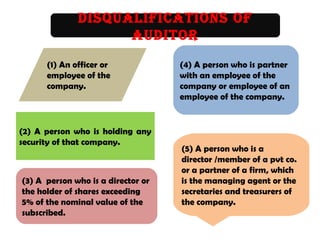
An auditor preparing for a company any report required
to be prepared by an approved company auditor, unless
if he falls within any of the following categories :
disQualifications of
auditor
(4) A person who is partner
with an employee of the
company or employee of an
employee of the company.
(1) An officer or
employee of the
company.
(5) A person who is a
director /member of a pvt co.
or a partner of a firm, which
is the managing agent or the
secretaries and treasurers of
the company.
(2) A person who is holding any
security of that company.
(3) A person who is a director or
the holder of shares exceeding
5% of the nominal value of the
subscribed.
aPPointMEnt of auditor
Appointment
by Company
Appointment
by Directors
Appointment
by Registrar
APPOINTMENT BY COMPANY
The general rule is that, the company by
means of a resolution of its members is
required to appoint an auditor of each annual
general meeting under Section 172 (1) of the
Act.
APPOINTMENT BY DIRECTORS
•To appoint the first auditor for the company
[Section 171(1) CA]
•To fill any casual vacancy in the office of an
auditor. Failing such as an appointment, the
surviving or continuing auditors, if any, may
act [Sec 171(3) CA]
APPOINTMENT BY REGISTRAR
•Where an auditor of a company has been
removed from office, and the company has not
appointed another auditor [Sec 172(8) CA]
•To act on a written application of a member
where the directors of the company fail to
appoint an auditor [Sec 172(10) of the Act]
TERMINATION OF AUDITOR
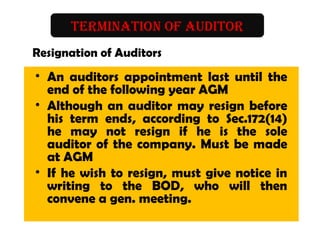
Resignation of Auditors
• An auditors appointment last until the
end of the following year AGM
• Although an auditor may resign before
his term ends, according to Sec.172(14)
he may not resign if he is the sole
auditor of the company. Must be made
at AGM
• If he wish to resign, must give notice in
writing to the BOD, who will then
convene a gen. meeting.
TERMINATION OF AUDITOR
Removal of Auditors
• Sec. 172(4) an auditor may not be removed except
by ordinary resolution at a gen. meeting where
special notice (at least 28 days) have been given.
• The co. is required to send notice to auditor and
Registrar of Co. as soon as they receive it.
• Within 7 days after receipt of the notice, make
explanation in writing to the company.
• He can then may request the company to send
copies of his explanation to all members entitled to
attend the gen. meeting.
• At the meeting, he may request for his explanation
to be read & may speak to defend himself.
• Sec 127(7) – When an auditor has been removed,
another auditor appointed at a gen meeting may
replace him.
• The appointment of new auditor must be made by
a resolution passed by a majority of not less than ¾
of the members of the company who are entitled to
vote (in person or by proxy).
• If the company does not appoint another auditor,
the Registrar of the Co is empowered to appoint for
the company. [Sec.172(8)]
DUTIES & RESPONSIBILITIES
DUTy TO ThE ShAREhOLDER
The auditor is regarded as agents of shareholders rather
than as agents of the directors.
Re London and General Bank
•Auditors are to be appointed by the shareholder and
are to report to the, directly and not to or through the
director.
• This was to ensure that the shareholders received
independent and reliable information respecting the
true financial position of the company at the time the
audit was concluded.
Duty to the company
The auditor owe fiduciary duty to the company to treat
any information and trade secrets acquired by him in the
course of his professional work as confidential.
Auditor are in contractual relationship with the
company and on the basis of ordinary principles of
contract law, can be liable to the company if they fail
to honour the term of the contract.
Duty of care anD skill
•The auditor should not put himself in a position of
conflict.
•An auditor must exhibit in carrying out his task is that
an ordinary auditor.
Patric Tay V Public Accountant Board
Held : That a failure to follow prescribe statement of
accounting guidelines could amount to professional
misconduct.
Duty to thirD party
Common law has established that an auditor may in
stipulated circumstances be liable to third parties.
Caparo Industries Plc V Dickman
•Perhaps the locus classicus for this principle in so far as
the duty owed by auditor is concerned.
•The Caparo case decided that to establish liability, it
had to be shown there was foresee ability of loss and
damage and that justice and reasonableness require
that liability be found.
Duty to the trustee for Debentures
•The auditor is obliged by the provisions of the CA/by the
debenture/ trust deed to furnish the corporation with
specified report, certificates or documents.
•Within 7 days after furnishing, auditor is obliged to post
a copy of the report, cert / doc to every trustee for the
deb. holder. [sec 175(1)]
Law Society V KPMG Peat Marwick
Held : If a negligent breach of duty to a trustee causes
damage both to the trustee in his personal capacity and
to the trust property, the trustee can claim on both his
own and on the beneficiary’s account
Duty of confiDentially
ii) In accordance with the provision of any written law or
where the disclosure is compelled by the process of law or
by competent authority
i) For the purpose of discharging duties to the company
iii) Where disclosure is reasonable necessary to protect
the auditor’s interest. For example, to defend an action
off negligent or to defend disciplinary action by the
accountant’s professional body.
thank
you

Audit committee

  • 1.
    1. Amir HazzriBin Jamaludin AC090734 2. Mohammad Mustaqim Bin Zainal Abidin AC091285 3. Nabilatul Husna Bt Hamid Khan AC090715 4. Nurul Nabila Izzaty Bt Adnan AC090678 Audit committee
  • 2.
  • 3.
    What is audit? Theprimary purpose of an audit of a financial report is to express an opinion on whether the financial report is prepared, in all materials respects, in accordance with an identified financial reporting framework. iNtRoductioN Legal framework of auditing ; The roles and responsibilities of auditors, and their relationship with other corporate participants, such as directors & shareholders are governed mainly by company law.
  • 4.
    The Malaysian AccountingStandards Board (MASB) :- • Established under the Financial Reporting Act 1971, as an independent authority to develop and issue financial reporting standards in Malaysia. Functions :- •Set up to improve and tighten accounting standards to give these standards the force law . • To facilitate enforcement of these standards through companies.
  • 5.
    The Audit OversightBoard (AOB) :- • Established under part III of Securities Commission Act 1993, Commenced in April 2010. •Function:- 1) to assist the Securities Commission in overseeing the auditors of public interest entities. standards. 2) to protect the interest of investors by promoting confidence in the quality and reliability of audited financial statement of public interest entities, by •Registering auditors of public interest entities •Conducting inspections and monitoring programs on registered auditors to assess the extent of their compliance with recognized auditing ethical
  • 6.
    ScoPe oF WoRK Toobtain audit evidence about the amounts and disclosure in the financial statements. Evaluating the appropriateness of accounting policies used and the reasonableness of accounting estimates made by the director as well as evaluating the overall presentation of the financial statements.
  • 7.
    Qualification of auditor (1)Must be approved as a company auditor by the Minister of Finance according to Sec. 9(1) of CA. (2) Good character and competent to perform duties of an auditor. (3) Must register as a public accountant with the MIA , under the Accountant Act 1967, be at least 21 years old & considered fit and proper person. (4) Must not be closely related to the company, nor can be in a position where officers of the company can have influence on him.
  • 8.
    An auditor preparingfor a company any report required to be prepared by an approved company auditor, unless if he falls within any of the following categories :
  • 9.
    disQualifications of auditor (4) Aperson who is partner with an employee of the company or employee of an employee of the company. (1) An officer or employee of the company. (5) A person who is a director /member of a pvt co. or a partner of a firm, which is the managing agent or the secretaries and treasurers of the company. (2) A person who is holding any security of that company. (3) A person who is a director or the holder of shares exceeding 5% of the nominal value of the subscribed.
  • 10.
    aPPointMEnt of auditor Appointment byCompany Appointment by Directors Appointment by Registrar
  • 11.
    APPOINTMENT BY COMPANY Thegeneral rule is that, the company by means of a resolution of its members is required to appoint an auditor of each annual general meeting under Section 172 (1) of the Act.
  • 12.
    APPOINTMENT BY DIRECTORS •Toappoint the first auditor for the company [Section 171(1) CA] •To fill any casual vacancy in the office of an auditor. Failing such as an appointment, the surviving or continuing auditors, if any, may act [Sec 171(3) CA]
  • 13.
    APPOINTMENT BY REGISTRAR •Wherean auditor of a company has been removed from office, and the company has not appointed another auditor [Sec 172(8) CA] •To act on a written application of a member where the directors of the company fail to appoint an auditor [Sec 172(10) of the Act]
  • 14.
    TERMINATION OF AUDITOR Resignationof Auditors • An auditors appointment last until the end of the following year AGM • Although an auditor may resign before his term ends, according to Sec.172(14) he may not resign if he is the sole auditor of the company. Must be made at AGM • If he wish to resign, must give notice in writing to the BOD, who will then convene a gen. meeting.
  • 15.
    TERMINATION OF AUDITOR Removalof Auditors • Sec. 172(4) an auditor may not be removed except by ordinary resolution at a gen. meeting where special notice (at least 28 days) have been given. • The co. is required to send notice to auditor and Registrar of Co. as soon as they receive it. • Within 7 days after receipt of the notice, make explanation in writing to the company. • He can then may request the company to send copies of his explanation to all members entitled to attend the gen. meeting.
  • 16.
    • At themeeting, he may request for his explanation to be read & may speak to defend himself. • Sec 127(7) – When an auditor has been removed, another auditor appointed at a gen meeting may replace him. • The appointment of new auditor must be made by a resolution passed by a majority of not less than ¾ of the members of the company who are entitled to vote (in person or by proxy). • If the company does not appoint another auditor, the Registrar of the Co is empowered to appoint for the company. [Sec.172(8)]
  • 17.
  • 18.
    DUTy TO ThEShAREhOLDER The auditor is regarded as agents of shareholders rather than as agents of the directors. Re London and General Bank •Auditors are to be appointed by the shareholder and are to report to the, directly and not to or through the director. • This was to ensure that the shareholders received independent and reliable information respecting the true financial position of the company at the time the audit was concluded.
  • 19.
    Duty to thecompany The auditor owe fiduciary duty to the company to treat any information and trade secrets acquired by him in the course of his professional work as confidential. Auditor are in contractual relationship with the company and on the basis of ordinary principles of contract law, can be liable to the company if they fail to honour the term of the contract.
  • 20.
    Duty of careanD skill •The auditor should not put himself in a position of conflict. •An auditor must exhibit in carrying out his task is that an ordinary auditor. Patric Tay V Public Accountant Board Held : That a failure to follow prescribe statement of accounting guidelines could amount to professional misconduct.
  • 21.
    Duty to thirDparty Common law has established that an auditor may in stipulated circumstances be liable to third parties. Caparo Industries Plc V Dickman •Perhaps the locus classicus for this principle in so far as the duty owed by auditor is concerned. •The Caparo case decided that to establish liability, it had to be shown there was foresee ability of loss and damage and that justice and reasonableness require that liability be found.
  • 22.
    Duty to thetrustee for Debentures •The auditor is obliged by the provisions of the CA/by the debenture/ trust deed to furnish the corporation with specified report, certificates or documents. •Within 7 days after furnishing, auditor is obliged to post a copy of the report, cert / doc to every trustee for the deb. holder. [sec 175(1)] Law Society V KPMG Peat Marwick Held : If a negligent breach of duty to a trustee causes damage both to the trustee in his personal capacity and to the trust property, the trustee can claim on both his own and on the beneficiary’s account
  • 23.
    Duty of confiDentially ii)In accordance with the provision of any written law or where the disclosure is compelled by the process of law or by competent authority i) For the purpose of discharging duties to the company iii) Where disclosure is reasonable necessary to protect the auditor’s interest. For example, to defend an action off negligent or to defend disciplinary action by the accountant’s professional body.
  • 24.