INTERPERSONAL RELATIONS
N SHESHA PRASAD
PGT ENGLISH
KVAFS BEGUMPET
KVAFS BEGUMPET
What does the term INTERPERSONAL RELATIONSHIP mean?
An interpersonal relationship is an association between
two or more people that may range from fleeting to
enduring.
This association may be based on inference, love,
solidarity, regular business interactions, or some other type
of social commitment.
Interpersonal relationships are formed in the context of
social, cultural and other influences. The context can vary
from family or kinship relations, friendship, marriage,
relations with associates, work, clubs, neighborhoods, and
places of worship.
They may be regulated by law, custom, or mutual
agreement, and are the basis of social groups and society
as a whole.
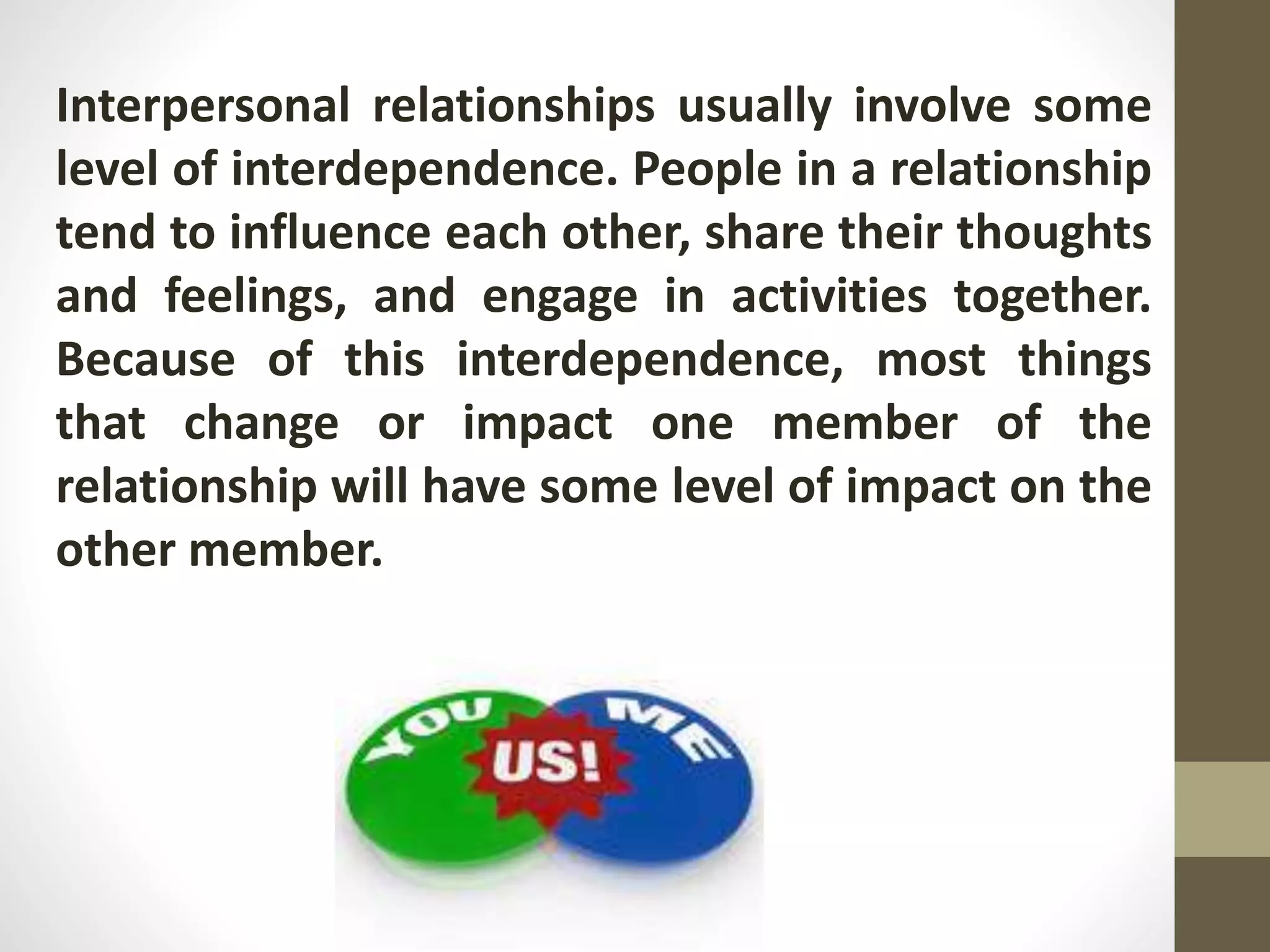
Interpersonal relationships usually involve some
level of interdependence. People in a relationship
tend to influence each other, share their thoughts
and feelings, and engage in activities together.
Because of this interdependence, most things
that change or impact one member of the
relationship will have some level of impact on the
other member.
 Individuals in an interpersonal relationship must share
common goals and objectives. They should have more or less
similar interests and think on the same lines. It is always
better if individuals come from similar backgrounds.
 Individuals in an interpersonal relationship must respect
each other’s views and opinions. A sense of trust is
important.
 Individuals must be attached to each other for a healthy
interpersonal relationship.
 Transparency plays a pivotal role in interpersonal
relationship. It is important for an individual to be honest
and transparent.
In an Interpersonal Relationship
INDIVIDUAL
NEIGHBOURHOOD
FAMILY
FRIENDS
BOSS
COLLEAGUESSUBORDINATES
LESS PRIVILEGED
RELATIVES
TYPES OF INTERPERSONAL RELATIONSHIPS
Relationships are like bank accounts: the more we deposit
the greater they become; therefore, the more we can draw
from them..
The consequences of poor depositing in interpersonal
relationships leads to stress, lack of communication,
suspicion, isolation, prejudice, conflict, frustration, lack of
sympathy and empathy, poor health and so on..
The common element of all close relationships is
interdependence, an interpersonal association in which two
people consistently and reciprocally influence one another’s
lives, focus their thoughts and emotions on one another, and
if possible, regularly engage in joint activities..
Such interdependence occurs across age groups and among
individuals representing many quite different relationships..
COMPONENTS
OF
INTERPERSONAL
RELATIONSHIPS
It is the ability to feel with others in
social situations, which can lead to the
development of good Interpersonal
relationships.
Empathy
It is the ability to feel for others in social
situations which can lead to the development
of good Interpersonal relationships
Sympathy
It is the ability to be sensitive to the feelings,
emotions and needs of others in social situation,
which can lead to the development of good
Interpersonal relationships.
Sensitivity
It is the ability to endure and respect feelings,
views, attitudes etc., of others in Interpersonal
interactions irrespective of our agreement or
disagreement on them.
Tolerance
TRUST
An essential factor to strengthen any
and every relationship.
It is the ability to see the positive aspects in
others and appreciate them in Interpersonal
relationships.
Positive Attitude
It is the ability to accept the others with their
strengths and weaknesses, without showing any
personal bias or prejudice to Interpersonal
relationships..
Accepting Others
It is the ability to demonstrate a healthy
attitude of give and take in social situation with
others while interacting..
Sharing
It is the ability to show behaviour that is appropriate
to different social situations, which can earn respect
and facilitate good Interpersonal relationships..
Etiquette
Healthy Distance: is the ability to take only that much
of liberty as the relationship empowers and demands
and not misuse the liberty between any two
individuals in any social situations..
Prejudice and Stereotyping: is the ability to interact
with people without being governed by preconceived
notions about individuals groups in any social
situation.
Effective Communication: is the ability to express the
thoughts and feelings in non-threatening ways.
How do we
strengthen
relationships?
Identify, value,andStrengthenyourInterpersonalRelations.
Identify:
Everyone needs to decide what's important to them. Define the value that you are
looking for in a relationship. This will change during different stages of our lives.
Invest:
Make a conscious effort to invest the time into the value you have defined.
Develop, strengthen, and maintain the work relations, personal relations, and
family relations that are important to you.
Contribute:
Contribute value to your relations that are valuable to you. Relationships are
mutually beneficial. Unless both parties are creating value, there really is no point
spending your valuable time. Work relations, personal relations, and family
relations have needs. Find out what they are, and contribute the value you have.
Taking without giving is an unhealthy relationship doomed for failure. Use
your interpersonal skills and effective interpersonal communicaton to find out
what is important to the relationships that are important to you. If you contribute,
you will receive the value important to you.
Follow Up:
Follow up with the relationships you identify as bringing value to your
life. Spend the time and effort to communicate often, identify needs,
and bring value where you can. Following up often in your work
relations, personal relations, and family relations where you have
identified value will start devoting your time where there is value. You
will no longer have time to devote to unhealthy relations, and you will
see added value surface in your life.
A person can have many relationships at work, in their personal life,
and family life. Interpersonal relations is where the work is done,
enjoyment comes from, and value is created. Identiy what is important
to you and seek out those relationships. Invest the time and effort to
strengthen and maintain them. Contribute value to the relationships
you pursue. Follow up with the needs of the individuals that bring
value to you. If you do, you will add value to your interpersonal life.
SOME CHERISHED
RELATIONSHIPS
OF INDIAN
CULTURE
The dutiful son who carted his parents everywhere on his
shoulders - a son to be proud of! Shantvan Kumar and Gyanvati’s
joy and pride
PARENT-CHILD
Shravan Kumar
An ideal Friendship that remained unaffected by wealth,
power, distance and time
FRIENDS
Shri Krishna Sudama
Eklavya epitomised the student teacher relationship
with his supreme sacrifice. A Student that every
Teacher dreams of
TEACHER-STUDENT GURU- SHISHYA
The ultimate saga of every married couple is to
attain the heights that Savitri Satyavan reached
HUSBAND-WIFE
An exemplary relationship in which supreme sacrifice,
empathy, mutual trust and togetherness created the
right essence of marriage
Dritarashtra and Gandhari:
MASTER-FOLLOWER
A saga of true devotion and loyalty that is rare to find
FACTORS THAT
RUIN
RELATIONSHIPS
EGO
The ego, the feeling of self importance, “The I Feeling” in
any of the partners often hurts the emotions resulting in
the weakening of relationships.
POWER
The acquisition of any kind of power like financial, political
or emotional gives rise to the feelings of superiority in the
“Haves” and of inferiority in the “Have Nots” which may
have a detrimental effect on a relationship.
External Influence
Sometimes the interference of mischief makers leads to
misunderstandings between the two people involved and
the relations turn sour
distance
When people are separated by large distances, the
attraction and strength of the relationship gets dull and the
relationship dies a natural death.
time
Time is a termite that eats away many relationships and the
people involved slowly drift away from each other.
differences
Too many differences like, political, religious, different
views have an adverse effect on the relationship and
prevent two people from getting close or the relationship
from flourishing
jealousy
A relationship has no future if one person is jealous of the
other’s position, success or happiness.
Competition
Competition is like an acid. It eats away the strongest of
strong relationships.
Basicnature of people
Relationships are also affected by basic nature of the
people involved like lack of confidence in the other
person, doubts, lack of understanding e.t.c.
STRENGTHENING
RELATIONSHIPS
THROUGH SPECIAL DAYS
Rakshabandhan
A day to express the love and affection that we have
for our sisters
Bhai dooj
A day to cherish the care and protection that our brothers give us
Mothers’ day
A day to acknowledge the supreme sacrifices that our
mothers make for us and the unfathomable love that
they shower on us
Fathers’ day
The perfect time to convey our appreciation of
our pillars of strength- our fathers.
Children’s Day
The pride and joy of our lives- A day to tell them
how colourless and empty our lives are without
them
Teachers’ day
The ideal day to thank our teachers for their knowledge
and guidance
Labour day/ may day
Need we say any more to emphasise on the
importance of celebrating labour day?
Friendship day
A day to value and strengthen the most meaningful
relationship in the world
acknowledgements
 Google
 Wikipedia
Interpersonal relationships

Interpersonal relationships

  • 1.
    INTERPERSONAL RELATIONS N SHESHAPRASAD PGT ENGLISH KVAFS BEGUMPET KVAFS BEGUMPET
  • 2.
    What does theterm INTERPERSONAL RELATIONSHIP mean? An interpersonal relationship is an association between two or more people that may range from fleeting to enduring. This association may be based on inference, love, solidarity, regular business interactions, or some other type of social commitment. Interpersonal relationships are formed in the context of social, cultural and other influences. The context can vary from family or kinship relations, friendship, marriage, relations with associates, work, clubs, neighborhoods, and places of worship. They may be regulated by law, custom, or mutual agreement, and are the basis of social groups and society as a whole.
  • 3.
    Interpersonal relationships usuallyinvolve some level of interdependence. People in a relationship tend to influence each other, share their thoughts and feelings, and engage in activities together. Because of this interdependence, most things that change or impact one member of the relationship will have some level of impact on the other member.
  • 4.
     Individuals inan interpersonal relationship must share common goals and objectives. They should have more or less similar interests and think on the same lines. It is always better if individuals come from similar backgrounds.  Individuals in an interpersonal relationship must respect each other’s views and opinions. A sense of trust is important.  Individuals must be attached to each other for a healthy interpersonal relationship.  Transparency plays a pivotal role in interpersonal relationship. It is important for an individual to be honest and transparent. In an Interpersonal Relationship
  • 5.
  • 6.
    Relationships are likebank accounts: the more we deposit the greater they become; therefore, the more we can draw from them.. The consequences of poor depositing in interpersonal relationships leads to stress, lack of communication, suspicion, isolation, prejudice, conflict, frustration, lack of sympathy and empathy, poor health and so on..
  • 7.
    The common elementof all close relationships is interdependence, an interpersonal association in which two people consistently and reciprocally influence one another’s lives, focus their thoughts and emotions on one another, and if possible, regularly engage in joint activities.. Such interdependence occurs across age groups and among individuals representing many quite different relationships..
  • 8.
  • 9.
    It is theability to feel with others in social situations, which can lead to the development of good Interpersonal relationships. Empathy
  • 10.
    It is theability to feel for others in social situations which can lead to the development of good Interpersonal relationships Sympathy
  • 11.
    It is theability to be sensitive to the feelings, emotions and needs of others in social situation, which can lead to the development of good Interpersonal relationships. Sensitivity
  • 12.
    It is theability to endure and respect feelings, views, attitudes etc., of others in Interpersonal interactions irrespective of our agreement or disagreement on them. Tolerance
  • 13.
    TRUST An essential factorto strengthen any and every relationship.
  • 14.
    It is theability to see the positive aspects in others and appreciate them in Interpersonal relationships. Positive Attitude
  • 15.
    It is theability to accept the others with their strengths and weaknesses, without showing any personal bias or prejudice to Interpersonal relationships.. Accepting Others
  • 16.
    It is theability to demonstrate a healthy attitude of give and take in social situation with others while interacting.. Sharing
  • 17.
    It is theability to show behaviour that is appropriate to different social situations, which can earn respect and facilitate good Interpersonal relationships.. Etiquette
  • 18.
    Healthy Distance: isthe ability to take only that much of liberty as the relationship empowers and demands and not misuse the liberty between any two individuals in any social situations.. Prejudice and Stereotyping: is the ability to interact with people without being governed by preconceived notions about individuals groups in any social situation. Effective Communication: is the ability to express the thoughts and feelings in non-threatening ways.
  • 19.
  • 20.
    Identify, value,andStrengthenyourInterpersonalRelations. Identify: Everyone needsto decide what's important to them. Define the value that you are looking for in a relationship. This will change during different stages of our lives. Invest: Make a conscious effort to invest the time into the value you have defined. Develop, strengthen, and maintain the work relations, personal relations, and family relations that are important to you. Contribute: Contribute value to your relations that are valuable to you. Relationships are mutually beneficial. Unless both parties are creating value, there really is no point spending your valuable time. Work relations, personal relations, and family relations have needs. Find out what they are, and contribute the value you have. Taking without giving is an unhealthy relationship doomed for failure. Use your interpersonal skills and effective interpersonal communicaton to find out what is important to the relationships that are important to you. If you contribute, you will receive the value important to you.
  • 21.
    Follow Up: Follow upwith the relationships you identify as bringing value to your life. Spend the time and effort to communicate often, identify needs, and bring value where you can. Following up often in your work relations, personal relations, and family relations where you have identified value will start devoting your time where there is value. You will no longer have time to devote to unhealthy relations, and you will see added value surface in your life. A person can have many relationships at work, in their personal life, and family life. Interpersonal relations is where the work is done, enjoyment comes from, and value is created. Identiy what is important to you and seek out those relationships. Invest the time and effort to strengthen and maintain them. Contribute value to the relationships you pursue. Follow up with the needs of the individuals that bring value to you. If you do, you will add value to your interpersonal life.
  • 22.
  • 23.
    The dutiful sonwho carted his parents everywhere on his shoulders - a son to be proud of! Shantvan Kumar and Gyanvati’s joy and pride PARENT-CHILD Shravan Kumar
  • 24.
    An ideal Friendshipthat remained unaffected by wealth, power, distance and time FRIENDS Shri Krishna Sudama
  • 25.
    Eklavya epitomised thestudent teacher relationship with his supreme sacrifice. A Student that every Teacher dreams of TEACHER-STUDENT GURU- SHISHYA
  • 26.
    The ultimate sagaof every married couple is to attain the heights that Savitri Satyavan reached HUSBAND-WIFE
  • 27.
    An exemplary relationshipin which supreme sacrifice, empathy, mutual trust and togetherness created the right essence of marriage Dritarashtra and Gandhari:
  • 28.
    MASTER-FOLLOWER A saga oftrue devotion and loyalty that is rare to find
  • 29.
  • 30.
    EGO The ego, thefeeling of self importance, “The I Feeling” in any of the partners often hurts the emotions resulting in the weakening of relationships. POWER The acquisition of any kind of power like financial, political or emotional gives rise to the feelings of superiority in the “Haves” and of inferiority in the “Have Nots” which may have a detrimental effect on a relationship. External Influence Sometimes the interference of mischief makers leads to misunderstandings between the two people involved and the relations turn sour
  • 31.
    distance When people areseparated by large distances, the attraction and strength of the relationship gets dull and the relationship dies a natural death. time Time is a termite that eats away many relationships and the people involved slowly drift away from each other. differences Too many differences like, political, religious, different views have an adverse effect on the relationship and prevent two people from getting close or the relationship from flourishing
  • 32.
    jealousy A relationship hasno future if one person is jealous of the other’s position, success or happiness. Competition Competition is like an acid. It eats away the strongest of strong relationships. Basicnature of people Relationships are also affected by basic nature of the people involved like lack of confidence in the other person, doubts, lack of understanding e.t.c.
  • 33.
  • 34.
    Rakshabandhan A day toexpress the love and affection that we have for our sisters
  • 35.
    Bhai dooj A dayto cherish the care and protection that our brothers give us
  • 36.
    Mothers’ day A dayto acknowledge the supreme sacrifices that our mothers make for us and the unfathomable love that they shower on us
  • 37.
    Fathers’ day The perfecttime to convey our appreciation of our pillars of strength- our fathers.
  • 38.
    Children’s Day The prideand joy of our lives- A day to tell them how colourless and empty our lives are without them
  • 39.
    Teachers’ day The idealday to thank our teachers for their knowledge and guidance
  • 40.
    Labour day/ mayday Need we say any more to emphasise on the importance of celebrating labour day?
  • 41.
    Friendship day A dayto value and strengthen the most meaningful relationship in the world
  • 42.