www.england.nhs.uk
Dynamic registers
November 2016
www.england.nhs.uk
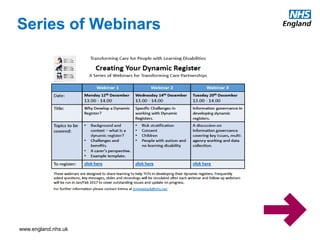
Series of Webinars
www.england.nhs.uk
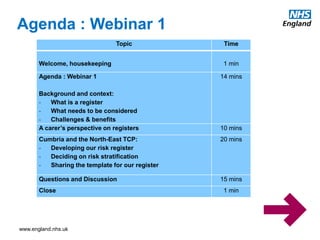
Topic Time
Welcome, housekeeping 1 min
Agenda : Webinar 1
Background and context:
- What is a register
- What needs to be considered
- Challenges & benefits
14 mins
A carer’s perspective on registers 10 mins
Cumbria and the North-East TCP:
- Developing our risk register
- Deciding on risk stratification
- Sharing the template for our register
20 mins
Questions and Discussion 15 mins
Close 1 min
Agenda : Webinar 1
www.england.nhs.uk
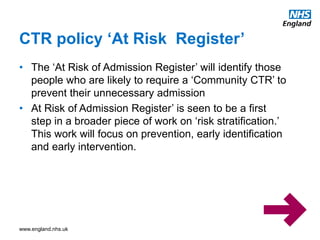
CTR policy ‘At Risk Register’
• The ‘At Risk of Admission Register’ will identify those
people who are likely to require a ‘Community CTR’ to
prevent their unnecessary admission
• At Risk of Admission Register’ is seen to be a first
step in a broader piece of work on ‘risk stratification.’
This work will focus on prevention, early identification
and early intervention.
www.england.nhs.uk
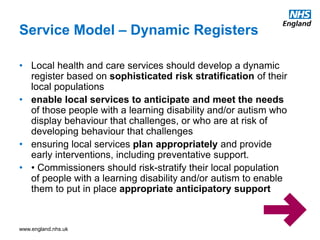
Service Model – Dynamic Registers
• Local health and care services should develop a dynamic
register based on sophisticated risk stratification of their
local populations
• enable local services to anticipate and meet the needs
of those people with a learning disability and/or autism who
display behaviour that challenges, or who are at risk of
developing behaviour that challenges
• ensuring local services plan appropriately and provide
early interventions, including preventative support.
• • Commissioners should risk-stratify their local population
of people with a learning disability and/or autism to enable
them to put in place appropriate anticipatory support
www.england.nhs.uk
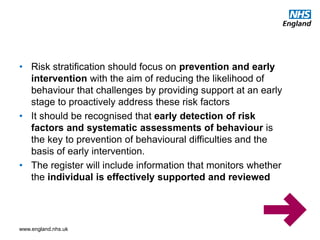
• Risk stratification should focus on prevention and early
intervention with the aim of reducing the likelihood of
behaviour that challenges by providing support at an early
stage to proactively address these risk factors
• It should be recognised that early detection of risk
factors and systematic assessments of behaviour is
the key to prevention of behavioural difficulties and the
basis of early intervention.
• The register will include information that monitors whether
the individual is effectively supported and reviewed
www.england.nhs.uk
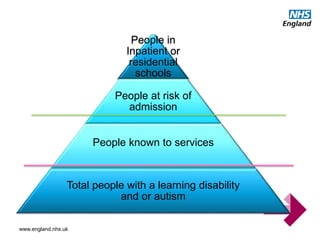
People in
Inpatient or
residential
schools
People at risk of
admission
People known to services
Total people with a learning disability
and or autism
www.england.nhs.uk
Some of the key points made in the
2007 Mansell Report:
• Good practice is fragile, and it is not sensible to plan on the basis
that challenging behaviour can be readily ‘fixed.’
• The potential for challenging behaviour exists for many service
users in many situations; and the problem of behaviour that
challenge is not likely to go away.
• The implication is, that the appropriate goal of learning disability
services is to support the individual in achieving as good a
quality of life as possible in spite of their problems.
• In practice, challenging behaviour will be an enduring
characteristic of the lives of many service users.
• There will always be a large pool of people who present some
challenging behaviour, which can be made better or worse
depending on how well services support them
www.england.nhs.uk
• It is important to remember that challenging behaviour
is merely a label given to a behaviour on the basis of
its perceived consequences i.e. it places someone at
risk of harm, or risk social exclusion.
• As such ‘challenging behaviour’ is a label attached to
a social interaction or exchange between a person
[with a learning disability] and other(s), wherein the
characteristics of other parties are as important (if not
more so) in determining whether harm or social
exclusion are likely result, as the characteristics of a
person with a learning disability.
Challenging behaviour is a social
construct
www.england.nhs.uk
Any Questions?
www.england.nhs.uk
Dynamic Registers
My perspective as a carer – Jacky Martel
www.england.nhs.uk
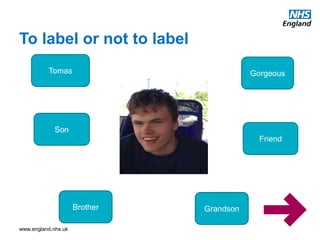
To label or not to label
Tomas
Son
Brother
Friend
Grandson
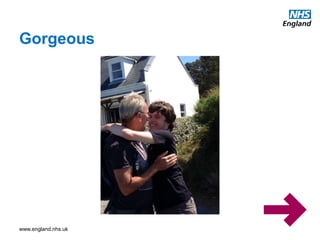
Gorgeous
www.england.nhs.uk
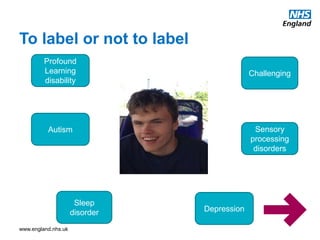
To label or not to label
Profound
Learning
disability
Autism
Sleep
disorder
Sensory
processing
disorders
Depression
Challenging
www.england.nhs.uk
Joined up???
www.england.nhs.uk
What I want out of a register
• Recognition that even if things seem stable extra
consideration needs to be given before changes
made
• Not having to emphasise how wrong things can go –
having that understood
• Early planning at key transition points such as move
to adulthood
www.england.nhs.uk
Gorgeous
www.england.nhs.uk
Questions?
www.england.nhs.uk
Transforming Care in the
North East and Cumbria
Developing a standardised template:
Dynamic Support Register
Dan Maddison & Sarah Dean
Partners in improving local health
NORTH EAST & CUMBRIA
LEARNING DISABILITIES & AUTISM
TRANSFORMING CARE PROGRAMME
www.england.nhs.uk
TCP Dynamic Support Register
• Overseen by the Transforming Care Board
• Confirm & Challenge Group
• Local Implementation Teams
• Task and Finish Group:
• Risk Stratification Process
• Data Sharing Process
• Standardised Support Register
• Into Community Model of Care.
Partners in improving local health
NORTH EAST & CUMBRIA
LEARNING DISABILITIES & AUTISM
TRANSFORMING CARE PROGRAMME
www.england.nhs.uk
Background and Process
• Assessment of current risk registers
• Agree process and governance
• Case management tool
• MDT process pre CTR
• Transitions planning
• TCP sub group- Dynamic register
• Standard risk register – approval
• Local Implementation.
Partners in improving local health
NORTH EAST & CUMBRIA
LEARNING DISABILITIES & AUTISM
TRANSFORMING CARE PROGRAMME
www.england.nhs.uk
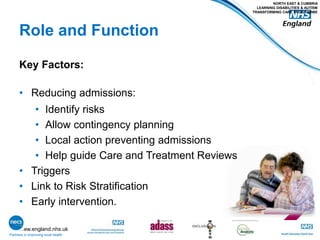
Role and Function
Key Factors:
• Reducing admissions:
• Identify risks
• Allow contingency planning
• Local action preventing admissions
• Help guide Care and Treatment Reviews
• Triggers
• Link to Risk Stratification
• Early intervention.
Partners in improving local health
NORTH EAST & CUMBRIA
LEARNING DISABILITIES & AUTISM
TRANSFORMING CARE PROGRAMME
www.england.nhs.uk
DSR Contents
• Patient/Person Information
• Risk of requiring more intensive support/admission
• Community CTR
• Actual Hospital Admission Data
• Overall RAG Rating.
Partners in improving local health
NORTH EAST & CUMBRIA
LEARNING DISABILITIES & AUTISM
TRANSFORMING CARE PROGRAMME
www.england.nhs.uk
DSR Contents (continued)
Partners in improving local health
NORTH EAST & CUMBRIA
LEARNING DISABILITIES & AUTISM
TRANSFORMING CARE PROGRAMME
NORTH OF ENGLAND
COMMISSIONING SUPPORT
Sub data:
• Primary & Secondary Diagnosis
• Current Accommodation Type
• Advocacy Arrangements IMCA/IMHA/OTHER
• Responsible Authority (incl OOA plans)
• Professional Lead
• Care Provider
• Current care plan
• including risk assessment and contingency plan
• Previous admission
• Community CTR Date & Outcomes
www.england.nhs.uk
Risk Triggers
• Significant life events
• Mental illness
• History of admission
• Significant behavioural challenges
• Unstable environment
• Having no fixed address
• Being in contact with the Criminal Justice System
• Admission or presenting “in crisis”
• No family carers/advocates
• Drug and alcohol dependencies
• Issues with transition from child to adult services
• “52 –week” residential placement
Partners in improving local health
NORTH EAST & CUMBRIA
LEARNING DISABILITIES & AUTISM
TRANSFORMING CARE PROGRAMME
NORTH OF ENGLAND
COMMISSIONING SUPPORT
www.england.nhs.uk
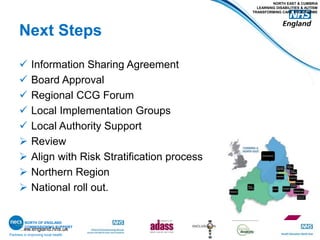
Next Steps
 Information Sharing Agreement
 Board Approval
 Regional CCG Forum
 Local Implementation Groups
 Local Authority Support
 Review
 Align with Risk Stratification process
 Northern Region
 National roll out.
Partners in improving local health
NORTH EAST & CUMBRIA
LEARNING DISABILITIES & AUTISM
TRANSFORMING CARE PROGRAMME
NORTH OF ENGLAND
COMMISSIONING SUPPORT
www.england.nhs.uk
Any questions?
Daniel Maddison, Project Manager
danielmaddison@nhs.net
01642 746914
Sarah Dean, South Tyneside LA
Partners in improving local health
NORTH EAST & CUMBRIA
LEARNING DISABILITIES & AUTISM
TRANSFORMING CARE PROGRAMME
www.england.nhs.uk
Questions and open discussion

Learning Disabilities: Dynamic Registers Webinar – 12 December 2016

  • 1.
  • 2.
  • 3.
    www.england.nhs.uk Topic Time Welcome, housekeeping1 min Agenda : Webinar 1 Background and context: - What is a register - What needs to be considered - Challenges & benefits 14 mins A carer’s perspective on registers 10 mins Cumbria and the North-East TCP: - Developing our risk register - Deciding on risk stratification - Sharing the template for our register 20 mins Questions and Discussion 15 mins Close 1 min Agenda : Webinar 1
  • 4.
    www.england.nhs.uk CTR policy ‘AtRisk Register’ • The ‘At Risk of Admission Register’ will identify those people who are likely to require a ‘Community CTR’ to prevent their unnecessary admission • At Risk of Admission Register’ is seen to be a first step in a broader piece of work on ‘risk stratification.’ This work will focus on prevention, early identification and early intervention.
  • 5.
    www.england.nhs.uk Service Model –Dynamic Registers • Local health and care services should develop a dynamic register based on sophisticated risk stratification of their local populations • enable local services to anticipate and meet the needs of those people with a learning disability and/or autism who display behaviour that challenges, or who are at risk of developing behaviour that challenges • ensuring local services plan appropriately and provide early interventions, including preventative support. • • Commissioners should risk-stratify their local population of people with a learning disability and/or autism to enable them to put in place appropriate anticipatory support
  • 6.
    www.england.nhs.uk • Risk stratificationshould focus on prevention and early intervention with the aim of reducing the likelihood of behaviour that challenges by providing support at an early stage to proactively address these risk factors • It should be recognised that early detection of risk factors and systematic assessments of behaviour is the key to prevention of behavioural difficulties and the basis of early intervention. • The register will include information that monitors whether the individual is effectively supported and reviewed
  • 7.
    www.england.nhs.uk People in Inpatient or residential schools Peopleat risk of admission People known to services Total people with a learning disability and or autism
  • 8.
    www.england.nhs.uk Some of thekey points made in the 2007 Mansell Report: • Good practice is fragile, and it is not sensible to plan on the basis that challenging behaviour can be readily ‘fixed.’ • The potential for challenging behaviour exists for many service users in many situations; and the problem of behaviour that challenge is not likely to go away. • The implication is, that the appropriate goal of learning disability services is to support the individual in achieving as good a quality of life as possible in spite of their problems. • In practice, challenging behaviour will be an enduring characteristic of the lives of many service users. • There will always be a large pool of people who present some challenging behaviour, which can be made better or worse depending on how well services support them
  • 9.
    www.england.nhs.uk • It isimportant to remember that challenging behaviour is merely a label given to a behaviour on the basis of its perceived consequences i.e. it places someone at risk of harm, or risk social exclusion. • As such ‘challenging behaviour’ is a label attached to a social interaction or exchange between a person [with a learning disability] and other(s), wherein the characteristics of other parties are as important (if not more so) in determining whether harm or social exclusion are likely result, as the characteristics of a person with a learning disability. Challenging behaviour is a social construct
  • 10.
  • 11.
  • 12.
    www.england.nhs.uk To label ornot to label Tomas Son Brother Friend Grandson Gorgeous
  • 13.
    www.england.nhs.uk To label ornot to label Profound Learning disability Autism Sleep disorder Sensory processing disorders Depression Challenging
  • 14.
  • 15.
    www.england.nhs.uk What I wantout of a register • Recognition that even if things seem stable extra consideration needs to be given before changes made • Not having to emphasise how wrong things can go – having that understood • Early planning at key transition points such as move to adulthood
  • 16.
  • 17.
  • 18.
    www.england.nhs.uk Transforming Care inthe North East and Cumbria Developing a standardised template: Dynamic Support Register Dan Maddison & Sarah Dean Partners in improving local health NORTH EAST & CUMBRIA LEARNING DISABILITIES & AUTISM TRANSFORMING CARE PROGRAMME
  • 19.
    www.england.nhs.uk TCP Dynamic SupportRegister • Overseen by the Transforming Care Board • Confirm & Challenge Group • Local Implementation Teams • Task and Finish Group: • Risk Stratification Process • Data Sharing Process • Standardised Support Register • Into Community Model of Care. Partners in improving local health NORTH EAST & CUMBRIA LEARNING DISABILITIES & AUTISM TRANSFORMING CARE PROGRAMME
  • 20.
    www.england.nhs.uk Background and Process •Assessment of current risk registers • Agree process and governance • Case management tool • MDT process pre CTR • Transitions planning • TCP sub group- Dynamic register • Standard risk register – approval • Local Implementation. Partners in improving local health NORTH EAST & CUMBRIA LEARNING DISABILITIES & AUTISM TRANSFORMING CARE PROGRAMME
  • 21.
    www.england.nhs.uk Role and Function KeyFactors: • Reducing admissions: • Identify risks • Allow contingency planning • Local action preventing admissions • Help guide Care and Treatment Reviews • Triggers • Link to Risk Stratification • Early intervention. Partners in improving local health NORTH EAST & CUMBRIA LEARNING DISABILITIES & AUTISM TRANSFORMING CARE PROGRAMME
  • 22.
    www.england.nhs.uk DSR Contents • Patient/PersonInformation • Risk of requiring more intensive support/admission • Community CTR • Actual Hospital Admission Data • Overall RAG Rating. Partners in improving local health NORTH EAST & CUMBRIA LEARNING DISABILITIES & AUTISM TRANSFORMING CARE PROGRAMME
  • 23.
    www.england.nhs.uk DSR Contents (continued) Partnersin improving local health NORTH EAST & CUMBRIA LEARNING DISABILITIES & AUTISM TRANSFORMING CARE PROGRAMME NORTH OF ENGLAND COMMISSIONING SUPPORT Sub data: • Primary & Secondary Diagnosis • Current Accommodation Type • Advocacy Arrangements IMCA/IMHA/OTHER • Responsible Authority (incl OOA plans) • Professional Lead • Care Provider • Current care plan • including risk assessment and contingency plan • Previous admission • Community CTR Date & Outcomes
  • 24.
    www.england.nhs.uk Risk Triggers • Significantlife events • Mental illness • History of admission • Significant behavioural challenges • Unstable environment • Having no fixed address • Being in contact with the Criminal Justice System • Admission or presenting “in crisis” • No family carers/advocates • Drug and alcohol dependencies • Issues with transition from child to adult services • “52 –week” residential placement Partners in improving local health NORTH EAST & CUMBRIA LEARNING DISABILITIES & AUTISM TRANSFORMING CARE PROGRAMME NORTH OF ENGLAND COMMISSIONING SUPPORT
  • 25.
    www.england.nhs.uk Next Steps  InformationSharing Agreement  Board Approval  Regional CCG Forum  Local Implementation Groups  Local Authority Support  Review  Align with Risk Stratification process  Northern Region  National roll out. Partners in improving local health NORTH EAST & CUMBRIA LEARNING DISABILITIES & AUTISM TRANSFORMING CARE PROGRAMME NORTH OF ENGLAND COMMISSIONING SUPPORT
  • 26.
    www.england.nhs.uk Any questions? Daniel Maddison,Project Manager danielmaddison@nhs.net 01642 746914 Sarah Dean, South Tyneside LA Partners in improving local health NORTH EAST & CUMBRIA LEARNING DISABILITIES & AUTISM TRANSFORMING CARE PROGRAMME
  • 27.

Editor's Notes

  • #6 Rationale: behaviour that challenges can often be predicted, and early intervention taken to prevent, manage or minimise that behaviour. Understanding the factors that increase the risk of people developing or displaying behaviours that challenge, and having a clear understanding of which individuals are most at risk, can enable services to work together to proactively put in place appropriate anticipatory support.
  • #25 There are specific factors which may place someone “at risk of requiring more intensive support” and if present in a person’s life this should prompt inclusion on the “Dynamic Support Register” these include: ·        Significant life events and/or changes such as bereavement or abuse. ·        Unstable/ Untreated mental illness ·        Presenting significant behavioural challenges Challenging behaviour is defined as; Culturally abnormal behaviour(s) of such an intensity, frequency or duration that the physical safety of the person or others is likely to be placed in serious jeopardy, or behaviour which is likely to seriously limit use of, or result in the person being denied access to, ordinary community facilities*. ·        Being supported in an unstable environment or by a changing staff team ·        Not being previously known to learning disability services ·        Having no fixed address ·        Being in contact with the Criminal Justice System ·        Previous history of admission or presenting “in crisis” at Accident and Emergency Departments or having recently been discharged from long stay hospital beds. ·        Having no family carers/advocates ·        Having drug and alcohol dependencies ·        Having no effectively planned transition from child to adult learning disability services ·        Being placed in specialist “52 –week” residential schools ·       
  • #26 Linked with Information Sharing process about people accommodated across different areas Board Approval – Agreed with caveat that a roll out plan is in place Regional CCG Forum - Roll Out Agreed Local Implementation Groups Review by PMO Team in Apr 2017 Northern Region Assessment & Implementation being considered National roll out of single approved model?