Increasing Student Achievement byIncreasing Parent Involvement1Dr. Cynthia Fuselier, Director of Curriculum, New Brighton Area School District
         Bounded AwarenessBounded awareness is the phenomenon in which individuals do not “see” accessible and perceivable information during the decision-making process, while “seeing” other equally accessible and perceivable information. As a result, useful information remains out of focus for the decision-maker.2
How does this apply to parent involvement?Test Scores/Adequate Yearly ProgressAthleticsBehaviorAwardsSafetyNo Child Left Behind3
What we know research says about parent involvement…Partnerships tend to decline across the grades.Affluent communities currently have more positive family involvement, on average, unless schools and teachers in economically distressed communities work to build positive partnerships with their students’ families.Schools in more economically depressed communities make more contacts with families about the problems and difficulties their children are having.Single parents, parents who are employed outside the home, parents who live far from the school, and fathers are less involved, on average, at the school building, unless the school organizes opportunities for families to volunteer at various times and in various places to support the school and their children.4
The research says…Teachers who create partnerships with parents are more likely to report that all parents can help their children.These teachers are less likely to stereotype single parents, poor parents, or those with less education as unable to help.5
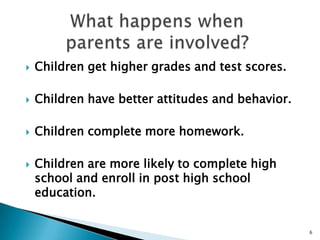
What happens when parents are involved?Children get higher grades and test scores.Children have better attitudes and behavior.Children complete more homework.Children are more likely to complete high school and enroll in post high school education.6
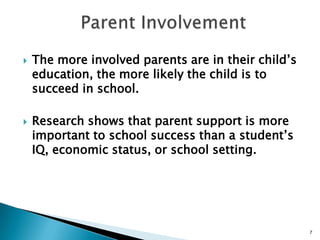
      Parent InvolvementThe more involved parents are in their child’s education, the more likely the child is to succeed in school.Research shows that parent support is more important to school success than a student’s IQ, economic status, or school setting.7
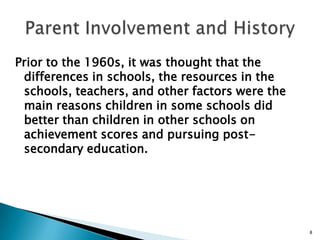
Parent Involvement and HistoryPrior to the 1960s, it was thought that the differences in schools, the resources in the schools, teachers, and other factors were the main reasons children in some schools did better than children in other schools on achievement scores and pursuing post-secondary education.8
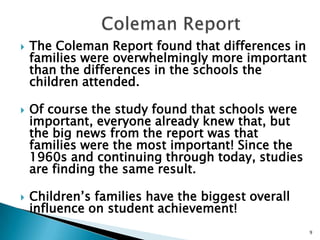
   Coleman ReportThe Coleman Report found that differences in families were overwhelmingly more important than the differences in the schools the children attended. Of course the study found that schools were important, everyone already knew that, but the big news from the report was that families were the most important! Since the 1960s and continuing through today, studies are finding the same result.Children’s families have the biggest overall influence on student achievement!9
the research continues…This same report led to a study of 1900 elementary students that found……when schools encouraged students to read at home with parents, they made much bigger gains than children who practiced only at school with teachers – regardless of their race and/or socioeconomic status.10
Are you surprised that……measurements of a child’s intelligence less than one-year-old show virtually no racial or social-class differences, yet racial and social class achievement gaps are firmly established by the time students start kindergarten?Something happens before kindergarten that produces differences in academic proficiency. 11
            Could this be it? A child from a low-income family is read to an average of 25 hours before entering kindergarten, while a child from a middle-income family is read to an average of 1,700 hours. McQuillan, J. (1998). The Literacy Crisis: False Claims, Real Solutions.  Packard and MacArthur Foundations.12
When are children learning?Are they learning in the morning? In the afternoon? In the car? At home? When they’re alone? With friends? At school? Playing games? When is it that they learn?How would you answer this question? What do you believe researchers will say about this question?13
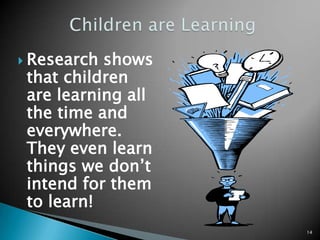
Children are LearningResearch shows that children              are learning all the time and everywhere. They even learn things we don’t intend for them to learn!14
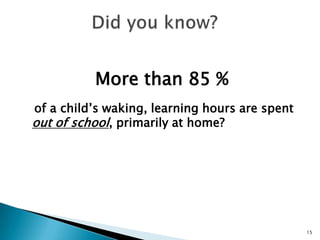
Did you know?More than 85 %   of a child’s waking, learning hours are spent out of school, primarily at home?15
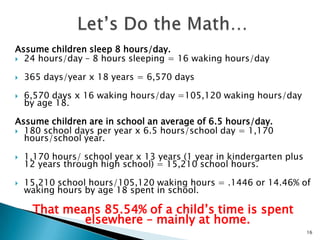
Let’s Do the Math…Assume children sleep 8 hours/day.24 hours/day – 8 hours sleeping = 16 waking hours/day365 days/year x 18 years = 6,570 days6,570 days x 16 waking hours/day =105,120 waking hours/day by age 18.Assume children are in school an average of 6.5 hours/day.180 school days per year x 6.5 hours/school day = 1,170 hours/school year.1,170 hours/ school year x 13 years (1 year in kindergarten plus 12 years through high school) = 15,210 school hours.15,210 school hours/105,120 waking hours = .1446 or 14.46% of waking hours by age 18 spent in school.That means 85.54% of a child’s time is spent elsewhere – mainly at home.16
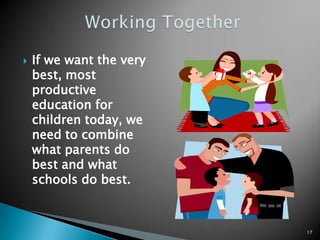
Working TogetherIf we want the very best, most productive education for children today, we need to combine what parents do best and what schools do best.17
What do schools do best?Provide formal education like the Three Rs: Reading, Writing, ArithmeticTeachers are best at teaching:    Science    LanguagesMathematics    Fine Arts    History    Sports18
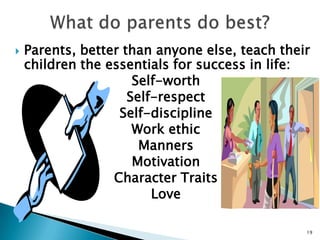
What do parents do best?Parents, better than anyone else, teach their children the essentials for success in life:Self-worthSelf-respectSelf-disciplineWork ethicMannersMotivationCharacter TraitsLove19
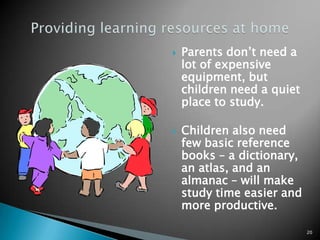
Providing learning resources at homeParents don’t need a lot of expensive equipment, but children need a quiet place to study. Children also need few basic reference books – a dictionary, an atlas, and an almanac – will make study time easier and more productive.20
Help parents help their children develop routinesHave regular homework or reading time.
Have a regular bedtime that allows for plenty of rest.
Give children age-appropriate chores.
Give children a nutritious breakfast every morning.21
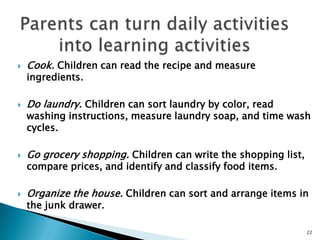
Parents can turn daily activities into learning activitiesCook. Children can read the recipe and measure ingredients.Do laundry. Children can sort laundry by color, read washing instructions, measure laundry soap, and time wash cycles.Go grocery shopping. Children can write the shopping list, compare prices, and identify and classify food items.Organize the house. Children can sort and arrange items in the junk drawer.22
Greet guest by name and reinforce the values and attitudes of the New Brighton Area School District on a daily basis!23
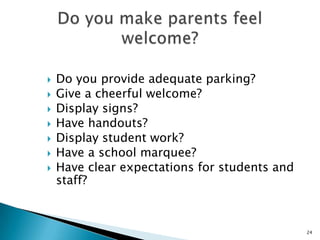
Do you make parents feel welcome?Do you provide adequate parking?Give a cheerful welcome?Display signs?Have handouts?Display student work?Have a school marquee?Have clear expectations for students and staff?24
How is your waiting area?Do visitors and parents have something to read?Is there something available for them to view?25
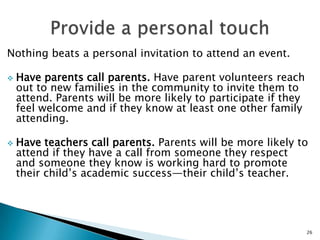
Provide a personal touchNothing beats a personal invitation to attend an event. Have parents call parents. Have parent volunteers reach out to new families in the community to invite them to attend. Parents will be more likely to participate if they feel welcome and if they know at least one other family attending.
Have teachers call parents. Parents will be more likely to attend if they have a call from someone they respect and someone they know is working hard to promote their child’s academic success—their child’s teacher.26
Provide an incentiveTry offering the following to motivate parents to attend:Discount coupons. Have a parent-teacher team solicit coupons from local restaurants and businesses to distribute at your event.
Handouts. Advertise that you will have handouts of learning activities parents can use at home to help their child. Prepare take-home packets to distribute in advance.27
        Involve their childrenAsk students to write invitations to their parents -Or have a fold-over invitation printed and have each student add an illustration to the cover.
Allow children to attend - Set up an activity for the children while the parents are engaged in the meeting. Recruit a parent-teacher team to plan it and provide adult supervision during the event.28
      Make attending convenientMost parents work hard all day. To motivate them to attend:Schedule it early in the evening. Most families want to be home by 8:00 pm.Begin and end promptly. Advertise a beginning and a closing time. Then stick to your schedule. Parents will be more likely to attend your next event if they know they can be home for their child’s bedtime.Do something they enjoy – Have a party!29
Do what ever it takes to create a family atmosphere in your buildingHave you ever walked into a place and felt uncomfortable?Were you able to focus on the reason you came to the place as well as you would have had you not been uncomfortable?30
Once you have parents involved…Ensure the success of your meeting byEstablishing a fun, friendly, non-threatening atmosphere.Having plenty of signs and or helpers to guide parents to the right room as they arrive.Greeting parents individually or cordially as they enter the room.Avoiding questions that any parent can answer incorrectly, so there is never a possibility of embarrassing anyone.Having nametags for parents and staff.31
Extra Touches mean a lot …Serve refreshmentsRemember that some parents may be uncomfortable reading or writing in publicHave plenty of handoutsStart and end on time, respecting parents’ childcare arrangements and family commitments32

Parent Involvement Presentation

  • 1.
    Increasing Student AchievementbyIncreasing Parent Involvement1Dr. Cynthia Fuselier, Director of Curriculum, New Brighton Area School District
  • 2.
    Bounded AwarenessBounded awareness is the phenomenon in which individuals do not “see” accessible and perceivable information during the decision-making process, while “seeing” other equally accessible and perceivable information. As a result, useful information remains out of focus for the decision-maker.2
  • 3.
    How does thisapply to parent involvement?Test Scores/Adequate Yearly ProgressAthleticsBehaviorAwardsSafetyNo Child Left Behind3
  • 4.
    What we knowresearch says about parent involvement…Partnerships tend to decline across the grades.Affluent communities currently have more positive family involvement, on average, unless schools and teachers in economically distressed communities work to build positive partnerships with their students’ families.Schools in more economically depressed communities make more contacts with families about the problems and difficulties their children are having.Single parents, parents who are employed outside the home, parents who live far from the school, and fathers are less involved, on average, at the school building, unless the school organizes opportunities for families to volunteer at various times and in various places to support the school and their children.4

  • 5.
    The research says…Teacherswho create partnerships with parents are more likely to report that all parents can help their children.These teachers are less likely to stereotype single parents, poor parents, or those with less education as unable to help.5

  • 6.
    What happens whenparents are involved?Children get higher grades and test scores.Children have better attitudes and behavior.Children complete more homework.Children are more likely to complete high school and enroll in post high school education.6
  • 7.
    Parent InvolvementThe more involved parents are in their child’s education, the more likely the child is to succeed in school.Research shows that parent support is more important to school success than a student’s IQ, economic status, or school setting.7
  • 8.
    Parent Involvement andHistoryPrior to the 1960s, it was thought that the differences in schools, the resources in the schools, teachers, and other factors were the main reasons children in some schools did better than children in other schools on achievement scores and pursuing post-secondary education.8
  • 9.
    Coleman ReportThe Coleman Report found that differences in families were overwhelmingly more important than the differences in the schools the children attended. Of course the study found that schools were important, everyone already knew that, but the big news from the report was that families were the most important! Since the 1960s and continuing through today, studies are finding the same result.Children’s families have the biggest overall influence on student achievement!9
  • 10.
    the research continues…Thissame report led to a study of 1900 elementary students that found……when schools encouraged students to read at home with parents, they made much bigger gains than children who practiced only at school with teachers – regardless of their race and/or socioeconomic status.10
  • 11.
    Are you surprisedthat……measurements of a child’s intelligence less than one-year-old show virtually no racial or social-class differences, yet racial and social class achievement gaps are firmly established by the time students start kindergarten?Something happens before kindergarten that produces differences in academic proficiency. 11
  • 12.
    Could this be it? A child from a low-income family is read to an average of 25 hours before entering kindergarten, while a child from a middle-income family is read to an average of 1,700 hours. McQuillan, J. (1998). The Literacy Crisis: False Claims, Real Solutions. Packard and MacArthur Foundations.12
  • 13.
    When are childrenlearning?Are they learning in the morning? In the afternoon? In the car? At home? When they’re alone? With friends? At school? Playing games? When is it that they learn?How would you answer this question? What do you believe researchers will say about this question?13
  • 14.
    Children are LearningResearchshows that children are learning all the time and everywhere. They even learn things we don’t intend for them to learn!14
  • 15.
    Did you know?Morethan 85 % of a child’s waking, learning hours are spent out of school, primarily at home?15
  • 16.
    Let’s Do theMath…Assume children sleep 8 hours/day.24 hours/day – 8 hours sleeping = 16 waking hours/day365 days/year x 18 years = 6,570 days6,570 days x 16 waking hours/day =105,120 waking hours/day by age 18.Assume children are in school an average of 6.5 hours/day.180 school days per year x 6.5 hours/school day = 1,170 hours/school year.1,170 hours/ school year x 13 years (1 year in kindergarten plus 12 years through high school) = 15,210 school hours.15,210 school hours/105,120 waking hours = .1446 or 14.46% of waking hours by age 18 spent in school.That means 85.54% of a child’s time is spent elsewhere – mainly at home.16
  • 17.
    Working TogetherIf wewant the very best, most productive education for children today, we need to combine what parents do best and what schools do best.17
  • 18.
    What do schoolsdo best?Provide formal education like the Three Rs: Reading, Writing, ArithmeticTeachers are best at teaching: Science LanguagesMathematics Fine Arts History Sports18
  • 19.
    What do parentsdo best?Parents, better than anyone else, teach their children the essentials for success in life:Self-worthSelf-respectSelf-disciplineWork ethicMannersMotivationCharacter TraitsLove19
  • 20.
    Providing learning resourcesat homeParents don’t need a lot of expensive equipment, but children need a quiet place to study. Children also need few basic reference books – a dictionary, an atlas, and an almanac – will make study time easier and more productive.20
  • 21.
    Help parents helptheir children develop routinesHave regular homework or reading time.
  • 22.
    Have a regularbedtime that allows for plenty of rest.
  • 23.
  • 24.
    Give children anutritious breakfast every morning.21
  • 25.
    Parents can turndaily activities into learning activitiesCook. Children can read the recipe and measure ingredients.Do laundry. Children can sort laundry by color, read washing instructions, measure laundry soap, and time wash cycles.Go grocery shopping. Children can write the shopping list, compare prices, and identify and classify food items.Organize the house. Children can sort and arrange items in the junk drawer.22
  • 26.
    Greet guest byname and reinforce the values and attitudes of the New Brighton Area School District on a daily basis!23
  • 27.
    Do you makeparents feel welcome?Do you provide adequate parking?Give a cheerful welcome?Display signs?Have handouts?Display student work?Have a school marquee?Have clear expectations for students and staff?24
  • 28.
    How is yourwaiting area?Do visitors and parents have something to read?Is there something available for them to view?25
  • 29.
    Provide a personaltouchNothing beats a personal invitation to attend an event. Have parents call parents. Have parent volunteers reach out to new families in the community to invite them to attend. Parents will be more likely to participate if they feel welcome and if they know at least one other family attending.
  • 30.
    Have teachers callparents. Parents will be more likely to attend if they have a call from someone they respect and someone they know is working hard to promote their child’s academic success—their child’s teacher.26
  • 31.
    Provide an incentiveTryoffering the following to motivate parents to attend:Discount coupons. Have a parent-teacher team solicit coupons from local restaurants and businesses to distribute at your event.
  • 32.
    Handouts. Advertise thatyou will have handouts of learning activities parents can use at home to help their child. Prepare take-home packets to distribute in advance.27
  • 33.
    Involve their childrenAsk students to write invitations to their parents -Or have a fold-over invitation printed and have each student add an illustration to the cover.
  • 34.
    Allow children toattend - Set up an activity for the children while the parents are engaged in the meeting. Recruit a parent-teacher team to plan it and provide adult supervision during the event.28
  • 35.
    Make attending convenientMost parents work hard all day. To motivate them to attend:Schedule it early in the evening. Most families want to be home by 8:00 pm.Begin and end promptly. Advertise a beginning and a closing time. Then stick to your schedule. Parents will be more likely to attend your next event if they know they can be home for their child’s bedtime.Do something they enjoy – Have a party!29
  • 36.
    Do what everit takes to create a family atmosphere in your buildingHave you ever walked into a place and felt uncomfortable?Were you able to focus on the reason you came to the place as well as you would have had you not been uncomfortable?30
  • 37.
    Once you haveparents involved…Ensure the success of your meeting byEstablishing a fun, friendly, non-threatening atmosphere.Having plenty of signs and or helpers to guide parents to the right room as they arrive.Greeting parents individually or cordially as they enter the room.Avoiding questions that any parent can answer incorrectly, so there is never a possibility of embarrassing anyone.Having nametags for parents and staff.31
  • 38.
    Extra Touches meana lot …Serve refreshmentsRemember that some parents may be uncomfortable reading or writing in publicHave plenty of handoutsStart and end on time, respecting parents’ childcare arrangements and family commitments32