VISVESVARAYA TECHNOLOGICALUNIVERSITY,
BELGAUM
Technical Seminar
on
“Artificial Intelligence in
Healthcare”
Presented by :
Muhammed Iyas AD
( 1BT14IS009 )
Department of Information Science & Engineering
BTL Institute of Technology and Management,
Bangalore-99
Table of Content:
• Introduction to Research Area.
• Introduction to Research Topic.
• Comparison with Existing System.
• Applications.
• Conclusion.
• Reference.
4/10/2018 Artificial Intelligence in Healthcare 2
Introduction to Research Area :
• Artificial Intelligence (AI) :
Artificial intelligence is defined as the
combination of science and the engineering on
creating intelligent computer systems that are
able to perform tasks without receiving any
instruction directly from humans.
4/10/2018 Artificial Intelligence in Healthcare 3
Classification of AI :
• Common Classification:
1. Strong Artificial Intelligence.
2. Weak Artificial Intelligence.
• Classification from Arend Hintze:
1. Type 1: Reactive Machines.
2. Type 2: Limited Memory.
3. Type 3 : Theory of Mind.
4. Type 4 : Self Awareness.
4/10/2018 Artificial Intelligence in Healthcare 4
AI Technologies Used in Health care:
• Machine Learning.
• Machine Vision.
• Natural Language Processing (NLP).
• Robotics.
4/10/2018 Artificial Intelligence in Healthcare 5
Introduction to Research Topic :
• Healthcare :
Maintenance of health via prevention, Diagnosis
and Treatment of diseases ,
illness, injury, and other physical and mental
impairments in human beings.
4/10/2018 Artificial Intelligence in Healthcare 6
Continues……
• Existing Healthcare System :
• Treatments are only based the current study.
• It’s hard to find a doctor who knows you.
• Lack of knowledge.
• Unexpected Deaths due to human errors.
4/10/2018 Artificial Intelligence in Healthcare 7
Comparison with Existing System :
• Way of Treatment.
• Efficiency.
• Advantages.
• Challenges.
4/10/2018 Artificial Intelligence in Healthcare 8
Roles of AI in Healthcare:
• Disease Prediction :
• Traditionally approaches of doctors.
• Use of AI technologies in this area.
• Benefits.
4/10/2018 Artificial Intelligence in Healthcare 9
Example
4/10/2018 Artificial Intelligence in Healthcare 10
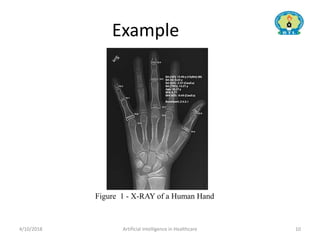
Figure 1 - X-RAY of a Human Hand
Continues…
• Drug Manufacturing :
• Old Approach.
• Proposed Approach.
• Benefits.
4/10/2018 Artificial Intelligence in Healthcare 11
4/10/2018 Artificial Intelligence in Healthcare 12
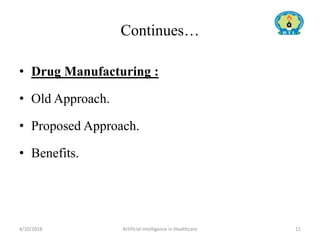
Figure 2 – Robots in drug manufacturing.
Continues…
• Treatment Decision :
• Current Approach.
• AI used Approach.
• Benefits.
4/10/2018 Artificial Intelligence in Healthcare 13
4/10/2018 Artificial Intelligence in Healthcare 14
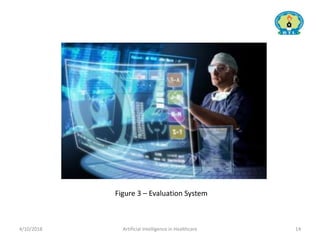
Figure 3 – Evaluation System
4/10/2018 Artificial Intelligence in Healthcare 15
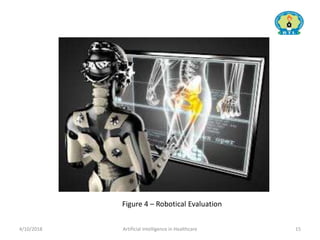
Figure 4 – Robotical Evaluation
Continues…
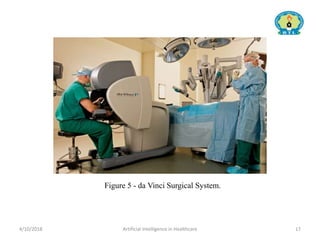
• Surgery :
• Existing Approach.
• AI used Approach.
• Benefits.
4/10/2018 Artificial Intelligence in Healthcare 16
4/10/2018 Artificial Intelligence in Healthcare 17
Figure 5 - da Vinci Surgical System.
Advantages:
• Leading to advancements in healthcare
treatments.
• The ability to quickly and more accurately
identify signs of disease.
• Patients can ask medical questions and receive
answers in absence of a doctor.
• Reduces the treatment cost.
• Makes the treatment decision faster.
• Helps to reduce the human errors.
4/10/2018 Artificial Intelligence in Healthcare 18
Challenges:
• Training Doctors/Patients.
• Adoption.
• Regulations.
• Maintenance.
• Security.
4/10/2018 Artificial Intelligence in Healthcare 19
Conclusion :
• The primary aim of AI in healthcare is to analyze
relationships between or treatment techniques and
patient outcomes.
• AI can achieve fast and accurate Diagnostics.
• It will be very helpful to reduce the human errors
as well as the cost of treatment.
4/10/2018 Artificial Intelligence in Healthcare 20
Reference :
• http://searchcio.techtarget.com/definition/AI.
• http://www.healthcareitnews.com/slideshow/how-ai-transforming-
healthcare-and-solving-problems.
• https://www.forbes.com/sites/forbestechcouncil/2018/01/30/how-ai-is-
transforming-the-future-of-healthcare.
• http://www.pharmtech.com/understanding-potential-artificial-
intelligence-across-pharmaceutical-lifecycl’.
• https://www.accenture.com/us-en/insight-artificial-intelligence-
healthcare.
• https://medium.com/@Unfoldlabs/the-impact-of-artificial-intelligence-in-
healthcare-4bc657f129f5.
4/10/2018 Artificial Intelligence in Healthcare 21
4/10/2018 Artificial Intelligence in Healthcare 22

Artificial intelligence in Health Care

  • 1.
    VISVESVARAYA TECHNOLOGICALUNIVERSITY, BELGAUM Technical Seminar on “ArtificialIntelligence in Healthcare” Presented by : Muhammed Iyas AD ( 1BT14IS009 ) Department of Information Science & Engineering BTL Institute of Technology and Management, Bangalore-99
  • 2.
    Table of Content: •Introduction to Research Area. • Introduction to Research Topic. • Comparison with Existing System. • Applications. • Conclusion. • Reference. 4/10/2018 Artificial Intelligence in Healthcare 2
  • 3.
    Introduction to ResearchArea : • Artificial Intelligence (AI) : Artificial intelligence is defined as the combination of science and the engineering on creating intelligent computer systems that are able to perform tasks without receiving any instruction directly from humans. 4/10/2018 Artificial Intelligence in Healthcare 3
  • 4.
    Classification of AI: • Common Classification: 1. Strong Artificial Intelligence. 2. Weak Artificial Intelligence. • Classification from Arend Hintze: 1. Type 1: Reactive Machines. 2. Type 2: Limited Memory. 3. Type 3 : Theory of Mind. 4. Type 4 : Self Awareness. 4/10/2018 Artificial Intelligence in Healthcare 4
  • 5.
    AI Technologies Usedin Health care: • Machine Learning. • Machine Vision. • Natural Language Processing (NLP). • Robotics. 4/10/2018 Artificial Intelligence in Healthcare 5
  • 6.
    Introduction to ResearchTopic : • Healthcare : Maintenance of health via prevention, Diagnosis and Treatment of diseases , illness, injury, and other physical and mental impairments in human beings. 4/10/2018 Artificial Intelligence in Healthcare 6
  • 7.
    Continues…… • Existing HealthcareSystem : • Treatments are only based the current study. • It’s hard to find a doctor who knows you. • Lack of knowledge. • Unexpected Deaths due to human errors. 4/10/2018 Artificial Intelligence in Healthcare 7
  • 8.
    Comparison with ExistingSystem : • Way of Treatment. • Efficiency. • Advantages. • Challenges. 4/10/2018 Artificial Intelligence in Healthcare 8
  • 9.
    Roles of AIin Healthcare: • Disease Prediction : • Traditionally approaches of doctors. • Use of AI technologies in this area. • Benefits. 4/10/2018 Artificial Intelligence in Healthcare 9
  • 10.
    Example 4/10/2018 Artificial Intelligencein Healthcare 10 Figure 1 - X-RAY of a Human Hand
  • 11.
    Continues… • Drug Manufacturing: • Old Approach. • Proposed Approach. • Benefits. 4/10/2018 Artificial Intelligence in Healthcare 11
  • 12.
    4/10/2018 Artificial Intelligencein Healthcare 12 Figure 2 – Robots in drug manufacturing.
  • 13.
    Continues… • Treatment Decision: • Current Approach. • AI used Approach. • Benefits. 4/10/2018 Artificial Intelligence in Healthcare 13
  • 14.
    4/10/2018 Artificial Intelligencein Healthcare 14 Figure 3 – Evaluation System
  • 15.
    4/10/2018 Artificial Intelligencein Healthcare 15 Figure 4 – Robotical Evaluation
  • 16.
    Continues… • Surgery : •Existing Approach. • AI used Approach. • Benefits. 4/10/2018 Artificial Intelligence in Healthcare 16
  • 17.
    4/10/2018 Artificial Intelligencein Healthcare 17 Figure 5 - da Vinci Surgical System.
  • 18.
    Advantages: • Leading toadvancements in healthcare treatments. • The ability to quickly and more accurately identify signs of disease. • Patients can ask medical questions and receive answers in absence of a doctor. • Reduces the treatment cost. • Makes the treatment decision faster. • Helps to reduce the human errors. 4/10/2018 Artificial Intelligence in Healthcare 18
  • 19.
    Challenges: • Training Doctors/Patients. •Adoption. • Regulations. • Maintenance. • Security. 4/10/2018 Artificial Intelligence in Healthcare 19
  • 20.
    Conclusion : • Theprimary aim of AI in healthcare is to analyze relationships between or treatment techniques and patient outcomes. • AI can achieve fast and accurate Diagnostics. • It will be very helpful to reduce the human errors as well as the cost of treatment. 4/10/2018 Artificial Intelligence in Healthcare 20
  • 21.
    Reference : • http://searchcio.techtarget.com/definition/AI. •http://www.healthcareitnews.com/slideshow/how-ai-transforming- healthcare-and-solving-problems. • https://www.forbes.com/sites/forbestechcouncil/2018/01/30/how-ai-is- transforming-the-future-of-healthcare. • http://www.pharmtech.com/understanding-potential-artificial- intelligence-across-pharmaceutical-lifecycl’. • https://www.accenture.com/us-en/insight-artificial-intelligence- healthcare. • https://medium.com/@Unfoldlabs/the-impact-of-artificial-intelligence-in- healthcare-4bc657f129f5. 4/10/2018 Artificial Intelligence in Healthcare 21
  • 22.