C A R O L A N N E D UF F Y
MAP WOMAN
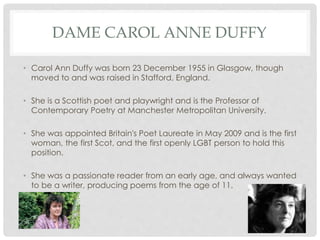
DAME CAROL ANNE DUFFY
• Carol Ann Duffy was born 23 December 1955 in Glasgow, though
moved to and was raised in Stafford, England.
• She is a Scottish poet and playwright and is the Professor of
Contemporary Poetry at Manchester Metropolitan University.
• She was appointed Britain's Poet Laureate in May 2009 and is the first
woman, the first Scot, and the first openly LGBT person to hold this
position.
• She was a passionate reader from an early age, and always wanted
to be a writer, producing poems from the age of 11.
BIBLIOGRAPHY AND COMMON TOPICS
• Her collections include:
• Standing Female Nude (1985), winner of a Scottish Arts Council Award;
• Selling Manhattan (1987), which won a Somerset Maugham Award;
• Mean Time (1993), which won the Whitbread Poetry Award;
• Rapture (2005), winner of the T. S. Eliot Prize.
• Her poems address issues such as oppression, gender, and violence,
in accessible language which has made them popular in schools.
"I'm not interested, as a poet, in words like 'plash'—Seamus Heaney words,
interesting words. I like to use simple words, but in a complicated way”
• Duffy's work explores both out everyday experiences as well as the
rich fantasy life of others and herself. In many of her works she
dramatizes scenes from childhood, adolescence, and adult life in
attempt to convey commonly shared moments of love, memory,
and language.
OTHER WORKS
Originally
We came from our own country in a red room
which fell through the fields, our mother singing
our father’s name to the turn of the wheels.
My brothers cried, one of them bawling, Home,
Home, as the miles rushed back to the city,
the street, the house, the vacant rooms
where we didn’t live any more. I stared
at the eyes of a blind toy, holding its paw.
All childhood is an emigration. Some are slow,
leaving you standing, resigned, up an avenue
where no one you know stays. Others are sudden.
Your accent wrong. Corners, which seem familiar,
leading to unimagined pebble-dashed estates, big boys
eating worms and shouting words you don’t understand.
My parents’ anxiety stirred like a loose tooth
in my head. I want our own country, I said.
But then you forget, or don’t recall, or change,
and, seeing your brother swallow a slug, feel only
a skelf of shame. I remember my tongue
shedding its skin like a snake, my voice
in the classroom sounding just like the rest. Do I only think
I lost a river, culture, speech, sense of first space
and the right place? Now, Where do you come from?
strangers ask. Originally? And I hesitate.
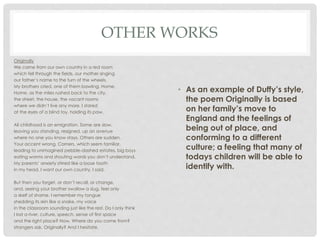
• As an example of Duffy’s style,
the poem Originally is based
on her family’s move to
England and the feelings of
being out of place, and
conforming to a different
culture; a feeling that many of
todays children will be able to
identify with.
THEMES IN MAP WOMAN
• This poem is part of a collection of poems in ‘Feminine Gospels’
which are all about the experiences of women- ranging from the
historical to the imagined.
• Duffy hauntingly illustrates that your hometown will never leave you.
She explores whether not being able to escape the past is something
of a burden – something negative, or something positive; it helps you
identify yourself as a person.
• However, Duffy points out that it’s about finding your own skin that
you’re comfortable with – quite literally.
ANALYSIS
• There is a constant metaphor throughout the poem that a woman’s
skin is a map of her own experiences , emotions and surroundings.
• ‘She covered it up with… and finger tip sleeved’ – the array of
clothing listed begins with general items, however as the list
progresses, it becomes increasingly apparent that concealment of
this woman's skin is vital. This sense of desire for concealment through
excessive measures has us, as an audience, sympathize with this
woman, who’s skin evidently bears a heavy weight upon.
• The words ‘birth mark’ and ‘tattoo’ provoke connotations of
permanence – she cant, no matter how hard she may ever try,
escape from the grasps of her marked skin.
• The suggestion of her skin being an ‘A-Z map’ that ‘grew’ indicates
that she is not simply a representation of the present, but also the
past and the future. The dash between A and Z is used to illustrate
the past and the present being linked together – displays that you
cant ever escape the past, for both your present and future
existence is dependent on past experiences. – this is a major theme
in the poem.
ANALYSIS
• The phrase ‘ a precise second skin’ implies that this women, who is
clearly shaped by her past experiences, has attempted to combat
her present issues with the ‘skin’ she’s woven out of past events. This
displays that although we may not hold the past in high regard, we
learn from it how not to make the same mistake in future
circumstances.
• The line following the above, ‘broad if she binged, thin when she
slimmed’, could show this woman’s confidence in the face of matters
she’s experienced before, which she’s able to combat with her
‘second skin’, however, in the face of matters she’s less familiar with,
she’s depicted as helpless and confused due to her hapless inability
to deal with them in a manner known to her - This evokes a sense of
sympathy toward the woman.
• The references to 'birthmark, tattoo', images denoting permanence,
are juxtaposed with a string of verbs with connotations of growth and
change: 'grew', 'binged', 'slimmed' and 'begin'.
ANALYSIS
• Use of the word ‘nib’ – the tip of a pen – suggests that the town is a
focal point in her life, and that she can almost never escape both
the town itself and the things she’s experienced within it as they
define her being – synonyms.
• The reference to specific places in the town throughout the poem,
‘St Mary’s church’, ‘Market square’, ‘Junction 13’, highlights just how
attached this woman is to the town and it’s going-ons.
• The use of the word ‘anchored’ in stanza 6 indicates that this
woman's life is firmly attached to the town, and that no matter how
hard she may try; “she sponged, soaped scrubbed”, she can never
rid her self of that fact.
• In stanza 7 she once again covers up her skin, with “her chiffon veil, a
delicate braille”. This suggests that she might be trying to hide her
past or make herself ‘harder to read’ – this builds up to the poem’s
climax where she sheds her skin in it’s entirety rather than having to
cover it up.
ANALYSIS
• Use of the words ‘looped’ and ‘repeatedly’ in stanza 8 displays the
cyclical structure of this woman’s life, emotions and experiences. It
also links with the escapist intentions that this woman harbors. The
phrase in stanza 1 ‘ a precis of where to end or go back or begin’
also suggests this cyclical structure, and also that no matter how she
may physically alter in size, the map she bears upon her skin never
fades nor changes – her past can never escape her. She also visit
and flees the town a number of times in the duration of the poem
• In stanza 3, the narrator describes ‘your tiny face trapped in the
windows bottle thick glass like a fly’- this indicates that this woman
feels caught in the towns nauseating societal web and cannot seem
to break free. The suggestion of being ‘tiny’ illustrates how
insignificant she feels, which could explain why she seeks her own
respite, and not instead to gain help of others.
ANALYSIS
• However, despite the narrators seemingly negative outlook on to the
effect her past has had on her mind and body, she emanates a
nostalgic sense through her recollection of her past – ‘You could sit
on a wooden bench as a wedding pair ran, ringed, from the church,
confetti skittering over the marble stones’ – there’s a strong sense of
beauty and happiness in some of her memories – despite the weight
her past bears on her, it still holds a cherished place of joy within her.
• In the third last stanza Duffy writes that “something was wrong … in
streets with new names” indicating that her hometown has changed,
that the places the “knew like that back of her hand”, “what was
familiar was only a facade”. She then sleeps and sheds her skin,
symbolising her becoming herself and finding her own sense of
locality and individuality; “what was she looking for?” she then
realises that this place was not her home – “she ate up the miles. Her
skin itched ... Hunting for home”; her home is not simply where she
grew up but where she consolidated herself as a woman.
IMAGERY
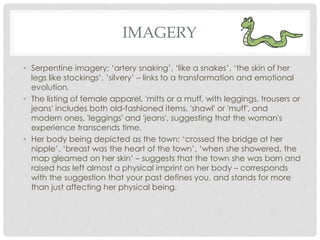
• Serpentine imagery; ‘artery snaking’, ‘like a snakes’, ‘the skin of her
legs like stockings’, ’silvery’ – links to a transformation and emotional
evolution.
• The listing of female apparel, 'mitts or a muff, with leggings, trousers or
jeans' includes both old-fashioned items, 'shawl' or 'muff', and
modern ones, 'leggings' and 'jeans', suggesting that the woman's
experience transcends time.
• Her body being depicted as the town; ‘crossed the bridge at her
nipple’, ‘breast was the heart of the town’, ‘when she showered, the
map gleamed on her skin’ – suggests that the town she was born and
raised has left almost a physical imprint on her body – corresponds
with the suggestion that your past defines you, and stands for more
than just affecting her physical being.

Map Woman Analysis

  • 1.
    C A RO L A N N E D UF F Y MAP WOMAN
  • 2.
    DAME CAROL ANNEDUFFY • Carol Ann Duffy was born 23 December 1955 in Glasgow, though moved to and was raised in Stafford, England. • She is a Scottish poet and playwright and is the Professor of Contemporary Poetry at Manchester Metropolitan University. • She was appointed Britain's Poet Laureate in May 2009 and is the first woman, the first Scot, and the first openly LGBT person to hold this position. • She was a passionate reader from an early age, and always wanted to be a writer, producing poems from the age of 11.
  • 3.
    BIBLIOGRAPHY AND COMMONTOPICS • Her collections include: • Standing Female Nude (1985), winner of a Scottish Arts Council Award; • Selling Manhattan (1987), which won a Somerset Maugham Award; • Mean Time (1993), which won the Whitbread Poetry Award; • Rapture (2005), winner of the T. S. Eliot Prize. • Her poems address issues such as oppression, gender, and violence, in accessible language which has made them popular in schools. "I'm not interested, as a poet, in words like 'plash'—Seamus Heaney words, interesting words. I like to use simple words, but in a complicated way” • Duffy's work explores both out everyday experiences as well as the rich fantasy life of others and herself. In many of her works she dramatizes scenes from childhood, adolescence, and adult life in attempt to convey commonly shared moments of love, memory, and language.
  • 4.
    OTHER WORKS Originally We camefrom our own country in a red room which fell through the fields, our mother singing our father’s name to the turn of the wheels. My brothers cried, one of them bawling, Home, Home, as the miles rushed back to the city, the street, the house, the vacant rooms where we didn’t live any more. I stared at the eyes of a blind toy, holding its paw. All childhood is an emigration. Some are slow, leaving you standing, resigned, up an avenue where no one you know stays. Others are sudden. Your accent wrong. Corners, which seem familiar, leading to unimagined pebble-dashed estates, big boys eating worms and shouting words you don’t understand. My parents’ anxiety stirred like a loose tooth in my head. I want our own country, I said. But then you forget, or don’t recall, or change, and, seeing your brother swallow a slug, feel only a skelf of shame. I remember my tongue shedding its skin like a snake, my voice in the classroom sounding just like the rest. Do I only think I lost a river, culture, speech, sense of first space and the right place? Now, Where do you come from? strangers ask. Originally? And I hesitate. • As an example of Duffy’s style, the poem Originally is based on her family’s move to England and the feelings of being out of place, and conforming to a different culture; a feeling that many of todays children will be able to identify with.
  • 5.
    THEMES IN MAPWOMAN • This poem is part of a collection of poems in ‘Feminine Gospels’ which are all about the experiences of women- ranging from the historical to the imagined. • Duffy hauntingly illustrates that your hometown will never leave you. She explores whether not being able to escape the past is something of a burden – something negative, or something positive; it helps you identify yourself as a person. • However, Duffy points out that it’s about finding your own skin that you’re comfortable with – quite literally.
  • 6.
    ANALYSIS • There isa constant metaphor throughout the poem that a woman’s skin is a map of her own experiences , emotions and surroundings. • ‘She covered it up with… and finger tip sleeved’ – the array of clothing listed begins with general items, however as the list progresses, it becomes increasingly apparent that concealment of this woman's skin is vital. This sense of desire for concealment through excessive measures has us, as an audience, sympathize with this woman, who’s skin evidently bears a heavy weight upon. • The words ‘birth mark’ and ‘tattoo’ provoke connotations of permanence – she cant, no matter how hard she may ever try, escape from the grasps of her marked skin. • The suggestion of her skin being an ‘A-Z map’ that ‘grew’ indicates that she is not simply a representation of the present, but also the past and the future. The dash between A and Z is used to illustrate the past and the present being linked together – displays that you cant ever escape the past, for both your present and future existence is dependent on past experiences. – this is a major theme in the poem.
  • 7.
    ANALYSIS • The phrase‘ a precise second skin’ implies that this women, who is clearly shaped by her past experiences, has attempted to combat her present issues with the ‘skin’ she’s woven out of past events. This displays that although we may not hold the past in high regard, we learn from it how not to make the same mistake in future circumstances. • The line following the above, ‘broad if she binged, thin when she slimmed’, could show this woman’s confidence in the face of matters she’s experienced before, which she’s able to combat with her ‘second skin’, however, in the face of matters she’s less familiar with, she’s depicted as helpless and confused due to her hapless inability to deal with them in a manner known to her - This evokes a sense of sympathy toward the woman. • The references to 'birthmark, tattoo', images denoting permanence, are juxtaposed with a string of verbs with connotations of growth and change: 'grew', 'binged', 'slimmed' and 'begin'.
  • 8.
    ANALYSIS • Use ofthe word ‘nib’ – the tip of a pen – suggests that the town is a focal point in her life, and that she can almost never escape both the town itself and the things she’s experienced within it as they define her being – synonyms. • The reference to specific places in the town throughout the poem, ‘St Mary’s church’, ‘Market square’, ‘Junction 13’, highlights just how attached this woman is to the town and it’s going-ons. • The use of the word ‘anchored’ in stanza 6 indicates that this woman's life is firmly attached to the town, and that no matter how hard she may try; “she sponged, soaped scrubbed”, she can never rid her self of that fact. • In stanza 7 she once again covers up her skin, with “her chiffon veil, a delicate braille”. This suggests that she might be trying to hide her past or make herself ‘harder to read’ – this builds up to the poem’s climax where she sheds her skin in it’s entirety rather than having to cover it up.
  • 9.
    ANALYSIS • Use ofthe words ‘looped’ and ‘repeatedly’ in stanza 8 displays the cyclical structure of this woman’s life, emotions and experiences. It also links with the escapist intentions that this woman harbors. The phrase in stanza 1 ‘ a precis of where to end or go back or begin’ also suggests this cyclical structure, and also that no matter how she may physically alter in size, the map she bears upon her skin never fades nor changes – her past can never escape her. She also visit and flees the town a number of times in the duration of the poem • In stanza 3, the narrator describes ‘your tiny face trapped in the windows bottle thick glass like a fly’- this indicates that this woman feels caught in the towns nauseating societal web and cannot seem to break free. The suggestion of being ‘tiny’ illustrates how insignificant she feels, which could explain why she seeks her own respite, and not instead to gain help of others.
  • 10.
    ANALYSIS • However, despitethe narrators seemingly negative outlook on to the effect her past has had on her mind and body, she emanates a nostalgic sense through her recollection of her past – ‘You could sit on a wooden bench as a wedding pair ran, ringed, from the church, confetti skittering over the marble stones’ – there’s a strong sense of beauty and happiness in some of her memories – despite the weight her past bears on her, it still holds a cherished place of joy within her. • In the third last stanza Duffy writes that “something was wrong … in streets with new names” indicating that her hometown has changed, that the places the “knew like that back of her hand”, “what was familiar was only a facade”. She then sleeps and sheds her skin, symbolising her becoming herself and finding her own sense of locality and individuality; “what was she looking for?” she then realises that this place was not her home – “she ate up the miles. Her skin itched ... Hunting for home”; her home is not simply where she grew up but where she consolidated herself as a woman.
  • 11.
    IMAGERY • Serpentine imagery;‘artery snaking’, ‘like a snakes’, ‘the skin of her legs like stockings’, ’silvery’ – links to a transformation and emotional evolution. • The listing of female apparel, 'mitts or a muff, with leggings, trousers or jeans' includes both old-fashioned items, 'shawl' or 'muff', and modern ones, 'leggings' and 'jeans', suggesting that the woman's experience transcends time. • Her body being depicted as the town; ‘crossed the bridge at her nipple’, ‘breast was the heart of the town’, ‘when she showered, the map gleamed on her skin’ – suggests that the town she was born and raised has left almost a physical imprint on her body – corresponds with the suggestion that your past defines you, and stands for more than just affecting her physical being.