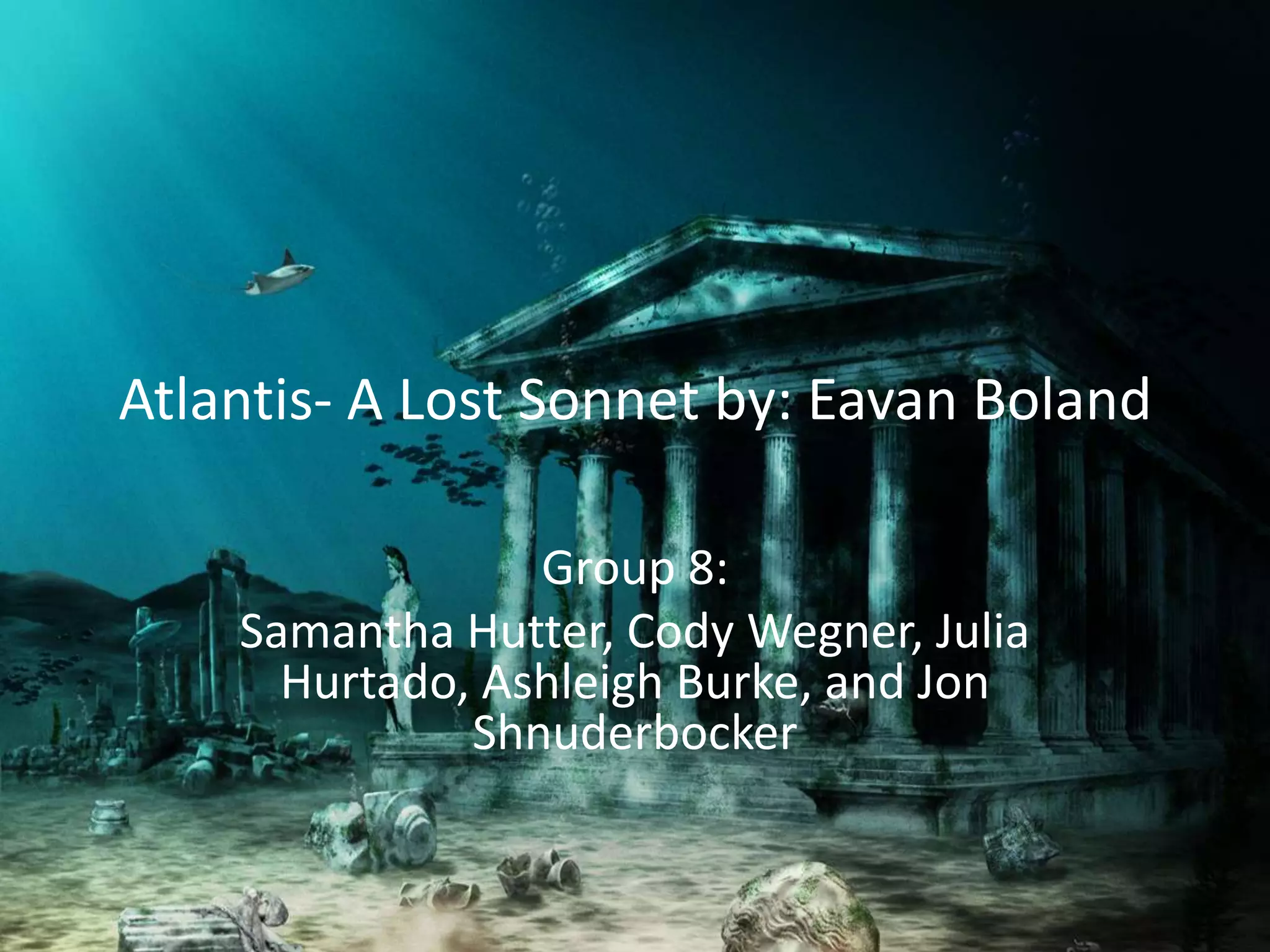
Atlantis- A Lost Sonnet by: Eavan BolandGroup 8:Samantha Hutter, Cody Wegner, Julia Hurtado, Ashleigh Burke, and Jon Shnuderbocker
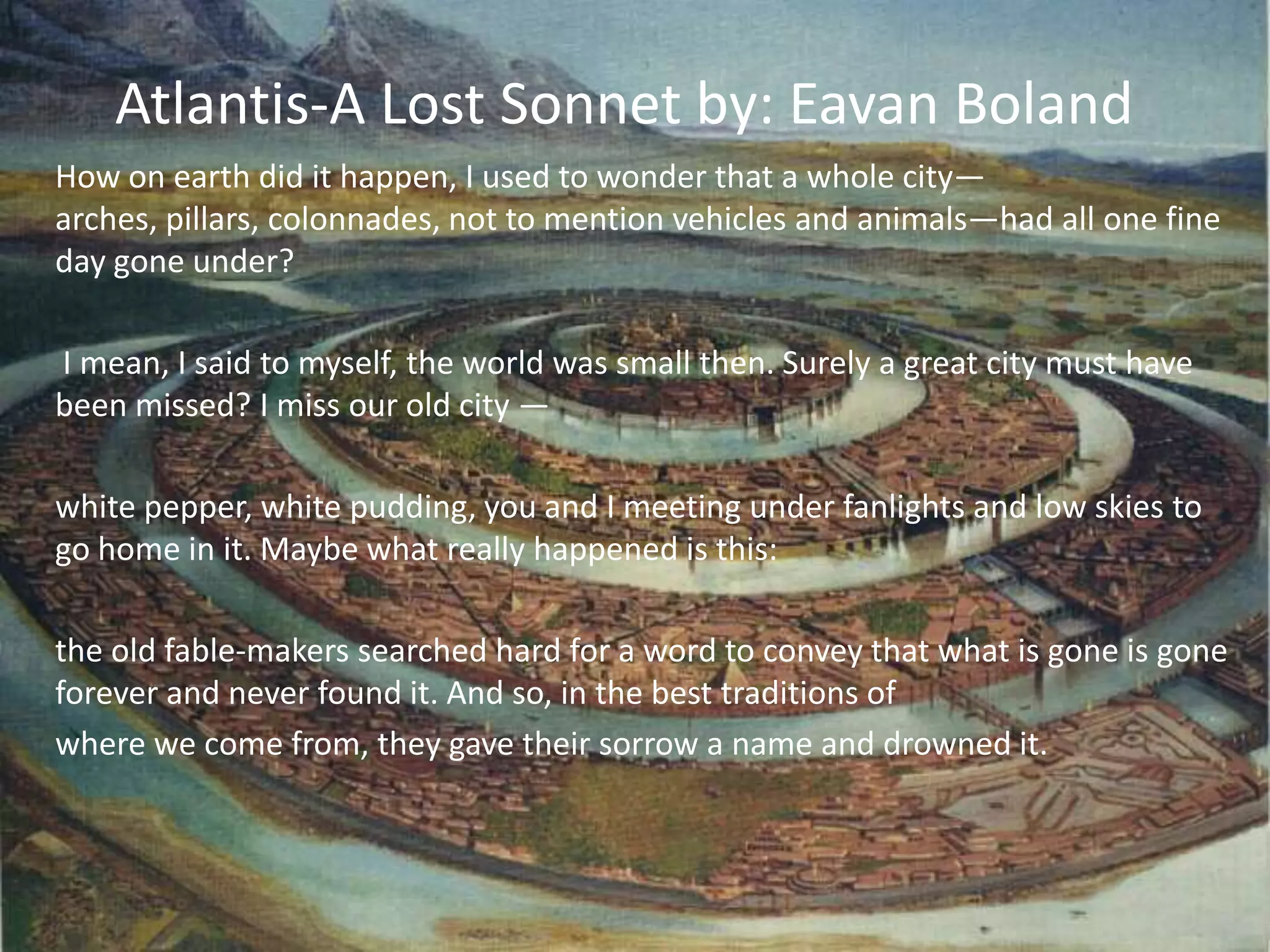
Atlantis-A Lost Sonnet by: Eavan BolandHow on earth did it happen, I used to wonder that a whole city—arches, pillars, colonnades, not to mention vehicles and animals—had all one fine day gone under? I mean, I said to myself, the world was small then. Surely a great city must have been missed? I miss our old city — white pepper, white pudding, you and I meeting under fanlights and low skies to go home in it. Maybe what really happened is this:the old fable-makers searched hard for a word to convey that what is gone is gone forever and never found it. And so, in the best traditions of where we come from, they gave their sorrow a name and drowned it.
Thesis Statement Thesis Statement In Bolands, “Atlantis-A Lost Sonnet” it illustrates the fear of having something of great value taken way, this fear was common in the late 20th century when people would criticize the written work done by women.
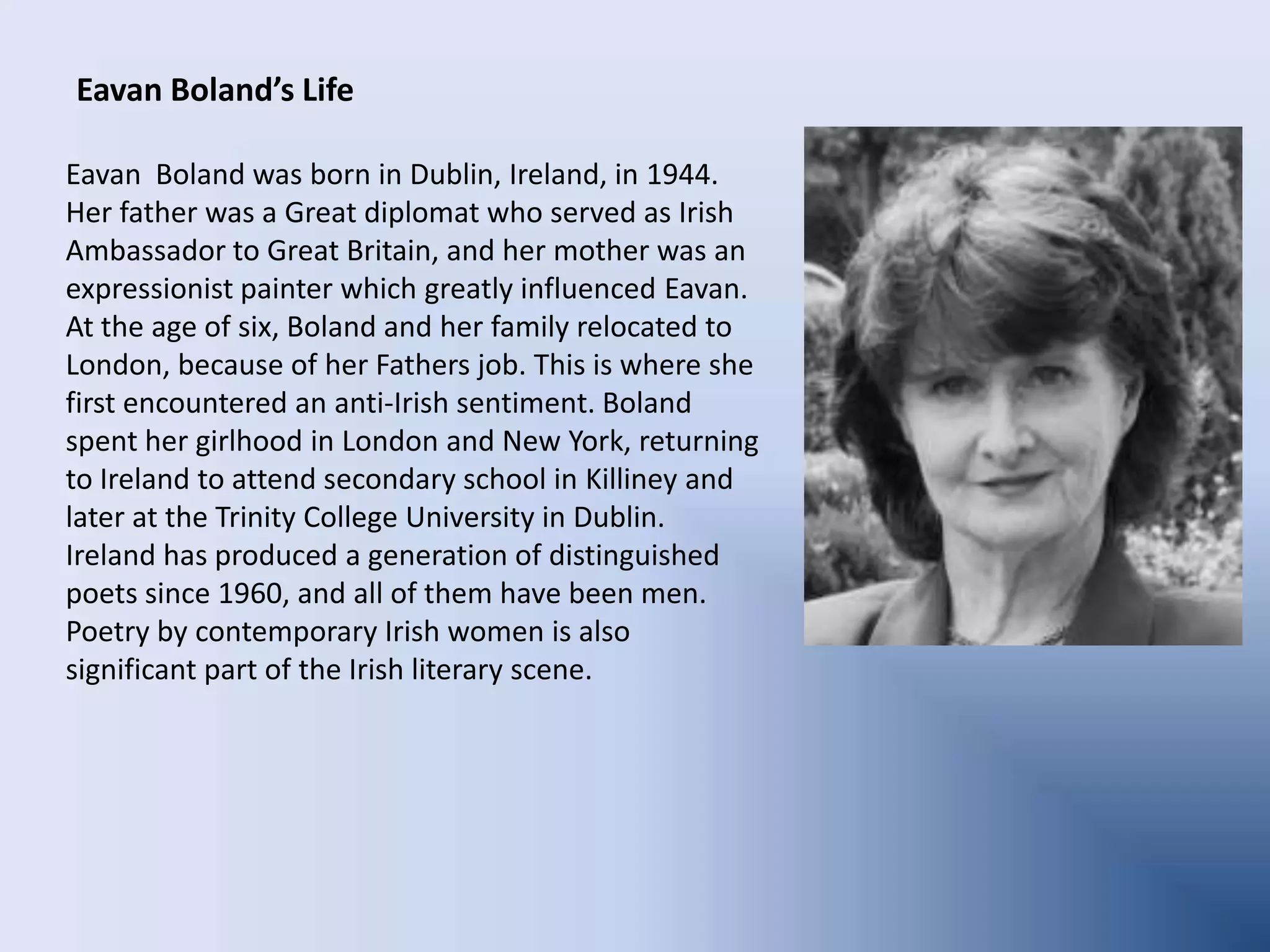
Eavan Boland’s LifeEavan  Boland was born in Dublin, Ireland, in 1944. Her father was a Great diplomat who served as Irish Ambassador to Great Britain, and her mother was an expressionist painter which greatly influenced Eavan.At the age of six, Boland and her family relocated to London, because of her Fathers job. This is where she first encountered an anti-Irish sentiment. Boland spent her girlhood in London and New York, returning to Ireland to attend secondary school in Killiney and later at the Trinity College University in Dublin. Ireland has produced a generation of distinguished poets since 1960, and all of them have been men. Poetry by contemporary Irish women is also significant part of the Irish literary scene.
HardshipsMale stereotypes about the role of women in society continue to be very strong in Ireland and make Irish women less confident about their creative abilities. Women must contend as well with another potentially depersonalizing pressure, that of feminist ideology, which urges women toward another sort of conformity. Boland and the other female poets have managed to overcome both obstacles and develop personal voices.Though still a student when she published her first collection, 23 Poems (1962), Boland’s early work is informed by her experiences as a young wife and mother, and her growing awareness of the troubled role of women in Irish history and culture. Over the course of her long career, Eavan Boland has emerged as one of the foremost  female voices in Irish literature. She later returned to Dublin for school, and she received her B.A. from Trinity College in 1966.
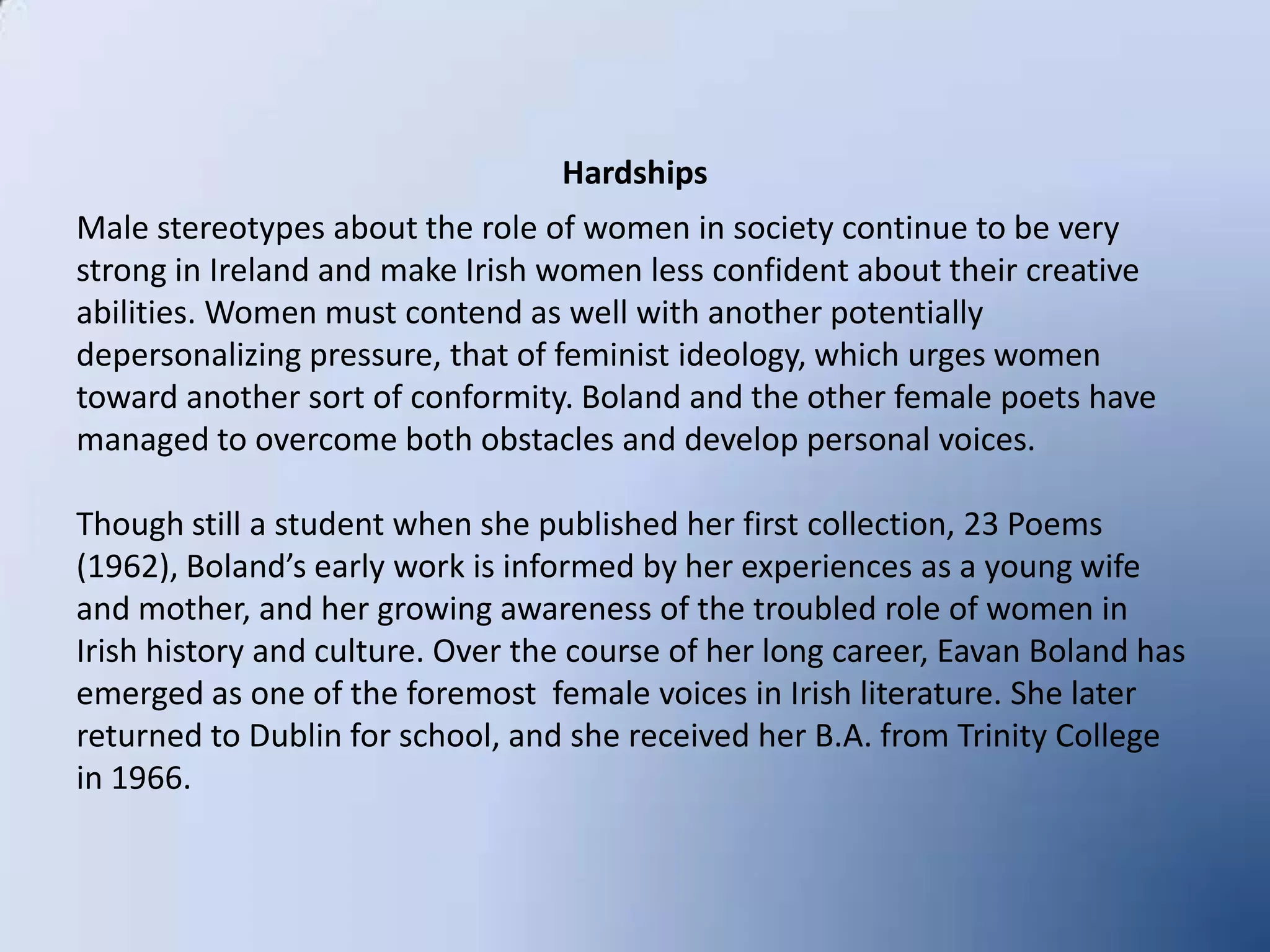
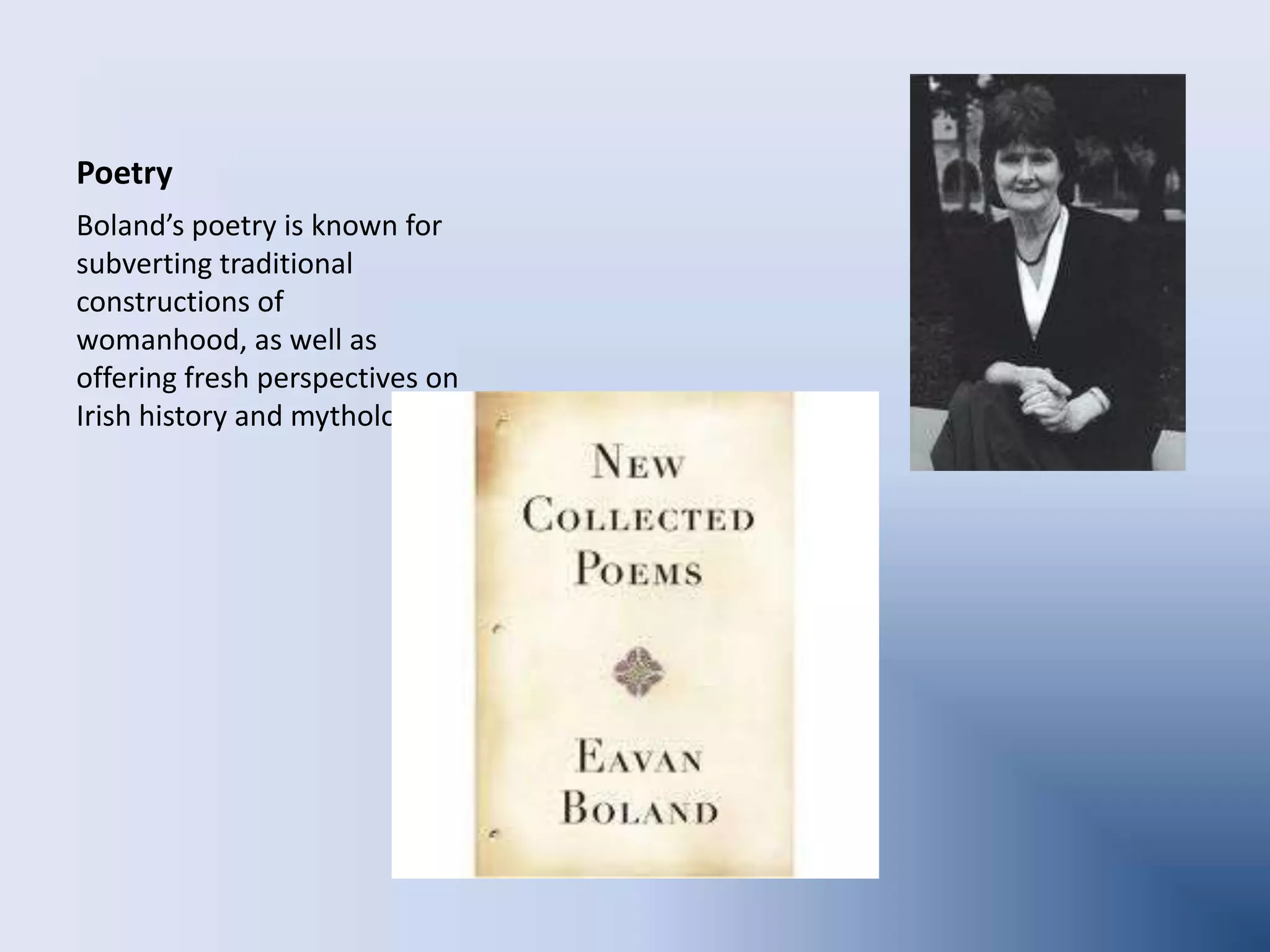
PoetryBoland’s poetry is known for subverting traditional constructions of womanhood, as well as offering fresh perspectives on Irish history and mythology.
Books & WorksHer books of poetry include New Collected Poems (W.W. Norton & Co., 2008), Domestic Violence, (2007), Against Love Poems (2001), The Lost Land (1998), An Origin Like Water: Collected Poems 1967-1987 (1996), In a Time of Violence (1994), Outside History: Selected Poems 1980-1990 (1990), The Journey and Other Poems (1986), Night Feed (1982), and In Her Own Image (1980).In addition to her books of poetry, Boland is also the author of Object Lessons: The Life of the Woman and the Poet in Our Time (W. W. Norton, 1995), a volume of prose, After Every War (Princeton, 2004), an anthology of German women poets, and she co-edited The Making of a Poem: A Norton Anthology of Poetic Forms (with Mark Strand; W. W. Norton & Co., 2000).
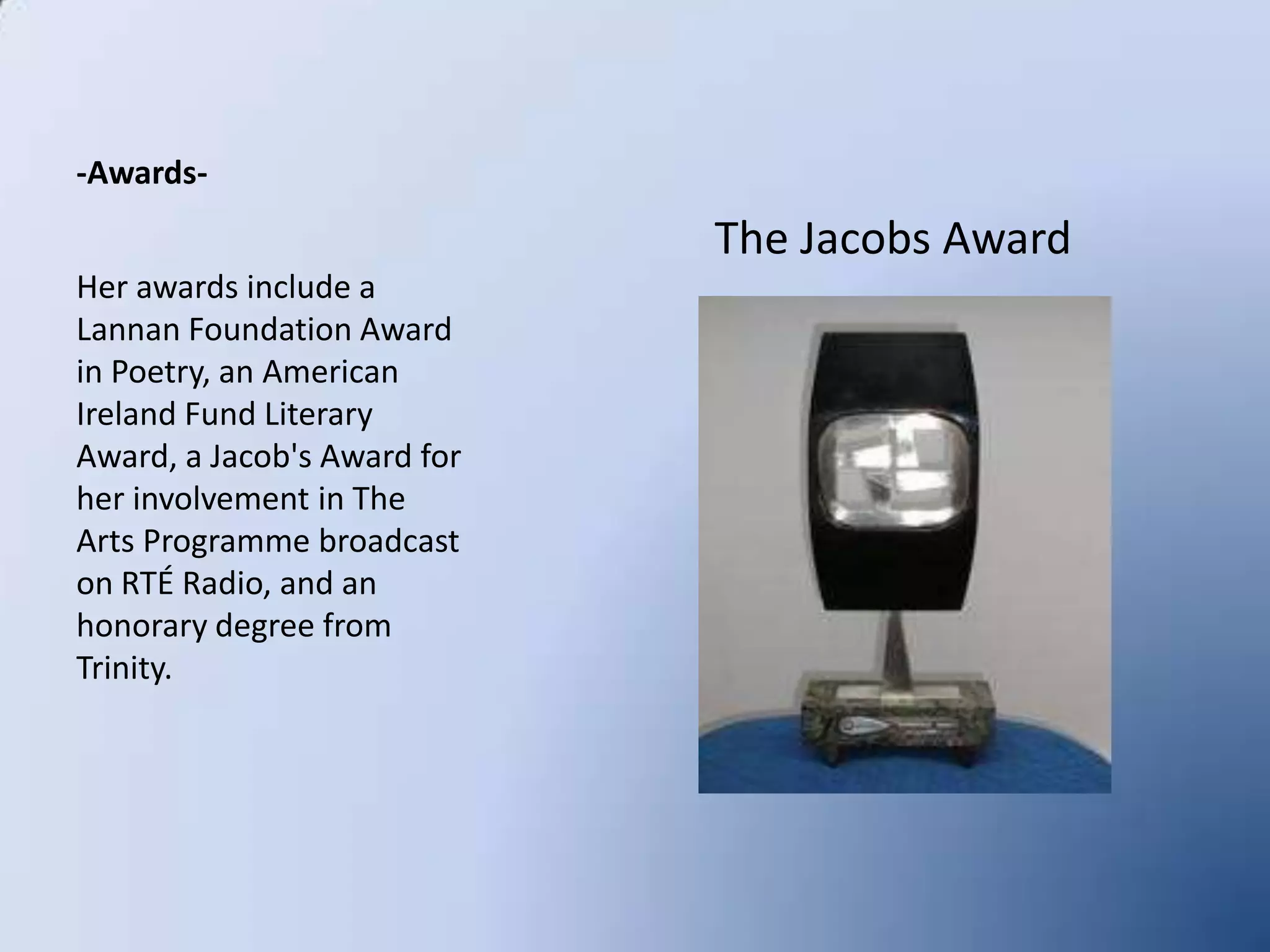
-Awards-Her awards include a Lannan Foundation Award in Poetry, an American Ireland Fund Literary Award, a Jacob's Award for her involvement in The Arts Programme broadcast on RTÉ Radio, and an honorary degree from Trinity.     The Jacobs Award
-TEACHINGS-She has taught at Trinity College, University College, Bowdoin College, and she was a member of the International Writing Program at the University of Iowa. She is also a regular reviewer for the Irish Times.
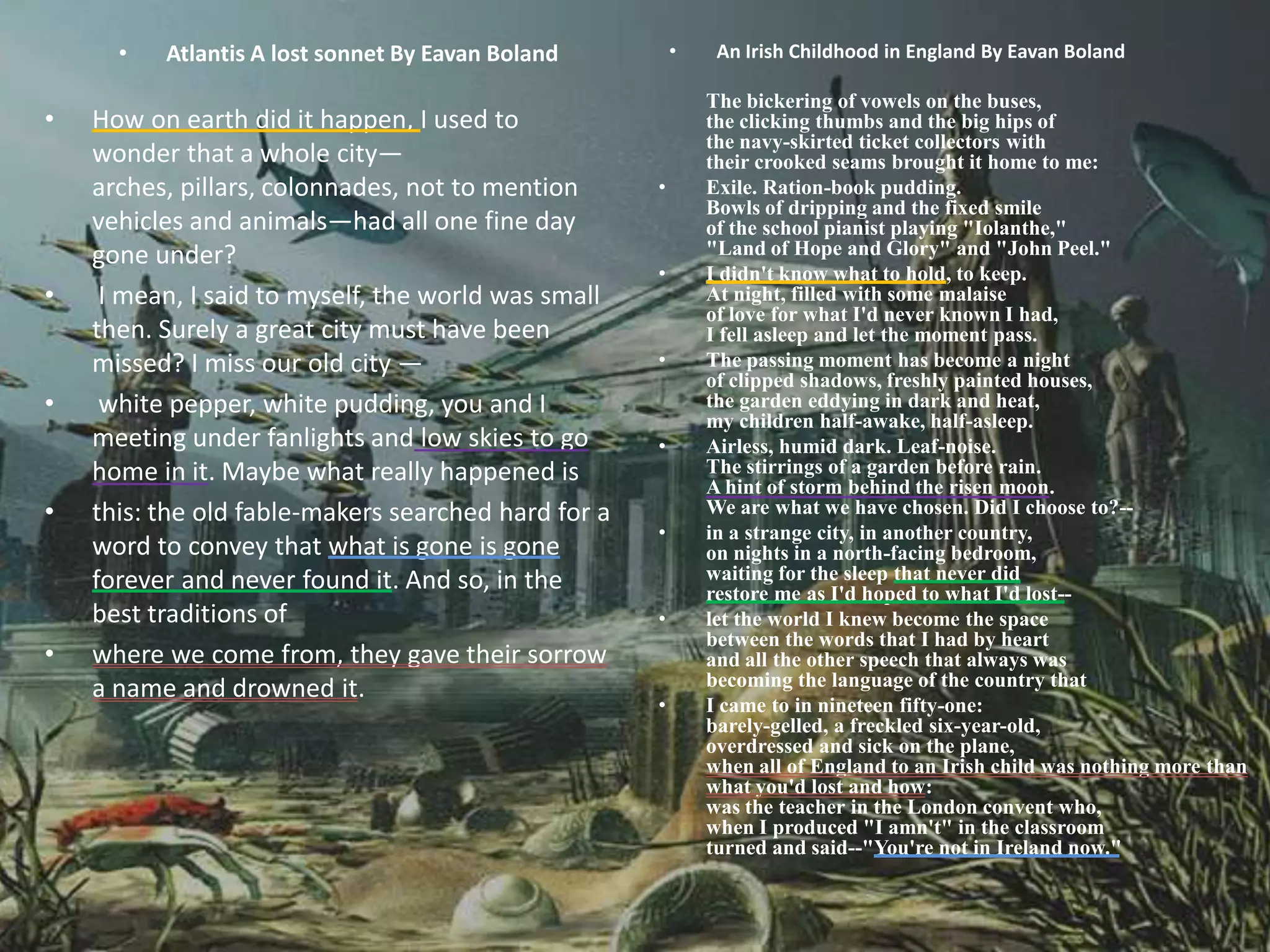
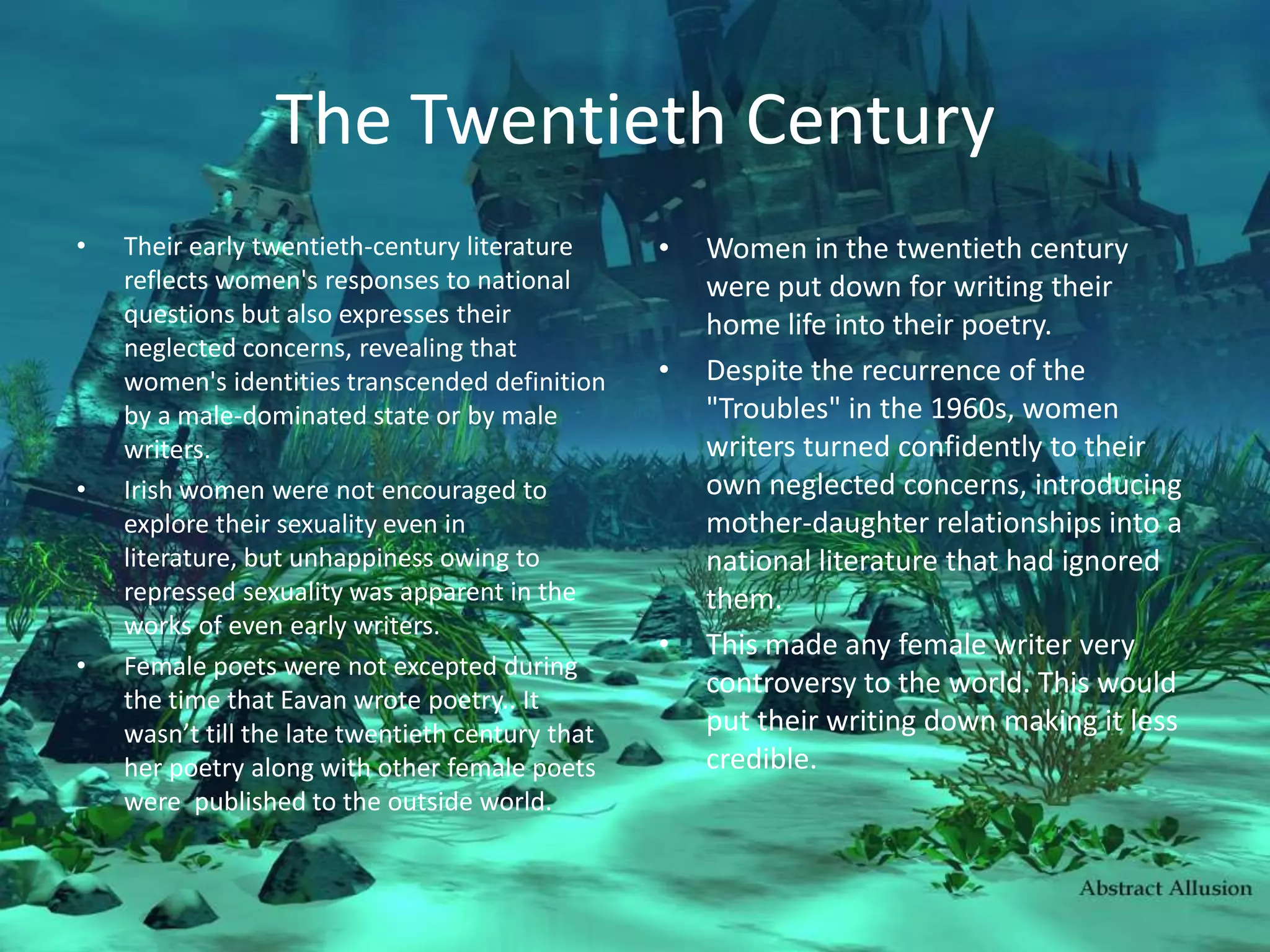
-CURRENT LIFE-Boland and her husband, author Kevin Casey, have two daughters  Sarah and Eavan, and she is currently a professor of English at Stanford University where she directs the creative writing program.                 <3
Atlantis A lost sonnet By Eavan BolandAn Irish Childhood in England By Eavan BolandThe bickering of vowels on the buses, the clicking thumbs and the big hips of the navy-skirted ticket collectors with their crooked seams brought it home to me:Exile. Ration-book pudding.Bowls of dripping and the fixed smile of the school pianist playing "Iolanthe," "Land of Hope and Glory" and "John Peel."I didn't know what to hold, to keep.At night, filled with some malaise of love for what I'd never known I had, I fell asleep and let the moment pass.The passing moment has become a night of clipped shadows, freshly painted houses, the garden eddying in dark and heat, my children half-awake, half-asleep.Airless, humid dark. Leaf-noise.The stirrings of a garden before rain.A hint of storm behind the risen moon.We are what we have chosen. Did I choose to?--in a strange city, in another country, on nights in a north-facing bedroom, waiting for the sleep that never did restore me as I'd hoped to what I'd lost--let the world I knew become the space between the words that I had by heartand all the other speech that always was becoming the language of the country thatI came to in nineteen fifty-one: barely-gelled, a freckled six-year-old, overdressed and sick on the plane, when all of England to an Irish child was nothing more than what you'd lost and how: was the teacher in the London convent who, when I produced "I amn't" in the classroom turned and said--"You're not in Ireland now." How on earth did it happen, I used to wonder that a whole city—arches, pillars, colonnades, not to mention vehicles and animals—had all one fine day gone under? I mean, I said to myself, the world was small then. Surely a great city must have been missed? I miss our old city — white pepper, white pudding, you and I meeting under fanlights and low skies to go home in it. Maybe what really happened is this: the old fable-makers searched hard for a word to convey that what is gone is gone forever and never found it. And so, in the best traditions of where we come from, they gave their sorrow a name and drowned it.
The Twentieth CenturyTheir early twentieth-century literature reflects women's responses to national questions but also expresses their neglected concerns, revealing that women's identities transcended definition by a male-dominated state or by male writers.Irish women were not encouraged to explore their sexuality even in literature, but unhappiness owing to repressed sexuality was apparent in the works of even early writers.Female poets were not excepted during the time that Eavan wrote poetry.. It wasn’t till the late twentieth century that her poetry along with other female poets were  published to the outside world. Women in the twentieth century were put down for writing their home life into their poetry. Despite the recurrence of the "Troubles" in the 1960s, women writers turned confidently to their own neglected concerns, introducing mother-daughter relationships into a national literature that had ignored them.This made any female writer very controversy to the world. This would put their writing down making it less credible.

Presentation slideshow1

  • 1.
    Atlantis- A LostSonnet by: Eavan BolandGroup 8:Samantha Hutter, Cody Wegner, Julia Hurtado, Ashleigh Burke, and Jon Shnuderbocker
  • 2.
    Atlantis-A Lost Sonnetby: Eavan BolandHow on earth did it happen, I used to wonder that a whole city—arches, pillars, colonnades, not to mention vehicles and animals—had all one fine day gone under? I mean, I said to myself, the world was small then. Surely a great city must have been missed? I miss our old city — white pepper, white pudding, you and I meeting under fanlights and low skies to go home in it. Maybe what really happened is this:the old fable-makers searched hard for a word to convey that what is gone is gone forever and never found it. And so, in the best traditions of where we come from, they gave their sorrow a name and drowned it.
  • 3.
    Thesis Statement ThesisStatement In Bolands, “Atlantis-A Lost Sonnet” it illustrates the fear of having something of great value taken way, this fear was common in the late 20th century when people would criticize the written work done by women.
  • 4.
    Eavan Boland’s LifeEavan Boland was born in Dublin, Ireland, in 1944. Her father was a Great diplomat who served as Irish Ambassador to Great Britain, and her mother was an expressionist painter which greatly influenced Eavan.At the age of six, Boland and her family relocated to London, because of her Fathers job. This is where she first encountered an anti-Irish sentiment. Boland spent her girlhood in London and New York, returning to Ireland to attend secondary school in Killiney and later at the Trinity College University in Dublin. Ireland has produced a generation of distinguished poets since 1960, and all of them have been men. Poetry by contemporary Irish women is also significant part of the Irish literary scene.
  • 5.
    HardshipsMale stereotypes aboutthe role of women in society continue to be very strong in Ireland and make Irish women less confident about their creative abilities. Women must contend as well with another potentially depersonalizing pressure, that of feminist ideology, which urges women toward another sort of conformity. Boland and the other female poets have managed to overcome both obstacles and develop personal voices.Though still a student when she published her first collection, 23 Poems (1962), Boland’s early work is informed by her experiences as a young wife and mother, and her growing awareness of the troubled role of women in Irish history and culture. Over the course of her long career, Eavan Boland has emerged as one of the foremost female voices in Irish literature. She later returned to Dublin for school, and she received her B.A. from Trinity College in 1966.
  • 6.
    PoetryBoland’s poetry isknown for subverting traditional constructions of womanhood, as well as offering fresh perspectives on Irish history and mythology.
  • 7.
    Books & WorksHerbooks of poetry include New Collected Poems (W.W. Norton & Co., 2008), Domestic Violence, (2007), Against Love Poems (2001), The Lost Land (1998), An Origin Like Water: Collected Poems 1967-1987 (1996), In a Time of Violence (1994), Outside History: Selected Poems 1980-1990 (1990), The Journey and Other Poems (1986), Night Feed (1982), and In Her Own Image (1980).In addition to her books of poetry, Boland is also the author of Object Lessons: The Life of the Woman and the Poet in Our Time (W. W. Norton, 1995), a volume of prose, After Every War (Princeton, 2004), an anthology of German women poets, and she co-edited The Making of a Poem: A Norton Anthology of Poetic Forms (with Mark Strand; W. W. Norton & Co., 2000).
  • 8.
    -Awards-Her awards includea Lannan Foundation Award in Poetry, an American Ireland Fund Literary Award, a Jacob's Award for her involvement in The Arts Programme broadcast on RTÉ Radio, and an honorary degree from Trinity. The Jacobs Award
  • 9.
    -TEACHINGS-She has taughtat Trinity College, University College, Bowdoin College, and she was a member of the International Writing Program at the University of Iowa. She is also a regular reviewer for the Irish Times.
  • 10.
    -CURRENT LIFE-Boland andher husband, author Kevin Casey, have two daughters Sarah and Eavan, and she is currently a professor of English at Stanford University where she directs the creative writing program. <3
  • 11.
    Atlantis A lostsonnet By Eavan BolandAn Irish Childhood in England By Eavan BolandThe bickering of vowels on the buses, the clicking thumbs and the big hips of the navy-skirted ticket collectors with their crooked seams brought it home to me:Exile. Ration-book pudding.Bowls of dripping and the fixed smile of the school pianist playing "Iolanthe," "Land of Hope and Glory" and "John Peel."I didn't know what to hold, to keep.At night, filled with some malaise of love for what I'd never known I had, I fell asleep and let the moment pass.The passing moment has become a night of clipped shadows, freshly painted houses, the garden eddying in dark and heat, my children half-awake, half-asleep.Airless, humid dark. Leaf-noise.The stirrings of a garden before rain.A hint of storm behind the risen moon.We are what we have chosen. Did I choose to?--in a strange city, in another country, on nights in a north-facing bedroom, waiting for the sleep that never did restore me as I'd hoped to what I'd lost--let the world I knew become the space between the words that I had by heartand all the other speech that always was becoming the language of the country thatI came to in nineteen fifty-one: barely-gelled, a freckled six-year-old, overdressed and sick on the plane, when all of England to an Irish child was nothing more than what you'd lost and how: was the teacher in the London convent who, when I produced "I amn't" in the classroom turned and said--"You're not in Ireland now." How on earth did it happen, I used to wonder that a whole city—arches, pillars, colonnades, not to mention vehicles and animals—had all one fine day gone under? I mean, I said to myself, the world was small then. Surely a great city must have been missed? I miss our old city — white pepper, white pudding, you and I meeting under fanlights and low skies to go home in it. Maybe what really happened is this: the old fable-makers searched hard for a word to convey that what is gone is gone forever and never found it. And so, in the best traditions of where we come from, they gave their sorrow a name and drowned it.
  • 12.
    The Twentieth CenturyTheirearly twentieth-century literature reflects women's responses to national questions but also expresses their neglected concerns, revealing that women's identities transcended definition by a male-dominated state or by male writers.Irish women were not encouraged to explore their sexuality even in literature, but unhappiness owing to repressed sexuality was apparent in the works of even early writers.Female poets were not excepted during the time that Eavan wrote poetry.. It wasn’t till the late twentieth century that her poetry along with other female poets were published to the outside world. Women in the twentieth century were put down for writing their home life into their poetry. Despite the recurrence of the "Troubles" in the 1960s, women writers turned confidently to their own neglected concerns, introducing mother-daughter relationships into a national literature that had ignored them.This made any female writer very controversy to the world. This would put their writing down making it less credible.