HOW TO WRITE FOR THE AP EXAM
AP Psychology
JUST THE FACTS
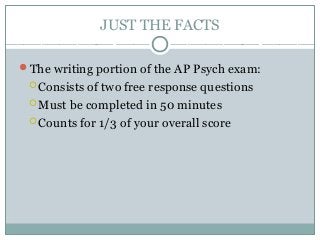
The writing portion of the AP Psych exam:
 Consists of two free response questions
 Must be completed in 50 minutes
 Counts for 1/3 of your overall score
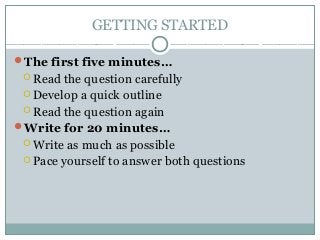
GETTING STARTED
The first five minutes…
 Read the question carefully
 Develop a quick outline
 Read the question again
Write for 20 minutes…
 Write as much as possible
 Pace yourself to answer both questions
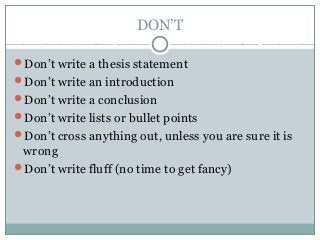
DON’T
Don’t write a thesis statement
Don’t write an introduction
Don’t write a conclusion
Don’t write lists or bullet points
Don’t cross anything out, unless you are sure it is
wrong
Don’t write fluff (no time to get fancy)
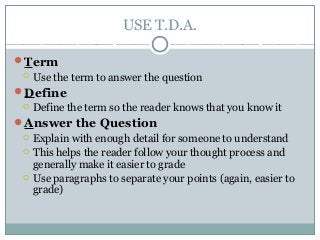
USE T.D.A.
Term
 Use the term to answer the question
Define
 Define the term so the reader knows that you know it
Answer the Question
 Explain with enough detail for someone to understand
 This helps the reader follow your thought process and
generally make it easier to grade
 Use paragraphs to separate your points (again, easier to
grade)
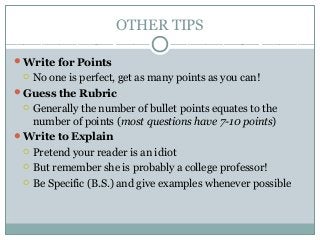
OTHER TIPS
Write for Points
 No one is perfect, get as many points as you can!
Guess the Rubric
 Generally the number of bullet points equates to the
number of points (most questions have 7-10 points)
Write to Explain
 Pretend your reader is an idiot
 But remember she is probably a college professor!
 Be Specific (B.S.) and give examples whenever possible
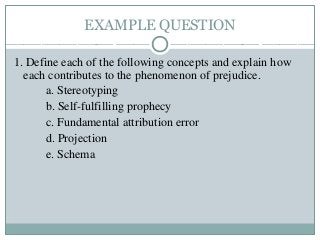
EXAMPLE QUESTION
1. Define each of the following concepts and explain how
each contributes to the phenomenon of prejudice.
a. Stereotyping
b. Self-fulfilling prophecy
c. Fundamental attribution error
d. Projection
e. Schema
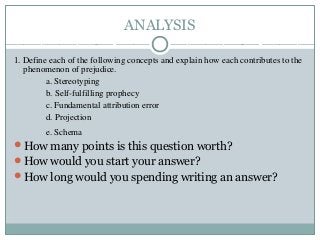
ANALYSIS
1. Define each of the following concepts and explain how each contributes to the
phenomenon of prejudice.
a. Stereotyping
b. Self-fulfilling prophecy
c. Fundamental attribution error
d. Projection
e. Schema
How many points is this question worth?
How would you start your answer?
How long would you spending writing an answer?
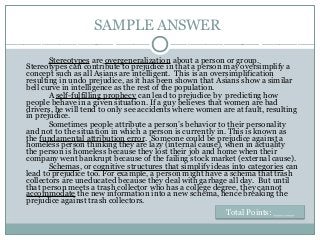
SAMPLE ANSWER
Stereotypes are overgeneralization about a person or group.
Stereotypes can contribute to prejudice in that a person may oversimplify a
concept such as all Asians are intelligent. This is an oversimplification
resulting in undo prejudice, as it has been shown that Asians show a similar
bell curve in intelligence as the rest of the population.
A self-fulfilling prophecy can lead to prejudice by predicting how
people behave in a given situation. If a guy believes that women are bad
drivers, he will tend to only see accidents where women are at fault, resulting
in prejudice.
Sometimes people attribute a person’s behavior to their personality
and not to the situation in which a person is currently in. This is known as
the fundamental attribution error. Someone could be prejudice against a
homeless person thinking they are lazy (internal cause), when in actuality
the person is homeless because they lost their job and home when their
company went bankrupt because of the failing stock market (external cause).
Schemas, or cognitive structures that simplify ideas into categories can
lead to prejudice too. For example, a person might have a schema that trash
collectors are uneducated because they deal with garbage all day. But until
that person meets a trash collector who has a college degree, they cannot
accommodate the new information into a new schema, hence breaking the
prejudice against trash collectors.
Total Points: ____
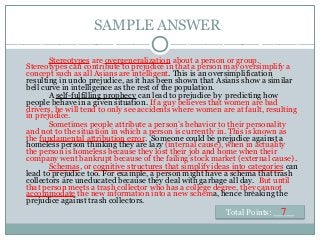
SAMPLE ANSWER
Stereotypes are overgeneralization about a person or group.
Stereotypes can contribute to prejudice in that a person may oversimplify a
concept such as all Asians are intelligent. This is an oversimplification
resulting in undo prejudice, as it has been shown that Asians show a similar
bell curve in intelligence as the rest of the population.
A self-fulfilling prophecy can lead to prejudice by predicting how
people behave in a given situation. If a guy believes that women are bad
drivers, he will tend to only see accidents where women are at fault, resulting
in prejudice.
Sometimes people attribute a person’s behavior to their personality
and not to the situation in which a person is currently in. This is known as
the fundamental attribution error. Someone could be prejudice against a
homeless person thinking they are lazy (internal cause), when in actuality
the person is homeless because they lost their job and home when their
company went bankrupt because of the failing stock market (external cause).
Schemas, or cognitive structures that simplify ideas into categories can
lead to prejudice too. For example, a person might have a schema that trash
collectors are uneducated because they deal with garbage all day. But until
that person meets a trash collector who has a college degree, they cannot
accommodate the new information into a new schema, hence breaking the
prejudice against trash collectors.
Total Points: ____7


FRQ Writing for AP Psychology

  • 1.
    HOW TO WRITEFOR THE AP EXAM AP Psychology
  • 2.
    JUST THE FACTS Thewriting portion of the AP Psych exam:  Consists of two free response questions  Must be completed in 50 minutes  Counts for 1/3 of your overall score
  • 3.
    GETTING STARTED The firstfive minutes…  Read the question carefully  Develop a quick outline  Read the question again Write for 20 minutes…  Write as much as possible  Pace yourself to answer both questions
  • 4.
    DON’T Don’t write athesis statement Don’t write an introduction Don’t write a conclusion Don’t write lists or bullet points Don’t cross anything out, unless you are sure it is wrong Don’t write fluff (no time to get fancy)
  • 5.
    USE T.D.A. Term  Usethe term to answer the question Define  Define the term so the reader knows that you know it Answer the Question  Explain with enough detail for someone to understand  This helps the reader follow your thought process and generally make it easier to grade  Use paragraphs to separate your points (again, easier to grade)
  • 6.
    OTHER TIPS Write forPoints  No one is perfect, get as many points as you can! Guess the Rubric  Generally the number of bullet points equates to the number of points (most questions have 7-10 points) Write to Explain  Pretend your reader is an idiot  But remember she is probably a college professor!  Be Specific (B.S.) and give examples whenever possible
  • 7.
    EXAMPLE QUESTION 1. Defineeach of the following concepts and explain how each contributes to the phenomenon of prejudice. a. Stereotyping b. Self-fulfilling prophecy c. Fundamental attribution error d. Projection e. Schema
  • 8.
    ANALYSIS 1. Define eachof the following concepts and explain how each contributes to the phenomenon of prejudice. a. Stereotyping b. Self-fulfilling prophecy c. Fundamental attribution error d. Projection e. Schema How many points is this question worth? How would you start your answer? How long would you spending writing an answer?
  • 9.
    SAMPLE ANSWER Stereotypes areovergeneralization about a person or group. Stereotypes can contribute to prejudice in that a person may oversimplify a concept such as all Asians are intelligent. This is an oversimplification resulting in undo prejudice, as it has been shown that Asians show a similar bell curve in intelligence as the rest of the population. A self-fulfilling prophecy can lead to prejudice by predicting how people behave in a given situation. If a guy believes that women are bad drivers, he will tend to only see accidents where women are at fault, resulting in prejudice. Sometimes people attribute a person’s behavior to their personality and not to the situation in which a person is currently in. This is known as the fundamental attribution error. Someone could be prejudice against a homeless person thinking they are lazy (internal cause), when in actuality the person is homeless because they lost their job and home when their company went bankrupt because of the failing stock market (external cause). Schemas, or cognitive structures that simplify ideas into categories can lead to prejudice too. For example, a person might have a schema that trash collectors are uneducated because they deal with garbage all day. But until that person meets a trash collector who has a college degree, they cannot accommodate the new information into a new schema, hence breaking the prejudice against trash collectors. Total Points: ____
  • 10.
    SAMPLE ANSWER Stereotypes areovergeneralization about a person or group. Stereotypes can contribute to prejudice in that a person may oversimplify a concept such as all Asians are intelligent. This is an oversimplification resulting in undo prejudice, as it has been shown that Asians show a similar bell curve in intelligence as the rest of the population. A self-fulfilling prophecy can lead to prejudice by predicting how people behave in a given situation. If a guy believes that women are bad drivers, he will tend to only see accidents where women are at fault, resulting in prejudice. Sometimes people attribute a person’s behavior to their personality and not to the situation in which a person is currently in. This is known as the fundamental attribution error. Someone could be prejudice against a homeless person thinking they are lazy (internal cause), when in actuality the person is homeless because they lost their job and home when their company went bankrupt because of the failing stock market (external cause). Schemas, or cognitive structures that simplify ideas into categories can lead to prejudice too. For example, a person might have a schema that trash collectors are uneducated because they deal with garbage all day. But until that person meets a trash collector who has a college degree, they cannot accommodate the new information into a new schema, hence breaking the prejudice against trash collectors. Total Points: ____7