Exchange knowledge and techniques on roads and road transport
Electric Road Systems: a solution for the future?
Miguel Caso Florez – PIARC Technical Director
Dominic Leal – Researcher TRL
Exchange knowledge and techniques on roads and road transport
Content of this presentation:
• PIARC Special Project – ERS: a solution for the future? Miguel Caso Florez
• ERS: technical aspects. Dominic Leal
• ERS: development challenges and opportunities. Miguel Caso Florez
Electric Road Systems: a solution for the future?
Exchange knowledge and techniques on roads and road transport
PIARC Special Project – ERS: a solution for the future?
Miguel Caso Florez
Electric Road Systems: a solution for the future?
Exchange knowledge and techniques on roads and road transport
PIARC Special Project mechanism aims to respond to emerging
issues in the road sector within a limited time frame (12 months).
Special Project on ERS was proposed by Sweden and it was actively
supported by Portugal and United Kingdom.
The following PIARC Technical Committees were involved:
• TC D.1 Road asset management.
• TC B.4 Freight transport.
• TC E.2 Environment Considerations in Road Projects and
Operations.
Selected external consultant: Transport Research Laboratory (TRL).
Electric Road Systems: a solution for the future?
PIARC Special Project
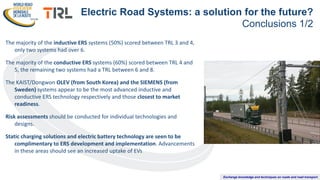
Exchange knowledge and techniques on roads and road transport
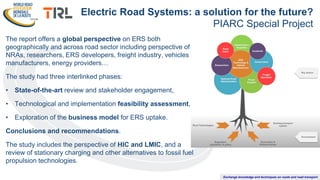
The report offers a global perspective on ERS both
geographically and across road sector including perspective of
NRAs, researchers, ERS developers, freight industry, vehicles
manufacturers, energy providers…
The study had three interlinked phases:
• State-of-the-art review and stakeholder engagement,
• Technological and implementation feasibility assessment,
• Exploration of the business model for ERS uptake.
Conclusions and recommendations.
The study includes the perspective of HIC and LMIC, and a
review of stationary charging and other alternatives to fossil fuel
propulsion technologies.
Electric Road Systems: a solution for the future?
PIARC Special Project
Exchange knowledge and techniques on roads and road transport
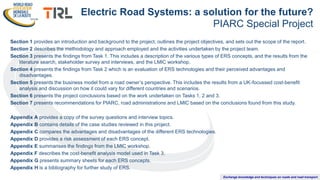
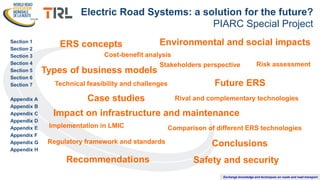
Section 1 provides an introduction and background to the project, outlines the project objectives, and sets out the scope of the report.
Section 2 describes the methodology and approach employed and the activities undertaken by the project team.
Section 3 presents the findings from Task 1. This includes a description of the various types of ERS concepts, and the results from the
literature search, stakeholder survey and interviews, and the LMIC workshop.
Section 4 presents the findings from Task 2 which is an evaluation of ERS technologies and their perceived advantages and
disadvantages.
Section 5 presents the business model from a road owner’s perspective. This includes the results from a UK-focussed cost-benefit
analysis and discussion on how it could vary for different countries and scenarios.
Section 6 presents the project conclusions based on the work undertaken on Tasks 1, 2 and 3.
Section 7 presents recommendations for PIARC, road administrations and LMIC based on the conclusions found from this study.
Appendix A provides a copy of the survey questions and interview topics.
Appendix B contains details of the case studies reviewed in this project.
Appendix C compares the advantages and disadvantages of the different ERS technologies.
Appendix D provides a risk assessment of each ERS concept.
Appendix E summarises the findings from the LMIC workshop.
Appendix F describes the cost-benefit analysis model used in Task 3.
Appendix G presents summary sheets for each ERS concepts.
Appendix H is a bibliography for further study of ERS.
Electric Road Systems: a solution for the future?
PIARC Special Project
Exchange knowledge and techniques on roads and road transport
Section 1
Section 2
Section 3
Section 4
Section 5
Section 6
Section 7
Appendix A
Appendix B
Appendix C
Appendix D
Appendix E
Appendix F
Appendix G
Appendix H
Electric Road Systems: a solution for the future?
PIARC Special Project
ERS concepts
Case studies Rival and complementary technologies
Risk assessment
Regulatory framework and standards
Technical feasibility and challenges
Comparison of different ERS technologies
Stakeholders perspective
Conclusions
Safety and security
Impact on infrastructure and maintenance
Environmental and social impacts
Types of business models
Future ERS
Recommendations
Cost-benefit analysis
Implementation in LMIC
Exchange knowledge and techniques on roads and road transport
Electric Road Systems: a solution for the future?
PIARC Special Project
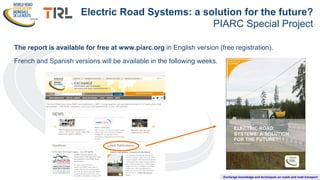
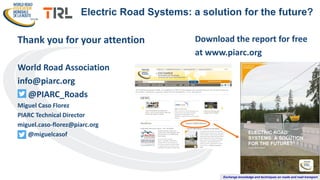
The report is available for free at www.piarc.org in English version (free registration).
French and Spanish versions will be available in the following weeks.
Exchange knowledge and techniques on roads and road transport
ERS: technical aspects
Dominic Leal
Electric Road Systems: a solution for the future?
Exchange knowledge and techniques on roads and road transport
Electric Road Systems: a solution for the future?
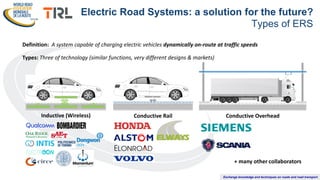
Types of ERS
Definition: A system capable of charging electric vehicles dynamically on-route at traffic speeds
Types: Three of technology (similar functions, very different designs & markets)
Inductive (Wireless) Conductive Rail Conductive Overhead
+ many other collaborators
Exchange knowledge and techniques on roads and road transport
Electric Road Systems: a solution for the future?
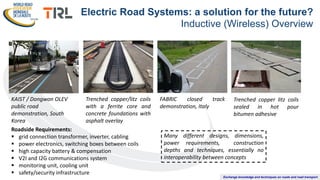
Inductive (Wireless) Overview
Trenched copper/litz coils
with a ferrite core and
concrete foundations with
asphalt overlay
FABRIC closed track
demonstration, Italy
KAIST / Dongwon OLEV
public road
demonstration, South
Korea
Trenched copper litz coils
sealed in hot pour
bitumen adhesive
Roadside Requirements:
▪ grid connection transformer, inverter, cabling
▪ power electronics, switching boxes between coils
▪ high capacity battery & compensation
▪ V2I and I2G communications system
▪ monitoring unit, cooling unit
▪ safety/security infrastructure
Many different designs, dimensions,
power requirements, construction
depths and techniques, essentially no
interoperability between concepts
Exchange knowledge and techniques on roads and road transport
Electric Road Systems: a solution for the future?
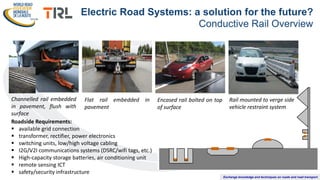
Conductive Rail Overview
Channelled rail embedded
in pavement, flush with
surface
Flat rail embedded in
pavement
Encased rail bolted on top
of surface
Rail mounted to verge side
vehicle restraint system
Roadside Requirements:
▪ available grid connection
▪ transformer, rectifier, power electronics
▪ switching units, low/high voltage cabling
▪ I2G/V2I communications systems (DSRC/wifi tags, etc.)
▪ High-capacity storage batteries, air conditioning unit
▪ remote sensing ICT
▪ safety/security infrastructure
Exchange knowledge and techniques on roads and road transport
Electric Road Systems: a solution for the future?
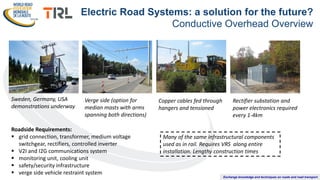
Conductive Overhead Overview
Sweden, Germany, USA
demonstrations underway
Verge side (option for
median masts with arms
spanning both directions)
Rectifier substation and
power electronics required
every 1-4km
Copper cables fed through
hangers and tensioned
Roadside Requirements:
▪ grid connection, transformer, medium voltage
switchgear, rectifiers, controlled inverter
▪ V2I and I2G communications system
▪ monitoring unit, cooling unit
▪ safety/security infrastructure
▪ verge side vehicle restraint system
Many of the same infrastructural components
used as in rail. Requires VRS along entire
installation. Lengthy construction times
Exchange knowledge and techniques on roads and road transport
Electric Road Systems: a solution for the future?
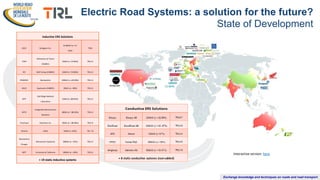
State of Development
Inductive ERS Solutions
OLEV Dongwon Inc.
15-85kW (η =71-
91%)
TRL9
CWD
Politecnico di Torino
(FABRIC)
20kW (η =75-85%) TRL3-4
IPV SAET Group (FABRIC) 20kW (η =70-80%) TRL3-4
PRIMOVE Bombardier 200kW (η =69-90%) TRL5-6
HALO Qualcomm (FABRIC) 20kW (η = 80%) TRL3-4
WPT
Oak Ridge National
Laboratory
20kW (η =88-95%) TRL3-4
INTIS
Integrated Infrastructure
Solutions
60kW (η = 88-93%) TRL3-4
Electroad Electreon Inc. 20kW (η = 88-90%) TRL5-6
Victoria CIRCE 50kW (η =92%) TRL 7-8
Momentum
Charger
Momentum Dynamics 300kW (η = 95%) TRL3-4
WPT University of California 200kW (η = 60%) TRL3-4
+ 19 static inductive systems
Interactive version: here
Exchange knowledge and techniques on roads and road transport
Electric Road Systems: a solution for the future?
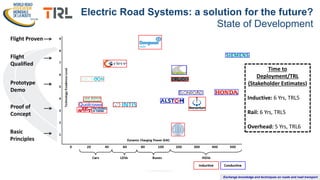
State of Development
Flight Proven
Flight
Qualified
Basic
Principles
Proof of
Concept
Prototype
Demo
Time to
Deployment/TRL
(Stakeholder Estimates)
Inductive: 6 Yrs, TRL5
Rail: 6 Yrs, TRL5
Overhead: 5 Yrs, TRL6
Exchange knowledge and techniques on roads and road transport
ERS: development challenges and opportunities.
Miguel Caso Florez
Electric Road Systems: a solution for the future?
Exchange knowledge and techniques on roads and road transport
Understanding the ERS market:
Freight industry (HGVs) and public transport operators (buses) are likely first adopters of
ERS.
Private passenger cars (LVs) are likely to charge at home if possible, as this is likely to be
cheaper and more convenient than public charging facilities.
Private cars would only need ERS under very specific circumstances (over 90% of the rides
are short and urban), while autonomous shared cars could need furthermore ERS.
Static charging facilities could be a significant competitor technology for LVs (less relevant
to HGVs and buses) but they also play a complementary role on the EV uptake.
Adapting vehicles to ERS has a user cost => Only worth it if significant use: private cars?
KEY QUESTION: Who are we designing the ERS for? A system designed solely for HGVs
may look very different to a system aimed a more mixed user group both technically
and in terms of the business model.
Electric Road Systems: a solution for the future?
Opportunities
Exchange knowledge and techniques on roads and road transport
Key barriers: high capital cost (for installation, maintenance and
administration) and risks associated with relatively immature
technology.
A key message from stakeholders was that government support is
critical to ERS development and in addressing industry concerns.
Responsibility for ownership and operation of ERS technology
remains to be defined. Most likely private public partnership
would be needed for implementation. Modifications to the
existing regulatory framework and concessions will be needed.
Electric Road Systems: a solution for the future?
Challenges 1/2
?
Exchange knowledge and techniques on roads and road transport
How many kms of ERS do we need?
Freight operators only require 25km per day of charging at ERS to achieve
satisfactory payback compared to diesel.
20,000km of conductive rail ERS could provide €3.1bn annual savings
compared to diesel use.
Interoperability:
Currently a variety of technologies have been developed and demonstrated
with no interoperability between or within concept types.
The various conductive solutions proposed are all inherently non-
interoperable.
The interoperability considerations for inductive power transfer systems
are more advanced.
Electric Road Systems: a solution for the future?
Challenges 2/2
Exchange knowledge and techniques on roads and road transport
Funding mechanism: user-payer principle, but not only.
ERS can allow Governments to meet carbon reduction
targets. Some governments may wish to partially
subsidise ERS (at least initially to encourage take-up).
Users of ERS should have reduced costs compared to
conventional fuels to support ERS development.
Electrifying only 5% of road network could produce a 50%
GHG reduction of road transport.
Electric Road Systems: a solution for the future?
Business model and government support 1/2
Exchange knowledge and techniques on roads and road transport
Chicken and egg situation: hauliers only likely to purchase
ERS equipment for their fleet if there are sufficient
routes to use it and funders only willing to invest in
installing the technology if there are sufficient vehicles
with the equipment installed.
 Government support is required for funding/part
funding the initial investment and through policies and
financial incentives to promote up-take.
KEY MESSAGE: Policy and regulatory framework clarity
and stability overtime is essential.
Electric Road Systems: a solution for the future?
Business model and government support 2/2
Exchange knowledge and techniques on roads and road transport
Significant assumptions still needed in terms of take-up, electricity mark-up and
operational costs etc. as these are currently unknown.
The outputs of the model are:
• The annual system operational costs, i.e. the maintenance and
administration costs, plus the cost of the electricity used by the users.
• The annual benefits accrued from selling electricity to the users.
• Annual societal benefits (both in terms of absolute and monetary values);
namely reduction in the CO2 emissions, and reduction of the PM and NOx
emissions at the tailpipe.
• Cumulative balance and payback time.
Electric Road Systems: a solution for the future?
UK business model case study 1/2
?
Exchange knowledge and techniques on roads and road transport
Technology penetration assumptions:
• Annual take-up rate for both LVs and HGVs: 5%
• Initial percentage of equipped LVs and HGVs: 5%
• Limit to the technology penetration in the LVs fleet: 30%
• Limit to the technology penetration in the HGVs fleet: 75%
Electric Road Systems: a solution for the future?
UK business model case study 2/2
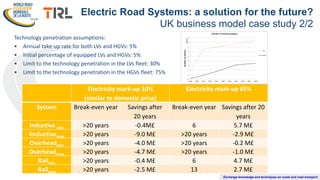
Electricity mark-up 10%
(similar to domestic price)
Electricity mark-up 65%
System Break-even year Savings after
20 years
Break-even year Savings after 20
years
Inductive min >20 years -0.4M£ 6 5.7 M£
Iinductivemax >20 years -9.0 M£ >20 years -2.9 M£
Overheadmin >20 years -4.0 M£ >20 years -0.2 M£
Overheadmax >20 years -4.7 M£ >20 years -1.0 M£
Railmin >20 years -0.4 M£ 6 4.7 M£
Railmax >20 years -2.5 M£ 13 2.7 M£
Exchange knowledge and techniques on roads and road transport
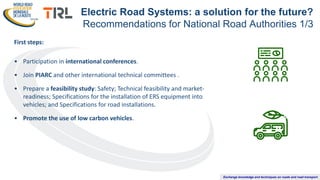
First steps:
• Participation in international conferences.
• Join PIARC and other international technical committees .
• Prepare a feasibility study: Safety; Technical feasibility and market-
readiness; Specifications for the installation of ERS equipment into
vehicles; and Specifications for road installations.
• Promote the use of low carbon vehicles.
Electric Road Systems: a solution for the future?
Recommendations for National Road Authorities 1/3
Exchange knowledge and techniques on roads and road transport
Intermediate steps:
• Assess the potential impacts of ERS
• Identify suitable routes for ERS
• Develop guidelines for ERS systems
• Identify specifications and standards that will require modifications
• Commission research
• Discuss the possibility of installing ERS with government and policy levers to
encourage
• Create a cross-industry forum
• International standards and guidelines
• Including ERS as part of their low carbon vision
• Gain public support
Electric Road Systems: a solution for the future?
Recommendations for National Road Authorities 2/3
Exchange knowledge and techniques on roads and road transport
Advanced steps:
• Participation in trials.
• Work with government - Work with national government to
ensure the regulatory framework is flexible enough to adapt to
new transport technologies and business models.
• Publish results of trials.
Electric Road Systems: a solution for the future?
Recommendations for National Road Authorities 3/3
Exchange knowledge and techniques on roads and road transport
The majority of the inductive ERS systems (50%) scored between TRL 3 and 4,
only two systems had over 6.
The majority of the conductive ERS systems (60%) scored between TRL 4 and
5, the remaining two systems had a TRL between 6 and 8.
The KAIST/Dongwon OLEV (from South Korea) and the SIEMENS (from
Sweden) systems appear to be the most advanced inductive and
conductive ERS technology respectively and those closest to market
readiness.
Risk assessments should be conducted for individual technologies and
designs.
Static charging solutions and electric battery technology are seen to be
complimentary to ERS development and implementation. Advancements
in these areas should see an increased uptake of EVs
Electric Road Systems: a solution for the future?
Conclusions 1/2
Exchange knowledge and techniques on roads and road transport
The CBA shows that some types of ERS are
financially viable if sufficient capital
investment can be made, as long as the
electricity mark-up and uptake is sufficient.
There is a need to better understand the
market for ERS, in particular if LVs will use
the system and the role of alternative
technologies and other future social and
technological changes (autonomous electric
shared vehicles).
ERS has the potential to play a major role in the
decarbonisation of road transport, but in
the short term is most likely to be adapted
by specific parties to meet localised needs
rather than a universal solution.
Electric Road Systems: a solution for the future?
Conclusions 2/2
Exchange knowledge and techniques on roads and road transport
Thank you for your attention
World Road Association
info@piarc.org
@PIARC_Roads
Miguel Caso Florez
PIARC Technical Director
miguel.caso-florez@piarc.org
@miguelcasof
Electric Road Systems: a solution for the future?
Download the report for free
at www.piarc.org

Electric Road Systems: a solution for the future?

  • 1.
    Exchange knowledge andtechniques on roads and road transport Electric Road Systems: a solution for the future? Miguel Caso Florez – PIARC Technical Director Dominic Leal – Researcher TRL
  • 2.
    Exchange knowledge andtechniques on roads and road transport Content of this presentation: • PIARC Special Project – ERS: a solution for the future? Miguel Caso Florez • ERS: technical aspects. Dominic Leal • ERS: development challenges and opportunities. Miguel Caso Florez Electric Road Systems: a solution for the future?
  • 3.
    Exchange knowledge andtechniques on roads and road transport PIARC Special Project – ERS: a solution for the future? Miguel Caso Florez Electric Road Systems: a solution for the future?
  • 4.
    Exchange knowledge andtechniques on roads and road transport PIARC Special Project mechanism aims to respond to emerging issues in the road sector within a limited time frame (12 months). Special Project on ERS was proposed by Sweden and it was actively supported by Portugal and United Kingdom. The following PIARC Technical Committees were involved: • TC D.1 Road asset management. • TC B.4 Freight transport. • TC E.2 Environment Considerations in Road Projects and Operations. Selected external consultant: Transport Research Laboratory (TRL). Electric Road Systems: a solution for the future? PIARC Special Project
  • 5.
    Exchange knowledge andtechniques on roads and road transport The report offers a global perspective on ERS both geographically and across road sector including perspective of NRAs, researchers, ERS developers, freight industry, vehicles manufacturers, energy providers… The study had three interlinked phases: • State-of-the-art review and stakeholder engagement, • Technological and implementation feasibility assessment, • Exploration of the business model for ERS uptake. Conclusions and recommendations. The study includes the perspective of HIC and LMIC, and a review of stationary charging and other alternatives to fossil fuel propulsion technologies. Electric Road Systems: a solution for the future? PIARC Special Project
  • 6.
    Exchange knowledge andtechniques on roads and road transport Section 1 provides an introduction and background to the project, outlines the project objectives, and sets out the scope of the report. Section 2 describes the methodology and approach employed and the activities undertaken by the project team. Section 3 presents the findings from Task 1. This includes a description of the various types of ERS concepts, and the results from the literature search, stakeholder survey and interviews, and the LMIC workshop. Section 4 presents the findings from Task 2 which is an evaluation of ERS technologies and their perceived advantages and disadvantages. Section 5 presents the business model from a road owner’s perspective. This includes the results from a UK-focussed cost-benefit analysis and discussion on how it could vary for different countries and scenarios. Section 6 presents the project conclusions based on the work undertaken on Tasks 1, 2 and 3. Section 7 presents recommendations for PIARC, road administrations and LMIC based on the conclusions found from this study. Appendix A provides a copy of the survey questions and interview topics. Appendix B contains details of the case studies reviewed in this project. Appendix C compares the advantages and disadvantages of the different ERS technologies. Appendix D provides a risk assessment of each ERS concept. Appendix E summarises the findings from the LMIC workshop. Appendix F describes the cost-benefit analysis model used in Task 3. Appendix G presents summary sheets for each ERS concepts. Appendix H is a bibliography for further study of ERS. Electric Road Systems: a solution for the future? PIARC Special Project
  • 7.
    Exchange knowledge andtechniques on roads and road transport Section 1 Section 2 Section 3 Section 4 Section 5 Section 6 Section 7 Appendix A Appendix B Appendix C Appendix D Appendix E Appendix F Appendix G Appendix H Electric Road Systems: a solution for the future? PIARC Special Project ERS concepts Case studies Rival and complementary technologies Risk assessment Regulatory framework and standards Technical feasibility and challenges Comparison of different ERS technologies Stakeholders perspective Conclusions Safety and security Impact on infrastructure and maintenance Environmental and social impacts Types of business models Future ERS Recommendations Cost-benefit analysis Implementation in LMIC
  • 8.
    Exchange knowledge andtechniques on roads and road transport Electric Road Systems: a solution for the future? PIARC Special Project The report is available for free at www.piarc.org in English version (free registration). French and Spanish versions will be available in the following weeks.
  • 9.
    Exchange knowledge andtechniques on roads and road transport ERS: technical aspects Dominic Leal Electric Road Systems: a solution for the future?
  • 10.
    Exchange knowledge andtechniques on roads and road transport Electric Road Systems: a solution for the future? Types of ERS Definition: A system capable of charging electric vehicles dynamically on-route at traffic speeds Types: Three of technology (similar functions, very different designs & markets) Inductive (Wireless) Conductive Rail Conductive Overhead + many other collaborators
  • 11.
    Exchange knowledge andtechniques on roads and road transport Electric Road Systems: a solution for the future? Inductive (Wireless) Overview Trenched copper/litz coils with a ferrite core and concrete foundations with asphalt overlay FABRIC closed track demonstration, Italy KAIST / Dongwon OLEV public road demonstration, South Korea Trenched copper litz coils sealed in hot pour bitumen adhesive Roadside Requirements: ▪ grid connection transformer, inverter, cabling ▪ power electronics, switching boxes between coils ▪ high capacity battery & compensation ▪ V2I and I2G communications system ▪ monitoring unit, cooling unit ▪ safety/security infrastructure Many different designs, dimensions, power requirements, construction depths and techniques, essentially no interoperability between concepts
  • 12.
    Exchange knowledge andtechniques on roads and road transport Electric Road Systems: a solution for the future? Conductive Rail Overview Channelled rail embedded in pavement, flush with surface Flat rail embedded in pavement Encased rail bolted on top of surface Rail mounted to verge side vehicle restraint system Roadside Requirements: ▪ available grid connection ▪ transformer, rectifier, power electronics ▪ switching units, low/high voltage cabling ▪ I2G/V2I communications systems (DSRC/wifi tags, etc.) ▪ High-capacity storage batteries, air conditioning unit ▪ remote sensing ICT ▪ safety/security infrastructure
  • 13.
    Exchange knowledge andtechniques on roads and road transport Electric Road Systems: a solution for the future? Conductive Overhead Overview Sweden, Germany, USA demonstrations underway Verge side (option for median masts with arms spanning both directions) Rectifier substation and power electronics required every 1-4km Copper cables fed through hangers and tensioned Roadside Requirements: ▪ grid connection, transformer, medium voltage switchgear, rectifiers, controlled inverter ▪ V2I and I2G communications system ▪ monitoring unit, cooling unit ▪ safety/security infrastructure ▪ verge side vehicle restraint system Many of the same infrastructural components used as in rail. Requires VRS along entire installation. Lengthy construction times
  • 14.
    Exchange knowledge andtechniques on roads and road transport Electric Road Systems: a solution for the future? State of Development Inductive ERS Solutions OLEV Dongwon Inc. 15-85kW (η =71- 91%) TRL9 CWD Politecnico di Torino (FABRIC) 20kW (η =75-85%) TRL3-4 IPV SAET Group (FABRIC) 20kW (η =70-80%) TRL3-4 PRIMOVE Bombardier 200kW (η =69-90%) TRL5-6 HALO Qualcomm (FABRIC) 20kW (η = 80%) TRL3-4 WPT Oak Ridge National Laboratory 20kW (η =88-95%) TRL3-4 INTIS Integrated Infrastructure Solutions 60kW (η = 88-93%) TRL3-4 Electroad Electreon Inc. 20kW (η = 88-90%) TRL5-6 Victoria CIRCE 50kW (η =92%) TRL 7-8 Momentum Charger Momentum Dynamics 300kW (η = 95%) TRL3-4 WPT University of California 200kW (η = 60%) TRL3-4 + 19 static inductive systems Interactive version: here
  • 15.
    Exchange knowledge andtechniques on roads and road transport Electric Road Systems: a solution for the future? State of Development Flight Proven Flight Qualified Basic Principles Proof of Concept Prototype Demo Time to Deployment/TRL (Stakeholder Estimates) Inductive: 6 Yrs, TRL5 Rail: 6 Yrs, TRL5 Overhead: 5 Yrs, TRL6
  • 16.
    Exchange knowledge andtechniques on roads and road transport ERS: development challenges and opportunities. Miguel Caso Florez Electric Road Systems: a solution for the future?
  • 17.
    Exchange knowledge andtechniques on roads and road transport Understanding the ERS market: Freight industry (HGVs) and public transport operators (buses) are likely first adopters of ERS. Private passenger cars (LVs) are likely to charge at home if possible, as this is likely to be cheaper and more convenient than public charging facilities. Private cars would only need ERS under very specific circumstances (over 90% of the rides are short and urban), while autonomous shared cars could need furthermore ERS. Static charging facilities could be a significant competitor technology for LVs (less relevant to HGVs and buses) but they also play a complementary role on the EV uptake. Adapting vehicles to ERS has a user cost => Only worth it if significant use: private cars? KEY QUESTION: Who are we designing the ERS for? A system designed solely for HGVs may look very different to a system aimed a more mixed user group both technically and in terms of the business model. Electric Road Systems: a solution for the future? Opportunities
  • 18.
    Exchange knowledge andtechniques on roads and road transport Key barriers: high capital cost (for installation, maintenance and administration) and risks associated with relatively immature technology. A key message from stakeholders was that government support is critical to ERS development and in addressing industry concerns. Responsibility for ownership and operation of ERS technology remains to be defined. Most likely private public partnership would be needed for implementation. Modifications to the existing regulatory framework and concessions will be needed. Electric Road Systems: a solution for the future? Challenges 1/2 ?
  • 19.
    Exchange knowledge andtechniques on roads and road transport How many kms of ERS do we need? Freight operators only require 25km per day of charging at ERS to achieve satisfactory payback compared to diesel. 20,000km of conductive rail ERS could provide €3.1bn annual savings compared to diesel use. Interoperability: Currently a variety of technologies have been developed and demonstrated with no interoperability between or within concept types. The various conductive solutions proposed are all inherently non- interoperable. The interoperability considerations for inductive power transfer systems are more advanced. Electric Road Systems: a solution for the future? Challenges 2/2
  • 20.
    Exchange knowledge andtechniques on roads and road transport Funding mechanism: user-payer principle, but not only. ERS can allow Governments to meet carbon reduction targets. Some governments may wish to partially subsidise ERS (at least initially to encourage take-up). Users of ERS should have reduced costs compared to conventional fuels to support ERS development. Electrifying only 5% of road network could produce a 50% GHG reduction of road transport. Electric Road Systems: a solution for the future? Business model and government support 1/2
  • 21.
    Exchange knowledge andtechniques on roads and road transport Chicken and egg situation: hauliers only likely to purchase ERS equipment for their fleet if there are sufficient routes to use it and funders only willing to invest in installing the technology if there are sufficient vehicles with the equipment installed.  Government support is required for funding/part funding the initial investment and through policies and financial incentives to promote up-take. KEY MESSAGE: Policy and regulatory framework clarity and stability overtime is essential. Electric Road Systems: a solution for the future? Business model and government support 2/2
  • 22.
    Exchange knowledge andtechniques on roads and road transport Significant assumptions still needed in terms of take-up, electricity mark-up and operational costs etc. as these are currently unknown. The outputs of the model are: • The annual system operational costs, i.e. the maintenance and administration costs, plus the cost of the electricity used by the users. • The annual benefits accrued from selling electricity to the users. • Annual societal benefits (both in terms of absolute and monetary values); namely reduction in the CO2 emissions, and reduction of the PM and NOx emissions at the tailpipe. • Cumulative balance and payback time. Electric Road Systems: a solution for the future? UK business model case study 1/2 ?
  • 23.
    Exchange knowledge andtechniques on roads and road transport Technology penetration assumptions: • Annual take-up rate for both LVs and HGVs: 5% • Initial percentage of equipped LVs and HGVs: 5% • Limit to the technology penetration in the LVs fleet: 30% • Limit to the technology penetration in the HGVs fleet: 75% Electric Road Systems: a solution for the future? UK business model case study 2/2 Electricity mark-up 10% (similar to domestic price) Electricity mark-up 65% System Break-even year Savings after 20 years Break-even year Savings after 20 years Inductive min >20 years -0.4M£ 6 5.7 M£ Iinductivemax >20 years -9.0 M£ >20 years -2.9 M£ Overheadmin >20 years -4.0 M£ >20 years -0.2 M£ Overheadmax >20 years -4.7 M£ >20 years -1.0 M£ Railmin >20 years -0.4 M£ 6 4.7 M£ Railmax >20 years -2.5 M£ 13 2.7 M£
  • 24.
    Exchange knowledge andtechniques on roads and road transport First steps: • Participation in international conferences. • Join PIARC and other international technical committees . • Prepare a feasibility study: Safety; Technical feasibility and market- readiness; Specifications for the installation of ERS equipment into vehicles; and Specifications for road installations. • Promote the use of low carbon vehicles. Electric Road Systems: a solution for the future? Recommendations for National Road Authorities 1/3
  • 25.
    Exchange knowledge andtechniques on roads and road transport Intermediate steps: • Assess the potential impacts of ERS • Identify suitable routes for ERS • Develop guidelines for ERS systems • Identify specifications and standards that will require modifications • Commission research • Discuss the possibility of installing ERS with government and policy levers to encourage • Create a cross-industry forum • International standards and guidelines • Including ERS as part of their low carbon vision • Gain public support Electric Road Systems: a solution for the future? Recommendations for National Road Authorities 2/3
  • 26.
    Exchange knowledge andtechniques on roads and road transport Advanced steps: • Participation in trials. • Work with government - Work with national government to ensure the regulatory framework is flexible enough to adapt to new transport technologies and business models. • Publish results of trials. Electric Road Systems: a solution for the future? Recommendations for National Road Authorities 3/3
  • 27.
    Exchange knowledge andtechniques on roads and road transport The majority of the inductive ERS systems (50%) scored between TRL 3 and 4, only two systems had over 6. The majority of the conductive ERS systems (60%) scored between TRL 4 and 5, the remaining two systems had a TRL between 6 and 8. The KAIST/Dongwon OLEV (from South Korea) and the SIEMENS (from Sweden) systems appear to be the most advanced inductive and conductive ERS technology respectively and those closest to market readiness. Risk assessments should be conducted for individual technologies and designs. Static charging solutions and electric battery technology are seen to be complimentary to ERS development and implementation. Advancements in these areas should see an increased uptake of EVs Electric Road Systems: a solution for the future? Conclusions 1/2
  • 28.
    Exchange knowledge andtechniques on roads and road transport The CBA shows that some types of ERS are financially viable if sufficient capital investment can be made, as long as the electricity mark-up and uptake is sufficient. There is a need to better understand the market for ERS, in particular if LVs will use the system and the role of alternative technologies and other future social and technological changes (autonomous electric shared vehicles). ERS has the potential to play a major role in the decarbonisation of road transport, but in the short term is most likely to be adapted by specific parties to meet localised needs rather than a universal solution. Electric Road Systems: a solution for the future? Conclusions 2/2
  • 29.
    Exchange knowledge andtechniques on roads and road transport Thank you for your attention World Road Association info@piarc.org @PIARC_Roads Miguel Caso Florez PIARC Technical Director miguel.caso-florez@piarc.org @miguelcasof Electric Road Systems: a solution for the future? Download the report for free at www.piarc.org