CHAPTER 12
PRESENTATION:
NEUROLOGY
By Melina Clark
SUFFIXES IN NEUROLOGY
While there are numerous suffixes in the medical
field, there are 5 that are important to the study of
neurology…
-plagiarism: paralysis
-taxia: muscle coordination
-tropic: pertaining to development
-puresis: weakness
-phasia: speech
We will go over 2 in depth.
-PLEGIA: PARALYSIS
❖These forms of –plegia can
occur through a variety of
means
❖Congenital conditions such
as cerebral palsy or diabetes
can be a cause
❖Strokes, tumors, and other
brain-injuring events can also
be a cause of –plegia
conditions
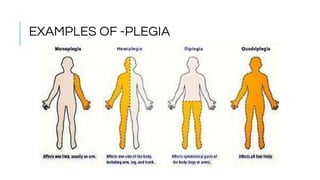
❖Monoplegia: paralysis of
one limb
❖Paraplegia: paralysis of
lower body and both legs
Also called diplegia
❖Hemiplegia: paralysis on
only one side of the body
❖Quadriplegia: paralysis of
all 4 limbs
EXAMPLES OF -PLEGIA
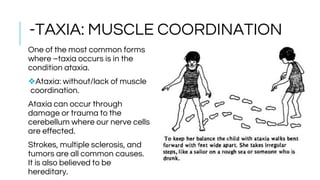
-TAXIA: MUSCLE COORDINATION
One of the most common forms
where –taxia occurs is in the
condition ataxia.
❖Ataxia: without/lack of muscle
coordination.
Ataxia can occur through
damage or trauma to the
cerebellum where our nerve cells
are effected.
Strokes, multiple sclerosis, and
tumors are all common causes.
It is also believed to be
hereditary.

Presentation2 med term

  • 1.
  • 2.
    SUFFIXES IN NEUROLOGY Whilethere are numerous suffixes in the medical field, there are 5 that are important to the study of neurology… -plagiarism: paralysis -taxia: muscle coordination -tropic: pertaining to development -puresis: weakness -phasia: speech We will go over 2 in depth.
  • 3.
    -PLEGIA: PARALYSIS ❖These formsof –plegia can occur through a variety of means ❖Congenital conditions such as cerebral palsy or diabetes can be a cause ❖Strokes, tumors, and other brain-injuring events can also be a cause of –plegia conditions ❖Monoplegia: paralysis of one limb ❖Paraplegia: paralysis of lower body and both legs Also called diplegia ❖Hemiplegia: paralysis on only one side of the body ❖Quadriplegia: paralysis of all 4 limbs
  • 4.
  • 5.
    -TAXIA: MUSCLE COORDINATION Oneof the most common forms where –taxia occurs is in the condition ataxia. ❖Ataxia: without/lack of muscle coordination. Ataxia can occur through damage or trauma to the cerebellum where our nerve cells are effected. Strokes, multiple sclerosis, and tumors are all common causes. It is also believed to be hereditary.