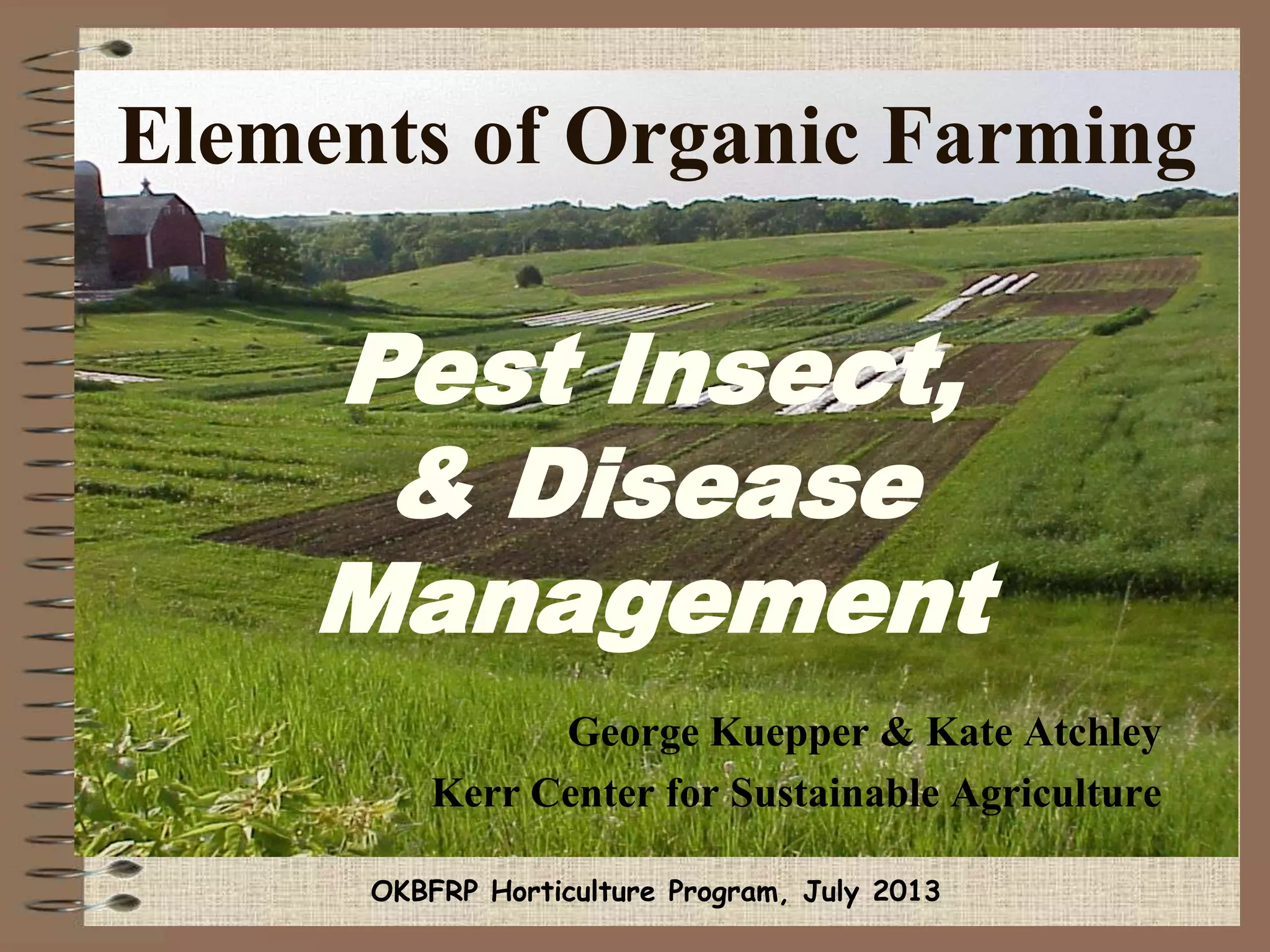
Elements of Organic Farming
George Kuepper & Kate Atchley
Kerr Center for Sustainable Agriculture
Pest Insect,
& Disease
Management
OKBFRP Horticulture Program, July 2013
Regarding Weeds
Pest Insects & Diseases
Well-designed organic systems have
higher ecological stability and lower
pest pressure overall. “1000 tiny
hammers”
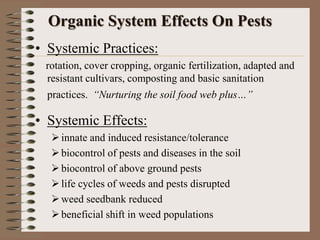
Organic System Effects On Pests
• Systemic Practices:
rotation, cover cropping, organic fertilization, adapted and
resistant cultivars, composting and basic sanitation
practices. “Nurturing the soil food web plus…”
• Systemic Effects:
innate and induced resistance/tolerance
biocontrol of pests and diseases in the soil
biocontrol of above ground pests
life cycles of weeds and pests disrupted
weed seedbank reduced
beneficial shift in weed populations
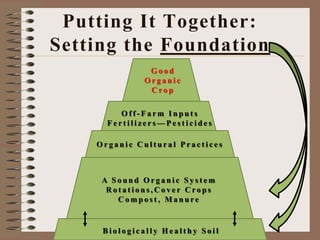
Putting It Together:
Setting the Foundation
B i o l o g i c a l l y H e a l t h y S o i l
A S o u n d O r g a n i c S y s t e m
R o t a t i o n s , C o v e r C ro p s
C o m p o s t , M a n u re
O r g a n i c C u l t u r a l P r a c t i c e s
O f f - F a r m I n p u t s
F e r t i l i z e r s — P e s t i c i d e s
G o o d
O r g a n i c
C ro p
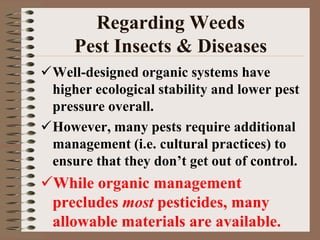
Well-designed organic systems have
higher ecological stability and lower pest
pressure overall.
However, many pests require
additional management (i.e. cultural
practices) to ensure that they don’t
get out of control. “More tiny
hammers…”
Regarding Weeds
Pest Insects & Diseases
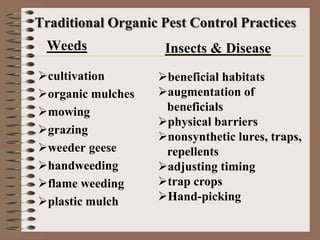
Traditional Organic Pest Control Practices
Weeds
cultivation
organic mulches
mowing
grazing
weeder geese
handweeding
flame weeding
plastic mulch
Insects & Disease
beneficial habitats
augmentation of
beneficials
physical barriers
nonsynthetic lures, traps,
repellents
adjusting timing
trap crops
Hand-picking
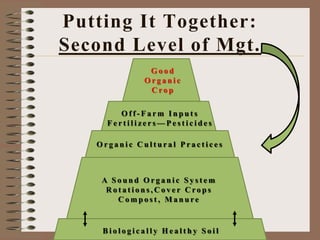
Putting It Together:
Second Level of Mgt.
B i o l o g i c a l l y H e a l t h y S o i l
A S o u n d O r g a n i c S y s t e m
R o t a t i o n s , C o v e r C ro p s
C o m p o s t , M a n u re
O r g a n i c C u l t u r a l P r a c t i c e s
O f f - F a r m I n p u t s
F e r t i l i z e r s — P e s t i c i d e s
G o o d
O r g a n i c
C ro p
Well-designed organic systems have
higher ecological stability and lower pest
pressure overall.
However, many pests require additional
management (i.e. cultural practices) to
ensure that they don’t get out of control.
While organic management
precludes most pesticides, many
allowable materials are available.
Regarding Weeds
Pest Insects & Diseases
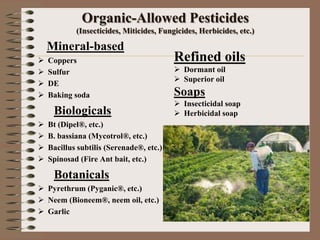
Organic-Allowed Pesticides
(Insecticides, Miticides, Fungicides, Herbicides, etc.)
Mineral-based
 Coppers
 Sulfur
 DE
 Baking soda
Biologicals
 Bt (Dipel®, etc.)
 B. bassiana (Mycotrol®, etc.)
 Bacillus subtilis (Serenade®, etc.)
 Spinosad (Fire Ant bait, etc.)
Botanicals
 Pyrethrum (Pyganic®, etc.)
 Neem (Bioneem®, neem oil, etc.)
 Garlic
Refined oils
 Dormant oil
 Superior oil
Soaps
 Insecticidal soap
 Herbicidal soap
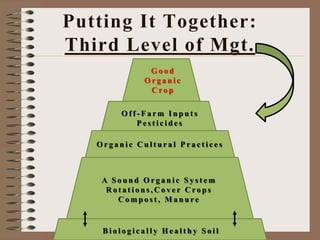
Putting It Together:
Third Level of Mgt.
B i o l o g i c a l l y H e a l t h y S o i l
A S o u n d O r g a n i c S y s t e m
R o t a t i o n s , C o v e r C ro p s
C o m p o s t , M a n u re
O r g a n i c C u l t u r a l P r a c t i c e s
O f f - F a r m I n p u t s
P e s t i c i d e s
G o o d
O r g a n i c
C ro p
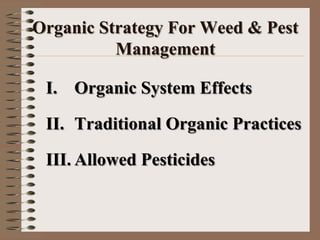
Organic Strategy For Weed & Pest
Management
I. Organic System Effects
II. Traditional Organic Practices
III. Allowed Pesticides
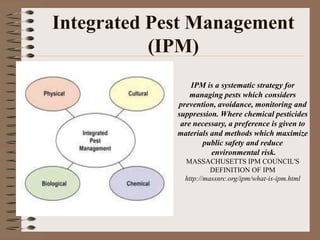
Integrated Pest Management
(IPM)
IPM is a systematic strategy for
managing pests which considers
prevention, avoidance, monitoring and
suppression. Where chemical pesticides
are necessary, a preference is given to
materials and methods which maximize
public safety and reduce
environmental risk.
MASSACHUSETTS IPM COUNCIL'S
DEFINITION OF IPM
http://massnrc.org/ipm/what-is-ipm.html
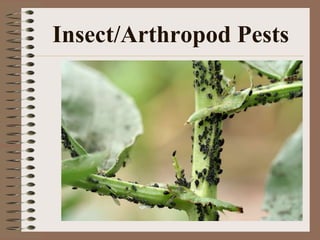
Insect/Arthropod Pests
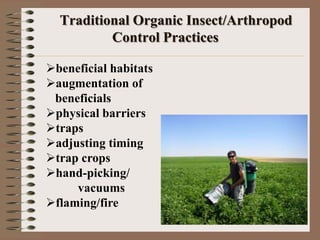
Traditional Organic Insect/Arthropod
Control Practices
beneficial habitats
augmentation of
beneficials
physical barriers
traps
adjusting timing
trap crops
hand-picking/
vacuums
flaming/fire
Pest I.D. is Critical
Cue in Kate
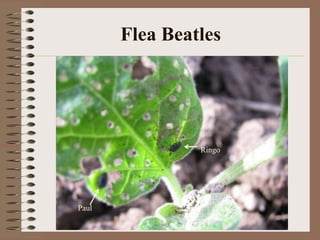
Flea Beatles
Ringo
Paul
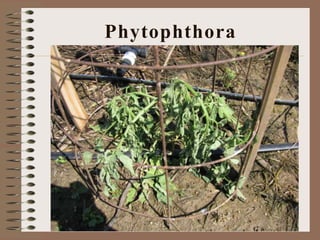
Phytophthora
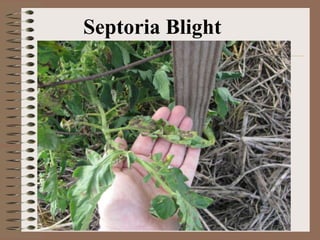
Septoria Blight
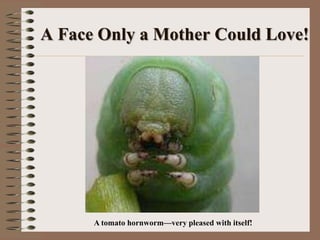
A Face Only a Mother Could Love!
A tomato hornworm—very pleased with itself!
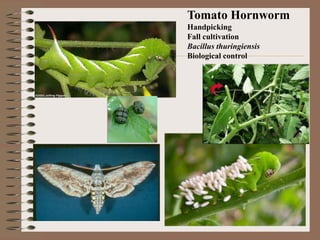
Tomato Hornworm
Handpicking
Fall cultivation
Bacillus thuringiensis
Biological control
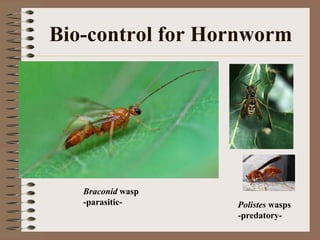
Bio-control for Hornworm
Polistes wasps
-predatory-
Braconid wasp
-parasitic-
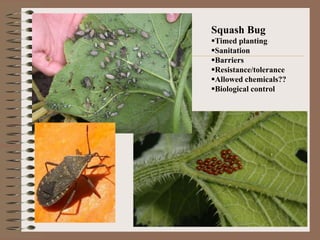
Squash Bug
Timed planting
Sanitation
Barriers
Resistance/tolerance
Allowed chemicals??
Biological control
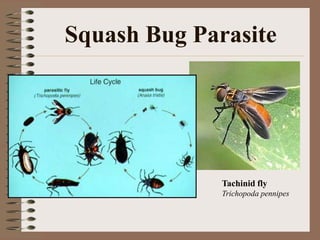
Squash Bug Parasite
Tachinid fly
Trichopoda pennipes
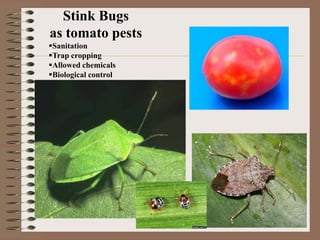
Stink Bugs
as tomato pests
Sanitation
Trap cropping
Allowed chemicals
Biological control
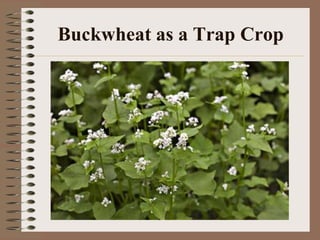
Buckwheat as a Trap Crop
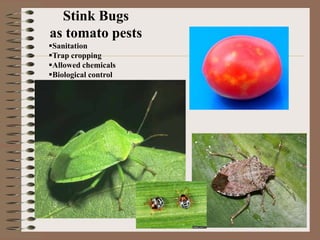
Stink Bugs
as tomato pests
Sanitation
Trap cropping
Allowed chemicals
Biological control
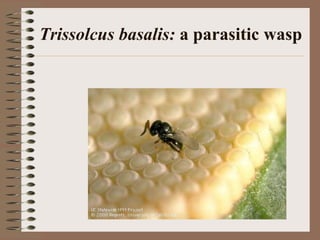
Trissolcus basalis: a parasitic wasp
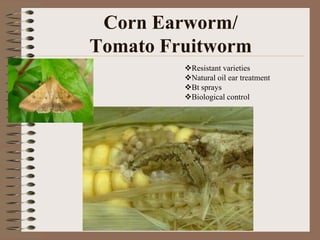
Corn Earworm/
Tomato Fruitworm
Resistant varieties
Natural oil ear treatment
Bt sprays
Biological control
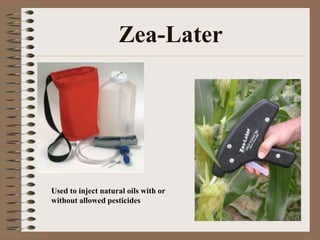
Zea-Later
Used to inject natural oils with or
without allowed pesticides
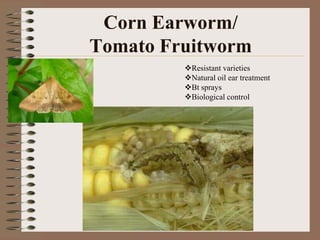
Corn Earworm/
Tomato Fruitworm
Resistant varieties
Natural oil ear treatment
Bt sprays
Biological control
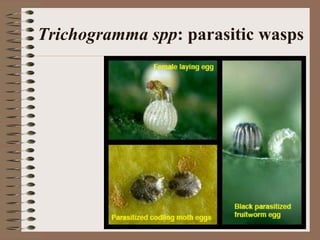
Trichogramma spp: parasitic wasps
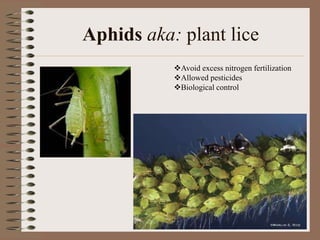
Aphids aka: plant lice
Avoid excess nitrogen fertilization
Allowed pesticides
Biological control
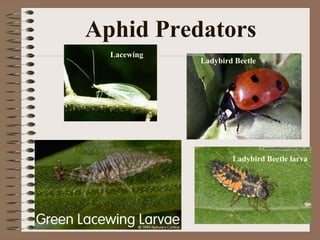
Aphid Predators
Ladybird Beetle
Ladybird Beetle larva
Lacewing
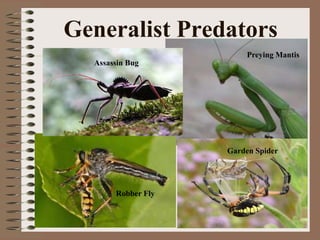
Generalist Predators
Assassin Bug
Preying Mantis
Robber Fly
Garden Spider
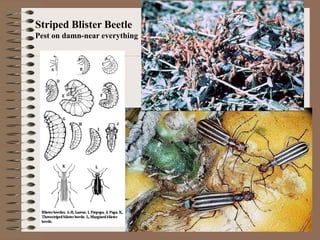
Striped Blister Beetle
Pest on damn-near everything
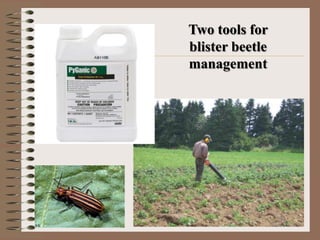
Two tools for
blister beetle
management
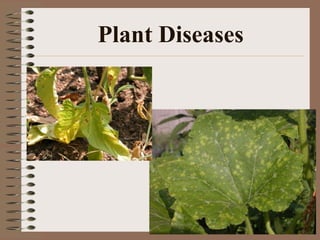
Plant Diseases
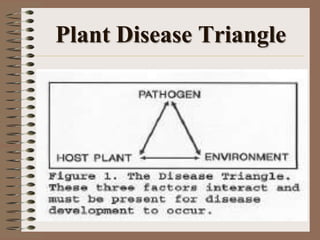
Plant Disease Triangle
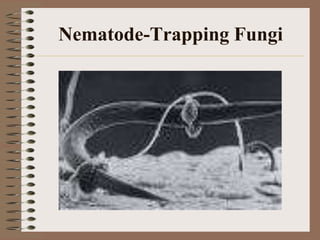
Nematode-Trapping Fungi
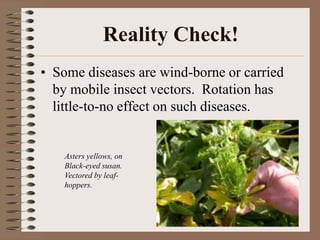
Reality Check!
• Some diseases are wind-borne or carried
by mobile insect vectors. Rotation has
little-to-no effect on such diseases.
Asters yellows, on
Black-eyed susan.
Vectored by leaf-
hoppers.
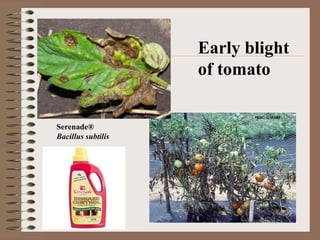
Early blight
of tomato
Serenade®
Bacillus subtilis
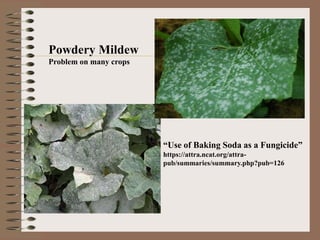
Powdery Mildew
Problem on many crops
“Use of Baking Soda as a Fungicide”
https://attra.ncat.org/attra-
pub/summaries/summary.php?pub=126
Useful
Resource
http://web.pppmb.cals.cornell.edu/resourceguide/
Useful Resource
George Kuepper
The Kerr Center
P.O. Box 588
Poteau, OK 74953
918-647-9123
gkuepper@kerrcenter.com

Elements of Organic Farming: Pest, Insect, & Disease Management

Editor's Notes

  • #3 Define a few terms: Pest Pesticide
  • #5 Now we’ve not talked yet about the other aspects of organic growing, have we. If you are going to grow a good crop, there are lots of other cultural practices you will need or want to use. Composting for sure. There are some inputs you’ll probably want to buy. But you will find, with a bio-extensive system, you will need less of those. It is a very self-sufficient approach that needs less off-farm inputs.
  • #6 Define a few terms: Pest Pesticide
  • #8 Now we’ve not talked yet about the other aspects of organic growing, have we. If you are going to grow a good crop, there are lots of other cultural practices you will need or want to use. Composting for sure. There are some inputs you’ll probably want to buy. But you will find, with a bio-extensive system, you will need less of those. It is a very self-sufficient approach that needs less off-farm inputs.
  • #9 Define a few terms: Pest Pesticide
  • #11 Now we’ve not talked yet about the other aspects of organic growing, have we. If you are going to grow a good crop, there are lots of other cultural practices you will need or want to use. Composting for sure. There are some inputs you’ll probably want to buy. But you will find, with a bio-extensive system, you will need less of those. It is a very self-sufficient approach that needs less off-farm inputs.
  • #16 You need to know your friends from your enemies
  • #26 Tachinid fly is parasite; also a wasp
  • #28 Tachinid fly is parasite; also a wasp
  • #41 Here is another indirect effect of rotation and the creation of a biologically active soil. Not only are antibiotics created as I mentioned earlier, but you get interesting organisms like nematode-trapping fungi, that can put quite a dent in those pest populations.
  • #42 Again, we need a reality check. Rotation does a lot to control plant disease, but we also need to remember that that some diseases are windborne and some are brought in by vectors. For example: Asters yellows…a phytoplasma spread by leafhoppers. Pic shows asters yellow on black-eyed susan.