Worrld
Literature
Prof. Mary Jane C. Villanueva, LPT, IIGRE
World literature Introduction to Civilization
Before the dawn civilization, people roamed the
face of the earth. These people were nomads or, in
other words wanderer, they were hunters and
gatherers in a constant move searching for food
and resources. The waves of migration brought
groups of people to cover great distances to the
farthest corners of the world.
Emergence of Civilization
The emergence of civilization began at the point in time when people
permanently settled down with the advent of ;
Agriculture or the cultivation of the soil to produce food., [farmers], these
people found settlements along rivers that deposit minerals to soil make
it a fertile ground for cultivation and a source of fresh drinkable water as
well as, irrigation.
The term civilization is etymologically derived from Latin word, ‘’civitas’’
which means ‘’city’’. A civilization resembling a city, maybe taken as a
permanent settlement of people having an organized way of life its
established social institutions.
Culture
CONCEPT OF CULTURE . Part of civilization is the development of culture
which gives the distinct characteristics of a group of people. People develop their
own culture out of their learning and experiences.
Culture is a way of life, refers to the totality of what man has learned as a
member of society.
Elements of Culture make up its totality
1. Knowledge. Any information received and perceived to be true, it does not
necessarily mean that such information is factual.
Elements of Culture
a.
b.
c.
2. Beliefs . The perception of accepted reality. Reality refers to the existence of
things whether material or non-material but not imaginary.
3. Social Norms . These are the established expectations of society as to
how a person is supposed to act depending on the requirements of the time, place,
or situation.
Folkways . The patterns of repetitive behavior which become a habitual
and conventional part of living, included are customs and traditions.
Mores . The set of moral obligations and standards that distinguishes right
from wrong or good from bad conduct.
Laws . The set of bonding rules or measures that induces man to act or
restrain him from acting
Elements of Culture
4. Values. Anything held to be relatively worthy, important,
desirable, or valuable. It is not concerned with morality, manners,
or conduct.
5.Technology and material culture. The practical
application of knowledge in converting raw materials into
finished products. Examples: structures, tools, equipments,
clothes, such things do not necessarily have to be advanced or
complex.
CHARACTERISTICS OF CULTURE
2.
3.
4.
1. Learnable. Culture is acquired through training, instruction, observation
and imitation.
Transmittable. Culture influences others attitudes, habits, and behavior
through communication.
Universal. Culture is shared in common because people are members of a
society with established expectations on everybody.
Dynamic. Culture changes overtime as people respond to challenges and
adapt to situations and environments.
Social Institutions
a.
b.
Social Institution is an established system of social norms revolving around the
needs of people, it provides the ways and means of achieving the needs of the
people.
FIVE BASIC SOCIAL INSTITUTIONS
Family. A social structure built on personal relationships and affiliation of
consanguinity [ blood relationship]. Affinity [ marriage], or adoption that forms
the basic core of social norms, it is therefore, the basic unit of society.
Education. The institution through which knowledge formation and skills
training is received for occupational preparation.
Social Institutions
3.
4.
5.
Economy. The institution through which economic resources
are utilized for the satisfaction of human wants.
Politics. The institution through which power is controlled and
exercised for the promotion and protection of interests.
Religion. The institution through which the spiritual or non-
material needs of the people are provided through a system of
beliefs and practices revolving around the divine or sacred.
Religion
1.
2.
3.
4.
Classification of religious organizations;
Ecclesia/ the church. It is dominant religion in a
society, in terms of majority members and socio-political
influence.
Sect. Refers to religious group that have separated out of
protest or conflict from a parent church.
Denominations. Religious groups that were
independently founded and originated of their own religion.
Cult. It is a small group with fanatical following revolving
around a dominant charismatic leader.
Cultural Functions of Religion
1.
2.
3.
4.
5.
It satisfies the emotional and spiritual needs of a person.
Provides a sense of hope and assurance to a person in
doubt, fear, or trouble,
It legitimizes and reinforces beliefs, mores, and values.
Regulates and guide the lives of people in their social
roles, functions and relationships.
Facilitates and promotes group integration and solidarity
Literature
The study of literature mirrors the culture of the
people since it reveals the influences and views of
the people regarding topics in their culture and
themes of their historical time period.
Literature. Is an enduring expression of significant
varied human experiences in words well chosen and
arranged, it deals with ideas, thoughts, and emotions,
Role of Literature in Civilization
2.
3.
4.
1. Transmit Culture. Literature instills the culture of a group as the values,
morals and more.
Preserves identity. Literature reflects people’s common history shared
experiences and sense of civilization’ achievements.
Catalyst for change. Literature promotes awareness, conveys ideas, and
mobilizes people to a course of action.
Entertainment. Literature is a source of pleasure and relaxation, it
stimulates imagination, creative thinking, and creative writing.
Classifications of Literature
According to...
a.
b.
a.
b.
FORM
Oral Literature. delivered and handed down on orally through memorization and recitation.
Written Literature . transferred handed down on through writings.
BASIS
Fiction Literature. based on imagination or fantasy.
Non-Fiction. based on narrative or exposition of true to life stories, experiences, or
encounters
TYPE
a.Poetry. the type of Literature, in verse and stanza format, which presents an arrangement
of rhythmic or melodious words to the effect of evoking emotional responses
b.Prose. This type of Literature, in sentence and paragraph and format, which presents
feeling, thoughts and ideas straight-forward.
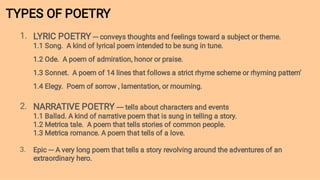
TYPES OF POETRY
1.
2.
3.
LYRIC POETRY --- conveys thoughts and feelings toward a subject or theme.
1.1 Song. A kind of lyrical poem intended to be sung in tune.
1.2 Ode. A poem of admiration, honor or praise.
1.3 Sonnet. A poem of 14 lines that follows a strict rhyme scheme or rhyming pattern’
1.4 Elegy. Poem of sorrow , lamentation, or mourning.
NARRATIVE POETRY ---- tells about characters and events
1.1 Ballad. A kind of narrative poem that is sung in telling a story.
1.2 Metrica tale. A poem that tells stories of common people.
1.3 Metrica romance. A poem that tells of a love.
Epic --- A very long poem that tells a story revolving around the adventures of an
extraordinary hero.
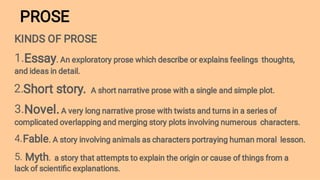
PROSE
1.
2.
3.
4.
5.
KINDS OF PROSE
Essay. An exploratory prose which describe or explains feelings thoughts,
and ideas in detail.
Short story. A short narrative prose with a single and simple plot.
Novel.A very long narrative prose with twists and turns in a series of
complicated overlapping and merging story plots involving numerous characters.
Fable. A story involving animals as characters portraying human moral lesson.
Myth. a story that attempts to explain the origin or cause of things from a
lack of scientific explanations.
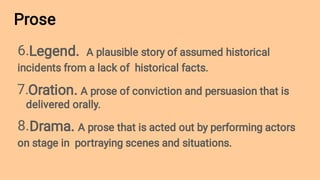
Prose
6.
7.
8.
Legend. A plausible story of assumed historical
incidents from a lack of historical facts.
Oration. A prose of conviction and persuasion that is
delivered orally.
Drama. A prose that is acted out by performing actors
on stage in portraying scenes and situations.
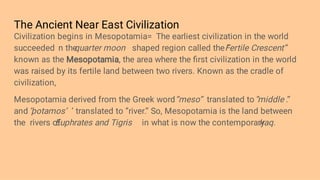
The Ancient Near East Civilization
Civilization begins in Mesopotamia= The earliest civilization in the world
succeeded n the
quarter moon shaped region called the ‘’
Fertile Crescent’’
known as the Mesopotamia, the area where the first civilization in the world
was raised by its fertile land between two rivers. Known as the cradle of
civilization,
Mesopotamia derived from the Greek word‘’meso’’ translated to ‘’
middle .’’
and ‘
’potamos’ ’ translated to ‘’river.’’ So, Mesopotamia is the land between
the rivers of
Euphrates and Tigris in what is now the contemporary
Iraq.
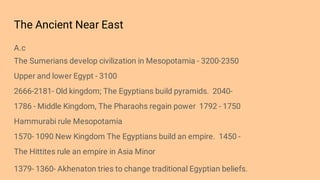
The Ancient Near East
A.c
The Sumerians develop civilization in Mesopotamia - 3200-2350
Upper and lower Egypt - 3100
2666-2181- Old kingdom; The Egyptians build pyramids. 2040-
1786 - Middle Kingdom, The Pharaohs regain power 1792 - 1750
Hammurabi rule Mesopotamia
1570- 1090 New Kingdom The Egyptians build an empire. 1450 -
The Hittites rule an empire in Asia Minor
1379- 1360- Akhenaton tries to change traditional Egyptian beliefs.
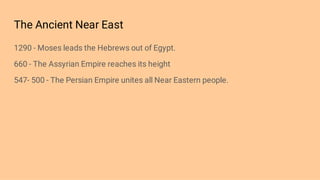
The Ancient Near East
1290 - Moses leads the Hebrews out of Egypt.
660 - The Assyrian Empire reaches its height
547- 500 - The Persian Empire unites all Near Eastern people.
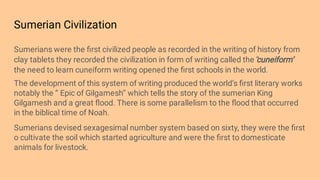
Sumerian Civilization
Sumerians were the first civilized people as recorded in the writing of history from
clay tablets they recorded the civilization in form of writing called the ‘’
cuneiform’
the need to learn cuneiform writing opened the first schools in the world.
The development of this system of writing produced the world’s first literary works
notably the ‘’ Epic of Gilgamesh’’ which tells the story of the sumerian King
Gilgamesh and a great flood. There is some parallelism to the flood that occurred
in the biblical time of Noah.
Sumerians devised sexagesimal number system based on sixty, they were the first
o cultivate the soil which started agriculture and were the first to domesticate
animals for livestock.
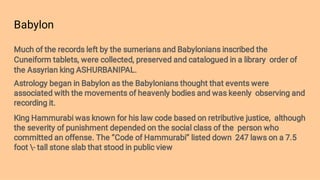
Babylon
Much of the records left by the sumerians and Babylonians inscribed the
Cuneiform tablets, were collected, preserved and catalogued in a library order of
the Assyrian king ASHURBANIPAL.
Astrology began in Babylon as the Babylonians thought that events were
associated with the movements of heavenly bodies and was keenly observing and
recording it.
King Hammurabi was known for his law code based on retributive justice, although
the severity of punishment depended on the social class of the person who
committed an offense. The ‘’Code of Hammurabi’’ listed down 247 laws on a 7.5
foot - tall stone slab that stood in public view
DRAGON’S LAIRS
China, Korea, and Japan are some of the world’s oldest enduring civilizations.
Their close geographical proximity with each other enabled them to
socio-politically economically interact and share some cultural elements, Chinese
civilization has influenced the region and the world in many ways innumerable.
OVER THE GREAT WALL OF CHINA
Early civilizations in China emerged at the valley of two major river system; The
Huang Ho. [yellow river] in the north and the Yangtze river is the longest river in
Asia and the third longest river in the world.China;s name is derived from the Chin
dynasty founded by Shih Huang-ti who united the peoples of China.Chinese
civilization was persistently challenged by Nomadic Mongolian tribes to the north.
The ‘’Great Wall,’’ was placed as a long-term effective solution to keep out the
nomadic invaders.
China
The Great Wall was a cumulative construction project of successive Chinese
ruling dynasties beginning with the Chin dynasty. The Great wall serves as barrier,
also a defense garrisons. Look out post are positioned at intervals and alerting
each other through a smoke signaling relay system. In order to see the smoke at
night, a mixture is added to give the smoke a bright color in the dark.
Belief and Philosophy
The early Chinese practiced ancestry worship. They believed that the spirits of
their dead ancestors would be able to help them in life’s problems Questions are
inscribed on animal bones or shells. The cracks formed from the heating of it were
then interpreted, this kind of divination is called osteomancy.
Chinese beliefs and Philosophy
Chinese superstitious belief revolve around the channeling of good fortune leading
to the development of certain belief systems. One such system is what the
Chinese called’ ‘’ Feng shui’’means literally the wind and water.
Feng shui is a system of aesthetics adopted to promote good fortune by
harmonizing with the elements and energy that flow through surrounding areas. It
has much to do with the orientation and arrangement of objects and structures.
Chinese Philosophy primarily sought to awaken public morals at a time when
China under the Zhou/ Chou dynasty was in political and social upheaval due to
warring states and people facing a collapse in morals.
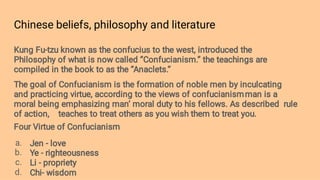
Chinese beliefs, philosophy and literature
a.
b.
c.
d.
Kung Fu-tzu known as the confucius to the west, introduced the
Philosophy of what is now called ‘’Confucianism.’’ the teachings are
compiled in the book to as the ‘’Anaclets.’’
The goal of Confucianism is the formation of noble men by inculcating
and practicing virtue, according to the views of confucianismman is a
moral being emphasizing man’ moral duty to his fellows. As described rule
of action, teaches to treat others as you wish them to treat you.
Four Virtue of Confucianism
Jen - love
Ye - righteousness
Li - propriety
Chi- wisdom
beliefs , Philosophy and Literature
ao-tzu = introduced another Philosophy known as ‘’
Taoism’’ translated as ‘’
Way of virtue, ’’ which
aches the principles of ‘’
wu wei’ ’ translated as action through inaction or effortless doing.
iterature
Animal shells andbones the early chinese inscribed their writings.
Bamboo scrolls the most recent preceding the use of paper.
Han dynast y invented chinese paper, was produced the ‘
’Shiji’’ [ records of the rand
historian.] it was the first systematic historical manuscript written in paper.
ima Qian/ Ssuma Chien who was recognized as the‘’Father of Chinese
istoriography.
ang Dynasty called the golden age in poetry . the period produced China’s reatest
poet
DuFu
Beliefs , Philosophy and LIterature
The Chinese valued visual appeal in literary writing leading to the
development of the art and style of handwriting called ‘’Calligraphy’’ with
the use of an ink brush. Tu Meng of the Tang dynasty developed 120
expressions to describe different styles of calligraphy and established
criteria for them, much like the different font styles available today for
typing.
The volume of early dispersed Chinese Literature found its way being
complied for posterity into the so-called ‘’Wu Jing’’ [five classics] and ‘’Shi
Shu’’ [four books]. These literary works formed the basis for the
competitive civil service exams in early China.
The ‘’Wu Jing’’ [ five classics]
1.
2.
3.
4.
5.
Five collection of five ancient Chinese books for the study of
Confucianism namely;
I- Ching/ Yi Jing [ classic of changes] a textual source of divination
Shi Jing [ classic of poetry] An anthropology of the oldest Chinese
poems.
Li Ji [ classic of rites] a documentation of Chinese Imperial Court
norms and ceremonies
Shu Jing [ classic of History] A compilation of documents and
speeches made by Chinese government refers and officials.
Lin Jing [ Spring and Autumn Annals] A collection of official
interstate chronicles.
Shi Shu [ four books]
2.
3.
4.
Text were selected by Zhu Xi/ Chu Hsi to serve as an Introduction to
Confucianism
1Ta- hsueh [great learning]
Chung Yung [ doctrine of the mean]
Lun Yu [Anaclets of Confucius] the recorded statements of Confucius.
Meng Tzu [ Mencius]
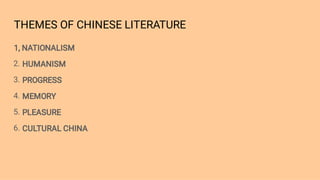
THEMES OF CHINESE LITERATURE
2.
3.
4.
5.
6.
1, NATIONALISM
HUMANISM
PROGRESS
MEMORY
PLEASURE
CULTURAL CHINA
FAMOUS CHINESE POET
1.
2.
LI BAI [LI BO]= His famous work ‘’ Waking from Drunkenness on a
Spring Day’’ The Hard Road to Shu, and The Quiet Night Thought, still
being taught in schools in China. The Quiet Night is his famous work,
he was a poet of Tang dynasty, known as the ‘’immortal poet.’’
WANG WEI- Portrait famous work of Wang Wei was painted on the
wall of a monastery in Ch’ing - yuan.
Chinese culture stress the importance of the family
The family was always the most important part of the chinese society. It
was more considered more important than the individual or the government.
Respect and obedience to one’s parents. This respect extended to the
family’s ancestors the early rulers of china worshiped not only various
deities but also the spirits of their ‘’honored ancestors.’’ women are given a
lesser role,The Father, the husband and the eldest son were given positions
of respect and superiority. They looked forward to both men and women of
old age, for it brought them wisdom, respect and leisure, Filial piety
required the eldest son tp provide a good life for his aging parents, living
or dead.
Writings of
confucius
Confucius writings have scholarly influenced chinese culture. Confucianism is
collection of moral code for society than religious creed, though confucius
sometimes beingworshipped as a Deity.
MORNING CALM AT KOREA
The Korean Peninsula emerged with the founding kingdom of ‘’Joseon’’ OR
‘’Chosun’’ the name bears the meaning ‘’Land of the morning Calm.’’
The Koguryo Kingdom occupied the largest territory in the peninsula owing to
its founder Prince Jumong who reigned as King Dong Myeong Seong, resisted the
Han dynasty and consolidated much of the tribes,
korea
While Koguryo occupied the Northern part of the peninsula, one of King Dong
Myeong Seong’s sons Prince Onji Founded the Paekje Kingdom South of
the peninsula. Also situated south of the peninsula is the silla
kingdom founded by King Bak Hyeokgeose. Aided by the chinese
Tang dynasty, the kingdom managed to conquer Paekje and Koguryo.
In the years that came, the peninsula was unified by King Taejo
Wang Geong with the founding of the Koryeo Kingdom from which the
present name Korea was derived, the Kingdom introduced the world’s
first movable metal- type printing.
Korean Literature
Back from old stone age Korean Literature can be traced back, the
collective art, dance, music and literature, starting in festival activities,
this art form ministered the political function of a society, the religious
function of distinguishing and defining a supernatural power ready
to prevent calamity on earth, and the economic functions of stirring
productive activity, especially related to agriculture. The farmwork
song and the early forms of Myth, the narrative poetry that shows
their abundant harvests of the New stone age.were transmitted
orally.
Rising sun of Japan
Japanese writings came from china in the 5th century
through the korean peninsula.
Kojiki
Nihon Shoki were the two surviving works and historical
records; completed in the early 8th century.
rRising Sun of Japan
Japan’s literature were known for poetry, the novell and the drama. There
are some of their literary works which are not highly recognized in other
countries, these includes the following; diaries, travel accounts, books of
random thoughts- are also interesting.
Japan’s literature starts from oral traditions that was being recorded in
written form during the early 8th century after a writing system
introduced in China.
Rising sun of Japan
The Japanese originally call their country ‘’Nippon’’ derived from
borrowing the Chinese characters ‘’ jih’’ [sun] and ‘’pun’’ [origin] to
represent the Japanese word Nippon. It is why Japan is popularly called
the ‘’ Land of the Rising Sun.’’
The earliest written records about Japan are from chinese sources
which mentioned Japan as ‘’Wa’’ with earlier accounts referring to a
land of hundreds of scattered tribal communities. Early Japanese
society revolves around the ‘’uji’’ or clan.
Japa
n
ukiyo= [ floating world]much like an early ‘’Las Vegas’’ offered the
Japanese a place of socialization, relaxation, entertainment, and
pleasure. Present in Ukiyo are restaurants, taverns and offered a taste
of some Japanese cultural venues of the time such as ‘’sumo’’ wrestling
and the ‘’;geisha’’ art of pleasure.
Sumo is type of wrestling whereby a fighter must throw his opponent
out of the circle wherein they wrestle.
Geisha is an exclusive female occupation trained in the social arts
whose services for companion, entertainment, and pleasure afre paid
by wealthy male customers.
1.
2.
3.
Japan
The ancient Japanese believed in’’kami’’[ spirits and gods]
dwelling in nature and also yielded the forces of nature.
Shaman was believed to have the power to control and
intercede with the spirits of gods for the community;s
benefit or cure people’s illnesses
BELIEF IN KAMI DEVELOPED INTO ANIMIST RELIGION
KNOWN AS SHINTO
All living and non-living things have varying spiritual
qualities that empower and characterize them.
Worship and reverence are given to the kami of things
including ancestral spirits.
Physical cleanliness emcompasses spiritual purity.
Literature
The Japanese evolved their written languages by borrowing ‘’Kanji’’
[chinese characters] for representing Japanese phonetic sounds. Over
time. New characters were infused to make up for the lack of available
sounds. The end result is the Japanese modern writing called ‘’kana.’’
The women in the imperial court were responsible for the numerous
literary works of the period,
Genji Monogatari [ tales of genji] the oldest known novel in the world by
Lady Murasaki Shikibu,
Japan literature
The Manyoshu[ collection ot ten thousand leaves] is the oldest
existing collection of Japanese poetry.
Kojiki [ record of Ancient Matters] and Nihon Shoki [ Chronicles of
Japan] contained the first Japanese written accounts of Japan’s past.
Traditional Japanese dramas forbade women performing on stage
because of common instances of being invited for prostitution, the
reason only by male actors .
Japanese literature
1.
2.
3.
Traditional Japanese theater exists in three types;
NOH - slow-pace drama set on a stage with a simple fixed wall paper
background whereby actors in masks present their storytelling with
suggestive appearance and movement. Actors move in a slow graceful
manner. It is the oldest form of traditional Japanese theatre.
KABUKI - a lively drama performed on a rotating stage designed with many
contraptions like trapdoors that allowed the actors to appear and disappear
frequently during the plays, Rather than mere storytelling, the actors engage
in dialogue and portray scenes.
BUNRAKU- Aform of puppet theater depicting life-like appearing puppets.
Egypt
The ancient Egyptian settled along the fertile soil near the delta of the river Nile. the
Nile river is the longest river in the world. Without the Nile there would be no civilization,
but only dessert, which is why Herodotus called Egypt, ‘’The gift of the nile.
Pyramids were built as the final resting place of the Pharaohs and their consorts, it
was built by Egyptian free. Great Pyramids of Giza the most famous and popular.
Papyrus plants grew abundantly near the Nile river from which the fibers provided the
material they used for writing, the Egyptian develop their own system of writing
combining pictographs with sound signs called ‘’hieroglyphics.
LITERATURE
1.
2.
3.
The religious literature of Ancient Egypt includes hymn to the gods, mythological
and magical texts, An extensive collection of mortuary texts are enumerated as
follows;
The Book of the dead, these are the papyrus scrolls that constitute a collection
of magical formulas intended to guide the dead through the various trials that
they would encounter before reaching the underworld.
Coffin texts these are the inscriptions found on the coffin and on the walls of
tombs of private individuals.
Pyramid texts these are the inscriptions found on the walls of tombs inside the
Pyramids. They depict the Egyptian view of the afterlife and the ascent of the
pharaoh into the sky after death,
Egyptian literature
The range of secular literature includes stories, instructive literature,
known as wisdom texts, poems biographical historical texts and
scientific treatises, including mathematical and medical text.
Greeks literature
The Greeks were polytheistic. The Greek gods and goddesses were immortals and
more powerful than mortal beings, but they were nevertheless subjected to
natural laws which put limitations on them. They were not morally perfect and
swayed by emotions.
The Greeks held the earliest Olympic Games at Olympia where they meet every
four years. The site is chosen in honor of Zeus, one of the 12 major gods and
goddesses believed to be dwelling at a palace cloud above Mount Olympus. Many
of the included ancient games are still part of the modern Olympics.
Literature
Hellenic civilization produced the world’s earliest historians with Herodotus being
regarded as the Father of History, the Epics’’ ILiad and Odyssey’’ are the two notable
Greek epics based on Greek Mythology, and attributed to the poet named Homer.
The ILiad is about one episode in the Trojan War centering on the conflict between
Achilles and Agamemnon. Where as the Odyssey revolves around the adventures of
the hero Odysseus returning home from the Trojan War.
Thespis Greek actor regarded as the ‘’ Father of Drama’’he presented himself in a
monologue impersonating different characters.
Comedy and tragedy were the two kinds of dramsa performed at open- air theatre.
Medieval Europe
The church
In times of certainties and the troubles the people turned to the
church for moral and spiritual guidance, the church also performed
charitable works and did what it can provide for what is lacking on the
community.
The Great Schism in 1054 split the church into the Roman Catholic
church and the Greek Orthodox Church. This happened when Pope Leo
IX of the church in Rome nad Patriarch Michael l of the church in
Constantinople excommunicated each other in a dispute over authority
and supremacy over the Christian Church.
Medieval Europe
The protestant reformation movement led by former Augustinian monk,
Martin Luther caused the further division of the church when it sought to
criticize at that time inside the Catholic Church. Over the years, many
other independent churches were founded due to doctrinal differences
and issues.
In the absence of printing, monks painstakingly handwrote books on
parchment paper. Calligraphy developed in western handwriting and
established the role in using uppercase and lowercase letter,
Literature in Medieval period
1.
2.
The bulk of religious and academic literary works of that time were the important contributions
of the monk scholars. Most of the literary works of the time were written in latin and came
mostly from anonymous writers. A few other names wrote in their vernacular. Some of the
notable writers of this period are;
Saint Augustine [354-430] the Bishop of Hippo[ now in modern Alegria] who is known for his
autobiographical book ‘’Confessions] The book accounts for Augustine’s sinful life and his
conversion to Christianity, Many scholars believe this work to be the first western
autobiography.
Saint Thomas Aquinas[1225- 1274] An Italian Dominican priest who is known for his
book ‘’Summa Theologiae’’ [ summary of treatise of Theology] T he book is a synthesis of
Aristotelian logic and Christian Theology which demonstrates that there can be no
contradiction between the truths of faith, based on divine revelation, and those of human
reason.
3.
4.
Dante Alighieri[ 1265- 1321] An Italian poet who is known for his epic poem’’ La
Divina Commedia’’ [divine comedy] In this epic poem, Dante imagine himself
visiting hell, purgatory and heaven.
Geoffrey Chaucer[ 1343-1400]. An English poet and author who is known for his
book ‘’Canterbury tales’’ the book is a collection of stories told in part by pilgrims
who met by chance and travelled on a pilgrimage.
5, Francesco Petrarca [1304- 1374] An Italian poet who is considered as the Father
of Humanism and is known for his collection of poems
‘’Canzoniere.’’ ‘’
Literature of medieval
2.
3.
4.
The dominant theme of non-religious literary writings at the time was
‘’courtly love’’ which originated in france and popularized by troubadours or travelling
minstrels singing stories, Courtly love is an idealized and illicit from of love between a
knight or a noble man and a married noble woman, four elements characterize courtly
love;
1, Aristocratic involved characters of nobility. Its setting was the royal palace.
Ritualistic involved chivalry, romantic courtship and gesturesnof affection and
admiration.
Secrecy involved a secret mutual understanding between the lovers and sometimes
known only to confidants.
Adultery involved an extramaritla affair which offers thrill and an escape from the
dull routines and boring confinements of noble marriages
Renaissance man
Rebirth
The Renaissance period is marked by a rebirth in a cultural advances which
began in Italy, Renaissance is a french word translates to rebirth, it marked the
start of modernization.
In Medieval period , people were inclined towards religious matters, People
Almost played a passive role while the church strongly guided and regulated
the lives of the people. The church was the primary and authoritative source of
knowledge.
Renaissance
There was a revived interest in the arts and sciences much like in ancient Greek
and Roman civilization,The rebirth took place when focus shifted from religion to
humanism and the humanities.
Humanism is the philosophy that views the importance of human being with the
goal of developing the aspects of humanity to the fullest and greatness. Humanists
believe that man should be free to develop his potentials, pursue his interests and live
to his satisfaction. In this way man manifested curiosity, creativity, individuality and
superiority.
Humanism seeks to bring out the best in man, Leonardo da VInci is usually cited as
an exemplary of the ‘’Renaissance man’’ He was versatile as an Architect, enineer, painter,
sculptor and scientist
ARTS
Italian Architect Filippo Brunelleschi introduced ‘’ linear
perspective’’ since then the Renaissance artist depicted their arts
subjects as close to being realistic as possible using linear perspective,
proportion, balance, and harmony.
Two classic styles of painting;
1, Chiaroscuro the use of heavy contrast between light and dark
shades to produce an illusion of depth and dimensionality,
Examples are Rembrandt’s paintings.
2, Sfumato the use of fine shading effects that produces soft blending
between colors and tones. An example is the ‘’Mona lisa’’ painting of
Da Vinci.
GREATEST MASTER ARTIST AND THEIR KNOWN
WORKS
1.
2.
3.
4.
Donatello[ 1386- 1486] one of his known sculptural works is bronze
statue of ‘’David’’
Leonardo Da VInci [ 1452- 1519] he is known for the paintings ‘’Mona
lisa’’ and the ‘’Last Supper’’
Michelangelo Buonarroti[ 1475- 1574] He is known for the paintings that
adore the ceiling of the Sistine Chapel which took nearly 4 years to
complete,
Rafaello Sansio[ 1483- 1520] One of his known paintings is ‘’ The School
of Athens.’’
Literature
1.
2.
In 1456, Johannes Guttenberg printed the first book which is the Bible.
Guttenberg’s printing press machine was a breakthrough in western civilization as it
became possible for the first time to mass produce books cheaper and faster,
thereby making reading materials more publicly available.
Latin was the main language in medieval literature. Local vernaculars in french,
spanish, italian, and English claimed its own popularity in Renaissance literature
notably;
Desiderius Erasmus [1466- 1536] A Dutch theologian is known for his essay
‘’Encomium Moriae’’ [Praise of folly]. This essay is satiric exposition of the
obstacles restricting the fulfillment of Christ’s teaching,
Niccolo Machiavelli[1469- 1527] An Italian political philosopher and the ‘’Father of
Modern Political Science’’ who is known for his 1532 influential book, ‘’ ll Principe’’[
The Prince]
Literature
4.
5.
The book advised rulers on matters of politics and governance such as how a ruler must
behave. A prince being thus obliged to know well how to act as a beast must imitate the fox
and the Lion, for the Lion cannot protect himself from traps and the fox cannot defend
himself from wolves. One must therefore, be a fox to recognize traps and a lion to frighten
wolves.
Thomas MOre[1529-1532] An English statesman and author who is know the book
describes the ideal commonwealth, Where all work is for the common good.
Miguel de cervantes [1547- 1616] A Spanish novelist who is a known for his [1605 Classic
novel’’ Don QUIxote’’ dela Mancha’’ The novel revolves around the delusional character of
Alonso Quijano who assumes the role of a knight with a mission to change the world.
Literature
5. William Shakespeare[ 1564- 1616] An English poet and playwright who is
known for his plays.’’Romeo and Juliet’’ ‘’Macbeth’’ and ‘’Hamlet’’ among others
18th and 19th Century Western Literature
ThE FOLLOWING ARE SOME OF THE DISTINGUISHED WESTERN
LITERARY WRITERS IN THE 18TH TO THE 19TH CENTURY WHOSE BEST
KNOWN LITERARY WORKS ARE CONSIDERED MODERN CLASSICS.
EUROPEAN LITERATURE;
1. Daniel Defoe[ 1659- 1661] An English writer who is best known for his
1719 novel ‘’ robinson Crusoe’’ which revolves around the adventures
of a shipwrecked and stranded sailor in a remote tropical island.
European literature
Jonathan swift[ 1667-1745] An Irish writer who is best known for his 1726 book
the ‘’Gulliver’s travels ‘’ which presents a satirical view of European politics and
petty differences.
Victor Hugo[ 1802-1885] A french writer who is best known for his novels ‘’
Notre- Dame de Paris’’ also known as the ‘’Hunchback of Notre dame’’ in 1831,
and Les Miserables [ the miserable Ones] in 1862
Alexander Dumas p’ere[ 1802-1870] A french Writer who is best known for his
1844 novels ‘’ Le Comte de Monte-Cristo’’ [The Count of Monte- Cristo] and ‘’Les
Miserables’’ [ The Miserable Ones] in 1862. And ‘’Les Trois Mousquetaires’’[ The
Three Musketeers.
EUROPEAN literature
Hans Christian Anderson[1805-1875] A Danish writer who is best known for his
popular childrens’ stories such as Den lille havfrue[ the little mermaid] in 1837,’’
Den grimme selling’’[ the Ugly Duckling] in 1843 and ‘’ Sneedronningen [ The Snow
Queen] in 1846.
Charles Dickinson[1812-1870] An English writer who is known for his novels. The
Posthumous Papers of the Pickwick club in 1836 and ‘’Oliver twist’’ in 1838.
Rudyard Kipling [1885-1936] An English writer who is known for his work of fiction ‘’
The Jungle Book’’ which tells of an abandoned boy who is raised by the wolves in
the indian jungle and later reunited with civilization.
American Literature
1.
2.
3.
Ralph Waldo Emerson [1803- 1882] he is the best known for his collection of
poem and essays, among which is his 1836 essay ‘’Nature’’ whIch Formulates
and expresses his philosophy on transcendentalism.
Nathaniel Hawthorne[ 1804- 1864] He is best known for his 1850 novel
‘’The Scarlet Letter’’ Which revolves around the struggles of the main
Character Hester Prynne who is cast out of her community for committing
adultery
Edgar ALLAN poe [1809-1849] He is known for his trademark Gothic themes
in literary writing, Among his know literary works are ‘’ The fall of the House of
Usher’’ in 1839. ‘’The Tale Heart’’ in 1843. ‘’The Cast of Amontillado’’ in 1846,
and ‘’The Raven’’ in 1875.
American Literature
4.
5.
6.
7.
Harriet Beecher Stowe [1811-1896] She is best known for her 1852 novel ‘’
Uncle Tom’s Cbin’’ Which depicted the life of African slaves in America.
Herman Melville [ 1819- 1891] He is best known for his 1851 novel ‘’Moby Dick’’
which revolves around the adventures of a sailor on board an expeditionary ship
commanded by a captain seeking revenge on an infamous whale named Moby
Dick,
Louisa May Alcott- [1832-1891] she is best known for her 1868 novel’’ little
women’’ which is loosely based on her childhood life with her sisters.
Samuel Langhorne Clemens[ 1835- 1910] he is more popularly known by his
pen name ‘’Mark Twain’’ among his best known novels are ‘’ The Adventure of
Tom Sawyer’’ in 1876, and ‘’ The Adventures of Huckleberry Finn in 1884.

WORLD-LITERATURE-.pdf

  • 1.
    Worrld Literature Prof. Mary JaneC. Villanueva, LPT, IIGRE
  • 2.
    World literature Introductionto Civilization Before the dawn civilization, people roamed the face of the earth. These people were nomads or, in other words wanderer, they were hunters and gatherers in a constant move searching for food and resources. The waves of migration brought groups of people to cover great distances to the farthest corners of the world.
  • 3.
    Emergence of Civilization Theemergence of civilization began at the point in time when people permanently settled down with the advent of ; Agriculture or the cultivation of the soil to produce food., [farmers], these people found settlements along rivers that deposit minerals to soil make it a fertile ground for cultivation and a source of fresh drinkable water as well as, irrigation. The term civilization is etymologically derived from Latin word, ‘’civitas’’ which means ‘’city’’. A civilization resembling a city, maybe taken as a permanent settlement of people having an organized way of life its established social institutions.
  • 4.
    Culture CONCEPT OF CULTURE. Part of civilization is the development of culture which gives the distinct characteristics of a group of people. People develop their own culture out of their learning and experiences. Culture is a way of life, refers to the totality of what man has learned as a member of society. Elements of Culture make up its totality 1. Knowledge. Any information received and perceived to be true, it does not necessarily mean that such information is factual.
  • 5.
    Elements of Culture a. b. c. 2.Beliefs . The perception of accepted reality. Reality refers to the existence of things whether material or non-material but not imaginary. 3. Social Norms . These are the established expectations of society as to how a person is supposed to act depending on the requirements of the time, place, or situation. Folkways . The patterns of repetitive behavior which become a habitual and conventional part of living, included are customs and traditions. Mores . The set of moral obligations and standards that distinguishes right from wrong or good from bad conduct. Laws . The set of bonding rules or measures that induces man to act or restrain him from acting
  • 6.
    Elements of Culture 4.Values. Anything held to be relatively worthy, important, desirable, or valuable. It is not concerned with morality, manners, or conduct. 5.Technology and material culture. The practical application of knowledge in converting raw materials into finished products. Examples: structures, tools, equipments, clothes, such things do not necessarily have to be advanced or complex.
  • 7.
    CHARACTERISTICS OF CULTURE 2. 3. 4. 1.Learnable. Culture is acquired through training, instruction, observation and imitation. Transmittable. Culture influences others attitudes, habits, and behavior through communication. Universal. Culture is shared in common because people are members of a society with established expectations on everybody. Dynamic. Culture changes overtime as people respond to challenges and adapt to situations and environments.
  • 8.
    Social Institutions a. b. Social Institutionis an established system of social norms revolving around the needs of people, it provides the ways and means of achieving the needs of the people. FIVE BASIC SOCIAL INSTITUTIONS Family. A social structure built on personal relationships and affiliation of consanguinity [ blood relationship]. Affinity [ marriage], or adoption that forms the basic core of social norms, it is therefore, the basic unit of society. Education. The institution through which knowledge formation and skills training is received for occupational preparation.
  • 9.
    Social Institutions 3. 4. 5. Economy. Theinstitution through which economic resources are utilized for the satisfaction of human wants. Politics. The institution through which power is controlled and exercised for the promotion and protection of interests. Religion. The institution through which the spiritual or non- material needs of the people are provided through a system of beliefs and practices revolving around the divine or sacred.
  • 10.
    Religion 1. 2. 3. 4. Classification of religiousorganizations; Ecclesia/ the church. It is dominant religion in a society, in terms of majority members and socio-political influence. Sect. Refers to religious group that have separated out of protest or conflict from a parent church. Denominations. Religious groups that were independently founded and originated of their own religion. Cult. It is a small group with fanatical following revolving around a dominant charismatic leader.
  • 11.
    Cultural Functions ofReligion 1. 2. 3. 4. 5. It satisfies the emotional and spiritual needs of a person. Provides a sense of hope and assurance to a person in doubt, fear, or trouble, It legitimizes and reinforces beliefs, mores, and values. Regulates and guide the lives of people in their social roles, functions and relationships. Facilitates and promotes group integration and solidarity
  • 12.
    Literature The study ofliterature mirrors the culture of the people since it reveals the influences and views of the people regarding topics in their culture and themes of their historical time period. Literature. Is an enduring expression of significant varied human experiences in words well chosen and arranged, it deals with ideas, thoughts, and emotions,
  • 13.
    Role of Literaturein Civilization 2. 3. 4. 1. Transmit Culture. Literature instills the culture of a group as the values, morals and more. Preserves identity. Literature reflects people’s common history shared experiences and sense of civilization’ achievements. Catalyst for change. Literature promotes awareness, conveys ideas, and mobilizes people to a course of action. Entertainment. Literature is a source of pleasure and relaxation, it stimulates imagination, creative thinking, and creative writing.
  • 14.
    Classifications of Literature Accordingto... a. b. a. b. FORM Oral Literature. delivered and handed down on orally through memorization and recitation. Written Literature . transferred handed down on through writings. BASIS Fiction Literature. based on imagination or fantasy. Non-Fiction. based on narrative or exposition of true to life stories, experiences, or encounters TYPE a.Poetry. the type of Literature, in verse and stanza format, which presents an arrangement of rhythmic or melodious words to the effect of evoking emotional responses b.Prose. This type of Literature, in sentence and paragraph and format, which presents feeling, thoughts and ideas straight-forward.
  • 15.
    TYPES OF POETRY 1. 2. 3. LYRICPOETRY --- conveys thoughts and feelings toward a subject or theme. 1.1 Song. A kind of lyrical poem intended to be sung in tune. 1.2 Ode. A poem of admiration, honor or praise. 1.3 Sonnet. A poem of 14 lines that follows a strict rhyme scheme or rhyming pattern’ 1.4 Elegy. Poem of sorrow , lamentation, or mourning. NARRATIVE POETRY ---- tells about characters and events 1.1 Ballad. A kind of narrative poem that is sung in telling a story. 1.2 Metrica tale. A poem that tells stories of common people. 1.3 Metrica romance. A poem that tells of a love. Epic --- A very long poem that tells a story revolving around the adventures of an extraordinary hero.
  • 16.
    PROSE 1. 2. 3. 4. 5. KINDS OF PROSE Essay.An exploratory prose which describe or explains feelings thoughts, and ideas in detail. Short story. A short narrative prose with a single and simple plot. Novel.A very long narrative prose with twists and turns in a series of complicated overlapping and merging story plots involving numerous characters. Fable. A story involving animals as characters portraying human moral lesson. Myth. a story that attempts to explain the origin or cause of things from a lack of scientific explanations.
  • 17.
    Prose 6. 7. 8. Legend. A plausiblestory of assumed historical incidents from a lack of historical facts. Oration. A prose of conviction and persuasion that is delivered orally. Drama. A prose that is acted out by performing actors on stage in portraying scenes and situations.
  • 18.
    The Ancient NearEast Civilization Civilization begins in Mesopotamia= The earliest civilization in the world succeeded n the quarter moon shaped region called the ‘’ Fertile Crescent’’ known as the Mesopotamia, the area where the first civilization in the world was raised by its fertile land between two rivers. Known as the cradle of civilization, Mesopotamia derived from the Greek word‘’meso’’ translated to ‘’ middle .’’ and ‘ ’potamos’ ’ translated to ‘’river.’’ So, Mesopotamia is the land between the rivers of Euphrates and Tigris in what is now the contemporary Iraq.
  • 19.
    The Ancient NearEast A.c The Sumerians develop civilization in Mesopotamia - 3200-2350 Upper and lower Egypt - 3100 2666-2181- Old kingdom; The Egyptians build pyramids. 2040- 1786 - Middle Kingdom, The Pharaohs regain power 1792 - 1750 Hammurabi rule Mesopotamia 1570- 1090 New Kingdom The Egyptians build an empire. 1450 - The Hittites rule an empire in Asia Minor 1379- 1360- Akhenaton tries to change traditional Egyptian beliefs.
  • 20.
    The Ancient NearEast 1290 - Moses leads the Hebrews out of Egypt. 660 - The Assyrian Empire reaches its height 547- 500 - The Persian Empire unites all Near Eastern people.
  • 21.
    Sumerian Civilization Sumerians werethe first civilized people as recorded in the writing of history from clay tablets they recorded the civilization in form of writing called the ‘’ cuneiform’ the need to learn cuneiform writing opened the first schools in the world. The development of this system of writing produced the world’s first literary works notably the ‘’ Epic of Gilgamesh’’ which tells the story of the sumerian King Gilgamesh and a great flood. There is some parallelism to the flood that occurred in the biblical time of Noah. Sumerians devised sexagesimal number system based on sixty, they were the first o cultivate the soil which started agriculture and were the first to domesticate animals for livestock.
  • 22.
    Babylon Much of therecords left by the sumerians and Babylonians inscribed the Cuneiform tablets, were collected, preserved and catalogued in a library order of the Assyrian king ASHURBANIPAL. Astrology began in Babylon as the Babylonians thought that events were associated with the movements of heavenly bodies and was keenly observing and recording it. King Hammurabi was known for his law code based on retributive justice, although the severity of punishment depended on the social class of the person who committed an offense. The ‘’Code of Hammurabi’’ listed down 247 laws on a 7.5 foot - tall stone slab that stood in public view
  • 24.
    DRAGON’S LAIRS China, Korea,and Japan are some of the world’s oldest enduring civilizations. Their close geographical proximity with each other enabled them to socio-politically economically interact and share some cultural elements, Chinese civilization has influenced the region and the world in many ways innumerable. OVER THE GREAT WALL OF CHINA Early civilizations in China emerged at the valley of two major river system; The Huang Ho. [yellow river] in the north and the Yangtze river is the longest river in Asia and the third longest river in the world.China;s name is derived from the Chin dynasty founded by Shih Huang-ti who united the peoples of China.Chinese civilization was persistently challenged by Nomadic Mongolian tribes to the north. The ‘’Great Wall,’’ was placed as a long-term effective solution to keep out the nomadic invaders.
  • 25.
    China The Great Wallwas a cumulative construction project of successive Chinese ruling dynasties beginning with the Chin dynasty. The Great wall serves as barrier, also a defense garrisons. Look out post are positioned at intervals and alerting each other through a smoke signaling relay system. In order to see the smoke at night, a mixture is added to give the smoke a bright color in the dark. Belief and Philosophy The early Chinese practiced ancestry worship. They believed that the spirits of their dead ancestors would be able to help them in life’s problems Questions are inscribed on animal bones or shells. The cracks formed from the heating of it were then interpreted, this kind of divination is called osteomancy.
  • 26.
    Chinese beliefs andPhilosophy Chinese superstitious belief revolve around the channeling of good fortune leading to the development of certain belief systems. One such system is what the Chinese called’ ‘’ Feng shui’’means literally the wind and water. Feng shui is a system of aesthetics adopted to promote good fortune by harmonizing with the elements and energy that flow through surrounding areas. It has much to do with the orientation and arrangement of objects and structures. Chinese Philosophy primarily sought to awaken public morals at a time when China under the Zhou/ Chou dynasty was in political and social upheaval due to warring states and people facing a collapse in morals.
  • 27.
    Chinese beliefs, philosophyand literature a. b. c. d. Kung Fu-tzu known as the confucius to the west, introduced the Philosophy of what is now called ‘’Confucianism.’’ the teachings are compiled in the book to as the ‘’Anaclets.’’ The goal of Confucianism is the formation of noble men by inculcating and practicing virtue, according to the views of confucianismman is a moral being emphasizing man’ moral duty to his fellows. As described rule of action, teaches to treat others as you wish them to treat you. Four Virtue of Confucianism Jen - love Ye - righteousness Li - propriety Chi- wisdom
  • 28.
    beliefs , Philosophyand Literature ao-tzu = introduced another Philosophy known as ‘’ Taoism’’ translated as ‘’ Way of virtue, ’’ which aches the principles of ‘’ wu wei’ ’ translated as action through inaction or effortless doing. iterature Animal shells andbones the early chinese inscribed their writings. Bamboo scrolls the most recent preceding the use of paper. Han dynast y invented chinese paper, was produced the ‘ ’Shiji’’ [ records of the rand historian.] it was the first systematic historical manuscript written in paper. ima Qian/ Ssuma Chien who was recognized as the‘’Father of Chinese istoriography. ang Dynasty called the golden age in poetry . the period produced China’s reatest poet DuFu
  • 29.
    Beliefs , Philosophyand LIterature The Chinese valued visual appeal in literary writing leading to the development of the art and style of handwriting called ‘’Calligraphy’’ with the use of an ink brush. Tu Meng of the Tang dynasty developed 120 expressions to describe different styles of calligraphy and established criteria for them, much like the different font styles available today for typing. The volume of early dispersed Chinese Literature found its way being complied for posterity into the so-called ‘’Wu Jing’’ [five classics] and ‘’Shi Shu’’ [four books]. These literary works formed the basis for the competitive civil service exams in early China.
  • 30.
    The ‘’Wu Jing’’[ five classics] 1. 2. 3. 4. 5. Five collection of five ancient Chinese books for the study of Confucianism namely; I- Ching/ Yi Jing [ classic of changes] a textual source of divination Shi Jing [ classic of poetry] An anthropology of the oldest Chinese poems. Li Ji [ classic of rites] a documentation of Chinese Imperial Court norms and ceremonies Shu Jing [ classic of History] A compilation of documents and speeches made by Chinese government refers and officials. Lin Jing [ Spring and Autumn Annals] A collection of official interstate chronicles.
  • 31.
    Shi Shu [four books] 2. 3. 4. Text were selected by Zhu Xi/ Chu Hsi to serve as an Introduction to Confucianism 1Ta- hsueh [great learning] Chung Yung [ doctrine of the mean] Lun Yu [Anaclets of Confucius] the recorded statements of Confucius. Meng Tzu [ Mencius]
  • 32.
    THEMES OF CHINESELITERATURE 2. 3. 4. 5. 6. 1, NATIONALISM HUMANISM PROGRESS MEMORY PLEASURE CULTURAL CHINA
  • 33.
    FAMOUS CHINESE POET 1. 2. LIBAI [LI BO]= His famous work ‘’ Waking from Drunkenness on a Spring Day’’ The Hard Road to Shu, and The Quiet Night Thought, still being taught in schools in China. The Quiet Night is his famous work, he was a poet of Tang dynasty, known as the ‘’immortal poet.’’ WANG WEI- Portrait famous work of Wang Wei was painted on the wall of a monastery in Ch’ing - yuan.
  • 34.
    Chinese culture stressthe importance of the family The family was always the most important part of the chinese society. It was more considered more important than the individual or the government. Respect and obedience to one’s parents. This respect extended to the family’s ancestors the early rulers of china worshiped not only various deities but also the spirits of their ‘’honored ancestors.’’ women are given a lesser role,The Father, the husband and the eldest son were given positions of respect and superiority. They looked forward to both men and women of old age, for it brought them wisdom, respect and leisure, Filial piety required the eldest son tp provide a good life for his aging parents, living or dead.
  • 35.
    Writings of confucius Confucius writingshave scholarly influenced chinese culture. Confucianism is collection of moral code for society than religious creed, though confucius sometimes beingworshipped as a Deity. MORNING CALM AT KOREA The Korean Peninsula emerged with the founding kingdom of ‘’Joseon’’ OR ‘’Chosun’’ the name bears the meaning ‘’Land of the morning Calm.’’ The Koguryo Kingdom occupied the largest territory in the peninsula owing to its founder Prince Jumong who reigned as King Dong Myeong Seong, resisted the Han dynasty and consolidated much of the tribes,
  • 36.
    korea While Koguryo occupiedthe Northern part of the peninsula, one of King Dong Myeong Seong’s sons Prince Onji Founded the Paekje Kingdom South of the peninsula. Also situated south of the peninsula is the silla kingdom founded by King Bak Hyeokgeose. Aided by the chinese Tang dynasty, the kingdom managed to conquer Paekje and Koguryo. In the years that came, the peninsula was unified by King Taejo Wang Geong with the founding of the Koryeo Kingdom from which the present name Korea was derived, the Kingdom introduced the world’s first movable metal- type printing.
  • 37.
    Korean Literature Back fromold stone age Korean Literature can be traced back, the collective art, dance, music and literature, starting in festival activities, this art form ministered the political function of a society, the religious function of distinguishing and defining a supernatural power ready to prevent calamity on earth, and the economic functions of stirring productive activity, especially related to agriculture. The farmwork song and the early forms of Myth, the narrative poetry that shows their abundant harvests of the New stone age.were transmitted orally.
  • 38.
    Rising sun ofJapan Japanese writings came from china in the 5th century through the korean peninsula. Kojiki Nihon Shoki were the two surviving works and historical records; completed in the early 8th century.
  • 39.
    rRising Sun ofJapan Japan’s literature were known for poetry, the novell and the drama. There are some of their literary works which are not highly recognized in other countries, these includes the following; diaries, travel accounts, books of random thoughts- are also interesting. Japan’s literature starts from oral traditions that was being recorded in written form during the early 8th century after a writing system introduced in China.
  • 40.
    Rising sun ofJapan The Japanese originally call their country ‘’Nippon’’ derived from borrowing the Chinese characters ‘’ jih’’ [sun] and ‘’pun’’ [origin] to represent the Japanese word Nippon. It is why Japan is popularly called the ‘’ Land of the Rising Sun.’’ The earliest written records about Japan are from chinese sources which mentioned Japan as ‘’Wa’’ with earlier accounts referring to a land of hundreds of scattered tribal communities. Early Japanese society revolves around the ‘’uji’’ or clan.
  • 41.
    Japa n ukiyo= [ floatingworld]much like an early ‘’Las Vegas’’ offered the Japanese a place of socialization, relaxation, entertainment, and pleasure. Present in Ukiyo are restaurants, taverns and offered a taste of some Japanese cultural venues of the time such as ‘’sumo’’ wrestling and the ‘’;geisha’’ art of pleasure. Sumo is type of wrestling whereby a fighter must throw his opponent out of the circle wherein they wrestle. Geisha is an exclusive female occupation trained in the social arts whose services for companion, entertainment, and pleasure afre paid by wealthy male customers.
  • 42.
    1. 2. 3. Japan The ancient Japanesebelieved in’’kami’’[ spirits and gods] dwelling in nature and also yielded the forces of nature. Shaman was believed to have the power to control and intercede with the spirits of gods for the community;s benefit or cure people’s illnesses BELIEF IN KAMI DEVELOPED INTO ANIMIST RELIGION KNOWN AS SHINTO All living and non-living things have varying spiritual qualities that empower and characterize them. Worship and reverence are given to the kami of things including ancestral spirits. Physical cleanliness emcompasses spiritual purity.
  • 43.
    Literature The Japanese evolvedtheir written languages by borrowing ‘’Kanji’’ [chinese characters] for representing Japanese phonetic sounds. Over time. New characters were infused to make up for the lack of available sounds. The end result is the Japanese modern writing called ‘’kana.’’ The women in the imperial court were responsible for the numerous literary works of the period, Genji Monogatari [ tales of genji] the oldest known novel in the world by Lady Murasaki Shikibu,
  • 44.
    Japan literature The Manyoshu[collection ot ten thousand leaves] is the oldest existing collection of Japanese poetry. Kojiki [ record of Ancient Matters] and Nihon Shoki [ Chronicles of Japan] contained the first Japanese written accounts of Japan’s past. Traditional Japanese dramas forbade women performing on stage because of common instances of being invited for prostitution, the reason only by male actors .
  • 45.
    Japanese literature 1. 2. 3. Traditional Japanesetheater exists in three types; NOH - slow-pace drama set on a stage with a simple fixed wall paper background whereby actors in masks present their storytelling with suggestive appearance and movement. Actors move in a slow graceful manner. It is the oldest form of traditional Japanese theatre. KABUKI - a lively drama performed on a rotating stage designed with many contraptions like trapdoors that allowed the actors to appear and disappear frequently during the plays, Rather than mere storytelling, the actors engage in dialogue and portray scenes. BUNRAKU- Aform of puppet theater depicting life-like appearing puppets.
  • 46.
    Egypt The ancient Egyptiansettled along the fertile soil near the delta of the river Nile. the Nile river is the longest river in the world. Without the Nile there would be no civilization, but only dessert, which is why Herodotus called Egypt, ‘’The gift of the nile. Pyramids were built as the final resting place of the Pharaohs and their consorts, it was built by Egyptian free. Great Pyramids of Giza the most famous and popular. Papyrus plants grew abundantly near the Nile river from which the fibers provided the material they used for writing, the Egyptian develop their own system of writing combining pictographs with sound signs called ‘’hieroglyphics.
  • 47.
    LITERATURE 1. 2. 3. The religious literatureof Ancient Egypt includes hymn to the gods, mythological and magical texts, An extensive collection of mortuary texts are enumerated as follows; The Book of the dead, these are the papyrus scrolls that constitute a collection of magical formulas intended to guide the dead through the various trials that they would encounter before reaching the underworld. Coffin texts these are the inscriptions found on the coffin and on the walls of tombs of private individuals. Pyramid texts these are the inscriptions found on the walls of tombs inside the Pyramids. They depict the Egyptian view of the afterlife and the ascent of the pharaoh into the sky after death,
  • 48.
    Egyptian literature The rangeof secular literature includes stories, instructive literature, known as wisdom texts, poems biographical historical texts and scientific treatises, including mathematical and medical text.
  • 49.
    Greeks literature The Greekswere polytheistic. The Greek gods and goddesses were immortals and more powerful than mortal beings, but they were nevertheless subjected to natural laws which put limitations on them. They were not morally perfect and swayed by emotions. The Greeks held the earliest Olympic Games at Olympia where they meet every four years. The site is chosen in honor of Zeus, one of the 12 major gods and goddesses believed to be dwelling at a palace cloud above Mount Olympus. Many of the included ancient games are still part of the modern Olympics.
  • 50.
    Literature Hellenic civilization producedthe world’s earliest historians with Herodotus being regarded as the Father of History, the Epics’’ ILiad and Odyssey’’ are the two notable Greek epics based on Greek Mythology, and attributed to the poet named Homer. The ILiad is about one episode in the Trojan War centering on the conflict between Achilles and Agamemnon. Where as the Odyssey revolves around the adventures of the hero Odysseus returning home from the Trojan War. Thespis Greek actor regarded as the ‘’ Father of Drama’’he presented himself in a monologue impersonating different characters. Comedy and tragedy were the two kinds of dramsa performed at open- air theatre.
  • 51.
    Medieval Europe The church Intimes of certainties and the troubles the people turned to the church for moral and spiritual guidance, the church also performed charitable works and did what it can provide for what is lacking on the community. The Great Schism in 1054 split the church into the Roman Catholic church and the Greek Orthodox Church. This happened when Pope Leo IX of the church in Rome nad Patriarch Michael l of the church in Constantinople excommunicated each other in a dispute over authority and supremacy over the Christian Church.
  • 52.
    Medieval Europe The protestantreformation movement led by former Augustinian monk, Martin Luther caused the further division of the church when it sought to criticize at that time inside the Catholic Church. Over the years, many other independent churches were founded due to doctrinal differences and issues. In the absence of printing, monks painstakingly handwrote books on parchment paper. Calligraphy developed in western handwriting and established the role in using uppercase and lowercase letter,
  • 53.
    Literature in Medievalperiod 1. 2. The bulk of religious and academic literary works of that time were the important contributions of the monk scholars. Most of the literary works of the time were written in latin and came mostly from anonymous writers. A few other names wrote in their vernacular. Some of the notable writers of this period are; Saint Augustine [354-430] the Bishop of Hippo[ now in modern Alegria] who is known for his autobiographical book ‘’Confessions] The book accounts for Augustine’s sinful life and his conversion to Christianity, Many scholars believe this work to be the first western autobiography. Saint Thomas Aquinas[1225- 1274] An Italian Dominican priest who is known for his book ‘’Summa Theologiae’’ [ summary of treatise of Theology] T he book is a synthesis of Aristotelian logic and Christian Theology which demonstrates that there can be no contradiction between the truths of faith, based on divine revelation, and those of human reason.
  • 55.
    3. 4. Dante Alighieri[ 1265-1321] An Italian poet who is known for his epic poem’’ La Divina Commedia’’ [divine comedy] In this epic poem, Dante imagine himself visiting hell, purgatory and heaven. Geoffrey Chaucer[ 1343-1400]. An English poet and author who is known for his book ‘’Canterbury tales’’ the book is a collection of stories told in part by pilgrims who met by chance and travelled on a pilgrimage. 5, Francesco Petrarca [1304- 1374] An Italian poet who is considered as the Father of Humanism and is known for his collection of poems ‘’Canzoniere.’’ ‘’
  • 56.
    Literature of medieval 2. 3. 4. Thedominant theme of non-religious literary writings at the time was ‘’courtly love’’ which originated in france and popularized by troubadours or travelling minstrels singing stories, Courtly love is an idealized and illicit from of love between a knight or a noble man and a married noble woman, four elements characterize courtly love; 1, Aristocratic involved characters of nobility. Its setting was the royal palace. Ritualistic involved chivalry, romantic courtship and gesturesnof affection and admiration. Secrecy involved a secret mutual understanding between the lovers and sometimes known only to confidants. Adultery involved an extramaritla affair which offers thrill and an escape from the dull routines and boring confinements of noble marriages
  • 57.
    Renaissance man Rebirth The Renaissanceperiod is marked by a rebirth in a cultural advances which began in Italy, Renaissance is a french word translates to rebirth, it marked the start of modernization. In Medieval period , people were inclined towards religious matters, People Almost played a passive role while the church strongly guided and regulated the lives of the people. The church was the primary and authoritative source of knowledge.
  • 58.
    Renaissance There was arevived interest in the arts and sciences much like in ancient Greek and Roman civilization,The rebirth took place when focus shifted from religion to humanism and the humanities. Humanism is the philosophy that views the importance of human being with the goal of developing the aspects of humanity to the fullest and greatness. Humanists believe that man should be free to develop his potentials, pursue his interests and live to his satisfaction. In this way man manifested curiosity, creativity, individuality and superiority. Humanism seeks to bring out the best in man, Leonardo da VInci is usually cited as an exemplary of the ‘’Renaissance man’’ He was versatile as an Architect, enineer, painter, sculptor and scientist
  • 59.
    ARTS Italian Architect FilippoBrunelleschi introduced ‘’ linear perspective’’ since then the Renaissance artist depicted their arts subjects as close to being realistic as possible using linear perspective, proportion, balance, and harmony. Two classic styles of painting; 1, Chiaroscuro the use of heavy contrast between light and dark shades to produce an illusion of depth and dimensionality, Examples are Rembrandt’s paintings. 2, Sfumato the use of fine shading effects that produces soft blending between colors and tones. An example is the ‘’Mona lisa’’ painting of Da Vinci.
  • 60.
    GREATEST MASTER ARTISTAND THEIR KNOWN WORKS 1. 2. 3. 4. Donatello[ 1386- 1486] one of his known sculptural works is bronze statue of ‘’David’’ Leonardo Da VInci [ 1452- 1519] he is known for the paintings ‘’Mona lisa’’ and the ‘’Last Supper’’ Michelangelo Buonarroti[ 1475- 1574] He is known for the paintings that adore the ceiling of the Sistine Chapel which took nearly 4 years to complete, Rafaello Sansio[ 1483- 1520] One of his known paintings is ‘’ The School of Athens.’’
  • 61.
    Literature 1. 2. In 1456, JohannesGuttenberg printed the first book which is the Bible. Guttenberg’s printing press machine was a breakthrough in western civilization as it became possible for the first time to mass produce books cheaper and faster, thereby making reading materials more publicly available. Latin was the main language in medieval literature. Local vernaculars in french, spanish, italian, and English claimed its own popularity in Renaissance literature notably; Desiderius Erasmus [1466- 1536] A Dutch theologian is known for his essay ‘’Encomium Moriae’’ [Praise of folly]. This essay is satiric exposition of the obstacles restricting the fulfillment of Christ’s teaching, Niccolo Machiavelli[1469- 1527] An Italian political philosopher and the ‘’Father of Modern Political Science’’ who is known for his 1532 influential book, ‘’ ll Principe’’[ The Prince]
  • 62.
    Literature 4. 5. The book advisedrulers on matters of politics and governance such as how a ruler must behave. A prince being thus obliged to know well how to act as a beast must imitate the fox and the Lion, for the Lion cannot protect himself from traps and the fox cannot defend himself from wolves. One must therefore, be a fox to recognize traps and a lion to frighten wolves. Thomas MOre[1529-1532] An English statesman and author who is know the book describes the ideal commonwealth, Where all work is for the common good. Miguel de cervantes [1547- 1616] A Spanish novelist who is a known for his [1605 Classic novel’’ Don QUIxote’’ dela Mancha’’ The novel revolves around the delusional character of Alonso Quijano who assumes the role of a knight with a mission to change the world.
  • 63.
    Literature 5. William Shakespeare[1564- 1616] An English poet and playwright who is known for his plays.’’Romeo and Juliet’’ ‘’Macbeth’’ and ‘’Hamlet’’ among others
  • 64.
    18th and 19thCentury Western Literature ThE FOLLOWING ARE SOME OF THE DISTINGUISHED WESTERN LITERARY WRITERS IN THE 18TH TO THE 19TH CENTURY WHOSE BEST KNOWN LITERARY WORKS ARE CONSIDERED MODERN CLASSICS. EUROPEAN LITERATURE; 1. Daniel Defoe[ 1659- 1661] An English writer who is best known for his 1719 novel ‘’ robinson Crusoe’’ which revolves around the adventures of a shipwrecked and stranded sailor in a remote tropical island.
  • 65.
    European literature Jonathan swift[1667-1745] An Irish writer who is best known for his 1726 book the ‘’Gulliver’s travels ‘’ which presents a satirical view of European politics and petty differences. Victor Hugo[ 1802-1885] A french writer who is best known for his novels ‘’ Notre- Dame de Paris’’ also known as the ‘’Hunchback of Notre dame’’ in 1831, and Les Miserables [ the miserable Ones] in 1862 Alexander Dumas p’ere[ 1802-1870] A french Writer who is best known for his 1844 novels ‘’ Le Comte de Monte-Cristo’’ [The Count of Monte- Cristo] and ‘’Les Miserables’’ [ The Miserable Ones] in 1862. And ‘’Les Trois Mousquetaires’’[ The Three Musketeers.
  • 66.
    EUROPEAN literature Hans ChristianAnderson[1805-1875] A Danish writer who is best known for his popular childrens’ stories such as Den lille havfrue[ the little mermaid] in 1837,’’ Den grimme selling’’[ the Ugly Duckling] in 1843 and ‘’ Sneedronningen [ The Snow Queen] in 1846. Charles Dickinson[1812-1870] An English writer who is known for his novels. The Posthumous Papers of the Pickwick club in 1836 and ‘’Oliver twist’’ in 1838. Rudyard Kipling [1885-1936] An English writer who is known for his work of fiction ‘’ The Jungle Book’’ which tells of an abandoned boy who is raised by the wolves in the indian jungle and later reunited with civilization.
  • 67.
    American Literature 1. 2. 3. Ralph WaldoEmerson [1803- 1882] he is the best known for his collection of poem and essays, among which is his 1836 essay ‘’Nature’’ whIch Formulates and expresses his philosophy on transcendentalism. Nathaniel Hawthorne[ 1804- 1864] He is best known for his 1850 novel ‘’The Scarlet Letter’’ Which revolves around the struggles of the main Character Hester Prynne who is cast out of her community for committing adultery Edgar ALLAN poe [1809-1849] He is known for his trademark Gothic themes in literary writing, Among his know literary works are ‘’ The fall of the House of Usher’’ in 1839. ‘’The Tale Heart’’ in 1843. ‘’The Cast of Amontillado’’ in 1846, and ‘’The Raven’’ in 1875.
  • 68.
    American Literature 4. 5. 6. 7. Harriet BeecherStowe [1811-1896] She is best known for her 1852 novel ‘’ Uncle Tom’s Cbin’’ Which depicted the life of African slaves in America. Herman Melville [ 1819- 1891] He is best known for his 1851 novel ‘’Moby Dick’’ which revolves around the adventures of a sailor on board an expeditionary ship commanded by a captain seeking revenge on an infamous whale named Moby Dick, Louisa May Alcott- [1832-1891] she is best known for her 1868 novel’’ little women’’ which is loosely based on her childhood life with her sisters. Samuel Langhorne Clemens[ 1835- 1910] he is more popularly known by his pen name ‘’Mark Twain’’ among his best known novels are ‘’ The Adventure of Tom Sawyer’’ in 1876, and ‘’ The Adventures of Huckleberry Finn in 1884.