Alexandria University
Production Engineering
Discussion of
bachelor project
Supervisor:
Prof. Dr. Helmi Abdel Maksoud Youssef
Team members
 Mohamed Abdel kader sawah
 Mohamed Abdel Wahab Hassaan
 Mahmoud Hamed Mustafa Hussein
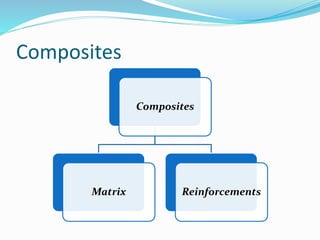
Composites
Composites
Matrix Reinforcements
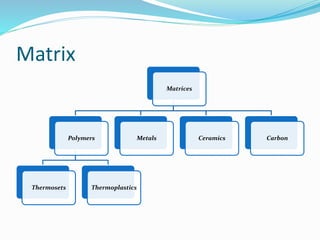
Matrix
Matrices
Polymers
Thermosets Thermoplastics
Metals Ceramics Carbon
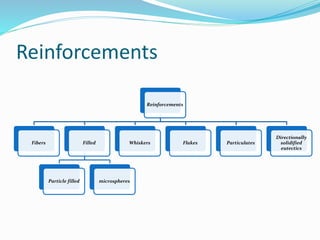
Reinforcements
Reinforcements
Fibers Filled
Particle filled microspheres
Whiskers Flakes Particulates
Directionally
solidified
eutectics
Applications
 Aircrafts,
 Military ships,
 Sports equipments,
 Construction (concrete),
 Bridges,
 Automotive,
 Moulds, etc.
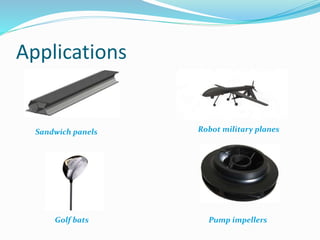
Applications
Sandwich panels
Golf bats
Robot military planes
Pump impellers
Advantages
 High resistance to fatigue and corrosion.
 High resistance to impact damage.
 High strength or stiffness to weight ratio.
 Less inspections and structural repairs.
 Improved friction and wear properties.
Disadvantages
 High cost of raw materials and fabrication.
 Transverse properties may be weak.
 Analysis is difficult.
 Reuse and disposal may be difficult.
 Difficult to attach.
Machinability
 In general, machinability differs for each material.
 But it’s not a material constant.
 Machinability depends on machining conditions.
 It also depends on the physical and chemical
properties of work part.
Factors affecting machinability
 Forms of chip,
 Surface of machined part,
 Tool condition,
 And cutting forces.
Parameters of machinability
 Mechanical properties of work part,
 Cutting tool; material and geometry,
 Levels of process parameters,
 Machining environment; lubrication, etc.,
 Rigidity and stiffness of M/C,
 Type of machining operation.
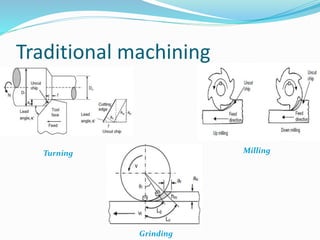
Traditional machining
Milling
Turning
Grinding
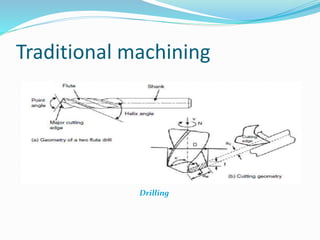
Traditional machining
Drilling
Machining parameters
 Cutting speed,
 Cutting forces,
 Workpiece, and tool materials,
 Lubrication,
 Feed rate.
Samples preparation
 Al-Si alloy “piston alloy”(11.56% Si),
 Nickel micro particles,
 Al2O3 nano particles.
Samples preparation
 Melting of matrix alloy (at 700 °C).
 Preheating of reinforcing particles (at 400°C for 30
min).
 Mechanical stirring and squeeze casting.
Samples
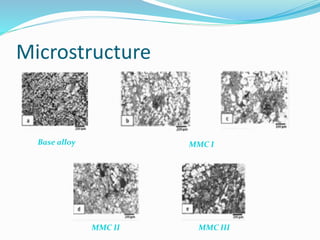
Microstructure
Base alloy MMC I
MMC II MMC III
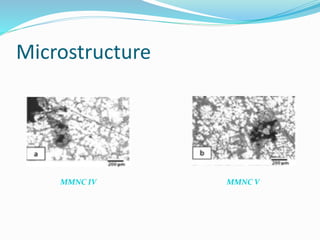
Microstructure
MMNC IV MMNC V
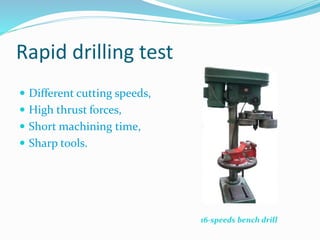
Rapid drilling test
 Different cutting speeds,
 High thrust forces,
 Short machining time,
 Sharp tools.
16-speeds bench drill
Equipment
 Powermeter (η = 95%),
 Avometer (η = 99%),
 Thrust weights (30, 40, and 50 Kg),
 High speed steel AISA M42 (6mm, and 8mm),
 103-lit carbide drill bit(6mm),
 16-speeds bench drill (E-type).
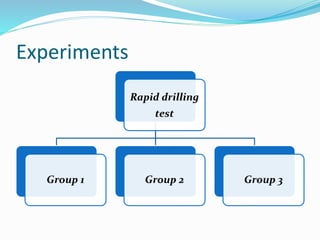
Experiments
Rapid drilling
test
Group 1 Group 2 Group 3
Group 1
 Drill diameter: 8mm
 Speed: 770 RPM (19.35 m/min)
 Feed forces: 300, 400, and 500 N
 Machining time: 10 sec
 Materials:
Base alloy
Al-Si base alloy + 5%wt. Ni
Al-Si base alloy + 10%wt. Ni
Al-Si base alloy + 15%wt. Ni
Al-Si base alloy + 5%wt. Ni + 2%wt 𝐴𝑙2𝑂3
Al-Si base alloy + 5%wt. Ni + 3%wt 𝐴𝑙2𝑂3
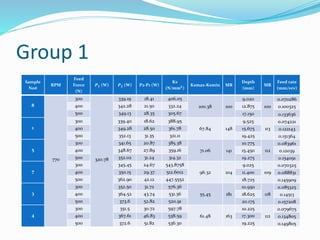
Group 1
Sample
No#
RPM
Feed
Force
(N)
𝑷𝟏 (W) 𝑷𝟐 (W) P2-P1 (W)
Ks
(N/𝒎𝒎𝟐)
Ksmax-Ksmin MR
Depth
(mm)
MR
Feed rate
(mm/rev)
8
770
300
320.78
339.19 18.41 406.05
100.38 100
9.020
100
0.070286
400 342.28 21.50 332.24 12.875 0.100325
500 349.13 28.35 305.67 17.150 0.133636
1
300 339.40 18.62 388.95
67.84 148
9.525
113
0.074221
400 349.28 28.50 361.78 15.675 0.122143
500 352.13 31.35 321.11 19.425 0.151364
5
300 341.65 20.87 385.38
71.06 141
10.775
112
0.083961
400 348.67 27.89 359.16 15.450 0.12039
500 352.02 31.24 314.32 19.275 0.154091
7
300 345.45 24.67 543.8758
96.32 104
9.025
109
0.070325
400 350.15 29.37 512.6012 11.400 0.088831
500 362.90 42.12 447.5552 18.725 0.145909
3
300 352.50 31.72 576.36
55.45 181
10.950
118
0.085325
400 364.52 43.74 531.36 18.625 0.14513
500 373.6 52.82 520.91 20.175 0.157208
4
300 351.5 30.72 597.78
61.48 163
10.225
112
0.079675
400 367.61 46.83 538.59 17.300 0.134805
500 372.6 51.82 536.30 19.225 0.149805
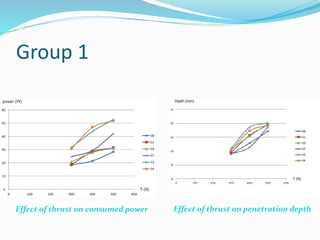
Group 1
Effect of thrust on consumed power Effect of thrust on penetration depth
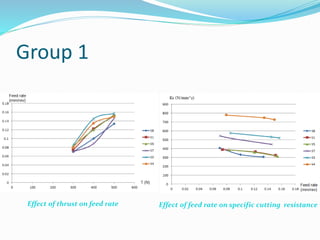
Group 1
Effect of thrust on feed rate Effect of feed rate on specific cutting resistance
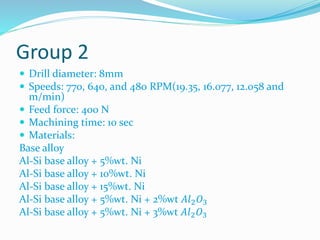
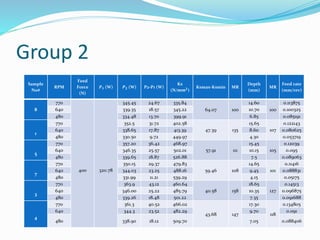
Group 2
 Drill diameter: 8mm
 Speeds: 770, 640, and 480 RPM(19.35, 16.077, 12.058 and
m/min)
 Feed force: 400 N
 Machining time: 10 sec
 Materials:
Base alloy
Al-Si base alloy + 5%wt. Ni
Al-Si base alloy + 10%wt. Ni
Al-Si base alloy + 15%wt. Ni
Al-Si base alloy + 5%wt. Ni + 2%wt 𝐴𝑙2𝑂3
Al-Si base alloy + 5%wt. Ni + 3%wt 𝐴𝑙2𝑂3
Group 2
Sample
No#
RPM
Feed
Force
(N)
𝑷𝟏 (W) 𝑷𝟐 (W) P2-P1 (W)
Ks
(N/𝒎𝒎𝟐)
Ksmax-Ksmin MR
Depth
(mm)
MR
Feed rate
(mm/rev)
8
770
400 320.78
345.45 24.67 335.84
64.07 100
14.60
100
0.113875
640 339.35 18.57 345.22 10.70 0.100325
480 334.48 13.70 399.91 6.85 0.085191
1
770 352.5 31.72 402.58
47.39 135
15.65
107
0.122143
640 338.65 17.87 413.39 8.60 0.080625
480 330.50 9.72 449.97 4.30 0.053719
5
770 357.20 36.42 468.97
57.91 111
15.45
105
0.12039
640 346.35 25.57 502.01 10.15 0.095
480 339.65 18.87 526.88 7.5 0.089063
7
770 350.15 29.37 479.83
59.46 108
14.65
101
0.11416
640 344.03 23.25 488.16 9.45 0.088831
480 331.99 11.21 539.29 4.15 0.05175
3
770 363.9 43.12 460.64
40.58 158
18.65
127
0.14513
640 346.00 25.22 485.79 10.35 0.096875
480 339.26 18.48 501.22 7.35 0.091688
4
770 361.3 40.52 466.02
43.68 147
17.30
118
0.134805
640 344.3 23.52 482.29 9.70 0.091
480 338.90 18.12 509.70 7.05 0.088406
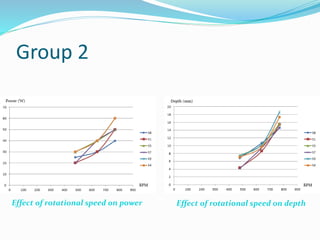
Group 2
Effect of rotational speed on power Effect of rotational speed on depth
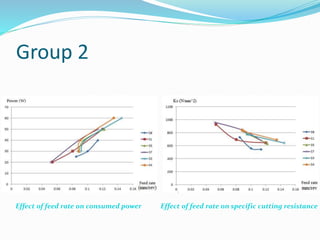
Group 2
Effect of feed rate on consumed power Effect of feed rate on specific cutting resistance
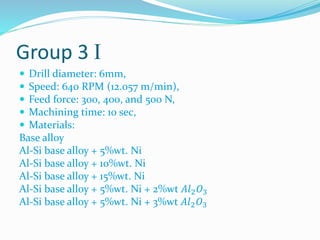
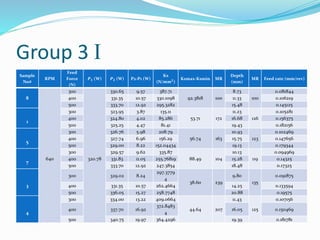
Group 3 I
 Drill diameter: 6mm,
 Speed: 640 RPM (12.057 m/min),
 Feed force: 300, 400, and 500 N,
 Machining time: 10 sec,
 Materials:
Base alloy
Al-Si base alloy + 5%wt. Ni
Al-Si base alloy + 10%wt. Ni
Al-Si base alloy + 15%wt. Ni
Al-Si base alloy + 5%wt. Ni + 2%wt 𝐴𝑙2𝑂3
Al-Si base alloy + 5%wt. Ni + 3%wt 𝐴𝑙2𝑂3
Group 3 I
Sample
No#
RPM
Feed
Force
(N)
𝑷𝟏 (W) 𝑷𝟐 (W) P2-P1 (W)
Ks
(N/𝒎𝒎𝟐)
Ksmax-Ksmin MR
Depth
(mm)
MR Feed rate (mm/rev)
8
640
300
320.78
330.65 9.57 387.71
92.3818 100
8.73
100
0.081844
400 331.35 10.57 330.1098 11.33 0.106219
500 333.70 12.92 295.3282 15.48 0.145125
1
300 323.95 3.87 135.11
53.71 172
11.23
126
0.105281
400 324.80 4.02 85.286 16.68 0.156375
500 325.25 4.47 81.41 19.43 0.182156
5
300 326.76 5.98 208.79
56.74 163
10.93
123
0.102469
400 327.74 6.96 156.29 15.75 0.147656
500 329.00 8.22 152.04434 19.13 0.179344
7
300 329.57 9.62 335.87
88.49 104
10.13
119
0.094969
400 331.83 11.05 255.76819 15.28 0.14325
500 333.70 12.92 247.3854 18.48 0.17325
3
300 329.02 8.24
297.3779
4
38.60 239
9.80
135
0.091875
400 331.35 10.57 262.4664 14.25 0.133594
500 336.05 15.27 258.7748 20.88 0.19575
4
300 334.00 13.22 409.0664
44.64 207
11.43
125
0.107156
400 337.70 16.92
372.8483
4
16.05 0.150469
500 340.75 19.97 364.4296 19.39 0.181781
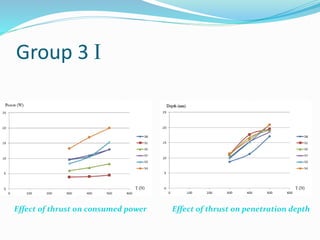
Group 3 I
Effect of thrust on consumed power Effect of thrust on penetration depth
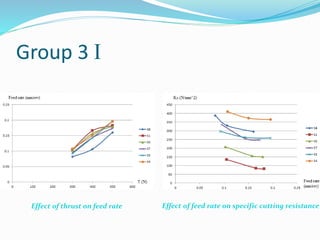
Group 3 I
Effect of thrust on feed rate Effect of feed rate on specific cutting resistance
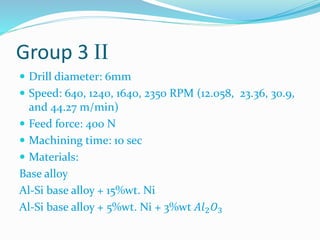
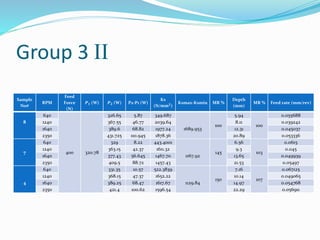
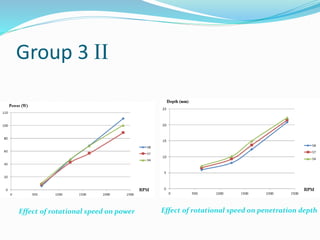
Group 3 II
 Drill diameter: 6mm
 Speed: 640, 1240, 1640, 2350 RPM (12.058, 23.36, 30.9,
and 44.27 m/min)
 Feed force: 400 N
 Machining time: 10 sec
 Materials:
Base alloy
Al-Si base alloy + 15%wt. Ni
Al-Si base alloy + 5%wt. Ni + 3%wt 𝐴𝑙2𝑂3
Group 3 II
Sample
No#
RPM
Feed
Force
(N)
𝑷𝟏 (W) 𝑷𝟐 (W) P2-P1 (W)
Ks
(N/𝒎𝒎𝟐)
Ksmax-Ksmin MR %
Depth
(mm)
MR % Feed rate (mm/rev)
8
640
400 320.78
326.65 5.87 349.687
1689.953
100
5.94
100
0.055688
1240 367.55 46.77 2039.64 8.11 0.039242
1640 389.6 68.82 1977.24 12.31 0.045037
2350 431.725 110.945 1878.36 20.89 0.053336
7
640 329 8.22 443.4001
1167.92
145
6.56
103
0.0615
1240 363.15 42.37 1611.32 9.3 0.045
1640 377.43 56.645 1467.70 13.65 0.049939
2350 409.5 88.72 1457.43 21.53 0.05497
4
640 331.35 10.57 522.3839
1129.84
150
7.16
107
0.067125
1240 368.15 47.37 1652.22 10.14 0.049065
1640 389.25 68.47 1617.67 14.97 0.054768
2350 421.4 100.62 1596.54 22.29 0.056911
Group 3 II
Effect of rotational speed on power Effect of rotational speed on penetration depth
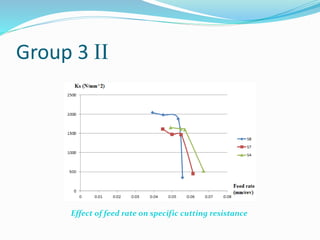
Group 3 II
Effect of feed rate on specific cutting resistance
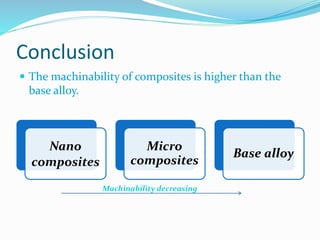
Conclusion
 The machinability of composites is higher than the
base alloy.
Nano
composites
Micro
composites
Base alloy
Machinability decreasing
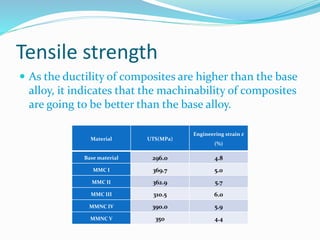
Tensile strength
 As the ductility of composites are higher than the base
alloy, it indicates that the machinability of composites
are going to be better than the base alloy.
Material UTS(MPa)
Engineering strain 𝜺
(%)
Base material 296.0 4.8
MMC I 369.7 5.0
MMC II 362.9 5.7
MMC III 310.5 6.0
MMNC IV 390.0 5.9
MMNC V 350 4.4
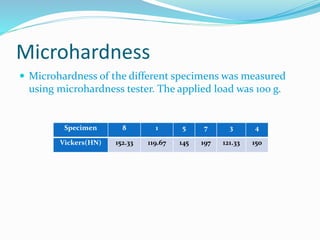
Microhardness
 Microhardness of the different specimens was measured
using microhardness tester. The applied load was 100 g.
Specimen 8 1 5 7 3 4
Vickers(HN) 152.33 119.67 145 197 121.33 150
Machinability of Composite Materials.pptx

Machinability of Composite Materials.pptx

  • 1.
    Alexandria University Production Engineering Discussionof bachelor project Supervisor: Prof. Dr. Helmi Abdel Maksoud Youssef
  • 2.
    Team members  MohamedAbdel kader sawah  Mohamed Abdel Wahab Hassaan  Mahmoud Hamed Mustafa Hussein
  • 3.
  • 4.
  • 5.
    Reinforcements Reinforcements Fibers Filled Particle filledmicrospheres Whiskers Flakes Particulates Directionally solidified eutectics
  • 6.
    Applications  Aircrafts,  Militaryships,  Sports equipments,  Construction (concrete),  Bridges,  Automotive,  Moulds, etc.
  • 7.
    Applications Sandwich panels Golf bats Robotmilitary planes Pump impellers
  • 8.
    Advantages  High resistanceto fatigue and corrosion.  High resistance to impact damage.  High strength or stiffness to weight ratio.  Less inspections and structural repairs.  Improved friction and wear properties.
  • 9.
    Disadvantages  High costof raw materials and fabrication.  Transverse properties may be weak.  Analysis is difficult.  Reuse and disposal may be difficult.  Difficult to attach.
  • 10.
    Machinability  In general,machinability differs for each material.  But it’s not a material constant.  Machinability depends on machining conditions.  It also depends on the physical and chemical properties of work part.
  • 11.
    Factors affecting machinability Forms of chip,  Surface of machined part,  Tool condition,  And cutting forces.
  • 12.
    Parameters of machinability Mechanical properties of work part,  Cutting tool; material and geometry,  Levels of process parameters,  Machining environment; lubrication, etc.,  Rigidity and stiffness of M/C,  Type of machining operation.
  • 13.
  • 14.
  • 15.
    Machining parameters  Cuttingspeed,  Cutting forces,  Workpiece, and tool materials,  Lubrication,  Feed rate.
  • 16.
    Samples preparation  Al-Sialloy “piston alloy”(11.56% Si),  Nickel micro particles,  Al2O3 nano particles.
  • 17.
    Samples preparation  Meltingof matrix alloy (at 700 °C).  Preheating of reinforcing particles (at 400°C for 30 min).  Mechanical stirring and squeeze casting.
  • 18.
  • 19.
  • 20.
  • 21.
    Rapid drilling test Different cutting speeds,  High thrust forces,  Short machining time,  Sharp tools. 16-speeds bench drill
  • 22.
    Equipment  Powermeter (η= 95%),  Avometer (η = 99%),  Thrust weights (30, 40, and 50 Kg),  High speed steel AISA M42 (6mm, and 8mm),  103-lit carbide drill bit(6mm),  16-speeds bench drill (E-type).
  • 23.
  • 24.
    Group 1  Drilldiameter: 8mm  Speed: 770 RPM (19.35 m/min)  Feed forces: 300, 400, and 500 N  Machining time: 10 sec  Materials: Base alloy Al-Si base alloy + 5%wt. Ni Al-Si base alloy + 10%wt. Ni Al-Si base alloy + 15%wt. Ni Al-Si base alloy + 5%wt. Ni + 2%wt 𝐴𝑙2𝑂3 Al-Si base alloy + 5%wt. Ni + 3%wt 𝐴𝑙2𝑂3
  • 25.
    Group 1 Sample No# RPM Feed Force (N) 𝑷𝟏 (W)𝑷𝟐 (W) P2-P1 (W) Ks (N/𝒎𝒎𝟐) Ksmax-Ksmin MR Depth (mm) MR Feed rate (mm/rev) 8 770 300 320.78 339.19 18.41 406.05 100.38 100 9.020 100 0.070286 400 342.28 21.50 332.24 12.875 0.100325 500 349.13 28.35 305.67 17.150 0.133636 1 300 339.40 18.62 388.95 67.84 148 9.525 113 0.074221 400 349.28 28.50 361.78 15.675 0.122143 500 352.13 31.35 321.11 19.425 0.151364 5 300 341.65 20.87 385.38 71.06 141 10.775 112 0.083961 400 348.67 27.89 359.16 15.450 0.12039 500 352.02 31.24 314.32 19.275 0.154091 7 300 345.45 24.67 543.8758 96.32 104 9.025 109 0.070325 400 350.15 29.37 512.6012 11.400 0.088831 500 362.90 42.12 447.5552 18.725 0.145909 3 300 352.50 31.72 576.36 55.45 181 10.950 118 0.085325 400 364.52 43.74 531.36 18.625 0.14513 500 373.6 52.82 520.91 20.175 0.157208 4 300 351.5 30.72 597.78 61.48 163 10.225 112 0.079675 400 367.61 46.83 538.59 17.300 0.134805 500 372.6 51.82 536.30 19.225 0.149805
  • 26.
    Group 1 Effect ofthrust on consumed power Effect of thrust on penetration depth
  • 27.
    Group 1 Effect ofthrust on feed rate Effect of feed rate on specific cutting resistance
  • 28.
    Group 2  Drilldiameter: 8mm  Speeds: 770, 640, and 480 RPM(19.35, 16.077, 12.058 and m/min)  Feed force: 400 N  Machining time: 10 sec  Materials: Base alloy Al-Si base alloy + 5%wt. Ni Al-Si base alloy + 10%wt. Ni Al-Si base alloy + 15%wt. Ni Al-Si base alloy + 5%wt. Ni + 2%wt 𝐴𝑙2𝑂3 Al-Si base alloy + 5%wt. Ni + 3%wt 𝐴𝑙2𝑂3
  • 29.
    Group 2 Sample No# RPM Feed Force (N) 𝑷𝟏 (W)𝑷𝟐 (W) P2-P1 (W) Ks (N/𝒎𝒎𝟐) Ksmax-Ksmin MR Depth (mm) MR Feed rate (mm/rev) 8 770 400 320.78 345.45 24.67 335.84 64.07 100 14.60 100 0.113875 640 339.35 18.57 345.22 10.70 0.100325 480 334.48 13.70 399.91 6.85 0.085191 1 770 352.5 31.72 402.58 47.39 135 15.65 107 0.122143 640 338.65 17.87 413.39 8.60 0.080625 480 330.50 9.72 449.97 4.30 0.053719 5 770 357.20 36.42 468.97 57.91 111 15.45 105 0.12039 640 346.35 25.57 502.01 10.15 0.095 480 339.65 18.87 526.88 7.5 0.089063 7 770 350.15 29.37 479.83 59.46 108 14.65 101 0.11416 640 344.03 23.25 488.16 9.45 0.088831 480 331.99 11.21 539.29 4.15 0.05175 3 770 363.9 43.12 460.64 40.58 158 18.65 127 0.14513 640 346.00 25.22 485.79 10.35 0.096875 480 339.26 18.48 501.22 7.35 0.091688 4 770 361.3 40.52 466.02 43.68 147 17.30 118 0.134805 640 344.3 23.52 482.29 9.70 0.091 480 338.90 18.12 509.70 7.05 0.088406
  • 30.
    Group 2 Effect ofrotational speed on power Effect of rotational speed on depth
  • 31.
    Group 2 Effect offeed rate on consumed power Effect of feed rate on specific cutting resistance
  • 32.
    Group 3 I Drill diameter: 6mm,  Speed: 640 RPM (12.057 m/min),  Feed force: 300, 400, and 500 N,  Machining time: 10 sec,  Materials: Base alloy Al-Si base alloy + 5%wt. Ni Al-Si base alloy + 10%wt. Ni Al-Si base alloy + 15%wt. Ni Al-Si base alloy + 5%wt. Ni + 2%wt 𝐴𝑙2𝑂3 Al-Si base alloy + 5%wt. Ni + 3%wt 𝐴𝑙2𝑂3
  • 33.
    Group 3 I Sample No# RPM Feed Force (N) 𝑷𝟏(W) 𝑷𝟐 (W) P2-P1 (W) Ks (N/𝒎𝒎𝟐) Ksmax-Ksmin MR Depth (mm) MR Feed rate (mm/rev) 8 640 300 320.78 330.65 9.57 387.71 92.3818 100 8.73 100 0.081844 400 331.35 10.57 330.1098 11.33 0.106219 500 333.70 12.92 295.3282 15.48 0.145125 1 300 323.95 3.87 135.11 53.71 172 11.23 126 0.105281 400 324.80 4.02 85.286 16.68 0.156375 500 325.25 4.47 81.41 19.43 0.182156 5 300 326.76 5.98 208.79 56.74 163 10.93 123 0.102469 400 327.74 6.96 156.29 15.75 0.147656 500 329.00 8.22 152.04434 19.13 0.179344 7 300 329.57 9.62 335.87 88.49 104 10.13 119 0.094969 400 331.83 11.05 255.76819 15.28 0.14325 500 333.70 12.92 247.3854 18.48 0.17325 3 300 329.02 8.24 297.3779 4 38.60 239 9.80 135 0.091875 400 331.35 10.57 262.4664 14.25 0.133594 500 336.05 15.27 258.7748 20.88 0.19575 4 300 334.00 13.22 409.0664 44.64 207 11.43 125 0.107156 400 337.70 16.92 372.8483 4 16.05 0.150469 500 340.75 19.97 364.4296 19.39 0.181781
  • 34.
    Group 3 I Effectof thrust on consumed power Effect of thrust on penetration depth
  • 35.
    Group 3 I Effectof thrust on feed rate Effect of feed rate on specific cutting resistance
  • 36.
    Group 3 II Drill diameter: 6mm  Speed: 640, 1240, 1640, 2350 RPM (12.058, 23.36, 30.9, and 44.27 m/min)  Feed force: 400 N  Machining time: 10 sec  Materials: Base alloy Al-Si base alloy + 15%wt. Ni Al-Si base alloy + 5%wt. Ni + 3%wt 𝐴𝑙2𝑂3
  • 37.
    Group 3 II Sample No# RPM Feed Force (N) 𝑷𝟏(W) 𝑷𝟐 (W) P2-P1 (W) Ks (N/𝒎𝒎𝟐) Ksmax-Ksmin MR % Depth (mm) MR % Feed rate (mm/rev) 8 640 400 320.78 326.65 5.87 349.687 1689.953 100 5.94 100 0.055688 1240 367.55 46.77 2039.64 8.11 0.039242 1640 389.6 68.82 1977.24 12.31 0.045037 2350 431.725 110.945 1878.36 20.89 0.053336 7 640 329 8.22 443.4001 1167.92 145 6.56 103 0.0615 1240 363.15 42.37 1611.32 9.3 0.045 1640 377.43 56.645 1467.70 13.65 0.049939 2350 409.5 88.72 1457.43 21.53 0.05497 4 640 331.35 10.57 522.3839 1129.84 150 7.16 107 0.067125 1240 368.15 47.37 1652.22 10.14 0.049065 1640 389.25 68.47 1617.67 14.97 0.054768 2350 421.4 100.62 1596.54 22.29 0.056911
  • 38.
    Group 3 II Effectof rotational speed on power Effect of rotational speed on penetration depth
  • 39.
    Group 3 II Effectof feed rate on specific cutting resistance
  • 40.
    Conclusion  The machinabilityof composites is higher than the base alloy. Nano composites Micro composites Base alloy Machinability decreasing
  • 41.
    Tensile strength  Asthe ductility of composites are higher than the base alloy, it indicates that the machinability of composites are going to be better than the base alloy. Material UTS(MPa) Engineering strain 𝜺 (%) Base material 296.0 4.8 MMC I 369.7 5.0 MMC II 362.9 5.7 MMC III 310.5 6.0 MMNC IV 390.0 5.9 MMNC V 350 4.4
  • 42.
    Microhardness  Microhardness ofthe different specimens was measured using microhardness tester. The applied load was 100 g. Specimen 8 1 5 7 3 4 Vickers(HN) 152.33 119.67 145 197 121.33 150