Let’s study literature with IT!
LPM Webinar
September 5, 2016.
Presenter: M.-Hélène Fasquel –
American OIB Language and Literature
instructor. Lycée Nelson Mandela,
Nantes.
Guest author: Cyane
Host: Amélie Silvert
Organizer: Jurgen Wagner.
1
Welcome to this webinar!!!
 Let’s focus on you to begin with!
 Where do you live and which language
do you teach?
 Is it your first webinar?
 Please answer in the chat box 
2
OIB Language and Literature
 International option
 L/L syllabus:13 works
 6 hours and a half per week
 Includes:
◦ Traditional study of literature (close reading, essay
writing, commentary practice, debates, discussions,
group/pair work, project-based pedagogy, oral practice,
presentations,…)
◦ Guest speakers, webinars, online creative
competitions, projects involving American and French-
speaking authors,…)
◦ But also flipped learning (when most appropriate),
◦ And IT-enhanced classes. 3
Combining 4 essential motivation
factors
 ICT:
 collaboration,
 content creation,
 online publishing,
 Fun and engaging activities,
 Authentic communication,
 Learning with one’s peers AND experts.
4
Objective:
Concept which allows teachers to share
resources with their pupils and to collaborate
easily with teachers from umpteen countries,
which gives the students an opportunity to study
at their pace, to study differently depending on
their learning styles (different types of resources
are offered),
which permits them to work in groups and help
each other, build their own learning and go
further than they would have in a traditional class.
For instance… 5
My definition of the flipped classroom
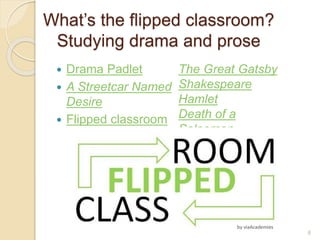
What’s the flipped classroom?
Studying drama and prose
 Drama Padlet
 A Streetcar Named
Desire
 Flipped classroom
6
The Great Gatsby
Shakespeare
Hamlet
Death of a
Salesman
7
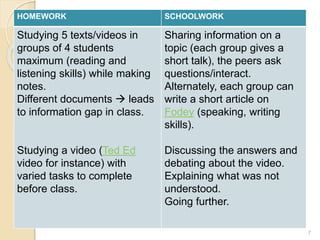
HOMEWORK SCHOOLWORK
Studying 5 texts/videos in
groups of 4 students
maximum (reading and
listening skills) while making
notes.
Different documents  leads
to information gap in class.
Studying a video (Ted Ed
video for instance) with
varied tasks to complete
before class.
Sharing information on a
topic (each group gives a
short talk), the peers ask
questions/interact.
Alternately, each group can
write a short article on
Fodey (speaking, writing
skills).
Discussing the answers and
debating about the video.
Explaining what was not
understood.
Going further.
Any questions?
 You can add your questions on this
Padlet:
 https://padlet.com/mhfasquel/lit_webin
ar
8
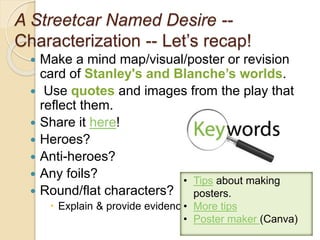
A Streetcar Named Desire --
Characterization -- Let’s recap!
 Make a mind map/visual/poster or revision
card of Stanley's and Blanche’s worlds.
 Use quotes and images from the play that
reflect them.
 Share it here!
 Heroes?
 Anti-heroes?
 Any foils?
 Round/flat characters?
 Explain & provide evidence.
9
• Tips about making
posters.
• More tips
• Poster maker (Canva)
The Great Gatsby -- Let’s recap!
 Homework time: Study this Ted Ed
lesson and answer the questions. Jot
down notes.
 Debate time: Let’s discuss your findings and
answers!
◦ Do you think characters should be likeable?
◦ Does Gatsby really love Daisy?
◦ To what extent do you think his quest is
heroic?
10
The Great Gatsby -- Homework.
 Let’s play a game!
https://quizlet.com/20155811/s
catter
 You can revise the main facts
on this webpage:
https://quizlet.com/20155811/g
reat-gatsby-chapter-4-flash-
cards/
In class:
 Let’s list the main facts
11
The Great Gatsby -- Your TED-style
talks
 Choose among the following topics!
 Pair work or group work (maximum of 4
students)
◦ The American dream in The Great Gatsby
◦ Symbolism and imagery
◦ Quotes (in-depth analysis)
◦ Main themes and topics
◦ Literary context (review) – 4 presentations
 Romanticism
 Realism
 Naturalism
 Modernism
◦ Compare and contrast The Great Gatsby with 12
Your TED-style talks
 Deliver a TED-style talk!!!
 One example to study (about poetry)
 One more example to study (about the
danger of a single story)
 Your rubric
13
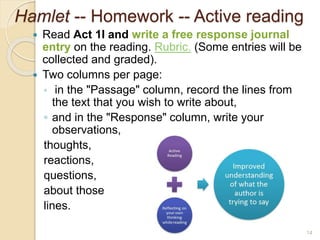
Hamlet -- Homework -- Active reading
 Read Act 1I and write a free response journal
entry on the reading. Rubric. (Some entries will be
collected and graded).
 Two columns per page:
◦ in the "Passage" column, record the lines from
the text that you wish to write about,
◦ and in the "Response" column, write your
observations,
thoughts,
reactions,
questions,
about those
lines.
14
And now for something (not so)
completely different…
 Projects past, present and
upcoming…
15
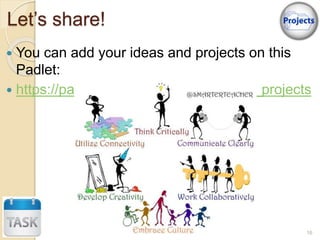
Let’s share!
 You can add your ideas and projects on this
Padlet:
 https://padlet.com/mhfasquel/lit_ideas_projects
16
Creative writing competition
 Paper Planes Creative Writing Competition (Animal
Circus by Alix et Mathieu and Devour the pages
by Charlotte)
Learning more about the media
 Vocable competition
Video challenge
 EF Challenge for High Schools
American author
 Last but not least: Partnership with Eric
Price, American award-winning fantasy
author.
Projects
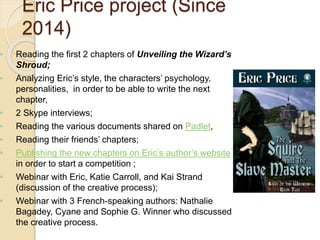
◦ Reading the first 2 chapters of Unveiling the Wizard’s
Shroud;
◦ Analyzing Eric’s style, the characters’ psychology,
personalities, in order to be able to write the next
chapter,
◦ 2 Skype interviews;
◦ Reading the various documents shared on Padlet,
◦ Reading their friends’ chapters;
◦ Publishing the new chapters on Eric’s author’s website
in order to start a competition ;
◦ Webinar with Eric, Katie Carroll, and Kai Strand
(discussion of the creative process);
◦ Webinar with 3 French-speaking authors: Nathalie
Bagadey, Cyane and Sophie G. Winner who discussed
the creative process.
Eric Price project (Since
2014)
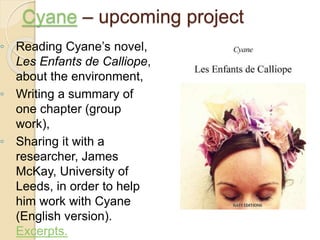
◦ Reading Cyane’s novel,
Les Enfants de Calliope,
about the environment,
◦ Writing a summary of
one chapter (group
work),
◦ Sharing it with a
researcher, James
McKay, University of
Leeds, in order to help
him work with Cyane
(English version).
Excerpts.
Cyane – upcoming project
Upcoming eTwinning project
 eTwinning project involving 4 schools (British and
American International Sections) with Chris Segond,
Debra and Heather Bainbridge.
 Building Bridges: From 3e Inter to 2nde OIB
 In this project, four international sections will come
together to build links. This project focuses on the
difficult steps of transitioning from a 3e
International Section (British, in our case) to a
2nde OIB section (one American, one British in this
project). We will ask our students to talk about their
fears and expectations, to give each other good
advice for preparing for the 'next step', and
discussing reading and the reading process, an
essential part of the work we do in the section. 20
Upcoming project: Literature in the
making
 Author partnership (7 so far)
 Skype interviews and analysis of today’s
literature!
 All the links and slides 
21
Any questions?
 You can add your questions on this
Padlet:
 https://padlet.com/mhfasquel/lit_webin
ar
22
mhfasquel@gmail.com
On Twitter: @mariehel2
Slideshare
My files on Slideshare.
Blog
On Facebook, LinkedIn &
Google+, eTwinning: Marie-Hélène Fasquel
Feel free to contact me! 23
Contact information
24
Thank you very much for your
attention and participation!

Let's study literature with IT! ideas, projects and tasks.

  • 1.
    Let’s study literaturewith IT! LPM Webinar September 5, 2016. Presenter: M.-Hélène Fasquel – American OIB Language and Literature instructor. Lycée Nelson Mandela, Nantes. Guest author: Cyane Host: Amélie Silvert Organizer: Jurgen Wagner. 1
  • 2.
    Welcome to thiswebinar!!!  Let’s focus on you to begin with!  Where do you live and which language do you teach?  Is it your first webinar?  Please answer in the chat box  2
  • 3.
    OIB Language andLiterature  International option  L/L syllabus:13 works  6 hours and a half per week  Includes: ◦ Traditional study of literature (close reading, essay writing, commentary practice, debates, discussions, group/pair work, project-based pedagogy, oral practice, presentations,…) ◦ Guest speakers, webinars, online creative competitions, projects involving American and French- speaking authors,…) ◦ But also flipped learning (when most appropriate), ◦ And IT-enhanced classes. 3
  • 4.
    Combining 4 essentialmotivation factors  ICT:  collaboration,  content creation,  online publishing,  Fun and engaging activities,  Authentic communication,  Learning with one’s peers AND experts. 4 Objective:
  • 5.
    Concept which allowsteachers to share resources with their pupils and to collaborate easily with teachers from umpteen countries, which gives the students an opportunity to study at their pace, to study differently depending on their learning styles (different types of resources are offered), which permits them to work in groups and help each other, build their own learning and go further than they would have in a traditional class. For instance… 5 My definition of the flipped classroom
  • 6.
    What’s the flippedclassroom? Studying drama and prose  Drama Padlet  A Streetcar Named Desire  Flipped classroom 6 The Great Gatsby Shakespeare Hamlet Death of a Salesman
  • 7.
    7 HOMEWORK SCHOOLWORK Studying 5texts/videos in groups of 4 students maximum (reading and listening skills) while making notes. Different documents  leads to information gap in class. Studying a video (Ted Ed video for instance) with varied tasks to complete before class. Sharing information on a topic (each group gives a short talk), the peers ask questions/interact. Alternately, each group can write a short article on Fodey (speaking, writing skills). Discussing the answers and debating about the video. Explaining what was not understood. Going further.
  • 8.
    Any questions?  Youcan add your questions on this Padlet:  https://padlet.com/mhfasquel/lit_webin ar 8
  • 9.
    A Streetcar NamedDesire -- Characterization -- Let’s recap!  Make a mind map/visual/poster or revision card of Stanley's and Blanche’s worlds.  Use quotes and images from the play that reflect them.  Share it here!  Heroes?  Anti-heroes?  Any foils?  Round/flat characters?  Explain & provide evidence. 9 • Tips about making posters. • More tips • Poster maker (Canva)
  • 10.
    The Great Gatsby-- Let’s recap!  Homework time: Study this Ted Ed lesson and answer the questions. Jot down notes.  Debate time: Let’s discuss your findings and answers! ◦ Do you think characters should be likeable? ◦ Does Gatsby really love Daisy? ◦ To what extent do you think his quest is heroic? 10
  • 11.
    The Great Gatsby-- Homework.  Let’s play a game! https://quizlet.com/20155811/s catter  You can revise the main facts on this webpage: https://quizlet.com/20155811/g reat-gatsby-chapter-4-flash- cards/ In class:  Let’s list the main facts 11
  • 12.
    The Great Gatsby-- Your TED-style talks  Choose among the following topics!  Pair work or group work (maximum of 4 students) ◦ The American dream in The Great Gatsby ◦ Symbolism and imagery ◦ Quotes (in-depth analysis) ◦ Main themes and topics ◦ Literary context (review) – 4 presentations  Romanticism  Realism  Naturalism  Modernism ◦ Compare and contrast The Great Gatsby with 12
  • 13.
    Your TED-style talks Deliver a TED-style talk!!!  One example to study (about poetry)  One more example to study (about the danger of a single story)  Your rubric 13
  • 14.
    Hamlet -- Homework-- Active reading  Read Act 1I and write a free response journal entry on the reading. Rubric. (Some entries will be collected and graded).  Two columns per page: ◦ in the "Passage" column, record the lines from the text that you wish to write about, ◦ and in the "Response" column, write your observations, thoughts, reactions, questions, about those lines. 14
  • 15.
    And now forsomething (not so) completely different…  Projects past, present and upcoming… 15
  • 16.
    Let’s share!  Youcan add your ideas and projects on this Padlet:  https://padlet.com/mhfasquel/lit_ideas_projects 16
  • 17.
    Creative writing competition Paper Planes Creative Writing Competition (Animal Circus by Alix et Mathieu and Devour the pages by Charlotte) Learning more about the media  Vocable competition Video challenge  EF Challenge for High Schools American author  Last but not least: Partnership with Eric Price, American award-winning fantasy author. Projects
  • 18.
    ◦ Reading thefirst 2 chapters of Unveiling the Wizard’s Shroud; ◦ Analyzing Eric’s style, the characters’ psychology, personalities, in order to be able to write the next chapter, ◦ 2 Skype interviews; ◦ Reading the various documents shared on Padlet, ◦ Reading their friends’ chapters; ◦ Publishing the new chapters on Eric’s author’s website in order to start a competition ; ◦ Webinar with Eric, Katie Carroll, and Kai Strand (discussion of the creative process); ◦ Webinar with 3 French-speaking authors: Nathalie Bagadey, Cyane and Sophie G. Winner who discussed the creative process. Eric Price project (Since 2014)
  • 19.
    ◦ Reading Cyane’snovel, Les Enfants de Calliope, about the environment, ◦ Writing a summary of one chapter (group work), ◦ Sharing it with a researcher, James McKay, University of Leeds, in order to help him work with Cyane (English version). Excerpts. Cyane – upcoming project
  • 20.
    Upcoming eTwinning project eTwinning project involving 4 schools (British and American International Sections) with Chris Segond, Debra and Heather Bainbridge.  Building Bridges: From 3e Inter to 2nde OIB  In this project, four international sections will come together to build links. This project focuses on the difficult steps of transitioning from a 3e International Section (British, in our case) to a 2nde OIB section (one American, one British in this project). We will ask our students to talk about their fears and expectations, to give each other good advice for preparing for the 'next step', and discussing reading and the reading process, an essential part of the work we do in the section. 20
  • 21.
    Upcoming project: Literaturein the making  Author partnership (7 so far)  Skype interviews and analysis of today’s literature!  All the links and slides  21
  • 22.
    Any questions?  Youcan add your questions on this Padlet:  https://padlet.com/mhfasquel/lit_webin ar 22
  • 23.
    mhfasquel@gmail.com On Twitter: @mariehel2 Slideshare Myfiles on Slideshare. Blog On Facebook, LinkedIn & Google+, eTwinning: Marie-Hélène Fasquel Feel free to contact me! 23 Contact information
  • 24.
    24 Thank you verymuch for your attention and participation!