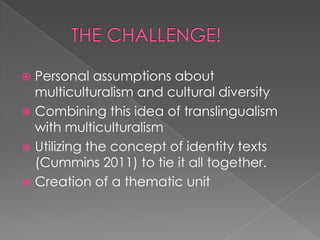
 Personal assumptions about
  multiculturalism and cultural diversity
 Combining this idea of translingualism
  with multiculturalism
 Utilizing the concept of identity texts
  (Cummins 2011) to tie it all together.
 Creation of a thematic unit
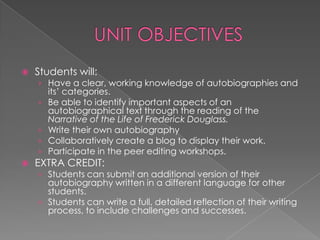
   Students will:
    › Have a clear, working knowledge of autobiographies and
        its’ categories.
    ›   Be able to identify important aspects of an
        autobiographical text through the reading of the
        Narrative of the Life of Frederick Douglass.
    ›   Write their own autobiography
    ›   Collaboratively create a blog to display their work.
    ›   Participate in the peer editing workshops.
   EXTRA CREDIT:
    › Students can submit an additional version of their
      autobiography written in a different language for other
      students.
    › Students can write a full, detailed reflection of their writing
      process, to include challenges and successes.
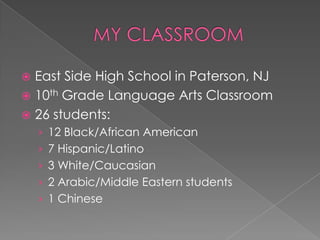
 East Side High School in Paterson, NJ
 10th Grade Language Arts Classroom
 26 students:
    › 12 Black/African American
    › 7 Hispanic/Latino
    › 3 White/Caucasian
    › 2 Arabic/Middle Eastern students
    › 1 Chinese
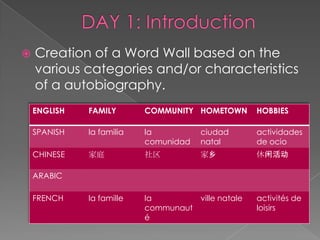
   Creation of a Word Wall based on the
    various categories and/or characteristics
    of a autobiography.
    ENGLISH   FAMILY       COMMUNITY HOMETOWN       HOBBIES

    SPANISH   la familia   la          ciudad       actividades
                           comunidad   natal        de ocio
    CHINESE   家庭           社区          家乡           休闲活动

    ARABIC

    FRENCH    la famille   la        ville natale   activités de
                           communaut                loisirs
                           é
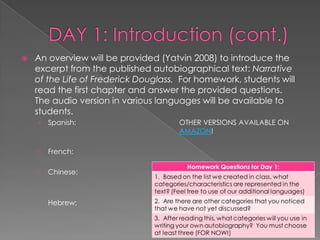
   An overview will be provided (Yatvin 2008) to introduce the
    excerpt from the published autobiographical text: Narrative
    of the Life of Frederick Douglass. For homework, students will
    read the first chapter and answer the provided questions.
    The audio version in various languages will be available to
    students.
    ›   Spanish:                      OTHER VERSIONS AVAILABLE ON
                                      AMAZON!

    ›   French:

    ›   Chinese:


    ›   Hebrew:
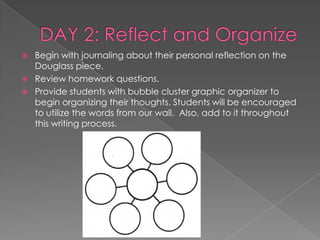
   Begin with journaling about their personal reflection on the
    Douglass piece.
   Review homework questions.
   Provide students with bubble cluster graphic organizer to
    begin organizing their thoughts. Students will be encouraged
    to utilize the words from our wall. Also, add to it throughout
    this writing process.
   Students will come into class with their first rough
    drafts.
   Students are broken into pairs and groups of three.
   Students will work in a different group or pair each
    time.
   Guidelines will be provided for peer editing, i.e. what
    to look for.
   The teacher will walk around to provide informal
    guidance, advice, and instruction.
   At the end of each workshop, students will correct
    and polish drafts.
   Students will be encouraged to use words from the
    word wall and add to the wall with teacher approval.
   All drafts will be collected at the end.
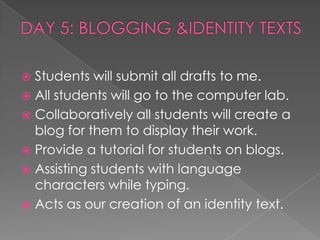
 Students will submit all drafts to me.
 All students will go to the computer lab.
 Collaboratively all students will create a
  blog for them to display their work.
 Provide a tutorial for students on blogs.
 Assisting students with language
  characters while typing.
 Acts as our creation of an identity text.
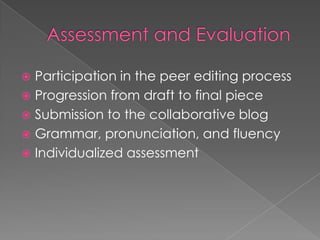
 Participation in the peer editing process
 Progression from draft to final piece
 Submission to the collaborative blog
 Grammar, pronunciation, and fluency
 Individualized assessment
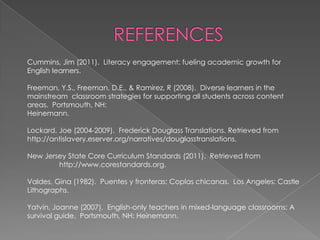
Cummins, Jim (2011). Literacy engagement: fueling academic growth for
English learners.

Freeman, Y.S., Freeman, D.E., & Ramirez, R (2008). Diverse learners in the
mainstream classroom strategies for supporting all students across content
areas. Portsmouth, NH:
Heinemann.

Lockard, Joe (2004-2009). Frederick Douglass Translations. Retrieved from
http://antislavery.eserver.org/narratives/douglasstranslations.

New Jersey State Core Curriculum Standards (2011). Retrieved from
        http://www.corestandards.org.

Valdes, Gina (1982). Puentes y fronteras: Coplas chicanas. Los Angeles: Castle
Lithographs.

Yatvin, Joanne (2007). English-only teachers in mixed-language classrooms: A
survival guide. Portsmouth, NH: Heinemann.

Final lesson plan

  • 2.
     Personal assumptionsabout multiculturalism and cultural diversity  Combining this idea of translingualism with multiculturalism  Utilizing the concept of identity texts (Cummins 2011) to tie it all together.  Creation of a thematic unit
  • 3.
    Students will: › Have a clear, working knowledge of autobiographies and its’ categories. › Be able to identify important aspects of an autobiographical text through the reading of the Narrative of the Life of Frederick Douglass. › Write their own autobiography › Collaboratively create a blog to display their work. › Participate in the peer editing workshops.  EXTRA CREDIT: › Students can submit an additional version of their autobiography written in a different language for other students. › Students can write a full, detailed reflection of their writing process, to include challenges and successes.
  • 4.
     East SideHigh School in Paterson, NJ  10th Grade Language Arts Classroom  26 students: › 12 Black/African American › 7 Hispanic/Latino › 3 White/Caucasian › 2 Arabic/Middle Eastern students › 1 Chinese
  • 5.
    Creation of a Word Wall based on the various categories and/or characteristics of a autobiography. ENGLISH FAMILY COMMUNITY HOMETOWN HOBBIES SPANISH la familia la ciudad actividades comunidad natal de ocio CHINESE 家庭 社区 家乡 休闲活动 ARABIC FRENCH la famille la ville natale activités de communaut loisirs é
  • 6.
    An overview will be provided (Yatvin 2008) to introduce the excerpt from the published autobiographical text: Narrative of the Life of Frederick Douglass. For homework, students will read the first chapter and answer the provided questions. The audio version in various languages will be available to students. › Spanish: OTHER VERSIONS AVAILABLE ON AMAZON! › French: › Chinese: › Hebrew:
  • 7.
    Begin with journaling about their personal reflection on the Douglass piece.  Review homework questions.  Provide students with bubble cluster graphic organizer to begin organizing their thoughts. Students will be encouraged to utilize the words from our wall. Also, add to it throughout this writing process.
  • 8.
    Students will come into class with their first rough drafts.  Students are broken into pairs and groups of three.  Students will work in a different group or pair each time.  Guidelines will be provided for peer editing, i.e. what to look for.  The teacher will walk around to provide informal guidance, advice, and instruction.  At the end of each workshop, students will correct and polish drafts.  Students will be encouraged to use words from the word wall and add to the wall with teacher approval.  All drafts will be collected at the end.
  • 9.
     Students willsubmit all drafts to me.  All students will go to the computer lab.  Collaboratively all students will create a blog for them to display their work.  Provide a tutorial for students on blogs.  Assisting students with language characters while typing.  Acts as our creation of an identity text.
  • 10.
     Participation inthe peer editing process  Progression from draft to final piece  Submission to the collaborative blog  Grammar, pronunciation, and fluency  Individualized assessment
  • 11.
    Cummins, Jim (2011).Literacy engagement: fueling academic growth for English learners. Freeman, Y.S., Freeman, D.E., & Ramirez, R (2008). Diverse learners in the mainstream classroom strategies for supporting all students across content areas. Portsmouth, NH: Heinemann. Lockard, Joe (2004-2009). Frederick Douglass Translations. Retrieved from http://antislavery.eserver.org/narratives/douglasstranslations. New Jersey State Core Curriculum Standards (2011). Retrieved from http://www.corestandards.org. Valdes, Gina (1982). Puentes y fronteras: Coplas chicanas. Los Angeles: Castle Lithographs. Yatvin, Joanne (2007). English-only teachers in mixed-language classrooms: A survival guide. Portsmouth, NH: Heinemann.