CLOUD COMPUTING
By
CLOUD
COMPUTING
What is Cloud Computing?
• Cloud Computing is a general term used to describe a new
class of network based computing that takes place over the
Internet,
– basically a step on from Utility Computing
– a collection/group of integrated and networked hardware,
software and Internet infrastructure (called a platform).
– Using the Internet for communication and transport
provides hardware, software and networking services to
clients
• These platforms hide the complexity and details of the
underlying infrastructure from users and applications by
providing very simple graphical interface or API (Applications
Programming Interface).
What is Cloud Computing?
• In addition, the platform provides on demand
services, that are always on, anywhere,
anytime and any place.
• Pay for use and as needed, elastic
– scale up and down in capacity and functionalities
• The hardware and software services are
available to
– general public, enterprises, corporations and
businesses markets
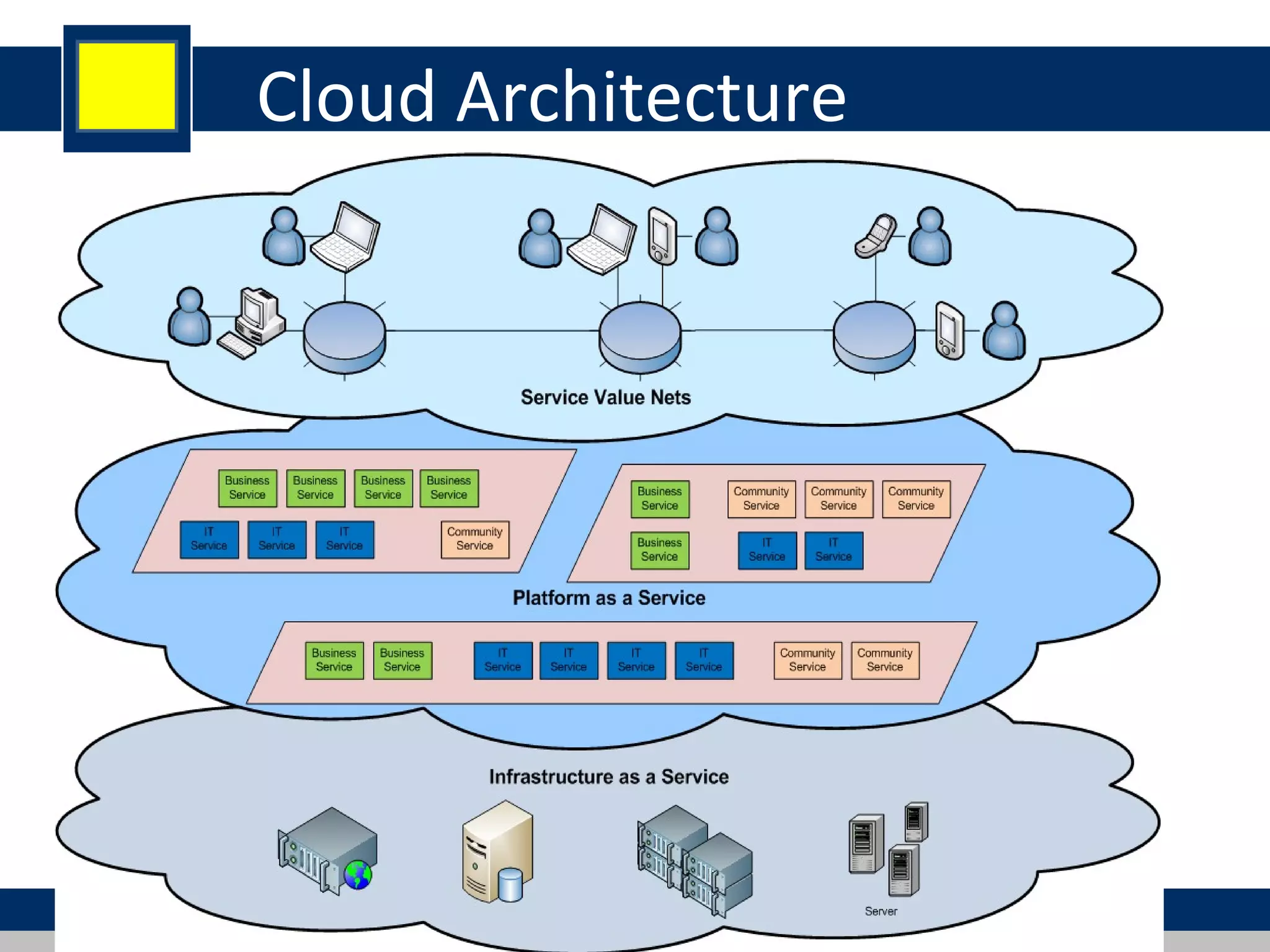
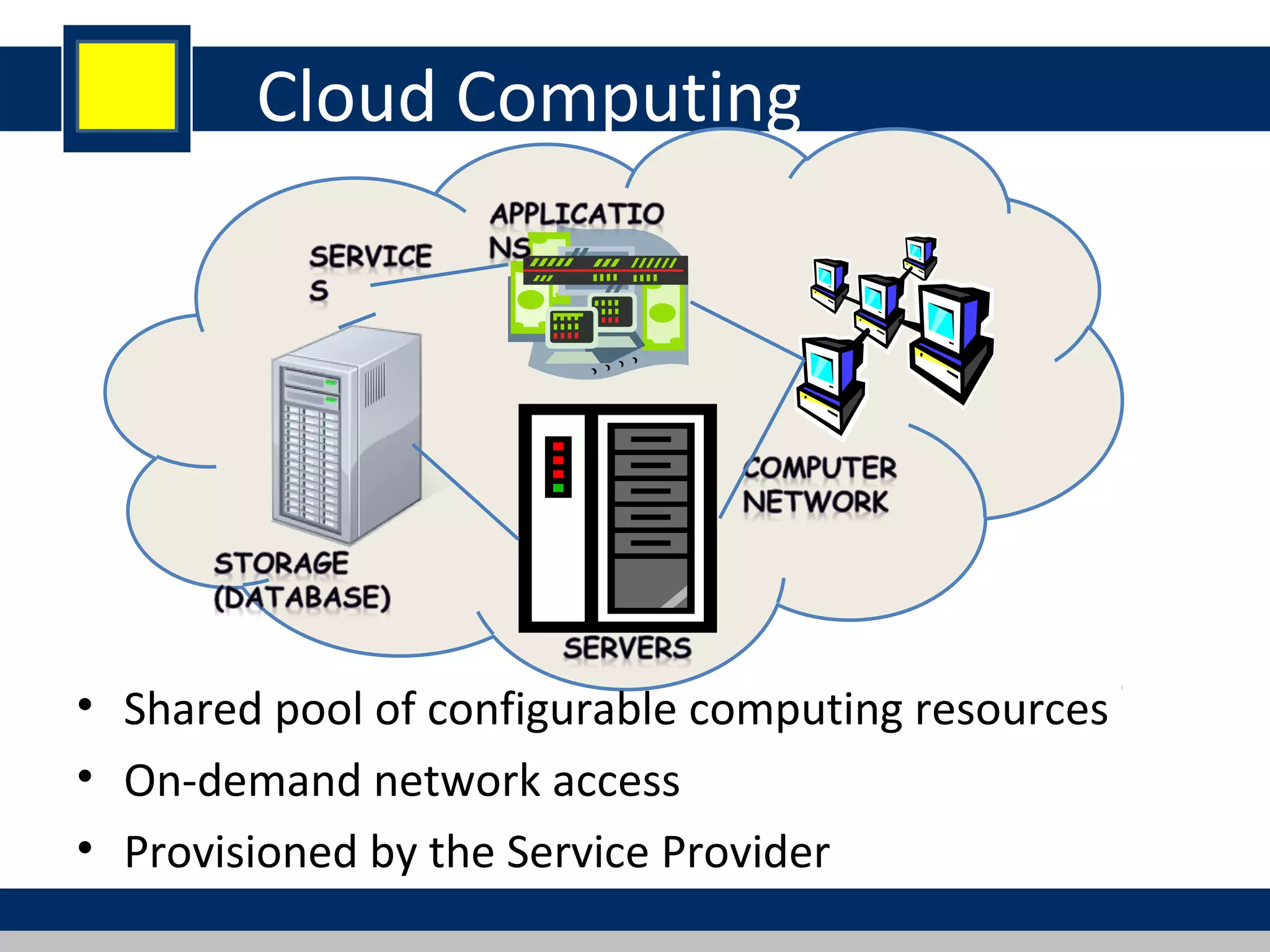
Cloud Architecture
Cloud Computing
• Shared pool of configurable computing resources
• On-demand network access
• Provisioned by the Service Provider
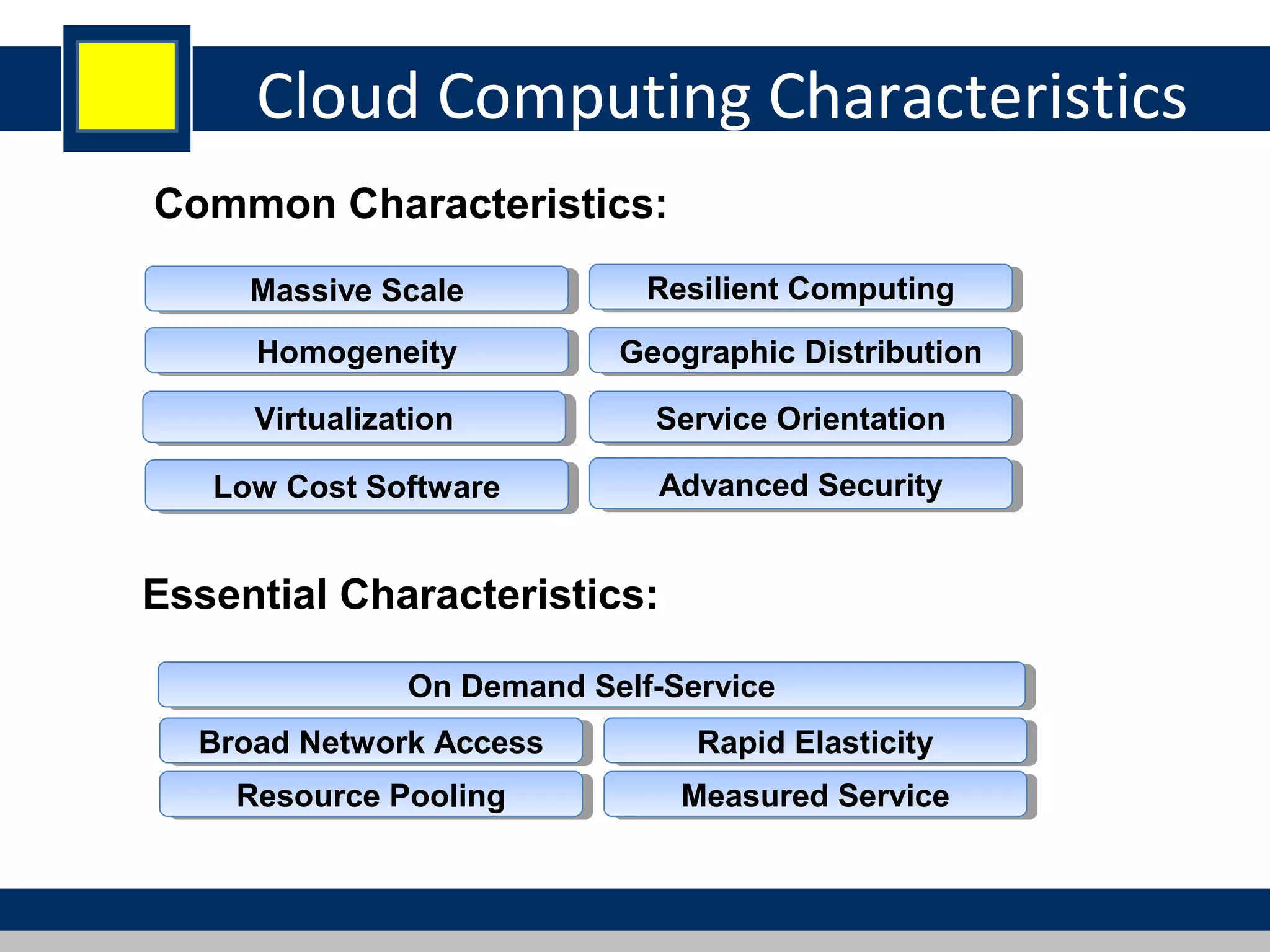
Cloud Computing Characteristics
Common Characteristics:
Low Cost SoftwareLow Cost Software
VirtualizationVirtualization Service OrientationService Orientation
Advanced SecurityAdvanced Security
HomogeneityHomogeneity
Massive ScaleMassive Scale Resilient ComputingResilient Computing
Geographic DistributionGeographic Distribution
Essential Characteristics:
Resource PoolingResource Pooling
Broad Network AccessBroad Network Access Rapid ElasticityRapid Elasticity
Measured ServiceMeasured Service
On Demand Self-ServiceOn Demand Self-Service
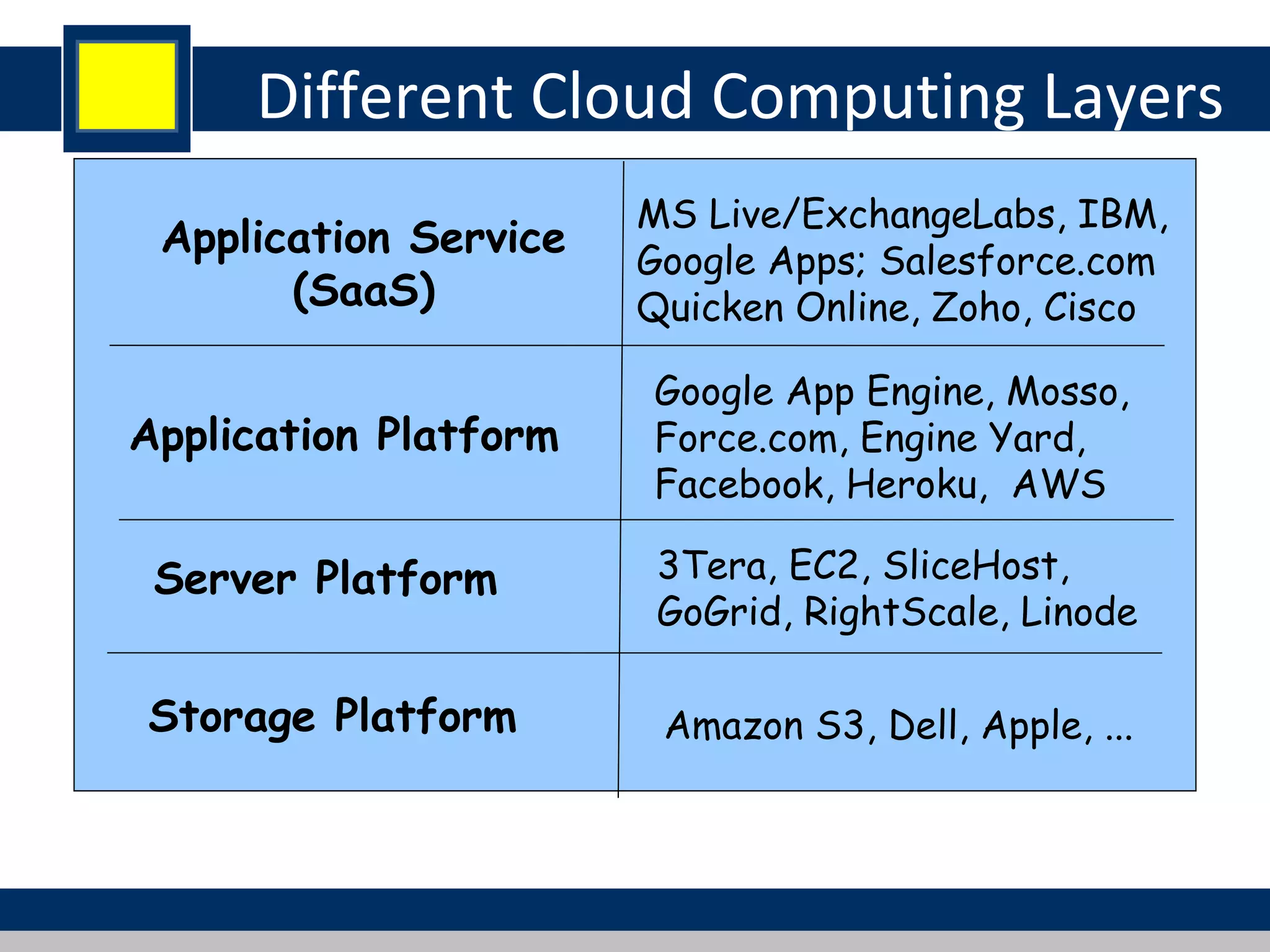
Different Cloud Computing Layers
Application Service
(SaaS)
Application Platform
Server Platform
Storage Platform Amazon S3, Dell, Apple, ...
3Tera, EC2, SliceHost,
GoGrid, RightScale, Linode
Google App Engine, Mosso,
Force.com, Engine Yard,
Facebook, Heroku, AWS
MS Live/ExchangeLabs, IBM,
Google Apps; Salesforce.com
Quicken Online, Zoho, Cisco
Services
Application
Development
Platform
Storage
Hosting
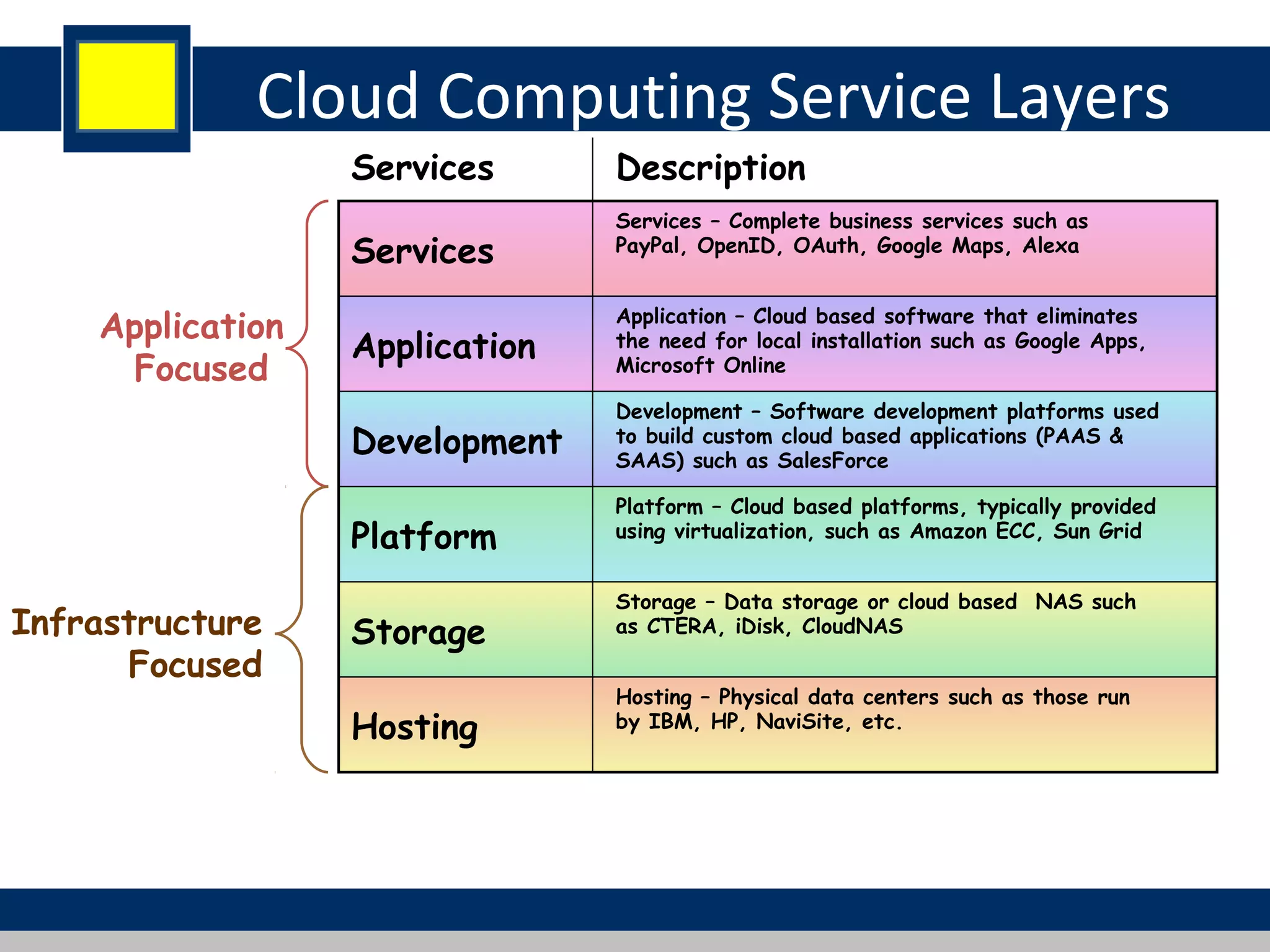
Cloud Computing Service Layers
Description
Services – Complete business services such as
PayPal, OpenID, OAuth, Google Maps, Alexa
Services
Application
Focused
Infrastructure
Focused
Application – Cloud based software that eliminates
the need for local installation such as Google Apps,
Microsoft Online
Storage – Data storage or cloud based NAS such
as CTERA, iDisk, CloudNAS
Development – Software development platforms used
to build custom cloud based applications (PAAS &
SAAS) such as SalesForce
Platform – Cloud based platforms, typically provided
using virtualization, such as Amazon ECC, Sun Grid
Hosting – Physical data centers such as those run
by IBM, HP, NaviSite, etc.
Basic Cloud Characteristics
• The “no-need-to-know” in terms of the underlying
details of infrastructure, applications interface with
the infrastructure via the APIs.
• The “flexibility and elasticity” allows these systems
to scale up and down at will
– utilising the resources of all kinds
• CPU, storage, server capacity, load balancing, and databases
• The “pay as much as used and needed” type of
utility computing and the “always on!, anywhere
and any place” type of network-based computing.
Software as a Service (SaaS)
• SaaS is a model of software deployment where an
application is hosted as a service provided to
customers across the Internet.
• Saas alleviates the burden of software
maintenance/support
– but users relinquish control over software versions and
requirements.
• Terms that are used in this sphere include
– Platform as a Service (PaaS) and
– Infrastructure as a Service (IaaS)
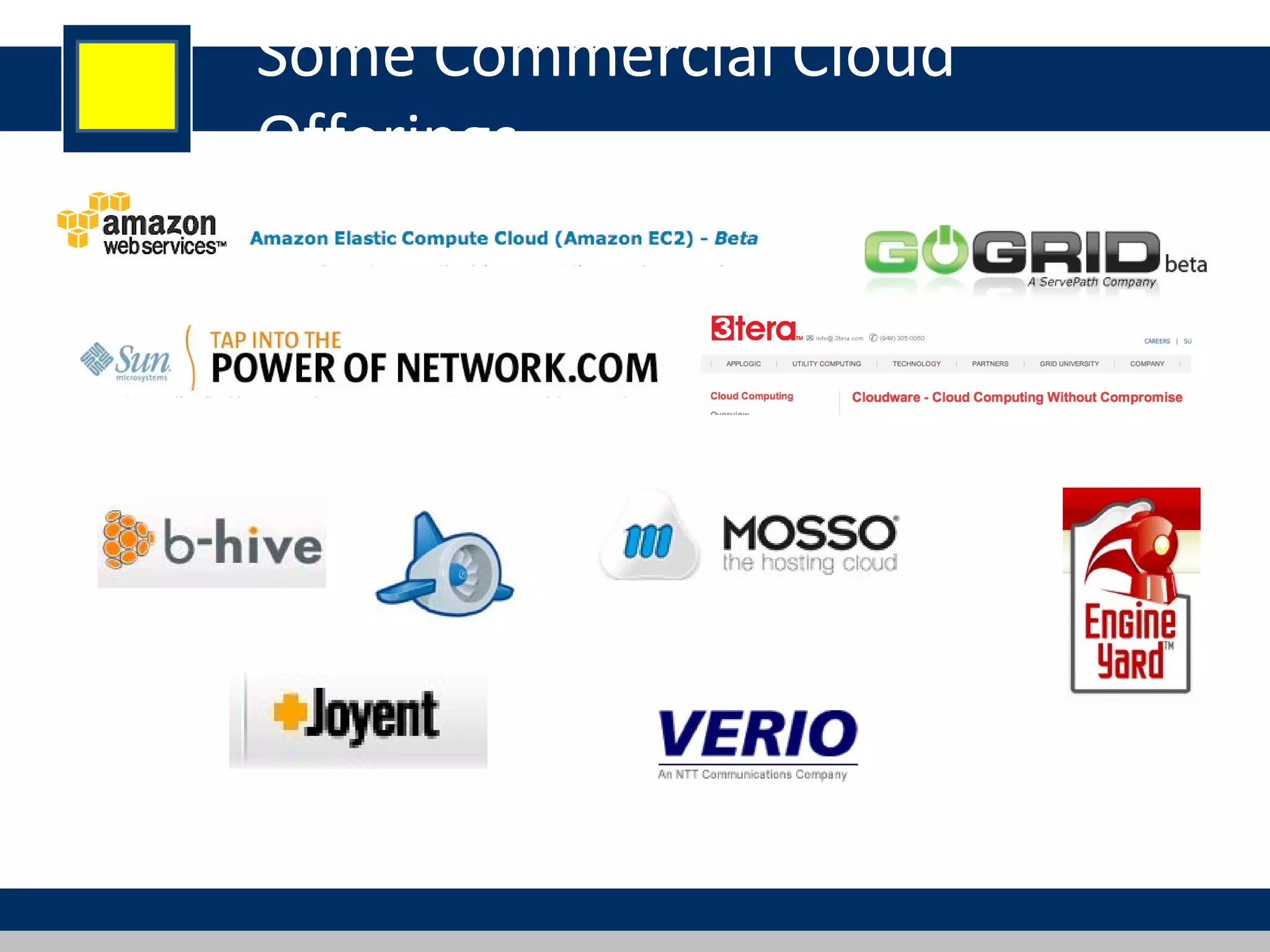
Some Commercial Cloud
Offerings
Advantages of Cloud Computing
• Lower computer costs
• Improved Performance
• Reduced Software Cost
• Instant Software Updates
• Improved Document Format Compatibility
• Unlimited Storage Capacity
• Increased Data reliability
• Universal Document Access
• Latest Version Availability
Disadvantages of Cloud Computing
• Requires a constant Internet connection
• Does not work well with low-speed connections
• Features might be limited
• Stored data might not be secure
• Stored data can be lost
THANK YOU
THANK YOU

Cloud computing

  • 1.
  • 2.
    What is CloudComputing? • Cloud Computing is a general term used to describe a new class of network based computing that takes place over the Internet, – basically a step on from Utility Computing – a collection/group of integrated and networked hardware, software and Internet infrastructure (called a platform). – Using the Internet for communication and transport provides hardware, software and networking services to clients • These platforms hide the complexity and details of the underlying infrastructure from users and applications by providing very simple graphical interface or API (Applications Programming Interface).
  • 3.
    What is CloudComputing? • In addition, the platform provides on demand services, that are always on, anywhere, anytime and any place. • Pay for use and as needed, elastic – scale up and down in capacity and functionalities • The hardware and software services are available to – general public, enterprises, corporations and businesses markets
  • 4.
  • 5.
    Cloud Computing • Sharedpool of configurable computing resources • On-demand network access • Provisioned by the Service Provider
  • 6.
    Cloud Computing Characteristics CommonCharacteristics: Low Cost SoftwareLow Cost Software VirtualizationVirtualization Service OrientationService Orientation Advanced SecurityAdvanced Security HomogeneityHomogeneity Massive ScaleMassive Scale Resilient ComputingResilient Computing Geographic DistributionGeographic Distribution Essential Characteristics: Resource PoolingResource Pooling Broad Network AccessBroad Network Access Rapid ElasticityRapid Elasticity Measured ServiceMeasured Service On Demand Self-ServiceOn Demand Self-Service
  • 7.
    Different Cloud ComputingLayers Application Service (SaaS) Application Platform Server Platform Storage Platform Amazon S3, Dell, Apple, ... 3Tera, EC2, SliceHost, GoGrid, RightScale, Linode Google App Engine, Mosso, Force.com, Engine Yard, Facebook, Heroku, AWS MS Live/ExchangeLabs, IBM, Google Apps; Salesforce.com Quicken Online, Zoho, Cisco
  • 8.
    Services Application Development Platform Storage Hosting Cloud Computing ServiceLayers Description Services – Complete business services such as PayPal, OpenID, OAuth, Google Maps, Alexa Services Application Focused Infrastructure Focused Application – Cloud based software that eliminates the need for local installation such as Google Apps, Microsoft Online Storage – Data storage or cloud based NAS such as CTERA, iDisk, CloudNAS Development – Software development platforms used to build custom cloud based applications (PAAS & SAAS) such as SalesForce Platform – Cloud based platforms, typically provided using virtualization, such as Amazon ECC, Sun Grid Hosting – Physical data centers such as those run by IBM, HP, NaviSite, etc.
  • 9.
    Basic Cloud Characteristics •The “no-need-to-know” in terms of the underlying details of infrastructure, applications interface with the infrastructure via the APIs. • The “flexibility and elasticity” allows these systems to scale up and down at will – utilising the resources of all kinds • CPU, storage, server capacity, load balancing, and databases • The “pay as much as used and needed” type of utility computing and the “always on!, anywhere and any place” type of network-based computing.
  • 10.
    Software as aService (SaaS) • SaaS is a model of software deployment where an application is hosted as a service provided to customers across the Internet. • Saas alleviates the burden of software maintenance/support – but users relinquish control over software versions and requirements. • Terms that are used in this sphere include – Platform as a Service (PaaS) and – Infrastructure as a Service (IaaS)
  • 11.
  • 12.
    Advantages of CloudComputing • Lower computer costs • Improved Performance • Reduced Software Cost • Instant Software Updates • Improved Document Format Compatibility • Unlimited Storage Capacity • Increased Data reliability • Universal Document Access • Latest Version Availability
  • 13.
    Disadvantages of CloudComputing • Requires a constant Internet connection • Does not work well with low-speed connections • Features might be limited • Stored data might not be secure • Stored data can be lost
  • 14.

Editor's Notes

  • #6 Cloud computing is a model for enabling convenient, on-demand network access to a shared pool of configurable computing resources (e.g., networks, servers, storage, applications, and services) that can be rapidly provisioned and released with minimal management effort or service provider interaction. cloud computing customers do not own the physical infrastructure. Cloud computing users avoid capital expenditure (CapEx) on hardware, software, and services when they pay a provider only for what they use. Low shared infrastructure and costs, low management overhead, and immediate access to a broad range of applications
  • #7 ScalabilityInfrastructure capacity allows for traffic spikes and minimizes delays. ResiliencyCloud providers have mirrored solutions to minimize downtime in the event of a disaster. This type of resiliency can give businesses the sustainability they need during unanticipated events. Homogeneity: No matter which cloud provider and architecture an organization uses, an open cloud will make it easy for them to work with other groups, even if those other groups choose different providers and architectures. On-demand self-service. A consumer can unilaterally provision computing capabilities, such as server time and network storage, as needed automatically without requiring human interaction with each service’s provider. Broad network access. Capabilities are available over the network and accessed through standard mechanisms that promote use by heterogeneous thin or thick client platforms (e.g., mobile phones, laptops, and PDAs). Resource pooling. Multi-tenant model.. There is a sense of location independence in that the customer generally has no control or knowledge over the exact location of the provided resources but may be able to specify location at a higher level of abstraction (e.g., country, state, or datacenter). Examples of resources include storage, processing, memory, network bandwidth, and virtual machines. Rapid elasticity. Capabilities can be rapidly and elastically provisioned, in some cases automatically, to quickly scale out and rapidly released to quickly scale in. To the consumer, the capabilities available for provisioning often appear to be unlimited and can be purchased in any quantity at any time. Measured Service. Cloud systems automatically control and optimize resource use by leveraging a metering capability at some level of abstraction appropriate to the type of service (e.g., storage, processing, bandwidth, and active user accounts).