MELANOCYTIC
LESIONS
Presented by: Dr Lucky
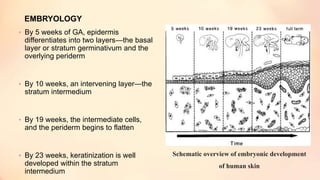
EMBRYOLOGY
• By 5 weeks of GA, epidermis
differentiates into two layers—the basal
layer or stratum germinativum and the
overlying periderm
• By 10 weeks, an intervening layer—the
stratum intermedium
• By 19 weeks, the intermediate cells,
and the periderm begins to flatten
• By 23 weeks, keratinization is well
developed within the stratum
intermedium
Schematic overview of embryonic development
of human skin
ANATOMY
• Skin consists of 3 layers:
• Epidermis, Dermis and Subcutaneous fat
• Ectoderm gives rise to epidermis and its appendages
• Mesoderm provides the mesenchymal elements of the dermis and
subcutaneous fat
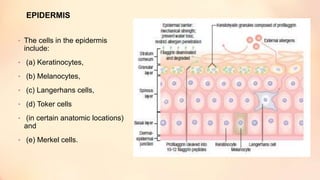
EPIDERMIS
• The cells in the epidermis
include:
• (a) Keratinocytes,
• (b) Melanocytes,
• (c) Langerhans cells,
• (d) Toker cells
• (in certain anatomic locations)
and
• (e) Merkel cells.
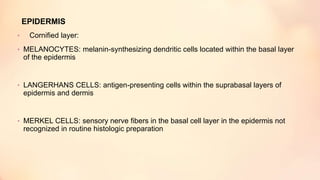
EPIDERMIS
• Cornified layer:
• MELANOCYTES: melanin-synthesizing dendritic cells located within the basal layer
of the epidermis
• LANGERHANS CELLS: antigen-presenting cells within the suprabasal layers of
epidermis and dermis
• MERKEL CELLS: sensory nerve fibers in the basal cell layer in the epidermis not
recognized in routine histologic preparation
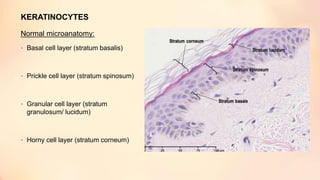
KERATINOCYTES
Normal microanatomy:
• Basal cell layer (stratum basalis)
• Prickle cell layer (stratum spinosum)
• Granular cell layer (stratum
granulosum/ lucidum)
• Horny cell layer (stratum corneum)
DERMIS
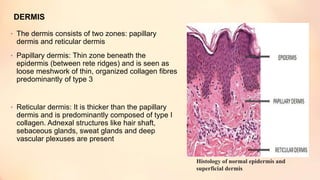
• The dermis consists of two zones: papillary
dermis and reticular dermis
• Papillary dermis: Thin zone beneath the
epidermis (between rete ridges) and is seen as
loose meshwork of thin, organized collagen fibres
predominantly of type 3
• Reticular dermis: It is thicker than the papillary
dermis and is predominantly composed of type I
collagen. Adnexal structures like hair shaft,
sebaceous glands, sweat glands and deep
vascular plexuses are present
Histology of normal epidermis and
superficial dermis
DERMIS & SUBCUTANEOUS FAT
Cellular components of the dermis:
• Dermal dendritic cells
• Fibroblasts
• Mast cells
• Macrophages /monocytes
Emigrant inflammatory cells:
• Neutrophils
• Eosinophils
• Lymphocytes
• Plasma cells
SUBCUTANEOUS FAT:
• Adipocytes separated by thin fibrous
septae
• Small vessels and is crucial in
thermal regulation
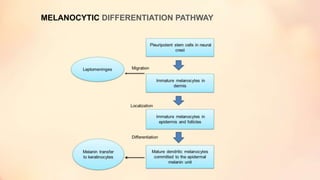
MELANOCYTIC DIFFERENTIATION PATHWAY
• Embryonic origin of melanocytes is the neural crest
• Melanocytes produce melanin within cytoplasmic packets called melanosomes
• These contain greater amounts of melanin in darker skinned individuals
• The melanin is distributed to keratinocytes via dendrites when stimulated by
exposure to ultraviolet radiation
• Cramer proposed the theory of melanocytic differentiation pathway
FORMATION OF MELANIN
MATURATION OF MELANIN
• The maturation of melanin undergoes four stage:
• Stage I melanosomes are spherical without tyrosinase activity in periphery of
nucleus
• Stage II melanosomes are tyrosinase containing elongated organelle, get
organized filamentous matrix with no melanin deposition in eumelanosome and
already formed melanin and a vesiculo-globular matrix in phaeomelanosomes
• The production of the internal matrix fibers and the maturation from stage I to
stage II appear dependent on a protein named Pmel17 (or gp 100/Silver)
MATURATION OF MELANIN
• Pmel17 is cleaved into several fragments which constitute the fibrillar matrix
of the organite
• In stage III melanosomes, melanin is uniformly deposited
• Stage IV melanosomes are fully packed, with melanin obscuring the internal
structures and supplied from the dendrites to the neighboring keratinocytes
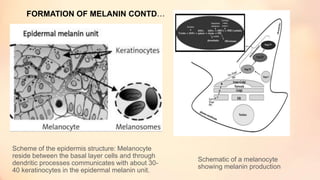
Schematic of a melanocyte
showing melanin production
FORMATION OF MELANIN CONTD…
Scheme of the epidermis structure: Melanocyte
reside between the basal layer cells and through
dendritic processes communicates with about 30-
40 keratinocytes in the epidermal melanin unit.
Melanocytic lesions may be due to:
• Proliferation of melanocytes may result in congenital or acquired benign melanocytic nevi
• Increase in melanin within the epidermis without an increase in melanocytes (ephelides)
• An increase in melanocytes along the basement membrane of the epidermis (lentigines)
• Nests of melanocytes at the epidermal/dermal junction and/or within the dermis (moles)
• Melanocytic lesions are pigmented, but dermal naevi are as skin colored or pink lesions
• Darker skin types have darker moles
• Sun exposure leads to a greater number of lesions, and not confined to sun exposed sites
INTRODUCTION
• Either Benign or malignant
• Melanocytic Nevi are due to BRAF mutation and less often NRAS
• Dysplastic Nevi are best regarded as markers of melanoma risk, characterized by
architectural or cytological atypia
• Melanoma is aggressive malignancy, tumours of few millimetres metastasize
• Characteristic of the dermal tumour are depth of invasion and mitotic activity
correlates with survival
INTRODUCTION CONTD…
Types of melanocytic nevi according to localization, distribution and
morphology of nevus cells: 1. Normal melanocytes, 2. Junctional, 3.
Compound, 4. Intradermic or Intramucosal, 5. Blue
PATHOGENESIS
• Acquired mutation that leads to activation of NRAS or serine/
threonine kinase BRAF downstream of RAS mutation of
BRAF stimulate the downstream kinase activate
transcription factors neoplasm
SOLAR LENTIGO
• Benign melanocytic proliferation due to sun exposure
• Multiple lesions, often poorly circumscribed
• Also called solar lentigines, age spots
• Seen in un exposed skin of elderly after 40yrs
• Multiple large solar lentigens on upper back and shoulders suggest prior
severe sunburn, a risk factor for melanoma
• Abnormal pigment retention in keratinocytes appears to be the primary defect
WHO HISTOLOGICAL CLASSIFICATION OF MELANOCYTIC TUMORS
BENIGN:
• Lentiginous melanocytic lesions
• Junctional melanocytic nevus
• Compound melanocytic nevus
• Intradermal melanocytic nevus
• Spitz nevus(epithelioid and
spindle-cell nevus)
• Pigmented spindle cell nevus of
Reed (AKA Pigmented spindle cell
nevus)
• Blue nevus
• Cellular blue nevus
Lentiginous melanocytic lesions
• Solar lentigo
• Lentigo simplex
• Lentiginous nevus
• Lentiginous melanoma in situ
SOLAR LENTIGO CONTD…
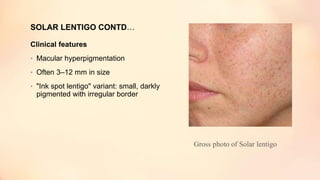
Clinical features
• Macular hyperpigmentation
• Often 3–12 mm in size
• "Ink spot lentigo" variant: small, darkly
pigmented with irregular border
Gross photo of Solar lentigo
SOLAR LENTIGO CONTD…
Microscopy:
• Characterized by elongation of the rete ridge, extending deeply into the
dermis, finger-like projections form and connect with adjacent rete ridges to
form a reticulate pattern
• Heavy basal hyperpigmentation
• Increased number of melanocytes, at the bases of the clubbed and budding
rete ridges
• Variable numbers of melanophages are present in the papillary dermis
• When solar lentigos undergo regression they develop a heavy lichenoid
inflammatory cell infiltrate in the papillary dermis and referred to as a lichen
planus-like keratosis
Solar lentigo: Elongation of rete ridges
and increased irregular pigmentation at
tips of retes,variable chronic inflammatory
infiltrate in dermis (H & E,10x)
SOLAR LENTIGO CONTD…
‘Ink-spot’ lentigo. There is heavy pigmentation of
the basal layer.There is mild acanthosis.
(H & E,10x)
LENTIGO SIMPLEX
Clinical features:
• Acquired, small usually less than 2 mm, fairly symmetrical and well-circumscribed
flat, evenly coloured, usually on sun-exposed skin, seen in persons <40 years of age
• The cause is unknown
• Multiple lentigines can occur, referred to as lentigines profusa
or generalized lentigines
• They do not darken or increase in number on sun exposure
• They may be associated with Peutz-Jeghers syndrome, Xeroderma-pigmentosum
and Carney's complex
LENTIGO SIMPLEX
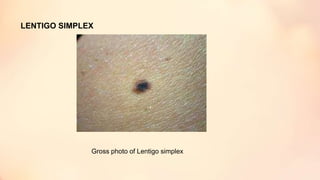
Gross photo of Lentigo simplex
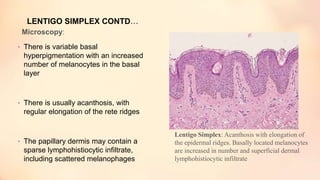
Microscopy:
• There is variable basal
hyperpigmentation with an increased
number of melanocytes in the basal
layer
• There is usually acanthosis, with
regular elongation of the rete ridges
• The papillary dermis may contain a
sparse lymphohistiocytic infiltrate,
including scattered melanophages
LENTIGO SIMPLEX CONTD…
Lentigo Simplex: Acanthosis with elongation of
the epidermal ridges. Basally located melanocytes
are increased in number and superficial dermal
lymphohistiocytic infiltrate
LENTIGINOUS NEVUS
• May be congenital or acquired
• Ages of 20 and 40 years.
• Well-circumscribed, with multiple pigmented macules or papules
• Also called "speckled lentiginous nevus" or "nevus spilus”
• Approximately 80% of speckled lentiginous nevi appear at birth or during early
infancy
• May be due to "reactivation" of radial proliferation
• May represent a localized defect in neural crest melanoblasts that populate a
particular area of the skin
• Environmental and genetic factors play a role
• Mosaicism may be an explanation for the development of zosteriform
speckled lentiginous nevus
• Often benign, increase in size, formation of irregular borders or peripheral
change in color and usually 5 mm or less
• Associated findings include ichthyosis, epidermal nevi, nevus sebaceous,
scleral pigmentation, and neurofibromatosis type I, adult-onset hearing loss
LENTIGINOUS NEVUS CONTD…
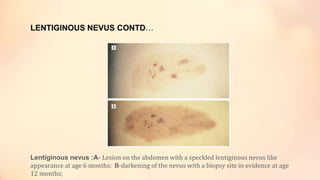
Lentiginous nevus :A- Lesion on the abdomen with a speckled lentiginous nevus like
appearance at age 6 months; B-darkening of the nevus with a biopsy site in evidence at age
12 months;
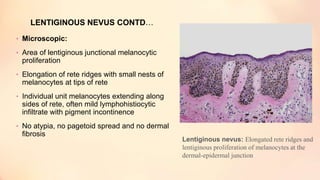
• Microscopic:
• Area of lentiginous junctional melanocytic
proliferation
• Elongation of rete ridges with small nests of
melanocytes at tips of rete
• Individual unit melanocytes extending along
sides of rete, often mild lymphohistiocytic
infiltrate with pigment incontinence
• No atypia, no pagetoid spread and no dermal
fibrosis
LENTIGINOUS NEVUS CONTD…
Lentiginous nevus: Elongated rete ridges and
lentiginous proliferation of melanocytes at the
dermal-epidermal junction
LENTIGINOUS MELANOMA IN SITU
• Lentiginous melanoma is a slowly progressive variant of melanoma found on sun-
damaged skin of the trunk and limbs
• It is usually diagnosed when the malignant cells are in situ and it is thought to have
a low risk of invasive melanoma
• More common in males, in between 60 and 80 years
• Risk of development of melanoma 6% (2 peaks: <10 y and adult life)
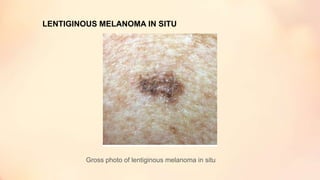
LENTIGINOUS MELANOMA IN SITU
Gross photo of lentiginous melanoma in situ
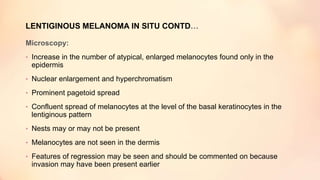
Microscopy:
• Increase in the number of atypical, enlarged melanocytes found only in the
epidermis
• Nuclear enlargement and hyperchromatism
• Prominent pagetoid spread
• Confluent spread of melanocytes at the level of the basal keratinocytes in the
lentiginous pattern
• Nests may or may not be present
• Melanocytes are not seen in the dermis
• Features of regression may be seen and should be commented on because
invasion may have been present earlier
LENTIGINOUS MELANOMA IN SITU CONTD…
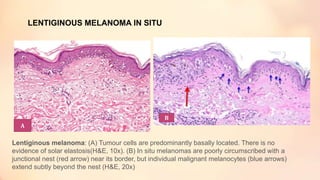
LENTIGINOUS MELANOMA IN SITU
Lentiginous melanoma: (A) Tumour cells are predominantly basally located. There is no
evidence of solar elastosis(H&E, 10x). (B) In situ melanomas are poorly circumscribed with a
junctional nest (red arrow) near its border, but individual malignant melanocytes (blue arrows)
extend subtly beyond the nest (H&E, 20x)
A
B
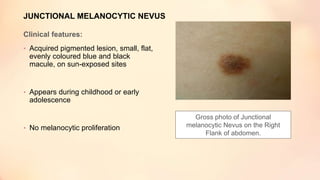
JUNCTIONAL MELANOCYTIC NEVUS
Clinical features:
• Acquired pigmented lesion, small, flat,
evenly coloured blue and black
macule, on sun-exposed sites
• Appears during childhood or early
adolescence
• No melanocytic proliferation
Gross photo of Junctional
melanocytic Nevus on the Right
Flank of abdomen.
JUNCTIONAL MELANOCYTIC NEVUS CONTD…
Junctional nevus: note the nests of nevus cells in the
basal layer of the epithelium with an intact basement
membrane
Microscopy:
• Discrete nests of melanocytes nevus cells
at the dermoepidermal junction, on the tips
of rete ridges
• Cells are oval to cuboidal in shape, with
clear cytoplasm containing a variable
amount of melanin pigment
• Nests of nevus cells sometimes bulge into
the underlying dermis, which may contain a
few melanophages and a sparse
lymphohistiocytic infiltrate
COMPOUND MELANOCYTIC NEVUS
Clinical features:
• Acquired pigmented lesion
• small, slightly raised, evenly tan to
brown coloured, on sun-exposed
skin
Gross photo of Compound Nevus
COMPOUND MELANOCYTIC NEVUS CONTD…
Microscopy:
• Compound nevi have both junctional nests and an intradermal component of
nevus cells
• Cells in the upper dermis are cuboidal, with melanin pigment in the cytoplasm,
deeper cells are often smaller and contain less melanin
• Apoptosis is sometimes seen in the deeper cells
• Nevus cells are arranged in orderly nests or cords
• Overlying epidermis may be flat, show acanthosis, or may have seborrheic
keratosis-like appearance
• Pagetoid spread of melanocytes is usually limited to the site of trauma
• Mitoses are rare
COMPOUND MELANOCYTIC NEVUS CONTD…
Benign compound nevus with both junctional and
dermal nests of nevus cells. (H & E, 20x)
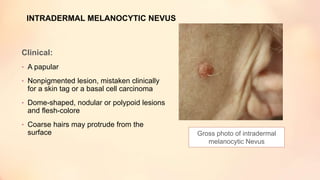
INTRADERMAL MELANOCYTIC NEVUS
Clinical:
• A papular
• Nonpigmented lesion, mistaken clinically
for a skin tag or a basal cell carcinoma
• Dome-shaped, nodular or polypoid lesions
and flesh-colore
• Coarse hairs may protrude from the
surface Gross photo of intradermal
melanocytic Nevus
INTRADERMAL MELANOCYTIC NEVUS CONTD…
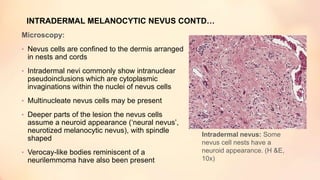
Microscopy:
• Nevus cells are confined to the dermis arranged
in nests and cords
• Intradermal nevi commonly show intranuclear
pseudoinclusions which are cytoplasmic
invaginations within the nuclei of nevus cells
• Multinucleate nevus cells may be present
• Deeper parts of the lesion the nevus cells
assume a neuroid appearance (‘neural nevus’,
neurotized melanocytic nevus), with spindle
shaped
• Verocay-like bodies reminiscent of a
neurilemmoma have also been present
Intradermal nevus: Some
nevus cell nests have a
neuroid appearance. (H &E,
10x)
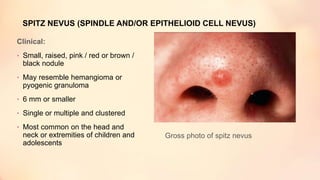
SPITZ NEVUS (SPINDLE AND/OR EPITHELIOID CELL NEVUS)
Clinical:
• Small, raised, pink / red or brown /
black nodule
• May resemble hemangioma or
pyogenic granuloma
• 6 mm or smaller
• Single or multiple and clustered
• Most common on the head and
neck or extremities of children and
adolescents
Gross photo of spitz nevus
SPITZ NEVUS (SPINDLE AND/OR EPITHELIOID CELL NEVUS) CONTD…
Microscopy:
• The cell type, symmetrical with no lateral extension of junctional activity beyond the
dermal component
• Maturation of nevus cells
• Lack of pagetoid spread of single melanocytes
• Kamino bodies seen
• Melanocytes are spindled, epithelioid, or a mixed population that are arranged in
vertically oriented nests at the epidermal–dermal junction with often a space between
the epidermis and nested melanocytes
SPITZ NEVUS (SPINDLE AND/OR EPITHELIOID CELL NEVUS) CONTD...
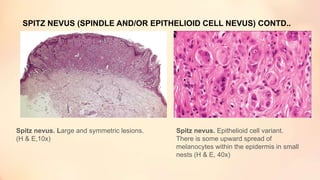
• There is usually ‘maturation’ of nevus cells in depth
• Epithelioid melanocytes have large nuclei and abundant eosinophilic cytoplasm
• Numerous ectatic, thin-walled vascular spaces may be seen in the papillary dermis
• Superficial mitoses may be seen
• Pagetoid spread may be seen
SPITZ NEVUS (SPINDLE AND/OR EPITHELIOID CELL NEVUS) CONTD..
Spitz nevus. Large and symmetric lesions.
(H & E,10x)
Spitz nevus. Epithelioid cell variant.
There is some upward spread of
melanocytes within the epidermis in small
nests (H & E, 40x)
SPITZ NEVUS (SPINDLE AND/OR EPITHELIOID CELL NEVUS) CONTD..
Spitz nevus. Spindle cell
variant ( H&E, 40x)
Spitz nevus composed of plump, spindle-
shaped cells. (H & E, 40x)
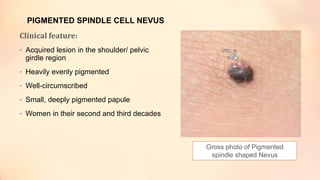
PIGMENTED SPINDLE CELL NEVUS
Clinical feature:
• Acquired lesion in the shoulder/ pelvic
girdle region
• Heavily evenly pigmented
• Well-circumscribed
• Small, deeply pigmented papule
• Women in their second and third decades
Gross photo of Pigmented
spindle shaped Nevus
PIGMENTED SPINDLE CELL NEVUS CONTD…
Microscopy:
• Symmetric and well-circumscribed
proliferation of spindled melanocytes in the
epidermis and superficial dermis
• A pattern of a woven basket is seen
• Pagetoid spread of cells
• Tumour is composed of spindle-shaped cells
in nests, with the formation of
interconnected fascicles oriented vertically,
horizontally, and tangentially. Pigmented spindle-cell nevus. The
fascicles of spindles shaped cells are
confined, to the epidermis and the
papillary dermis. There is melanin
incontinence at the base of the lesion
PIGMENTED SPINDLE CELL NEVUS CONTD…
• Broad zone of melanophages in the
superficial dermis present beneath the
melanocytes
• Many melanophages are present
• Eosinophilic globules (Kamino bodies), may
be demonstrated
• Sometimes contain melanin granules.
Junctional clefting, similar to that seen in the
Spitz nevus, is often present
Pigmented spindle-cell nevus: High
power view of nested cells (H & E, 40x)
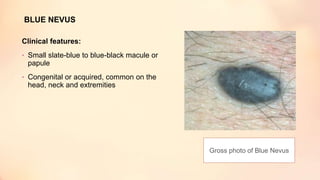
BLUE NEVUS
Clinical features:
• Small slate-blue to blue-black macule or
papule
• Congenital or acquired, common on the
head, neck and extremities
Gross photo of Blue Nevus
BLUE NEVUS CONTD…
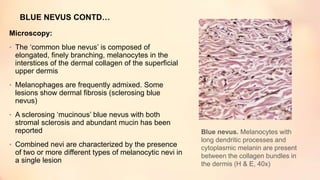
Microscopy:
• The ‘common blue nevus’ is composed of
elongated, finely branching, melanocytes in the
interstices of the dermal collagen of the superficial
upper dermis
• Melanophages are frequently admixed. Some
lesions show dermal fibrosis (sclerosing blue
nevus)
• A sclerosing ‘mucinous’ blue nevus with both
stromal sclerosis and abundant mucin has been
reported
• Combined nevi are characterized by the presence
of two or more different types of melanocytic nevi in
a single lesion
Blue nevus. Melanocytes with
long dendritic processes and
cytoplasmic melanin are present
between the collagen bundles in
the dermis (H & E, 40x)
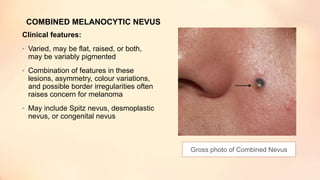
COMBINED MELANOCYTIC NEVUS
Clinical features:
• Varied, may be flat, raised, or both,
may be variably pigmented
• Combination of features in these
lesions, asymmetry, colour variations,
and possible border irregularities often
raises concern for melanoma
• May include Spitz nevus, desmoplastic
nevus, or congenital nevus
Gross photo of Combined Nevus
COMBINED MELANOCYTIC NEVUS
Microscopy:
• Common combinations is a compound
melanocytic nevus and a blue nevus
• The epithelioid blue nevus is often part of a
combined nevus that may include Spitz
nevus, desmoplastic nevus, or congenital
nevus
• The melanocytes in blue nevi of all types
express S100 protein, melan-A (MART-1),
and HMB-45.
• They do not stain for carcinoembryonic
antigen (CEA)
Combined nevus: there are conspicuous
bipolar and dendritic cells
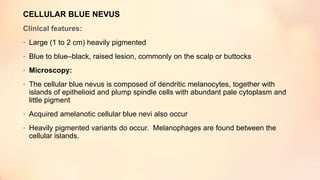
CELLULAR BLUE NEVUS
Clinical features:
• Large (1 to 2 cm) heavily pigmented
• Blue to blue–black, raised lesion, commonly on the scalp or buttocks
• Microscopy:
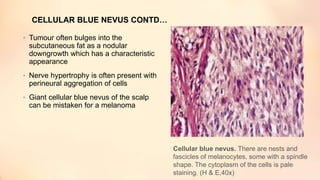
• The cellular blue nevus is composed of dendritic melanocytes, together with
islands of epithelioid and plump spindle cells with abundant pale cytoplasm and
little pigment
• Acquired amelanotic cellular blue nevi also occur
• Heavily pigmented variants do occur. Melanophages are found between the
cellular islands.
CELLULAR BLUE NEVUS CONTD…
• Tumour often bulges into the
subcutaneous fat as a nodular
downgrowth which has a characteristic
appearance
• Nerve hypertrophy is often present with
perineural aggregation of cells
• Giant cellular blue nevus of the scalp
can be mistaken for a melanoma
Cellular blue nevus. There are nests and
fascicles of melanocytes, some with a spindle
shape. The cytoplasm of the cells is pale
staining. (H & E,40x)
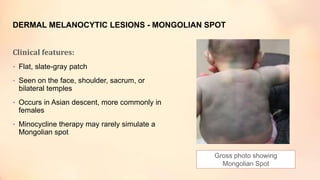
DERMAL MELANOCYTIC LESIONS - MONGOLIAN SPOT
Clinical features:
• Flat, slate-gray patch
• Seen on the face, shoulder, sacrum, or
bilateral temples
• Occurs in Asian descent, more commonly in
females
• Minocycline therapy may rarely simulate a
Mongolian spot
Gross photo showing
Mongolian Spot
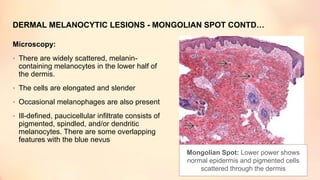
DERMAL MELANOCYTIC LESIONS - MONGOLIAN SPOT CONTD…
Microscopy:
• There are widely scattered, melanin-
containing melanocytes in the lower half of
the dermis.
• The cells are elongated and slender
• Occasional melanophages are also present
• Ill-defined, paucicellular infiltrate consists of
pigmented, spindled, and/or dendritic
melanocytes. There are some overlapping
features with the blue nevus
Mongolian Spot: Lower power shows
normal epidermis and pigmented cells
scattered through the dermis
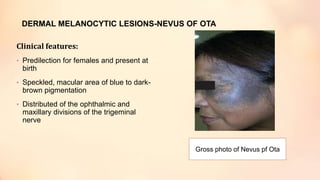
DERMAL MELANOCYTIC LESIONS-NEVUS OF OTA
Clinical features:
• Predilection for females and present at
birth
• Speckled, macular area of blue to dark-
brown pigmentation
• Distributed of the ophthalmic and
maxillary divisions of the trigeminal
nerve
Gross photo of Nevus pf Ota
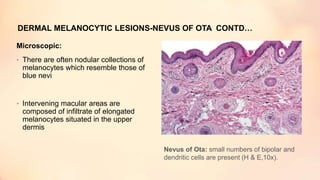
DERMAL MELANOCYTIC LESIONS-NEVUS OF OTA CONTD…
Microscopic:
• There are often nodular collections of
melanocytes which resemble those of
blue nevi
• Intervening macular areas are
composed of infiltrate of elongated
melanocytes situated in the upper
dermis
Nevus of Ota: small numbers of bipolar and
dendritic cells are present (H & E,10x).
CONGENITAL NEVUS
Clinical features:
• Congenital nevi are pigmented lesions
that are present at birth or appear during
infancy
• Classified as small (< 2 cm), intermediate
(2 to 20 cm), or large (>20 cm)
• Frequently varied in pigmentation and
have irregular borders
• May be hairy and may cover large areas
of the body
• Involvement of the leptomeninges by
benign or malignant melanocytes, it is
known as neurocutaneous melanosis
Giant congenital melanocytic nevus
with risk of malignant change
CONGENITAL NEVUS CONTD…
Microscopic:
• Congenital nevi (CN) may be junctional, compound or intradermal in type,
depending on the age at which they are removed
• In neonates they are often junctional and if biopsied in the first week of life the
melanocytic hyperplasia may be quite prominent in the epidermis
• Adnexal epithelium but the melanocytes are predominantly dermal with time
• The epidermal melanocytic pattern is highly variable, ranging from no significant
melanocytic proliferation, to nested melanocytes, to confluent lentiginous
hyperplasia
CONGENITAL NEVUS CONTD…
• Mitotic figures may be present at any level
• CN*, from the scalp, is complex pattern of spindle cells, perivascular pseudorosettes, and
tactoid bodies and called neurocristic hamartoma
• CN removed in the first year of life, has two types of cells-there are small nevus cells in the
reticular dermis, usually separated by a space from overlying larger cells in the epidermis
• Full-thickness dermal involvement, which is clearly visible in routine hematoxylin and eosin-
stained sections, seems to be a feature of the larger congenital nevi
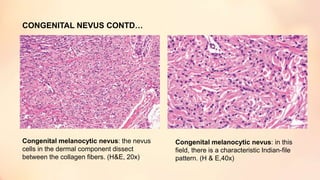
• *Congenital nevi
Congenital melanocytic nevus: in this
field, there is a characteristic Indian-file
pattern. (H & E,40x)
CONGENITAL NEVUS CONTD…
Congenital melanocytic nevus: the nevus
cells in the dermal component dissect
between the collagen fibers. (H&E, 20x)
DEEP PENETRATING NEVUS
Clinical features:
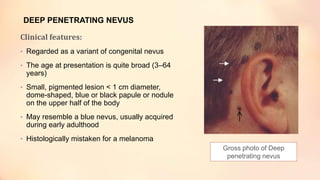
• Regarded as a variant of congenital nevus
• The age at presentation is quite broad (3–64
years)
• Small, pigmented lesion < 1 cm diameter,
dome-shaped, blue or black papule or nodule
on the upper half of the body
• May resemble a blue nevus, usually acquired
during early adulthood
• Histologically mistaken for a melanoma
Gross photo of Deep
penetrating nevus
DEEP PENETRATING NEVUS CONTD…
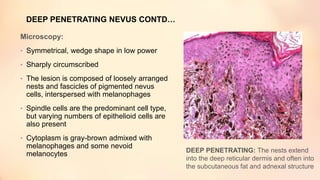
Microscopy:
• Symmetrical, wedge shape in low power
• Sharply circumscribed
• The lesion is composed of loosely arranged
nests and fascicles of pigmented nevus
cells, interspersed with melanophages
• Spindle cells are the predominant cell type,
but varying numbers of epithelioid cells are
also present
• Cytoplasm is gray-brown admixed with
melanophages and some nevoid
melanocytes DEEP PENETRATING: The nests extend
into the deep reticular dermis and often into
the subcutaneous fat and adnexal structure
DEEP PENETRATING NEVUS CONTD…
• The nests extend into the deep reticular dermis and often into the subcutaneous fat
and adnexal structure
• Although there is some pleomorphism of the nuclei of the nevus cells, nucleoli are
inconspicuous
• Nuclear vacuoles and smudging of the chromatin pattern
• Immunohistochemical studies have shown that the cells express S100 protein and
HMB-45
HALO NEVUS
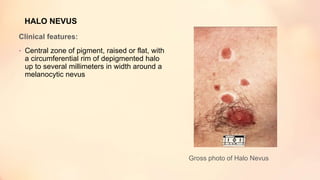
Clinical features:
• Central zone of pigment, raised or flat, with
a circumferential rim of depigmented halo
up to several millimeters in width around a
melanocytic nevus
Gross photo of Halo Nevus
HALO NEVUS CONTD…
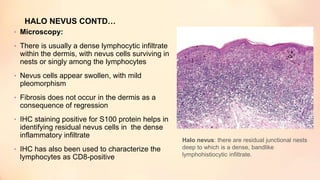
• Microscopy:
• There is usually a dense lymphocytic infiltrate
within the dermis, with nevus cells surviving in
nests or singly among the lymphocytes
• Nevus cells appear swollen, with mild
pleomorphism
• Fibrosis does not occur in the dermis as a
consequence of regression
• IHC staining positive for S100 protein helps in
identifying residual nevus cells in the dense
inflammatory infiltrate
• IHC has also been used to characterize the
lymphocytes as CD8-positive
Halo nevus: there are residual junctional nests
deep to which is a dense, bandlike
lymphohistiocytic infiltrate.
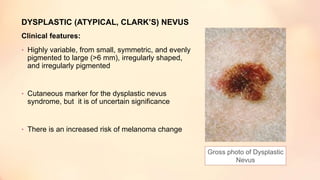
DYSPLASTIC (ATYPICAL, CLARK’S) NEVUS
Clinical features:
• Highly variable, from small, symmetric, and evenly
pigmented to large (>6 mm), irregularly shaped,
and irregularly pigmented
• Cutaneous marker for the dysplastic nevus
syndrome, but it is of uncertain significance
• There is an increased risk of melanoma change
Gross photo of Dysplastic
Nevus
DYSPLASTIC (ATYPICAL, CLARK’S) NEVUS
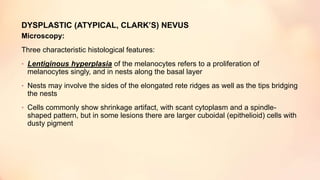
Microscopy:
Three characteristic histological features:
• Lentiginous hyperplasia of the melanocytes refers to a proliferation of
melanocytes singly, and in nests along the basal layer
• Nests may involve the sides of the elongated rete ridges as well as the tips bridging
the nests
• Cells commonly show shrinkage artifact, with scant cytoplasm and a spindle-
shaped pattern, but in some lesions there are larger cuboidal (epithelioid) cells with
dusty pigment
DYSPLASTIC (ATYPICAL, CLARK’S) NEVUS
• Random cytological atypia refers to the presence of occasional cells with enlarged
hyperchromatic nuclei, sometimes with prominent nucleoli. The nuclei equal or
larger the nucleus of the overlying keratinocytes in size
• There is often a progression of cytological atypia with increasing age of the patient
• Stromal response consists of lamellar and concentric fibroplasia of the papillary
dermis, associated with a proliferation of dermal dendrocytes. Sometimes there is
fibrosis in the upper reticular dermis, resulting in more widely spaced nests, often
larger than usual
DYSPLASTIC (ATYPICAL, CLARK’S) NEVUS
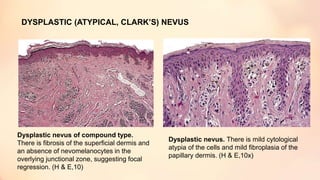
Dysplastic nevus of compound type.
There is fibrosis of the superficial dermis and
an absence of nevomelanocytes in the
overlying junctional zone, suggesting focal
regression. (H & E,10)
Dysplastic nevus. There is mild cytological
atypia of the cells and mild fibroplasia of the
papillary dermis. (H & E,10x)
SECONDARU CHANGES IN NEVUS
• They include the incidental finding of amyloid or of bone, epidermal spongiosis
producing a clinical eczematous halo
• Meyerson’s nevus, the concurrence of psoriasis, increased amounts of elastic
tissue, nodular myxoid change, cystic dilatation of hair follicles, folliculitis,
epidermal, dermoid, or tricholemmal cyst formation, psammoma body formation,
sebocyte-like melanocytes, granular cell change, granulomatous, basal cell
carcinoma, syringoma
• Tiny foci of hyperpigmentation may develop in nevi. The increased pigment may
be in epidermal melanocytes, melanophages, or dermal nevus cells. The heavily
pigmented foci correspond to circumscribed nodules of atypical epithelioid cells –
clonal nevi
SECONDARY CHANGES IN NEVUS
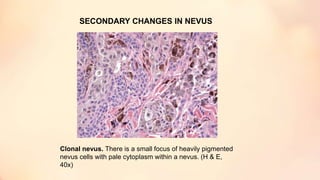
Clonal nevus. There is a small focus of heavily pigmented
nevus cells with pale cytoplasm within a nevus. (H & E,
40x)
NEVI ON SPECIAL SITES
Clinical features:
• Varies with site
• Special sites include mucocutaneous sites such as the conjunctiva,
anus, external genitalia, umbilicus, acral skin (palms/soles), and areola
Microscopy:
• In addition to the features associated with junctional and/or compound
nevi, the junctional melanocytic proliferations with either a lentiginous
or pagetoid pattern, loss of cohesion, and asymmetry
CLASSIFICATION OF MELANOMA
• Lentigo maligna melanoma (10–40%)
• Superficial spreading melanoma (30–60%)1343
• Nodular melanoma (15–35%)
• Acral lentiginous melanoma (5–10%)
• Desmoplastic (and neurotropic) melanoma (rare)
• Miscellaneous group (rare)
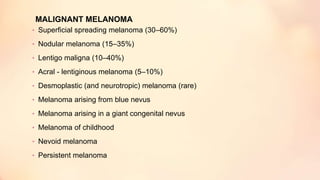
MALIGNANT MELANOMA
• Superficial spreading melanoma (30–60%)
• Nodular melanoma (15–35%)
• Lentigo maligna (10–40%)
• Acral - lentiginous melanoma (5–10%)
• Desmoplastic (and neurotropic) melanoma (rare)
• Melanoma arising from blue nevus
• Melanoma arising in a giant congenital nevus
• Melanoma of childhood
• Nevoid melanoma
• Persistent melanoma
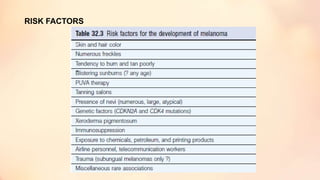
RISK FACTORS
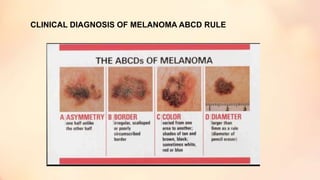
CLINICAL DIAGNOSIS OF MELANOMA ABCD RULE
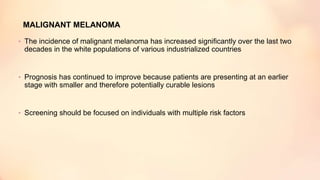
MALIGNANT MELANOMA
• The incidence of malignant melanoma has increased significantly over the last two
decades in the white populations of various industrialized countries
• Prognosis has continued to improve because patients are presenting at an earlier
stage with smaller and therefore potentially curable lesions
• Screening should be focused on individuals with multiple risk factors
MALIGNANT MELANOMA CONTD…
Microscopic
Before considering the histopathological features of each subtypes, three aspects that
require consideration:
• the concept of radial and vertical growth phase
• the nomenclature for precursor lesions, including the radial growth phase
• the examination and reporting of melanomas
MALIGNANT MELANOMA CONTD…
• The radial growth phase refers to the progressive centrifugal spread which is
characterized by intraepidermal proliferation of atypical melanocytes with features that
differ in the subtypes.
• The radial growth phase precedes the development of the vertical growth phase,
although nodular melanomas have no radial growth
• Invasion of the papillary dermis may not have the same prognosis as penetration of
the reticular dermis
• Invasion of the papillary dermis, either single or in small nests, resembling cells of
epidermis-k/a invasive radial growth phase
MALIGNANT MELANOMA CONTD…
• Angiogenesis and expression of vascular endothelial growth factor are associated with the
development of the vertical growth phase and tumour progression
• Destruction or loss of the basement membrane is not mandatory for melanoma invasion
• Vertical growth phase is an adverse prognostic factor
• Precursor lesions of malignant melanoma are termed as ‘atypical melanocytic hyperplasia’,
‘pagetoid melanocytic proliferation’, ‘pagetoid melanocytosis’, ‘precancerous melanosis’,
‘severe melanocytic dysplasia’ and, ‘dysplastic (atypical) nevus’
MALIGNANT MELANOMA CONTD…
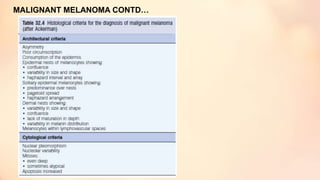
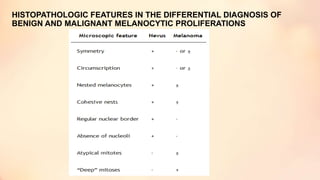
HISTOPATHOLOGIC FEATURES IN THE DIFFERENTIAL DIAGNOSIS OF
BENIGN AND MALIGNANT MELANOCYTIC PROLIFERATIONS
SUPERFICIAL SPREADING MELANOMA
• Commonest type on white skin
• Males, seen in fourth or fifth decade
• Site-any body site, and the lower extremities in females
• Early presentation is of an irregularly shaped, brown lesion, macular.
• Starts at only 4-5 mm in diameter, and grows gradually
• Subtle altered sensation
• Shorter radial growth and superficially invasive at the time of presentation
• Variegated colour with an irregular expanding margin
• Amelanotic variant has also been reported, it may simulate a patch of vitiligo
• Potentially clonally unstable with two or three distinct proliferating tumour cell stem
lines
SUPERFICIAL SPREADING MELANOMA CONTD…
• Characterized by a proliferation of atypical melanocytes, singly and in nests, within
the epidermis
• This pagetoid spread within the epidermis is known as ‘buckshot scatter’
• Superficial adnexal epithelium may also be involved
• Thinning of the epidermis with attenuation of basal and suprabasal layers
• Loss of rete ridges adjacent to collections of melanocytes
• Aberrant melanocyte–keratinocyte interactions
• The infiltrative component may be arranged in solid masses or may have a fascicular
arrangement
SUPERFICIAL SPREADING MELANOMA CONTD…
• Cells may be epithelioid, nevus cell-like, or even spindle-shaped without maturation
during their descent into the dermis
• Degree of cytological atypia
• A rare variant of melanoma, is the verrucous melanoma
• This occurs in back and limbs of middle-aged to older males
• Characterized by marked epidermal hyperplasia, elongation of the rete ridges, and
overlying hyperkeratosis
• This variant is often misdiagnosed clinically as a seborrheic keratosis
• The pseudoepitheliomatous hyperplasiandoes not appear to be due to epidermal
growth factor receptor
SUPERFICIAL SPREADING MELANOMA CONTD…
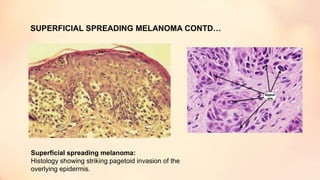
Superficial spreading melanoma:
Histology showing striking pagetoid invasion of the
overlying epidermis.
SUPERFICIAL SPREADING MELANOMA CONTD…
Differential diagnosis
• Seborrhoeic keratosis
• Pigmented actinic
• Keratosis or a pigmented squamous cell carcinoma.
NODULAR MELANOMAS
• No antecedent radial growth phase
• They are therefore nodular, polypoid or pedunculated
• Dark brown or blue-black lesions occurring anywhere on the body
• Flesh-coloured amelanotic variants are found
• Ulceration may be present
• A giant lesion up to 12 cm in width is seen
NODULAR MELANOMA CONTD…
• Invasive melanoma cells in the dermis with direct contact with the overlying
epidermis, and no morphological abnormality in the adjacent epidermis
• Has no adjacent intraepidermal component of atypical melanocytes
• Usually epidermal invasion by malignant cells may be seen
• Dermal component is composed of oval to round epithelioid cells
• Mast cells are increased
• Erythrophagocytosis by tumour cells
NODULAR MELANOMA CONTD…
Nodular melanoma. The tumour cells in the dermis have large,
hyperchromatic nuclei. There is no melanin present in the cells. They were
positive for S100 protein. (H & E,20x)
LENTIGO MALIGNA
• Precursor lesion
• Irregularly pigmented
• There is great variation in colour, with tan-
brown, black, and even pink areas present
• Invasive malignancy is characterized with the
development of elevated plaques or discrete
nodules
• Rapid progression to a invasive tumour Lentigo maligna: a dark black nodule of
invasive tumor is surrounded by typical
lentigo maligna.
LENTIGO MALIGNA CONTD…
• Characterized by an epidermal component of
atypical melanocytes, singly and in nests
• Pagetoid invasion of the epidermis
• Presence of junctional nesting, deep adnexal
involvement
• Melanocytes is present above the basal layer
• Epidermal atrophy
• Variable cytological atypia with tumour giant
cells Lentigo maligna:The nuclei are irregular,
angular, and hyperchromatic; and there is
early pagetoid spread. (H & E, 40x)
ACRAL LENTIGINOUS MELANOMAS
• Develop on palmar, plantar, and subungual skin
• Elderly patients, with a male preponderance
• More in Chinese people
• Pigmented plaques or nodules which are often ulcerated
• Subungual melanomas may present as longitudinal melanonychia
• Amelanotic variants have also been reported
• They are frequently misdiagnosed as benign disease
• Disease is often advanced at the time of diagnosis
• The most common site of the lesions was the great toe
• Dermoscopy may aid the diagnosis of early lesions of acral melanoma in situ
ACRAL LENTIGINOUS MELANOMAS CONTD…
• Radial growth phase which is characterized by a lentiginous pattern of atypical
melanocytes, with nesting
• The melanocytes are plump with a surrounding clear halo, giving a lacunar
appearance
• Heavily pigmented dendritic processes
• Approximately 15% of cases are amelanotic & epidermal component may look
misleadingly benign
• Invasive component may consist of epithelioid cells or spindle cells, or resemble
nevus cells
ACRAL LENTIGINOUS MELANOMAS CONTD…
• Desmoplastic stromal response may
be present
• Presence of small nevus cells was
associated with a worse prognosis
• Mitotic activity appears to be of
importance in predicting the
• It is not uncommon for tumour cells to
have infiltrated the deep dermis
Acral lentiginous melanoma (radial
growth phase). There are atypical
melanocytes within the basal layer that
show only slight upward spread.
(H & E,10x)
DESMOPLASTIC/SPINDLE CELL MELANOMA
• Seen on the head and neck, Male predominance
• Indurated plaque or bulky and firm
• In pure desmoplastic melanomas, desmoplasia is prominent throughout
• Neurotropism is present in approximately one-third of cases
• Recurrent
• Express N-cadherin & have a higher metastatic potential
• A 2 cm clearance has been suggested recently
DESMOPLASTIC/SPINDLE CELL MELANOMA CONTD…
• Composed of elongated spindle-shaped cells surrounded by mature collagen
bundles with variable stroma
• Desmoplastic melanoma is a fibrosing variant of spindle-cell melanoma
• The cells resemble fibroblasts, but there are scattered cells with hyperchromatic
and even bizarre nuclei
• Multinucleate cells are also present
• Neurotropism may be seen
• Desmoplastic melanoma can be regarded as a fibrosing variant of spindle-cell
melanoma
• IHC stains positive for S100 spindle cells and nearly 50% of spindle-cell
melanomas show staining for HMB-45
• Collections of lymphocytes and plasma cells is seen
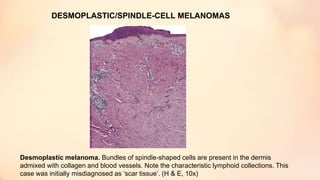
DESMOPLASTIC/SPINDLE-CELL MELANOMAS
Desmoplastic melanoma. Bundles of spindle-shaped cells are present in the dermis
admixed with collagen and blood vessels. Note the characteristic lymphoid collections. This
case was initially misdiagnosed as ‘scar tissue’. (H & E, 10x)
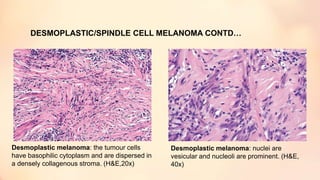
DESMOPLASTIC/SPINDLE CELL MELANOMA CONTD…
Desmoplastic melanoma: the tumour cells
have basophilic cytoplasm and are dispersed in
a densely collagenous stroma. (H&E,20x)
Desmoplastic melanoma: nuclei are
vesicular and nucleoli are prominent. (H&E,
40x)
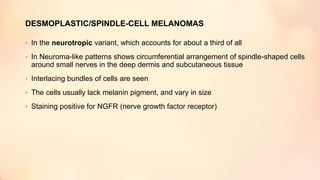
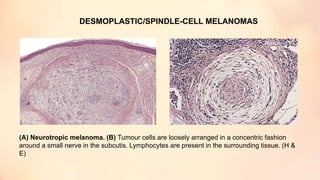
• In the neurotropic variant, which accounts for about a third of all
• In Neuroma-like patterns shows circumferential arrangement of spindle-shaped cells
around small nerves in the deep dermis and subcutaneous tissue
• Interlacing bundles of cells are seen
• The cells usually lack melanin pigment, and vary in size
• Staining positive for NGFR (nerve growth factor receptor)
DESMOPLASTIC/SPINDLE-CELL MELANOMAS
(A) Neurotropic melanoma. (B) Tumour cells are loosely arranged in a concentric fashion
around a small nerve in the subcutis. Lymphocytes are present in the surrounding tissue. (H &
E)
LEVEL AND THICKNESS
• In any report on a malignant melanoma the anatomical level of invasion (Clark’s
level) and the thickness of the tumour (Breslow thickness) should be stated.
• Five anatomical levels are recognized:
• 1. confined to the epidermis (in-situ melanoma)
• 2. invasion of the papillary dermis
• 3. invasion to the papillary/reticular dermal interface
• 4. invasion into the reticular dermis
• 5. invasion into subcutaneous fat.
LEVEL AND THICKNESS
• The thickness of a melanoma is measured from the top of the granular layer to the
deepest tumour cell
• The Breslow thickness can be predicted by 75 MHz ultrasonography which is
highly reliable
• Melanomas less than 1.00 mm in thickness are regarded as being ‘thin melanomas’
and generally have an excellent prognosis
• Bleeding is the symptom most strongly associated with an increased category of
Breslow depth
• Thick melanomas are usually associated with increasing age, particularly in males
REGRESSION
• Partial regression may be found in up to one-third of melanomas and higher in
thin melanomas
• Active regression is recognized by the presence of a heavy lymphocytic
infiltrate, apoptosis, scarring and proliferation of blood vessel with loss or
degeneration of tumour cells
• This infiltrate may have lichenoid (interface) qualities which obscure a lesion
• It seems likely that tumour cells are removed by lymphocyte mediated apoptosis
• Previous (old) regression is characterized by the presence of vascular fibrous
tissue with or without melanophages, and a variable lymphocytic infiltrate
REGRESSION CONTD…
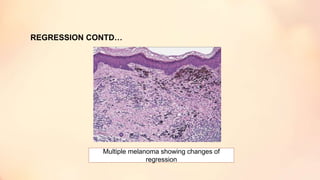
Multiple melanoma showing changes of
regression
REGRESSION
• Different stages of regression often coexist in the one specimen
• Vitiligo-like hypopigmentation may occur at sites distant from a melanoma
• Pigment-related ocular disturbances may also occur
• Depigmentation is sometimes related to regression of the lesion or the development
of metastases
• Complete regression appears to be associated with a poor outcome
• Such cases are now regarded as a discrete entity, primary dermal melanoma
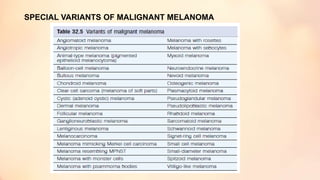
SPECIAL VARIANTS OF MALIGNANT MELANOMA
Follicular melanoma
• Rare variant of melanoma found in elderly patients
• Predilection for the nose
• Characterized by a deep-seated follicular structure in which atypical melanocytes
extend downward along the follicular epithelium and permeate parts of the follicle
as well as the adjacent dermis
• Tumour mostly resembles a comedo or a pigmented cyst
• The lesions would have been missed by superficial shave biopsy
• Tumour cells express melan-A, S100 protein, and HMB-45
SPECIAL VARIANTS OF MALIGNANT MELANOMA
Myxoid melanoma
• The myxoid variant was first described in a
metastatic deposit and than in primary
• Spindle and stellate-shaped cells are embedded in
a myxoid stroma.
• The stroma stains with Alcian blue, and the tumor
cells express S100 protein and neuron-specific
enolase
• Mast cells and transforming growth factor-β are
increased in myxoid melanoma, and these factors
may be responsible for stimulating fibroblasts to
produce mucin
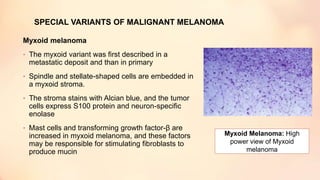
Myxoid Melanoma: High
power view of Myxoid
melanoma
SPECIAL VARIANTS OF MALIGNANT MELANOMA
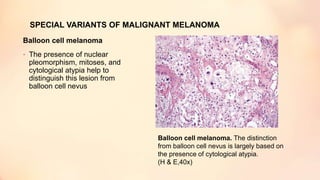
Balloon cell melanoma
• The presence of nuclear
pleomorphism, mitoses, and
cytological atypia help to
distinguish this lesion from
balloon cell nevus
Balloon cell melanoma. The distinction
from balloon cell nevus is largely based on
the presence of cytological atypia.
(H & E,40x)
SPECIAL VARIANTS OF MALIGNANT MELANOMA
Signet-ring cell melanoma
• The presence of signet-ring cells
has been reported in several
metastatic and recurrent
melanomas, and primary lesions
• Pseudoglandular features were
also present
• Cells are quite different from the
scattered sebocyte-like cells seen
in nevi and metastatic melanoma Signet-ring cell melanoma. The cells have an
eccentric nucleus and foamy cytoplasm. (H & E,
40x)
SPECIAL VARIANTS OF MALIGNANT MELANOMA
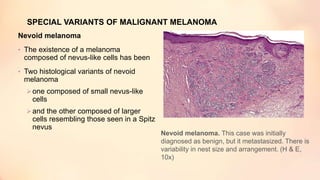
Nevoid melanoma
• The existence of a melanoma
composed of nevus-like cells has been
• Two histological variants of nevoid
melanoma
one composed of small nevus-like
cells
and the other composed of larger
cells resembling those seen in a Spitz
nevus
Nevoid melanoma. This case was initially
diagnosed as benign, but it metastasized. There is
variability in nest size and arrangement. (H & E,
10x)
SPECIAL VARIANTS OF MALIGNANT MELANOMA
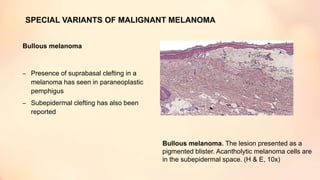
Bullous melanoma
– Presence of suprabasal clefting in a
melanoma has seen in paraneoplastic
pemphigus
– Subepidermal clefting has also been
reported
Bullous melanoma. The lesion presented as a
pigmented blister. Acantholytic melanoma cells are
in the subepidermal space. (H & E, 10x)
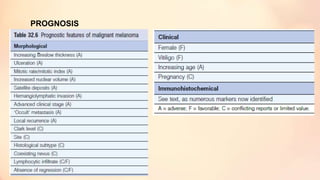
PROGNOSIS
POOR PROGNOSTIC INDICATORS
Primary tumour
Depth (Breslow) measured in mm
0-1 mm
1-2 mm
2-4 mm
> 4 mm
Ulceration
Site
Male sex
Vascular invasion
Perineural invasion : increased local
recurrence
Lymph node metastases
Site of involvement
Number of involved lymph nodes
Distant Metastases
Site
Visceral mets:worst
Lung mets: intermediate
Skin mets: better
Elevated blood LDH
(lactate dehydrogenase)
CONCLUSION
• Despite the advances of the molecular techniques, morphology remains the
gold standard in diagnosis and prognosis of Melanocytic lesions
• Cytogenetics/genetics in ambiguous melanocytic lesions /prognosis
• FISH probes are in development
– distinguish between melanoma and Spitz naevi
• melanoma: multiple chromosomal aberrations
• -9, -10, -6q, 8p +7, +8q, +6p, +1q, +17, +20
• naevi: none / rare aberrations
• Spitz naevi 50% normal, 50% +11p
REFERENCES
• Weedon D. Weedon's skin pathology. 3rd ed. Churchill
Livingstone: Elsevier; 2010.
• Humphrey PA, Dehner LP, Pfeifer JD. Washington Manual of
Surgical Pathology. [S.l.]: Wolters Kluwer Health; 2015.
• Mills SE. Histology for Pathologists. 3rd ed. Lippincott Williams
and Wilkins; 2007.
• McKee P, Calonje E, Brenn T, Lazar A. McKee's pathology of the
skin. [Edinburgh]: Elsevier Saunders; 2012.
Melanocytic lesions. Pathology

Melanocytic lesions. Pathology

  • 1.
  • 2.
    EMBRYOLOGY • By 5weeks of GA, epidermis differentiates into two layers—the basal layer or stratum germinativum and the overlying periderm • By 10 weeks, an intervening layer—the stratum intermedium • By 19 weeks, the intermediate cells, and the periderm begins to flatten • By 23 weeks, keratinization is well developed within the stratum intermedium Schematic overview of embryonic development of human skin
  • 3.
    ANATOMY • Skin consistsof 3 layers: • Epidermis, Dermis and Subcutaneous fat • Ectoderm gives rise to epidermis and its appendages • Mesoderm provides the mesenchymal elements of the dermis and subcutaneous fat
  • 4.
    EPIDERMIS • The cellsin the epidermis include: • (a) Keratinocytes, • (b) Melanocytes, • (c) Langerhans cells, • (d) Toker cells • (in certain anatomic locations) and • (e) Merkel cells.
  • 5.
    EPIDERMIS • Cornified layer: •MELANOCYTES: melanin-synthesizing dendritic cells located within the basal layer of the epidermis • LANGERHANS CELLS: antigen-presenting cells within the suprabasal layers of epidermis and dermis • MERKEL CELLS: sensory nerve fibers in the basal cell layer in the epidermis not recognized in routine histologic preparation
  • 6.
    KERATINOCYTES Normal microanatomy: • Basalcell layer (stratum basalis) • Prickle cell layer (stratum spinosum) • Granular cell layer (stratum granulosum/ lucidum) • Horny cell layer (stratum corneum)
  • 7.
    DERMIS • The dermisconsists of two zones: papillary dermis and reticular dermis • Papillary dermis: Thin zone beneath the epidermis (between rete ridges) and is seen as loose meshwork of thin, organized collagen fibres predominantly of type 3 • Reticular dermis: It is thicker than the papillary dermis and is predominantly composed of type I collagen. Adnexal structures like hair shaft, sebaceous glands, sweat glands and deep vascular plexuses are present Histology of normal epidermis and superficial dermis
  • 8.
    DERMIS & SUBCUTANEOUSFAT Cellular components of the dermis: • Dermal dendritic cells • Fibroblasts • Mast cells • Macrophages /monocytes Emigrant inflammatory cells: • Neutrophils • Eosinophils • Lymphocytes • Plasma cells SUBCUTANEOUS FAT: • Adipocytes separated by thin fibrous septae • Small vessels and is crucial in thermal regulation
  • 9.
  • 10.
    • Embryonic originof melanocytes is the neural crest • Melanocytes produce melanin within cytoplasmic packets called melanosomes • These contain greater amounts of melanin in darker skinned individuals • The melanin is distributed to keratinocytes via dendrites when stimulated by exposure to ultraviolet radiation • Cramer proposed the theory of melanocytic differentiation pathway FORMATION OF MELANIN
  • 11.
    MATURATION OF MELANIN •The maturation of melanin undergoes four stage: • Stage I melanosomes are spherical without tyrosinase activity in periphery of nucleus • Stage II melanosomes are tyrosinase containing elongated organelle, get organized filamentous matrix with no melanin deposition in eumelanosome and already formed melanin and a vesiculo-globular matrix in phaeomelanosomes • The production of the internal matrix fibers and the maturation from stage I to stage II appear dependent on a protein named Pmel17 (or gp 100/Silver)
  • 12.
    MATURATION OF MELANIN •Pmel17 is cleaved into several fragments which constitute the fibrillar matrix of the organite • In stage III melanosomes, melanin is uniformly deposited • Stage IV melanosomes are fully packed, with melanin obscuring the internal structures and supplied from the dendrites to the neighboring keratinocytes
  • 13.
    Schematic of amelanocyte showing melanin production FORMATION OF MELANIN CONTD… Scheme of the epidermis structure: Melanocyte reside between the basal layer cells and through dendritic processes communicates with about 30- 40 keratinocytes in the epidermal melanin unit.
  • 14.
    Melanocytic lesions maybe due to: • Proliferation of melanocytes may result in congenital or acquired benign melanocytic nevi • Increase in melanin within the epidermis without an increase in melanocytes (ephelides) • An increase in melanocytes along the basement membrane of the epidermis (lentigines) • Nests of melanocytes at the epidermal/dermal junction and/or within the dermis (moles) • Melanocytic lesions are pigmented, but dermal naevi are as skin colored or pink lesions • Darker skin types have darker moles • Sun exposure leads to a greater number of lesions, and not confined to sun exposed sites INTRODUCTION
  • 15.
    • Either Benignor malignant • Melanocytic Nevi are due to BRAF mutation and less often NRAS • Dysplastic Nevi are best regarded as markers of melanoma risk, characterized by architectural or cytological atypia • Melanoma is aggressive malignancy, tumours of few millimetres metastasize • Characteristic of the dermal tumour are depth of invasion and mitotic activity correlates with survival INTRODUCTION CONTD…
  • 16.
    Types of melanocyticnevi according to localization, distribution and morphology of nevus cells: 1. Normal melanocytes, 2. Junctional, 3. Compound, 4. Intradermic or Intramucosal, 5. Blue
  • 17.
    PATHOGENESIS • Acquired mutationthat leads to activation of NRAS or serine/ threonine kinase BRAF downstream of RAS mutation of BRAF stimulate the downstream kinase activate transcription factors neoplasm
  • 18.
    SOLAR LENTIGO • Benignmelanocytic proliferation due to sun exposure • Multiple lesions, often poorly circumscribed • Also called solar lentigines, age spots • Seen in un exposed skin of elderly after 40yrs • Multiple large solar lentigens on upper back and shoulders suggest prior severe sunburn, a risk factor for melanoma • Abnormal pigment retention in keratinocytes appears to be the primary defect
  • 19.
    WHO HISTOLOGICAL CLASSIFICATIONOF MELANOCYTIC TUMORS BENIGN: • Lentiginous melanocytic lesions • Junctional melanocytic nevus • Compound melanocytic nevus • Intradermal melanocytic nevus • Spitz nevus(epithelioid and spindle-cell nevus) • Pigmented spindle cell nevus of Reed (AKA Pigmented spindle cell nevus) • Blue nevus • Cellular blue nevus Lentiginous melanocytic lesions • Solar lentigo • Lentigo simplex • Lentiginous nevus • Lentiginous melanoma in situ
  • 20.
    SOLAR LENTIGO CONTD… Clinicalfeatures • Macular hyperpigmentation • Often 3–12 mm in size • "Ink spot lentigo" variant: small, darkly pigmented with irregular border Gross photo of Solar lentigo
  • 21.
    SOLAR LENTIGO CONTD… Microscopy: •Characterized by elongation of the rete ridge, extending deeply into the dermis, finger-like projections form and connect with adjacent rete ridges to form a reticulate pattern • Heavy basal hyperpigmentation • Increased number of melanocytes, at the bases of the clubbed and budding rete ridges • Variable numbers of melanophages are present in the papillary dermis • When solar lentigos undergo regression they develop a heavy lichenoid inflammatory cell infiltrate in the papillary dermis and referred to as a lichen planus-like keratosis
  • 22.
    Solar lentigo: Elongationof rete ridges and increased irregular pigmentation at tips of retes,variable chronic inflammatory infiltrate in dermis (H & E,10x) SOLAR LENTIGO CONTD… ‘Ink-spot’ lentigo. There is heavy pigmentation of the basal layer.There is mild acanthosis. (H & E,10x)
  • 23.
    LENTIGO SIMPLEX Clinical features: •Acquired, small usually less than 2 mm, fairly symmetrical and well-circumscribed flat, evenly coloured, usually on sun-exposed skin, seen in persons <40 years of age • The cause is unknown • Multiple lentigines can occur, referred to as lentigines profusa or generalized lentigines • They do not darken or increase in number on sun exposure • They may be associated with Peutz-Jeghers syndrome, Xeroderma-pigmentosum and Carney's complex
  • 24.
    LENTIGO SIMPLEX Gross photoof Lentigo simplex
  • 25.
    Microscopy: • There isvariable basal hyperpigmentation with an increased number of melanocytes in the basal layer • There is usually acanthosis, with regular elongation of the rete ridges • The papillary dermis may contain a sparse lymphohistiocytic infiltrate, including scattered melanophages LENTIGO SIMPLEX CONTD… Lentigo Simplex: Acanthosis with elongation of the epidermal ridges. Basally located melanocytes are increased in number and superficial dermal lymphohistiocytic infiltrate
  • 26.
    LENTIGINOUS NEVUS • Maybe congenital or acquired • Ages of 20 and 40 years. • Well-circumscribed, with multiple pigmented macules or papules • Also called "speckled lentiginous nevus" or "nevus spilus” • Approximately 80% of speckled lentiginous nevi appear at birth or during early infancy • May be due to "reactivation" of radial proliferation • May represent a localized defect in neural crest melanoblasts that populate a particular area of the skin
  • 27.
    • Environmental andgenetic factors play a role • Mosaicism may be an explanation for the development of zosteriform speckled lentiginous nevus • Often benign, increase in size, formation of irregular borders or peripheral change in color and usually 5 mm or less • Associated findings include ichthyosis, epidermal nevi, nevus sebaceous, scleral pigmentation, and neurofibromatosis type I, adult-onset hearing loss LENTIGINOUS NEVUS CONTD…
  • 28.
    LENTIGINOUS NEVUS CONTD… Lentiginousnevus :A- Lesion on the abdomen with a speckled lentiginous nevus like appearance at age 6 months; B-darkening of the nevus with a biopsy site in evidence at age 12 months;
  • 29.
    • Microscopic: • Areaof lentiginous junctional melanocytic proliferation • Elongation of rete ridges with small nests of melanocytes at tips of rete • Individual unit melanocytes extending along sides of rete, often mild lymphohistiocytic infiltrate with pigment incontinence • No atypia, no pagetoid spread and no dermal fibrosis LENTIGINOUS NEVUS CONTD… Lentiginous nevus: Elongated rete ridges and lentiginous proliferation of melanocytes at the dermal-epidermal junction
  • 30.
    LENTIGINOUS MELANOMA INSITU • Lentiginous melanoma is a slowly progressive variant of melanoma found on sun- damaged skin of the trunk and limbs • It is usually diagnosed when the malignant cells are in situ and it is thought to have a low risk of invasive melanoma • More common in males, in between 60 and 80 years • Risk of development of melanoma 6% (2 peaks: <10 y and adult life)
  • 31.
    LENTIGINOUS MELANOMA INSITU Gross photo of lentiginous melanoma in situ
  • 32.
    Microscopy: • Increase inthe number of atypical, enlarged melanocytes found only in the epidermis • Nuclear enlargement and hyperchromatism • Prominent pagetoid spread • Confluent spread of melanocytes at the level of the basal keratinocytes in the lentiginous pattern • Nests may or may not be present • Melanocytes are not seen in the dermis • Features of regression may be seen and should be commented on because invasion may have been present earlier LENTIGINOUS MELANOMA IN SITU CONTD…
  • 33.
    LENTIGINOUS MELANOMA INSITU Lentiginous melanoma: (A) Tumour cells are predominantly basally located. There is no evidence of solar elastosis(H&E, 10x). (B) In situ melanomas are poorly circumscribed with a junctional nest (red arrow) near its border, but individual malignant melanocytes (blue arrows) extend subtly beyond the nest (H&E, 20x) A B
  • 34.
    JUNCTIONAL MELANOCYTIC NEVUS Clinicalfeatures: • Acquired pigmented lesion, small, flat, evenly coloured blue and black macule, on sun-exposed sites • Appears during childhood or early adolescence • No melanocytic proliferation Gross photo of Junctional melanocytic Nevus on the Right Flank of abdomen.
  • 35.
    JUNCTIONAL MELANOCYTIC NEVUSCONTD… Junctional nevus: note the nests of nevus cells in the basal layer of the epithelium with an intact basement membrane Microscopy: • Discrete nests of melanocytes nevus cells at the dermoepidermal junction, on the tips of rete ridges • Cells are oval to cuboidal in shape, with clear cytoplasm containing a variable amount of melanin pigment • Nests of nevus cells sometimes bulge into the underlying dermis, which may contain a few melanophages and a sparse lymphohistiocytic infiltrate
  • 36.
    COMPOUND MELANOCYTIC NEVUS Clinicalfeatures: • Acquired pigmented lesion • small, slightly raised, evenly tan to brown coloured, on sun-exposed skin Gross photo of Compound Nevus
  • 37.
    COMPOUND MELANOCYTIC NEVUSCONTD… Microscopy: • Compound nevi have both junctional nests and an intradermal component of nevus cells • Cells in the upper dermis are cuboidal, with melanin pigment in the cytoplasm, deeper cells are often smaller and contain less melanin • Apoptosis is sometimes seen in the deeper cells • Nevus cells are arranged in orderly nests or cords • Overlying epidermis may be flat, show acanthosis, or may have seborrheic keratosis-like appearance • Pagetoid spread of melanocytes is usually limited to the site of trauma • Mitoses are rare
  • 38.
    COMPOUND MELANOCYTIC NEVUSCONTD… Benign compound nevus with both junctional and dermal nests of nevus cells. (H & E, 20x)
  • 39.
    INTRADERMAL MELANOCYTIC NEVUS Clinical: •A papular • Nonpigmented lesion, mistaken clinically for a skin tag or a basal cell carcinoma • Dome-shaped, nodular or polypoid lesions and flesh-colore • Coarse hairs may protrude from the surface Gross photo of intradermal melanocytic Nevus
  • 40.
    INTRADERMAL MELANOCYTIC NEVUSCONTD… Microscopy: • Nevus cells are confined to the dermis arranged in nests and cords • Intradermal nevi commonly show intranuclear pseudoinclusions which are cytoplasmic invaginations within the nuclei of nevus cells • Multinucleate nevus cells may be present • Deeper parts of the lesion the nevus cells assume a neuroid appearance (‘neural nevus’, neurotized melanocytic nevus), with spindle shaped • Verocay-like bodies reminiscent of a neurilemmoma have also been present Intradermal nevus: Some nevus cell nests have a neuroid appearance. (H &E, 10x)
  • 41.
    SPITZ NEVUS (SPINDLEAND/OR EPITHELIOID CELL NEVUS) Clinical: • Small, raised, pink / red or brown / black nodule • May resemble hemangioma or pyogenic granuloma • 6 mm or smaller • Single or multiple and clustered • Most common on the head and neck or extremities of children and adolescents Gross photo of spitz nevus
  • 42.
    SPITZ NEVUS (SPINDLEAND/OR EPITHELIOID CELL NEVUS) CONTD… Microscopy: • The cell type, symmetrical with no lateral extension of junctional activity beyond the dermal component • Maturation of nevus cells • Lack of pagetoid spread of single melanocytes • Kamino bodies seen • Melanocytes are spindled, epithelioid, or a mixed population that are arranged in vertically oriented nests at the epidermal–dermal junction with often a space between the epidermis and nested melanocytes
  • 43.
    SPITZ NEVUS (SPINDLEAND/OR EPITHELIOID CELL NEVUS) CONTD... • There is usually ‘maturation’ of nevus cells in depth • Epithelioid melanocytes have large nuclei and abundant eosinophilic cytoplasm • Numerous ectatic, thin-walled vascular spaces may be seen in the papillary dermis • Superficial mitoses may be seen • Pagetoid spread may be seen
  • 44.
    SPITZ NEVUS (SPINDLEAND/OR EPITHELIOID CELL NEVUS) CONTD.. Spitz nevus. Large and symmetric lesions. (H & E,10x) Spitz nevus. Epithelioid cell variant. There is some upward spread of melanocytes within the epidermis in small nests (H & E, 40x)
  • 45.
    SPITZ NEVUS (SPINDLEAND/OR EPITHELIOID CELL NEVUS) CONTD.. Spitz nevus. Spindle cell variant ( H&E, 40x) Spitz nevus composed of plump, spindle- shaped cells. (H & E, 40x)
  • 46.
    PIGMENTED SPINDLE CELLNEVUS Clinical feature: • Acquired lesion in the shoulder/ pelvic girdle region • Heavily evenly pigmented • Well-circumscribed • Small, deeply pigmented papule • Women in their second and third decades Gross photo of Pigmented spindle shaped Nevus
  • 47.
    PIGMENTED SPINDLE CELLNEVUS CONTD… Microscopy: • Symmetric and well-circumscribed proliferation of spindled melanocytes in the epidermis and superficial dermis • A pattern of a woven basket is seen • Pagetoid spread of cells • Tumour is composed of spindle-shaped cells in nests, with the formation of interconnected fascicles oriented vertically, horizontally, and tangentially. Pigmented spindle-cell nevus. The fascicles of spindles shaped cells are confined, to the epidermis and the papillary dermis. There is melanin incontinence at the base of the lesion
  • 48.
    PIGMENTED SPINDLE CELLNEVUS CONTD… • Broad zone of melanophages in the superficial dermis present beneath the melanocytes • Many melanophages are present • Eosinophilic globules (Kamino bodies), may be demonstrated • Sometimes contain melanin granules. Junctional clefting, similar to that seen in the Spitz nevus, is often present Pigmented spindle-cell nevus: High power view of nested cells (H & E, 40x)
  • 49.
    BLUE NEVUS Clinical features: •Small slate-blue to blue-black macule or papule • Congenital or acquired, common on the head, neck and extremities Gross photo of Blue Nevus
  • 50.
    BLUE NEVUS CONTD… Microscopy: •The ‘common blue nevus’ is composed of elongated, finely branching, melanocytes in the interstices of the dermal collagen of the superficial upper dermis • Melanophages are frequently admixed. Some lesions show dermal fibrosis (sclerosing blue nevus) • A sclerosing ‘mucinous’ blue nevus with both stromal sclerosis and abundant mucin has been reported • Combined nevi are characterized by the presence of two or more different types of melanocytic nevi in a single lesion Blue nevus. Melanocytes with long dendritic processes and cytoplasmic melanin are present between the collagen bundles in the dermis (H & E, 40x)
  • 51.
    COMBINED MELANOCYTIC NEVUS Clinicalfeatures: • Varied, may be flat, raised, or both, may be variably pigmented • Combination of features in these lesions, asymmetry, colour variations, and possible border irregularities often raises concern for melanoma • May include Spitz nevus, desmoplastic nevus, or congenital nevus Gross photo of Combined Nevus
  • 52.
    COMBINED MELANOCYTIC NEVUS Microscopy: •Common combinations is a compound melanocytic nevus and a blue nevus • The epithelioid blue nevus is often part of a combined nevus that may include Spitz nevus, desmoplastic nevus, or congenital nevus • The melanocytes in blue nevi of all types express S100 protein, melan-A (MART-1), and HMB-45. • They do not stain for carcinoembryonic antigen (CEA) Combined nevus: there are conspicuous bipolar and dendritic cells
  • 53.
    CELLULAR BLUE NEVUS Clinicalfeatures: • Large (1 to 2 cm) heavily pigmented • Blue to blue–black, raised lesion, commonly on the scalp or buttocks • Microscopy: • The cellular blue nevus is composed of dendritic melanocytes, together with islands of epithelioid and plump spindle cells with abundant pale cytoplasm and little pigment • Acquired amelanotic cellular blue nevi also occur • Heavily pigmented variants do occur. Melanophages are found between the cellular islands.
  • 54.
    CELLULAR BLUE NEVUSCONTD… • Tumour often bulges into the subcutaneous fat as a nodular downgrowth which has a characteristic appearance • Nerve hypertrophy is often present with perineural aggregation of cells • Giant cellular blue nevus of the scalp can be mistaken for a melanoma Cellular blue nevus. There are nests and fascicles of melanocytes, some with a spindle shape. The cytoplasm of the cells is pale staining. (H & E,40x)
  • 55.
    DERMAL MELANOCYTIC LESIONS- MONGOLIAN SPOT Clinical features: • Flat, slate-gray patch • Seen on the face, shoulder, sacrum, or bilateral temples • Occurs in Asian descent, more commonly in females • Minocycline therapy may rarely simulate a Mongolian spot Gross photo showing Mongolian Spot
  • 56.
    DERMAL MELANOCYTIC LESIONS- MONGOLIAN SPOT CONTD… Microscopy: • There are widely scattered, melanin- containing melanocytes in the lower half of the dermis. • The cells are elongated and slender • Occasional melanophages are also present • Ill-defined, paucicellular infiltrate consists of pigmented, spindled, and/or dendritic melanocytes. There are some overlapping features with the blue nevus Mongolian Spot: Lower power shows normal epidermis and pigmented cells scattered through the dermis
  • 57.
    DERMAL MELANOCYTIC LESIONS-NEVUSOF OTA Clinical features: • Predilection for females and present at birth • Speckled, macular area of blue to dark- brown pigmentation • Distributed of the ophthalmic and maxillary divisions of the trigeminal nerve Gross photo of Nevus pf Ota
  • 58.
    DERMAL MELANOCYTIC LESIONS-NEVUSOF OTA CONTD… Microscopic: • There are often nodular collections of melanocytes which resemble those of blue nevi • Intervening macular areas are composed of infiltrate of elongated melanocytes situated in the upper dermis Nevus of Ota: small numbers of bipolar and dendritic cells are present (H & E,10x).
  • 59.
    CONGENITAL NEVUS Clinical features: •Congenital nevi are pigmented lesions that are present at birth or appear during infancy • Classified as small (< 2 cm), intermediate (2 to 20 cm), or large (>20 cm) • Frequently varied in pigmentation and have irregular borders • May be hairy and may cover large areas of the body • Involvement of the leptomeninges by benign or malignant melanocytes, it is known as neurocutaneous melanosis Giant congenital melanocytic nevus with risk of malignant change
  • 60.
    CONGENITAL NEVUS CONTD… Microscopic: •Congenital nevi (CN) may be junctional, compound or intradermal in type, depending on the age at which they are removed • In neonates they are often junctional and if biopsied in the first week of life the melanocytic hyperplasia may be quite prominent in the epidermis • Adnexal epithelium but the melanocytes are predominantly dermal with time • The epidermal melanocytic pattern is highly variable, ranging from no significant melanocytic proliferation, to nested melanocytes, to confluent lentiginous hyperplasia
  • 61.
    CONGENITAL NEVUS CONTD… •Mitotic figures may be present at any level • CN*, from the scalp, is complex pattern of spindle cells, perivascular pseudorosettes, and tactoid bodies and called neurocristic hamartoma • CN removed in the first year of life, has two types of cells-there are small nevus cells in the reticular dermis, usually separated by a space from overlying larger cells in the epidermis • Full-thickness dermal involvement, which is clearly visible in routine hematoxylin and eosin- stained sections, seems to be a feature of the larger congenital nevi • *Congenital nevi
  • 62.
    Congenital melanocytic nevus:in this field, there is a characteristic Indian-file pattern. (H & E,40x) CONGENITAL NEVUS CONTD… Congenital melanocytic nevus: the nevus cells in the dermal component dissect between the collagen fibers. (H&E, 20x)
  • 63.
    DEEP PENETRATING NEVUS Clinicalfeatures: • Regarded as a variant of congenital nevus • The age at presentation is quite broad (3–64 years) • Small, pigmented lesion < 1 cm diameter, dome-shaped, blue or black papule or nodule on the upper half of the body • May resemble a blue nevus, usually acquired during early adulthood • Histologically mistaken for a melanoma Gross photo of Deep penetrating nevus
  • 64.
    DEEP PENETRATING NEVUSCONTD… Microscopy: • Symmetrical, wedge shape in low power • Sharply circumscribed • The lesion is composed of loosely arranged nests and fascicles of pigmented nevus cells, interspersed with melanophages • Spindle cells are the predominant cell type, but varying numbers of epithelioid cells are also present • Cytoplasm is gray-brown admixed with melanophages and some nevoid melanocytes DEEP PENETRATING: The nests extend into the deep reticular dermis and often into the subcutaneous fat and adnexal structure
  • 65.
    DEEP PENETRATING NEVUSCONTD… • The nests extend into the deep reticular dermis and often into the subcutaneous fat and adnexal structure • Although there is some pleomorphism of the nuclei of the nevus cells, nucleoli are inconspicuous • Nuclear vacuoles and smudging of the chromatin pattern • Immunohistochemical studies have shown that the cells express S100 protein and HMB-45
  • 66.
    HALO NEVUS Clinical features: •Central zone of pigment, raised or flat, with a circumferential rim of depigmented halo up to several millimeters in width around a melanocytic nevus Gross photo of Halo Nevus
  • 67.
    HALO NEVUS CONTD… •Microscopy: • There is usually a dense lymphocytic infiltrate within the dermis, with nevus cells surviving in nests or singly among the lymphocytes • Nevus cells appear swollen, with mild pleomorphism • Fibrosis does not occur in the dermis as a consequence of regression • IHC staining positive for S100 protein helps in identifying residual nevus cells in the dense inflammatory infiltrate • IHC has also been used to characterize the lymphocytes as CD8-positive Halo nevus: there are residual junctional nests deep to which is a dense, bandlike lymphohistiocytic infiltrate.
  • 68.
    DYSPLASTIC (ATYPICAL, CLARK’S)NEVUS Clinical features: • Highly variable, from small, symmetric, and evenly pigmented to large (>6 mm), irregularly shaped, and irregularly pigmented • Cutaneous marker for the dysplastic nevus syndrome, but it is of uncertain significance • There is an increased risk of melanoma change Gross photo of Dysplastic Nevus
  • 69.
    DYSPLASTIC (ATYPICAL, CLARK’S)NEVUS Microscopy: Three characteristic histological features: • Lentiginous hyperplasia of the melanocytes refers to a proliferation of melanocytes singly, and in nests along the basal layer • Nests may involve the sides of the elongated rete ridges as well as the tips bridging the nests • Cells commonly show shrinkage artifact, with scant cytoplasm and a spindle- shaped pattern, but in some lesions there are larger cuboidal (epithelioid) cells with dusty pigment
  • 70.
    DYSPLASTIC (ATYPICAL, CLARK’S)NEVUS • Random cytological atypia refers to the presence of occasional cells with enlarged hyperchromatic nuclei, sometimes with prominent nucleoli. The nuclei equal or larger the nucleus of the overlying keratinocytes in size • There is often a progression of cytological atypia with increasing age of the patient • Stromal response consists of lamellar and concentric fibroplasia of the papillary dermis, associated with a proliferation of dermal dendrocytes. Sometimes there is fibrosis in the upper reticular dermis, resulting in more widely spaced nests, often larger than usual
  • 71.
    DYSPLASTIC (ATYPICAL, CLARK’S)NEVUS Dysplastic nevus of compound type. There is fibrosis of the superficial dermis and an absence of nevomelanocytes in the overlying junctional zone, suggesting focal regression. (H & E,10) Dysplastic nevus. There is mild cytological atypia of the cells and mild fibroplasia of the papillary dermis. (H & E,10x)
  • 72.
    SECONDARU CHANGES INNEVUS • They include the incidental finding of amyloid or of bone, epidermal spongiosis producing a clinical eczematous halo • Meyerson’s nevus, the concurrence of psoriasis, increased amounts of elastic tissue, nodular myxoid change, cystic dilatation of hair follicles, folliculitis, epidermal, dermoid, or tricholemmal cyst formation, psammoma body formation, sebocyte-like melanocytes, granular cell change, granulomatous, basal cell carcinoma, syringoma • Tiny foci of hyperpigmentation may develop in nevi. The increased pigment may be in epidermal melanocytes, melanophages, or dermal nevus cells. The heavily pigmented foci correspond to circumscribed nodules of atypical epithelioid cells – clonal nevi
  • 73.
    SECONDARY CHANGES INNEVUS Clonal nevus. There is a small focus of heavily pigmented nevus cells with pale cytoplasm within a nevus. (H & E, 40x)
  • 74.
    NEVI ON SPECIALSITES Clinical features: • Varies with site • Special sites include mucocutaneous sites such as the conjunctiva, anus, external genitalia, umbilicus, acral skin (palms/soles), and areola Microscopy: • In addition to the features associated with junctional and/or compound nevi, the junctional melanocytic proliferations with either a lentiginous or pagetoid pattern, loss of cohesion, and asymmetry
  • 75.
    CLASSIFICATION OF MELANOMA •Lentigo maligna melanoma (10–40%) • Superficial spreading melanoma (30–60%)1343 • Nodular melanoma (15–35%) • Acral lentiginous melanoma (5–10%) • Desmoplastic (and neurotropic) melanoma (rare) • Miscellaneous group (rare)
  • 76.
    MALIGNANT MELANOMA • Superficialspreading melanoma (30–60%) • Nodular melanoma (15–35%) • Lentigo maligna (10–40%) • Acral - lentiginous melanoma (5–10%) • Desmoplastic (and neurotropic) melanoma (rare) • Melanoma arising from blue nevus • Melanoma arising in a giant congenital nevus • Melanoma of childhood • Nevoid melanoma • Persistent melanoma
  • 77.
  • 78.
    CLINICAL DIAGNOSIS OFMELANOMA ABCD RULE
  • 79.
    MALIGNANT MELANOMA • Theincidence of malignant melanoma has increased significantly over the last two decades in the white populations of various industrialized countries • Prognosis has continued to improve because patients are presenting at an earlier stage with smaller and therefore potentially curable lesions • Screening should be focused on individuals with multiple risk factors
  • 80.
    MALIGNANT MELANOMA CONTD… Microscopic Beforeconsidering the histopathological features of each subtypes, three aspects that require consideration: • the concept of radial and vertical growth phase • the nomenclature for precursor lesions, including the radial growth phase • the examination and reporting of melanomas
  • 81.
    MALIGNANT MELANOMA CONTD… •The radial growth phase refers to the progressive centrifugal spread which is characterized by intraepidermal proliferation of atypical melanocytes with features that differ in the subtypes. • The radial growth phase precedes the development of the vertical growth phase, although nodular melanomas have no radial growth • Invasion of the papillary dermis may not have the same prognosis as penetration of the reticular dermis • Invasion of the papillary dermis, either single or in small nests, resembling cells of epidermis-k/a invasive radial growth phase
  • 82.
    MALIGNANT MELANOMA CONTD… •Angiogenesis and expression of vascular endothelial growth factor are associated with the development of the vertical growth phase and tumour progression • Destruction or loss of the basement membrane is not mandatory for melanoma invasion • Vertical growth phase is an adverse prognostic factor • Precursor lesions of malignant melanoma are termed as ‘atypical melanocytic hyperplasia’, ‘pagetoid melanocytic proliferation’, ‘pagetoid melanocytosis’, ‘precancerous melanosis’, ‘severe melanocytic dysplasia’ and, ‘dysplastic (atypical) nevus’
  • 83.
  • 84.
    HISTOPATHOLOGIC FEATURES INTHE DIFFERENTIAL DIAGNOSIS OF BENIGN AND MALIGNANT MELANOCYTIC PROLIFERATIONS
  • 85.
    SUPERFICIAL SPREADING MELANOMA •Commonest type on white skin • Males, seen in fourth or fifth decade • Site-any body site, and the lower extremities in females • Early presentation is of an irregularly shaped, brown lesion, macular. • Starts at only 4-5 mm in diameter, and grows gradually • Subtle altered sensation • Shorter radial growth and superficially invasive at the time of presentation • Variegated colour with an irregular expanding margin • Amelanotic variant has also been reported, it may simulate a patch of vitiligo • Potentially clonally unstable with two or three distinct proliferating tumour cell stem lines
  • 86.
    SUPERFICIAL SPREADING MELANOMACONTD… • Characterized by a proliferation of atypical melanocytes, singly and in nests, within the epidermis • This pagetoid spread within the epidermis is known as ‘buckshot scatter’ • Superficial adnexal epithelium may also be involved • Thinning of the epidermis with attenuation of basal and suprabasal layers • Loss of rete ridges adjacent to collections of melanocytes • Aberrant melanocyte–keratinocyte interactions • The infiltrative component may be arranged in solid masses or may have a fascicular arrangement
  • 87.
    SUPERFICIAL SPREADING MELANOMACONTD… • Cells may be epithelioid, nevus cell-like, or even spindle-shaped without maturation during their descent into the dermis • Degree of cytological atypia • A rare variant of melanoma, is the verrucous melanoma • This occurs in back and limbs of middle-aged to older males • Characterized by marked epidermal hyperplasia, elongation of the rete ridges, and overlying hyperkeratosis • This variant is often misdiagnosed clinically as a seborrheic keratosis • The pseudoepitheliomatous hyperplasiandoes not appear to be due to epidermal growth factor receptor
  • 88.
    SUPERFICIAL SPREADING MELANOMACONTD… Superficial spreading melanoma: Histology showing striking pagetoid invasion of the overlying epidermis.
  • 89.
    SUPERFICIAL SPREADING MELANOMACONTD… Differential diagnosis • Seborrhoeic keratosis • Pigmented actinic • Keratosis or a pigmented squamous cell carcinoma.
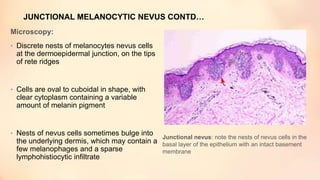
  • 90.
    NODULAR MELANOMAS • Noantecedent radial growth phase • They are therefore nodular, polypoid or pedunculated • Dark brown or blue-black lesions occurring anywhere on the body • Flesh-coloured amelanotic variants are found • Ulceration may be present • A giant lesion up to 12 cm in width is seen
  • 91.
    NODULAR MELANOMA CONTD… •Invasive melanoma cells in the dermis with direct contact with the overlying epidermis, and no morphological abnormality in the adjacent epidermis • Has no adjacent intraepidermal component of atypical melanocytes • Usually epidermal invasion by malignant cells may be seen • Dermal component is composed of oval to round epithelioid cells • Mast cells are increased • Erythrophagocytosis by tumour cells
  • 92.
    NODULAR MELANOMA CONTD… Nodularmelanoma. The tumour cells in the dermis have large, hyperchromatic nuclei. There is no melanin present in the cells. They were positive for S100 protein. (H & E,20x)
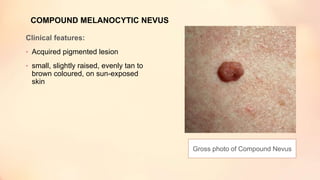
  • 93.
    LENTIGO MALIGNA • Precursorlesion • Irregularly pigmented • There is great variation in colour, with tan- brown, black, and even pink areas present • Invasive malignancy is characterized with the development of elevated plaques or discrete nodules • Rapid progression to a invasive tumour Lentigo maligna: a dark black nodule of invasive tumor is surrounded by typical lentigo maligna.
  • 94.
    LENTIGO MALIGNA CONTD… •Characterized by an epidermal component of atypical melanocytes, singly and in nests • Pagetoid invasion of the epidermis • Presence of junctional nesting, deep adnexal involvement • Melanocytes is present above the basal layer • Epidermal atrophy • Variable cytological atypia with tumour giant cells Lentigo maligna:The nuclei are irregular, angular, and hyperchromatic; and there is early pagetoid spread. (H & E, 40x)
  • 95.
    ACRAL LENTIGINOUS MELANOMAS •Develop on palmar, plantar, and subungual skin • Elderly patients, with a male preponderance • More in Chinese people • Pigmented plaques or nodules which are often ulcerated • Subungual melanomas may present as longitudinal melanonychia • Amelanotic variants have also been reported • They are frequently misdiagnosed as benign disease • Disease is often advanced at the time of diagnosis • The most common site of the lesions was the great toe • Dermoscopy may aid the diagnosis of early lesions of acral melanoma in situ
  • 96.
    ACRAL LENTIGINOUS MELANOMASCONTD… • Radial growth phase which is characterized by a lentiginous pattern of atypical melanocytes, with nesting • The melanocytes are plump with a surrounding clear halo, giving a lacunar appearance • Heavily pigmented dendritic processes • Approximately 15% of cases are amelanotic & epidermal component may look misleadingly benign • Invasive component may consist of epithelioid cells or spindle cells, or resemble nevus cells
  • 97.
    ACRAL LENTIGINOUS MELANOMASCONTD… • Desmoplastic stromal response may be present • Presence of small nevus cells was associated with a worse prognosis • Mitotic activity appears to be of importance in predicting the • It is not uncommon for tumour cells to have infiltrated the deep dermis Acral lentiginous melanoma (radial growth phase). There are atypical melanocytes within the basal layer that show only slight upward spread. (H & E,10x)
  • 98.
    DESMOPLASTIC/SPINDLE CELL MELANOMA •Seen on the head and neck, Male predominance • Indurated plaque or bulky and firm • In pure desmoplastic melanomas, desmoplasia is prominent throughout • Neurotropism is present in approximately one-third of cases • Recurrent • Express N-cadherin & have a higher metastatic potential • A 2 cm clearance has been suggested recently
  • 99.
    DESMOPLASTIC/SPINDLE CELL MELANOMACONTD… • Composed of elongated spindle-shaped cells surrounded by mature collagen bundles with variable stroma • Desmoplastic melanoma is a fibrosing variant of spindle-cell melanoma • The cells resemble fibroblasts, but there are scattered cells with hyperchromatic and even bizarre nuclei • Multinucleate cells are also present • Neurotropism may be seen • Desmoplastic melanoma can be regarded as a fibrosing variant of spindle-cell melanoma • IHC stains positive for S100 spindle cells and nearly 50% of spindle-cell melanomas show staining for HMB-45 • Collections of lymphocytes and plasma cells is seen
  • 100.
    DESMOPLASTIC/SPINDLE-CELL MELANOMAS Desmoplastic melanoma.Bundles of spindle-shaped cells are present in the dermis admixed with collagen and blood vessels. Note the characteristic lymphoid collections. This case was initially misdiagnosed as ‘scar tissue’. (H & E, 10x)
  • 101.
    DESMOPLASTIC/SPINDLE CELL MELANOMACONTD… Desmoplastic melanoma: the tumour cells have basophilic cytoplasm and are dispersed in a densely collagenous stroma. (H&E,20x) Desmoplastic melanoma: nuclei are vesicular and nucleoli are prominent. (H&E, 40x)
  • 102.
    • In theneurotropic variant, which accounts for about a third of all • In Neuroma-like patterns shows circumferential arrangement of spindle-shaped cells around small nerves in the deep dermis and subcutaneous tissue • Interlacing bundles of cells are seen • The cells usually lack melanin pigment, and vary in size • Staining positive for NGFR (nerve growth factor receptor) DESMOPLASTIC/SPINDLE-CELL MELANOMAS
  • 103.
    DESMOPLASTIC/SPINDLE-CELL MELANOMAS (A) Neurotropicmelanoma. (B) Tumour cells are loosely arranged in a concentric fashion around a small nerve in the subcutis. Lymphocytes are present in the surrounding tissue. (H & E)
  • 104.
    LEVEL AND THICKNESS •In any report on a malignant melanoma the anatomical level of invasion (Clark’s level) and the thickness of the tumour (Breslow thickness) should be stated. • Five anatomical levels are recognized: • 1. confined to the epidermis (in-situ melanoma) • 2. invasion of the papillary dermis • 3. invasion to the papillary/reticular dermal interface • 4. invasion into the reticular dermis • 5. invasion into subcutaneous fat.
  • 105.
    LEVEL AND THICKNESS •The thickness of a melanoma is measured from the top of the granular layer to the deepest tumour cell • The Breslow thickness can be predicted by 75 MHz ultrasonography which is highly reliable • Melanomas less than 1.00 mm in thickness are regarded as being ‘thin melanomas’ and generally have an excellent prognosis • Bleeding is the symptom most strongly associated with an increased category of Breslow depth • Thick melanomas are usually associated with increasing age, particularly in males
  • 106.
    REGRESSION • Partial regressionmay be found in up to one-third of melanomas and higher in thin melanomas • Active regression is recognized by the presence of a heavy lymphocytic infiltrate, apoptosis, scarring and proliferation of blood vessel with loss or degeneration of tumour cells • This infiltrate may have lichenoid (interface) qualities which obscure a lesion • It seems likely that tumour cells are removed by lymphocyte mediated apoptosis • Previous (old) regression is characterized by the presence of vascular fibrous tissue with or without melanophages, and a variable lymphocytic infiltrate
  • 107.
    REGRESSION CONTD… Multiple melanomashowing changes of regression
  • 108.
    REGRESSION • Different stagesof regression often coexist in the one specimen • Vitiligo-like hypopigmentation may occur at sites distant from a melanoma • Pigment-related ocular disturbances may also occur • Depigmentation is sometimes related to regression of the lesion or the development of metastases • Complete regression appears to be associated with a poor outcome • Such cases are now regarded as a discrete entity, primary dermal melanoma
  • 109.
    SPECIAL VARIANTS OFMALIGNANT MELANOMA
  • 110.
    SPECIAL VARIANTS OFMALIGNANT MELANOMA Follicular melanoma • Rare variant of melanoma found in elderly patients • Predilection for the nose • Characterized by a deep-seated follicular structure in which atypical melanocytes extend downward along the follicular epithelium and permeate parts of the follicle as well as the adjacent dermis • Tumour mostly resembles a comedo or a pigmented cyst • The lesions would have been missed by superficial shave biopsy • Tumour cells express melan-A, S100 protein, and HMB-45
  • 111.
    SPECIAL VARIANTS OFMALIGNANT MELANOMA Myxoid melanoma • The myxoid variant was first described in a metastatic deposit and than in primary • Spindle and stellate-shaped cells are embedded in a myxoid stroma. • The stroma stains with Alcian blue, and the tumor cells express S100 protein and neuron-specific enolase • Mast cells and transforming growth factor-β are increased in myxoid melanoma, and these factors may be responsible for stimulating fibroblasts to produce mucin Myxoid Melanoma: High power view of Myxoid melanoma
  • 112.
    SPECIAL VARIANTS OFMALIGNANT MELANOMA Balloon cell melanoma • The presence of nuclear pleomorphism, mitoses, and cytological atypia help to distinguish this lesion from balloon cell nevus Balloon cell melanoma. The distinction from balloon cell nevus is largely based on the presence of cytological atypia. (H & E,40x)
  • 113.
    SPECIAL VARIANTS OFMALIGNANT MELANOMA Signet-ring cell melanoma • The presence of signet-ring cells has been reported in several metastatic and recurrent melanomas, and primary lesions • Pseudoglandular features were also present • Cells are quite different from the scattered sebocyte-like cells seen in nevi and metastatic melanoma Signet-ring cell melanoma. The cells have an eccentric nucleus and foamy cytoplasm. (H & E, 40x)
  • 114.
    SPECIAL VARIANTS OFMALIGNANT MELANOMA Nevoid melanoma • The existence of a melanoma composed of nevus-like cells has been • Two histological variants of nevoid melanoma one composed of small nevus-like cells and the other composed of larger cells resembling those seen in a Spitz nevus Nevoid melanoma. This case was initially diagnosed as benign, but it metastasized. There is variability in nest size and arrangement. (H & E, 10x)
  • 115.
    SPECIAL VARIANTS OFMALIGNANT MELANOMA Bullous melanoma – Presence of suprabasal clefting in a melanoma has seen in paraneoplastic pemphigus – Subepidermal clefting has also been reported Bullous melanoma. The lesion presented as a pigmented blister. Acantholytic melanoma cells are in the subepidermal space. (H & E, 10x)
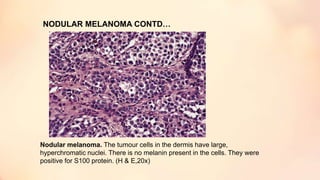
  • 116.
  • 117.
    POOR PROGNOSTIC INDICATORS Primarytumour Depth (Breslow) measured in mm 0-1 mm 1-2 mm 2-4 mm > 4 mm Ulceration Site Male sex Vascular invasion Perineural invasion : increased local recurrence Lymph node metastases Site of involvement Number of involved lymph nodes Distant Metastases Site Visceral mets:worst Lung mets: intermediate Skin mets: better Elevated blood LDH (lactate dehydrogenase)
  • 118.
    CONCLUSION • Despite theadvances of the molecular techniques, morphology remains the gold standard in diagnosis and prognosis of Melanocytic lesions • Cytogenetics/genetics in ambiguous melanocytic lesions /prognosis • FISH probes are in development – distinguish between melanoma and Spitz naevi • melanoma: multiple chromosomal aberrations • -9, -10, -6q, 8p +7, +8q, +6p, +1q, +17, +20 • naevi: none / rare aberrations • Spitz naevi 50% normal, 50% +11p
  • 119.
    REFERENCES • Weedon D.Weedon's skin pathology. 3rd ed. Churchill Livingstone: Elsevier; 2010. • Humphrey PA, Dehner LP, Pfeifer JD. Washington Manual of Surgical Pathology. [S.l.]: Wolters Kluwer Health; 2015. • Mills SE. Histology for Pathologists. 3rd ed. Lippincott Williams and Wilkins; 2007. • McKee P, Calonje E, Brenn T, Lazar A. McKee's pathology of the skin. [Edinburgh]: Elsevier Saunders; 2012.

Editor's Notes

  • #5 In addition, the epidermis contains the openings for the eccrine ducts (acrosyringium) and hair follicles.
  • #7 Stratum luciderm is seen in thik epidermis and represent a transition from stratum granulosum to stratum corneum.
  • #8 Dermis is supportive connective tissue. Papillary: It also contains thin elastic fibres, fibroblasts, capillaries, abundant ground substance like glycosaminoglycans and chondroitin sulfate. Cellular components of the dermis: these include dermal dendritic cells, fibroblasts, macrophages and mast cells.
  • #15 Add first: Present as macules, papules, plaques and nodules
  • #18 Add: But Nevi transforming into melanoma is rarely seen and this is due to the phenomenon – Oncogene-induced senescence. These mutation of RAS and BRAF causes limited period of proliferation and this is followed by permanent growth arrest caused by accumulation of p16/ INK4a which is a inhibitor of cyclin-dependent kinase
  • #19 Pigmented corneocytes are a feature of the ‘ink-spot’ lentigo on dermoscopy
  • #21 The ABCD rule (Asymmetry, irregular Border, Color variegation, Diameter larger than 6 mm), which are clinical criteria for the diagnosis of melanomas and their distinction from nevi, is not applicable to all solar lentigos
  • #22 D/D- resembling that seen in the reticulate type of seborrheic keratosis
  • #24 Micro: aggregate of melanocytes are not seen B. Melanocytes are present in contiguity near the tips and sides of elongated rete ridges “lentiginous proliferation.” There is no “continuous” proliferation between the rete.
  • #28 Zosteriform lesions follow a dermatome. Mosaicism is a condition in which cells within the same person have a different genetic makeup
  • #33 Prominent pagetoid spread (i.e., melanocytes are present above the suprapapillary plate)
  • #35 Immunohistochemical staining for Melan-A and/or HMB-45 is helpful in the demonstration of confluence or nonconfluence. The latter is reassuring that the junctional proliferation is more likely a junctional nevus.
  • #36 Immunohistochemical staining for Melan-A and/or HMB-45 is helpful in the demonstration of confluence or nonconfluence
  • #41 These various patterns may represent different expressions of peripheral nerve sheath differentiation. The cells in a neurofibroma show focal staining for Leu 7, glial fibrillary acid protein (GFAP), and myelin basic protein (MBP), antigens not expressed in neurotized
  • #42 It frequently is not pigmented; consequently, the clinical differential diagnosis might include a vascular lesion (angioma) or juvenile xanthogranuloma.
  • #43 Kamino bodies (KB), which are Eosinophilic, round globules with irregular edges and stained with PAS, generally located above the papillary dermis
  • #44 It frequently is not pigmented; consequently, the clinical differential diagnosis might include a vascular lesion (angioma) or juvenile xanthogranuloma. However, atypical mitoses, clustered mitoses, or deep mitoses should raise the possibility of a Spitz-like or spitzoid melanoma, regardless of age or site.
  • #50 The differential diagnosis includes dermal melanocytosis. In about 3% of cases, there is minimal pigment present. Such cases have been called ‘amelanotic’ or ‘hypopigmented’
  • #51 ‘True and blue’ nevi or combined nevi has a ‘amelanotic’ or ‘hypopigmented’ blue nevi. Occasionally, an overlying intradermal nevus is present such lesions are called combined or ‘true and blue’ nevi.
  • #52 The combination of epithelioid blue and Spitz features in the one lesion has been called a blitz nevus
  • #54 Add: Despite the striking tumorlike appearance, consideration of malignancy should not be entertained in the absence of necrosis, atypical mitosis, and prominent nucleoli
  • #55 Add: Despite the striking tumorlike appearance, consideration of malignancy should not be entertained in the absence of necrosis, atypical mitosis, and prominent nucleoli
  • #58 In Hori’s nevus the melanocytes are located in the middle and upper dermis and on electron microscopy melanosomes are in stages II–IV of melanization
  • #59 In Hori’s nevus the melanocytes are located in the middle and upper dermis and on electron microscopy melanosomes are in stages II–IV of melanization
  • #61 Mitotic figuresmay be present at any level. Proliferative nodules of monomorphous melanocytes and brisk mitotic activity may be present and might lead to an erroneous interpretation of melanoma.
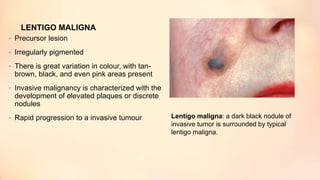
  • #67 Add: However, a heavy diffuse infiltrate of lymphocytes of the type seen in halo nevi is most unusual in a malignant melanoma. Macrophages are also present in the infiltrate.
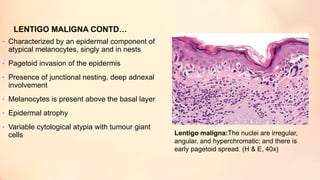
  • #68 Add: However, a heavy diffuse infiltrate of lymphocytes of the type seen in halo nevi is most unusual in a malignant melanoma. Macrophages are also present in the infiltrate. Granulomatous inflammation has also been described in regressing nevi with and without a depigmented halo
  • #69 The term ‘junctional nest disarray’ has been applied to the uneven distribution and pattern of the junctional component
  • #70 The term ‘junctional nest disarray’ has been applied to the uneven distribution and pattern of the junctional component
  • #71 Dermal dendrocytes are cells common to the mononuclear macrophage system and seen in immunologically associated inflammatory dermatoses
  • #73 Many interesting changes may be found in nevi.
  • #82 subtypes lentigo maligna, superficial spreading melanoma, and acral lentiginous melanoma. Melanomas in this phase are incapable of metastasis till growth factors comes to play e.g
  • #83 subtypes lentigo maligna, superficial spreading melanoma, and acral lentiginous melanoma. Melanomas in this phase are incapable of metastasis till growth factors comes to play e.g It may be difficult to assign a classification in about 5% of melanomas, because of overlap features.
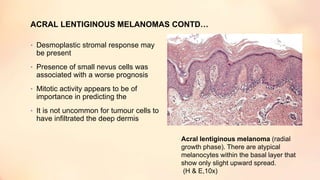
  • #84 Criteria for the diagnosis of malignant melanoma1616 are listed in Table 32.4.
  • #92 Mast cells are increased in this and other types of melanoma
  • #94 Invasive malignancy (vertical growth phase) Dermoscopy and confuse solar lentigo is or pigmented actinic keratosis with melanoma
  • #97 The epidermal component may look benign Stromal response: Osteosarcomatous change has been reported in the stroma
  • #99 lack BRAF mutations
  • #100 Desmoplastic melanoma can be regarded as a fibrosing variant of spindle-cell melanoma. Care must be taken not to misinterpret the S100-positive spindle cells found in scar tissue as desmoplastic melanoma and pure desmoplastic tumor is HMB 45 negative D/D dermatofibroma with a storiform appearance
  • #106 Breslow thickness
  • #107 If numerous melanophages are present, the term ‘nodular melanosis’ is used. This pattern is not exclusive to regressed melanomas Approximately 2% of patients with melanoma present with metastatic
  • #109 ELECTRON MICROSCOPY: Stage II melanosomes are considered the hallmark of malignant melanoma and melanin synthesis.
  • #113 The cells express the usual immunohistochemical markers of a malignant melanoma.