DEV PROJECT
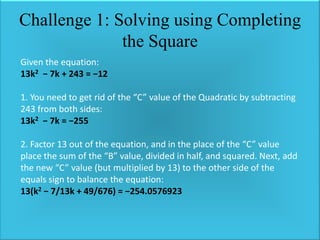
Challenge 1: Solving using Completing
the Square
Given the equation:
13k2 − 7k + 243 = −12
1. You need to get rid of the “C” value of the Quadratic by subtracting
243 from both sides:
13k2 − 7k = −255
2. Factor 13 out of the equation, and in the place of the “C” value
place the sum of the “B” value, divided in half, and squared. Next, add
the new “C” value (but multiplied by 13) to the other side of the
equals sign to balance the equation:
13(k2 − 7/13k + 49/676) = −254.0576923
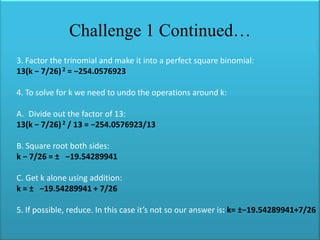
Challenge 1 Continued…
3. Factor the trinomial and make it into a perfect square binomial:
13(k − 7/26) 2 = −254.0576923
4. To solve for k we need to undo the operations around k:
A. Divide out the factor of 13:
13(k − 7/26) 2 / 13 = −254.0576923/13
B. Square root both sides:
k − 7/26 = ± −19.54289941
C. Get k alone using addition:
k = ± −19.54289941 + 7/26
5. If possible, reduce. In this case it’s not so our answer is: k= ±−19.54289941+7/26
Challenge 2: Factoring Polynomials
using Grouping
Given the equation:
126x3 − 42x2 − 72x + 252
1. Group the first two terms within parenthesis, and group the last two
terms within parenthesis:
(126x3 − 42x2) − (72x − 252)

NOTE: you factor out “-1” by grouping the last two terms, so flip the sign of “252”!

2. Factor out the greatest common factor (if possible). In this case it’s “3”:
3[(42x3 − 14x2) − (24x − 84)]
3. Factor out the greatest common factor from both sets of parenthesis:
3[7x2(6x − 2) −4(6x − 2)]
4. Since the “−4” and “7x2” are being acted on by the same “(6x − 2)” you
can write them in their own parenthesis, like so:
3(6x − 2)(7x2 − 4) Since you cant simplify further, you are done.
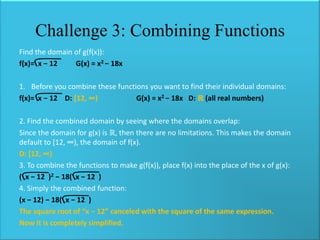
Challenge 3: Combining Functions
Find the domain of g(f(x)):
f(x)= x − 12
G(x) = x2 − 18x

1. Before you combine these functions you want to find their individual domains:
f(x)= x − 12 D: *12, ∞)
G(x) = x2 − 18x D: ℝ (all real numbers)
2. Find the combined domain by seeing where the domains overlap:
Since the domain for g(x) is ℝ, then there are no limitations. This makes the domain
default to [12, ∞), the domain of f(x).
D: *12, ∞)
3. To combine the functions to make g(f(x)), place f(x) into the place of the x of g(x):
( x − 12 )2 − 18( x − 12 )
4. Simply the combined function:
(x − 12) − 18( x − 12 )
The square root of “x − 12” canceled with the square of the same expression.
Now it is completely simplified.
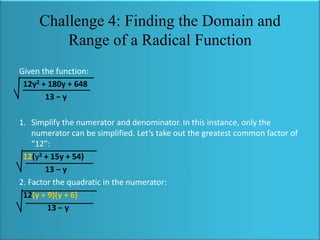
Challenge 4: Finding the Domain and
Range of a Radical Function
Given the function:
12y2 + 180y + 648
13 − y
1. Simplify the numerator and denominator. In this instance, only the
numerator can be simplified. Let’s take out the greatest common factor of
“12”:
12(y2 + 15y + 54)
13 − y
2. Factor the quadratic in the numerator:
12(y + 9)(y + 6)
13 − y
Challenge 4 Continued…
3. Now that the numerator and denominator are simplified, we can find the domain of each:
Given that the domain of the numerator and denominator would be all real numbers (ℝ) if they
were alone, the domain will have to abide by the rules of the enveloping operations:
The expression under the radical has to be greater to, or equal to, zero, and the denominator of a
rational has to be greater than, or less than, zero.
With these rules in mind, this means that the “y”s in the numerator have to be numbers that
make the numerator GREATER TO OR EQUAL to zero, while the “y”s in the denominator have to
be number(s) that make the denominator GREATER than zero.

The domain of the numerator would be D: (- ∞, -9]u[-6, ∞)
because -9 + 9 = 0
& -6 + 6 = 0
The domain of the denominator would be D: *13, ∞)
Because 13 − 13 = 0
4. Combine the domains with the rules in mind:
D: (- ∞, -9]u[-6, 13)u(13, ∞)

DEV Project

  • 1.
  • 2.
    Challenge 1: Solvingusing Completing the Square Given the equation: 13k2 − 7k + 243 = −12 1. You need to get rid of the “C” value of the Quadratic by subtracting 243 from both sides: 13k2 − 7k = −255 2. Factor 13 out of the equation, and in the place of the “C” value place the sum of the “B” value, divided in half, and squared. Next, add the new “C” value (but multiplied by 13) to the other side of the equals sign to balance the equation: 13(k2 − 7/13k + 49/676) = −254.0576923
  • 3.
    Challenge 1 Continued… 3.Factor the trinomial and make it into a perfect square binomial: 13(k − 7/26) 2 = −254.0576923 4. To solve for k we need to undo the operations around k: A. Divide out the factor of 13: 13(k − 7/26) 2 / 13 = −254.0576923/13 B. Square root both sides: k − 7/26 = ± −19.54289941 C. Get k alone using addition: k = ± −19.54289941 + 7/26 5. If possible, reduce. In this case it’s not so our answer is: k= ±−19.54289941+7/26
  • 4.
    Challenge 2: FactoringPolynomials using Grouping Given the equation: 126x3 − 42x2 − 72x + 252 1. Group the first two terms within parenthesis, and group the last two terms within parenthesis: (126x3 − 42x2) − (72x − 252) NOTE: you factor out “-1” by grouping the last two terms, so flip the sign of “252”! 2. Factor out the greatest common factor (if possible). In this case it’s “3”: 3[(42x3 − 14x2) − (24x − 84)] 3. Factor out the greatest common factor from both sets of parenthesis: 3[7x2(6x − 2) −4(6x − 2)] 4. Since the “−4” and “7x2” are being acted on by the same “(6x − 2)” you can write them in their own parenthesis, like so: 3(6x − 2)(7x2 − 4) Since you cant simplify further, you are done.
  • 5.
    Challenge 3: CombiningFunctions Find the domain of g(f(x)): f(x)= x − 12 G(x) = x2 − 18x 1. Before you combine these functions you want to find their individual domains: f(x)= x − 12 D: *12, ∞) G(x) = x2 − 18x D: ℝ (all real numbers) 2. Find the combined domain by seeing where the domains overlap: Since the domain for g(x) is ℝ, then there are no limitations. This makes the domain default to [12, ∞), the domain of f(x). D: *12, ∞) 3. To combine the functions to make g(f(x)), place f(x) into the place of the x of g(x): ( x − 12 )2 − 18( x − 12 ) 4. Simply the combined function: (x − 12) − 18( x − 12 ) The square root of “x − 12” canceled with the square of the same expression. Now it is completely simplified.
  • 6.
    Challenge 4: Findingthe Domain and Range of a Radical Function Given the function: 12y2 + 180y + 648 13 − y 1. Simplify the numerator and denominator. In this instance, only the numerator can be simplified. Let’s take out the greatest common factor of “12”: 12(y2 + 15y + 54) 13 − y 2. Factor the quadratic in the numerator: 12(y + 9)(y + 6) 13 − y
  • 7.
    Challenge 4 Continued… 3.Now that the numerator and denominator are simplified, we can find the domain of each: Given that the domain of the numerator and denominator would be all real numbers (ℝ) if they were alone, the domain will have to abide by the rules of the enveloping operations: The expression under the radical has to be greater to, or equal to, zero, and the denominator of a rational has to be greater than, or less than, zero. With these rules in mind, this means that the “y”s in the numerator have to be numbers that make the numerator GREATER TO OR EQUAL to zero, while the “y”s in the denominator have to be number(s) that make the denominator GREATER than zero. The domain of the numerator would be D: (- ∞, -9]u[-6, ∞) because -9 + 9 = 0 & -6 + 6 = 0 The domain of the denominator would be D: *13, ∞) Because 13 − 13 = 0 4. Combine the domains with the rules in mind: D: (- ∞, -9]u[-6, 13)u(13, ∞)