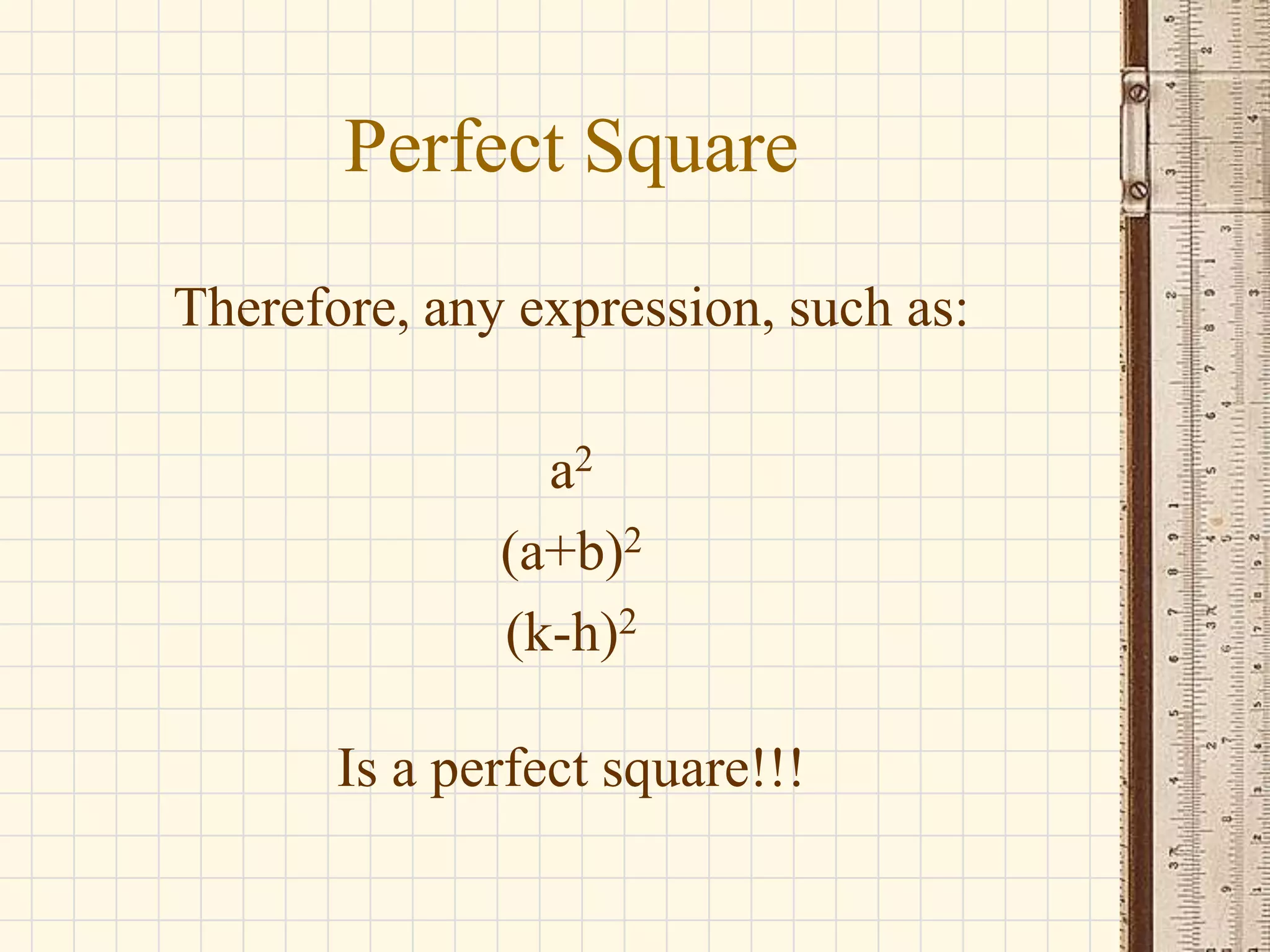
This document discusses perfect squares and the difference of two squares. It defines a perfect square as a number that can be expressed as a square, such as 9, 16, or 81. Any expression of the form a^2, (a+b)^2, or (k-h)^2 is also a perfect square. Perfect squares are helpful for expanding and factorizing expressions. For example, (c+d)^2 = c^2 + 2cd + d^2. The document also discusses how to find the area of a square when one side is increased by some amount b, using the formula (a+b)^2 = a^2 + 2ab + b^2. It concludes by explaining that
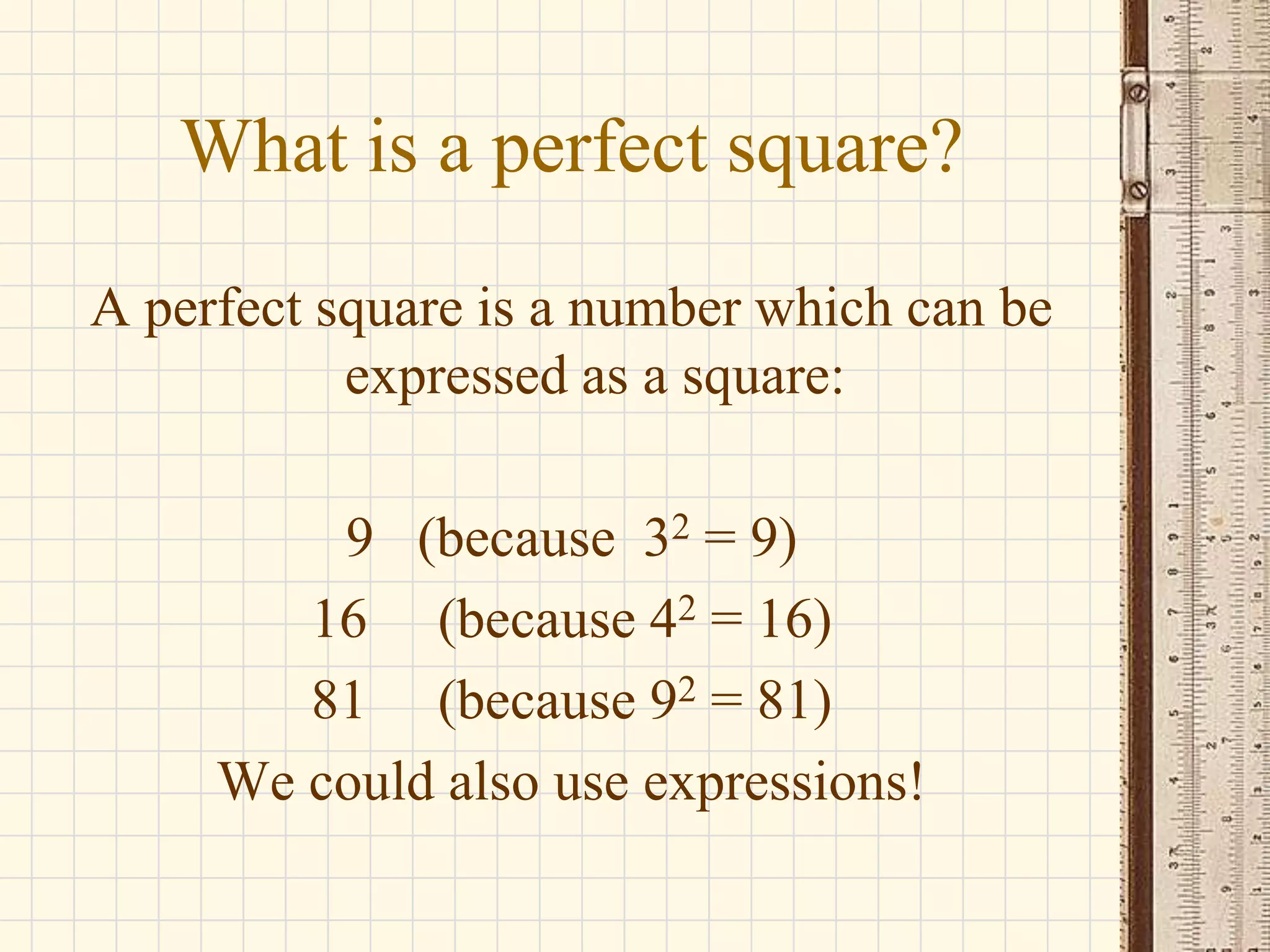
What is aperfect square?
A perfect square is a number which can be
expressed as a square:
9 (because 32 = 9)
16 (because 42 = 16)
81 (because 92 = 81)
We could also use expressions!
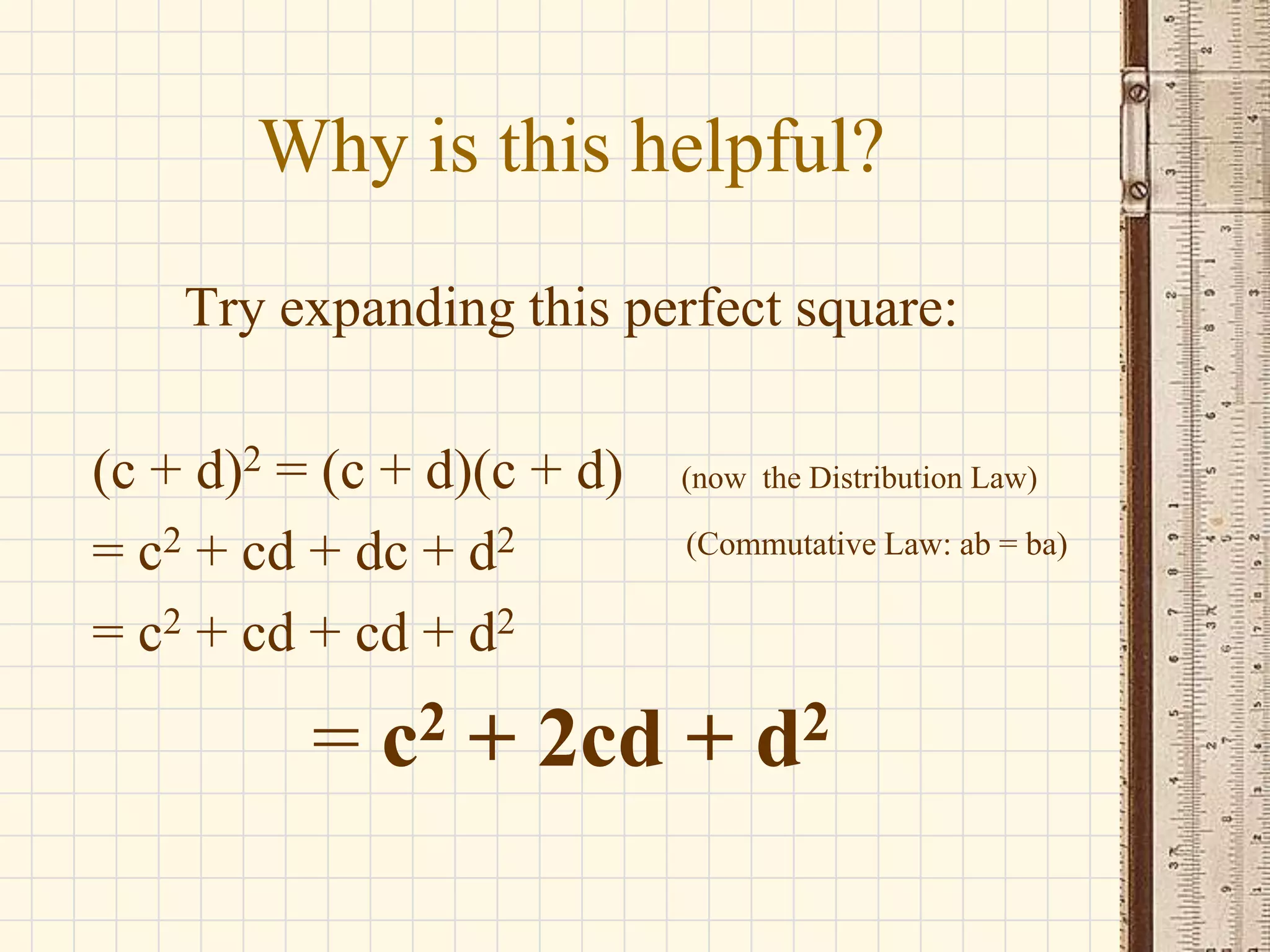
Why is thishelpful?
Try expanding this perfect square:
(c + d)2 = (c + d)(c + d)
= c2 + cd + dc + d2
= c2 + cd + cd + d2
=
2
c
(now the Distribution Law)
(Commutative Law: ab = ba)
+ 2cd +
2
d
2
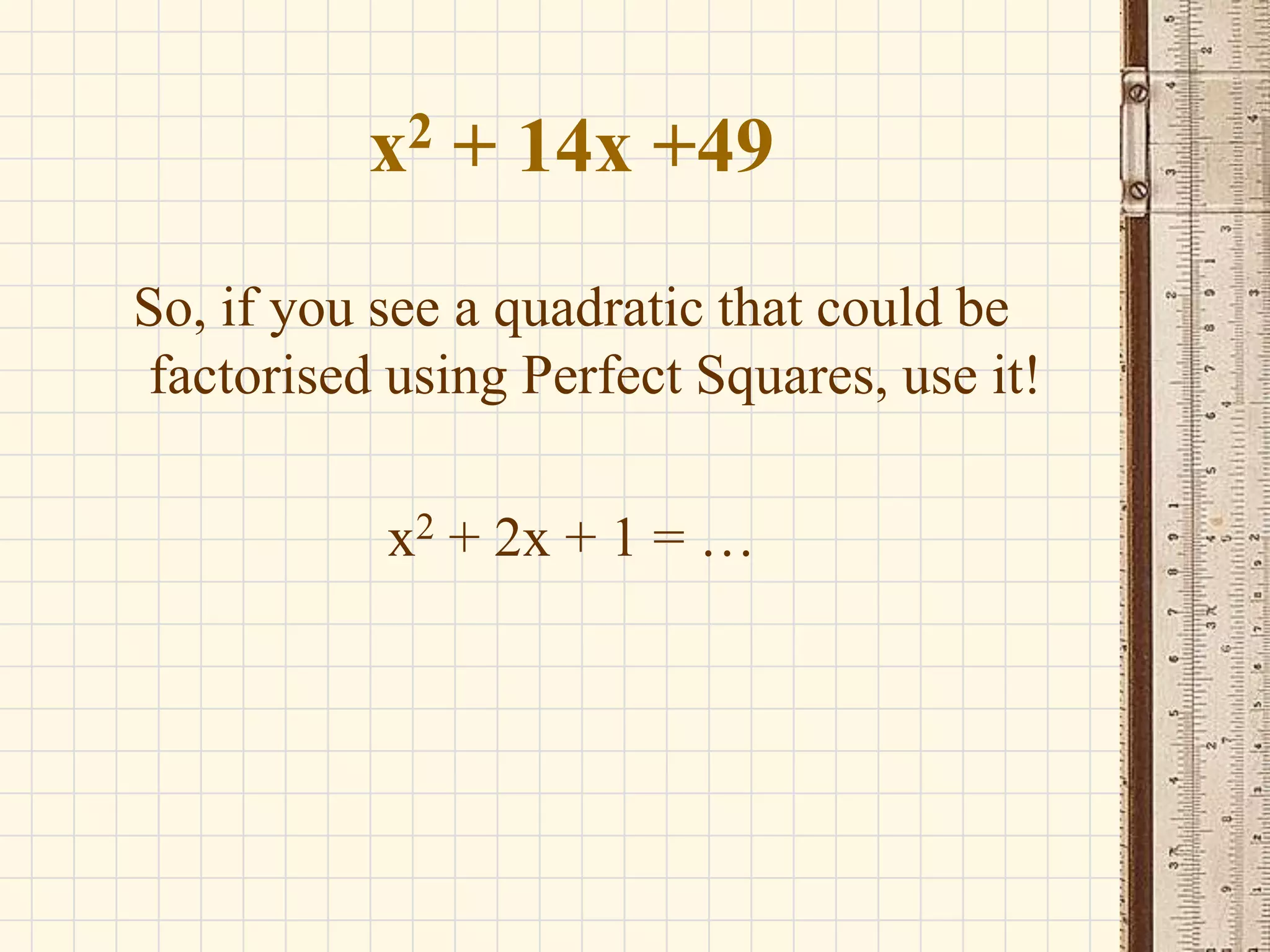
x
+ 14x +49
So,if you see a quadratic that could be
factorised using Perfect Squares, use it!
x2 + 2x + 1 = …
8.
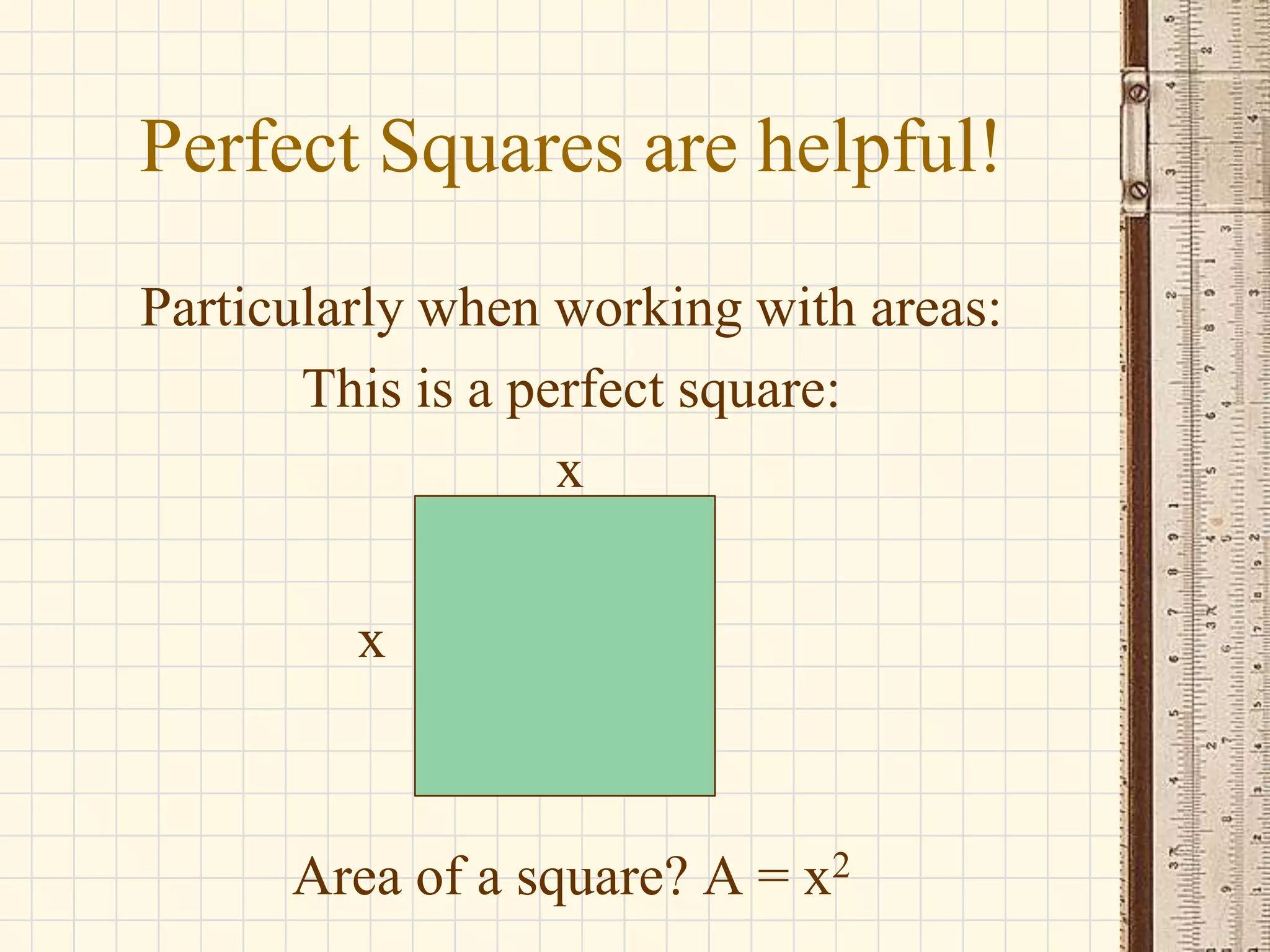
Perfect Squares arehelpful!
Particularly when working with areas:
This is a perfect square:
x
x
Area of a square? A = x2
9.
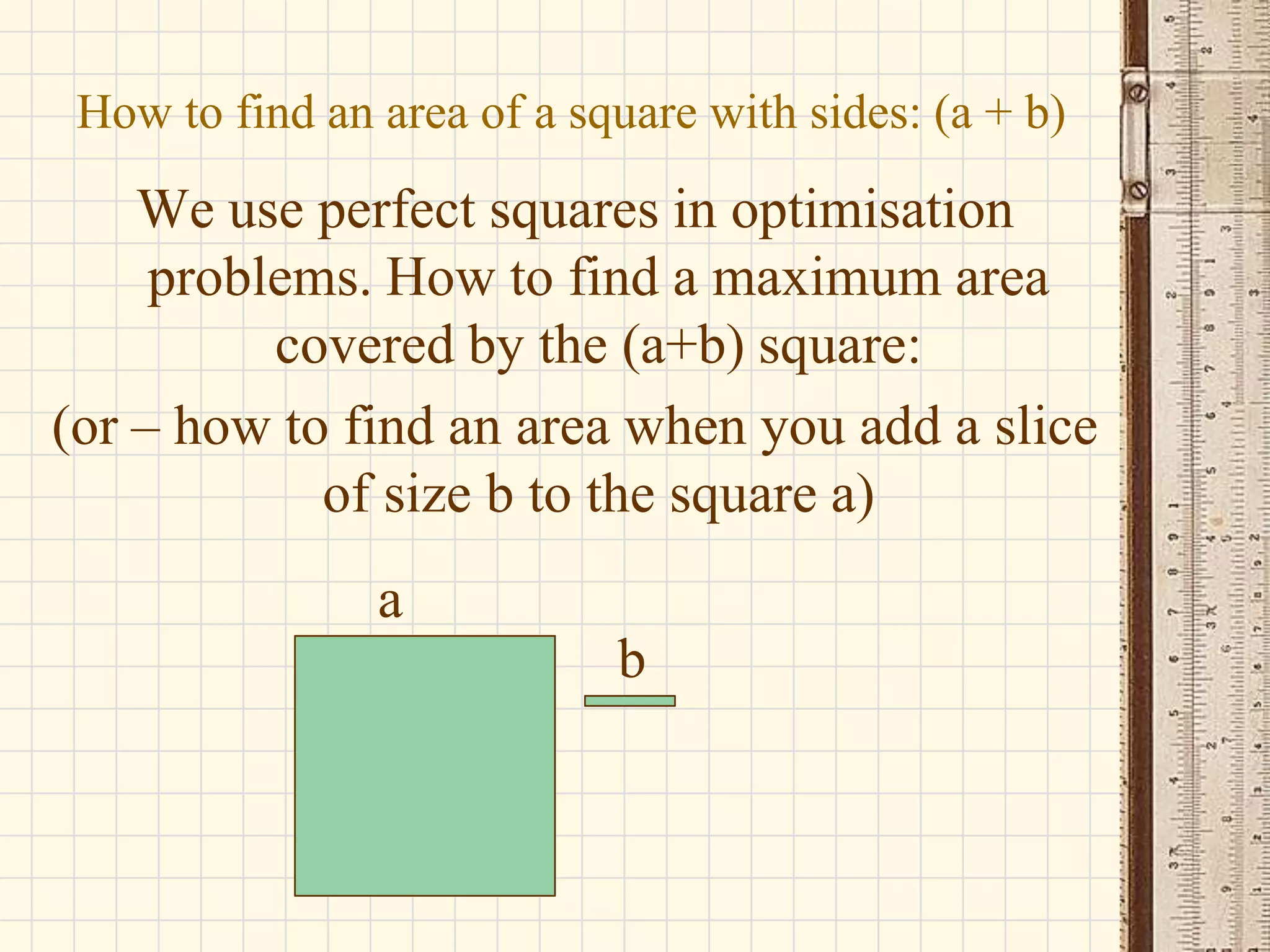
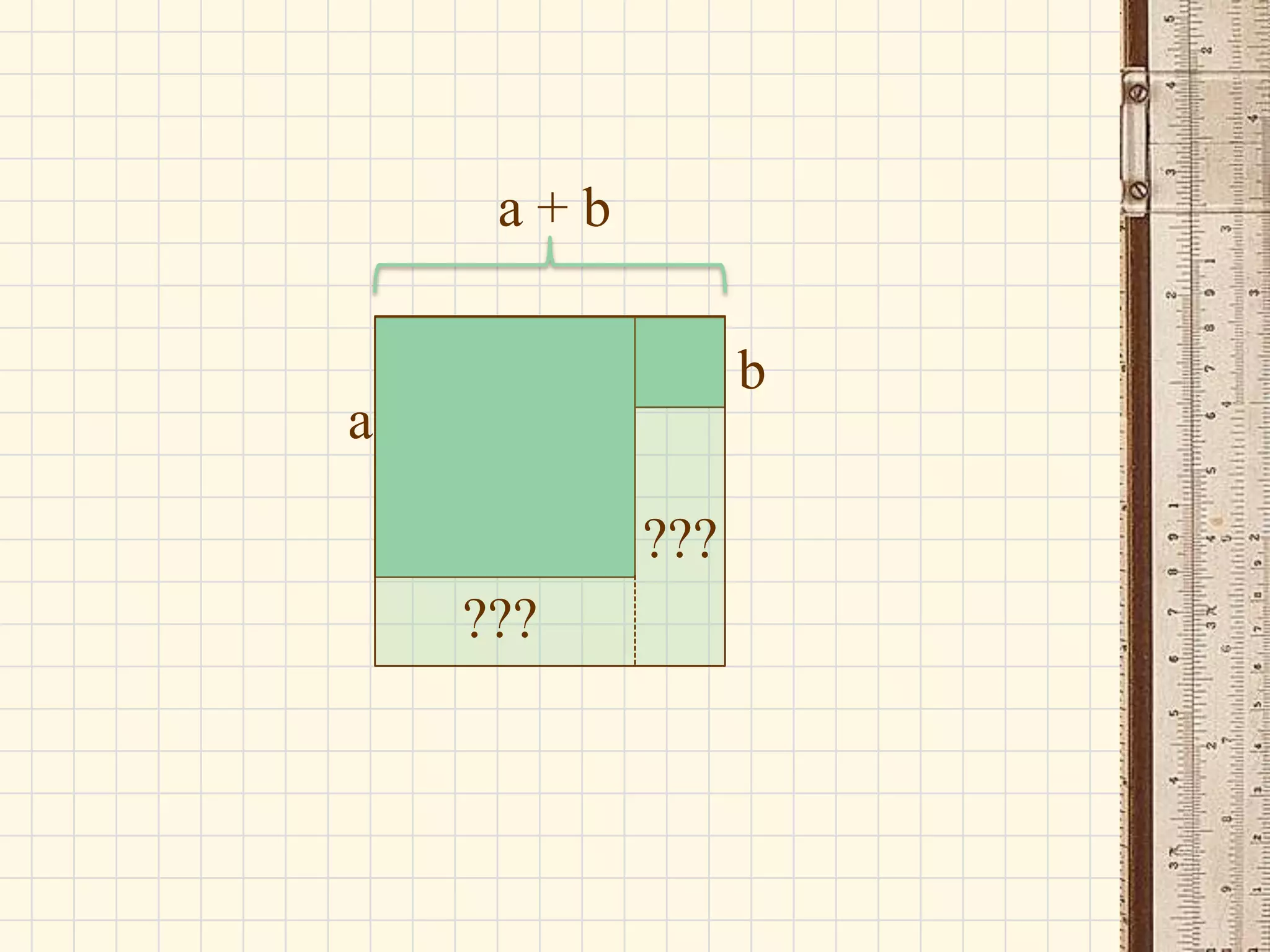
How to findan area of a square with sides: (a + b)
We use perfect squares in optimisation
problems. How to find a maximum area
covered by the (a+b) square:
(or – how to find an area when you add a slice
of size b to the square a)
a
b
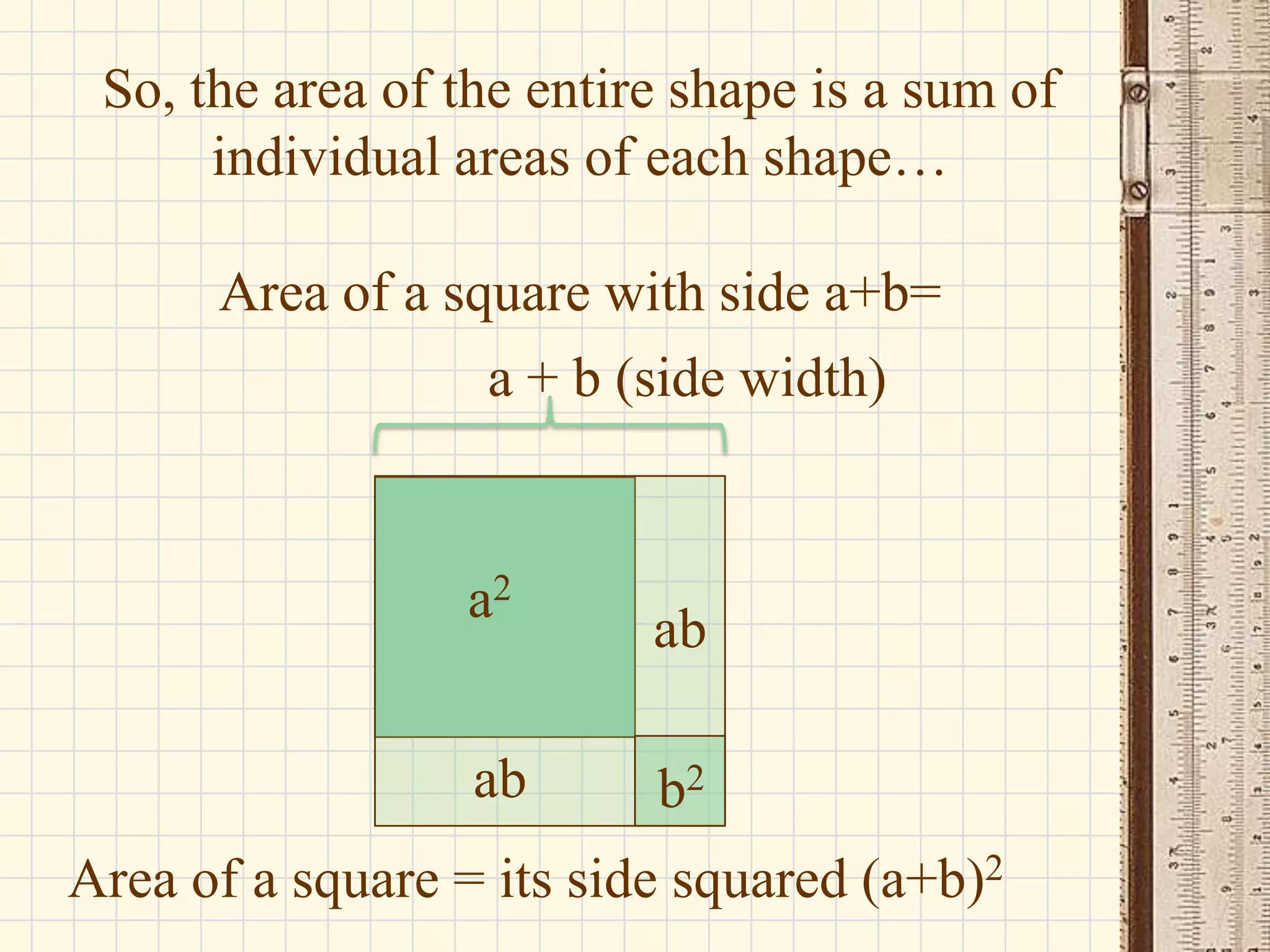
So, the areaof the entire shape is a sum of
individual areas of each shape…
Area of a square with side a+b=
a + b (side width)
a2
ab
ab
b2
Area of a square = its side squared (a+b)2
12.
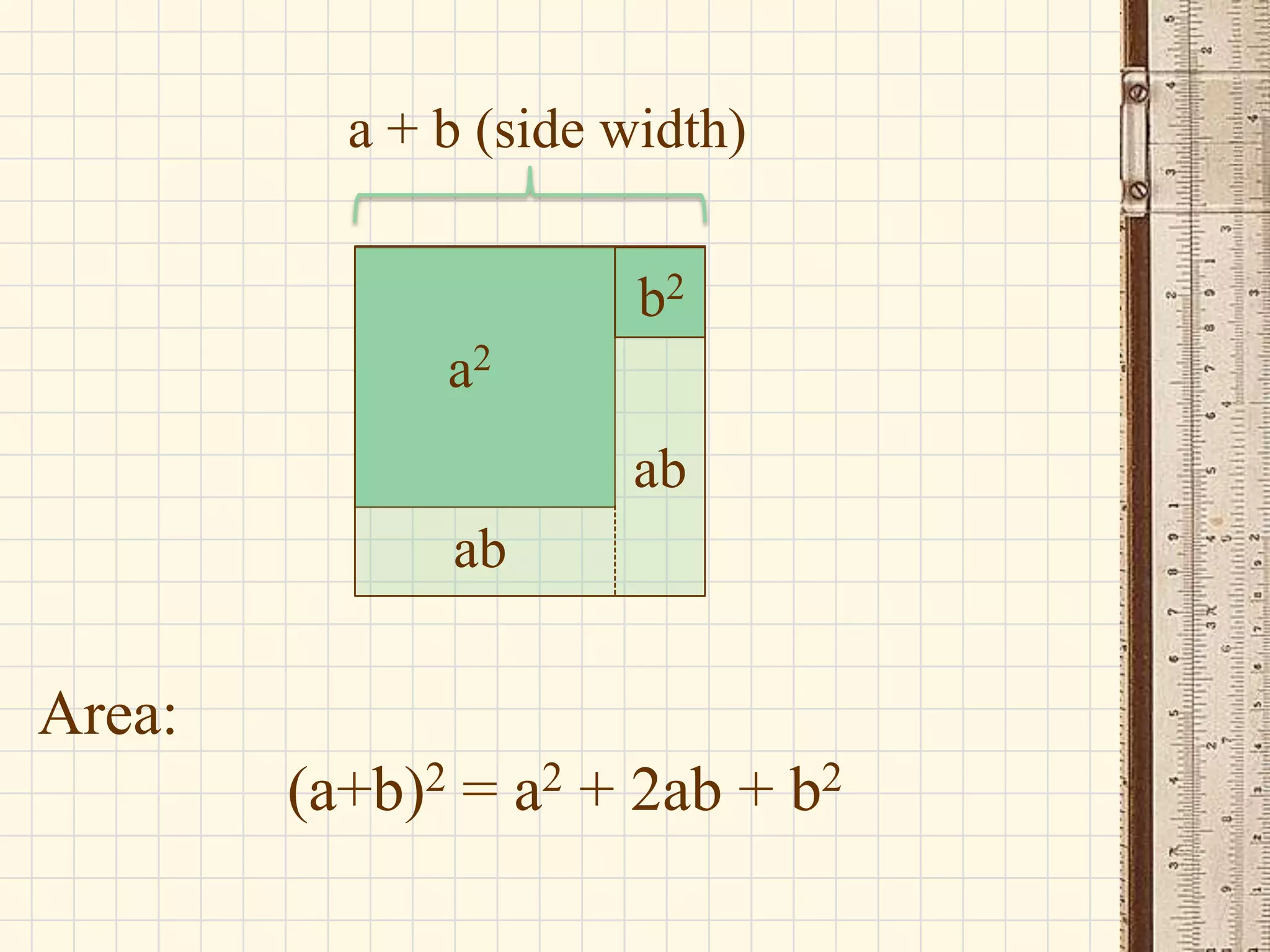
a + b(side width)
b2
a2
ab
ab
Area:
(a+b)2 = a2 + 2ab + b2
13.
2
(a+b)
=
2
a
+ 2ab +
2
b
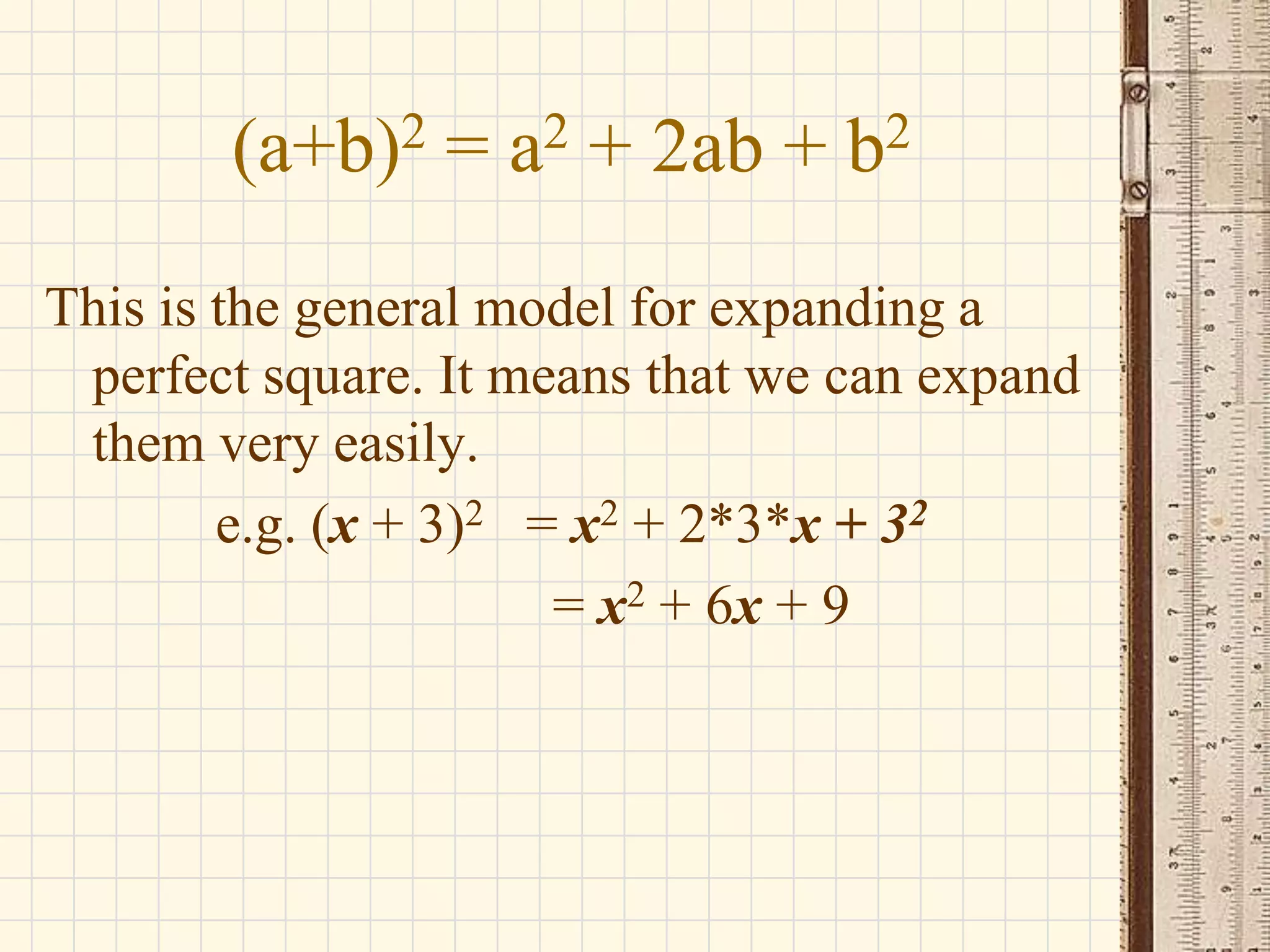
Thisis the general model for expanding a
perfect square. It means that we can expand
them very easily.
e.g. (x + 3)2 = x2 + 2*3*x + 32
= x2 + 6x + 9
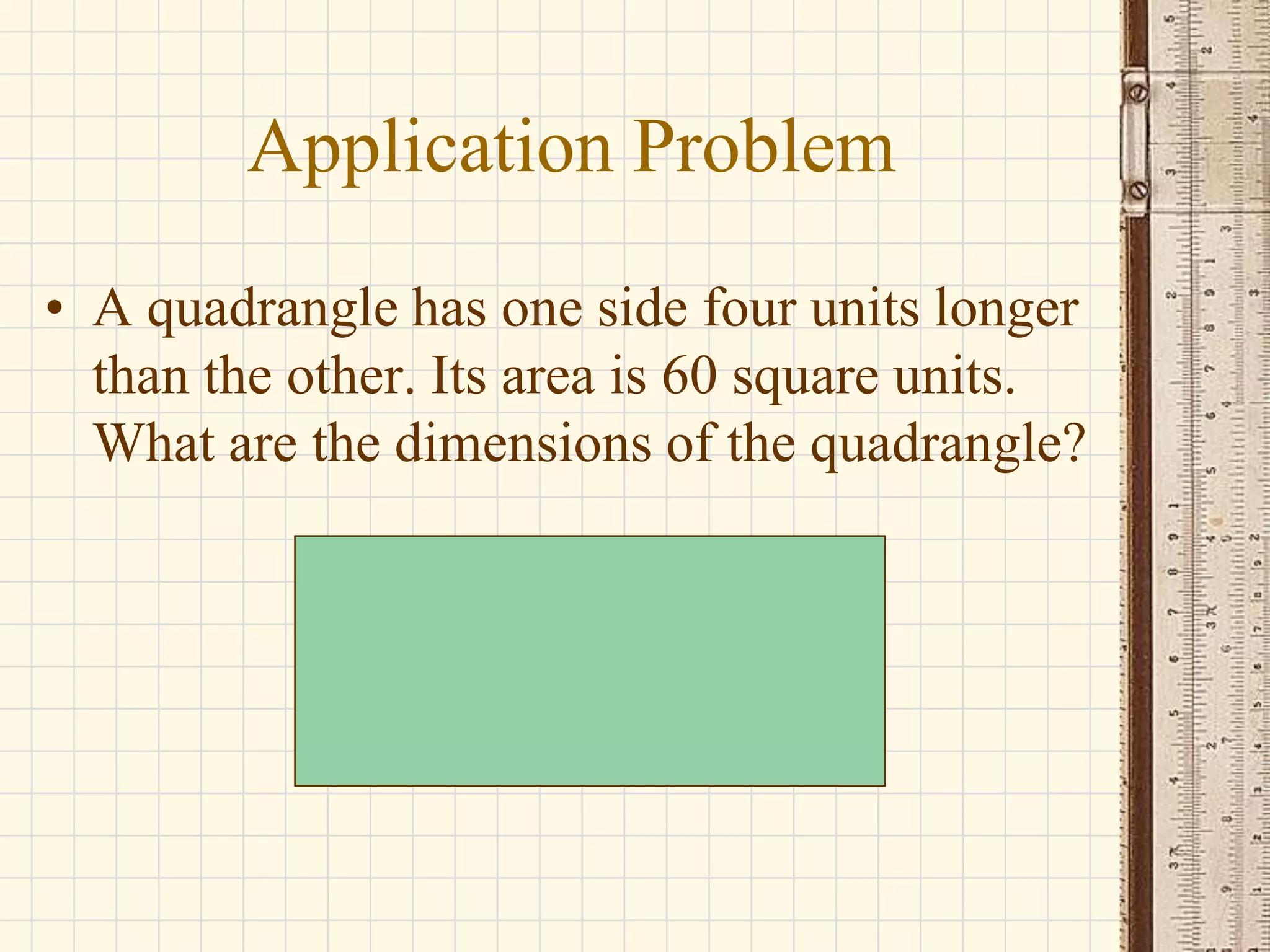
Application Problem
• Aquadrangle has one side four units longer
than the other. Its area is 60 square units.
What are the dimensions of the quadrangle?
16.
If we denotethe length of one side of the
quadrangle as x units, then the other
must be x + 4 units in length.
We must solve the equation: x *( x+4) =
60, which is equivalent to solving the
quadratic equation:
x2 + 4x -60 = 0
17.
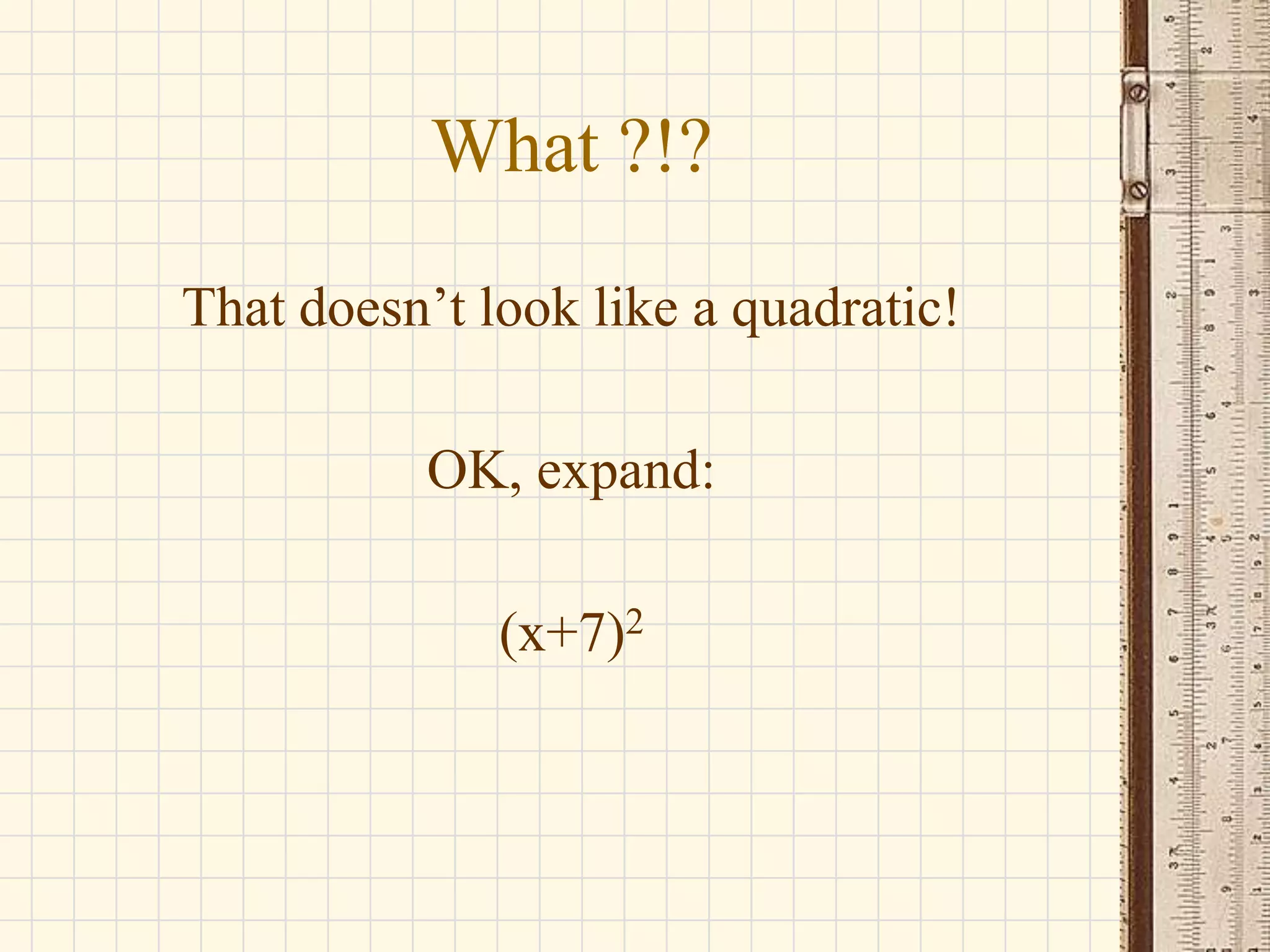
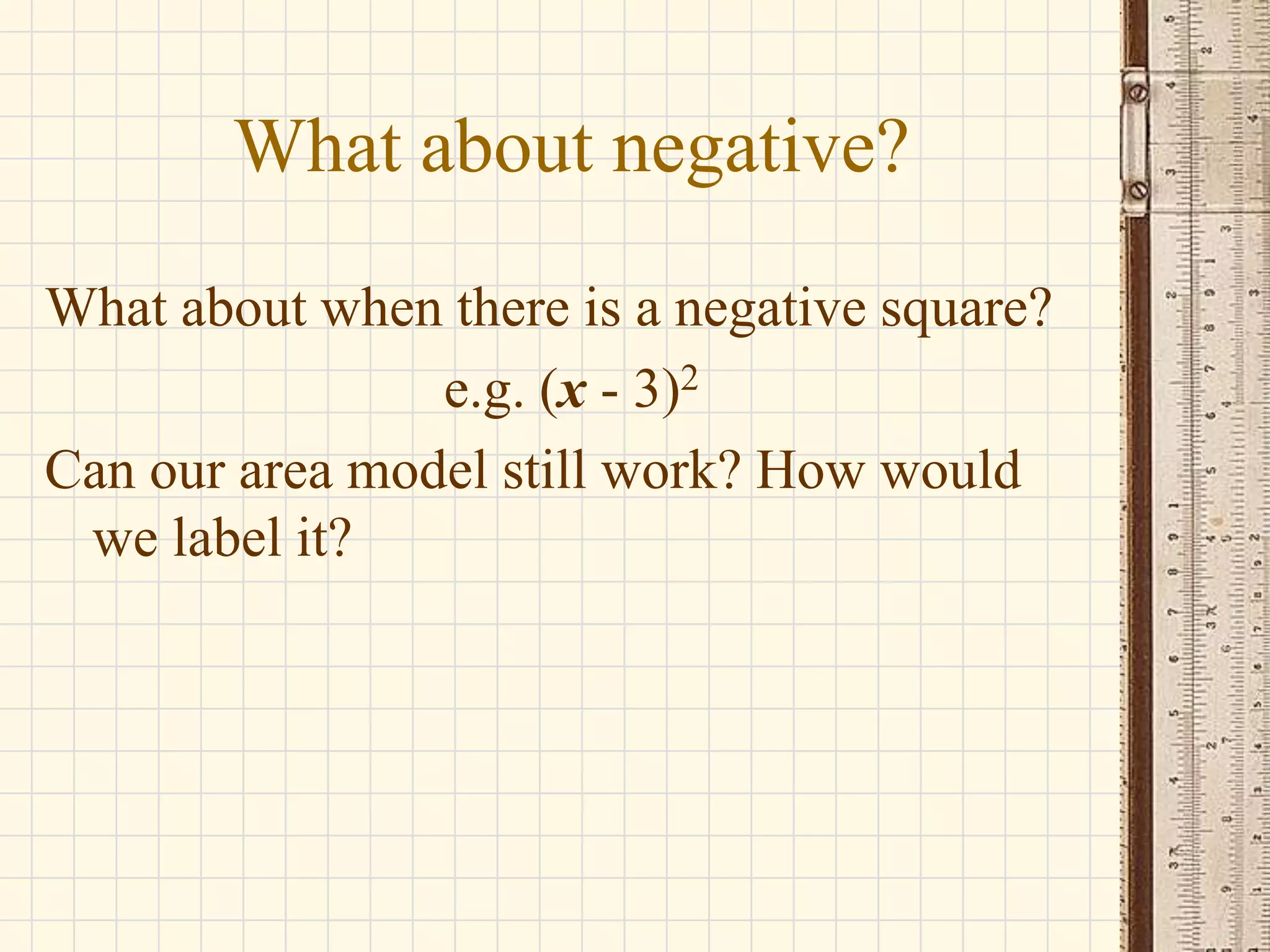
What about negative?
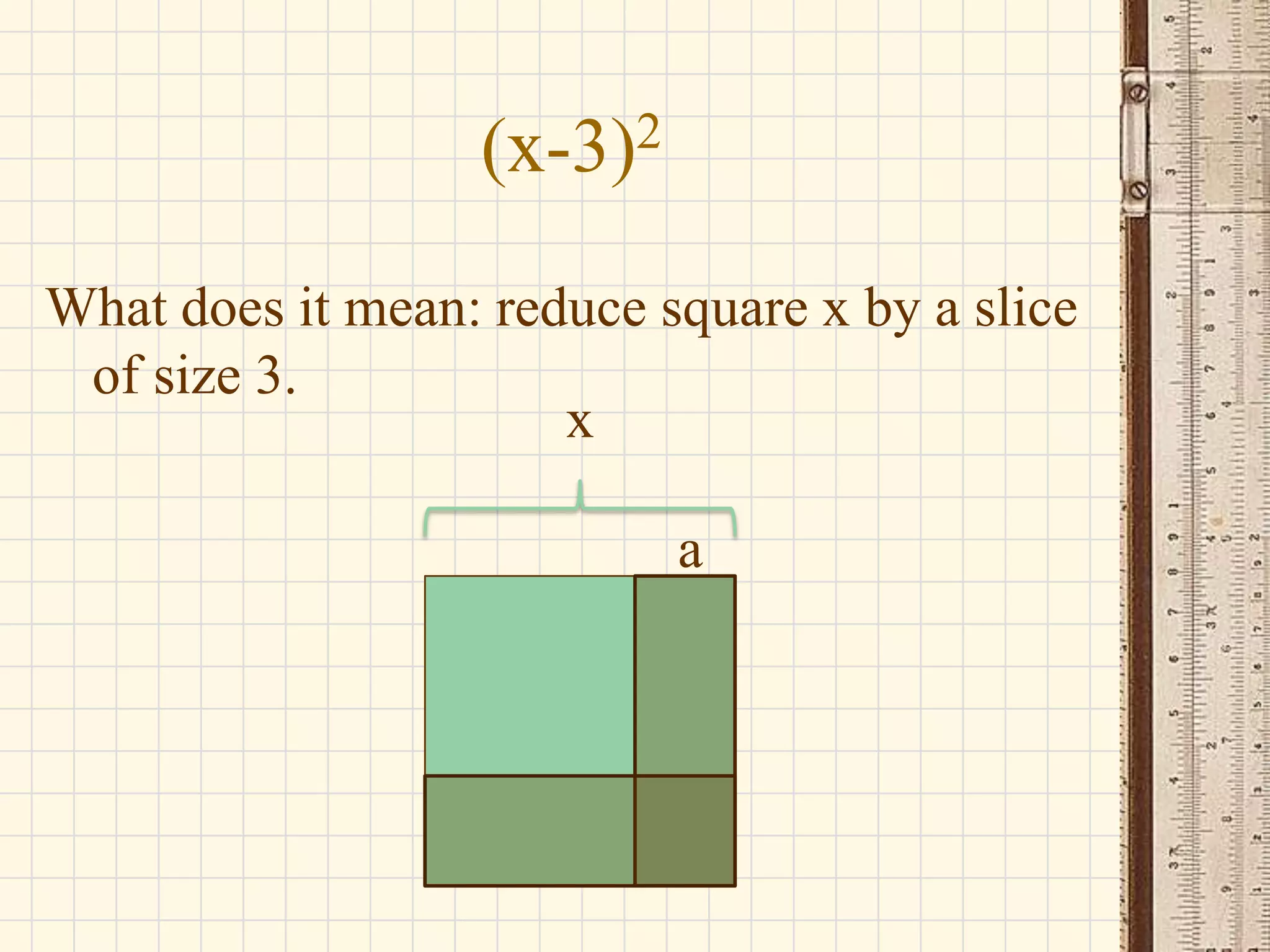
Whatabout when there is a negative square?
e.g. (x - 3)2
Can our area model still work? How would
we label it?



![Vibe Coding vs. Spec-Driven Development [Free Meetup]](https://cdn.slidesharecdn.com/ss_thumbnails/vibecodingvsspecdrivendevelopment-251209105622-43f455e7-thumbnail.jpg?width=640&height=640&fit=bounds)


