BIOE 3200 -Fall 2015
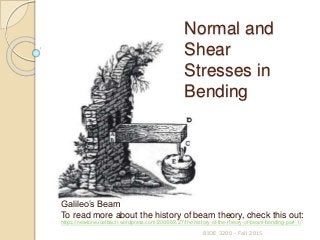
Galileo’s Beam
To read more about the history of beam theory, check this out:
https://newtonexcelbach.wordpress.com/2008/02/27/the-history-of-the-theory-of-beam-bending-part-1/
Normal and
Shear
Stresses in
Bending
Normal Stresses inBeams
BIOE 3200 - Fall 2015
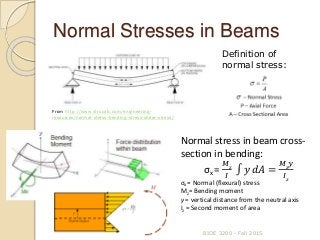
From http://www.strucalc.com/engineering-
resources/normal-stress-bending-stress-shear-stress/
Normal stress in beam cross-
section in bending:
σx =
𝑀 𝑧
𝐼
𝑦 𝑑𝐴 =
𝑀 𝑧
𝑦
𝐼 𝑧
σx = Normal (flexural) stress
Mz= Bending moment
y = vertical distance from the neutral axis
Iz = Second moment of area
Definition of
normal stress:
5.
Shear Stresses inBeams
BIOE 3200 - Fall 2015
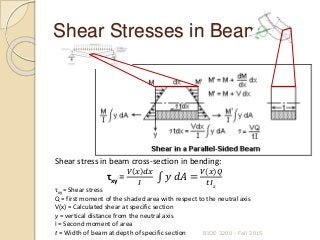
Shear stress in beam cross-section in bending:
τxy =
𝑉 𝑥 𝑑𝑥
𝐼
𝑦 𝑑𝐴 =
𝑉(𝑥)𝑄
𝑡𝐼 𝑧
τxy = Shear stress
Q = first moment of the shaded area with respect to the neutral axis
V(x) = Calculated shear at specific section
y = vertical distance from the neutral axis
I = Second moment of area
t = Width of beam at depth of specific section
6.
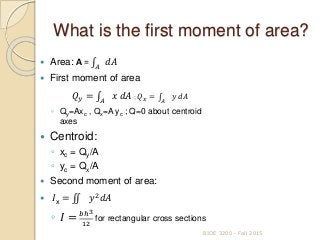
What is thefirst moment of area?
Area: A = 𝐴
𝑑𝐴
First moment of area
𝑄 𝑦 = 𝐴
𝑥 𝑑𝐴 ; 𝑄 𝑥 = 𝐴
𝑦 𝑑𝐴
◦ Qy=Axc , Qx=A yc ; Q=0 about centroid
axes
Centroid:
◦ xc = Qy/A
◦ yc = Qx/A
Second moment of area:
𝐼x = 𝑦2
𝑑𝐴
◦ 𝐼 = 𝑏ℎ3
12
for rectangular cross sections
BIOE 3200 - Fall 2015
7.
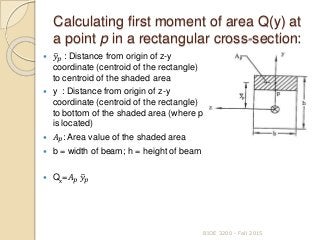
Calculating first momentof area Q(y) at
a point p in a rectangular cross-section:
𝑦𝑝 : Distance from origin of z-y
coordinate (centroid of the rectangle)
to centroid of the shaded area
y : Distance from origin of z-y
coordinate (centroid of the rectangle)
to bottom of the shaded area (where p
is located)
𝐴 𝑝: Area value of the shaded area
b = width of beam; h = height of beam
Qx=𝐴 𝑝 𝑦𝑝
BIOE 3200 - Fall 2015
Editor's Notes
#5 σx balances moment Mz across cross section of beam
#6 Shear stress balances shear force across cross section of beam
#7 Just as the moment of force is force times distance from an axis, the moment of area is area times the distance from an axis.
The point at which mass is concentrated is called the center of gravity.
The point at which area is concentrated is called the centroid.
If area is a flat thin slice of a mass, the centroid is then at the same place as the center
of gravity. This point is where you could balance the thin sheet on a sharp point and it would not tip off in any direction.
#8 Full explanation of how to calculate Q shown in text on pp. 218 – 219, Example 5.4.