SSC-411,4(0+4) : Village Attachment
DEPARTMENT OF HORTICULTURE,
INSTITUTE OF AGRICULTURAL SCIENCES,
RAJIV GANDHI SOUTH CAMPUS,
BANARAS HINDU UNIVERSITY,
BARKACHHA,MIRZAPUR
 Water is retained by the soil-particles(on their surfaces) especially
colloidal particles and the pore spaces by the force of adhesion and
cohesion.
 Such water present in the soil and is called as soil-water.
Classification of Soil Water
Gravitational water
Capillary water
Hygroscopic water
Physical classification Biological classification
Available water
Unavailable water
Super available water
(Drainage water)
Water contents present in soil under certain standard
conditions
represents definite soil moisture relationship and retention
of soil moisture in the field.
The soil moisture tension is measured with
“TENSIOMETER”
Soil Water Content Soil Moisture Content
 While studying soil water and discussing its availability or other
wise to plant, some specific terms called as soil moisture
constants are used and they are as follows :
 Maximum water holding
capacity
Field capacity
Maximum Capillary capacity
Moisture equivalents
Permanent wilting point
Hygroscopic coefficient
Available soil-moisture
Air capacity
Total pore volume
Continued.
.
I. Field Capacity (FC or 0fc):It is the non-saturated but still very wet soil condition
where gravity drainage becomes negligible and only micropores retain water.
 Factors affecting FC :
a.)Soil-texture b.)soil structure c.)type of clay d.)organic matter content
e.)soil-compaction f.) Impedition layer
Table : Influence of three soil textures on soil moisture constants
I. Permanent Wilting point (WP or 0wp ): Also known as “wilting coefficient”. It
is the soil moisture content at which the plants can no longer be able to meet their
transpiration requirement, become water-stressed .There is still some water in the
soil but not enough to be used by the plants. WP is of two types :
• Temporary wilting point.
• Ultimate wilting point
FACTORS AFFECTING PWP
Soil properties Plant properties
Soil texture
&
structure
Types of clay Organic matter content
SATURATION FIELD CAPACITY WILTING POINT
100% Moisture in soil
pores (both macro and
micro)
When water is no longer
drained by gravity
When plants have
extracted as much water
as they can
Capillarity and surface attraction combine to
pull more strongly than gravity on:
1) water in “micropores” and
2) water close to the “soil skin”
Fig. : Diagrammatic representation of saturation, field capacity and wilting point
Plant available water
Gravitational water
(Drainable)
10-30micron
Oven-dry
Air-dry
Wilting point Field capacity Saturation
Unavailable water
~0.2micron
Hygroscopic coefficient
-10000
bar
-1000
bar
-31 bar -15 bar -0.33bar -0.00 bar
Capillary waterHygroscopic
water
Increasing soil water constants
Increasing water potential
*-1000 bar to -300 bar depending on humidity
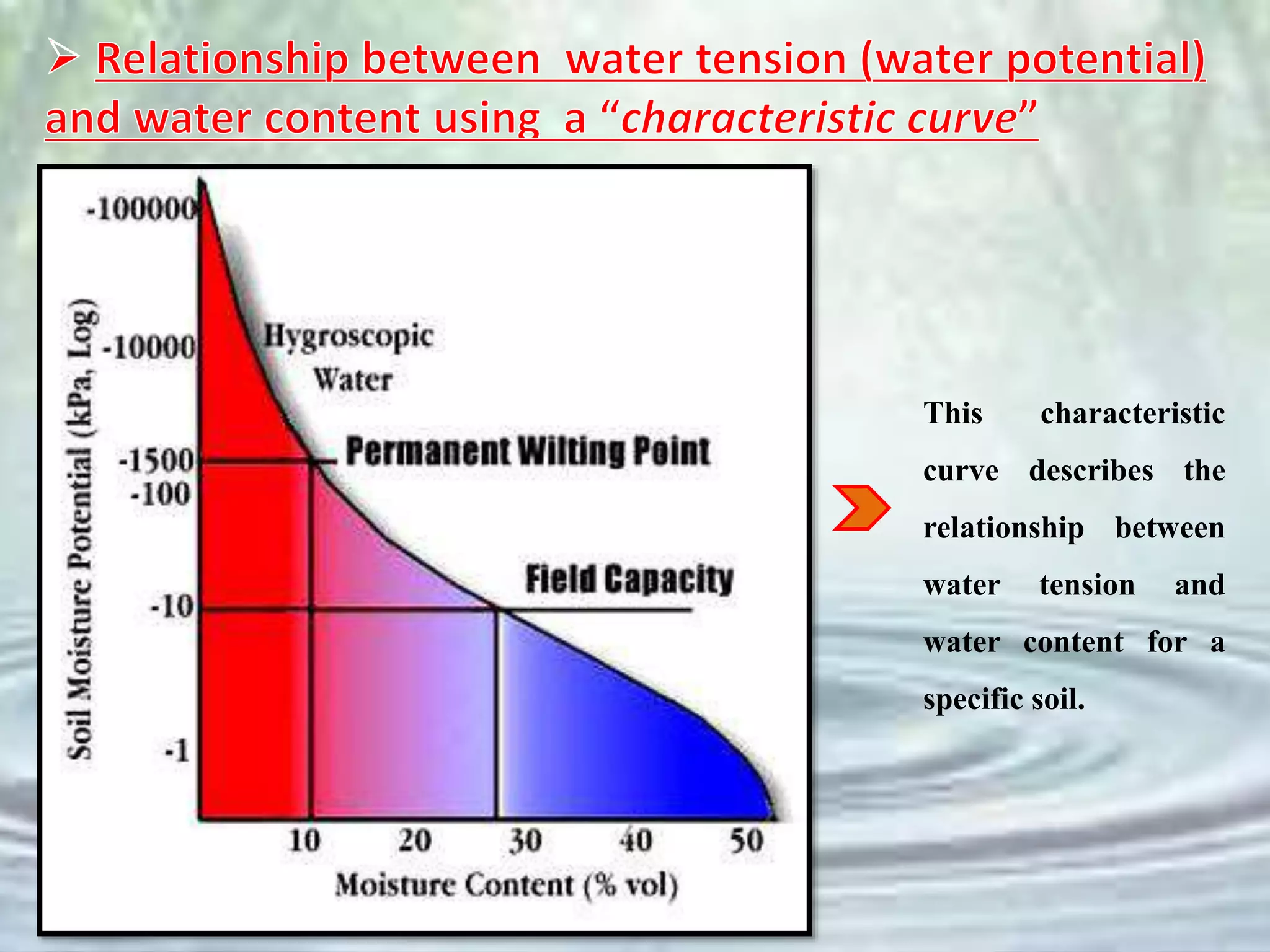
This characteristic
curve describes the
relationship between
water tension and
water content for a
specific soil.
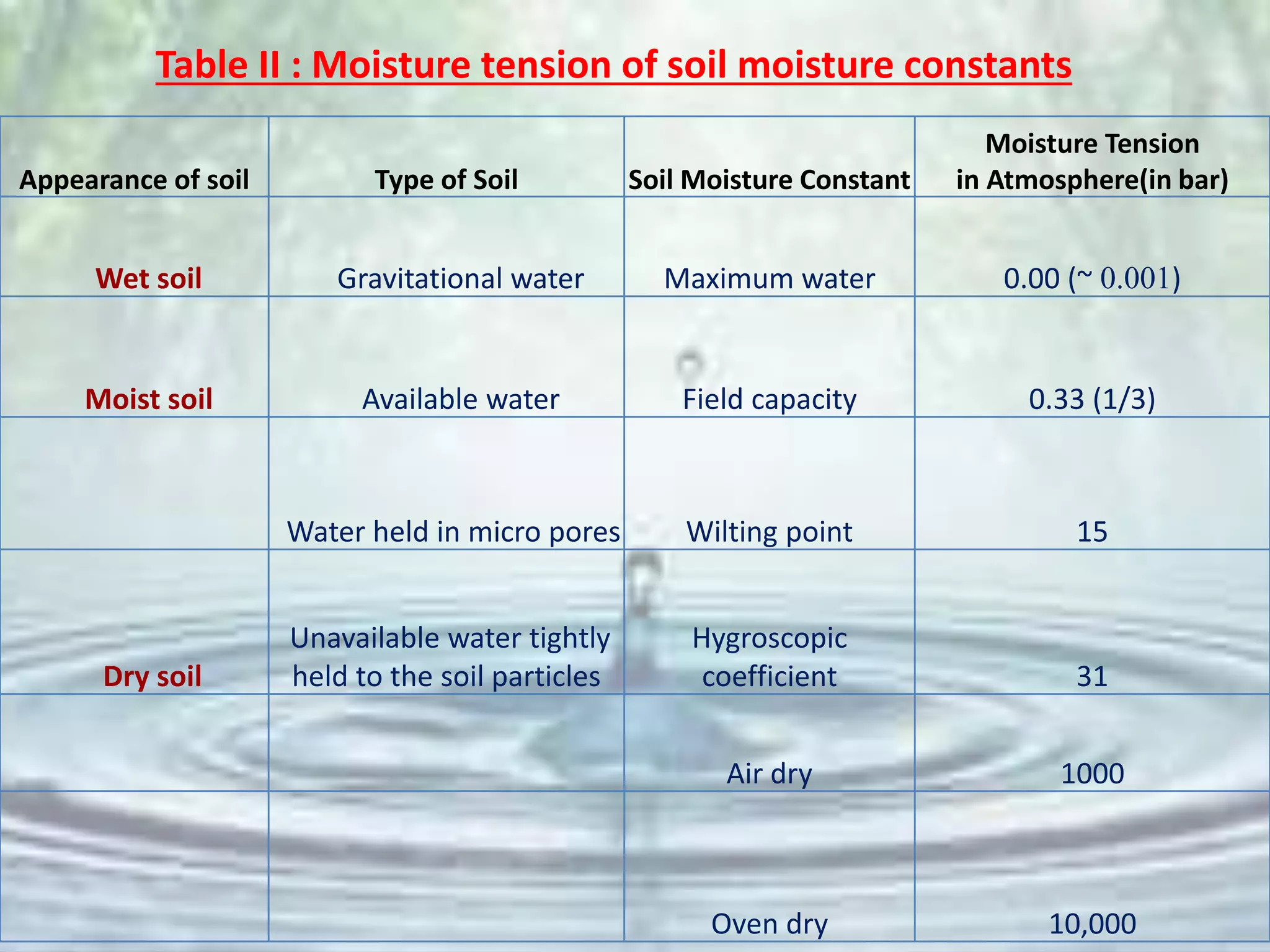
Appearance of soil Type of Soil Soil Moisture Constant
Moisture Tension
in Atmosphere(in bar)
Wet soil Gravitational water Maximum water 0.00 (~ 0.001)
Moist soil Available water Field capacity 0.33 (1/3)
Water held in micro pores Wilting point 15
Dry soil
Unavailable water tightly
held to the soil particles
Hygroscopic
coefficient 31
Air dry 1000
Oven dry 10,000
Table II : Moisture tension of soil moisture constants
Saturated flow Unsaturated flow Water-vapour movement
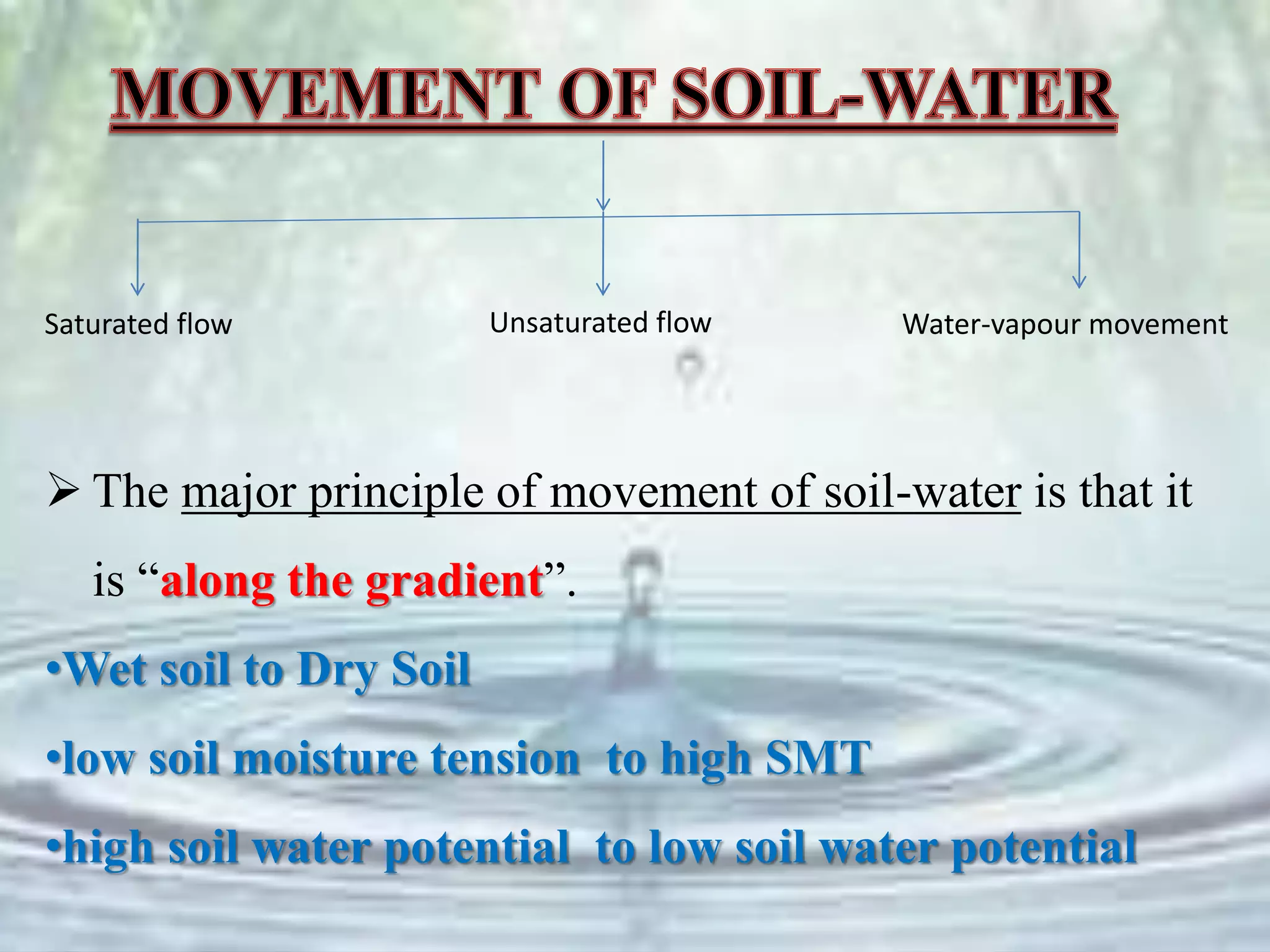
 The major principle of movement of soil-water is that it
is “along the gradient”.
•Wet soil to Dry Soil
•low soil moisture tension to high SMT
•high soil water potential to low soil water potential
• water move in the macropores since all of the pores are filled.
• Saturated flow is water flow caused by gravity’s pull.
• This water moves at water potentials larger than – 33 kPa.
• Factors affecting saturated flow :
1. Texture
2. Structure
3. Amount of organic matter
4. Temperature
5. Depth of soil to hard pan
6. Pressure
7. Amount of water in the soil
Saturated flow due
to gravity
•Macropores full of air
•Micropores = water + air
•Moisture tension gradient creates unsaturated flow
•It is flow of water held with water potentials < -1/3 bar.
•Factors Affecting the Unsaturated Flow
i. Nature of soil
i. Soil moisture content : The higher the percentage of water in the moist soil,
the greater is the suction gradient and the more rapid is the delivery.
Distribution of pores
Size of pores
Unsaturated flow
Micropores
Macropores
Movement from
The movement of water vapour from soils takes place in two ways:
(a)Internal movement
(b)External movement
There are mainly two soil conditions that affect the water vapour movement.
i. Moisture regimes
ii. Thermal regime
 Method of downward entry or
movement of water into the soil surface
 Determines the part of the precipitation
that would become the surface runoff.
Infiltration is governed by two forces:
a.) Gravity
b.) capillary action
Rate at which water enters the soil at the surface.
The rate of infiltration can be measured with Infiltrometer.
It is measured in inches per hour or millimeters per hour.
occurs when supply of water at surface is
not limited.
accumulated depth of water infiltrated
during a given period of time.
 Type of soil and its properties
- Porosity and hydraulic conductivity, soil-texture and
structure, soil-temperature
 Moisture content of soil
 Condition of soil surface and its vegetative cover
 rainfall intensity
 Percolation
 Water intake
 Overland flow
 Interflow (or
Subsurface flow)
 Seepage
 Leaching
Permeability
 Soil water is very essential for the proper plant growth and
development.
 Soil moisture constants are necessary to determine the moisture present
in soil under any certain condition and at any instant of time.
 Soil water movement is mainly of three types viz. saturated, unsaturated
and water vapour movement.
 Infiltration and other modes of water entry into the soil contributes to
the formation of water reservoir in soil.
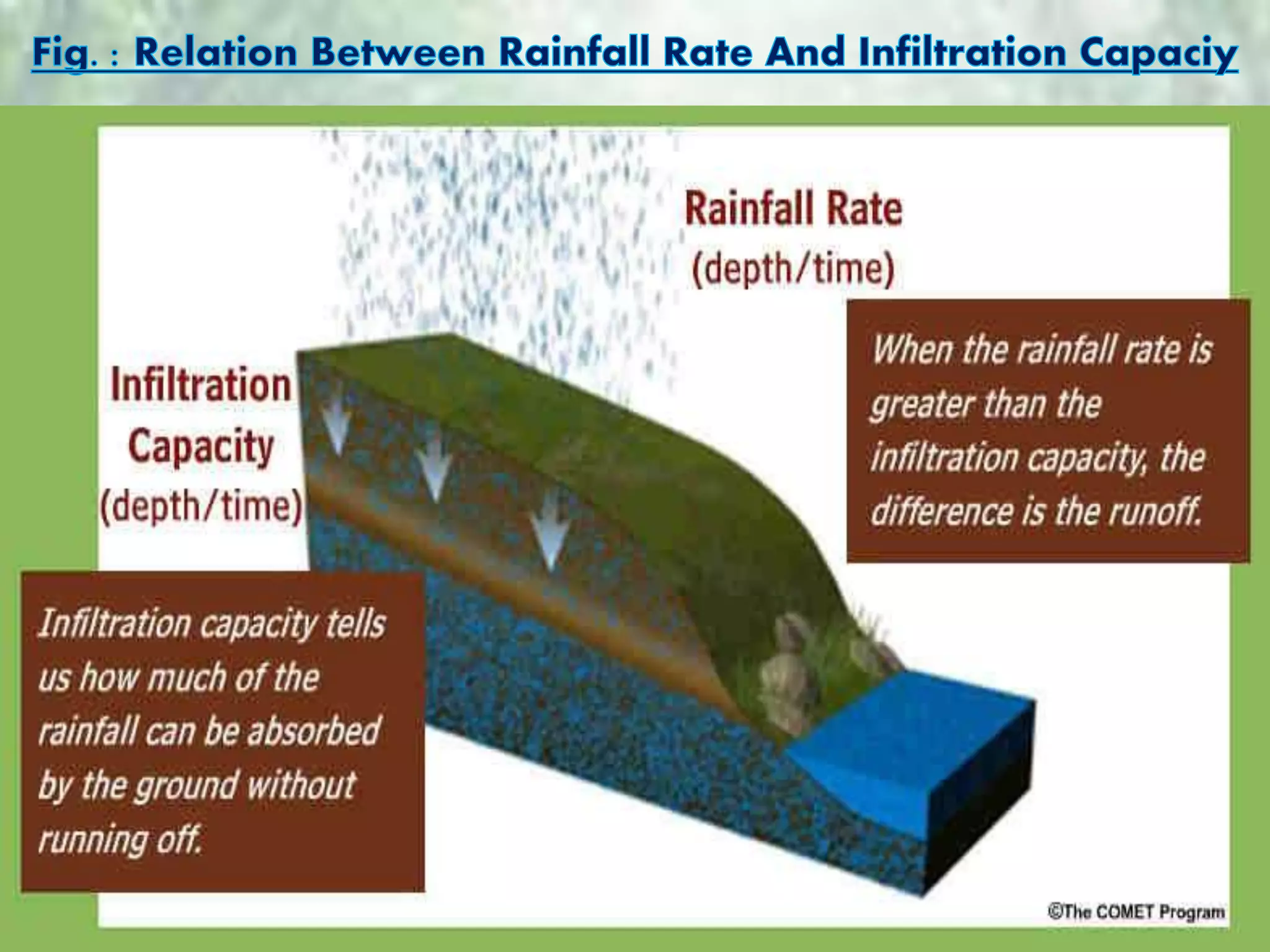
 Higher the rainfall rate, lesser the infiltration and higher the runoff.
R 12013(ssc-411)-soil moisture constants,soil-water movement &amp; infiltration

R 12013(ssc-411)-soil moisture constants,soil-water movement &amp; infiltration

  • 1.
    SSC-411,4(0+4) : VillageAttachment DEPARTMENT OF HORTICULTURE, INSTITUTE OF AGRICULTURAL SCIENCES, RAJIV GANDHI SOUTH CAMPUS, BANARAS HINDU UNIVERSITY, BARKACHHA,MIRZAPUR
  • 2.
     Water isretained by the soil-particles(on their surfaces) especially colloidal particles and the pore spaces by the force of adhesion and cohesion.  Such water present in the soil and is called as soil-water. Classification of Soil Water Gravitational water Capillary water Hygroscopic water Physical classification Biological classification Available water Unavailable water Super available water (Drainage water)
  • 4.
    Water contents presentin soil under certain standard conditions represents definite soil moisture relationship and retention of soil moisture in the field. The soil moisture tension is measured with “TENSIOMETER” Soil Water Content Soil Moisture Content
  • 5.
     While studyingsoil water and discussing its availability or other wise to plant, some specific terms called as soil moisture constants are used and they are as follows :  Maximum water holding capacity Field capacity Maximum Capillary capacity Moisture equivalents Permanent wilting point Hygroscopic coefficient Available soil-moisture Air capacity Total pore volume Continued. .
  • 6.
    I. Field Capacity(FC or 0fc):It is the non-saturated but still very wet soil condition where gravity drainage becomes negligible and only micropores retain water.  Factors affecting FC : a.)Soil-texture b.)soil structure c.)type of clay d.)organic matter content e.)soil-compaction f.) Impedition layer Table : Influence of three soil textures on soil moisture constants
  • 7.
    I. Permanent Wiltingpoint (WP or 0wp ): Also known as “wilting coefficient”. It is the soil moisture content at which the plants can no longer be able to meet their transpiration requirement, become water-stressed .There is still some water in the soil but not enough to be used by the plants. WP is of two types : • Temporary wilting point. • Ultimate wilting point FACTORS AFFECTING PWP Soil properties Plant properties Soil texture & structure Types of clay Organic matter content
  • 9.
    SATURATION FIELD CAPACITYWILTING POINT 100% Moisture in soil pores (both macro and micro) When water is no longer drained by gravity When plants have extracted as much water as they can Capillarity and surface attraction combine to pull more strongly than gravity on: 1) water in “micropores” and 2) water close to the “soil skin” Fig. : Diagrammatic representation of saturation, field capacity and wilting point
  • 10.
    Plant available water Gravitationalwater (Drainable) 10-30micron Oven-dry Air-dry Wilting point Field capacity Saturation Unavailable water ~0.2micron Hygroscopic coefficient -10000 bar -1000 bar -31 bar -15 bar -0.33bar -0.00 bar Capillary waterHygroscopic water Increasing soil water constants Increasing water potential *-1000 bar to -300 bar depending on humidity
  • 11.
    This characteristic curve describesthe relationship between water tension and water content for a specific soil.
  • 12.
    Appearance of soilType of Soil Soil Moisture Constant Moisture Tension in Atmosphere(in bar) Wet soil Gravitational water Maximum water 0.00 (~ 0.001) Moist soil Available water Field capacity 0.33 (1/3) Water held in micro pores Wilting point 15 Dry soil Unavailable water tightly held to the soil particles Hygroscopic coefficient 31 Air dry 1000 Oven dry 10,000 Table II : Moisture tension of soil moisture constants
  • 13.
    Saturated flow Unsaturatedflow Water-vapour movement  The major principle of movement of soil-water is that it is “along the gradient”. •Wet soil to Dry Soil •low soil moisture tension to high SMT •high soil water potential to low soil water potential
  • 14.
    • water movein the macropores since all of the pores are filled. • Saturated flow is water flow caused by gravity’s pull. • This water moves at water potentials larger than – 33 kPa. • Factors affecting saturated flow : 1. Texture 2. Structure 3. Amount of organic matter 4. Temperature 5. Depth of soil to hard pan 6. Pressure 7. Amount of water in the soil Saturated flow due to gravity
  • 15.
    •Macropores full ofair •Micropores = water + air •Moisture tension gradient creates unsaturated flow •It is flow of water held with water potentials < -1/3 bar. •Factors Affecting the Unsaturated Flow i. Nature of soil i. Soil moisture content : The higher the percentage of water in the moist soil, the greater is the suction gradient and the more rapid is the delivery. Distribution of pores Size of pores Unsaturated flow Micropores Macropores
  • 16.
    Movement from The movementof water vapour from soils takes place in two ways: (a)Internal movement (b)External movement There are mainly two soil conditions that affect the water vapour movement. i. Moisture regimes ii. Thermal regime
  • 17.
     Method ofdownward entry or movement of water into the soil surface  Determines the part of the precipitation that would become the surface runoff. Infiltration is governed by two forces: a.) Gravity b.) capillary action
  • 18.
    Rate at whichwater enters the soil at the surface. The rate of infiltration can be measured with Infiltrometer. It is measured in inches per hour or millimeters per hour. occurs when supply of water at surface is not limited. accumulated depth of water infiltrated during a given period of time.
  • 20.
     Type ofsoil and its properties - Porosity and hydraulic conductivity, soil-texture and structure, soil-temperature  Moisture content of soil  Condition of soil surface and its vegetative cover  rainfall intensity
  • 23.
     Percolation  Waterintake  Overland flow  Interflow (or Subsurface flow)  Seepage  Leaching Permeability
  • 25.
     Soil wateris very essential for the proper plant growth and development.  Soil moisture constants are necessary to determine the moisture present in soil under any certain condition and at any instant of time.  Soil water movement is mainly of three types viz. saturated, unsaturated and water vapour movement.  Infiltration and other modes of water entry into the soil contributes to the formation of water reservoir in soil.  Higher the rainfall rate, lesser the infiltration and higher the runoff.