5G RADIO
SPECTRUM
Introduction
• Spectrum is a key resource for any radio access network
• Four generations of cellular radio systems, providing telecommunications services with ever-increasing
capacity.
• The drivers for high network capacity are
• (1) availability of spectrum while accounting for abundance, cost of acquisition and operation
• (2) demand in terms of the traffic that is driven through the network,
• (3) diversity of services that can maintain load in a network across all hours of a day,
• (4) the multiplexing capability of the Internet Protocol (IP), and
• (5) the computational ability provided by the advances in semiconductor technology increasing
processing power and lowering storage cost
Spectrum for 4G
• 47 frequency bands for LTE Release 12, all of which are pertinent to specific
national or regional jurisdictions and some of which may overlap.
• these frequency bands cover roughly 1.3 GHz of independently addressable
spectrum.
• A single LTE carrier can have a variety of carrier bandwidths ranging from 1.4
MHz to a maximum of 20 MHz
• Release 10 of the LTE specification introduced
• Carrier Aggregation (CA) as a way to increase the system bandwidth for a single
LTE deployment.
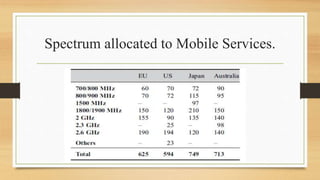
Spectrum allocated to Mobile Services.
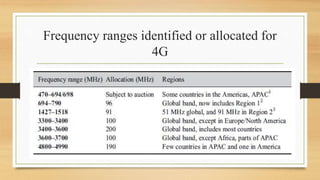
Frequency ranges identified or allocated for
4G
Spectrum challenges in 5G
• Mobile data volumes to be supported by 5G mobile access will
dramatically increase, and requirements on coverage, reliability and low
latency will be strengthened.
• Dedicated and licensed spectrum will continue to be preferred for 5G.
• Licensed spectrum ensures a stable framework for investment so that
coverage and QoS can be guaranteed.
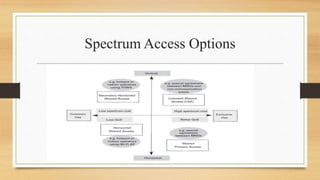
Spectrum Access Options
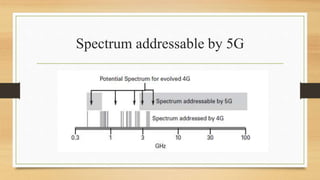
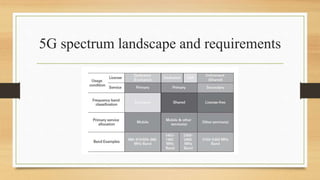
Spectrum addressable by 5G
5G spectrum landscape and requirements
Cont.,
• Radio access networks have historically evolved by increasing the spectrum efficiency
and spectrum availability in each new generation.
• In 5G radio access interfaces, a greater reliance on beamforming is expected to further
improve spectral efficiency, especially in the higher cmW and mmW bands.
• Beamforming can improve the geometry of user plane and dedicated signaling links.
• The region from 3 GHz to 30 GHz is heavily used by many of these services.
• the limitation on LTE to 100 MHz spectrum occupancy per system can be relaxed.
Bandwidth requirements
• 1. System Availability requirements and QoS requirements including
variability characteristics of diverse use cases,
• 2. Demands on the system influenced by extreme requirements such as
bandwidth, reliability and latency, the density of users and infrastructure,
and
• 3. Spectrum efficiency, e.g. in cases where techniques such as Coordinated
Multi-Point Transmission and Reception (CoMP) are used across many
antenna layers distributed spatially.
Spectrum access modes and sharing scenarios
• Current radio regulations provide four frequency band classifications: Exclusive
bands,
• Shared bands, License-free bands, and Receive-only bands.
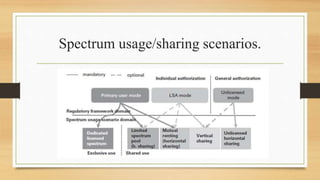
• In general the use of radio spectrum can be authorized in two ways:
• Individual Authorization (Licensed) and General Authorization (License Exempt
or Unlicensed).
• Authorization modes recognized as relevant for wireless communications are
Primary user mode, LSA mode and Unlicensed mode.
Spectrum usage/sharing scenarios.
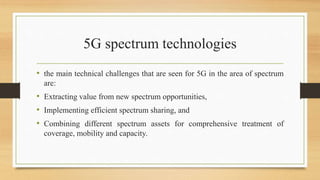
5G spectrum technologies
• the main technical challenges that are seen for 5G in the area of spectrum
are:
• Extracting value from new spectrum opportunities,
• Implementing efficient spectrum sharing, and
• Combining different spectrum assets for comprehensive treatment of
coverage, mobility and capacity.
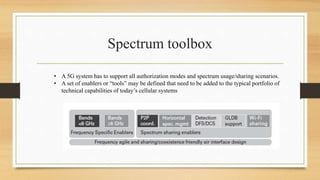
Spectrum toolbox
• A 5G system has to support all authorization modes and spectrum usage/sharing scenarios.
• A set of enablers or “tools” may be defined that need to be added to the typical portfolio of
technical capabilities of today’s cellular systems
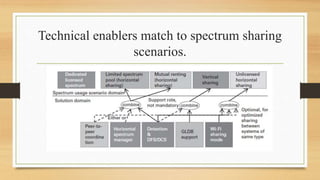
Technical enablers match to spectrum sharing
scenarios.

5G RADIO SPECTRUM.pptx

  • 1.
  • 2.
    Introduction • Spectrum isa key resource for any radio access network • Four generations of cellular radio systems, providing telecommunications services with ever-increasing capacity. • The drivers for high network capacity are • (1) availability of spectrum while accounting for abundance, cost of acquisition and operation • (2) demand in terms of the traffic that is driven through the network, • (3) diversity of services that can maintain load in a network across all hours of a day, • (4) the multiplexing capability of the Internet Protocol (IP), and • (5) the computational ability provided by the advances in semiconductor technology increasing processing power and lowering storage cost
  • 3.
    Spectrum for 4G •47 frequency bands for LTE Release 12, all of which are pertinent to specific national or regional jurisdictions and some of which may overlap. • these frequency bands cover roughly 1.3 GHz of independently addressable spectrum. • A single LTE carrier can have a variety of carrier bandwidths ranging from 1.4 MHz to a maximum of 20 MHz • Release 10 of the LTE specification introduced • Carrier Aggregation (CA) as a way to increase the system bandwidth for a single LTE deployment.
  • 4.
    Spectrum allocated toMobile Services.
  • 5.
    Frequency ranges identifiedor allocated for 4G
  • 6.
    Spectrum challenges in5G • Mobile data volumes to be supported by 5G mobile access will dramatically increase, and requirements on coverage, reliability and low latency will be strengthened. • Dedicated and licensed spectrum will continue to be preferred for 5G. • Licensed spectrum ensures a stable framework for investment so that coverage and QoS can be guaranteed.
  • 7.
  • 8.
  • 9.
    5G spectrum landscapeand requirements
  • 10.
    Cont., • Radio accessnetworks have historically evolved by increasing the spectrum efficiency and spectrum availability in each new generation. • In 5G radio access interfaces, a greater reliance on beamforming is expected to further improve spectral efficiency, especially in the higher cmW and mmW bands. • Beamforming can improve the geometry of user plane and dedicated signaling links. • The region from 3 GHz to 30 GHz is heavily used by many of these services. • the limitation on LTE to 100 MHz spectrum occupancy per system can be relaxed.
  • 11.
    Bandwidth requirements • 1.System Availability requirements and QoS requirements including variability characteristics of diverse use cases, • 2. Demands on the system influenced by extreme requirements such as bandwidth, reliability and latency, the density of users and infrastructure, and • 3. Spectrum efficiency, e.g. in cases where techniques such as Coordinated Multi-Point Transmission and Reception (CoMP) are used across many antenna layers distributed spatially.
  • 12.
    Spectrum access modesand sharing scenarios • Current radio regulations provide four frequency band classifications: Exclusive bands, • Shared bands, License-free bands, and Receive-only bands. • In general the use of radio spectrum can be authorized in two ways: • Individual Authorization (Licensed) and General Authorization (License Exempt or Unlicensed). • Authorization modes recognized as relevant for wireless communications are Primary user mode, LSA mode and Unlicensed mode.
  • 13.
  • 14.
    5G spectrum technologies •the main technical challenges that are seen for 5G in the area of spectrum are: • Extracting value from new spectrum opportunities, • Implementing efficient spectrum sharing, and • Combining different spectrum assets for comprehensive treatment of coverage, mobility and capacity.
  • 15.
    Spectrum toolbox • A5G system has to support all authorization modes and spectrum usage/sharing scenarios. • A set of enablers or “tools” may be defined that need to be added to the typical portfolio of technical capabilities of today’s cellular systems
  • 16.
    Technical enablers matchto spectrum sharing scenarios.