© SuperDataScienceDeep Learning A-Z
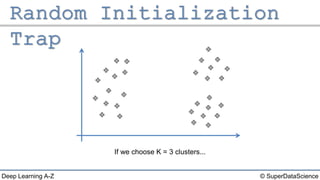
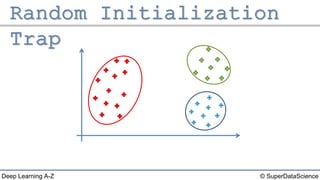
If we choose K = 3 clusters...
© SuperDataScienceDeep Learning A-Z
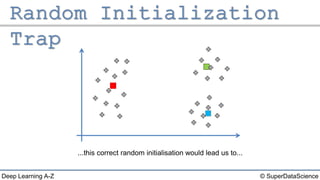
...this correct random initialisation would lead us to...
© SuperDataScienceDeep Learning A-Z
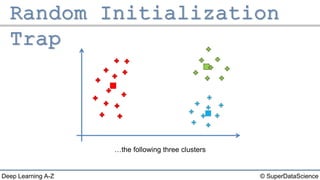
…the following three clusters
© SuperDataScienceDeep Learning A-Z
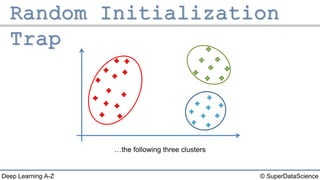
…the following three clusters
© SuperDataScienceDeep Learning A-Z
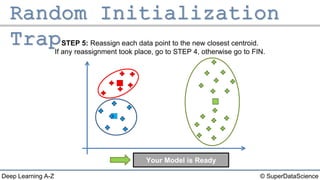
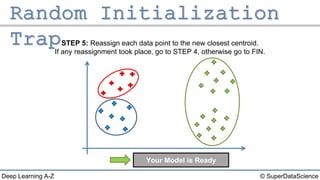
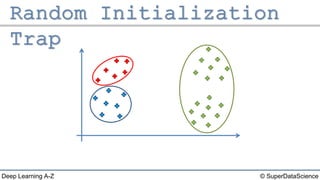
But what would happen if we had a bad random initialisation ?
© SuperDataScienceDeep Learning A-Z
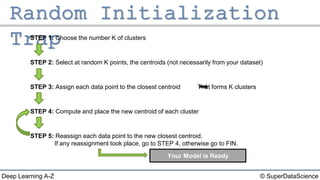
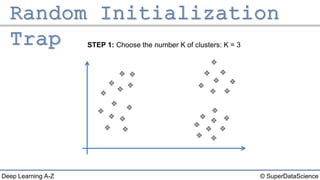
STEP 1: Choose the number K of clusters
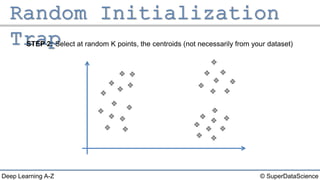
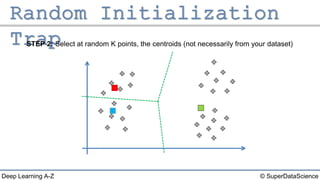
STEP 2: Select at random K points, the centroids (not necessarily from your dataset)
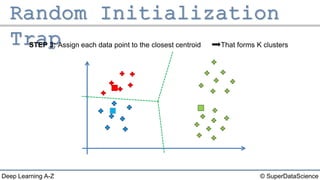
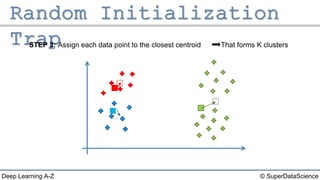
STEP 3: Assign each data point to the closest centroid That forms K clusters
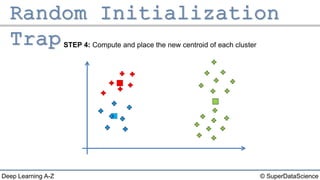
STEP 4: Compute and place the new centroid of each cluster
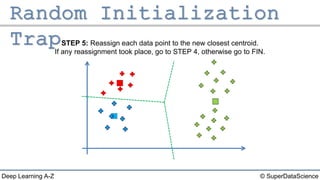
STEP 5: Reassign each data point to the new closest centroid.
If any reassignment took place, go to STEP 4, otherwise go to FIN.
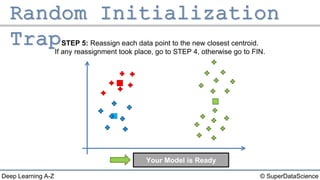
Your Model is Ready
© SuperDataScienceDeep Learning A-Z
STEP 1: Choose the number K of clusters: K = 3
© SuperDataScienceDeep Learning A-Z
STEP 2: Select at random K points, the centroids (not necessarily from your dataset)
© SuperDataScienceDeep Learning A-Z
STEP 2: Select at random K points, the centroids (not necessarily from your dataset)
© SuperDataScienceDeep Learning A-Z
STEP 3: Assign each data point to the closest centroid That forms K clusters
© SuperDataScienceDeep Learning A-Z
STEP 3: Assign each data point to the closest centroid That forms K clusters
© SuperDataScienceDeep Learning A-Z
STEP 4: Compute and place the new centroid of each cluster
© SuperDataScienceDeep Learning A-Z
STEP 5: Reassign each data point to the new closest centroid.
If any reassignment took place, go to STEP 4, otherwise go to FIN.
© SuperDataScienceDeep Learning A-Z
STEP 5: Reassign each data point to the new closest centroid.
If any reassignment took place, go to STEP 4, otherwise go to FIN.
Your Model is Ready
© SuperDataScienceDeep Learning A-Z
Your Model is Ready
STEP 5: Reassign each data point to the new closest centroid.
If any reassignment took place, go to STEP 4, otherwise go to FIN.
© SuperDataScienceDeep Learning A-Z
Your Model is Ready
STEP 5: Reassign each data point to the new closest centroid.
If any reassignment took place, go to STEP 4, otherwise go to FIN.
© SuperDataScienceDeep Learning A-Z
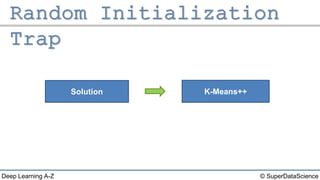
Solution K-Means++

Deep Learning A-Z™: Self Organizing Maps (SOM) - K-Means Clustering (part 2)