Self-Learning Systems for Cyber Security
Kim Hammar & Rolf Stadler
kimham@kth.se, stadler@kth.se
KTH Royal Institute of Technology
CDIS Spring Conference 2021
March 24, 2021
1/16
2/16
3/16
4/16
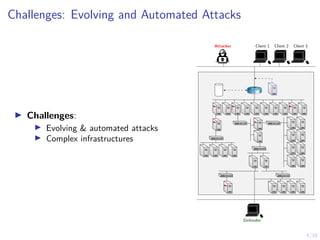
Challenges: Evolving and Automated Attacks
I Challenges:
I Evolving & automated attacks
I Complex infrastructures
Attacker Client 1 Client 2 Client 3
Defender
R1
4/16
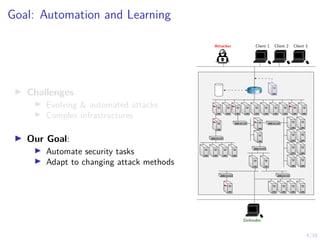
Goal: Automation and Learning
I Challenges
I Evolving & automated attacks
I Complex infrastructures
I Our Goal:
I Automate security tasks
I Adapt to changing attack methods
Attacker Client 1 Client 2 Client 3
Defender
R1
4/16
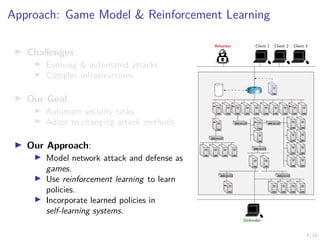
Approach: Game Model & Reinforcement Learning
I Challenges:
I Evolving & automated attacks
I Complex infrastructures
I Our Goal:
I Automate security tasks
I Adapt to changing attack methods
I Our Approach:
I Model network attack and defense as
games.
I Use reinforcement learning to learn
policies.
I Incorporate learned policies in
self-learning systems.
Attacker Client 1 Client 2 Client 3
Defender
R1
5/16
State of the Art
I Game-Learning Programs:
I TD-Gammon, AlphaGo Zero1
, OpenAI Five etc.
I =⇒ Impressive empirical results of RL and self-play
I Attack Simulations:
I Automated threat modeling2
, automated intrusion detection
etc.
I =⇒ Need for automation and better security tooling
I Mathematical Modeling:
I Game theory3
I Markov decision theory
I =⇒ Many security operations involves
strategic decision making
1
David Silver et al. “Mastering the game of Go without human knowledge”. In: Nature 550 (Oct. 2017),
pp. 354–. url: http://dx.doi.org/10.1038/nature24270.
2
Pontus Johnson, Robert Lagerström, and Mathias Ekstedt. “A Meta Language for Threat Modeling and
Attack Simulations”. In: Proceedings of the 13th International Conference on Availability, Reliability and Security.
ARES 2018. Hamburg, Germany: Association for Computing Machinery, 2018. isbn: 9781450364485. doi:
10.1145/3230833.3232799. url: https://doi.org/10.1145/3230833.3232799.
3
Tansu Alpcan and Tamer Basar. Network Security: A Decision and Game-Theoretic Approach. 1st. USA:
Cambridge University Press, 2010. isbn: 0521119324.
5/16
State of the Art
I Game-Learning Programs:
I TD-Gammon, AlphaGo Zero4
, OpenAI Five etc.
I =⇒ Impressive empirical results of RL and self-play
I Attack Simulations:
I Automated threat modeling5
, automated intrusion detection
etc.
I =⇒ Need for automation and better security tooling
I Mathematical Modeling:
I Game theory6
I Markov decision theory
I =⇒ Many security operations involves
strategic decision making
4
David Silver et al. “Mastering the game of Go without human knowledge”. In: Nature 550 (Oct. 2017),
pp. 354–. url: http://dx.doi.org/10.1038/nature24270.
5
Pontus Johnson, Robert Lagerström, and Mathias Ekstedt. “A Meta Language for Threat Modeling and
Attack Simulations”. In: Proceedings of the 13th International Conference on Availability, Reliability and Security.
ARES 2018. Hamburg, Germany: Association for Computing Machinery, 2018. isbn: 9781450364485. doi:
10.1145/3230833.3232799. url: https://doi.org/10.1145/3230833.3232799.
6
Tansu Alpcan and Tamer Basar. Network Security: A Decision and Game-Theoretic Approach. 1st. USA:
Cambridge University Press, 2010. isbn: 0521119324.
5/16
State of the Art
I Game-Learning Programs:
I TD-Gammon, AlphaGo Zero7
, OpenAI Five etc.
I =⇒ Impressive empirical results of RL and self-play
I Attack Simulations:
I Automated threat modeling8
, automated intrusion detection
etc.
I =⇒ Need for automation and better security tooling
I Mathematical Modeling:
I Game theory9
I Markov decision theory
I =⇒ Many security operations involves
strategic decision making
7
David Silver et al. “Mastering the game of Go without human knowledge”. In: Nature 550 (Oct. 2017),
pp. 354–. url: http://dx.doi.org/10.1038/nature24270.
8
Pontus Johnson, Robert Lagerström, and Mathias Ekstedt. “A Meta Language for Threat Modeling and
Attack Simulations”. In: Proceedings of the 13th International Conference on Availability, Reliability and Security.
ARES 2018. Hamburg, Germany: Association for Computing Machinery, 2018. isbn: 9781450364485. doi:
10.1145/3230833.3232799. url: https://doi.org/10.1145/3230833.3232799.
9
Tansu Alpcan and Tamer Basar. Network Security: A Decision and Game-Theoretic Approach. 1st. USA:
Cambridge University Press, 2010. isbn: 0521119324.
6/16
Our Work
I Use Case: Intrusion Prevention
I Our Method:
I Emulating computer infrastructures
I System identification and model creation
I Reinforcement learning and generalization
I Results: Learning to Capture The Flag
I Conclusions and Future Work
7/16
Use Case: Intrusion Prevention
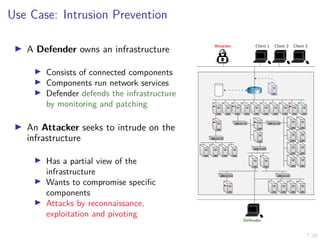
I A Defender owns an infrastructure
I Consists of connected components
I Components run network services
I Defender defends the infrastructure
by monitoring and patching
I An Attacker seeks to intrude on the
infrastructure
I Has a partial view of the
infrastructure
I Wants to compromise specific
components
I Attacks by reconnaissance,
exploitation and pivoting
Attacker Client 1 Client 2 Client 3
Defender
R1
8/16
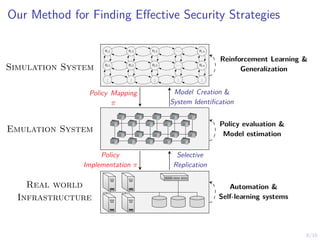
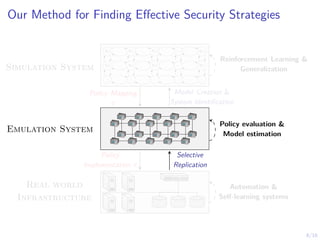
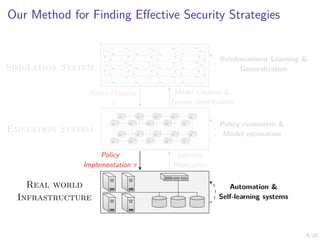
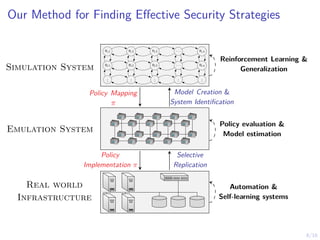
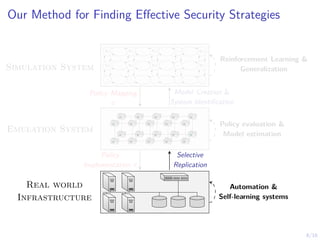
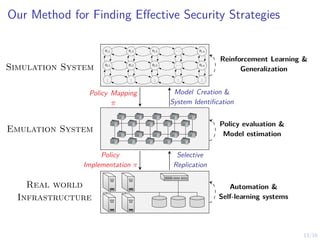
Our Method for Finding Effective Security Strategies
s1,1 s1,2 s1,3 . . . s1,n
s2,1 s2,2 s2,3 . . . s2,n
.
.
.
.
.
.
.
.
.
.
.
.
.
.
.
Emulation System
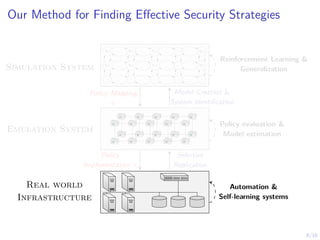
Real world
Infrastructure
Model Creation &
System Identification
Policy Mapping
π
Selective
Replication
Policy
Implementation π
Simulation System
Reinforcement Learning &
Generalization
Policy evaluation &
Model estimation
Automation &
Self-learning systems
8/16
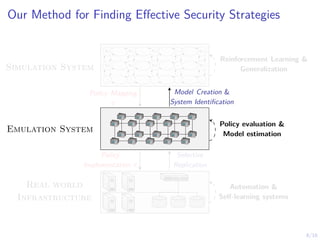
Our Method for Finding Effective Security Strategies
s1,1 s1,2 s1,3 . . . s1,n
s2,1 s2,2 s2,3 . . . s2,n
.
.
.
.
.
.
.
.
.
.
.
.
.
.
.
Emulation System
Real world
Infrastructure
Model Creation &
System Identification
Policy Mapping
π
Selective
Replication
Policy
Implementation π
Simulation System
Reinforcement Learning &
Generalization
Policy evaluation &
Model estimation
Automation &
Self-learning systems
8/16
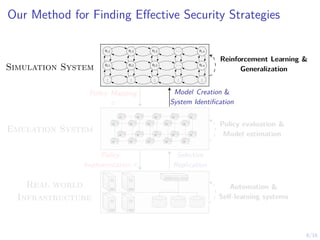
Our Method for Finding Effective Security Strategies
s1,1 s1,2 s1,3 . . . s1,n
s2,1 s2,2 s2,3 . . . s2,n
.
.
.
.
.
.
.
.
.
.
.
.
.
.
.
Emulation System
Real world
Infrastructure
Model Creation &
System Identification
Policy Mapping
π
Selective
Replication
Policy
Implementation π
Simulation System
Reinforcement Learning &
Generalization
Policy evaluation &
Model estimation
Automation &
Self-learning systems
8/16
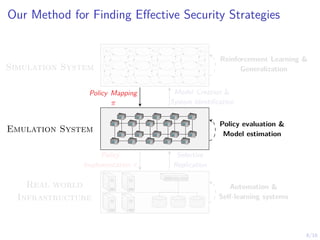
Our Method for Finding Effective Security Strategies
s1,1 s1,2 s1,3 . . . s1,n
s2,1 s2,2 s2,3 . . . s2,n
.
.
.
.
.
.
.
.
.
.
.
.
.
.
.
Emulation System
Real world
Infrastructure
Model Creation &
System Identification
Policy Mapping
π
Selective
Replication
Policy
Implementation π
Simulation System
Reinforcement Learning &
Generalization
Policy evaluation &
Model estimation
Automation &
Self-learning systems
8/16
Our Method for Finding Effective Security Strategies
s1,1 s1,2 s1,3 . . . s1,n
s2,1 s2,2 s2,3 . . . s2,n
.
.
.
.
.
.
.
.
.
.
.
.
.
.
.
Emulation System
Real world
Infrastructure
Model Creation &
System Identification
Policy Mapping
π
Selective
Replication
Policy
Implementation π
Simulation System
Reinforcement Learning &
Generalization
Policy evaluation &
Model estimation
Automation &
Self-learning systems
8/16
Our Method for Finding Effective Security Strategies
s1,1 s1,2 s1,3 . . . s1,n
s2,1 s2,2 s2,3 . . . s2,n
.
.
.
.
.
.
.
.
.
.
.
.
.
.
.
Emulation System
Real world
Infrastructure
Model Creation &
System Identification
Policy Mapping
π
Selective
Replication
Policy
Implementation π
Simulation System
Reinforcement Learning &
Generalization
Policy evaluation &
Model estimation
Automation &
Self-learning systems
8/16
Our Method for Finding Effective Security Strategies
s1,1 s1,2 s1,3 . . . s1,n
s2,1 s2,2 s2,3 . . . s2,n
.
.
.
.
.
.
.
.
.
.
.
.
.
.
.
Emulation System
Real world
Infrastructure
Model Creation &
System Identification
Policy Mapping
π
Selective
Replication
Policy
Implementation π
Simulation System
Reinforcement Learning &
Generalization
Policy evaluation &
Model estimation
Automation &
Self-learning systems
8/16
Our Method for Finding Effective Security Strategies
s1,1 s1,2 s1,3 . . . s1,n
s2,1 s2,2 s2,3 . . . s2,n
.
.
.
.
.
.
.
.
.
.
.
.
.
.
.
Emulation System
Real world
Infrastructure
Model Creation &
System Identification
Policy Mapping
π
Selective
Replication
Policy
Implementation π
Simulation System
Reinforcement Learning &
Generalization
Policy evaluation &
Model estimation
Automation &
Self-learning systems
8/16
Our Method for Finding Effective Security Strategies
s1,1 s1,2 s1,3 . . . s1,n
s2,1 s2,2 s2,3 . . . s2,n
.
.
.
.
.
.
.
.
.
.
.
.
.
.
.
Emulation System
Real world
Infrastructure
Model Creation &
System Identification
Policy Mapping
π
Selective
Replication
Policy
Implementation π
Simulation System
Reinforcement Learning &
Generalization
Policy evaluation &
Model estimation
Automation &
Self-learning systems
9/16
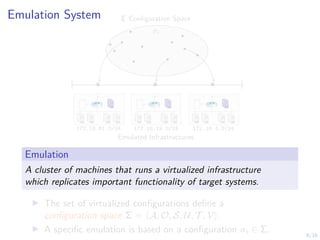
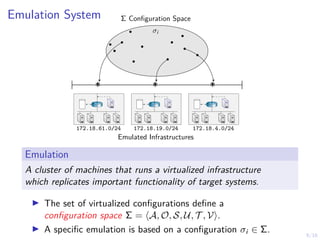
Emulation System Σ Configuration Space
σi
*
* *
172.18.4.0/24
172.18.19.0/24
172.18.61.0/24
Emulated Infrastructures
R1 R1 R1
Emulation
A cluster of machines that runs a virtualized infrastructure
which replicates important functionality of target systems.
I The set of virtualized configurations define a
configuration space Σ = hA, O, S, U, T , Vi.
I A specific emulation is based on a configuration σi ∈ Σ.
9/16
Emulation System Σ Configuration Space
σi
*
* *
172.18.4.0/24
172.18.19.0/24
172.18.61.0/24
Emulated Infrastructures
R1 R1 R1
Emulation
A cluster of machines that runs a virtualized infrastructure
which replicates important functionality of target systems.
I The set of virtualized configurations define a
configuration space Σ = hA, O, S, U, T , Vi.
I A specific emulation is based on a configuration σi ∈ Σ.
10/16
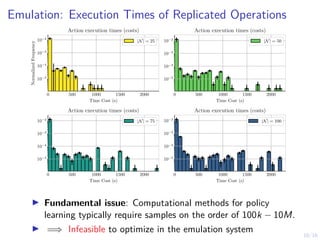
Emulation: Execution Times of Replicated Operations
0 500 1000 1500 2000
Time Cost (s)
10−5
10−4
10−3
10−2
Normalized
Frequency
Action execution times (costs)
|N| = 25
0 500 1000 1500 2000
Time Cost (s)
10−5
10−4
10−3
10−2
Action execution times (costs)
|N| = 50
0 500 1000 1500 2000
Time Cost (s)
10−5
10−4
10−3
10−2
Action execution times (costs)
|N| = 75
0 500 1000 1500 2000
Time Cost (s)
10−5
10−4
10−3
10−2
Action execution times (costs)
|N| = 100
I Fundamental issue: Computational methods for policy
learning typically require samples on the order of 100k − 10M.
I =⇒ Infeasible to optimize in the emulation system
11/16
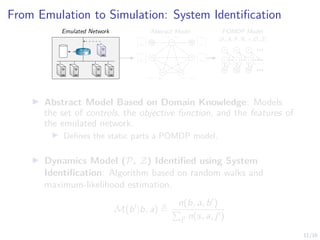
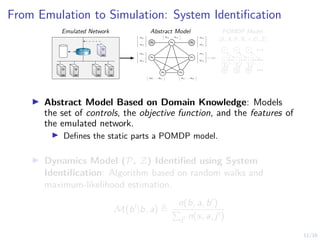
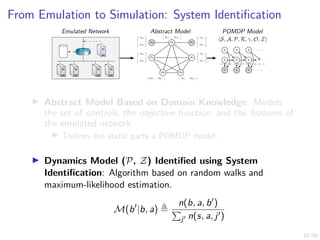
From Emulation to Simulation: System Identification
R1
m1
m2 m3
m4
m5
m6
m7
m1,1 . . . m1,k
h i
m5,1 . . . m5,k
h i
m6,1 . . . m6,k
h i
m2,1
.
.
.
m2,k








m3,1
.
.
.
m3,k








m7,1
.
.
.
m7,k








m4,1
.
.
.
m4,k








Emulated Network Abstract Model POMDP Model
hS, A, P, R, γ, O, Zi
a1 a2 a3 . . .
s1 s2 s3 . . .
o1 o2 o3 . . .
I Abstract Model Based on Domain Knowledge: Models
the set of controls, the objective function, and the features of
the emulated network.
I Defines the static parts a POMDP model.
I Dynamics Model (P, Z) Identified using System
Identification: Algorithm based on random walks and
maximum-likelihood estimation.
M(b0
|b, a) ,
n(b, a, b0)
P
j0 n(s, a, j0)
11/16
From Emulation to Simulation: System Identification
R1
m1
m2 m3
m4
m5
m6
m7
m1,1 . . . m1,k
h i
m5,1 . . . m5,k
h i
m6,1 . . . m6,k
h i
m2,1
.
.
.
m2,k








m3,1
.
.
.
m3,k








m7,1
.
.
.
m7,k








m4,1
.
.
.
m4,k








Emulated Network Abstract Model POMDP Model
hS, A, P, R, γ, O, Zi
a1 a2 a3 . . .
s1 s2 s3 . . .
o1 o2 o3 . . .
I Abstract Model Based on Domain Knowledge: Models
the set of controls, the objective function, and the features of
the emulated network.
I Defines the static parts a POMDP model.
I Dynamics Model (P, Z) Identified using System
Identification: Algorithm based on random walks and
maximum-likelihood estimation.
M(b0
|b, a) ,
n(b, a, b0)
P
j0 n(s, a, j0)
11/16
From Emulation to Simulation: System Identification
R1
m1
m2 m3
m4
m5
m6
m7
m1,1 . . . m1,k
h i
m5,1 . . . m5,k
h i
m6,1 . . . m6,k
h i
m2,1
.
.
.
m2,k








m3,1
.
.
.
m3,k








m7,1
.
.
.
m7,k








m4,1
.
.
.
m4,k








Emulated Network Abstract Model POMDP Model
hS, A, P, R, γ, O, Zi
a1 a2 a3 . . .
s1 s2 s3 . . .
o1 o2 o3 . . .
I Abstract Model Based on Domain Knowledge: Models
the set of controls, the objective function, and the features of
the emulated network.
I Defines the static parts a POMDP model.
I Dynamics Model (P, Z) Identified using System
Identification: Algorithm based on random walks and
maximum-likelihood estimation.
M(b0
|b, a) ,
n(b, a, b0)
P
j0 n(s, a, j0)
12/16
Policy Optimization in the Simulation System
using Reinforcement Learning
I Goal:
I Approximate π∗
= arg maxπ E
hPT
t=0 γt
rt+1
i
I Learning Algorithm:
I Represent π by πθ
I Define objective J(θ) = Eo∼ρπθ ,a∼πθ
[R]
I Maximize J(θ) by stochastic gradient ascent with
gradient
∇θJ(θ) = Eo∼ρπθ ,a∼πθ
[∇θ log πθ(a|o)Aπθ
(o, a)]
I Domain-Specific Challenges:
I Partial observability
I Large state space |S| = (w + 1)|N|·m·(m+1)
I Large action space |A| = |N| · (m + 1)
I Non-stationary Environment due to presence of
adversary
I Generalization
Agent
Environment
at
st+1
rt+1
12/16
Policy Optimization in the Simulation System
using Reinforcement Learning
I Goal:
I Approximate π∗
= arg maxπ E
hPT
t=0 γt
rt+1
i
I Learning Algorithm:
I Represent π by πθ
I Define objective J(θ) = Eo∼ρπθ ,a∼πθ
[R]
I Maximize J(θ) by stochastic gradient ascent with
gradient
∇θJ(θ) = Eo∼ρπθ ,a∼πθ
[∇θ log πθ(a|o)Aπθ
(o, a)]
I Domain-Specific Challenges:
I Partial observability
I Large state space |S| = (w + 1)|N|·m·(m+1)
I Large action space |A| = |N| · (m + 1)
I Non-stationary Environment due to presence of
adversary
I Generalization
Agent
Environment
at
st+1
rt+1
12/16
Policy Optimization in the Simulation System
using Reinforcement Learning
I Goal:
I Approximate π∗
= arg maxπ E
hPT
t=0 γt
rt+1
i
I Learning Algorithm:
I Represent π by πθ
I Define objective J(θ) = Eo∼ρπθ ,a∼πθ
[R]
I Maximize J(θ) by stochastic gradient ascent with
gradient
∇θJ(θ) = Eo∼ρπθ ,a∼πθ
[∇θ log πθ(a|o)Aπθ
(o, a)]
I Domain-Specific Challenges:
I Partial observability
I Large state space |S| = (w + 1)|N|·m·(m+1)
I Large action space |A| = |N| · (m + 1)
I Non-stationary Environment due to presence of
adversary
I Generalization
Agent
Environment
at
st+1
rt+1
12/16
Policy Optimization in the Simulation System
using Reinforcement Learning
I Goal:
I Approximate π∗
= arg maxπ E
PT
t=0
γt
rt+1

I Learning Algorithm:
I Represent π by πθ
I Define objective J(θ) = Eo∼ρπθ ,a∼πθ
[R]
I Maximize J(θ) by stochastic gradient ascent with gradient
∇θJ(θ) = Eo∼ρπθ ,a∼πθ
[∇θ log πθ(a|o)Aπθ (o, a)]
I Domain-Specific Challenges:
I Partial observability
I Large state space |S| = (w + 1)|N |·m·(m+1)
I Large action space |A| = |N | · (m + 1)
I Non-stationary Environment due to presence of adversary
I Generalization
I Finding Effective Security Strategies through
Reinforcement Learning and Self-Playa
a
Kim Hammar and Rolf Stadler. “Finding Effective Security Strategies through Reinforcement Learning and
Self-Play”. In: International Conference on Network and Service Management (CNSM 2020) (CNSM 2020). Izmir,
Turkey, Nov. 2020.
Agent
Environment
at
st+1
rt+1
13/16
Our Method for Finding Effective Security Strategies
s1,1 s1,2 s1,3 . . . s1,n
s2,1 s2,2 s2,3 . . . s2,n
.
.
.
.
.
.
.
.
.
.
.
.
.
.
.
Emulation System
Real world
Infrastructure
Model Creation 
System Identification
Policy Mapping
π
Selective
Replication
Policy
Implementation π
Simulation System
Reinforcement Learning 
Generalization
Policy evaluation 
Model estimation
Automation 
Self-learning systems
14/16
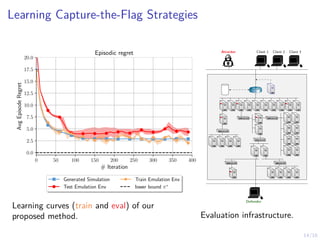
Learning Capture-the-Flag Strategies
0 50 100 150 200 250 300 350 400
# Iteration
0.0
2.5
5.0
7.5
10.0
12.5
15.0
17.5
20.0
Avg
Episode
Regret
Episodic regret
Generated Simulation
Test Emulation Env
Train Emulation Env
lower bound π∗
Learning curves (train and eval) of our
proposed method.
Attacker Client 1 Client 2 Client 3
Defender
R1
Evaluation infrastructure.
15/16
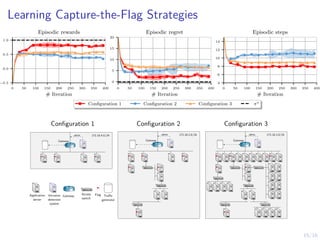
Learning Capture-the-Flag Strategies
0 50 100 150 200 250 300 350 400
# Iteration
−0.5
0.0
0.5
1.0
Episodic rewards
0 50 100 150 200 250 300 350 400
# Iteration
0
5
10
15
20
Episodic regret
0 50 100 150 200 250 300 350 400
# Iteration
4
6
8
10
12
14
Episodic steps
Configuration 1 Configuration 2 Configuration 3 π∗
R1
alerts
Gateway
172.18.4.0/24
R1
alerts
Gateway
172.18.3.0/24
R1
Gateway
alerts 172.18.2.0/24
Application
server
Intrusion
detection
system
R1
Gateway
Access
switch
Flag Traffic
generator
Configuration 1 Configuration 3
Configuration 2
16/16
Conclusions  Future Work
I Conclusions:
I We develop a method to find effective strategies for intrusion
prevention
I (1) emulation system; (2) system identification; (3) simulation system; (4) reinforcement
learning and (5) domain randomization and generalization.
I We show that self-learning can be successfully applied to
network infrastructures.
I Self-play reinforcement learning in Markov security game
I Key challenges: stable convergence, sample efficiency,
complexity of emulations, large state and action spaces
I Our research plans:
I Improving the system identification algorithm  generalization
I Evaluation on real world infrastructures

Self-Learning Systems for Cyber Security

  • 1.
    Self-Learning Systems forCyber Security Kim Hammar & Rolf Stadler kimham@kth.se, stadler@kth.se KTH Royal Institute of Technology CDIS Spring Conference 2021 March 24, 2021 1/16
  • 2.
  • 3.
  • 4.
    4/16 Challenges: Evolving andAutomated Attacks I Challenges: I Evolving & automated attacks I Complex infrastructures Attacker Client 1 Client 2 Client 3 Defender R1
  • 5.
    4/16 Goal: Automation andLearning I Challenges I Evolving & automated attacks I Complex infrastructures I Our Goal: I Automate security tasks I Adapt to changing attack methods Attacker Client 1 Client 2 Client 3 Defender R1
  • 6.
    4/16 Approach: Game Model& Reinforcement Learning I Challenges: I Evolving & automated attacks I Complex infrastructures I Our Goal: I Automate security tasks I Adapt to changing attack methods I Our Approach: I Model network attack and defense as games. I Use reinforcement learning to learn policies. I Incorporate learned policies in self-learning systems. Attacker Client 1 Client 2 Client 3 Defender R1
  • 7.
    5/16 State of theArt I Game-Learning Programs: I TD-Gammon, AlphaGo Zero1 , OpenAI Five etc. I =⇒ Impressive empirical results of RL and self-play I Attack Simulations: I Automated threat modeling2 , automated intrusion detection etc. I =⇒ Need for automation and better security tooling I Mathematical Modeling: I Game theory3 I Markov decision theory I =⇒ Many security operations involves strategic decision making 1 David Silver et al. “Mastering the game of Go without human knowledge”. In: Nature 550 (Oct. 2017), pp. 354–. url: http://dx.doi.org/10.1038/nature24270. 2 Pontus Johnson, Robert Lagerström, and Mathias Ekstedt. “A Meta Language for Threat Modeling and Attack Simulations”. In: Proceedings of the 13th International Conference on Availability, Reliability and Security. ARES 2018. Hamburg, Germany: Association for Computing Machinery, 2018. isbn: 9781450364485. doi: 10.1145/3230833.3232799. url: https://doi.org/10.1145/3230833.3232799. 3 Tansu Alpcan and Tamer Basar. Network Security: A Decision and Game-Theoretic Approach. 1st. USA: Cambridge University Press, 2010. isbn: 0521119324.
  • 8.
    5/16 State of theArt I Game-Learning Programs: I TD-Gammon, AlphaGo Zero4 , OpenAI Five etc. I =⇒ Impressive empirical results of RL and self-play I Attack Simulations: I Automated threat modeling5 , automated intrusion detection etc. I =⇒ Need for automation and better security tooling I Mathematical Modeling: I Game theory6 I Markov decision theory I =⇒ Many security operations involves strategic decision making 4 David Silver et al. “Mastering the game of Go without human knowledge”. In: Nature 550 (Oct. 2017), pp. 354–. url: http://dx.doi.org/10.1038/nature24270. 5 Pontus Johnson, Robert Lagerström, and Mathias Ekstedt. “A Meta Language for Threat Modeling and Attack Simulations”. In: Proceedings of the 13th International Conference on Availability, Reliability and Security. ARES 2018. Hamburg, Germany: Association for Computing Machinery, 2018. isbn: 9781450364485. doi: 10.1145/3230833.3232799. url: https://doi.org/10.1145/3230833.3232799. 6 Tansu Alpcan and Tamer Basar. Network Security: A Decision and Game-Theoretic Approach. 1st. USA: Cambridge University Press, 2010. isbn: 0521119324.
  • 9.
    5/16 State of theArt I Game-Learning Programs: I TD-Gammon, AlphaGo Zero7 , OpenAI Five etc. I =⇒ Impressive empirical results of RL and self-play I Attack Simulations: I Automated threat modeling8 , automated intrusion detection etc. I =⇒ Need for automation and better security tooling I Mathematical Modeling: I Game theory9 I Markov decision theory I =⇒ Many security operations involves strategic decision making 7 David Silver et al. “Mastering the game of Go without human knowledge”. In: Nature 550 (Oct. 2017), pp. 354–. url: http://dx.doi.org/10.1038/nature24270. 8 Pontus Johnson, Robert Lagerström, and Mathias Ekstedt. “A Meta Language for Threat Modeling and Attack Simulations”. In: Proceedings of the 13th International Conference on Availability, Reliability and Security. ARES 2018. Hamburg, Germany: Association for Computing Machinery, 2018. isbn: 9781450364485. doi: 10.1145/3230833.3232799. url: https://doi.org/10.1145/3230833.3232799. 9 Tansu Alpcan and Tamer Basar. Network Security: A Decision and Game-Theoretic Approach. 1st. USA: Cambridge University Press, 2010. isbn: 0521119324.
  • 10.
    6/16 Our Work I UseCase: Intrusion Prevention I Our Method: I Emulating computer infrastructures I System identification and model creation I Reinforcement learning and generalization I Results: Learning to Capture The Flag I Conclusions and Future Work
  • 11.
    7/16 Use Case: IntrusionPrevention I A Defender owns an infrastructure I Consists of connected components I Components run network services I Defender defends the infrastructure by monitoring and patching I An Attacker seeks to intrude on the infrastructure I Has a partial view of the infrastructure I Wants to compromise specific components I Attacks by reconnaissance, exploitation and pivoting Attacker Client 1 Client 2 Client 3 Defender R1
  • 12.
    8/16 Our Method forFinding Effective Security Strategies s1,1 s1,2 s1,3 . . . s1,n s2,1 s2,2 s2,3 . . . s2,n . . . . . . . . . . . . . . . Emulation System Real world Infrastructure Model Creation & System Identification Policy Mapping π Selective Replication Policy Implementation π Simulation System Reinforcement Learning & Generalization Policy evaluation & Model estimation Automation & Self-learning systems
  • 13.
    8/16 Our Method forFinding Effective Security Strategies s1,1 s1,2 s1,3 . . . s1,n s2,1 s2,2 s2,3 . . . s2,n . . . . . . . . . . . . . . . Emulation System Real world Infrastructure Model Creation & System Identification Policy Mapping π Selective Replication Policy Implementation π Simulation System Reinforcement Learning & Generalization Policy evaluation & Model estimation Automation & Self-learning systems
  • 14.
    8/16 Our Method forFinding Effective Security Strategies s1,1 s1,2 s1,3 . . . s1,n s2,1 s2,2 s2,3 . . . s2,n . . . . . . . . . . . . . . . Emulation System Real world Infrastructure Model Creation & System Identification Policy Mapping π Selective Replication Policy Implementation π Simulation System Reinforcement Learning & Generalization Policy evaluation & Model estimation Automation & Self-learning systems
  • 15.
    8/16 Our Method forFinding Effective Security Strategies s1,1 s1,2 s1,3 . . . s1,n s2,1 s2,2 s2,3 . . . s2,n . . . . . . . . . . . . . . . Emulation System Real world Infrastructure Model Creation & System Identification Policy Mapping π Selective Replication Policy Implementation π Simulation System Reinforcement Learning & Generalization Policy evaluation & Model estimation Automation & Self-learning systems
  • 16.
    8/16 Our Method forFinding Effective Security Strategies s1,1 s1,2 s1,3 . . . s1,n s2,1 s2,2 s2,3 . . . s2,n . . . . . . . . . . . . . . . Emulation System Real world Infrastructure Model Creation & System Identification Policy Mapping π Selective Replication Policy Implementation π Simulation System Reinforcement Learning & Generalization Policy evaluation & Model estimation Automation & Self-learning systems
  • 17.
    8/16 Our Method forFinding Effective Security Strategies s1,1 s1,2 s1,3 . . . s1,n s2,1 s2,2 s2,3 . . . s2,n . . . . . . . . . . . . . . . Emulation System Real world Infrastructure Model Creation & System Identification Policy Mapping π Selective Replication Policy Implementation π Simulation System Reinforcement Learning & Generalization Policy evaluation & Model estimation Automation & Self-learning systems
  • 18.
    8/16 Our Method forFinding Effective Security Strategies s1,1 s1,2 s1,3 . . . s1,n s2,1 s2,2 s2,3 . . . s2,n . . . . . . . . . . . . . . . Emulation System Real world Infrastructure Model Creation & System Identification Policy Mapping π Selective Replication Policy Implementation π Simulation System Reinforcement Learning & Generalization Policy evaluation & Model estimation Automation & Self-learning systems
  • 19.
    8/16 Our Method forFinding Effective Security Strategies s1,1 s1,2 s1,3 . . . s1,n s2,1 s2,2 s2,3 . . . s2,n . . . . . . . . . . . . . . . Emulation System Real world Infrastructure Model Creation & System Identification Policy Mapping π Selective Replication Policy Implementation π Simulation System Reinforcement Learning & Generalization Policy evaluation & Model estimation Automation & Self-learning systems
  • 20.
    8/16 Our Method forFinding Effective Security Strategies s1,1 s1,2 s1,3 . . . s1,n s2,1 s2,2 s2,3 . . . s2,n . . . . . . . . . . . . . . . Emulation System Real world Infrastructure Model Creation & System Identification Policy Mapping π Selective Replication Policy Implementation π Simulation System Reinforcement Learning & Generalization Policy evaluation & Model estimation Automation & Self-learning systems
  • 21.
    9/16 Emulation System ΣConfiguration Space σi * * * 172.18.4.0/24 172.18.19.0/24 172.18.61.0/24 Emulated Infrastructures R1 R1 R1 Emulation A cluster of machines that runs a virtualized infrastructure which replicates important functionality of target systems. I The set of virtualized configurations define a configuration space Σ = hA, O, S, U, T , Vi. I A specific emulation is based on a configuration σi ∈ Σ.
  • 22.
    9/16 Emulation System ΣConfiguration Space σi * * * 172.18.4.0/24 172.18.19.0/24 172.18.61.0/24 Emulated Infrastructures R1 R1 R1 Emulation A cluster of machines that runs a virtualized infrastructure which replicates important functionality of target systems. I The set of virtualized configurations define a configuration space Σ = hA, O, S, U, T , Vi. I A specific emulation is based on a configuration σi ∈ Σ.
  • 23.
    10/16 Emulation: Execution Timesof Replicated Operations 0 500 1000 1500 2000 Time Cost (s) 10−5 10−4 10−3 10−2 Normalized Frequency Action execution times (costs) |N| = 25 0 500 1000 1500 2000 Time Cost (s) 10−5 10−4 10−3 10−2 Action execution times (costs) |N| = 50 0 500 1000 1500 2000 Time Cost (s) 10−5 10−4 10−3 10−2 Action execution times (costs) |N| = 75 0 500 1000 1500 2000 Time Cost (s) 10−5 10−4 10−3 10−2 Action execution times (costs) |N| = 100 I Fundamental issue: Computational methods for policy learning typically require samples on the order of 100k − 10M. I =⇒ Infeasible to optimize in the emulation system
  • 24.
    11/16 From Emulation toSimulation: System Identification R1 m1 m2 m3 m4 m5 m6 m7 m1,1 . . . m1,k h i m5,1 . . . m5,k h i m6,1 . . . m6,k h i m2,1 . . . m2,k         m3,1 . . . m3,k         m7,1 . . . m7,k         m4,1 . . . m4,k         Emulated Network Abstract Model POMDP Model hS, A, P, R, γ, O, Zi a1 a2 a3 . . . s1 s2 s3 . . . o1 o2 o3 . . . I Abstract Model Based on Domain Knowledge: Models the set of controls, the objective function, and the features of the emulated network. I Defines the static parts a POMDP model. I Dynamics Model (P, Z) Identified using System Identification: Algorithm based on random walks and maximum-likelihood estimation. M(b0 |b, a) , n(b, a, b0) P j0 n(s, a, j0)
  • 25.
    11/16 From Emulation toSimulation: System Identification R1 m1 m2 m3 m4 m5 m6 m7 m1,1 . . . m1,k h i m5,1 . . . m5,k h i m6,1 . . . m6,k h i m2,1 . . . m2,k         m3,1 . . . m3,k         m7,1 . . . m7,k         m4,1 . . . m4,k         Emulated Network Abstract Model POMDP Model hS, A, P, R, γ, O, Zi a1 a2 a3 . . . s1 s2 s3 . . . o1 o2 o3 . . . I Abstract Model Based on Domain Knowledge: Models the set of controls, the objective function, and the features of the emulated network. I Defines the static parts a POMDP model. I Dynamics Model (P, Z) Identified using System Identification: Algorithm based on random walks and maximum-likelihood estimation. M(b0 |b, a) , n(b, a, b0) P j0 n(s, a, j0)
  • 26.
    11/16 From Emulation toSimulation: System Identification R1 m1 m2 m3 m4 m5 m6 m7 m1,1 . . . m1,k h i m5,1 . . . m5,k h i m6,1 . . . m6,k h i m2,1 . . . m2,k         m3,1 . . . m3,k         m7,1 . . . m7,k         m4,1 . . . m4,k         Emulated Network Abstract Model POMDP Model hS, A, P, R, γ, O, Zi a1 a2 a3 . . . s1 s2 s3 . . . o1 o2 o3 . . . I Abstract Model Based on Domain Knowledge: Models the set of controls, the objective function, and the features of the emulated network. I Defines the static parts a POMDP model. I Dynamics Model (P, Z) Identified using System Identification: Algorithm based on random walks and maximum-likelihood estimation. M(b0 |b, a) , n(b, a, b0) P j0 n(s, a, j0)
  • 27.
    12/16 Policy Optimization inthe Simulation System using Reinforcement Learning I Goal: I Approximate π∗ = arg maxπ E hPT t=0 γt rt+1 i I Learning Algorithm: I Represent π by πθ I Define objective J(θ) = Eo∼ρπθ ,a∼πθ [R] I Maximize J(θ) by stochastic gradient ascent with gradient ∇θJ(θ) = Eo∼ρπθ ,a∼πθ [∇θ log πθ(a|o)Aπθ (o, a)] I Domain-Specific Challenges: I Partial observability I Large state space |S| = (w + 1)|N|·m·(m+1) I Large action space |A| = |N| · (m + 1) I Non-stationary Environment due to presence of adversary I Generalization Agent Environment at st+1 rt+1
  • 28.
    12/16 Policy Optimization inthe Simulation System using Reinforcement Learning I Goal: I Approximate π∗ = arg maxπ E hPT t=0 γt rt+1 i I Learning Algorithm: I Represent π by πθ I Define objective J(θ) = Eo∼ρπθ ,a∼πθ [R] I Maximize J(θ) by stochastic gradient ascent with gradient ∇θJ(θ) = Eo∼ρπθ ,a∼πθ [∇θ log πθ(a|o)Aπθ (o, a)] I Domain-Specific Challenges: I Partial observability I Large state space |S| = (w + 1)|N|·m·(m+1) I Large action space |A| = |N| · (m + 1) I Non-stationary Environment due to presence of adversary I Generalization Agent Environment at st+1 rt+1
  • 29.
    12/16 Policy Optimization inthe Simulation System using Reinforcement Learning I Goal: I Approximate π∗ = arg maxπ E hPT t=0 γt rt+1 i I Learning Algorithm: I Represent π by πθ I Define objective J(θ) = Eo∼ρπθ ,a∼πθ [R] I Maximize J(θ) by stochastic gradient ascent with gradient ∇θJ(θ) = Eo∼ρπθ ,a∼πθ [∇θ log πθ(a|o)Aπθ (o, a)] I Domain-Specific Challenges: I Partial observability I Large state space |S| = (w + 1)|N|·m·(m+1) I Large action space |A| = |N| · (m + 1) I Non-stationary Environment due to presence of adversary I Generalization Agent Environment at st+1 rt+1
  • 30.
    12/16 Policy Optimization inthe Simulation System using Reinforcement Learning I Goal: I Approximate π∗ = arg maxπ E PT t=0 γt rt+1 I Learning Algorithm: I Represent π by πθ I Define objective J(θ) = Eo∼ρπθ ,a∼πθ [R] I Maximize J(θ) by stochastic gradient ascent with gradient ∇θJ(θ) = Eo∼ρπθ ,a∼πθ [∇θ log πθ(a|o)Aπθ (o, a)] I Domain-Specific Challenges: I Partial observability I Large state space |S| = (w + 1)|N |·m·(m+1) I Large action space |A| = |N | · (m + 1) I Non-stationary Environment due to presence of adversary I Generalization I Finding Effective Security Strategies through Reinforcement Learning and Self-Playa a Kim Hammar and Rolf Stadler. “Finding Effective Security Strategies through Reinforcement Learning and Self-Play”. In: International Conference on Network and Service Management (CNSM 2020) (CNSM 2020). Izmir, Turkey, Nov. 2020. Agent Environment at st+1 rt+1
  • 31.
    13/16 Our Method forFinding Effective Security Strategies s1,1 s1,2 s1,3 . . . s1,n s2,1 s2,2 s2,3 . . . s2,n . . . . . . . . . . . . . . . Emulation System Real world Infrastructure Model Creation System Identification Policy Mapping π Selective Replication Policy Implementation π Simulation System Reinforcement Learning Generalization Policy evaluation Model estimation Automation Self-learning systems
  • 32.
    14/16 Learning Capture-the-Flag Strategies 050 100 150 200 250 300 350 400 # Iteration 0.0 2.5 5.0 7.5 10.0 12.5 15.0 17.5 20.0 Avg Episode Regret Episodic regret Generated Simulation Test Emulation Env Train Emulation Env lower bound π∗ Learning curves (train and eval) of our proposed method. Attacker Client 1 Client 2 Client 3 Defender R1 Evaluation infrastructure.
  • 33.
    15/16 Learning Capture-the-Flag Strategies 050 100 150 200 250 300 350 400 # Iteration −0.5 0.0 0.5 1.0 Episodic rewards 0 50 100 150 200 250 300 350 400 # Iteration 0 5 10 15 20 Episodic regret 0 50 100 150 200 250 300 350 400 # Iteration 4 6 8 10 12 14 Episodic steps Configuration 1 Configuration 2 Configuration 3 π∗ R1 alerts Gateway 172.18.4.0/24 R1 alerts Gateway 172.18.3.0/24 R1 Gateway alerts 172.18.2.0/24 Application server Intrusion detection system R1 Gateway Access switch Flag Traffic generator Configuration 1 Configuration 3 Configuration 2
  • 34.
    16/16 Conclusions FutureWork I Conclusions: I We develop a method to find effective strategies for intrusion prevention I (1) emulation system; (2) system identification; (3) simulation system; (4) reinforcement learning and (5) domain randomization and generalization. I We show that self-learning can be successfully applied to network infrastructures. I Self-play reinforcement learning in Markov security game I Key challenges: stable convergence, sample efficiency, complexity of emulations, large state and action spaces I Our research plans: I Improving the system identification algorithm generalization I Evaluation on real world infrastructures