A3 Management Process
Problem Solving and Continuous Improvement Methodology
By: Kevin Jardim
Organizational Life
 It’s about getting results
 We have good projects, ideas, programs and
initiatives often failing to achieve the desired
results
 Most important issues transcend functional or
departmental boundaries
 Results can only be achieved with the help
and cooperation of others
What is organizational life like today (current-state)?
Is there line outside your office?
 “The problem is we need the new software
upgrade to be Movex compliant”
 “We need to upgrade the machines with
quick-change tooling as part of our lean
implementation”
 Our competitor has reduced prices and we
need this sales promotion to prevent losing
market share”
With all the issues today how do get them aligned?
A Lot of Good Ideas
 “I think we should increase
new product development to
beat the competition”
 “I think we should outsource
more to China to reduce our
costs”
 “I think we should trim the product line to get
rid of the low margin, low runners”
With all the good ideas today how do get them aligned?
So Many Solutions!
 “We need to implement lean
to reduce waste and improve
efficiency”
 “We need a new supply
chain initiative to buy more
from low cost countries and
reduce cost from current
suppliers”
 We need to do 80/20 analysis to weed out low margin
business
With all the good solutions today how do get them aligned?
How Do We Get Aligned?
A3 is a problem solving approach
intended to align the issues, ideas
and countermeasures
A3 Discipline (key concepts)
 States the issue and why it is important
 Provides background to facilitate understanding
 Current performance and future goals
 Analysis and root cause
 Countermeasures and action plans
 Measurement and adjustment
P
D
C
A
Three Keys to Lean Leadership
 Go See – Management must spent time on the
front lines
 Ask Why – Use the “Why?” technique daily
 Show Respect – Respect your people. Let the
people solve the problem. Not management.
A3 should change the way we manage and think
The A3 Management Discipline
A3 (PDCA) Story Board
17”
11”
Plan
Heading
Footnotes
Do
Check Act
Grasp the
situation
Try
Reflect
Hypothesis
Adjust
Cycles of learning and continuous work process improvement
Notice the Planning section is large (focus on the plan (not the solution))
A Format for Planning and Proposing – A3
 “A3” is just a paper size (international 11” X 17”)
 A3 planning began in the 60s as the Quality Circle
problem solving report-out format
 At Toyota, it evolved to become the standard format
for problem solving proposals, plans and status
reviews
 What is important is not the format, but rather the
process and thinking behind it
Again…A3 should be a way of thinking
An A3 is a PDCA Story Board
(not a form, not even a standardized format)
 Adjust for the type of story being told (quality problem versus
company strategy)
 Always the four steps of Plan, Do, Check and Act/Adjust
 No exact or specific look or format
 The more visual the better (pictures, charts, no small print)
 Fits on one page (use baby A3s for complicated stories)
 Must flow as a story (visual story teller)
A3 Process – The Scientific Method
 Observe reality - “go see”
 Presents facts
 Proposed working countermeasures designed to achieve a stated
goal
 Gain agreement
 Develop a plan for success
 Follow-up with a process of checking and adjusting for actual
results
Forces individuals to:
Toyota does not use the term solution. Countermeasures are thought to be
experiments
A3s Work at Different Levels
 Individuals use A3 thinking to propose projects, take
initiative, show ownership, sell ideas, gain agreement
and learn
 Managers use A3 to coach and teach, assign clear
responsibility, ownership and accountability, get good
plans from subordinates and mentor employees
 An organization uses A3 thinking to get decisions
made, to achieve objectives, to get things done, to
align people and teams along common goals and to
learn
A3 is also used as a report out & instead of a 50 page PowerPointA3 can be used as a visual check of the processFor middle managers - A3 can be used to engage other departments
The A3 Process
 It fosters dialogue within the organization
 It develops thinking problem solvers
 It encourages front-line initiative
 It encourages PDCA
 It clarifies the link between true problems and countermeasures
 It serves as an organizational learning tool
 It leads to results through effective countermeasures and
solutions based on facts, data and analysis
PDCA & A3s
 PDCA is the process to plan improvements and learn
one’s way to successful implementation
 PDCA thinking is used to propose and manage
changes as experiments
 A3 Storyboards are used to prepare and present the
business case for proposed changes and/or
countermeasures to problems
 A3 process proactively seeks input and feedback to
align proposed changes with priorities throughout the
organization
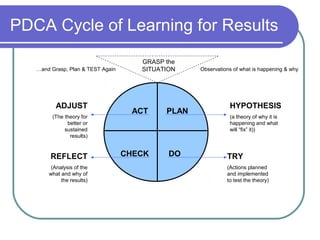
PDCA Cycle of Learning for Results
ACT PLAN
DOCHECK TRY
(Actions planned
and implemented
to test the theory)
REFLECT
(Analysis of the
what and why of
the results)
ADJUST
(The theory for
better or
sustained
results)
HYPOTHESIS
(a theory of why it is
happening and what
will “fix” it))
GRASP the
SITUATION…and Grasp, Plan & TEST Again Observations of what is happening & why
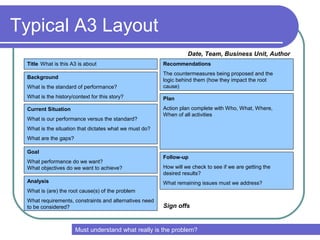
Typical A3 Layout
Title What is this A3 is about
Background
What is the standard of performance?
What is the history/context for this story?
Current Situation
What is our performance versus the standard?
What is the situation that dictates what we must do?
What are the gaps?
Goal
What performance do we want?
What objectives do we want to achieve?
Analysis
What is (are) the root cause(s) of the problem
What requirements, constraints and alternatives need
to be considered?
Recommendations
The countermeasures being proposed and the
logic behind them (how they impact the root
cause)
Plan
Action plan complete with Who, What, Where,
When of all activities
Follow-up
How will we check to see if we are getting the
desired results?
What remaining issues must we address?
Sign offs
Date, Team, Business Unit, Author
Must understand what really is the problem?
What is the “Right” Format?
 As varied as the problems
 As diverse as the people who will use it
 The focus needs to be on a rigorous thinking process
that leads to robust problem solving rather than a
standardized format for the “form”
The tool needs to be flexible!
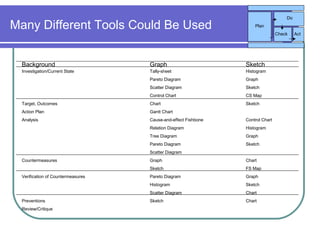
Many Different Tools Could Be Used
Background Graph Sketch
Investigation/Current State Tally-sheet Histogram
Pareto Diagram Graph
Scatter Diagram Sketch
Control Chart CS Map
Target, Outcomes Chart Sketch
Action Plan Gantt Chart
Analysis Cause-and-effect Fishbone Control Chart
Relation Diagram Histogram
Tree Diagram Graph
Pareto Diagram Sketch
Scatter Diagram
Countermeasures Graph Chart
Sketch FS Map
Verification of Countermeasures Pareto Diagram Graph
Histogram Sketch
Scatter Diagram Chart
Preventions Sketch Chart
Review/Critique
Plan
ActCheck
Do
A3 Discipline
 Stating the issue and why it is important
 Providing background to facilitate understanding
 Current performance and future goals
 Analysis and root cause
 Countermeasures and action plans
 Measurement and adjustment
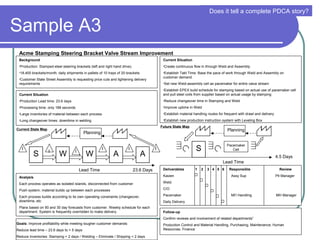
Sample A3
Acme Stamping Steering Bracket Valve Stream Improvement
Background
•Production: Stamped-steel steering brackets (left and right hand drive).
•18,400 brackets/month; daily shipments in pallets of 10 trays of 20 brackets
•Customer State Street Assembly is requesting price cuts and tightening delivery
requirements
Current Situation
•Production Lead time: 23.6 days
•Processing time: only 188 seconds
•Large inventories of material between each process
•Long changeover times: downtime in welding
Current State Map
S
II
I
I
I
I
WW A A
Planning
Lead Time 23.6 Days
Analysis
Each process operates as isolated islands, disconnected from customer
Push system; material builds up between each processes
Each process builds according to its own operating constraints (changeover,
downtime, etc
Plans based on 90 and 30 day forecasts from customer. Weekly schedule for each
department. System is frequently overridden to make delivery.
Goals: Improve profitability while meeting tougher customer demands:
Reduce lead time – 23.6 days to < 5 days
Reduce inventories: Stamping < 2 days / Welding – Eliminate / Shipping < 2 days
Current Situation
•Create continuous flow in through Weld and Assembly
•Establish Takt Time: Base the pace of work through Weld and Assembly on
customer demand
•Set new Weld-assembly cell as pacemaker for entire value stream
•Establish EPEX build schedule for stamping based on actual use of pacemaker cell
and pull steel coils from supplier based on actual usage by stamping
•Reduce changeover time in Stamping and Weld
•Improve uptime in Weld
•Establish material handling routes for frequent with drawl and delivery
•Establish new production instruction system with Leveling Box
Future State Map
Planning
S
Pacemaker
Cell
Lead Time
4.5 Days
Follow-up
Confirm reviews and involvement of related departments”
Production Control and Material Handling, Purchasing, Maintenance, Human
Resources, Finance
Deliverables 1 2 3 4 5 6 Responsible Review
Kaizen Assy Sup Plt Manager
Weld
C/O
Pacemaker Mt’l Handling MH Manager
Daily Delivery
Does it tell a complete PDCA story?
Avoid selling the solution in the background. State only the facts.
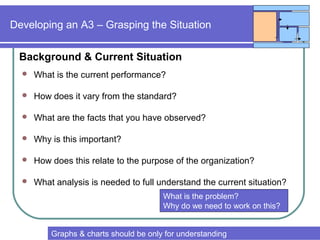
Developing an A3 – Grasping the Situation
 What is the current performance?
 How does it vary from the standard?
 What are the facts that you have observed?
 Why is this important?
 How does this relate to the purpose of the organization?
 What analysis is needed to full understand the current situation?
Background & Current Situation
What is the problem?
Why do we need to work on this?
Avoid broad statements. Should be specificGraphs & charts should be only for understanding
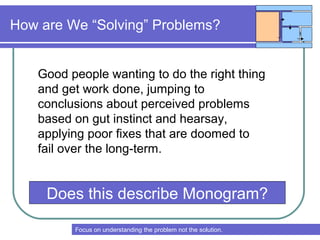
How are We “Solving” Problems?
Good people wanting to do the right thing
and get work done, jumping to
conclusions about perceived problems
based on gut instinct and hearsay,
applying poor fixes that are doomed to
fail over the long-term.
Does this describe Monogram?
Focus on understanding the problem not the solution.
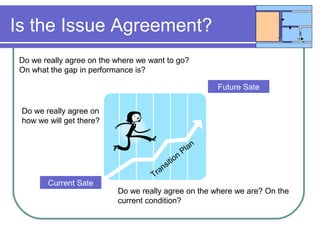
Is the Issue Agreement?
Do we really agree on the where we want to go?
On what the gap in performance is?
Do we really agree on
how we will get there?
Transition
Plan
Do we really agree on the where we are? On the
current condition?
Current Sate
Future Sate
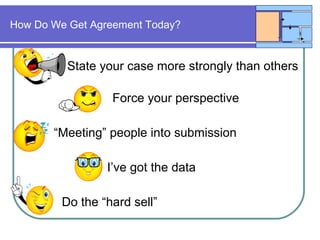
How Do We Get Agreement Today?
Do the “hard sell”
Force your perspective
State your case more strongly than others
“Meeting” people into submission
I’ve got the data
Engagement and Thinking
 Here is how I see things what about you?
 What am I missing?
 What do you think?
 What have you seen? “Gemba”
 How can we go see together?
Engaging Conversations
 Candor
 Disagreement surface early
 Informal dialogue
 Getting firsthand understanding
 Taking personalities out of the process
A3 as Storytelling
 The A3, it’s description of the issues, proposals and
plans must make sense to others
 The link between the actions and the issue need to be
based on the facts of the actual situation
 The story must be complete (PDCA)
 Your purpose is to get agreement that leads to action
(engagement rather than convincing)
Try to create common understanding & agreements to get good resultsAsk the deep “why” questions. Get down to the root cause
Key Questions
 Have you identified the gap between the current and future state?
 Did you go to the gemba – observe and talk to the people who do
the work in order to full grasp the situation?
 Did you clarify the true business objective(s)?
 Did you isolate the real root cause?
 Did you uncover the right information to support good analysis?
 Did you construct the A3 in the most clear and concise manner?
Do we really understand how this meets our objective?
Developing an A3 – Agreeing on a Plan
 What does performance need to be to fill the gap?
 Why aren’t we getting that performance today?
 What will it take to change our performance?
 What should our goal be for this issue?
 What tools/methods/process will we use to determine the root
cause and/or best solution?
 What is the root cause?
 What are the alternatives?
Goal and Analysis
Why this goal?
How do you know you fully understand
what needs to be done?
Some Common Problems in Planning
 We plan in terms of actions (tasks) rather than goals or objectives
 Responsibilities and the specifics of deliverables are not clear
 We plan in silos, out of context of the rest of organization or
operation
 We underestimate the time and effort required to implement
 We don’t make reviews part of the plan
Before You Get to implementing the Plan?
 What is the problem or issue?
 Who owns the problem?
 What is the root cause?
 What are some of the possible countermeasures?
 How will you decide which countermeasures to propose?
 How will you get agreement from everyone concerned?
Focus on the problem before you attempt to find countermeasures.Purpose is to create an understanding to get agreement.Are you working on the right problem to begin with?Think robustly about countermeasures. Don’t get locked into 1 countermeasure.
Developing an A3 – Proposing Action
 What is your recommendation /
countermeasure (make sure it relates to the
root cause)?
 What is the plan (who, what, where, when)?
 Gantt chart with exact timelines
 Deliverables
Why did you pick this countermeasure?
How do you know this will work?
How will you make sure it gets done?
Remember you are writing a story
Developing an A3 – Checking, Adjusting and Standardizing
 How will we know if the actions are delivering the expected
results (measurements, timing)?
 How will we make adjustments?
 How can we standardize the new processes once they are
working?
What have we learned?
How can we spread this learning?
How can we sustain the improvement?
 What other areas do we need to
look at?
 How do we review with everyone
and spread the lessons learned?
The Check on Your A3 Process
 Without the underlying management philosophy, without PDCA
as a discipline of the organization A3 can become just a new form
to display old thinking.
 Are we making better decisions and implementing them better
and faster?
 Are people more engaged in decision making? Is there more
candid dialogue?
 Is the focus on the process and the scientific method rather than
the idea or the person?
 Are we reducing the time to business results?
Summary A3 Process
 Structure effective and efficient dialogue to foster understanding
and reach agreement
17”
11” Plan
Heading
Footnotes
Do
Check Act
The Purpose of the A3 Process is to:

A3 Management Process

  • 1.
    A3 Management Process ProblemSolving and Continuous Improvement Methodology By: Kevin Jardim
  • 2.
    Organizational Life  It’sabout getting results  We have good projects, ideas, programs and initiatives often failing to achieve the desired results  Most important issues transcend functional or departmental boundaries  Results can only be achieved with the help and cooperation of others What is organizational life like today (current-state)?
  • 3.
    Is there lineoutside your office?  “The problem is we need the new software upgrade to be Movex compliant”  “We need to upgrade the machines with quick-change tooling as part of our lean implementation”  Our competitor has reduced prices and we need this sales promotion to prevent losing market share” With all the issues today how do get them aligned?
  • 4.
    A Lot ofGood Ideas  “I think we should increase new product development to beat the competition”  “I think we should outsource more to China to reduce our costs”  “I think we should trim the product line to get rid of the low margin, low runners” With all the good ideas today how do get them aligned?
  • 5.
    So Many Solutions! “We need to implement lean to reduce waste and improve efficiency”  “We need a new supply chain initiative to buy more from low cost countries and reduce cost from current suppliers”  We need to do 80/20 analysis to weed out low margin business With all the good solutions today how do get them aligned?
  • 6.
    How Do WeGet Aligned? A3 is a problem solving approach intended to align the issues, ideas and countermeasures
  • 7.
    A3 Discipline (keyconcepts)  States the issue and why it is important  Provides background to facilitate understanding  Current performance and future goals  Analysis and root cause  Countermeasures and action plans  Measurement and adjustment P D C A
  • 8.
    Three Keys toLean Leadership  Go See – Management must spent time on the front lines  Ask Why – Use the “Why?” technique daily  Show Respect – Respect your people. Let the people solve the problem. Not management. A3 should change the way we manage and think
  • 9.
    The A3 ManagementDiscipline A3 (PDCA) Story Board 17” 11” Plan Heading Footnotes Do Check Act Grasp the situation Try Reflect Hypothesis Adjust Cycles of learning and continuous work process improvement Notice the Planning section is large (focus on the plan (not the solution))
  • 10.
    A Format forPlanning and Proposing – A3  “A3” is just a paper size (international 11” X 17”)  A3 planning began in the 60s as the Quality Circle problem solving report-out format  At Toyota, it evolved to become the standard format for problem solving proposals, plans and status reviews  What is important is not the format, but rather the process and thinking behind it Again…A3 should be a way of thinking
  • 11.
    An A3 isa PDCA Story Board (not a form, not even a standardized format)  Adjust for the type of story being told (quality problem versus company strategy)  Always the four steps of Plan, Do, Check and Act/Adjust  No exact or specific look or format  The more visual the better (pictures, charts, no small print)  Fits on one page (use baby A3s for complicated stories)  Must flow as a story (visual story teller)
  • 12.
    A3 Process –The Scientific Method  Observe reality - “go see”  Presents facts  Proposed working countermeasures designed to achieve a stated goal  Gain agreement  Develop a plan for success  Follow-up with a process of checking and adjusting for actual results Forces individuals to: Toyota does not use the term solution. Countermeasures are thought to be experiments
  • 13.
    A3s Work atDifferent Levels  Individuals use A3 thinking to propose projects, take initiative, show ownership, sell ideas, gain agreement and learn  Managers use A3 to coach and teach, assign clear responsibility, ownership and accountability, get good plans from subordinates and mentor employees  An organization uses A3 thinking to get decisions made, to achieve objectives, to get things done, to align people and teams along common goals and to learn A3 is also used as a report out & instead of a 50 page PowerPointA3 can be used as a visual check of the processFor middle managers - A3 can be used to engage other departments
  • 14.
    The A3 Process It fosters dialogue within the organization  It develops thinking problem solvers  It encourages front-line initiative  It encourages PDCA  It clarifies the link between true problems and countermeasures  It serves as an organizational learning tool  It leads to results through effective countermeasures and solutions based on facts, data and analysis
  • 15.
    PDCA & A3s PDCA is the process to plan improvements and learn one’s way to successful implementation  PDCA thinking is used to propose and manage changes as experiments  A3 Storyboards are used to prepare and present the business case for proposed changes and/or countermeasures to problems  A3 process proactively seeks input and feedback to align proposed changes with priorities throughout the organization
  • 16.
    PDCA Cycle ofLearning for Results ACT PLAN DOCHECK TRY (Actions planned and implemented to test the theory) REFLECT (Analysis of the what and why of the results) ADJUST (The theory for better or sustained results) HYPOTHESIS (a theory of why it is happening and what will “fix” it)) GRASP the SITUATION…and Grasp, Plan & TEST Again Observations of what is happening & why
  • 17.
    Typical A3 Layout TitleWhat is this A3 is about Background What is the standard of performance? What is the history/context for this story? Current Situation What is our performance versus the standard? What is the situation that dictates what we must do? What are the gaps? Goal What performance do we want? What objectives do we want to achieve? Analysis What is (are) the root cause(s) of the problem What requirements, constraints and alternatives need to be considered? Recommendations The countermeasures being proposed and the logic behind them (how they impact the root cause) Plan Action plan complete with Who, What, Where, When of all activities Follow-up How will we check to see if we are getting the desired results? What remaining issues must we address? Sign offs Date, Team, Business Unit, Author Must understand what really is the problem?
  • 18.
    What is the“Right” Format?  As varied as the problems  As diverse as the people who will use it  The focus needs to be on a rigorous thinking process that leads to robust problem solving rather than a standardized format for the “form” The tool needs to be flexible!
  • 19.
    Many Different ToolsCould Be Used Background Graph Sketch Investigation/Current State Tally-sheet Histogram Pareto Diagram Graph Scatter Diagram Sketch Control Chart CS Map Target, Outcomes Chart Sketch Action Plan Gantt Chart Analysis Cause-and-effect Fishbone Control Chart Relation Diagram Histogram Tree Diagram Graph Pareto Diagram Sketch Scatter Diagram Countermeasures Graph Chart Sketch FS Map Verification of Countermeasures Pareto Diagram Graph Histogram Sketch Scatter Diagram Chart Preventions Sketch Chart Review/Critique Plan ActCheck Do
  • 20.
    A3 Discipline  Statingthe issue and why it is important  Providing background to facilitate understanding  Current performance and future goals  Analysis and root cause  Countermeasures and action plans  Measurement and adjustment
  • 21.
    Sample A3 Acme StampingSteering Bracket Valve Stream Improvement Background •Production: Stamped-steel steering brackets (left and right hand drive). •18,400 brackets/month; daily shipments in pallets of 10 trays of 20 brackets •Customer State Street Assembly is requesting price cuts and tightening delivery requirements Current Situation •Production Lead time: 23.6 days •Processing time: only 188 seconds •Large inventories of material between each process •Long changeover times: downtime in welding Current State Map S II I I I I WW A A Planning Lead Time 23.6 Days Analysis Each process operates as isolated islands, disconnected from customer Push system; material builds up between each processes Each process builds according to its own operating constraints (changeover, downtime, etc Plans based on 90 and 30 day forecasts from customer. Weekly schedule for each department. System is frequently overridden to make delivery. Goals: Improve profitability while meeting tougher customer demands: Reduce lead time – 23.6 days to < 5 days Reduce inventories: Stamping < 2 days / Welding – Eliminate / Shipping < 2 days Current Situation •Create continuous flow in through Weld and Assembly •Establish Takt Time: Base the pace of work through Weld and Assembly on customer demand •Set new Weld-assembly cell as pacemaker for entire value stream •Establish EPEX build schedule for stamping based on actual use of pacemaker cell and pull steel coils from supplier based on actual usage by stamping •Reduce changeover time in Stamping and Weld •Improve uptime in Weld •Establish material handling routes for frequent with drawl and delivery •Establish new production instruction system with Leveling Box Future State Map Planning S Pacemaker Cell Lead Time 4.5 Days Follow-up Confirm reviews and involvement of related departments” Production Control and Material Handling, Purchasing, Maintenance, Human Resources, Finance Deliverables 1 2 3 4 5 6 Responsible Review Kaizen Assy Sup Plt Manager Weld C/O Pacemaker Mt’l Handling MH Manager Daily Delivery Does it tell a complete PDCA story?
  • 22.
    Avoid selling thesolution in the background. State only the facts. Developing an A3 – Grasping the Situation  What is the current performance?  How does it vary from the standard?  What are the facts that you have observed?  Why is this important?  How does this relate to the purpose of the organization?  What analysis is needed to full understand the current situation? Background & Current Situation What is the problem? Why do we need to work on this? Avoid broad statements. Should be specificGraphs & charts should be only for understanding
  • 23.
    How are We“Solving” Problems? Good people wanting to do the right thing and get work done, jumping to conclusions about perceived problems based on gut instinct and hearsay, applying poor fixes that are doomed to fail over the long-term. Does this describe Monogram? Focus on understanding the problem not the solution.
  • 24.
    Is the IssueAgreement? Do we really agree on the where we want to go? On what the gap in performance is? Do we really agree on how we will get there? Transition Plan Do we really agree on the where we are? On the current condition? Current Sate Future Sate
  • 25.
    How Do WeGet Agreement Today? Do the “hard sell” Force your perspective State your case more strongly than others “Meeting” people into submission I’ve got the data
  • 26.
    Engagement and Thinking Here is how I see things what about you?  What am I missing?  What do you think?  What have you seen? “Gemba”  How can we go see together?
  • 27.
    Engaging Conversations  Candor Disagreement surface early  Informal dialogue  Getting firsthand understanding  Taking personalities out of the process
  • 28.
    A3 as Storytelling The A3, it’s description of the issues, proposals and plans must make sense to others  The link between the actions and the issue need to be based on the facts of the actual situation  The story must be complete (PDCA)  Your purpose is to get agreement that leads to action (engagement rather than convincing) Try to create common understanding & agreements to get good resultsAsk the deep “why” questions. Get down to the root cause
  • 29.
    Key Questions  Haveyou identified the gap between the current and future state?  Did you go to the gemba – observe and talk to the people who do the work in order to full grasp the situation?  Did you clarify the true business objective(s)?  Did you isolate the real root cause?  Did you uncover the right information to support good analysis?  Did you construct the A3 in the most clear and concise manner? Do we really understand how this meets our objective?
  • 30.
    Developing an A3– Agreeing on a Plan  What does performance need to be to fill the gap?  Why aren’t we getting that performance today?  What will it take to change our performance?  What should our goal be for this issue?  What tools/methods/process will we use to determine the root cause and/or best solution?  What is the root cause?  What are the alternatives? Goal and Analysis Why this goal? How do you know you fully understand what needs to be done?
  • 31.
    Some Common Problemsin Planning  We plan in terms of actions (tasks) rather than goals or objectives  Responsibilities and the specifics of deliverables are not clear  We plan in silos, out of context of the rest of organization or operation  We underestimate the time and effort required to implement  We don’t make reviews part of the plan
  • 32.
    Before You Getto implementing the Plan?  What is the problem or issue?  Who owns the problem?  What is the root cause?  What are some of the possible countermeasures?  How will you decide which countermeasures to propose?  How will you get agreement from everyone concerned? Focus on the problem before you attempt to find countermeasures.Purpose is to create an understanding to get agreement.Are you working on the right problem to begin with?Think robustly about countermeasures. Don’t get locked into 1 countermeasure.
  • 33.
    Developing an A3– Proposing Action  What is your recommendation / countermeasure (make sure it relates to the root cause)?  What is the plan (who, what, where, when)?  Gantt chart with exact timelines  Deliverables Why did you pick this countermeasure? How do you know this will work? How will you make sure it gets done? Remember you are writing a story
  • 34.
    Developing an A3– Checking, Adjusting and Standardizing  How will we know if the actions are delivering the expected results (measurements, timing)?  How will we make adjustments?  How can we standardize the new processes once they are working? What have we learned? How can we spread this learning? How can we sustain the improvement?  What other areas do we need to look at?  How do we review with everyone and spread the lessons learned?
  • 35.
    The Check onYour A3 Process  Without the underlying management philosophy, without PDCA as a discipline of the organization A3 can become just a new form to display old thinking.  Are we making better decisions and implementing them better and faster?  Are people more engaged in decision making? Is there more candid dialogue?  Is the focus on the process and the scientific method rather than the idea or the person?  Are we reducing the time to business results?
  • 36.
    Summary A3 Process Structure effective and efficient dialogue to foster understanding and reach agreement 17” 11” Plan Heading Footnotes Do Check Act The Purpose of the A3 Process is to: