Visual Inspection in Parenteral Drug
Products
1
Presentation By: Ms. Karishma Khemani (Quality Control Investigator)
Need of Visual Inspection
2
Product SISPQ
Pharmaceutical employees are expected to know, understand, and comply with the drug
manufacturing requirements that protect “product SISPQ”
S: Safety
I: Identity
S: Strength
P: Purity
Q: Quality
3
Why Inspect?
 Patient Risk Physiological Implications
 Chemical and Microbiological Implications
 Compendial Requirements
 Regulatory Requirements
 Process Knowledge and Continuous Process Improvement
4
5
What to inspect ?
To detect and eliminate defective units from the lot like -
 Extraneous Particulate matter in solution.
 Product precipitates.
 Sealing / crimping defects.
 Cracks / non-integral container-closure.
 Volume variations.
Regulatory requirement – “Injectable products should be essentially free from any visible particles” USP
<1>, <790> & <1790> , EP, JP.
Particulate Matter Concerns
 Patient Risk Factors to Consider: Particle Size Is the size in the range that will pass through the needle?
 Quantity Many vs. Single
 Composition Single 100 μm particle in 1mL dose is equivalent to an impurity level of 4 ppm (v/v)
Generally not a toxic concern
 Extrinsic vs. Intrinsic
 Inert?
 Biological?
6
What exactly is Visual Inspection ?
7
Visual Inspection
• Parenteral products must be visually inspected for defined
attributes.
• Every single drug container must be examined for container
defects and product defects.
• Defects are classified as critical, major and minor defects.
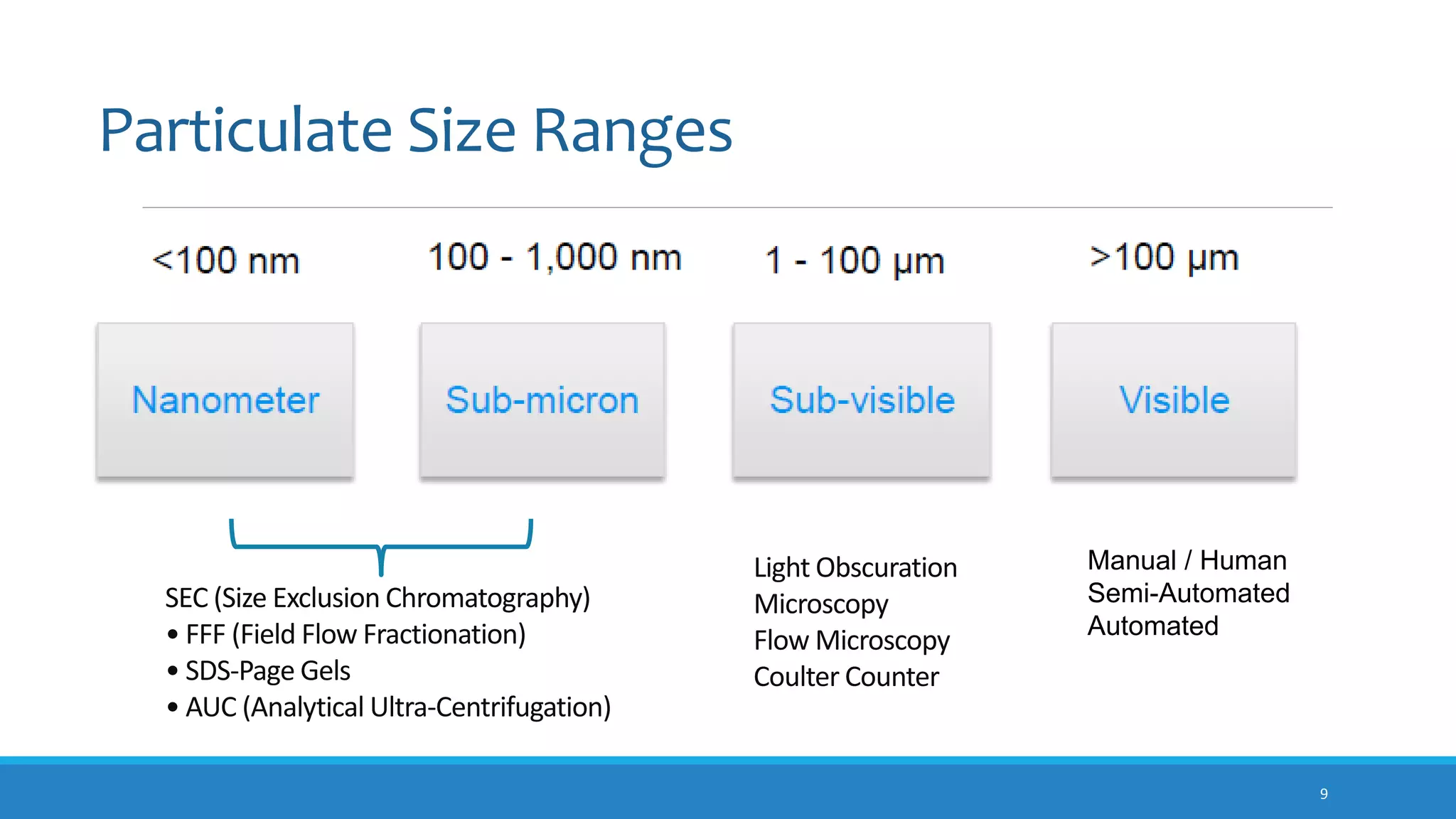
Particulate Size Ranges
9
SEC (Size Exclusion Chromatography)
• FFF (Field Flow Fractionation)
• SDS-Page Gels
• AUC (Analytical Ultra-Centrifugation)
Light Obscuration
Microscopy
Flow Microscopy
Coulter Counter
Manual / Human
Semi-Automated
Automated
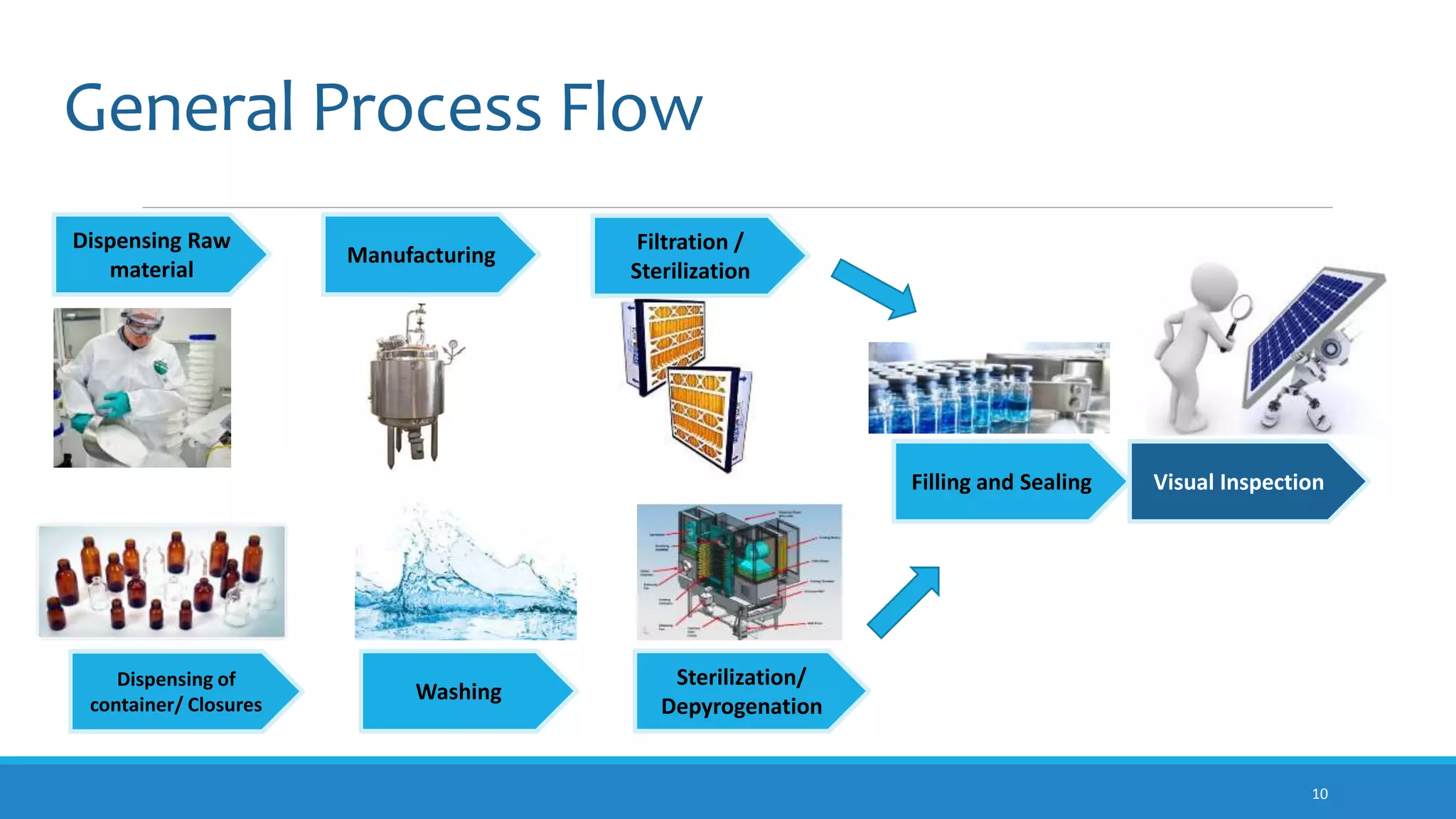
General Process Flow
10
Dispensing Raw
material
Visual InspectionFilling and Sealing
Sterilization/
Depyrogenation
Washing
Dispensing of
container/ Closures
Filtration /
Sterilization
Manufacturing
What does “essentially free” or “practically free”
mean?
 The goal is the production of product free of visible particles.
- This requires a well designed and run manufacturing and inspection processes.
- Inspection should not be a sorting process used to remove high quantities of unacceptable
product.
 100% inspection (human or machine) is needed to detect small quantities of randomly sourced
foreign material.
- 100% inspection (man or machine) is not 100% effective.
- Zero is not a practical limit.
11
Particle Family
12
Visible Particles
Extrinsic Intrinsic Inherent
Not part of product (or non
product contact).
From foreign and unexpected
sources.
Fibres (e.g., cellulous), clothing
fragments, hair, rubber, metal,
plastic, and paint.
Bioburden is unknown and
uncontrolled. Greater risk
Part of product / package
(product contact surfaces).
Known sources.
Glass, stainless steel,
rubber from stoppers, and
gasket material.
Can change in the product
over time.
Intrinsic to extrinsic
Expected from the drug
formulation.
Adjuvant material in
suspension products, certain
excipients in serum albumin,
proteinaceous aggregates.
Patient safety impacts should
be analysed.
Should be in specification
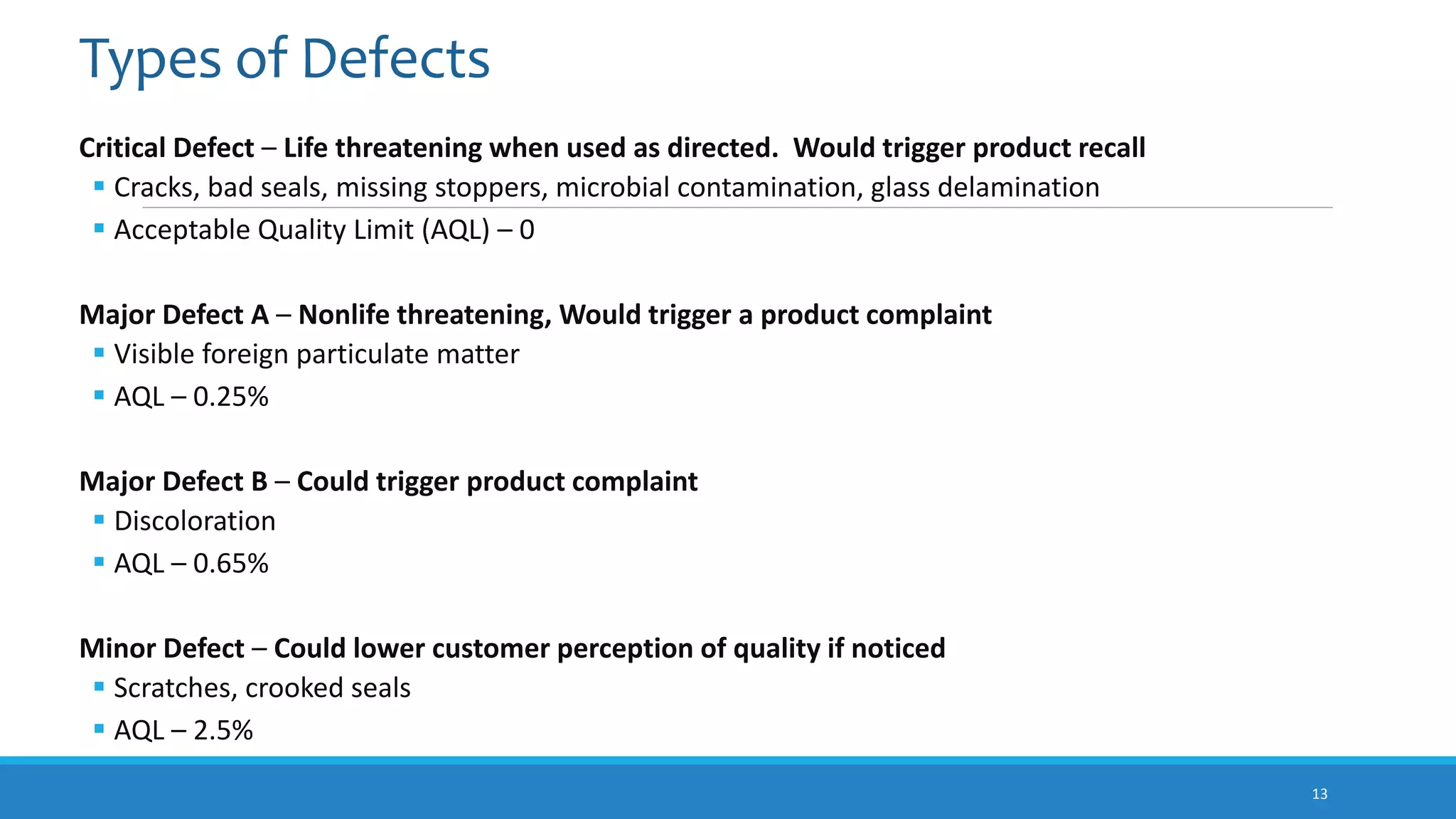
Types of Defects
Critical Defect – Life threatening when used as directed. Would trigger product recall
 Cracks, bad seals, missing stoppers, microbial contamination, glass delamination
 Acceptable Quality Limit (AQL) – 0
Major Defect A – Nonlife threatening, Would trigger a product complaint
 Visible foreign particulate matter
 AQL – 0.25%
Major Defect B – Could trigger product complaint
 Discoloration
 AQL – 0.65%
Minor Defect – Could lower customer perception of quality if noticed
 Scratches, crooked seals
 AQL – 2.5%
13
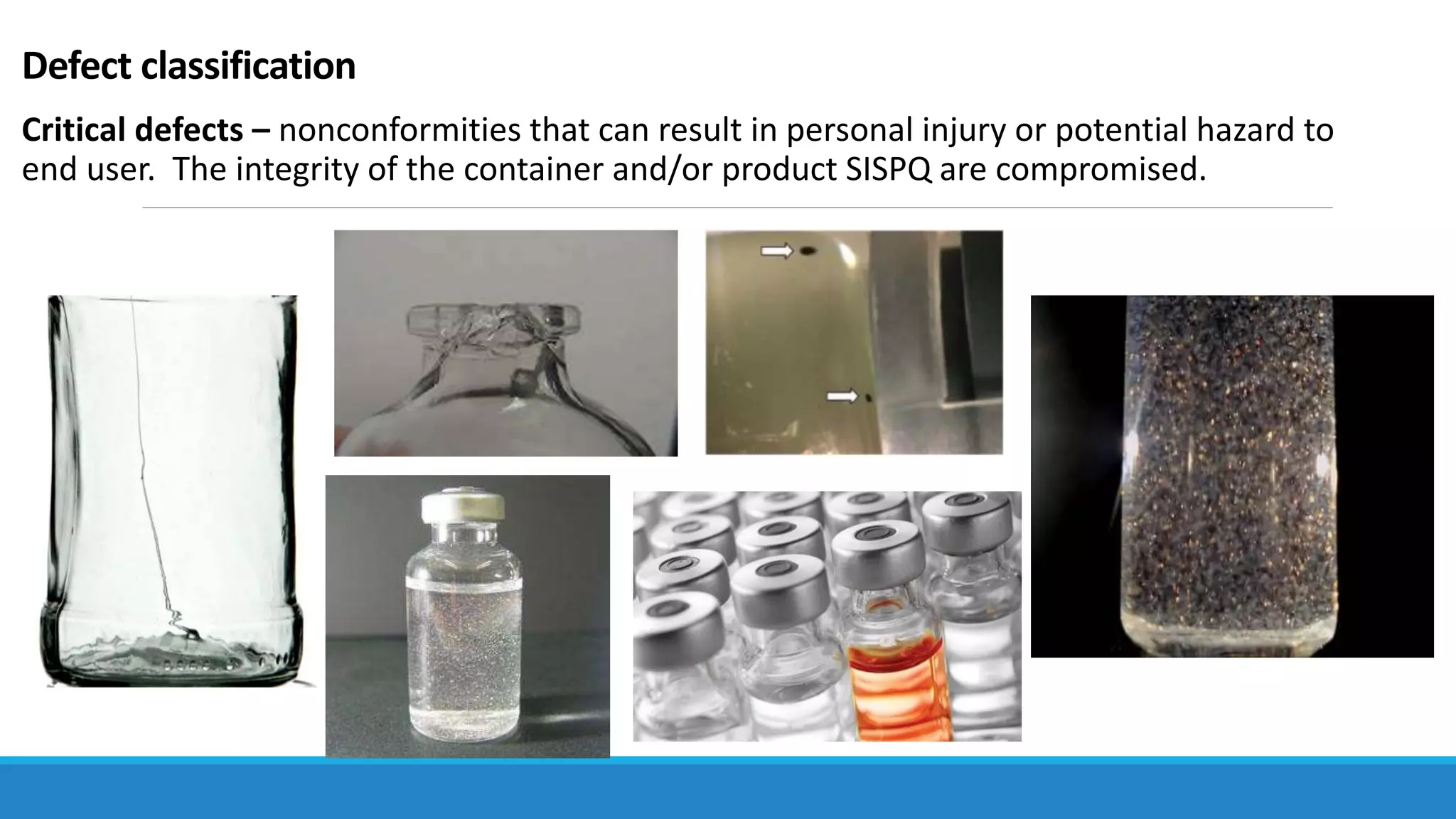
Defect classification
Critical defects – nonconformities that can result in personal injury or potential hazard to
end user. The integrity of the container and/or product SISPQ are compromised.
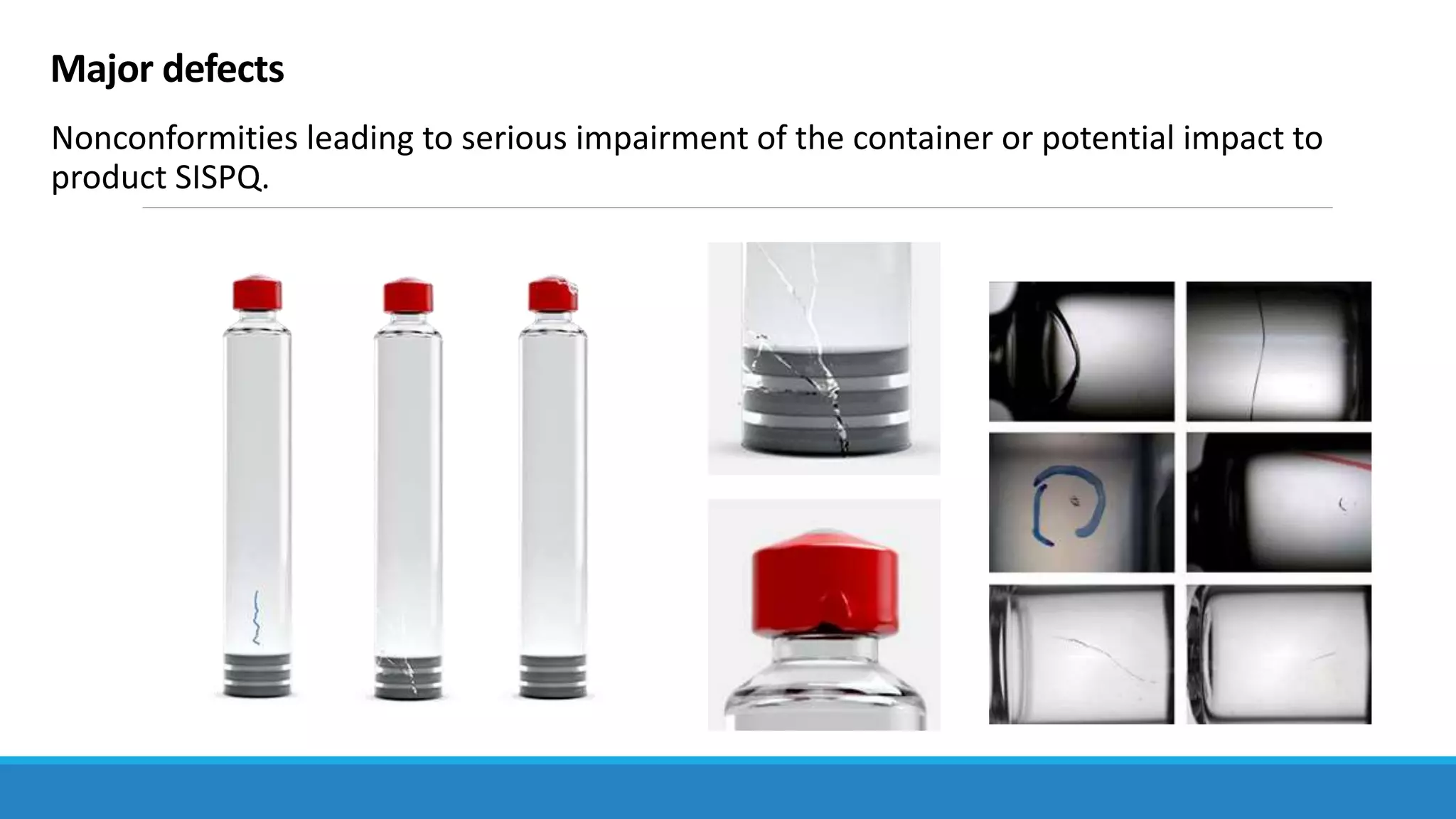
Major defects
Nonconformities leading to serious impairment of the container or potential impact to
product SISPQ.
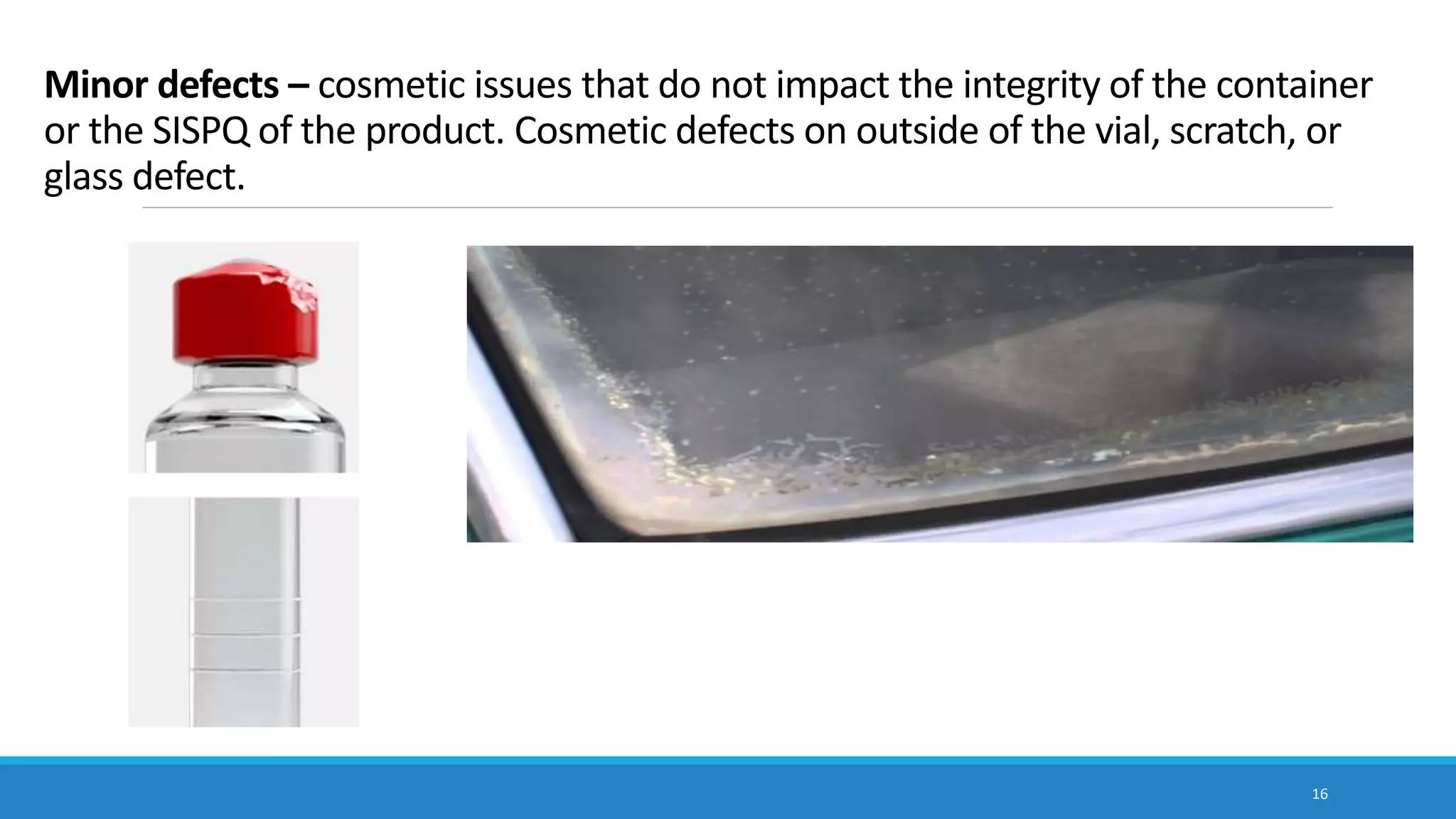
16
Minor defects – cosmetic issues that do not impact the integrity of the container
or the SISPQ of the product. Cosmetic defects on outside of the vial, scratch, or
glass defect.
17
Each of the defect categories is assigned a numerical value that represents the Acceptable
Quality Limit (AQL) : maximum number of each level of defect that can be found during
QA inspection without impacting overall batch quality.
The American National Standards Institute/American Society for Quality Control
(ANSI/ASQC) Z1.4-2008, Sampling Procedures and Tables for Inspection by Attributes is
the primary reference used for setting AQL levels.
What is AQL ?
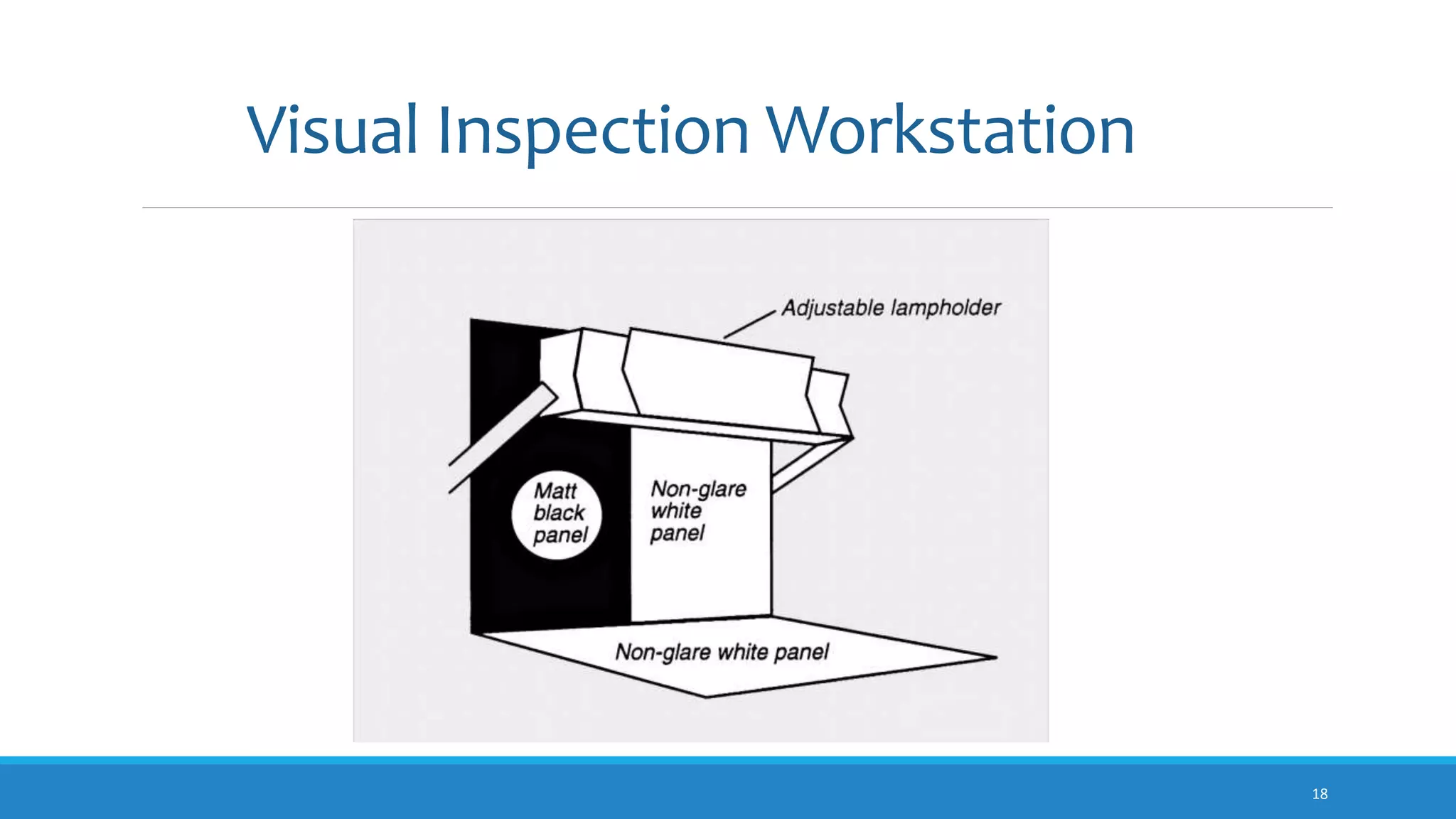
Visual Inspection Workstation
18
What is a “Visible particle”?
 Any definition of visibility must specify and control these critical variables:
- Illumination
Intensity
- Background
contrast
- Duration
Inspection time, rate or pace
- Agitation
Particle movement
19
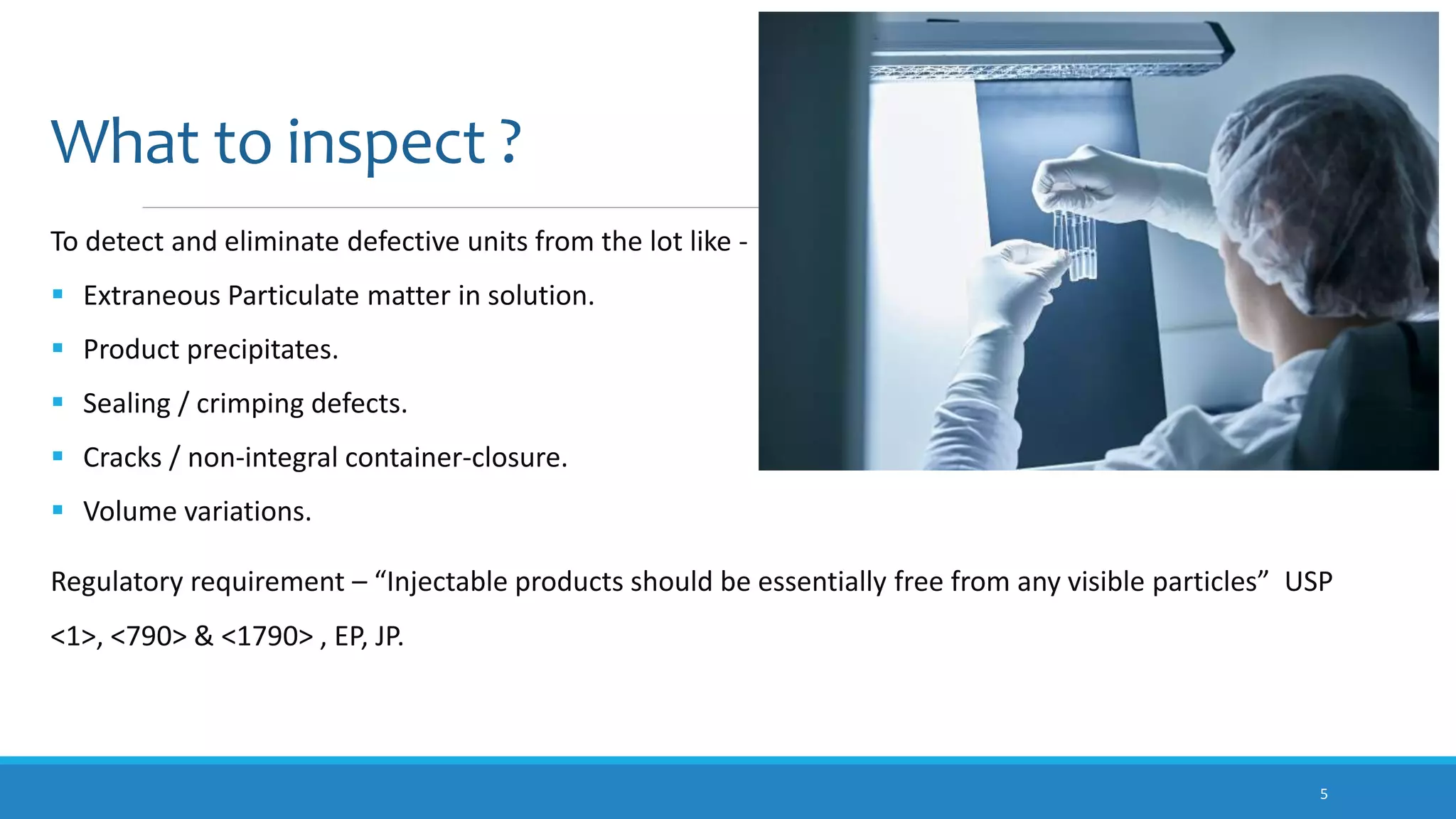
Manual Inspection
 An inspector physically picks up and examines the drug product
containers.
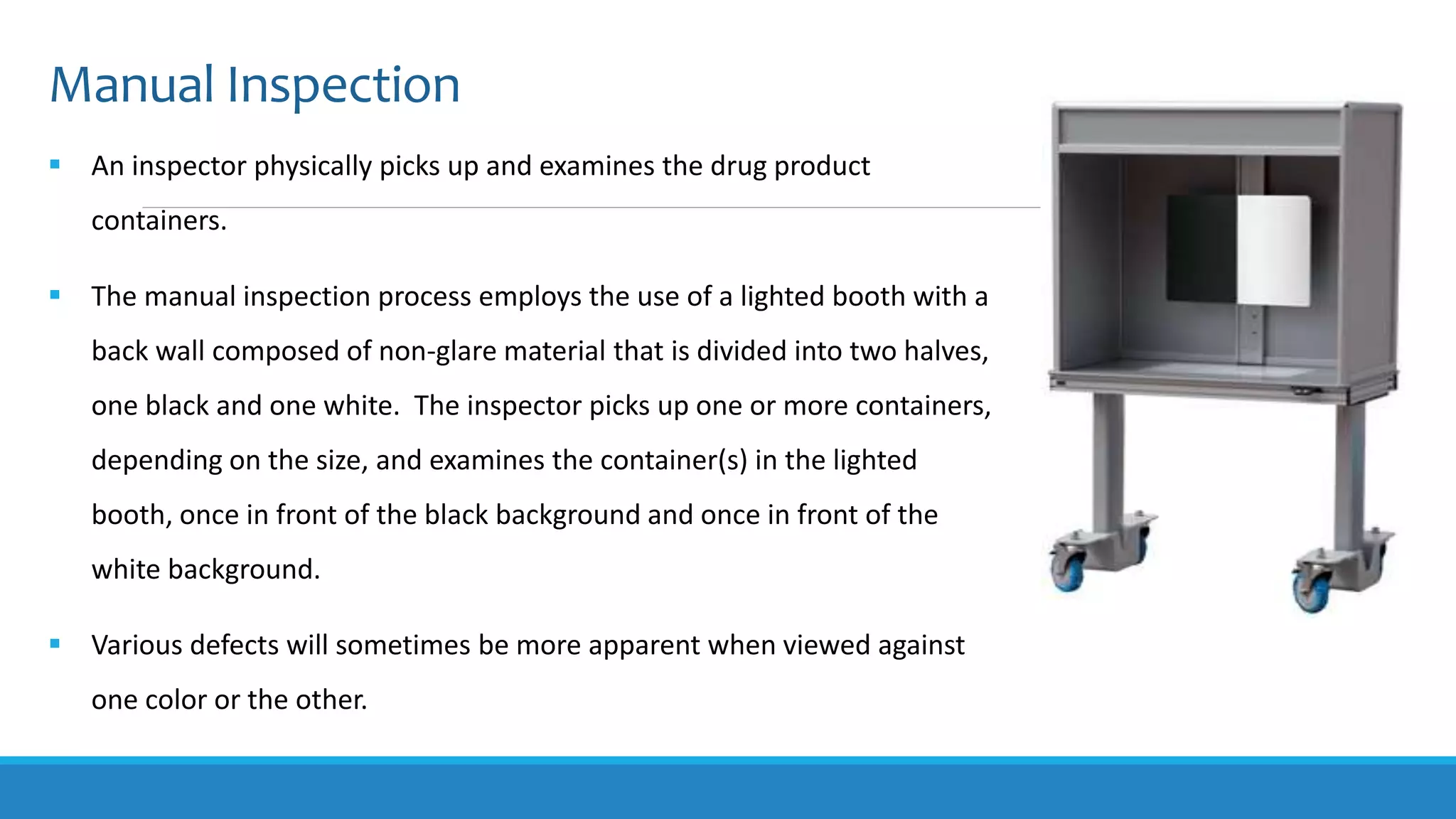
 The manual inspection process employs the use of a lighted booth with a
back wall composed of non-glare material that is divided into two halves,
one black and one white. The inspector picks up one or more containers,
depending on the size, and examines the container(s) in the lighted
booth, once in front of the black background and once in front of the
white background.
 Various defects will sometimes be more apparent when viewed against
one color or the other.
21
Manual Inspection (Cont…)
 The amount of time each container or set of containers is looked at should be limited and defined
within the inspection Standard Operating Procedure (SOP).
 Prolonged examination does not result in a better inspection; it generally results in a high level of false
rejects.
 Any containers having identified defects are rejected.
 Each defect is recorded in the appropriate category (critical, major, or minor).
 Inspectors must be properly trained and periodically recertified.
 Due to focus and concentration requirements, the maximum amount of time limit for inspection and
mandatory break are mandated.
22
 At the end of the inspection, the number of rejects is totaled.
 Limits for each defect type or overall defect limits vary to each manufacturer.
 Some have in-process limits that may trigger a tighter AQL (a larger sample set will be taken for the
AQL inspection).
 Others have limits for percentage of defects that may trigger an investigation if exceeded.
 There should be a mechanism in place to recognize and react to out-of-trend results that may
impact product quality.
Manual Inspection (Cont…)
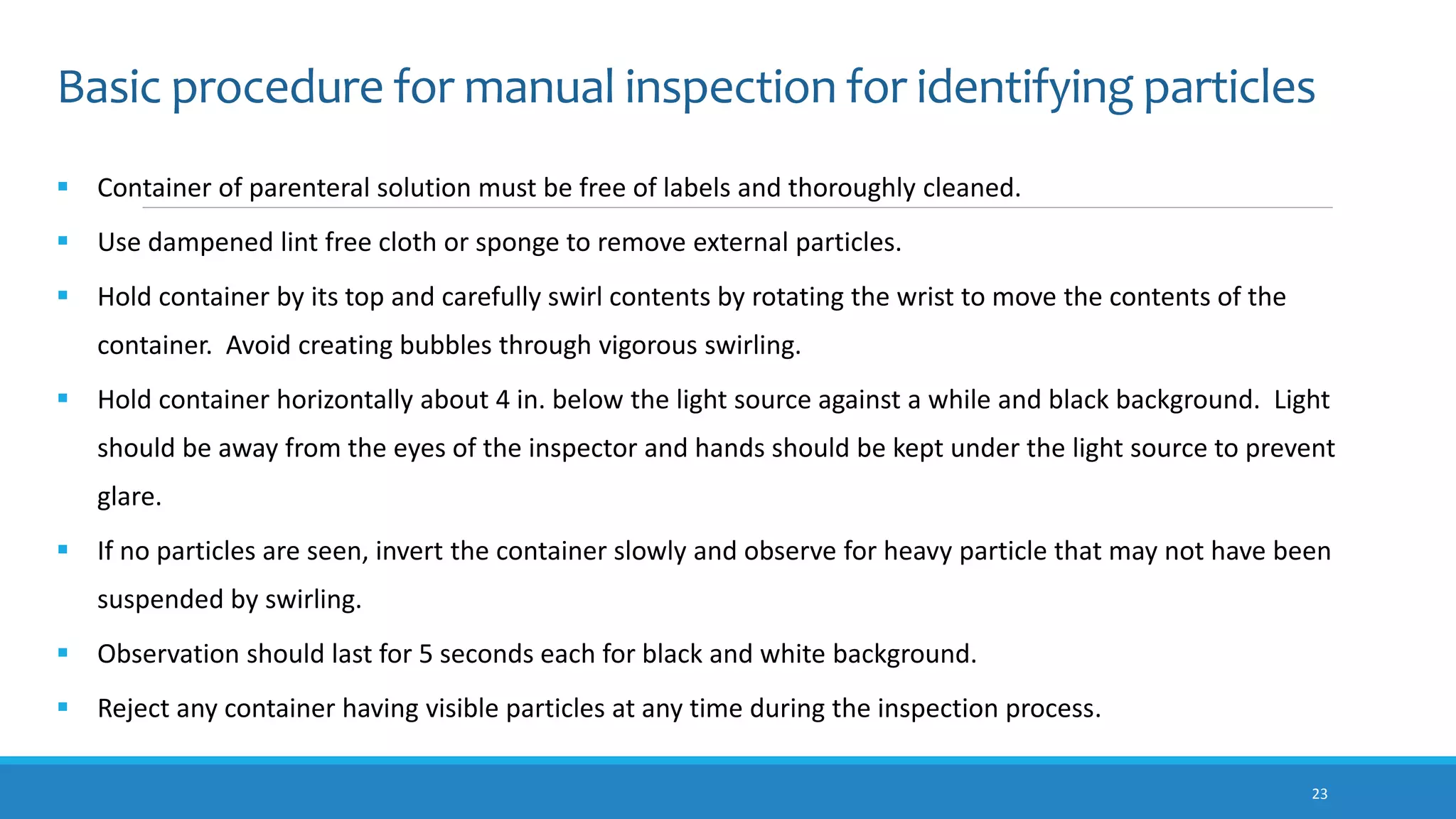
Basic procedure for manual inspection for identifying particles
 Container of parenteral solution must be free of labels and thoroughly cleaned.
 Use dampened lint free cloth or sponge to remove external particles.
 Hold container by its top and carefully swirl contents by rotating the wrist to move the contents of the
container. Avoid creating bubbles through vigorous swirling.
 Hold container horizontally about 4 in. below the light source against a while and black background. Light
should be away from the eyes of the inspector and hands should be kept under the light source to prevent
glare.
 If no particles are seen, invert the container slowly and observe for heavy particle that may not have been
suspended by swirling.
 Observation should last for 5 seconds each for black and white background.
 Reject any container having visible particles at any time during the inspection process.
23
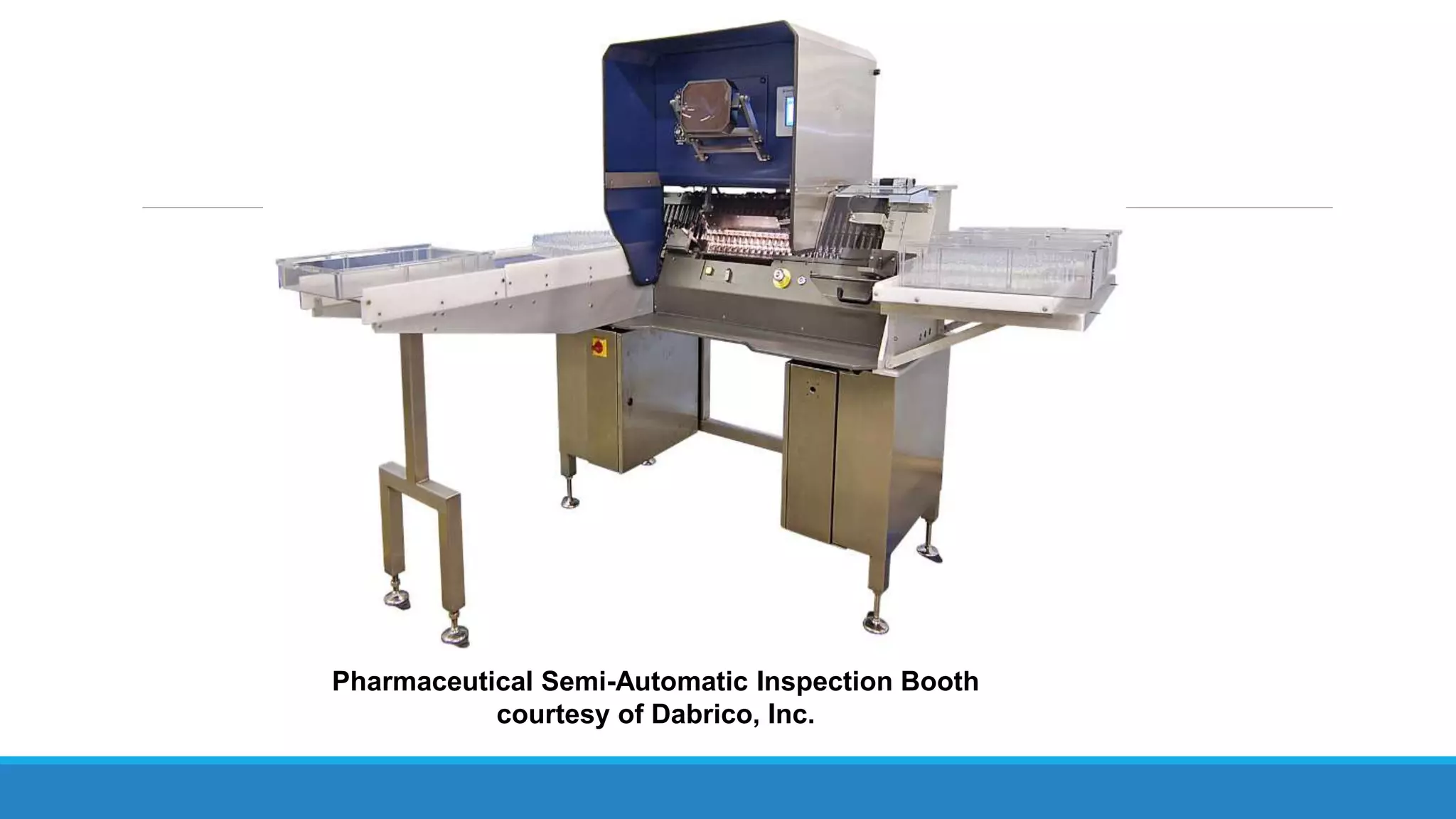
Semi-automated Inspection
 It is a manual inspection with an integrated conveyor and timing system.
 There are generally several booths linked together and the vials are delivered to the inspectors by the
conveyor.
 The vials travel down the conveyor and stop for the set inspection time.
 The inspector picks up the vials, performs the inspection in the lighted booth, and places them back on the
conveyer to proceed to traying off.
 This can increase efficiency as the inspectors do not have to handle a single tray at a time and the amount
of time spent inspecting each container/set of containers is more tightly controlled.
 Another advantage is that these systems generally include automated counting so that the inspectors do
not have to count the units inspected at the end of the process.
Pharmaceutical Semi-Automatic Inspection Booth
courtesy of Dabrico, Inc.
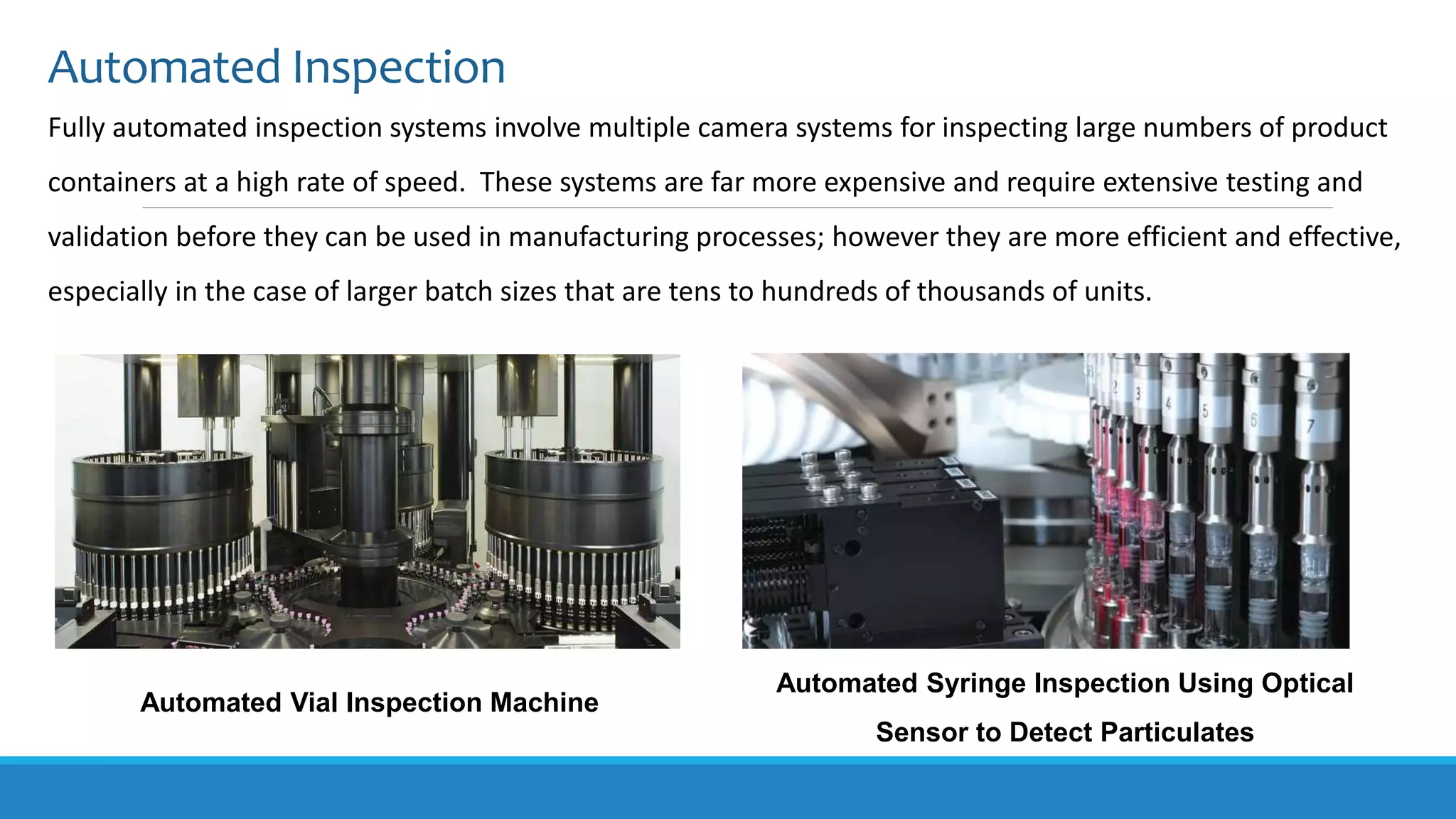
Automated Inspection
Fully automated inspection systems involve multiple camera systems for inspecting large numbers of product
containers at a high rate of speed. These systems are far more expensive and require extensive testing and
validation before they can be used in manufacturing processes; however they are more efficient and effective,
especially in the case of larger batch sizes that are tens to hundreds of thousands of units.
Automated Vial Inspection Machine
Automated Syringe Inspection Using Optical
Sensor to Detect Particulates
The Role of Visual Inspection in the Release of Parenterals
According to the requirements of pharmacopoeias (e.g. EU or US), batches of sterile injectables must be
100% visually inspected. This test, which is to be rated as an in-process control, must be validated; because of
its probabilistic nature. However, it is not 100% free from errors. That means that the discovery of defects like
particles, for example, is a question of probability. Visual inspection cannot rule out the presence of defects
in a tested batch. The higher one raises the probability of detection, the higher the so-called False Reject Rate
goes, meaning the rejection of actually error-free test pieces.
27
Now, how is one to handle the fact that the result of
an officially required batch test might not be 100%
correct?
For this, the US Pharmacopoeia intended an additional sampling inspection of containers which were found to be
adequate in chapter <790>. After much delay (because of US-internal discussions), the additional chapter <1790> was
published now, too. Intended are so-called AQL tests (acceptable quality limit). Depending on the number of
containers in a batch, a dictated AQL table defines the size of the sample, which is then visually inspected and in
which only a fixed number of defects may be found. The number thereby depends on the criticality of the defect. The
number of permitted critical defects in an AQL test should be 0, numbers permitted for major and minor defects are
also specified by the AQL limit. The USP set that limit at 0.65. This has the great advantage of making the
pharmacopoeia requirement measurable that batches of parenterals must be practically or essentially free of
particles.
28
Thanks
29

Visual Inspection of Parentetal Drug Products in Pharmaceutical Quality testing

  • 1.
    Visual Inspection inParenteral Drug Products 1 Presentation By: Ms. Karishma Khemani (Quality Control Investigator)
  • 2.
    Need of VisualInspection 2
  • 3.
    Product SISPQ Pharmaceutical employeesare expected to know, understand, and comply with the drug manufacturing requirements that protect “product SISPQ” S: Safety I: Identity S: Strength P: Purity Q: Quality 3
  • 4.
    Why Inspect?  PatientRisk Physiological Implications  Chemical and Microbiological Implications  Compendial Requirements  Regulatory Requirements  Process Knowledge and Continuous Process Improvement 4
  • 5.
    5 What to inspect? To detect and eliminate defective units from the lot like -  Extraneous Particulate matter in solution.  Product precipitates.  Sealing / crimping defects.  Cracks / non-integral container-closure.  Volume variations. Regulatory requirement – “Injectable products should be essentially free from any visible particles” USP <1>, <790> & <1790> , EP, JP.
  • 6.
    Particulate Matter Concerns Patient Risk Factors to Consider: Particle Size Is the size in the range that will pass through the needle?  Quantity Many vs. Single  Composition Single 100 μm particle in 1mL dose is equivalent to an impurity level of 4 ppm (v/v) Generally not a toxic concern  Extrinsic vs. Intrinsic  Inert?  Biological? 6
  • 7.
    What exactly isVisual Inspection ? 7
  • 8.
    Visual Inspection • Parenteralproducts must be visually inspected for defined attributes. • Every single drug container must be examined for container defects and product defects. • Defects are classified as critical, major and minor defects.
  • 9.
    Particulate Size Ranges 9 SEC(Size Exclusion Chromatography) • FFF (Field Flow Fractionation) • SDS-Page Gels • AUC (Analytical Ultra-Centrifugation) Light Obscuration Microscopy Flow Microscopy Coulter Counter Manual / Human Semi-Automated Automated
  • 10.
    General Process Flow 10 DispensingRaw material Visual InspectionFilling and Sealing Sterilization/ Depyrogenation Washing Dispensing of container/ Closures Filtration / Sterilization Manufacturing
  • 11.
    What does “essentiallyfree” or “practically free” mean?  The goal is the production of product free of visible particles. - This requires a well designed and run manufacturing and inspection processes. - Inspection should not be a sorting process used to remove high quantities of unacceptable product.  100% inspection (human or machine) is needed to detect small quantities of randomly sourced foreign material. - 100% inspection (man or machine) is not 100% effective. - Zero is not a practical limit. 11
  • 12.
    Particle Family 12 Visible Particles ExtrinsicIntrinsic Inherent Not part of product (or non product contact). From foreign and unexpected sources. Fibres (e.g., cellulous), clothing fragments, hair, rubber, metal, plastic, and paint. Bioburden is unknown and uncontrolled. Greater risk Part of product / package (product contact surfaces). Known sources. Glass, stainless steel, rubber from stoppers, and gasket material. Can change in the product over time. Intrinsic to extrinsic Expected from the drug formulation. Adjuvant material in suspension products, certain excipients in serum albumin, proteinaceous aggregates. Patient safety impacts should be analysed. Should be in specification
  • 13.
    Types of Defects CriticalDefect – Life threatening when used as directed. Would trigger product recall  Cracks, bad seals, missing stoppers, microbial contamination, glass delamination  Acceptable Quality Limit (AQL) – 0 Major Defect A – Nonlife threatening, Would trigger a product complaint  Visible foreign particulate matter  AQL – 0.25% Major Defect B – Could trigger product complaint  Discoloration  AQL – 0.65% Minor Defect – Could lower customer perception of quality if noticed  Scratches, crooked seals  AQL – 2.5% 13
  • 14.
    Defect classification Critical defects– nonconformities that can result in personal injury or potential hazard to end user. The integrity of the container and/or product SISPQ are compromised.
  • 15.
    Major defects Nonconformities leadingto serious impairment of the container or potential impact to product SISPQ.
  • 16.
    16 Minor defects –cosmetic issues that do not impact the integrity of the container or the SISPQ of the product. Cosmetic defects on outside of the vial, scratch, or glass defect.
  • 17.
    17 Each of thedefect categories is assigned a numerical value that represents the Acceptable Quality Limit (AQL) : maximum number of each level of defect that can be found during QA inspection without impacting overall batch quality. The American National Standards Institute/American Society for Quality Control (ANSI/ASQC) Z1.4-2008, Sampling Procedures and Tables for Inspection by Attributes is the primary reference used for setting AQL levels. What is AQL ?
  • 18.
  • 19.
    What is a“Visible particle”?  Any definition of visibility must specify and control these critical variables: - Illumination Intensity - Background contrast - Duration Inspection time, rate or pace - Agitation Particle movement 19
  • 20.
    Manual Inspection  Aninspector physically picks up and examines the drug product containers.  The manual inspection process employs the use of a lighted booth with a back wall composed of non-glare material that is divided into two halves, one black and one white. The inspector picks up one or more containers, depending on the size, and examines the container(s) in the lighted booth, once in front of the black background and once in front of the white background.  Various defects will sometimes be more apparent when viewed against one color or the other.
  • 21.
    21 Manual Inspection (Cont…) The amount of time each container or set of containers is looked at should be limited and defined within the inspection Standard Operating Procedure (SOP).  Prolonged examination does not result in a better inspection; it generally results in a high level of false rejects.  Any containers having identified defects are rejected.  Each defect is recorded in the appropriate category (critical, major, or minor).  Inspectors must be properly trained and periodically recertified.  Due to focus and concentration requirements, the maximum amount of time limit for inspection and mandatory break are mandated.
  • 22.
    22  At theend of the inspection, the number of rejects is totaled.  Limits for each defect type or overall defect limits vary to each manufacturer.  Some have in-process limits that may trigger a tighter AQL (a larger sample set will be taken for the AQL inspection).  Others have limits for percentage of defects that may trigger an investigation if exceeded.  There should be a mechanism in place to recognize and react to out-of-trend results that may impact product quality. Manual Inspection (Cont…)
  • 23.
    Basic procedure formanual inspection for identifying particles  Container of parenteral solution must be free of labels and thoroughly cleaned.  Use dampened lint free cloth or sponge to remove external particles.  Hold container by its top and carefully swirl contents by rotating the wrist to move the contents of the container. Avoid creating bubbles through vigorous swirling.  Hold container horizontally about 4 in. below the light source against a while and black background. Light should be away from the eyes of the inspector and hands should be kept under the light source to prevent glare.  If no particles are seen, invert the container slowly and observe for heavy particle that may not have been suspended by swirling.  Observation should last for 5 seconds each for black and white background.  Reject any container having visible particles at any time during the inspection process. 23
  • 24.
    Semi-automated Inspection  Itis a manual inspection with an integrated conveyor and timing system.  There are generally several booths linked together and the vials are delivered to the inspectors by the conveyor.  The vials travel down the conveyor and stop for the set inspection time.  The inspector picks up the vials, performs the inspection in the lighted booth, and places them back on the conveyer to proceed to traying off.  This can increase efficiency as the inspectors do not have to handle a single tray at a time and the amount of time spent inspecting each container/set of containers is more tightly controlled.  Another advantage is that these systems generally include automated counting so that the inspectors do not have to count the units inspected at the end of the process.
  • 25.
    Pharmaceutical Semi-Automatic InspectionBooth courtesy of Dabrico, Inc.
  • 26.
    Automated Inspection Fully automatedinspection systems involve multiple camera systems for inspecting large numbers of product containers at a high rate of speed. These systems are far more expensive and require extensive testing and validation before they can be used in manufacturing processes; however they are more efficient and effective, especially in the case of larger batch sizes that are tens to hundreds of thousands of units. Automated Vial Inspection Machine Automated Syringe Inspection Using Optical Sensor to Detect Particulates
  • 27.
    The Role ofVisual Inspection in the Release of Parenterals According to the requirements of pharmacopoeias (e.g. EU or US), batches of sterile injectables must be 100% visually inspected. This test, which is to be rated as an in-process control, must be validated; because of its probabilistic nature. However, it is not 100% free from errors. That means that the discovery of defects like particles, for example, is a question of probability. Visual inspection cannot rule out the presence of defects in a tested batch. The higher one raises the probability of detection, the higher the so-called False Reject Rate goes, meaning the rejection of actually error-free test pieces. 27
  • 28.
    Now, how isone to handle the fact that the result of an officially required batch test might not be 100% correct? For this, the US Pharmacopoeia intended an additional sampling inspection of containers which were found to be adequate in chapter <790>. After much delay (because of US-internal discussions), the additional chapter <1790> was published now, too. Intended are so-called AQL tests (acceptable quality limit). Depending on the number of containers in a batch, a dictated AQL table defines the size of the sample, which is then visually inspected and in which only a fixed number of defects may be found. The number thereby depends on the criticality of the defect. The number of permitted critical defects in an AQL test should be 0, numbers permitted for major and minor defects are also specified by the AQL limit. The USP set that limit at 0.65. This has the great advantage of making the pharmacopoeia requirement measurable that batches of parenterals must be practically or essentially free of particles. 28
  • 29.