Ethics in Clinical Practice
KABIRU MUHAMMAD KANI AMLSCN,
08038741550
Haematology and Blood Bank, Laboratory department,
Federal Medical Centre, Birnin Kudu
6th September, 2017
ETHICS
Character, custom, principles or
standards of human conduct,
• It is also referred to as moral
• According to Websters’s dictionary,
Ethics is a concept that deals with
moral issues of good and bad, based on
social norms.
• It’s the code written or unwritten that
guides the behaviour of human beings.
Professional Ethics (CLINICAL)
• It is a set of moral code of
conducts that guides professionals
in the practical management of
patients.
Professional Ethics: Needs
1. Have clear boundaries
2. Have commonly acceptable norms
3. Enhance respect within and outside the profession
4. Protect the RIGHTS of the client/patient
5. Protect the RIGHTS and privileges of the professional
Physiopedia
Clinical Ethics: Principles
1. Autonomy
2. Beneficence
3. Justice
4. Non-maleficence
5. Confidentiality
6. Dissipation of knowledge to client
Raja et.al
Clinical Ethics: CODES (clients)
MLSCN, NMCN, PCN, MDCN, MRTBN, HIM codes,
• Ensure the clients’ well being is placed above
personal interests.
• Every practitioner shall be personally accountable
for the quality and integrity of care given to
clients/Pts
• Exercise professional judgment, skill and care.
• Practice within the scope of one’s professional
competence.
• Where service is beyond one’s capacity, she/he
should summon another professional with
necessary capacity
• Practice the principle of Informed consent in
patient’s care.
• Maintain professional integrity and respect to all
patients with regard to their age, sex, culture,
religion and ethnicity.
• Maintain strict confidentiality on all information
gained during practice and protect the patient’s
right to privacy.
• Reject bribery in all its forms
Medical laboratory scientists
MLSCN codes
• Ensure that tests are done with a high level of
accuracy and timeliness.
• Be honest and realistic in reporting test results or
based on available data
• All experimental studies, genetics or reproductive
issues should comply with the institutional ethical
standards and where such do not exist should
comply with state or national ethical standards.
Physicians and Physiotherapists
• A physician shall give emergency care as a
humanitarian duty, unless he is sure that others
are willing and capable to give such care
• Under normal circumstance, Rx of radical
nature such as surgery or blood transfusion can
be given to Pt of full age and sane faculty ONLY
with his valid consent
MDCN codes, MRTB & Babalola (MDPDT-supreme court)
Nurses and Midwives
• Be punctual to duty and hand over
patients and equipment physically after
duty
• Switch off handsets/telephones while
giving care to clients/Pts
• Avoid the use of self in advertisement,
promotion or sale of commercial products
or services and illicit trade.
NMCN codes
Pharmacists
• Pharmacist should provide to each Pt relevant
information on drugs and medicinal products
• Any drug or medicine likely to be abused and
which may be detrimental to health should not
be supplied to a Pt when there is no reason to
believe that the drug or medicine is required for
such purpose
PCN codes
Private practice
• A registered practitioner in full time employment in
the public service shall not engage himself in extra-
mural private practice during official duty time under
any circumstance.
However,
• 5th schedule, Part I: (code of conduct for public
officers) section 2 (b) states that: A public officer
employed on full-time basis shall NOT engage or
participate in any private business, profession or
trade…FARMING
MLSCN, MDCN, 1999 Const. FRN
Ethical Obligations In Cases
• Confidentiality: Why?
– Public knowledge of health records can cause
discrimination and embarrassment
– Required by law and professional code, a breach
of which can lead to disciplinary and legal action
against an organization and employee
Ethical Obligations In Cases
• Confidentiality: What is covered?
– Personal information that can identify a pt
– Treatment information
– Details about illness and/or diagnosis
– Medical Record
– Conversation btw clinician and Pt and/or family.
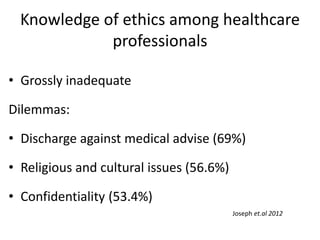
Knowledge of ethics among healthcare
professionals
• Grossly inadequate
Dilemmas:
• Discharge against medical advise (69%)
• Religious and cultural issues (56.6%)
• Confidentiality (53.4%)
Joseph et.al 2012
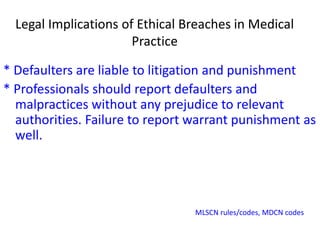
Legal Implications of Ethical Breaches in Medical
Practice
* Defaulters are liable to litigation and punishment
* Professionals should report defaulters and
malpractices without any prejudice to relevant
authorities. Failure to report warrant punishment as
well.
MLSCN rules/codes, MDCN codes
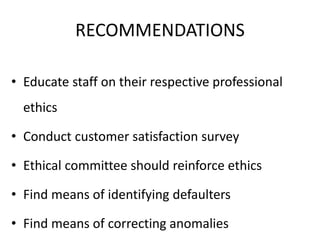
RECOMMENDATIONS
• Educate staff on their respective professional
ethics
• Conduct customer satisfaction survey
• Ethical committee should reinforce ethics
• Find means of identifying defaulters
• Find means of correcting anomalies
•COMMENTS!
• CONTRIBUTIONS!
Thank you
•QUESTIONS!!!
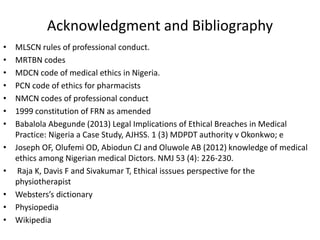
Acknowledgment and Bibliography
• MLSCN rules of professional conduct.
• MRTBN codes
• MDCN code of medical ethics in Nigeria.
• PCN code of ethics for pharmacists
• NMCN codes of professional conduct
• 1999 constitution of FRN as amended
• Babalola Abegunde (2013) Legal Implications of Ethical Breaches in Medical
Practice: Nigeria a Case Study, AJHSS. 1 (3) MDPDT authority v Okonkwo; e
• Joseph OF, Olufemi OD, Abiodun CJ and Oluwole AB (2012) knowledge of medical
ethics among Nigerian medical Dictors. NMJ 53 (4): 226-230.
• Raja K, Davis F and Sivakumar T, Ethical isssues perspective for the
physiotherapist
• Websters’s dictionary
• Physiopedia
• Wikipedia

Ethics in clinical practice

  • 1.
    Ethics in ClinicalPractice KABIRU MUHAMMAD KANI AMLSCN, 08038741550 Haematology and Blood Bank, Laboratory department, Federal Medical Centre, Birnin Kudu 6th September, 2017
  • 2.
    ETHICS Character, custom, principlesor standards of human conduct, • It is also referred to as moral
  • 3.
    • According toWebsters’s dictionary, Ethics is a concept that deals with moral issues of good and bad, based on social norms. • It’s the code written or unwritten that guides the behaviour of human beings.
  • 4.
    Professional Ethics (CLINICAL) •It is a set of moral code of conducts that guides professionals in the practical management of patients.
  • 5.
    Professional Ethics: Needs 1.Have clear boundaries 2. Have commonly acceptable norms 3. Enhance respect within and outside the profession 4. Protect the RIGHTS of the client/patient 5. Protect the RIGHTS and privileges of the professional Physiopedia
  • 6.
    Clinical Ethics: Principles 1.Autonomy 2. Beneficence 3. Justice 4. Non-maleficence 5. Confidentiality 6. Dissipation of knowledge to client Raja et.al
  • 7.
    Clinical Ethics: CODES(clients) MLSCN, NMCN, PCN, MDCN, MRTBN, HIM codes, • Ensure the clients’ well being is placed above personal interests. • Every practitioner shall be personally accountable for the quality and integrity of care given to clients/Pts • Exercise professional judgment, skill and care.
  • 8.
    • Practice withinthe scope of one’s professional competence. • Where service is beyond one’s capacity, she/he should summon another professional with necessary capacity • Practice the principle of Informed consent in patient’s care.
  • 9.
    • Maintain professionalintegrity and respect to all patients with regard to their age, sex, culture, religion and ethnicity. • Maintain strict confidentiality on all information gained during practice and protect the patient’s right to privacy. • Reject bribery in all its forms
  • 10.
    Medical laboratory scientists MLSCNcodes • Ensure that tests are done with a high level of accuracy and timeliness. • Be honest and realistic in reporting test results or based on available data • All experimental studies, genetics or reproductive issues should comply with the institutional ethical standards and where such do not exist should comply with state or national ethical standards.
  • 11.
    Physicians and Physiotherapists •A physician shall give emergency care as a humanitarian duty, unless he is sure that others are willing and capable to give such care • Under normal circumstance, Rx of radical nature such as surgery or blood transfusion can be given to Pt of full age and sane faculty ONLY with his valid consent MDCN codes, MRTB & Babalola (MDPDT-supreme court)
  • 12.
    Nurses and Midwives •Be punctual to duty and hand over patients and equipment physically after duty • Switch off handsets/telephones while giving care to clients/Pts • Avoid the use of self in advertisement, promotion or sale of commercial products or services and illicit trade. NMCN codes
  • 13.
    Pharmacists • Pharmacist shouldprovide to each Pt relevant information on drugs and medicinal products • Any drug or medicine likely to be abused and which may be detrimental to health should not be supplied to a Pt when there is no reason to believe that the drug or medicine is required for such purpose PCN codes
  • 14.
    Private practice • Aregistered practitioner in full time employment in the public service shall not engage himself in extra- mural private practice during official duty time under any circumstance. However, • 5th schedule, Part I: (code of conduct for public officers) section 2 (b) states that: A public officer employed on full-time basis shall NOT engage or participate in any private business, profession or trade…FARMING MLSCN, MDCN, 1999 Const. FRN
  • 15.
    Ethical Obligations InCases • Confidentiality: Why? – Public knowledge of health records can cause discrimination and embarrassment – Required by law and professional code, a breach of which can lead to disciplinary and legal action against an organization and employee
  • 16.
    Ethical Obligations InCases • Confidentiality: What is covered? – Personal information that can identify a pt – Treatment information – Details about illness and/or diagnosis – Medical Record – Conversation btw clinician and Pt and/or family.
  • 17.
    Knowledge of ethicsamong healthcare professionals • Grossly inadequate Dilemmas: • Discharge against medical advise (69%) • Religious and cultural issues (56.6%) • Confidentiality (53.4%) Joseph et.al 2012
  • 18.
    Legal Implications ofEthical Breaches in Medical Practice * Defaulters are liable to litigation and punishment * Professionals should report defaulters and malpractices without any prejudice to relevant authorities. Failure to report warrant punishment as well. MLSCN rules/codes, MDCN codes
  • 19.
    RECOMMENDATIONS • Educate staffon their respective professional ethics • Conduct customer satisfaction survey • Ethical committee should reinforce ethics • Find means of identifying defaulters • Find means of correcting anomalies
  • 20.
  • 21.
    Acknowledgment and Bibliography •MLSCN rules of professional conduct. • MRTBN codes • MDCN code of medical ethics in Nigeria. • PCN code of ethics for pharmacists • NMCN codes of professional conduct • 1999 constitution of FRN as amended • Babalola Abegunde (2013) Legal Implications of Ethical Breaches in Medical Practice: Nigeria a Case Study, AJHSS. 1 (3) MDPDT authority v Okonkwo; e • Joseph OF, Olufemi OD, Abiodun CJ and Oluwole AB (2012) knowledge of medical ethics among Nigerian medical Dictors. NMJ 53 (4): 226-230. • Raja K, Davis F and Sivakumar T, Ethical isssues perspective for the physiotherapist • Websters’s dictionary • Physiopedia • Wikipedia