GEOMETRY
Mathematics
SUBTOPICS
•Points, Lines, Planes and Angles
•Parallel
•Triangles
•Trigonometry
•Quadrilateral
• A point in geometry is a location. It has no size i.e. no width, no length
and no depth. A point is shown by a dot.
A line is defined as a line of points that extends infinitely in two
directions. It has one dimension, length. Points that are on the same
line are called collinear points.
•Two lines that are stretched into
infinity and still never intersect are
called coplanar lines and are said to
be parallel lines. The symbol for
“parallel to” is //.
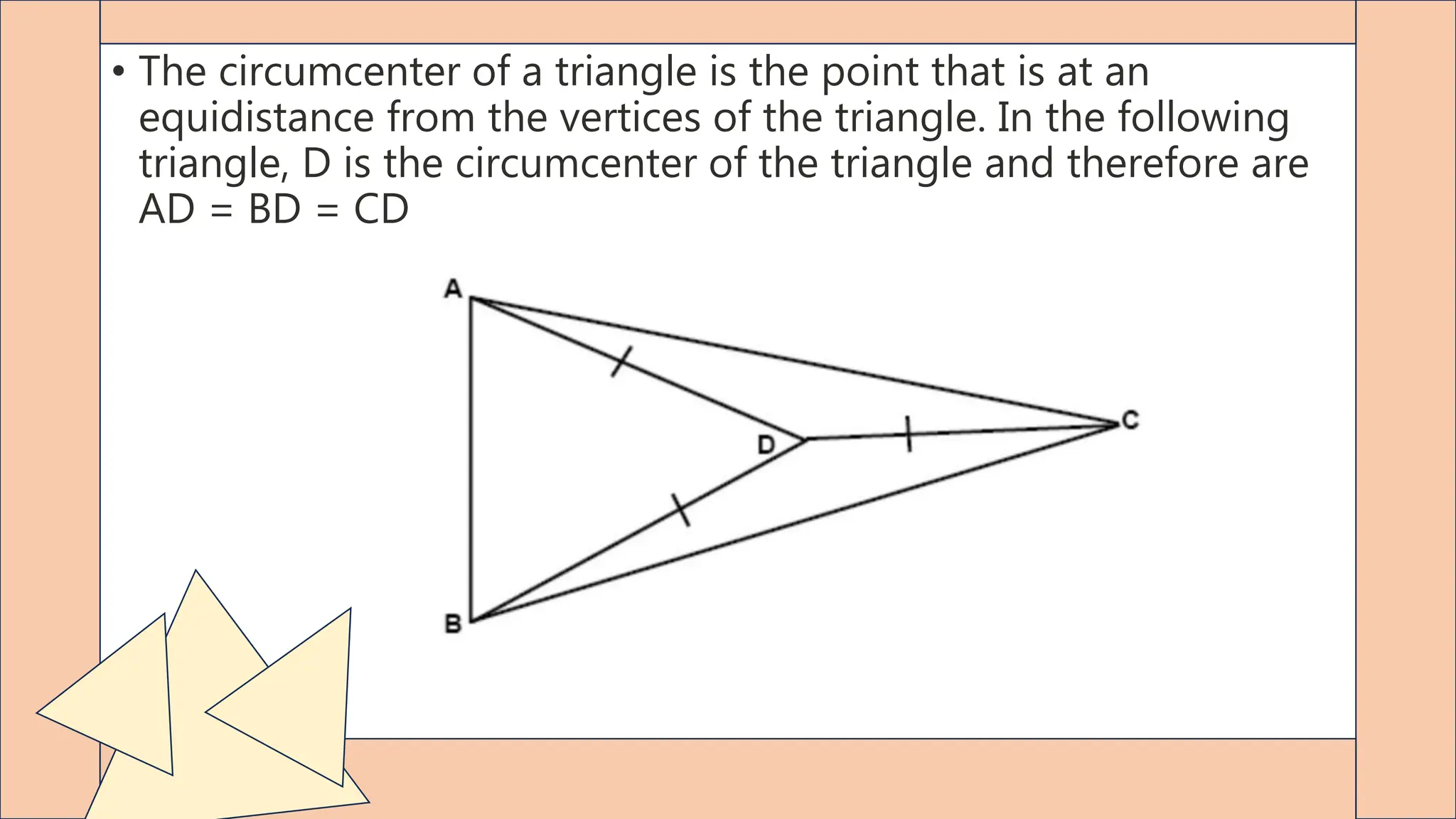
• The circumcenter of a triangle is the point that is at an
equidistance from the vertices of the triangle. In the following
triangle, D is the circumcenter of the triangle and therefore are
AD = BD = CD
•If we know the sides of a triangle –
we can always use the Pythagorean
Theorem backwards in order to
determine if we have a right
triangle, this is called the converse
of the Pythagorean Theorem.
When working with the Pythagorean
theorem we will sometimes encounter
whole specific numbers that always satisfy
our equation - these are called a
Pythagorean triple. One common
Pythagorean triple is the 3-4-5 triangle
where the sides are 3, 4 and 5 units long.
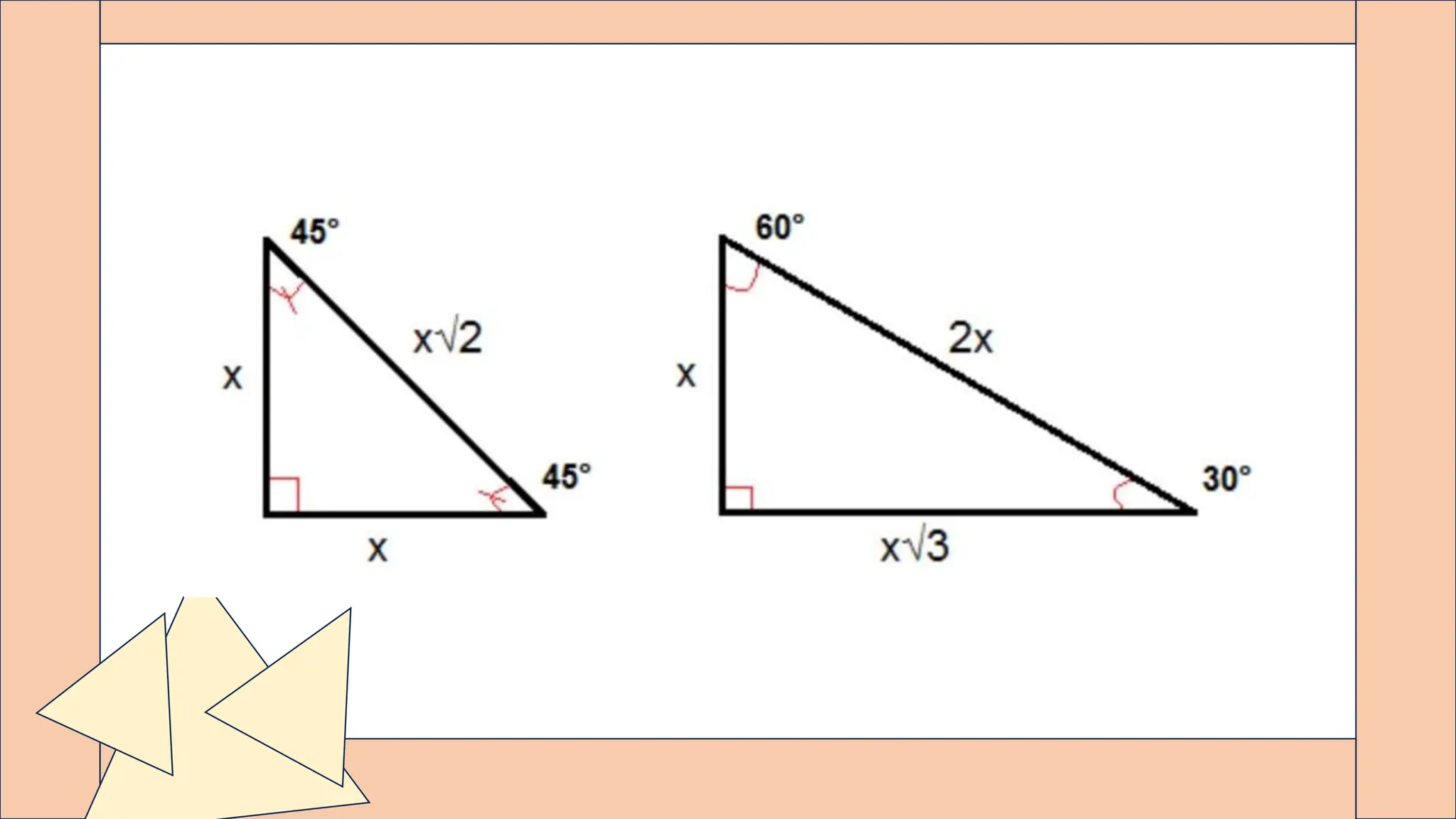
There are some special right triangles that are
good to know, the 45°-45°-90° triangle has
always a hypotenuse √2 times the length of a
leg. In a 30°-60°-90° triangle the length of the
hypotenuse is always twice the length of the
shorter leg and the length of the longer leg is
always √3 times the length of the shorter leg.
It is common knowledge that the sum of
the angles in a triangle is 180° but how
about in polygons with a greater
numbers of angles? If we are given a
convex polygon with n sides and S is the
sum of the measures of the interior
angles then S = 180(n - 2).
Reference:
• Math Planet (2018) “Geometry”

Geometry

  • 1.
  • 2.
    SUBTOPICS •Points, Lines, Planesand Angles •Parallel •Triangles •Trigonometry •Quadrilateral
  • 3.
    • A pointin geometry is a location. It has no size i.e. no width, no length and no depth. A point is shown by a dot. A line is defined as a line of points that extends infinitely in two directions. It has one dimension, length. Points that are on the same line are called collinear points.
  • 4.
    •Two lines thatare stretched into infinity and still never intersect are called coplanar lines and are said to be parallel lines. The symbol for “parallel to” is //.
  • 5.
    • The circumcenterof a triangle is the point that is at an equidistance from the vertices of the triangle. In the following triangle, D is the circumcenter of the triangle and therefore are AD = BD = CD
  • 6.
    •If we knowthe sides of a triangle – we can always use the Pythagorean Theorem backwards in order to determine if we have a right triangle, this is called the converse of the Pythagorean Theorem.
  • 7.
    When working withthe Pythagorean theorem we will sometimes encounter whole specific numbers that always satisfy our equation - these are called a Pythagorean triple. One common Pythagorean triple is the 3-4-5 triangle where the sides are 3, 4 and 5 units long.
  • 8.
    There are somespecial right triangles that are good to know, the 45°-45°-90° triangle has always a hypotenuse √2 times the length of a leg. In a 30°-60°-90° triangle the length of the hypotenuse is always twice the length of the shorter leg and the length of the longer leg is always √3 times the length of the shorter leg.
  • 10.
    It is commonknowledge that the sum of the angles in a triangle is 180° but how about in polygons with a greater numbers of angles? If we are given a convex polygon with n sides and S is the sum of the measures of the interior angles then S = 180(n - 2).
  • 11.
    Reference: • Math Planet(2018) “Geometry”