Health Care Informatics Presentation Learning Team A Jody Bush, Rolanda Canty, Daneshea Crews, Maria Schiaratura, and Julie Sykora University of Phoenix Health Care Informatics HCI  500 David Stibbards June 14, 2010
Introduction Health care informatics improves patient care Decreases medication errors Reduces health care costs Improved technology results in safer hospital care
Key Concepts Computerized Physician order Entry Improve hospitals standards Better protocols
CPOE Goals Prevent data errors Wrong order transcription Clinical errors that can result from inaccurate data Allergy not recorded Allergy recorded incorrectly Reimbursement problems due to data errors  Denials Duplicates Delays
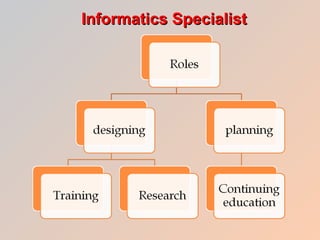
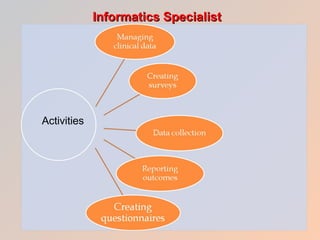
Informatics Specialist
Informatics Specialist  Activities
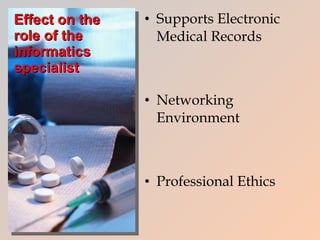
Effect on the role of the informatics specialist  Supports Electronic Medical Records Networking Environment Professional Ethics
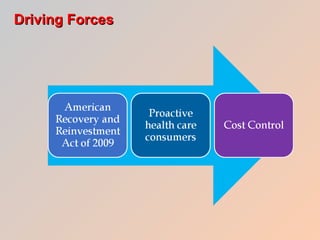
Driving Forces
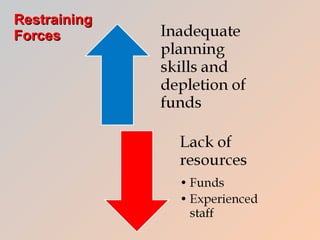
Restraining Forces
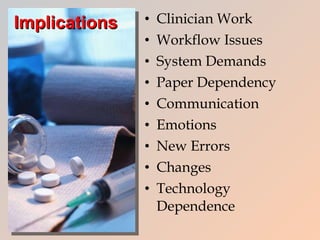
Implications Clinician Work Workflow Issues System Demands Paper Dependency Communication Emotions New Errors Changes Technology Dependence
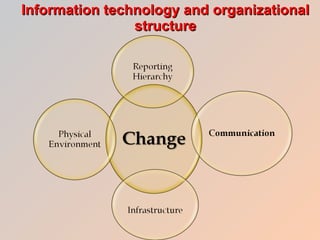
Information technology and organizational structure
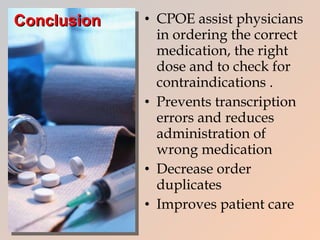
Conclusion CPOE assist physicians in ordering the correct medication, the right dose and to check for contraindications . Prevents transcription errors and reduces administration of wrong medication Decrease order duplicates  Improves patient care
THE END
References American Medical Informatics Association. (n.d.). Retrieved from http://www.amia.org Cooper, H. (2009).  Changing roles of Health Information Managers:  an education perspective.  Health Information Management Journal, 38(3), pp. 38-42.  Doolan, D. F., & Bates, D.W. (2002).  Computerized physician order entry systems in hospital s: Mandates and incentives. Technology & Medicine, 21(4),180-186.  Retrieved June 3,2010, from  http://www.mihealthandsafety.org/pdfs/Doolan Bates. pdf.    Hayes, J. (2008).  IT informatics . Engineering & Technology. Retrieved from http://www.theiet.org/engtechmag Hebda, T., Czar, P., & Mascara, C. (2009).  Handbook of informatics for nurses and health care professionals (4 th  ed.) upper Saddle River, NJ: Pearson Prentice Hall.
Kuperman, G., J. and Gibson, R., F. (2003, July). Computer Physician Order Entry:  Benefits, Costs, and Issues. Annals of Internal Medicine, 139(1). Retrieved May 31, 2010 from Columbia University database MacLean, S. (2009, June). Going with the flow: lessons from disruptive change.  Healthcare Informatics ,  26 (6), 89-90. Mosquera, M. (2010).  Healthcare IT news . MedTech Media. Retrieved from  http://www.healthcareitnews.com   Newbold, S.K., (2010).  A New Definition for Nursing Informatics.  Advance for Nurses.  Retrieved from  http://nursing.advanceweb.com/Editorial/Content/PrintFriendly.aspx?CC=7428
Physician Order Entry Team (2007).  Types of unintended consequences of cpoe.  Retrieved June 4, 2010, from Oregon Health & Science University Web site: http://www.ohsu.edu.academic/dmice/research/cpoe/unintended_consequences.php  Young, D. (2001).  CPOE reduces number of steps in medication-use process.  Retrieved June 13, 2010, from http://www.ashp.org/import/news/HealthSystemPharmacyNews/newsarticle.aspx?id=612

Health Informatics

  • 1.
    Health Care InformaticsPresentation Learning Team A Jody Bush, Rolanda Canty, Daneshea Crews, Maria Schiaratura, and Julie Sykora University of Phoenix Health Care Informatics HCI 500 David Stibbards June 14, 2010
  • 2.
    Introduction Health careinformatics improves patient care Decreases medication errors Reduces health care costs Improved technology results in safer hospital care
  • 3.
    Key Concepts ComputerizedPhysician order Entry Improve hospitals standards Better protocols
  • 4.
    CPOE Goals Preventdata errors Wrong order transcription Clinical errors that can result from inaccurate data Allergy not recorded Allergy recorded incorrectly Reimbursement problems due to data errors Denials Duplicates Delays
  • 5.
  • 6.
  • 7.
    Effect on therole of the informatics specialist Supports Electronic Medical Records Networking Environment Professional Ethics
  • 8.
  • 9.
  • 10.
    Implications Clinician WorkWorkflow Issues System Demands Paper Dependency Communication Emotions New Errors Changes Technology Dependence
  • 11.
    Information technology andorganizational structure
  • 12.
    Conclusion CPOE assistphysicians in ordering the correct medication, the right dose and to check for contraindications . Prevents transcription errors and reduces administration of wrong medication Decrease order duplicates Improves patient care
  • 13.
  • 14.
    References American MedicalInformatics Association. (n.d.). Retrieved from http://www.amia.org Cooper, H. (2009). Changing roles of Health Information Managers: an education perspective. Health Information Management Journal, 38(3), pp. 38-42. Doolan, D. F., & Bates, D.W. (2002). Computerized physician order entry systems in hospital s: Mandates and incentives. Technology & Medicine, 21(4),180-186. Retrieved June 3,2010, from http://www.mihealthandsafety.org/pdfs/Doolan Bates. pdf.   Hayes, J. (2008).  IT informatics . Engineering & Technology. Retrieved from http://www.theiet.org/engtechmag Hebda, T., Czar, P., & Mascara, C. (2009). Handbook of informatics for nurses and health care professionals (4 th ed.) upper Saddle River, NJ: Pearson Prentice Hall.
  • 15.
    Kuperman, G., J.and Gibson, R., F. (2003, July). Computer Physician Order Entry: Benefits, Costs, and Issues. Annals of Internal Medicine, 139(1). Retrieved May 31, 2010 from Columbia University database MacLean, S. (2009, June). Going with the flow: lessons from disruptive change. Healthcare Informatics , 26 (6), 89-90. Mosquera, M. (2010).  Healthcare IT news . MedTech Media. Retrieved from http://www.healthcareitnews.com Newbold, S.K., (2010). A New Definition for Nursing Informatics. Advance for Nurses. Retrieved from http://nursing.advanceweb.com/Editorial/Content/PrintFriendly.aspx?CC=7428
  • 16.
    Physician Order EntryTeam (2007). Types of unintended consequences of cpoe. Retrieved June 4, 2010, from Oregon Health & Science University Web site: http://www.ohsu.edu.academic/dmice/research/cpoe/unintended_consequences.php Young, D. (2001). CPOE reduces number of steps in medication-use process. Retrieved June 13, 2010, from http://www.ashp.org/import/news/HealthSystemPharmacyNews/newsarticle.aspx?id=612