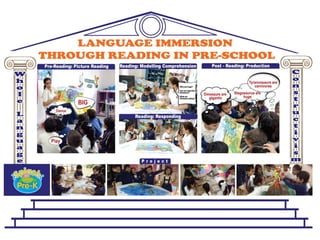
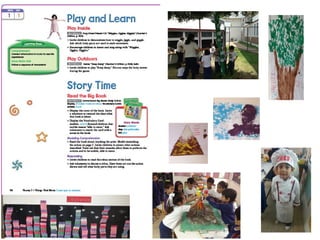


We use Whole Language, a teaching philosophy that
emphasizes literature, where language is treated as a
complete meaning-making system.
Reading
Modelling: The educator uses corporal gestures.
Responding: Children retell the story through ludic
activities. They can respond to questions asked by the
educator or a peer.
Whole Language
Children are able to produce chunks of language, building upon prior
knowledge, new words, structures, phrases, verbs and adjectives.
Comprehension is clear when they can connect the stories to their
real life experiences.
Science Children watched a video about different types of dinosaurs.
Social Studies Children learned about oceans, mountains, volcano.
Sing the song “I love e mountain”.
Math Children will compare small, medium and large. Sing “Math
Atrributes”. Rhyme “Five Huge Dinosaurs”.
Art & Drama Children playpat-a-cake and make different landscapes.
Constructivism
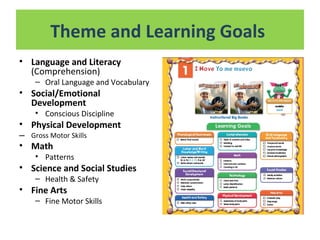
Theme and Learning Goals
• Language and Literacy
(Comprehension)
– Oral Language and Vocabulary
• Social/Emotional
Development
• Conscious Discipline
• Physical Development
– Gross Motor Skills
• Math
• Patterns
• Science and Social Studies
– Health & Safety
• Fine Arts
– Fine Motor Skills
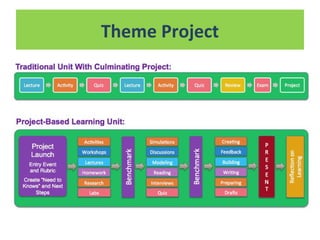
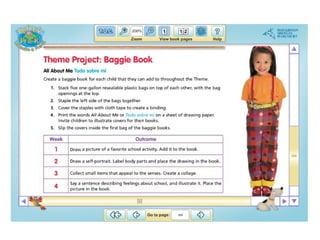
Theme Project
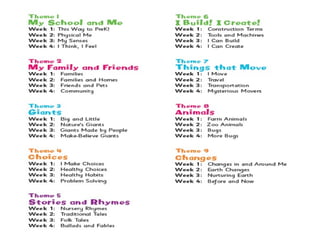
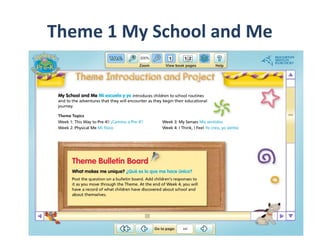
Theme 1 My School and Me
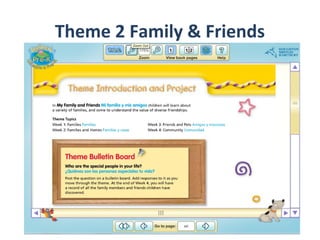
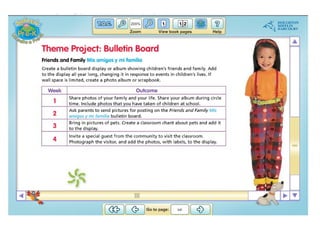
Theme 2 Family & Friends
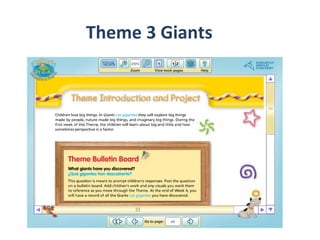
Theme 3 Giants
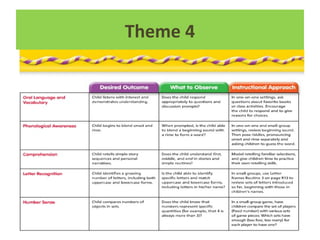
Theme 4 Choices
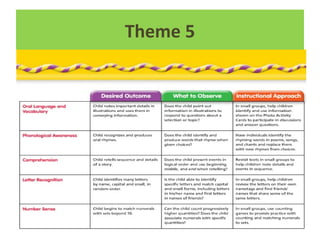
Theme 5 Stories and Rhymes
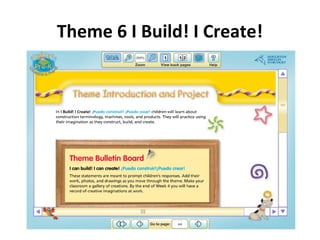
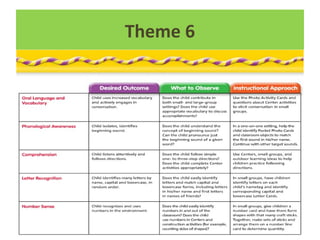
Theme 6 I Build! I Create!
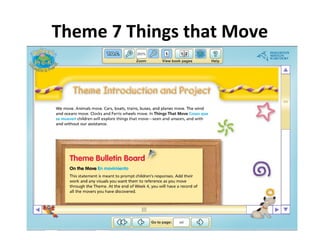
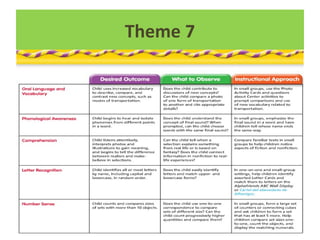
Theme 7 Things that Move
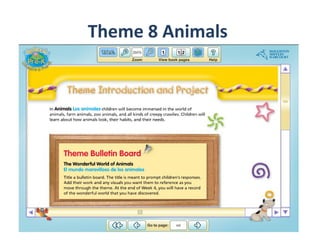
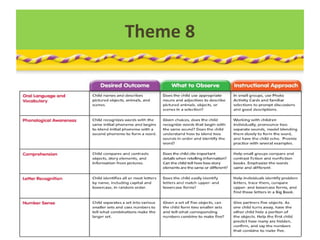
Theme 8 Animals
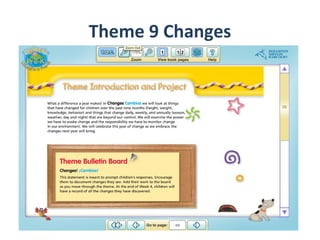
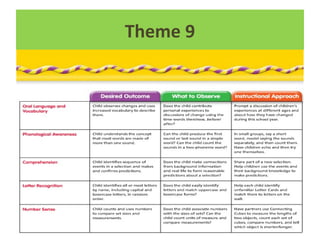
Theme 9 Changes
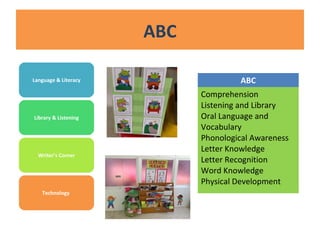
ABC
ABC
Comprehension
Listening and Library
Oral Language and
Vocabulary
Phonological Awareness
Letter Knowledge
Letter Recognition
Word Knowledge
Physical Development
Language & Literacy
Library & Listening
Writer’s Corner
Technology
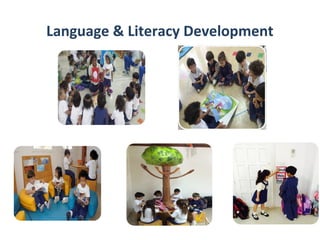
Language & Literacy Development
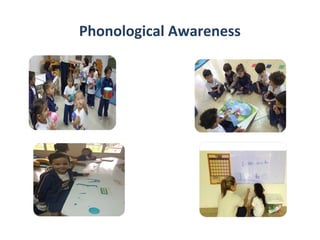
Phonological Awareness
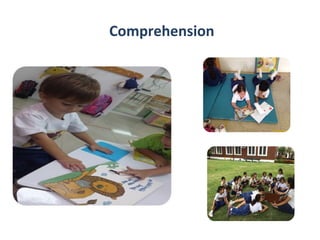
Comprehension
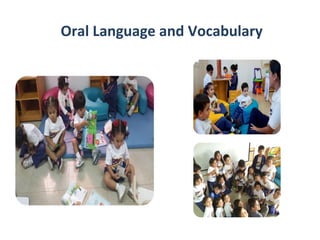
Oral Language and Vocabulary
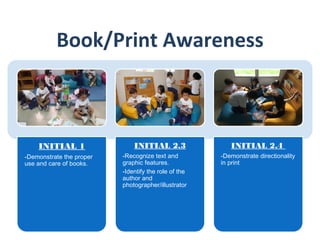
Book/Print Awareness
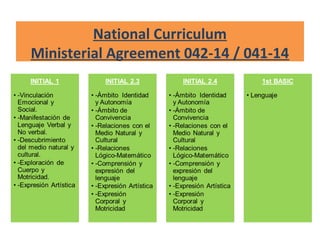
INITIAL 1
-Demonstrate the proper
use and care of books.
INITIAL 2.3
-Recognize text and
graphic features.
-Identify the role of the
author and
photographer/illustrator
INITIAL 2.4
-Demonstrate directionality
in print
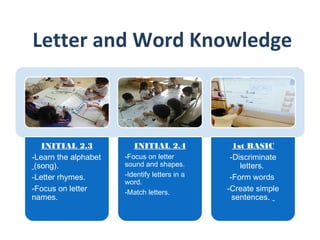
Letter and Word Knowledge
INITIAL 2.3
-Learn the alphabet
(song).
-Letter rhymes.
-Focus on letter
names.
INITIAL 2.4
-Focus on letter
sound and shapes.
-Identify letters in a
word.
-Match letters.
1st BASIC
-Discriminate
letters.
-Form words
-Create simple
sentences.
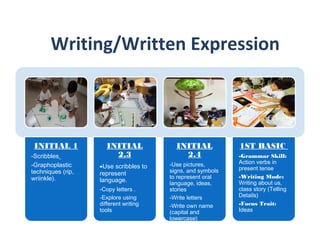
Writing/Written Expression
INITIAL 1
-Scribbles
-Graphoplastic
techniques (rip,
wriinkle).
INITIAL
2.3
-Use scribbles to
represent
language.
-Copy letters .
-Explore using
different writing
tools
INITIAL
2.4
-Use pictures,
signs, and symbols
to represent oral
language, ideas,
stories
-Write letters
-Write own name
(capital and
lowercase)
1ST BASIC
-Grammar Skill:
Action verbs in
present tense
-Writing Mode:
Writing about us,
class story (Telling
Details)
-Focus Trait:
Ideas
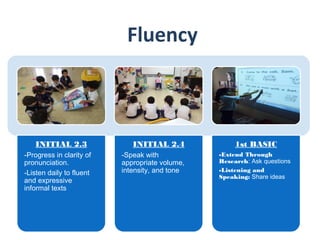
Fluency
INITIAL 2.3
-Progress in clarity of
pronunciation.
-Listen daily to fluent
and expressive
informal texts
INITIAL 2.4
-Speak with
appropriate volume,
intensity, and tone
1st BASIC
-Extend Through
Research: Ask questions
-Listening and
Speaking: Share ideas
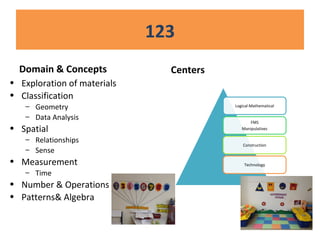
123
Domain & Concepts
• Exploration of materials
• Classification
– Geometry
– Data Analysis
• Spatial
– Relationships
– Sense
• Measurement
– Time
• Number & Operations
• Patterns& Algebra
Centers
Logical-Mathematical
FMS
Manipulatives
Construction
Technology
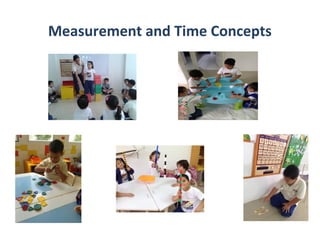
Measurement and Time Concepts
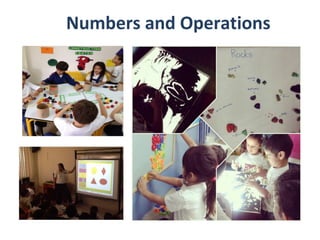
Numbers and Operations
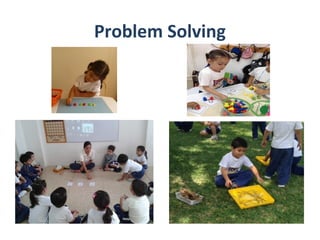
Problem Solving
Social/Science
Physical Development
Social Development
Emotional
Development
Health
Science
Music
Technology
Conscious Discipline
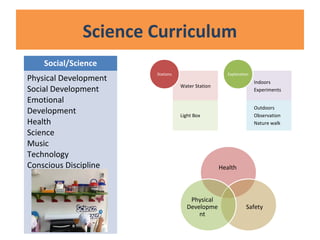
Science Curriculum
Water Station
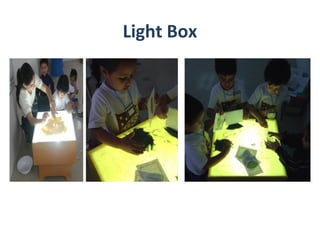
Light Box
Stations
Indoors
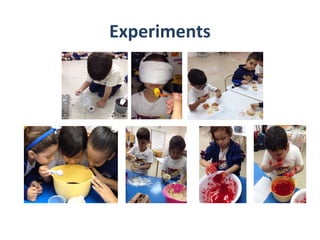
Experiments
Outdoors
Observation
Nature walk
Exploration
Health
Safety
Physical
Developme
nt
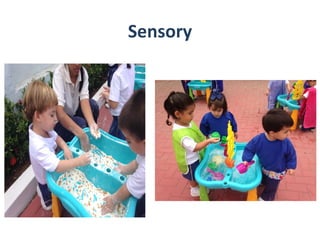
Sensory
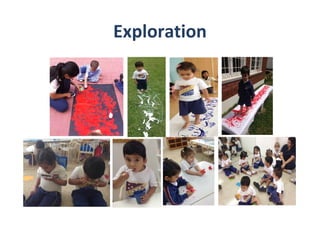
Exploration
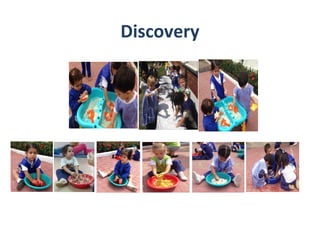
Discovery
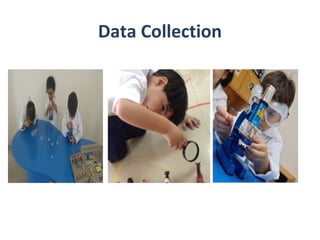
Data Collection
Experiments
Light Box
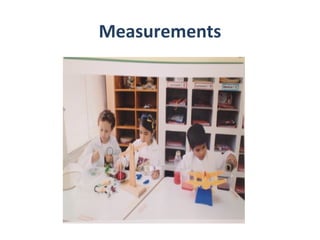
Measurements
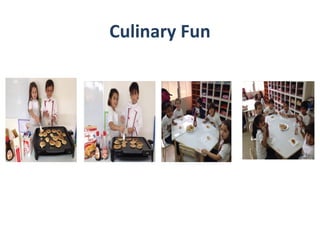
Culinary Fun
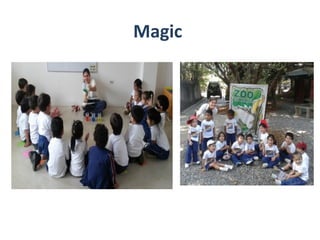
Magic
Social Studies
Individual, culture, and Community
•Discuss habitats
•Discuss routines and activities at home and at school
•Identify/Discuss similarities and differences among people,
objects, or places
•Investigate ways that people form a community
•Learn about different cultures
•Learn about family members
Economics
•Describe possible roles/responsibilities that people have
•Discuss where food comes from
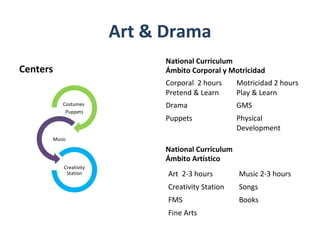
Art & Drama
Centers
Costumes
Puppets
Music
Creativity
Station
National Curriculum
Ámbito Corporal y Motricidad
Corporal 2 hours
Pretend & Learn
Motricidad 2 hours
Play & Learn
Drama GMS
Puppets Physical
Development
Art 2-3 hours Music 2-3 hours
Creativity Station Songs
FMS Books
Fine Arts
National Curriculum
Ámbito Artístico
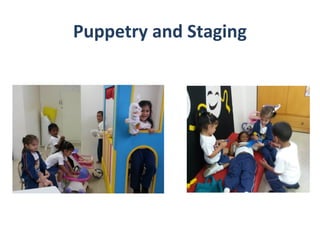
Puppetry and Staging
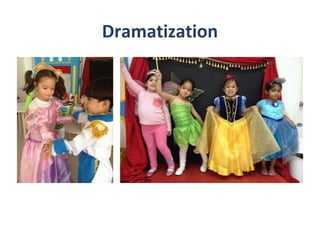
Dramatization
Social/Emotional Development
Social
• Act with courtesy and
respect to others
• Care for classroom
materials/school property
• Cooperate with others
• Discuss etiquette
• Help others
• Participate in group
activities
• Share with others
Emotional
• Adusts to a new classroom
situation
• Discuss emotions
• Express opinions
Conscious Discipline
Fine Arts and Music
Fine Arts
• Draw pictures/portraits
• Participate in role-playing
• Perform dance moves
• Reenact a story or rhyme
• Use various materials to
create artwork
Music
• Clap a pattern
• Explore rhythm
• Make instruments
• Participate in music
activities
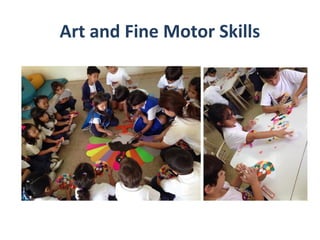
Art and Fine Motor Skills
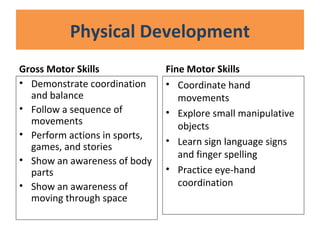
Physical Development
Gross Motor Skills
• Demonstrate coordination
and balance
• Follow a sequence of
movements
• Perform actions in sports,
games, and stories
• Show an awareness of body
parts
• Show an awareness of
moving through space
Fine Motor Skills
• Coordinate hand
movements
• Explore small manipulative
objects
• Learn sign language signs
and finger spelling
• Practice eye-hand
coordination
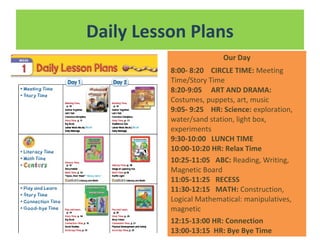
Daily Lesson Plans
Our Day
8:00- 8:20 CIRCLE TIME: Meeting
Time/Story Time
8:20-9:05 ART AND DRAMA:
Costumes, puppets, art, music
9:05- 9:25 HR: Science: exploration,
water/sand station, light box,
experiments
9:30-10:00 LUNCH TIME
10:00-10:20 HR: Relax Time
10:25-11:05 ABC: Reading, Writing,
Magnetic Board
11:05-11:25 RECESS
11:30-12:15 MATH: Construction,
Logical Mathematical: manipulatives,
magnetic
12:15-13:00 HR: Connection
13:00-13:15 HR: Bye Bye Time
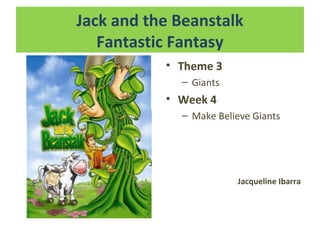
Jack and the Beanstalk
Fantastic Fantasy
• Theme 3
– Giants
• Week 4
– Make Believe Giants
Jacqueline Ibarra
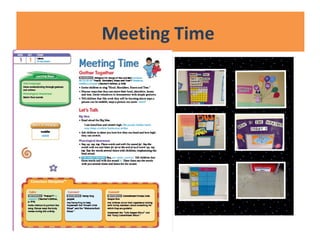
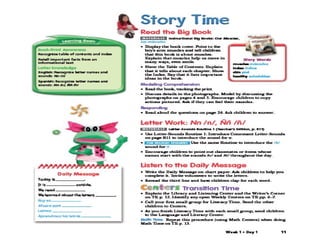
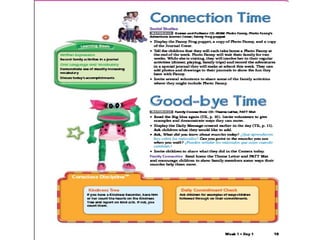
Meeting Time
• Materials
– Resources
• Pages R2-R9
• Daily Message
– Today is _________.
– It is ____ outside.
– We read __________
– We learned about____________
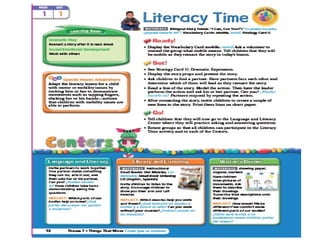
• CENTERS
– Transition Time
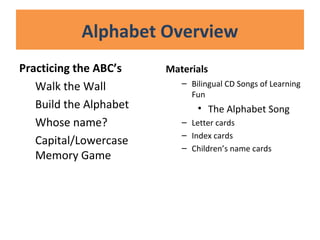
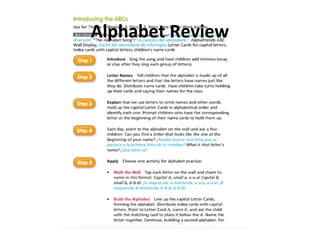
Alphabet Overview
Practicing the ABC’s
Walk the Wall
Build the Alphabet
Whose name?
Capital/Lowercase
Memory Game
Materials
– Bilingual CD Songs of Learning
Fun
• The Alphabet Song
– Letter cards
– Index cards
– Children’s name cards
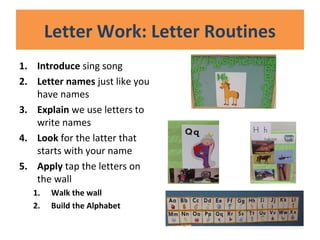
Letter Work: Letter Routines
1. Introduce sing song
2. Letter names just like you
have names
3. Explain we use letters to
write names
4. Look for the latter that
starts with your name
5. Apply tap the letters on
the wall
1. Walk the wall
2. Build the Alphabet
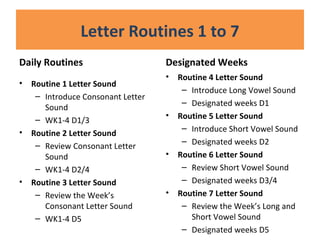
Letter Routines 1 to 7
Daily Routines
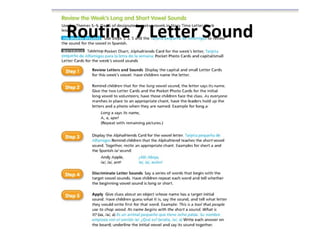
• Routine 1 Letter Sound
– Introduce Consonant Letter
Sound
– WK1-4 D1/3
• Routine 2 Letter Sound
– Review Consonant Letter
Sound
– WK1-4 D2/4
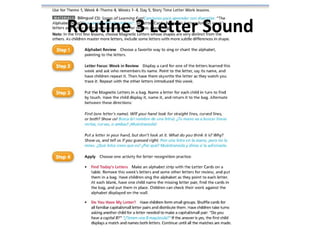
• Routine 3 Letter Sound
– Review the Week’s
Consonant Letter Sound
– WK1-4 D5
Designated Weeks
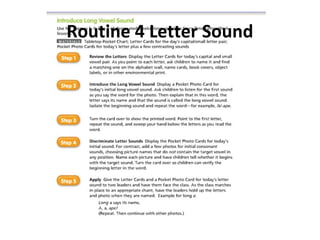
• Routine 4 Letter Sound
– Introduce Long Vowel Sound
– Designated weeks D1
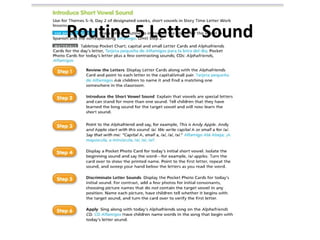
• Routine 5 Letter Sound
– Introduce Short Vowel Sound
– Designated weeks D2
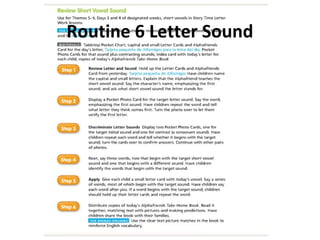
• Routine 6 Letter Sound
– Review Short Vowel Sound
– Designated weeks D3/4
• Routine 7 Letter Sound
– Review the Week’s Long and
Short Vowel Sound
– Designated weeks D5
Alphabet Review
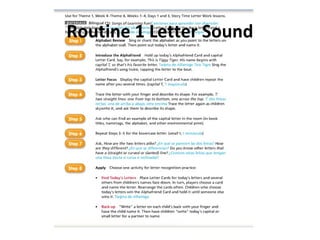
Routine 1 Letter Sound
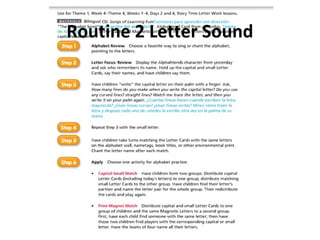
Routine 2 Letter Sound
Routine 3 Letter Sound
Routine 4 Letter Sound
Routine 5 Letter Sound
Routine 6 Letter Sound
Routine 7 Letter Sound
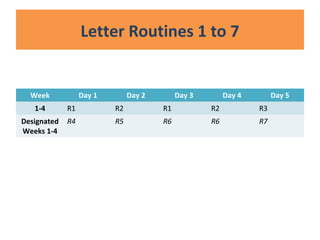
Week Day 1 Day 2 Day 3 Day 4 Day 5
1-4 R1 R2 R1 R2 R3
Designated
Weeks 1-4
R4 R5 R6 R6 R7
Letter Routines 1 to 7
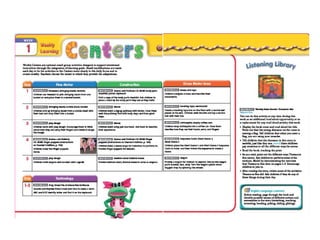
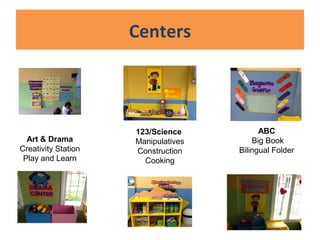
Centers
Art & Drama
Creativity Station
Play and Learn
123/Science
Manipulatives
Construction
Cooking
ABC
Big Book
Bilingual Folder
Centers
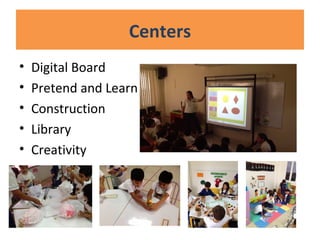
• Digital Board
• Pretend and Learn
• Construction
• Library
• Creativity
National Curriculum
Ministerial Agreement 042-14 / 041-14
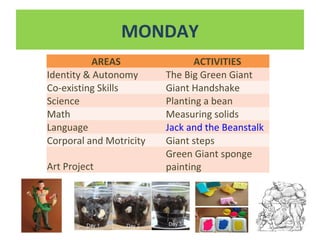
MONDAY
AREAS ACTIVITIES
Identity & Autonomy The Big Green Giant
Co-existing Skills Giant Handshake
Science Planting a bean
Math Measuring solids
Language Jack and the Beanstalk
Corporal and Motricity Giant steps
Art Project
Green Giant sponge
painting
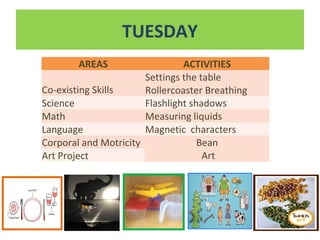
TUESDAY
AREAS ACTIVITIES
Co-existing Skills
Settings the table
Rollercoaster Breathing
Science Flashlight shadows
Math Measuring liquids
Language Magnetic characters
Corporal and Motricity Bean
ArtArt Project
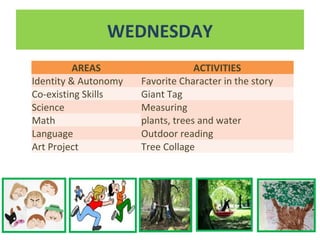
WEDNESDAY
AREAS ACTIVITIES
Identity & Autonomy Favorite Character in the story
Co-existing Skills Giant Tag
Science Measuring
plants, trees and waterMath
Language Outdoor reading
Art Project Tree Collage
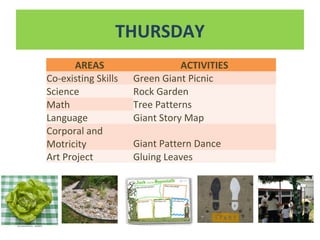
THURSDAY
AREAS ACTIVITIES
Co-existing Skills Green Giant Picnic
Science Rock Garden
Tree PatternsMath
Language Giant Story Map
Corporal and
Motricity Giant Pattern Dance
Art Project Gluing Leaves
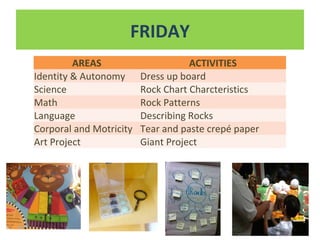
FRIDAY
AREAS ACTIVITIES
Identity & Autonomy Dress up board
Science Rock Chart Charcteristics
Math Rock Patterns
Language Describing Rocks
Corporal and Motricity Tear and paste crepé paper
Art Project Giant Project
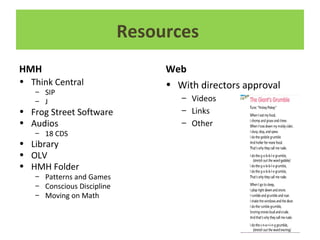
Resources
HMH
• Think Central
– SIP
– J
• Frog Street Software
• Audios
– 18 CDS
• Library
• OLV
• HMH Folder
– Patterns and Games
– Conscious Discipline
– Moving on Math
Web
• With directors approval
– Videos
– Links
– Other
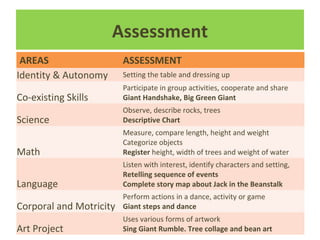
Assessment
AREAS ASSESSMENT
Identity & Autonomy Setting the table and dressing up
Co-existing Skills
Participate in group activities, cooperate and share
Giant Handshake, Big Green Giant
Science
Observe, describe rocks, trees
Descriptive Chart
Math
Measure, compare length, height and weight
Categorize objects
Register height, width of trees and weight of water
Language
Listen with interest, identify characters and setting,
Retelling sequence of events
Complete story map about Jack in the Beanstalk
Corporal and Motricity
Perform actions in a dance, activity or game
Giant steps and dance
Art Project
Uses various forms of artwork
Sing Giant Rumble. Tree collage and bean art
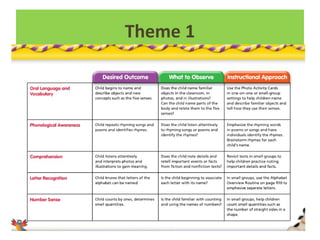
Theme 1
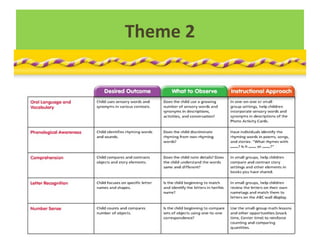
Theme 2
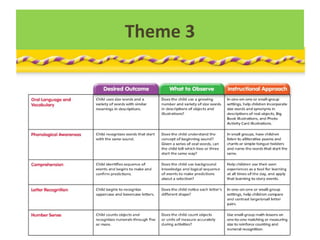
Theme 3
Theme 4
Theme 5
Theme 6
Theme 7
Theme 8
Theme 9
Assessment
Theme and Learning Goals
• Language and Literacy
(Comprehension)
– Oral language and Vocabulary
– Phonological Awareness
– Letter /Word knowledge
• Social/Emotional Development
– Physical Development
• Math
• Science and Social Studies
– Health
• Fine Arts
– Fine Motor Skills
– Gross Motor Skills
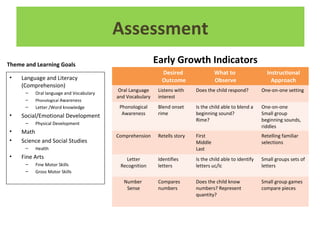
Early Growth Indicators
Desired
Outcome
What to
Observe
Instructional
Approach
Oral Language
and Vocabulary
Listens with
interest
Does the child respond? One-on-one setting
Phonological
Awareness
Blend onset
rime
Is the child able to blend a
beginning sound?
Rime?
One-on-one
Small group
beginning sounds,
riddles
Comprehension Retells story First
Middle
Last
Retelling familiar
selections
Letter
Recognition
Identifies
letters
Is the child able to identify
letters uc/lc
Small groups sets of
letters
Number
Sense
Compares
numbers
Does the child know
numbers? Represent
quantity?
Small group games
compare pieces
Hmh Splash into Pre K Planning 2015

Hmh Splash into Pre K Planning 2015

  • 2.
    We use WholeLanguage, a teaching philosophy that emphasizes literature, where language is treated as a complete meaning-making system. Reading Modelling: The educator uses corporal gestures. Responding: Children retell the story through ludic activities. They can respond to questions asked by the educator or a peer. Whole Language
  • 3.
    Children are ableto produce chunks of language, building upon prior knowledge, new words, structures, phrases, verbs and adjectives. Comprehension is clear when they can connect the stories to their real life experiences. Science Children watched a video about different types of dinosaurs. Social Studies Children learned about oceans, mountains, volcano. Sing the song “I love e mountain”. Math Children will compare small, medium and large. Sing “Math Atrributes”. Rhyme “Five Huge Dinosaurs”. Art & Drama Children playpat-a-cake and make different landscapes. Constructivism
  • 5.
    Theme and LearningGoals • Language and Literacy (Comprehension) – Oral Language and Vocabulary • Social/Emotional Development • Conscious Discipline • Physical Development – Gross Motor Skills • Math • Patterns • Science and Social Studies – Health & Safety • Fine Arts – Fine Motor Skills
  • 6.
  • 8.
    Theme 1 MySchool and Me
  • 10.
    Theme 2 Family& Friends
  • 12.
  • 14.
  • 16.
    Theme 5 Storiesand Rhymes
  • 18.
    Theme 6 IBuild! I Create!
  • 20.
    Theme 7 Thingsthat Move
  • 22.
  • 24.
  • 27.
    ABC ABC Comprehension Listening and Library OralLanguage and Vocabulary Phonological Awareness Letter Knowledge Letter Recognition Word Knowledge Physical Development Language & Literacy Library & Listening Writer’s Corner Technology
  • 28.
  • 29.
  • 30.
  • 31.
  • 32.
    Book/Print Awareness INITIAL 1 -Demonstratethe proper use and care of books. INITIAL 2.3 -Recognize text and graphic features. -Identify the role of the author and photographer/illustrator INITIAL 2.4 -Demonstrate directionality in print
  • 33.
    Letter and WordKnowledge INITIAL 2.3 -Learn the alphabet (song). -Letter rhymes. -Focus on letter names. INITIAL 2.4 -Focus on letter sound and shapes. -Identify letters in a word. -Match letters. 1st BASIC -Discriminate letters. -Form words -Create simple sentences.
  • 34.
    Writing/Written Expression INITIAL 1 -Scribbles -Graphoplastic techniques(rip, wriinkle). INITIAL 2.3 -Use scribbles to represent language. -Copy letters . -Explore using different writing tools INITIAL 2.4 -Use pictures, signs, and symbols to represent oral language, ideas, stories -Write letters -Write own name (capital and lowercase) 1ST BASIC -Grammar Skill: Action verbs in present tense -Writing Mode: Writing about us, class story (Telling Details) -Focus Trait: Ideas
  • 35.
    Fluency INITIAL 2.3 -Progress inclarity of pronunciation. -Listen daily to fluent and expressive informal texts INITIAL 2.4 -Speak with appropriate volume, intensity, and tone 1st BASIC -Extend Through Research: Ask questions -Listening and Speaking: Share ideas
  • 36.
    123 Domain & Concepts •Exploration of materials • Classification – Geometry – Data Analysis • Spatial – Relationships – Sense • Measurement – Time • Number & Operations • Patterns& Algebra Centers Logical-Mathematical FMS Manipulatives Construction Technology
  • 37.
  • 38.
  • 39.
  • 40.
    Social/Science Physical Development Social Development Emotional Development Health Science Music Technology ConsciousDiscipline Science Curriculum Water Station Light Box Stations Indoors Experiments Outdoors Observation Nature walk Exploration Health Safety Physical Developme nt
  • 41.
  • 42.
  • 43.
  • 44.
  • 45.
  • 46.
  • 47.
  • 48.
  • 49.
  • 50.
    Social Studies Individual, culture,and Community •Discuss habitats •Discuss routines and activities at home and at school •Identify/Discuss similarities and differences among people, objects, or places •Investigate ways that people form a community •Learn about different cultures •Learn about family members Economics •Describe possible roles/responsibilities that people have •Discuss where food comes from
  • 51.
    Art & Drama Centers Costumes Puppets Music Creativity Station NationalCurriculum Ámbito Corporal y Motricidad Corporal 2 hours Pretend & Learn Motricidad 2 hours Play & Learn Drama GMS Puppets Physical Development Art 2-3 hours Music 2-3 hours Creativity Station Songs FMS Books Fine Arts National Curriculum Ámbito Artístico
  • 52.
  • 53.
  • 54.
    Social/Emotional Development Social • Actwith courtesy and respect to others • Care for classroom materials/school property • Cooperate with others • Discuss etiquette • Help others • Participate in group activities • Share with others Emotional • Adusts to a new classroom situation • Discuss emotions • Express opinions
  • 55.
  • 56.
    Fine Arts andMusic Fine Arts • Draw pictures/portraits • Participate in role-playing • Perform dance moves • Reenact a story or rhyme • Use various materials to create artwork Music • Clap a pattern • Explore rhythm • Make instruments • Participate in music activities
  • 57.
    Art and FineMotor Skills
  • 58.
    Physical Development Gross MotorSkills • Demonstrate coordination and balance • Follow a sequence of movements • Perform actions in sports, games, and stories • Show an awareness of body parts • Show an awareness of moving through space Fine Motor Skills • Coordinate hand movements • Explore small manipulative objects • Learn sign language signs and finger spelling • Practice eye-hand coordination
  • 59.
    Daily Lesson Plans OurDay 8:00- 8:20 CIRCLE TIME: Meeting Time/Story Time 8:20-9:05 ART AND DRAMA: Costumes, puppets, art, music 9:05- 9:25 HR: Science: exploration, water/sand station, light box, experiments 9:30-10:00 LUNCH TIME 10:00-10:20 HR: Relax Time 10:25-11:05 ABC: Reading, Writing, Magnetic Board 11:05-11:25 RECESS 11:30-12:15 MATH: Construction, Logical Mathematical: manipulatives, magnetic 12:15-13:00 HR: Connection 13:00-13:15 HR: Bye Bye Time
  • 60.
    Jack and theBeanstalk Fantastic Fantasy • Theme 3 – Giants • Week 4 – Make Believe Giants Jacqueline Ibarra
  • 61.
  • 62.
    • Materials – Resources •Pages R2-R9 • Daily Message – Today is _________. – It is ____ outside. – We read __________ – We learned about____________ • CENTERS – Transition Time
  • 63.
    Alphabet Overview Practicing theABC’s Walk the Wall Build the Alphabet Whose name? Capital/Lowercase Memory Game Materials – Bilingual CD Songs of Learning Fun • The Alphabet Song – Letter cards – Index cards – Children’s name cards
  • 64.
    Letter Work: LetterRoutines 1. Introduce sing song 2. Letter names just like you have names 3. Explain we use letters to write names 4. Look for the latter that starts with your name 5. Apply tap the letters on the wall 1. Walk the wall 2. Build the Alphabet
  • 65.
    Letter Routines 1to 7 Daily Routines • Routine 1 Letter Sound – Introduce Consonant Letter Sound – WK1-4 D1/3 • Routine 2 Letter Sound – Review Consonant Letter Sound – WK1-4 D2/4 • Routine 3 Letter Sound – Review the Week’s Consonant Letter Sound – WK1-4 D5 Designated Weeks • Routine 4 Letter Sound – Introduce Long Vowel Sound – Designated weeks D1 • Routine 5 Letter Sound – Introduce Short Vowel Sound – Designated weeks D2 • Routine 6 Letter Sound – Review Short Vowel Sound – Designated weeks D3/4 • Routine 7 Letter Sound – Review the Week’s Long and Short Vowel Sound – Designated weeks D5
  • 66.
  • 67.
  • 68.
  • 69.
  • 70.
  • 71.
  • 72.
  • 73.
  • 74.
    Week Day 1Day 2 Day 3 Day 4 Day 5 1-4 R1 R2 R1 R2 R3 Designated Weeks 1-4 R4 R5 R6 R6 R7 Letter Routines 1 to 7
  • 80.
    Centers Art & Drama CreativityStation Play and Learn 123/Science Manipulatives Construction Cooking ABC Big Book Bilingual Folder
  • 81.
    Centers • Digital Board •Pretend and Learn • Construction • Library • Creativity
  • 83.
  • 84.
    MONDAY AREAS ACTIVITIES Identity &Autonomy The Big Green Giant Co-existing Skills Giant Handshake Science Planting a bean Math Measuring solids Language Jack and the Beanstalk Corporal and Motricity Giant steps Art Project Green Giant sponge painting
  • 85.
    TUESDAY AREAS ACTIVITIES Co-existing Skills Settingsthe table Rollercoaster Breathing Science Flashlight shadows Math Measuring liquids Language Magnetic characters Corporal and Motricity Bean ArtArt Project
  • 86.
    WEDNESDAY AREAS ACTIVITIES Identity &Autonomy Favorite Character in the story Co-existing Skills Giant Tag Science Measuring plants, trees and waterMath Language Outdoor reading Art Project Tree Collage
  • 87.
    THURSDAY AREAS ACTIVITIES Co-existing SkillsGreen Giant Picnic Science Rock Garden Tree PatternsMath Language Giant Story Map Corporal and Motricity Giant Pattern Dance Art Project Gluing Leaves
  • 88.
    FRIDAY AREAS ACTIVITIES Identity &Autonomy Dress up board Science Rock Chart Charcteristics Math Rock Patterns Language Describing Rocks Corporal and Motricity Tear and paste crepé paper Art Project Giant Project
  • 89.
    Resources HMH • Think Central –SIP – J • Frog Street Software • Audios – 18 CDS • Library • OLV • HMH Folder – Patterns and Games – Conscious Discipline – Moving on Math Web • With directors approval – Videos – Links – Other
  • 90.
    Assessment AREAS ASSESSMENT Identity &Autonomy Setting the table and dressing up Co-existing Skills Participate in group activities, cooperate and share Giant Handshake, Big Green Giant Science Observe, describe rocks, trees Descriptive Chart Math Measure, compare length, height and weight Categorize objects Register height, width of trees and weight of water Language Listen with interest, identify characters and setting, Retelling sequence of events Complete story map about Jack in the Beanstalk Corporal and Motricity Perform actions in a dance, activity or game Giant steps and dance Art Project Uses various forms of artwork Sing Giant Rumble. Tree collage and bean art
  • 91.
  • 92.
  • 93.
  • 94.
  • 95.
  • 96.
  • 97.
  • 98.
  • 99.
  • 100.
    Assessment Theme and LearningGoals • Language and Literacy (Comprehension) – Oral language and Vocabulary – Phonological Awareness – Letter /Word knowledge • Social/Emotional Development – Physical Development • Math • Science and Social Studies – Health • Fine Arts – Fine Motor Skills – Gross Motor Skills Early Growth Indicators Desired Outcome What to Observe Instructional Approach Oral Language and Vocabulary Listens with interest Does the child respond? One-on-one setting Phonological Awareness Blend onset rime Is the child able to blend a beginning sound? Rime? One-on-one Small group beginning sounds, riddles Comprehension Retells story First Middle Last Retelling familiar selections Letter Recognition Identifies letters Is the child able to identify letters uc/lc Small groups sets of letters Number Sense Compares numbers Does the child know numbers? Represent quantity? Small group games compare pieces