DNA Barcoding
A Potential Tracker of Climate Change and
it’s Effects on Flora and Fauna
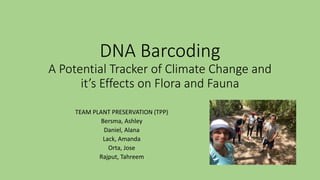
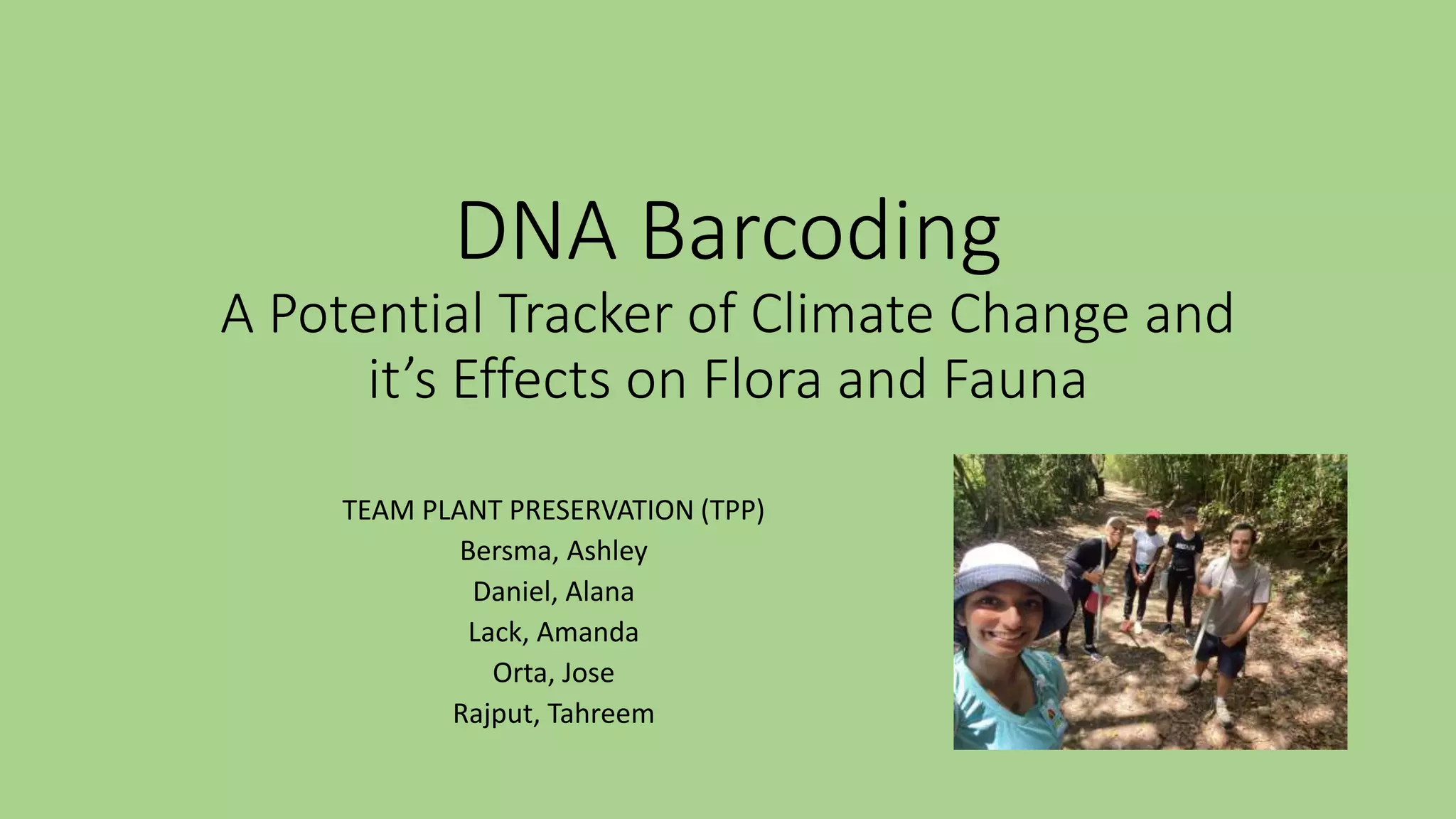
TEAM PLANT PRESERVATION (TPP)
Bersma, Ashley
Daniel, Alana
Lack, Amanda
Orta, Jose
Rajput, Tahreem
Introduction
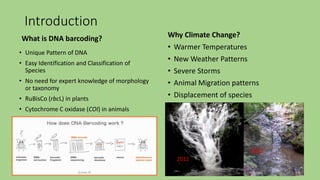
What is DNA barcoding?
• Unique Pattern of DNA
• Easy Identification and Classification of
Species
• No need for expert knowledge of morphology
or taxonomy
• RuBisCo (rbcL) in plants
• Cytochrome C oxidase (COI) in animals
Why Climate Change?
• Warmer Temperatures
• New Weather Patterns
• Severe Storms
• Animal Migration patterns
• Displacement of species
@2012
2022
Materials and Methods
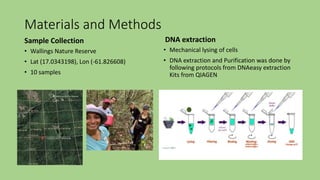
Sample Collection
• Wallings Nature Reserve
• Lat (17.0343198), Lon (-61.826608)
• 10 samples
DNA extraction
• Mechanical lysing of cells
• DNA extraction and Purification was done by
following protocols from DNAeasy extraction
Kits from QIAGEN
Materials and Methods
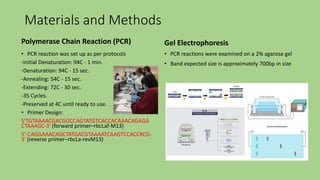
Polymerase Chain Reaction (PCR)
• PCR reaction was set up as per protocols
-Initial Denaturation: 94C - 1 min.
-Denaturation: 94C - 15 sec.
-Annealing: 54C - 15 sec.
-Extending: 72C - 30 sec.
-35 Cycles.
-Preserved at 4C until ready to use.
• Primer Design:
5'TGTAAAACGACGGCCAGTATGTCACCACAAACAGAGA
CTAAAGC-3' (forward primer–rbcLaf-M13)
5'-CAGGAAACAGCTATGACGTAAAATCAAGTCCACCRCG-
3' (reverse primer–rbcLa-revM13)
Gel Electrophoresis
• PCR reactions were examined on a 2% agarose gel
• Band expected size is approximately 700bp in size
Materials and Methods
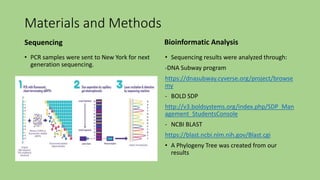
Sequencing
• PCR samples were sent to New York for next
generation sequencing.
Bioinformatic Analysis
• Sequencing results were analyzed through:
-DNA Subway program
https://dnasubway.cyverse.org/project/browse
my
- BOLD SDP
http://v3.boldsystems.org/index.php/SDP_Man
agement_StudentsConsole
- NCBI BLAST
https://blast.ncbi.nlm.nih.gov/Blast.cgi
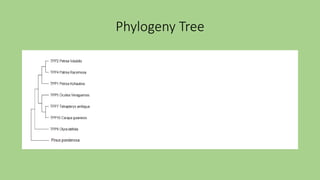
• A Phylogeny Tree was created from our
results
Results
Gel Electrophoresis
Results
Sequencing and DNA subway Analysis
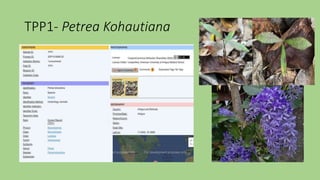
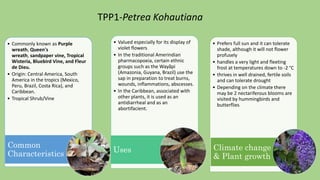
TPP1- Petrea Kohautiana
• Commonly known as Purple
wreath, Queen's
wreath, sandpaper vine, Tropical
Wisteria, Bluebird Vine, and Fleur
de Dieu.
• Origin: Central America, South
America in the tropics (Mexico,
Peru, Brazil, Costa Rica), and
Caribbean.
• Tropical Shrub/Vine
Common
Characteristics
• Valued especially for its display of
violet flowers
• In the traditional Amerindian
pharmacopoeia, certain ethnic
groups such as the Wayãpi
(Amazonia, Guyana, Brazil) use the
sap in preparation to treat burns,
wounds, inflammations, abscesses.
• In the Caribbean, associated with
other plants, it is used as an
antidiarrheal and as an
abortifacient.
Uses
• Prefers full sun and it can tolerate
shade, although it will not flower
profusely
• handles a very light and fleeting
frost at temperatures down to -2 °C
• thrives in well drained, fertile soils
and can tolerate drought
• Depending on the climate there
may be 2 nectariferous blooms are
visited by hummingbirds and
butterflies
Climate change
& Plant growth
TPP1-Petrea Kohautiana
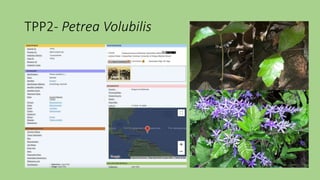
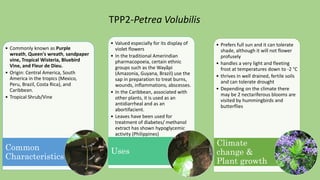
TPP2- Petrea Volubilis
• Commonly known as Purple
wreath, Queen's wreath, sandpaper
vine, Tropical Wisteria, Bluebird
Vine, and Fleur de Dieu.
• Origin: Central America, South
America in the tropics (Mexico,
Peru, Brazil, Costa Rica), and
Caribbean.
• Tropical Shrub/Vine
Common
Characteristics
• Valued especially for its display of
violet flowers
• In the traditional Amerindian
pharmacopoeia, certain ethnic
groups such as the Wayãpi
(Amazonia, Guyana, Brazil) use the
sap in preparation to treat burns,
wounds, inflammations, abscesses.
• In the Caribbean, associated with
other plants, it is used as an
antidiarrheal and as an
abortifacient.
• Leaves have been used for
treatment of diabetes/ methanol
extract has shown hypoglycemic
activity (Philippines)
Uses
• Prefers full sun and it can tolerate
shade, although it will not flower
profusely
• handles a very light and fleeting
frost at temperatures down to -2 °C
• thrives in well drained, fertile soils
and can tolerate drought
• Depending on the climate there
may be 2 nectariferous blooms are
visited by hummingbirds and
butterflies
Climate
change &
Plant growth
TPP2-Petrea Volubilis
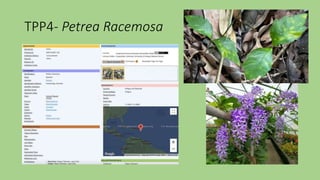
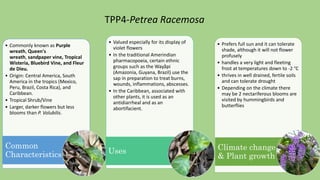
TPP4- Petrea Racemosa
• Commonly known as Purple
wreath, Queen's
wreath, sandpaper vine, Tropical
Wisteria, Bluebird Vine, and Fleur
de Dieu.
• Origin: Central America, South
America in the tropics (Mexico,
Peru, Brazil, Costa Rica), and
Caribbean.
• Tropical Shrub/Vine
• Larger, darker flowers but less
blooms than P. Volubilis.
Common
Characteristics
• Valued especially for its display of
violet flowers
• In the traditional Amerindian
pharmacopoeia, certain ethnic
groups such as the Wayãpi
(Amazonia, Guyana, Brazil) use the
sap in preparation to treat burns,
wounds, inflammations, abscesses.
• In the Caribbean, associated with
other plants, it is used as an
antidiarrheal and as an
abortifacient.
Uses
• Prefers full sun and it can tolerate
shade, although it will not flower
profusely
• handles a very light and fleeting
frost at temperatures down to -2 °C
• thrives in well drained, fertile soils
and can tolerate drought
• Depending on the climate there
may be 2 nectariferous blooms are
visited by hummingbirds and
butterflies
Climate change
& Plant growth
TPP4-Petrea Racemosa
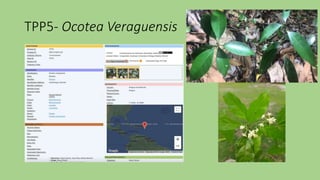
TPP5- Ocotea Veraguensis
• Accepted name: Mespilodaphne
Veraguensis
• Mostly distributed in tropical and
subtropical regions of the Americas
including that Caribbean.
• Can grow from 5 – 12 meters tall
• Thrives in moist forest or thickets,
mostly along stream banks, often
on dry rocky hillsides
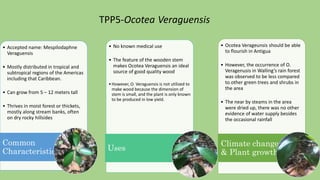
Common
Characteristics
• No known medical use
• The feature of the wooden stem
makes Ocotea Veraguensis an ideal
source of good quality wood
•However, O. Veraguensis is not utilized to
make wood because the dimension of
stem is small, and the plant is only known
to be produced in low yield.
Uses
• Ocotea Verageunsis should be able
to flourish in Antigua
• However, the occurrence of O.
Veragenusis in Walling’s rain forest
was observed to be less compared
to other green trees and shrubs in
the area
• The near by steams in the area
were dried up, there was no other
evidence of water supply besides
the occasional rainfall
Climate change
& Plant growth
TPP5-Ocotea Veraguensis
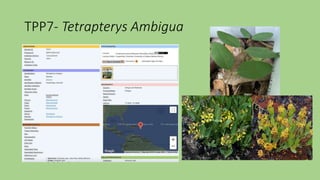
TPP7- Tetrapterys Ambigua
• Native to the Caribbean and Latino
America
• Small trees, shrubs or vines
• Toxic to livestock if consumed for
long periods of time
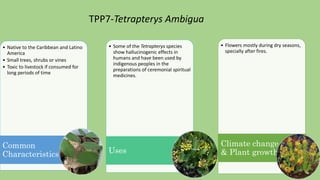
Common
Characteristics
• Some of the Tetrapterys species
show hallucinogenic effects in
humans and have been used by
indigenous peoples in the
preparations of ceremonial spiritual
medicines.
Uses
• Flowers mostly during dry seasons,
specially after fires.
Climate change
& Plant growth
TPP7-Tetrapterys Ambigua
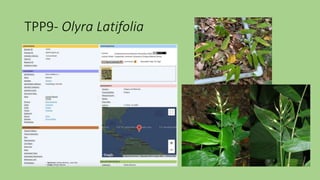
TPP9- Olyra Latifolia
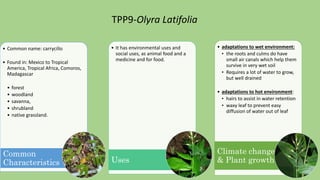
• Common name: carrycillo
• Found in: Mexico to Tropical
America, Tropical Africa, Comoros,
Madagascar
• forest
• woodland
• savanna,
• shrubland
• native grassland.
Common
Characteristics
• It has environmental uses and
social uses, as animal food and a
medicine and for food.
Uses
• adaptations to wet environment:
• the roots and culms do have
small air canals which help them
survive in very wet soil
• Requires a lot of water to grow,
but well drained
• adaptations to hot environment:
• hairs to assist in water retention
• waxy leaf to prevent easy
diffusion of water out of leaf
Climate change
& Plant growth
TPP9-Olyra Latifolia
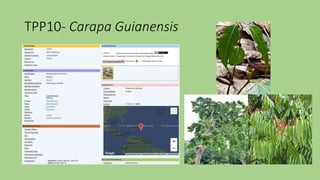
TPP10- Carapa Guianensis
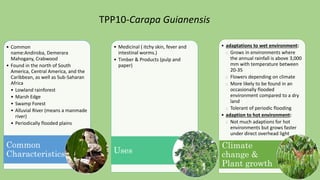
• Common
name:Andiroba, Demerara
Mahogany, Crabwood
• Found in the north of South
America, Central America, and the
Caribbean, as well as Sub-Saharan
Africa
• Lowland rainforest
• Marsh Edge
• Swamp Forest
• Alluvial River (means a manmade
river)
• Periodically flooded plains
Common
Characteristics
• Medicinal ( itchy skin, fever and
intestinal worms.)
• Timber & Products (pulp and
paper)
Uses
• adaptations to wet environment:
 Grows in environments where
the annual rainfall is above 3,000
mm with temperature between
20-35
 Flowers depending on climate
 More likely to be found in an
occasionally flooded
environment compared to a dry
land
 Tolerant of periodic flooding
• adaption to hot environment:
 Not much adaptions for hot
environments but grows faster
under direct overhead light
Climate
change &
Plant growth
TPP10-Carapa Guianensis
Phylogeny Tree
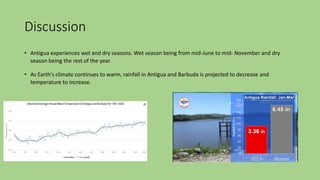
Discussion
• Antigua experiences wet and dry seasons. Wet season being from mid-June to mid- November and dry
season being the rest of the year.
• As Earth's climate continues to warm, rainfall in Antigua and Barbuda is projected to decrease and
temperature to increase.
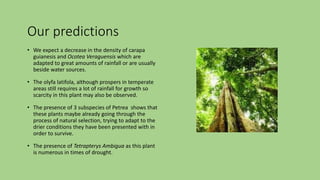
Our predictions
• We expect a decrease in the density of carapa
guianesis and Ocotea Veraguensis which are
adapted to great amounts of rainfall or are usually
beside water sources.
• The olyfa latifola, although prospers in temperate
areas still requires a lot of rainfall for growth so
scarcity in this plant may also be observed.
• The presence of 3 subspecies of Petrea shows that
these plants maybe already going through the
process of natural selection, trying to adapt to the
drier conditions they have been presented with in
order to survive.
• The presence of Tetrapterys Ambigua as this plant
is numerous in times of drought.
What’s next?
• To systematically track the density of these plants in the area as time progresses so we can see if our
predictions are true.
• Observe which plants are no longer in the area and which plants may have become invasive
• We can see the firsthand effect of climate change on the biodiversity.
• Intervention to curb climate change would be the best mode of action to preserve the plant life that currently
inhabit this ecosystem.
THANK YOU
Questions?

B. DNA Barcoding Presentation.pptx

  • 1.
    DNA Barcoding A PotentialTracker of Climate Change and it’s Effects on Flora and Fauna TEAM PLANT PRESERVATION (TPP) Bersma, Ashley Daniel, Alana Lack, Amanda Orta, Jose Rajput, Tahreem
  • 2.
    Introduction What is DNAbarcoding? • Unique Pattern of DNA • Easy Identification and Classification of Species • No need for expert knowledge of morphology or taxonomy • RuBisCo (rbcL) in plants • Cytochrome C oxidase (COI) in animals Why Climate Change? • Warmer Temperatures • New Weather Patterns • Severe Storms • Animal Migration patterns • Displacement of species @2012 2022
  • 3.
    Materials and Methods SampleCollection • Wallings Nature Reserve • Lat (17.0343198), Lon (-61.826608) • 10 samples DNA extraction • Mechanical lysing of cells • DNA extraction and Purification was done by following protocols from DNAeasy extraction Kits from QIAGEN
  • 4.
    Materials and Methods PolymeraseChain Reaction (PCR) • PCR reaction was set up as per protocols -Initial Denaturation: 94C - 1 min. -Denaturation: 94C - 15 sec. -Annealing: 54C - 15 sec. -Extending: 72C - 30 sec. -35 Cycles. -Preserved at 4C until ready to use. • Primer Design: 5'TGTAAAACGACGGCCAGTATGTCACCACAAACAGAGA CTAAAGC-3' (forward primer–rbcLaf-M13) 5'-CAGGAAACAGCTATGACGTAAAATCAAGTCCACCRCG- 3' (reverse primer–rbcLa-revM13) Gel Electrophoresis • PCR reactions were examined on a 2% agarose gel • Band expected size is approximately 700bp in size
  • 5.
    Materials and Methods Sequencing •PCR samples were sent to New York for next generation sequencing. Bioinformatic Analysis • Sequencing results were analyzed through: -DNA Subway program https://dnasubway.cyverse.org/project/browse my - BOLD SDP http://v3.boldsystems.org/index.php/SDP_Man agement_StudentsConsole - NCBI BLAST https://blast.ncbi.nlm.nih.gov/Blast.cgi • A Phylogeny Tree was created from our results
  • 6.
  • 7.
  • 8.
  • 9.
    • Commonly knownas Purple wreath, Queen's wreath, sandpaper vine, Tropical Wisteria, Bluebird Vine, and Fleur de Dieu. • Origin: Central America, South America in the tropics (Mexico, Peru, Brazil, Costa Rica), and Caribbean. • Tropical Shrub/Vine Common Characteristics • Valued especially for its display of violet flowers • In the traditional Amerindian pharmacopoeia, certain ethnic groups such as the Wayãpi (Amazonia, Guyana, Brazil) use the sap in preparation to treat burns, wounds, inflammations, abscesses. • In the Caribbean, associated with other plants, it is used as an antidiarrheal and as an abortifacient. Uses • Prefers full sun and it can tolerate shade, although it will not flower profusely • handles a very light and fleeting frost at temperatures down to -2 °C • thrives in well drained, fertile soils and can tolerate drought • Depending on the climate there may be 2 nectariferous blooms are visited by hummingbirds and butterflies Climate change & Plant growth TPP1-Petrea Kohautiana
  • 10.
  • 11.
    • Commonly knownas Purple wreath, Queen's wreath, sandpaper vine, Tropical Wisteria, Bluebird Vine, and Fleur de Dieu. • Origin: Central America, South America in the tropics (Mexico, Peru, Brazil, Costa Rica), and Caribbean. • Tropical Shrub/Vine Common Characteristics • Valued especially for its display of violet flowers • In the traditional Amerindian pharmacopoeia, certain ethnic groups such as the Wayãpi (Amazonia, Guyana, Brazil) use the sap in preparation to treat burns, wounds, inflammations, abscesses. • In the Caribbean, associated with other plants, it is used as an antidiarrheal and as an abortifacient. • Leaves have been used for treatment of diabetes/ methanol extract has shown hypoglycemic activity (Philippines) Uses • Prefers full sun and it can tolerate shade, although it will not flower profusely • handles a very light and fleeting frost at temperatures down to -2 °C • thrives in well drained, fertile soils and can tolerate drought • Depending on the climate there may be 2 nectariferous blooms are visited by hummingbirds and butterflies Climate change & Plant growth TPP2-Petrea Volubilis
  • 12.
  • 13.
    • Commonly knownas Purple wreath, Queen's wreath, sandpaper vine, Tropical Wisteria, Bluebird Vine, and Fleur de Dieu. • Origin: Central America, South America in the tropics (Mexico, Peru, Brazil, Costa Rica), and Caribbean. • Tropical Shrub/Vine • Larger, darker flowers but less blooms than P. Volubilis. Common Characteristics • Valued especially for its display of violet flowers • In the traditional Amerindian pharmacopoeia, certain ethnic groups such as the Wayãpi (Amazonia, Guyana, Brazil) use the sap in preparation to treat burns, wounds, inflammations, abscesses. • In the Caribbean, associated with other plants, it is used as an antidiarrheal and as an abortifacient. Uses • Prefers full sun and it can tolerate shade, although it will not flower profusely • handles a very light and fleeting frost at temperatures down to -2 °C • thrives in well drained, fertile soils and can tolerate drought • Depending on the climate there may be 2 nectariferous blooms are visited by hummingbirds and butterflies Climate change & Plant growth TPP4-Petrea Racemosa
  • 14.
  • 15.
    • Accepted name:Mespilodaphne Veraguensis • Mostly distributed in tropical and subtropical regions of the Americas including that Caribbean. • Can grow from 5 – 12 meters tall • Thrives in moist forest or thickets, mostly along stream banks, often on dry rocky hillsides Common Characteristics • No known medical use • The feature of the wooden stem makes Ocotea Veraguensis an ideal source of good quality wood •However, O. Veraguensis is not utilized to make wood because the dimension of stem is small, and the plant is only known to be produced in low yield. Uses • Ocotea Verageunsis should be able to flourish in Antigua • However, the occurrence of O. Veragenusis in Walling’s rain forest was observed to be less compared to other green trees and shrubs in the area • The near by steams in the area were dried up, there was no other evidence of water supply besides the occasional rainfall Climate change & Plant growth TPP5-Ocotea Veraguensis
  • 16.
  • 17.
    • Native tothe Caribbean and Latino America • Small trees, shrubs or vines • Toxic to livestock if consumed for long periods of time Common Characteristics • Some of the Tetrapterys species show hallucinogenic effects in humans and have been used by indigenous peoples in the preparations of ceremonial spiritual medicines. Uses • Flowers mostly during dry seasons, specially after fires. Climate change & Plant growth TPP7-Tetrapterys Ambigua
  • 18.
  • 19.
    • Common name:carrycillo • Found in: Mexico to Tropical America, Tropical Africa, Comoros, Madagascar • forest • woodland • savanna, • shrubland • native grassland. Common Characteristics • It has environmental uses and social uses, as animal food and a medicine and for food. Uses • adaptations to wet environment: • the roots and culms do have small air canals which help them survive in very wet soil • Requires a lot of water to grow, but well drained • adaptations to hot environment: • hairs to assist in water retention • waxy leaf to prevent easy diffusion of water out of leaf Climate change & Plant growth TPP9-Olyra Latifolia
  • 20.
  • 21.
    • Common name:Andiroba, Demerara Mahogany,Crabwood • Found in the north of South America, Central America, and the Caribbean, as well as Sub-Saharan Africa • Lowland rainforest • Marsh Edge • Swamp Forest • Alluvial River (means a manmade river) • Periodically flooded plains Common Characteristics • Medicinal ( itchy skin, fever and intestinal worms.) • Timber & Products (pulp and paper) Uses • adaptations to wet environment:  Grows in environments where the annual rainfall is above 3,000 mm with temperature between 20-35  Flowers depending on climate  More likely to be found in an occasionally flooded environment compared to a dry land  Tolerant of periodic flooding • adaption to hot environment:  Not much adaptions for hot environments but grows faster under direct overhead light Climate change & Plant growth TPP10-Carapa Guianensis
  • 22.
  • 23.
    Discussion • Antigua experienceswet and dry seasons. Wet season being from mid-June to mid- November and dry season being the rest of the year. • As Earth's climate continues to warm, rainfall in Antigua and Barbuda is projected to decrease and temperature to increase.
  • 24.
    Our predictions • Weexpect a decrease in the density of carapa guianesis and Ocotea Veraguensis which are adapted to great amounts of rainfall or are usually beside water sources. • The olyfa latifola, although prospers in temperate areas still requires a lot of rainfall for growth so scarcity in this plant may also be observed. • The presence of 3 subspecies of Petrea shows that these plants maybe already going through the process of natural selection, trying to adapt to the drier conditions they have been presented with in order to survive. • The presence of Tetrapterys Ambigua as this plant is numerous in times of drought.
  • 25.
    What’s next? • Tosystematically track the density of these plants in the area as time progresses so we can see if our predictions are true. • Observe which plants are no longer in the area and which plants may have become invasive • We can see the firsthand effect of climate change on the biodiversity. • Intervention to curb climate change would be the best mode of action to preserve the plant life that currently inhabit this ecosystem.
  • 26.

Editor's Notes

  • #10 Talk about how the growth of the plant is stunted as no plants of that type were seen that were more than 1 meter tall Mention the feature of the stem Talk about how climate change could be the reason for the stunted growth Talk about the advantage of the plant being cultivated for production of wood Talk about an idea to genetically modify the plant to produce thicker stems
  • #12 Talk about how the growth of the plant is stunted as no plants of that type were seen that were more than 1 meter tall Mention the feature of the stem Talk about how climate change could be the reason for the stunted growth Talk about the advantage of the plant being cultivated for production of wood Talk about an idea to genetically modify the plant to produce thicker stems
  • #14 Talk about how the growth of the plant is stunted as no plants of that type were seen that were more than 1 meter tall Mention the feature of the stem Talk about how climate change could be the reason for the stunted growth Talk about the advantage of the plant being cultivated for production of wood Talk about an idea to genetically modify the plant to produce thicker stems
  • #16 Talk about how the growth of the plant is stunted as no plants of that type were seen that were more than 1 meter tall Mention the feature of the stem Talk about how climate change could be the reason for the stunted growth Talk about the advantage of the plant being cultivated for production of wood Talk about an idea to genetically modify the plant to produce thicker stems
  • #18 Talk about how the growth of the plant is stunted as no plants of that type were seen that were more than 1 meter tall Mention the feature of the stem Talk about how climate change could be the reason for the stunted growth Talk about the advantage of the plant being cultivated for production of wood Talk about an idea to genetically modify the plant to produce thicker stems
  • #20 Talk about how the growth of the plant is stunted as no plants of that type were seen that were more than 1 meter tall Mention the feature of the stem Talk about how climate change could be the reason for the stunted growth Talk about the advantage of the plant being cultivated for production of wood Talk about an idea to genetically modify the plant to produce thicker stems
  • #22 Talk about how the growth of the plant is stunted as no plants of that type were seen that were more than 1 meter tall Mention the feature of the stem Talk about how climate change could be the reason for the stunted growth Talk about the advantage of the plant being cultivated for production of wood Talk about an idea to genetically modify the plant to produce thicker stems