WELCOME
JITHYA RAVEENDRAN
MA ENGLISH
NEHRU ARTS AND SCIENCE COLLEGE
KANHANGAD
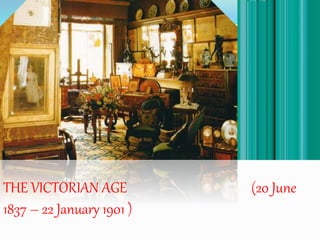
THE VICTORIAN AGE (20 June
1837 – 22 January 1901 )
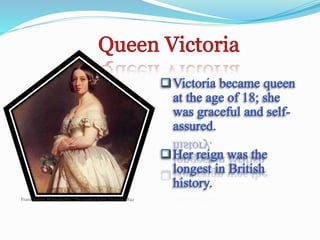
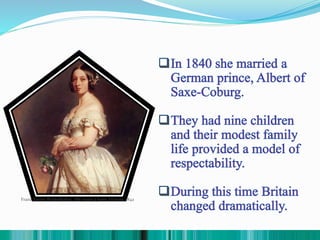
Franz Xavier Winterhalter, The young Queen Victoria, 1842
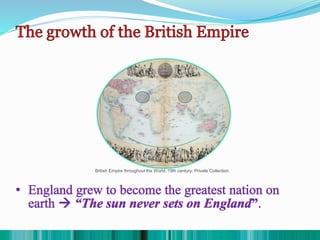
British Empire throughout the World, 19th century, Private Collection.
British Empire included Canada, Australia, New
Zealand, Hong Kong, Singapore, South Africa, Kenya,
and India.
.
Great Britain imported raw materials such as cotton
and silk and exported finished goods to countries
around the world.
By the mid-1800s, Great Britain was the largest
exporter and importer of goods in the world. It was
the primary manufacturer of goods and the wealthiest
country in the world.
Because of England’s success, the British felt it was
their duty to bring English values, laws, customs and
religion to the ‘savage” races around the world.
 1832: The First Reform Act granted the vote to
almost all male members of middle-class.
 1833: The Factory Act regulated child labour in
factories.
 1834: Poor Law Amendment established a
system of workhouses for poor people.
 1867: The Second Reform Act gave the vote to
skilled working men.
 1871: Trade Union Act legalised trade unions.
 1884: The Third Reform Act granted the right to
vote to all male householders.
Britain was a model of industrial success, individual
freedom and constitutional government
Upper and industrial middle-classes believed in a policy
of “laissez-faire” ie. non-interference with industry or
with national economy in order to promote free trade and
free competition (=Liberalism)
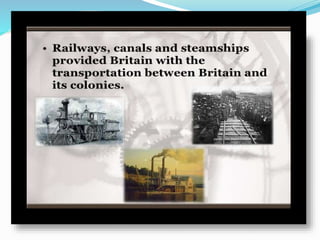
 triumph of industry (steam engine, steamboats,
shipbuilding, trains, iron industry)
 scientific progress (electricity, telegraph,
gas- lighting, stamp+postal system, medicine)
Imperialism = territorial expansion, colonies abroad
During the Victorian Age the British Empire reached
its largest extension: it was called “the Empire where
the sun never sets”
British Imperial power was sustained by:
• willingness to protect British trade routes and interests
against other nations; to gain new terrotories
• firm belief in the excellence of English culture and
institutions
1839-1842 Opium War against China
1853-1856 Crimean War
1857 Indian Mutiny
1877 Queen Victoria was named “Empress of
India”
1882 occupation of Egypt
1884 invasion of Sudan
1899-1902 Boers’ War
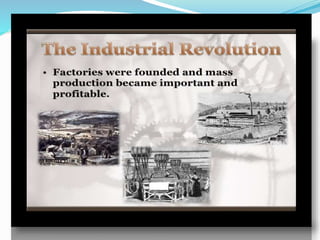
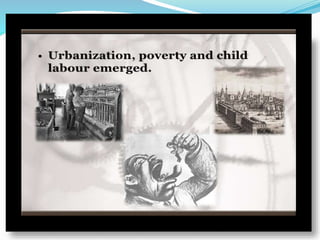
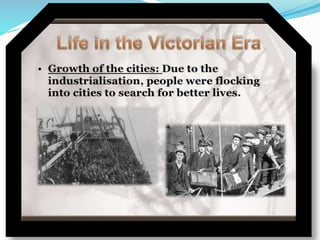
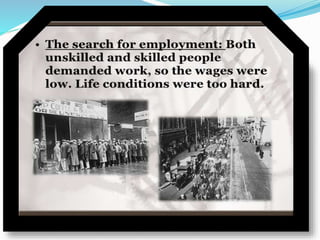
Urbanization - Britain became a nation of town
dwellers
Extraordinary industrial development
Overcrowding
Poverty - appalling living conditions in slums
(disease, bad sanitation, crime, high death rate)
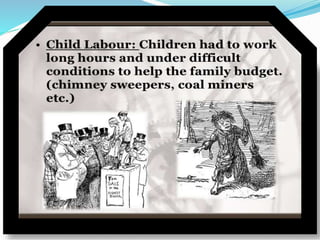
Terrible working conditions - (polluted
atmosphere, disatrous effects on health especially
on children)
A set code of moral values that explained the general
tendency to be excessively puritanical and to avoid taking
definite positions
 Material progress + wealth emerge from hard work
 Appearance is very important
 Respectability = a mixture of both morality and
hypocrisy, severity and conformity to social standards
 Philanthropy = charitable activity addressed to every
kind of poverty
 Victorian family = a patriarchal unit where the husband
was dominant and the wife was the angel in the home
 (the fallen woman)
 Patriotism
 Private life was separated from public behaviour
It was a particular situation which saw two opposing
aspects of life:
on one side PROSPERITY and MATERIAL
SCIENTIFIC PROGRESS, ETHICAL
CONFORMISM, MORALISM and
PHILANTHROPY
which opposed
on the other side POVERTY, UGLINESS,
CORRUPTION, MONEY and CAPITALISTIC
GREED
Contained a lot of contradictions caused among other
things by the influence of new philosophical trends,
religious movements, economic theories and scientific
discoveries of the period:
Evangelicalism = good moral Christian conduct
Utilitarianism = only what is useful is good, any
problem could be overcome through reason
Evolutionism = theory of evolution of species governed
by natural selection and struggle for survival
Determinism = theory which denies human freedom of
action, everything is strictly governed by cause and
effect
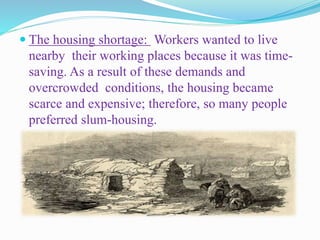
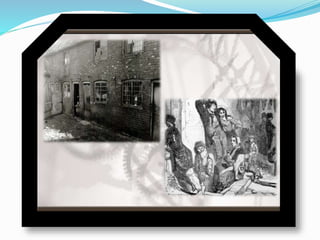
 The housing shortage: Workers wanted to live
nearby their working places because it was time-
saving. As a result of these demands and
overcrowded conditions, the housing became
scarce and expensive; therefore, so many people
preferred slum-housing.
Kellow Chesney made a description of
slum-housing in his book “The
Victorian Underworld” :
‘Hideous slums, some of them acres wide, some
no more than crannies of obscure misery, make up
a substantial part of the, metropolis … In big,
once handsome houses, thirty or more people of
all ages may inhabit a single room,’
The Victorian Age was a complex era characterized
by stability, progress and social reforms and also,
by great problems such as poverty, injustice and
social unrest.That’s why the Victorians felt obliged
to promote and invent a rigid code of values that
reflected the world as they wanted it to be.
 Working class - men and women who performed
physical labor, paid daily or weekly wages
 Middle class - men performed mental or "clean"
work, paid monthly or annually
 Upper class - did not work, income came from
inherited land and investments
 Photography
 Telegraph, telephone, cars, aircraft
 Sewage system and water pipes in London
 Water supply, gas network for heating and lighting
 This study of natural history was most powerfully
advanced by Charles Darwin and his theory of
evolution first published in his book On the Origin
of Species in 1859.
 Medicine progressed during the Victorian period.
 Ether, chloroform, nitrous oxide were used as a
way of anesthesia.
 In this way, operations such as dentistry cases
became painless.
 The Waterloo Teeth
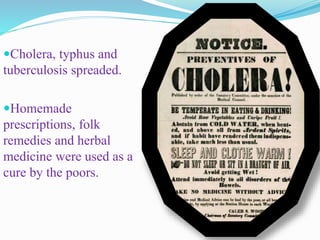
Cholera, typhus and
tuberculosis spreaded.
Homemade
prescriptions, folk
remedies and herbal
medicine were used as a
cure by the poors.
 Victorian England was a deeply religious country.
 A great number of people were habitual church-
goers, at least once, every Sunday.
 The Bible and religious stories were frequently and
widely read by people of every class.
 Towards the end of Queen Victoria's reign, the faith
of the English people began to slacken.
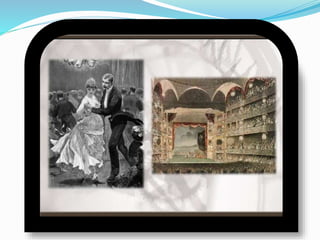
Types of entertainment depends on social classes.
Victorian Britain was interested in theatre, opera,
the arts, music and drama.
Gambling in casinos, drinking and prostitution were
popular.
Hypnotism and ghost conjuring aroused curiosity.
Hobbies such as studies of birds, butterflies,
seashells and wildflowers were also popular.
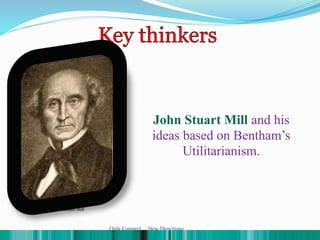
John Stuart Mill and his
ideas based on Bentham’s
Utilitarianism.
John Stuart Mill
Only Connect ... New Directions
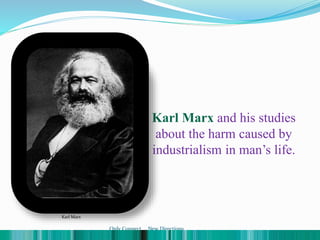
Karl Marx and his studies
about the harm caused by
industrialism in man’s life.
Karl Marx
Only Connect ... New Directions
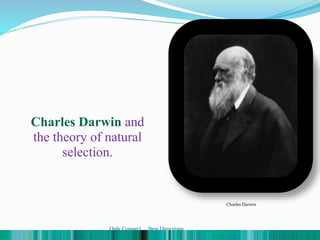
Charles Darwin and
the theory of natural
selection.
Charles Darwin
Only Connect ... New Directions
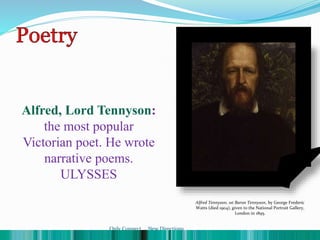
Alfred, Lord Tennyson:
the most popular
Victorian poet. He wrote
narrative poems.
ULYSSES
Alfred Tennyson, 1st Baron Tennyson, by George Frederic
Watts (died 1904), given to the National Portrait Gallery,
London in 1895.
Only Connect ... New Directions
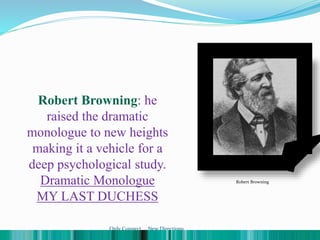
Robert Browning: he
raised the dramatic
monologue to new heights
making it a vehicle for a
deep psychological study.
Dramatic Monologue
MY LAST DUCHESS
Robert Browning
Only Connect ... New Directions
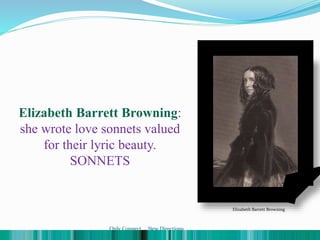
Elizabeth Barrett Browning:
she wrote love sonnets valued
for their lyric beauty.
SONNETS
Elizabeth Barrett Browning
Only Connect ... New Directions
The victorian age (1830 1901)

The victorian age (1830 1901)

  • 1.
    WELCOME JITHYA RAVEENDRAN MA ENGLISH NEHRUARTS AND SCIENCE COLLEGE KANHANGAD
  • 2.
    THE VICTORIAN AGE(20 June 1837 – 22 January 1901 )
  • 3.
    Franz Xavier Winterhalter,The young Queen Victoria, 1842
  • 4.
    Franz Xavier Winterhalter,The young Queen Victoria, 1842
  • 5.
    British Empire throughoutthe World, 19th century, Private Collection.
  • 6.
    British Empire includedCanada, Australia, New Zealand, Hong Kong, Singapore, South Africa, Kenya, and India. . Great Britain imported raw materials such as cotton and silk and exported finished goods to countries around the world. By the mid-1800s, Great Britain was the largest exporter and importer of goods in the world. It was the primary manufacturer of goods and the wealthiest country in the world. Because of England’s success, the British felt it was their duty to bring English values, laws, customs and religion to the ‘savage” races around the world.
  • 7.
     1832: TheFirst Reform Act granted the vote to almost all male members of middle-class.  1833: The Factory Act regulated child labour in factories.  1834: Poor Law Amendment established a system of workhouses for poor people.  1867: The Second Reform Act gave the vote to skilled working men.  1871: Trade Union Act legalised trade unions.  1884: The Third Reform Act granted the right to vote to all male householders.
  • 8.
    Britain was amodel of industrial success, individual freedom and constitutional government Upper and industrial middle-classes believed in a policy of “laissez-faire” ie. non-interference with industry or with national economy in order to promote free trade and free competition (=Liberalism)  triumph of industry (steam engine, steamboats, shipbuilding, trains, iron industry)  scientific progress (electricity, telegraph, gas- lighting, stamp+postal system, medicine)
  • 9.
    Imperialism = territorialexpansion, colonies abroad During the Victorian Age the British Empire reached its largest extension: it was called “the Empire where the sun never sets” British Imperial power was sustained by: • willingness to protect British trade routes and interests against other nations; to gain new terrotories • firm belief in the excellence of English culture and institutions
  • 10.
    1839-1842 Opium Waragainst China 1853-1856 Crimean War 1857 Indian Mutiny 1877 Queen Victoria was named “Empress of India” 1882 occupation of Egypt 1884 invasion of Sudan 1899-1902 Boers’ War
  • 11.
    Urbanization - Britainbecame a nation of town dwellers Extraordinary industrial development Overcrowding Poverty - appalling living conditions in slums (disease, bad sanitation, crime, high death rate) Terrible working conditions - (polluted atmosphere, disatrous effects on health especially on children)
  • 12.
    A set codeof moral values that explained the general tendency to be excessively puritanical and to avoid taking definite positions
  • 13.
     Material progress+ wealth emerge from hard work  Appearance is very important  Respectability = a mixture of both morality and hypocrisy, severity and conformity to social standards  Philanthropy = charitable activity addressed to every kind of poverty  Victorian family = a patriarchal unit where the husband was dominant and the wife was the angel in the home  (the fallen woman)  Patriotism  Private life was separated from public behaviour
  • 14.
    It was aparticular situation which saw two opposing aspects of life: on one side PROSPERITY and MATERIAL SCIENTIFIC PROGRESS, ETHICAL CONFORMISM, MORALISM and PHILANTHROPY which opposed on the other side POVERTY, UGLINESS, CORRUPTION, MONEY and CAPITALISTIC GREED
  • 15.
    Contained a lotof contradictions caused among other things by the influence of new philosophical trends, religious movements, economic theories and scientific discoveries of the period: Evangelicalism = good moral Christian conduct Utilitarianism = only what is useful is good, any problem could be overcome through reason Evolutionism = theory of evolution of species governed by natural selection and struggle for survival Determinism = theory which denies human freedom of action, everything is strictly governed by cause and effect
  • 22.
     The housingshortage: Workers wanted to live nearby their working places because it was time- saving. As a result of these demands and overcrowded conditions, the housing became scarce and expensive; therefore, so many people preferred slum-housing.
  • 23.
    Kellow Chesney madea description of slum-housing in his book “The Victorian Underworld” : ‘Hideous slums, some of them acres wide, some no more than crannies of obscure misery, make up a substantial part of the, metropolis … In big, once handsome houses, thirty or more people of all ages may inhabit a single room,’
  • 28.
    The Victorian Agewas a complex era characterized by stability, progress and social reforms and also, by great problems such as poverty, injustice and social unrest.That’s why the Victorians felt obliged to promote and invent a rigid code of values that reflected the world as they wanted it to be.
  • 30.
     Working class- men and women who performed physical labor, paid daily or weekly wages  Middle class - men performed mental or "clean" work, paid monthly or annually  Upper class - did not work, income came from inherited land and investments
  • 33.
     Photography  Telegraph,telephone, cars, aircraft  Sewage system and water pipes in London  Water supply, gas network for heating and lighting  This study of natural history was most powerfully advanced by Charles Darwin and his theory of evolution first published in his book On the Origin of Species in 1859.
  • 34.
     Medicine progressedduring the Victorian period.  Ether, chloroform, nitrous oxide were used as a way of anesthesia.  In this way, operations such as dentistry cases became painless.  The Waterloo Teeth
  • 35.
    Cholera, typhus and tuberculosisspreaded. Homemade prescriptions, folk remedies and herbal medicine were used as a cure by the poors.
  • 36.
     Victorian Englandwas a deeply religious country.  A great number of people were habitual church- goers, at least once, every Sunday.  The Bible and religious stories were frequently and widely read by people of every class.  Towards the end of Queen Victoria's reign, the faith of the English people began to slacken.
  • 37.
    Types of entertainmentdepends on social classes. Victorian Britain was interested in theatre, opera, the arts, music and drama. Gambling in casinos, drinking and prostitution were popular. Hypnotism and ghost conjuring aroused curiosity. Hobbies such as studies of birds, butterflies, seashells and wildflowers were also popular.
  • 40.
    John Stuart Milland his ideas based on Bentham’s Utilitarianism. John Stuart Mill Only Connect ... New Directions
  • 41.
    Karl Marx andhis studies about the harm caused by industrialism in man’s life. Karl Marx Only Connect ... New Directions
  • 42.
    Charles Darwin and thetheory of natural selection. Charles Darwin Only Connect ... New Directions
  • 49.
    Alfred, Lord Tennyson: themost popular Victorian poet. He wrote narrative poems. ULYSSES Alfred Tennyson, 1st Baron Tennyson, by George Frederic Watts (died 1904), given to the National Portrait Gallery, London in 1895. Only Connect ... New Directions
  • 50.
    Robert Browning: he raisedthe dramatic monologue to new heights making it a vehicle for a deep psychological study. Dramatic Monologue MY LAST DUCHESS Robert Browning Only Connect ... New Directions
  • 51.
    Elizabeth Barrett Browning: shewrote love sonnets valued for their lyric beauty. SONNETS Elizabeth Barrett Browning Only Connect ... New Directions