The CLEAR Framework to
Implement Active Learning
in STEM Education
Jingjing Lin
Center for IT-based Education
Toyohashi University of Technology
Toyohashi, Japan
lin.jingjing.qc@tut.jp
1
TRIGGER
2
TRIGGER
3
“
”
A higher level of cognitive
activities (doing homework)
does not need to wait until a
learner completes a lower
level of cognitive activities
(remembering all materials
taught in class).
REFLECTION
Bloom’s Taxonomy
Cognitive, Affective, Psychomotor.
Cognitive: knowledge, comprehension,
application, analysis, synthesis, and
evaluation
Taxonomy for Teaching,
Learning, and Assessment
Revised to:
remember, understand, apply, analyze,
evaluate, and create
1956
2001
4
Bloom’s Taxonomy
Taxonomy for Teaching,
Learning, and Assessment
1956
2001
1998
2006 2010 2016
2004
1983
2002
2001 2007
1994
2012
REALITY CHECK
5
Instant
Gratification
Author: McCrindle Research, from
https://newbeach.co/generation-alpha-better-be-ready/
NOW!
NOW!
REALITY CHECK
6
CLEAR:
THEORY
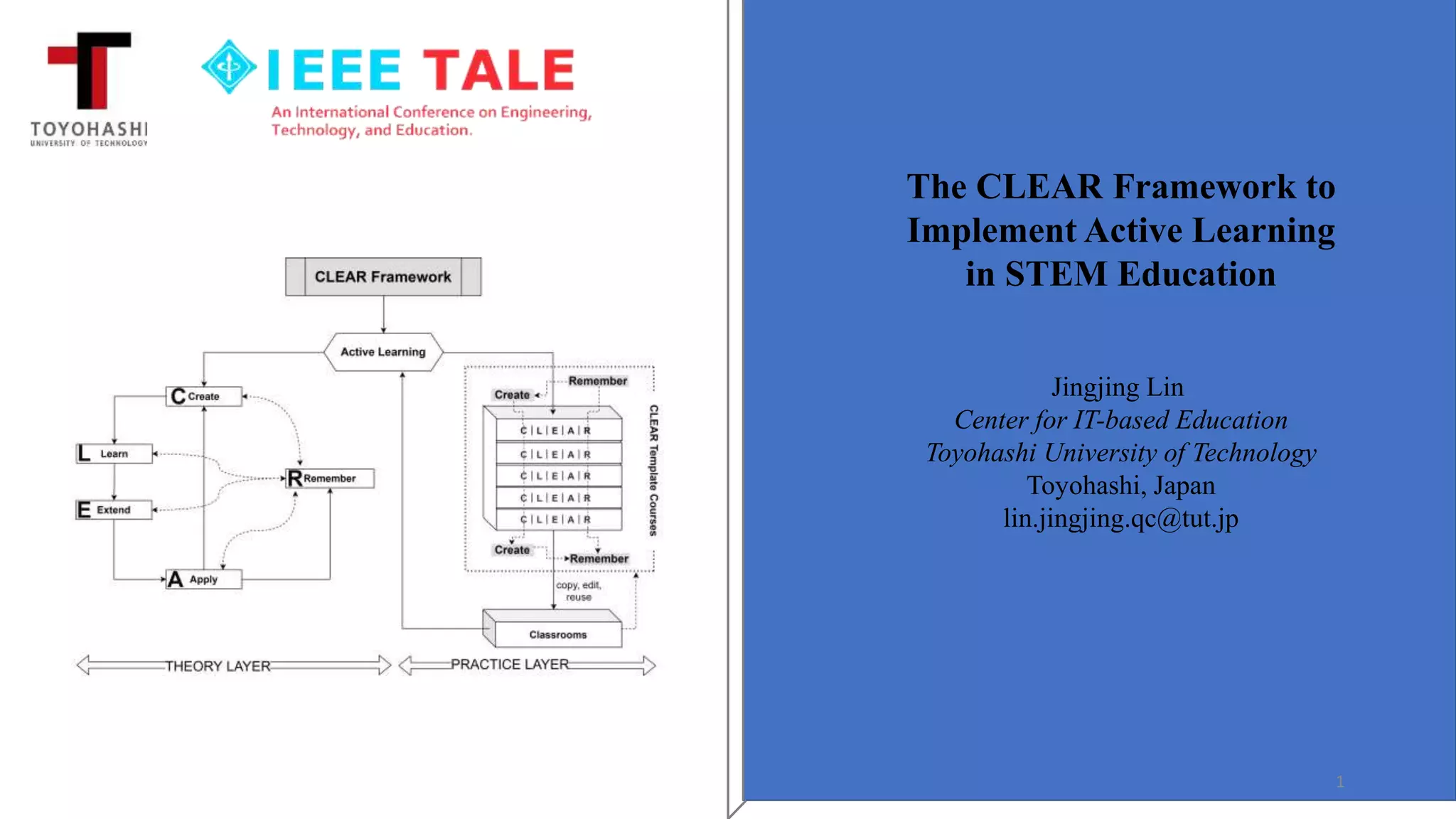
The CLEAR (Create, Learn, Extend, Apply, and
Remember) Framework of Active Learning
Fig 1 Create > Remember
7
Create > Remember
The CLEAR (Create, Learn, Extend, Apply, and
Remember) Framework of Active Learning
Fig 1
CLEAR: PRACTICE
8
CLEAR: PRACTICE
Create > Remember
Template Courses
• Copy & Paste: Create a new
course from template courses.
• Modify: edit the template-
based new course according to
needs.
• Deliver: enrol students and
deliver the teaching.
• Share: share the new course
as new template in the
database.
9
CLEAR: ADVANCEMENT
“
”
Simplicity
Simple to understand to easy to
implement.
Duality
A theory + A practice guide.
CLEAR model promotes
“create to remember”. It can
transform how STEM
teachers are trained and
how STEM courses are
taught considering three
following advancements in
the framework.
Basics
Return to a basic goal: help students
remember.
10
ONGOING WORK
“
”
Evidence
Literature review to check the CLEAR
model against research evidence.
Experts
Online interviews to check the CLEAR
model against award-winning teachers.
CLEAR model are
being validated by
ongoing research.
Experiment
Control group pretest/posttest online
experiment to evaluate the effectiveness of
the CLEAR model as a course design model.
11
LINKED PROJECT
“
”
Website
https://sites.google.com/view/clearinitiative
Host Institute
• Center for IT-based Education, Toyohashi
University of Technology, Japan
The CLEAR Initiative: To
Foster Digital Changes
in University-Level
STEM Education and
Faculty Development by
Promoting Active
Learning
12
Q & A
EMAIL
LIN.JINGJING.QC@TUT.JP
The CLEAR (Create, Learn, Extend, Apply, and
Remember) Framework of Active Learning
Fig 1
13
14

The CLEAR Framework to Implement Active Learning in STEM Education

  • 1.
    The CLEAR Frameworkto Implement Active Learning in STEM Education Jingjing Lin Center for IT-based Education Toyohashi University of Technology Toyohashi, Japan lin.jingjing.qc@tut.jp 1
  • 2.
  • 3.
  • 4.
    “ ” A higher levelof cognitive activities (doing homework) does not need to wait until a learner completes a lower level of cognitive activities (remembering all materials taught in class). REFLECTION Bloom’s Taxonomy Cognitive, Affective, Psychomotor. Cognitive: knowledge, comprehension, application, analysis, synthesis, and evaluation Taxonomy for Teaching, Learning, and Assessment Revised to: remember, understand, apply, analyze, evaluate, and create 1956 2001 4
  • 5.
    Bloom’s Taxonomy Taxonomy forTeaching, Learning, and Assessment 1956 2001 1998 2006 2010 2016 2004 1983 2002 2001 2007 1994 2012 REALITY CHECK 5
  • 6.
    Instant Gratification Author: McCrindle Research,from https://newbeach.co/generation-alpha-better-be-ready/ NOW! NOW! REALITY CHECK 6
  • 7.
    CLEAR: THEORY The CLEAR (Create,Learn, Extend, Apply, and Remember) Framework of Active Learning Fig 1 Create > Remember 7
  • 8.
    Create > Remember TheCLEAR (Create, Learn, Extend, Apply, and Remember) Framework of Active Learning Fig 1 CLEAR: PRACTICE 8
  • 9.
    CLEAR: PRACTICE Create >Remember Template Courses • Copy & Paste: Create a new course from template courses. • Modify: edit the template- based new course according to needs. • Deliver: enrol students and deliver the teaching. • Share: share the new course as new template in the database. 9
  • 10.
    CLEAR: ADVANCEMENT “ ” Simplicity Simple tounderstand to easy to implement. Duality A theory + A practice guide. CLEAR model promotes “create to remember”. It can transform how STEM teachers are trained and how STEM courses are taught considering three following advancements in the framework. Basics Return to a basic goal: help students remember. 10
  • 11.
    ONGOING WORK “ ” Evidence Literature reviewto check the CLEAR model against research evidence. Experts Online interviews to check the CLEAR model against award-winning teachers. CLEAR model are being validated by ongoing research. Experiment Control group pretest/posttest online experiment to evaluate the effectiveness of the CLEAR model as a course design model. 11
  • 12.
    LINKED PROJECT “ ” Website https://sites.google.com/view/clearinitiative Host Institute •Center for IT-based Education, Toyohashi University of Technology, Japan The CLEAR Initiative: To Foster Digital Changes in University-Level STEM Education and Faculty Development by Promoting Active Learning 12
  • 13.
    Q & A EMAIL LIN.JINGJING.QC@TUT.JP TheCLEAR (Create, Learn, Extend, Apply, and Remember) Framework of Active Learning Fig 1 13
  • 14.