Interest and Equivalence
Class 3
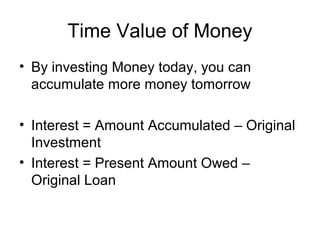
Time Value of Money
• By investing Money today, you can
accumulate more money tomorrow
• Interest = Amount Accumulated – Original
Investment
• Interest = Present Amount Owed –
Original Loan
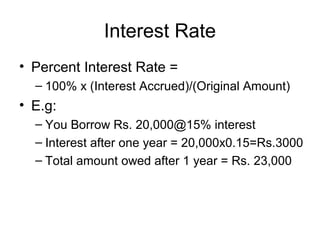
Interest Rate
• Percent Interest Rate =
– 100% x (Interest Accrued)/(Original Amount)
• E.g:
– You Borrow Rs. 20,000@15% interest
– Interest after one year = 20,000x0.15=Rs.3000
– Total amount owed after 1 year = Rs. 23,000
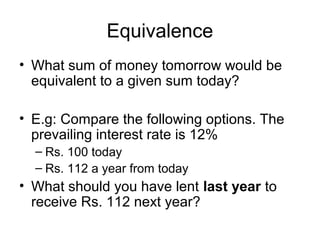
Equivalence
• What sum of money tomorrow would be
equivalent to a given sum today?
• E.g: Compare the following options. The
prevailing interest rate is 12%
– Rs. 100 today
– Rs. 112 a year from today
• What should you have lent last year to
receive Rs. 112 next year?
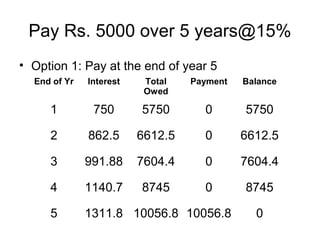
Pay Rs. 5000 over 5 years@15%
• Option 1: Pay at the end of year 5
End of Yr Interest Total
Owed
Payment Balance
1 750 5750 0 5750
2 862.5 6612.5 0 6612.5
3 991.88 7604.4 0 7604.4
4 1140.7 8745 0 8745
5 1311.8 10056.8 10056.8 0
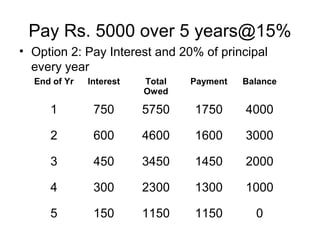
Pay Rs. 5000 over 5 years@15%
• Option 2: Pay Interest and 20% of principal
every year
End of Yr Interest Total
Owed
Payment Balance
1 750 5750 1750 4000
2 600 4600 1600 3000
3 450 3450 1450 2000
4 300 2300 1300 1000
5 150 1150 1150 0
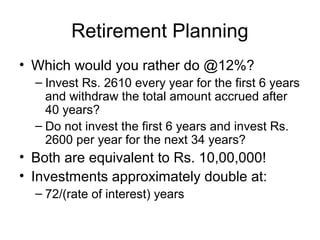
Retirement Planning
• Which would you rather do @12%?
– Invest Rs. 2610 every year for the first 6 years
and withdraw the total amount accrued after
40 years?
– Do not invest the first 6 years and invest Rs.
2600 per year for the next 34 years?
• Both are equivalent to Rs. 10,00,000!
• Investments approximately double at:
– 72/(rate of interest) years
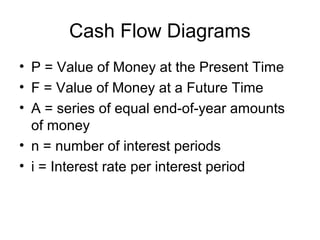
Cash Flow Diagrams
• P = Value of Money at the Present Time
• F = Value of Money at a Future Time
• A = series of equal end-of-year amounts
of money
• n = number of interest periods
• i = Interest rate per interest period
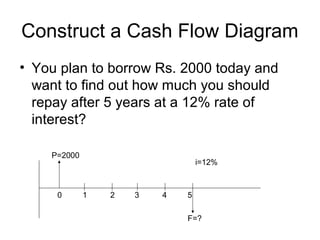
Construct a Cash Flow Diagram
• You plan to borrow Rs. 2000 today and
want to find out how much you should
repay after 5 years at a 12% rate of
interest?
P=2000
F=?
i=12%
0 1 2 3 4 5
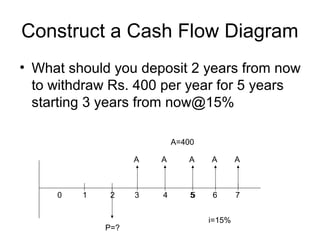
Construct a Cash Flow Diagram
• What should you deposit 2 years from now
to withdraw Rs. 400 per year for 5 years
starting 3 years from now@15%
P=?
i=15%
0 1 2 3 4 55 6 7
A=400
A AAAA
In Class Exercise
• Your friend tells you that he has just
repaid a loan he got 3 years ago at 10%
per year. You learn that he has just paid
Rs. 200. How much did he borrow?
• P = F/[(1+i)^n]
– P= 200/(1.10^3)
– P= Rs. 150
In Class Exercise
• Draw the cash-flow diagram
• You want to make 2 equal lump-sum
deposits, one 2 years from now and the
second 4 years from now, so you can
make 5 Rs. 100 withdrawals starting when
the second deposit is made. You also plan
to withdraw an additional Rs. 500, a year
after the withdrawal series ends
Thank You

1. interest and equivalence

  • 1.
  • 2.
    Time Value ofMoney • By investing Money today, you can accumulate more money tomorrow • Interest = Amount Accumulated – Original Investment • Interest = Present Amount Owed – Original Loan
  • 3.
    Interest Rate • PercentInterest Rate = – 100% x (Interest Accrued)/(Original Amount) • E.g: – You Borrow Rs. 20,000@15% interest – Interest after one year = 20,000x0.15=Rs.3000 – Total amount owed after 1 year = Rs. 23,000
  • 4.
    Equivalence • What sumof money tomorrow would be equivalent to a given sum today? • E.g: Compare the following options. The prevailing interest rate is 12% – Rs. 100 today – Rs. 112 a year from today • What should you have lent last year to receive Rs. 112 next year?
  • 5.
    Pay Rs. 5000over 5 years@15% • Option 1: Pay at the end of year 5 End of Yr Interest Total Owed Payment Balance 1 750 5750 0 5750 2 862.5 6612.5 0 6612.5 3 991.88 7604.4 0 7604.4 4 1140.7 8745 0 8745 5 1311.8 10056.8 10056.8 0
  • 6.
    Pay Rs. 5000over 5 years@15% • Option 2: Pay Interest and 20% of principal every year End of Yr Interest Total Owed Payment Balance 1 750 5750 1750 4000 2 600 4600 1600 3000 3 450 3450 1450 2000 4 300 2300 1300 1000 5 150 1150 1150 0
  • 7.
    Retirement Planning • Whichwould you rather do @12%? – Invest Rs. 2610 every year for the first 6 years and withdraw the total amount accrued after 40 years? – Do not invest the first 6 years and invest Rs. 2600 per year for the next 34 years? • Both are equivalent to Rs. 10,00,000! • Investments approximately double at: – 72/(rate of interest) years
  • 8.
    Cash Flow Diagrams •P = Value of Money at the Present Time • F = Value of Money at a Future Time • A = series of equal end-of-year amounts of money • n = number of interest periods • i = Interest rate per interest period
  • 9.
    Construct a CashFlow Diagram • You plan to borrow Rs. 2000 today and want to find out how much you should repay after 5 years at a 12% rate of interest? P=2000 F=? i=12% 0 1 2 3 4 5
  • 10.
    Construct a CashFlow Diagram • What should you deposit 2 years from now to withdraw Rs. 400 per year for 5 years starting 3 years from now@15% P=? i=15% 0 1 2 3 4 55 6 7 A=400 A AAAA
  • 11.
    In Class Exercise •Your friend tells you that he has just repaid a loan he got 3 years ago at 10% per year. You learn that he has just paid Rs. 200. How much did he borrow? • P = F/[(1+i)^n] – P= 200/(1.10^3) – P= Rs. 150
  • 12.
    In Class Exercise •Draw the cash-flow diagram • You want to make 2 equal lump-sum deposits, one 2 years from now and the second 4 years from now, so you can make 5 Rs. 100 withdrawals starting when the second deposit is made. You also plan to withdraw an additional Rs. 500, a year after the withdrawal series ends
  • 13.

Editor's Notes

  • #4 Make sure to announce that unless stated otherwise, rates and intervals are assumed to be annual
  • #6 This and the next slide illustrate that the two options presented are equivalent. These represent equivalent cash flows
  • #7 This and the next slide illustrate that the two options presented are equivalent. These represent equivalent cash flows
  • #8 @10%, money doubles every 7.2 years
  • #12 Assignment questions: 1.17, 1.19, 1.21
  • #13 Assignment questions: 1.17, 1.19, 1.21, 1.36, 1.44, 1.45