INTEREST FORMULAS AND
THEIR APPLICATIONS
INTEREST FORMULAS AND
THEIR APPLICATIONS
• Interest rate is the rental value of money. It represents the growth of
capital per unit period. The period may be a month, a quarter,
semiannual or a year. An interest rate 15% compounded annually
means that for every hundred rupees invested now, an amount of Rs.
15 will be added to the account at the end of the first year. So, the
total amount at the end of the first year will be Rs. 115.
• At the end of the second year, again 15% of Rs. 115, i.e. Rs. 17.25 will
be added to the account. Hence the total amount at the end of the
second year will be Rs. 132.25. The process will continue thus till the
specified number of years.
TIME VALUE OF MONEY
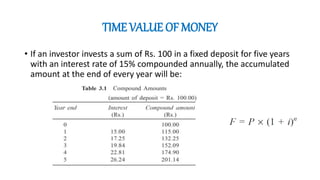
• If an investor invests a sum of Rs. 100 in a fixed deposit for five years
with an interest rate of 15% compounded annually, the accumulated
amount at the end of every year will be:
TIME VALUE OF MONEY
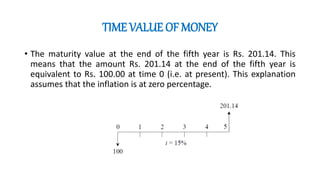
• The maturity value at the end of the fifth year is Rs. 201.14. This
means that the amount Rs. 201.14 at the end of the fifth year is
equivalent to Rs. 100.00 at time 0 (i.e. at present). This explanation
assumes that the inflation is at zero percentage.
TIME VALUE OF MONEY
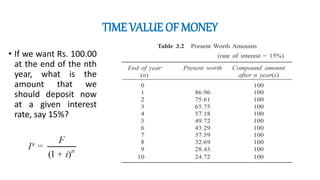
• If we want Rs. 100.00
at the end of the nth
year, what is the
amount that we
should deposit now
at a given interest
rate, say 15%?
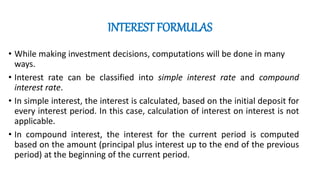
INTEREST FORMULAS
• While making investment decisions, computations will be done in many
ways.
• Interest rate can be classified into simple interest rate and compound
interest rate.
• In simple interest, the interest is calculated, based on the initial deposit for
every interest period. In this case, calculation of interest on interest is not
applicable.
• In compound interest, the interest for the current period is computed
based on the amount (principal plus interest up to the end of the previous
period) at the beginning of the current period.
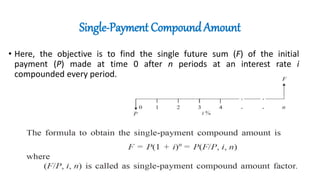
Single-Payment Compound Amount
• Here, the objective is to find the single future sum (F) of the initial
payment (P) made at time 0 after n periods at an interest rate i
compounded every period.
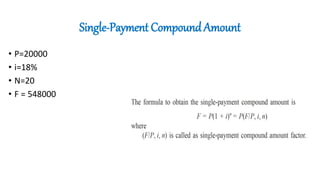
Single-Payment Compound Amount
• P=20000
• i=18%
• N=20
• F = 548000
Single-Payment Present Worth Amount
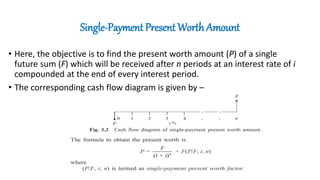
• Here, the objective is to find the present worth amount (P) of a single
future sum (F) which will be received after n periods at an interest rate of i
compounded at the end of every interest period.
• The corresponding cash flow diagram is given by –
Single-Payment Present Worth Amount
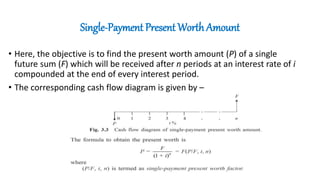
• Here, the objective is to find the present worth amount (P) of a single
future sum (F) which will be received after n periods at an interest rate of i
compounded at the end of every interest period.
• The corresponding cash flow diagram is given by –
Single-Payment Present Worth Amount
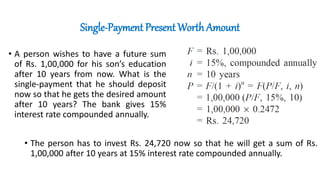
• A person wishes to have a future sum
of Rs. 1,00,000 for his son’s education
after 10 years from now. What is the
single-payment that he should deposit
now so that he gets the desired amount
after 10 years? The bank gives 15%
interest rate compounded annually.
• The person has to invest Rs. 24,720 now so that he will get a sum of Rs.
1,00,000 after 10 years at 15% interest rate compounded annually.
Equal-Payment Series Compound Amount
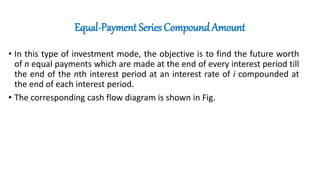
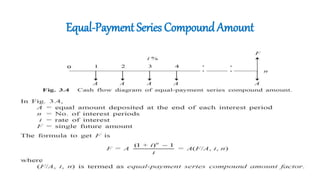
• In this type of investment mode, the objective is to find the future worth
of n equal payments which are made at the end of every interest period till
the end of the nth interest period at an interest rate of i compounded at
the end of each interest period.
• The corresponding cash flow diagram is shown in Fig.
Equal-Payment Series Compound Amount
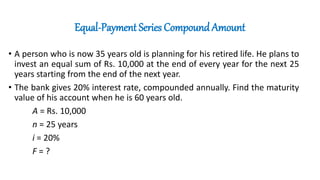
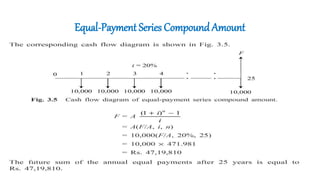
• A person who is now 35 years old is planning for his retired life. He plans to
invest an equal sum of Rs. 10,000 at the end of every year for the next 25
years starting from the end of the next year.
• The bank gives 20% interest rate, compounded annually. Find the maturity
value of his account when he is 60 years old.
A = Rs. 10,000
n = 25 years
i = 20%
F = ?
Equal-Payment Series Compound Amount
• A person who is now 35 years old is planning for his retired life. He plans to
invest an equal sum of Rs. 10,000 at the end of every year for the next 25
years starting from the end of the next year.
• The bank gives 20% interest rate, compounded annually. Find the maturity
value of his account when he is 60 years old.
A = Rs. 10,000
n = 25 years
i = 20%
F = ?
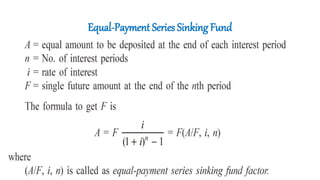
Equal-Payment Series Sinking Fund
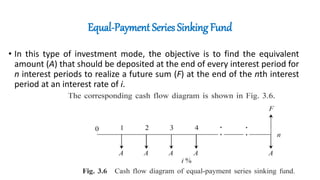
• In this type of investment mode, the objective is to find the equivalent
amount (A) that should be deposited at the end of every interest period for
n interest periods to realize a future sum (F) at the end of the nth interest
period at an interest rate of i.
Equal-Payment Series Sinking Fund
• In this type of investment mode, the objective is to find the equivalent
amount (A) that should be deposited at the end of every interest period for
n interest periods to realize a future sum (F) at the end of the nth interest
period at an interest rate of i.
Equal-Payment Series Sinking Fund
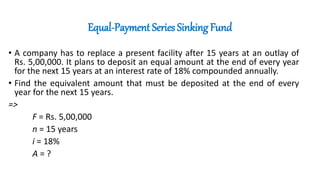
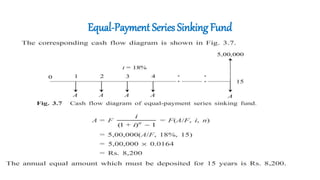
• A company has to replace a present facility after 15 years at an outlay of
Rs. 5,00,000. It plans to deposit an equal amount at the end of every year
for the next 15 years at an interest rate of 18% compounded annually.
• Find the equivalent amount that must be deposited at the end of every
year for the next 15 years.
=>
F = Rs. 5,00,000
n = 15 years
i = 18%
A = ?
Equal-Payment Series Sinking Fund
• A company has to replace a present facility after 15 years at an outlay of
Rs. 5,00,000. It plans to deposit an equal amount at the end of every year
for the next 15 years at an interest rate of 18% compounded annually.
• Find the equivalent amount that must be deposited at the end of every
year for the next 15 years.
=>
F = Rs. 5,00,000
n = 15 years
i = 18%
A = ?
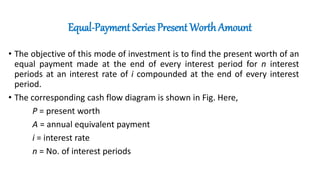
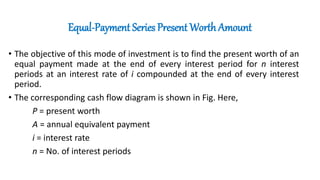
Equal-Payment Series Present Worth Amount
• The objective of this mode of investment is to find the present worth of an
equal payment made at the end of every interest period for n interest
periods at an interest rate of i compounded at the end of every interest
period.
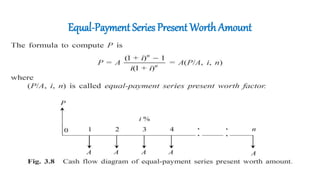
• The corresponding cash flow diagram is shown in Fig. Here,
P = present worth
A = annual equivalent payment
i = interest rate
n = No. of interest periods
Equal-Payment Series Present Worth Amount
• The objective of this mode of investment is to find the present worth of an
equal payment made at the end of every interest period for n interest
periods at an interest rate of i compounded at the end of every interest
period.
• The corresponding cash flow diagram is shown in Fig. Here,
P = present worth
A = annual equivalent payment
i = interest rate
n = No. of interest periods
Equal-Payment Series Present Worth Amount
• The objective of this mode of investment is to find the present worth of an
equal payment made at the end of every interest period for n interest
periods at an interest rate of i compounded at the end of every interest
period.
• The corresponding cash flow diagram is shown in Fig. Here,
P = present worth
A = annual equivalent payment
i = interest rate
n = No. of interest periods
Equal-Payment Series Present Worth Amount
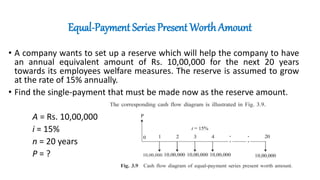
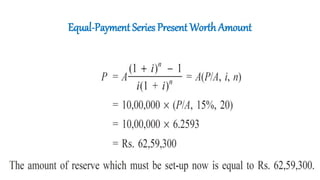
• A company wants to set up a reserve which will help the company to have
an annual equivalent amount of Rs. 10,00,000 for the next 20 years
towards its employees welfare measures. The reserve is assumed to grow
at the rate of 15% annually.
• Find the single-payment that must be made now as the reserve amount.
A = Rs. 10,00,000
i = 15%
n = 20 years
P = ?
Equal-Payment Series Present Worth Amount
• A company wants to set up a reserve which will help the company to have
an annual equivalent amount of Rs. 10,00,000 for the next 20 years
towards its employees welfare measures. The reserve is assumed to grow
at the rate of 15% annually.
• Find the single-payment that must be made now as the reserve amount.
A = Rs. 10,00,000
i = 15%
n = 20 years
P = ?
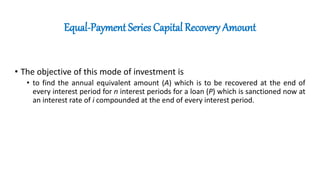
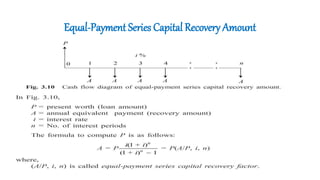
Equal-Payment Series Capital Recovery Amount
• The objective of this mode of investment is
• to find the annual equivalent amount (A) which is to be recovered at the end of
every interest period for n interest periods for a loan (P) which is sanctioned now at
an interest rate of i compounded at the end of every interest period.
Equal-Payment Series Capital Recovery Amount
• The objective of this mode of investment is
• to find the annual equivalent amount (A) which is to be recovered at the end
of every interest period for n interest periods for a loan (P) which is
sanctioned now at an interest rate of i compounded at the end of every
interest period.
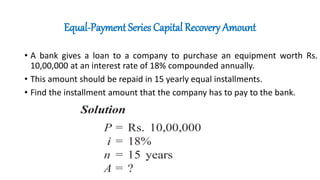
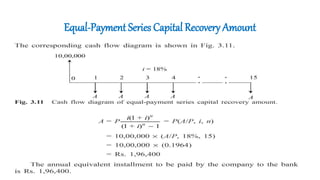
Equal-Payment Series Capital Recovery Amount
• A bank gives a loan to a company to purchase an equipment worth Rs.
10,00,000 at an interest rate of 18% compounded annually.
• This amount should be repaid in 15 yearly equal installments.
• Find the installment amount that the company has to pay to the bank.
Equal-Payment Series Capital Recovery Amount
• A bank gives a loan to a company to purchase an equipment worth
Rs. 10,00,000 at an interest rate of 18% compounded annually.
• This amount should be repaid in 15 yearly equal installments.
• Find the installment amount that the company has to pay to the
bank.
UniformGradient Series Annual Equivalent Amount
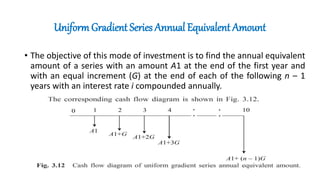
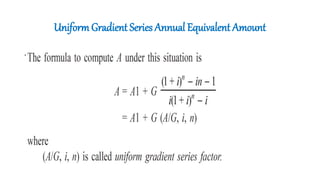
• The objective of this mode of investment is to find the annual equivalent
amount of a series with an amount A1 at the end of the first year and
with an equal increment (G) at the end of each of the following n – 1
years with an interest rate i compounded annually.
UniformGradient Series Annual Equivalent Amount
• The objective of this mode of investment is to find the annual equivalent
amount of a series with an amount A1 at the end of the first year and
with an equal increment (G) at the end of each of the following n – 1
years with an interest rate i compounded annually.
UniformGradient Series Annual Equivalent Amount
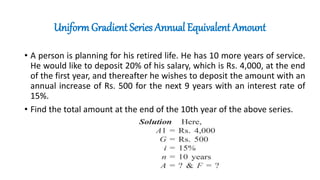
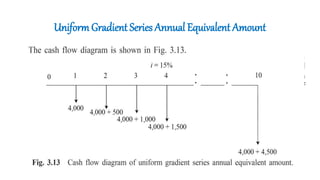
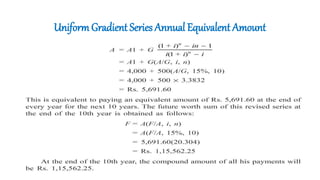
• A person is planning for his retired life. He has 10 more years of service.
He would like to deposit 20% of his salary, which is Rs. 4,000, at the end
of the first year, and thereafter he wishes to deposit the amount with an
annual increase of Rs. 500 for the next 9 years with an interest rate of
15%.
• Find the total amount at the end of the 10th year of the above series.
UniformGradient Series Annual Equivalent Amount
• A person is planning for his retired life. He has 10 more years of service.
He would like to deposit 20% of his salary, which is Rs. 4,000, at the end
of the first year, and thereafter he wishes to deposit the amount with an
annual increase of Rs. 500 for the next 9 years with an interest rate of
15%.
• Find the total amount at the end of the 10th year of the above series.
UniformGradient Series Annual Equivalent Amount
• A person is planning for his retired life. He has 10 more years of service.
He would like to deposit 20% of his salary, which is Rs. 4,000, at the end
of the first year, and thereafter he wishes to deposit the amount with an
annual increase of Rs. 500 for the next 9 years with an interest rate of
15%.
• Find the total amount at the end of the 10th year of the above series.
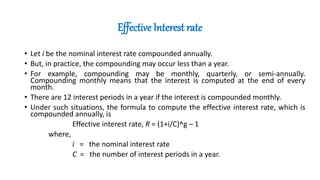
Effective Interest rate
• Let i be the nominal interest rate compounded annually.
• But, in practice, the compounding may occur less than a year.
• For example, compounding may be monthly, quarterly, or semi-annually.
Compounding monthly means that the interest is computed at the end of every
month.
• There are 12 interest periods in a year if the interest is compounded monthly.
• Under such situations, the formula to compute the effective interest rate, which is
compounded annually, is
Effective interest rate, R = (1+i/C)^g – 1
where,
i = the nominal interest rate
C = the number of interest periods in a year.
Effective Interest rate
• A person invests a sum of Rs. 5,000 in a bank at a nominal interest rate
of 12% for 10 years. The compounding is quarterly. Find the maturity
amount of the deposit after 10 years.
Effective Interest rate
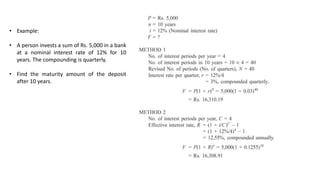
• Example:
• A person invests a sum of Rs. 5,000 in a bank
at a nominal interest rate of 12% for 10
years. The compounding is quarterly.
• Find the maturity amount of the deposit
after 10 years.

INTEREST FORMULAS AND VARIANCE QFCs.pptx

  • 1.
  • 2.
    INTEREST FORMULAS AND THEIRAPPLICATIONS • Interest rate is the rental value of money. It represents the growth of capital per unit period. The period may be a month, a quarter, semiannual or a year. An interest rate 15% compounded annually means that for every hundred rupees invested now, an amount of Rs. 15 will be added to the account at the end of the first year. So, the total amount at the end of the first year will be Rs. 115. • At the end of the second year, again 15% of Rs. 115, i.e. Rs. 17.25 will be added to the account. Hence the total amount at the end of the second year will be Rs. 132.25. The process will continue thus till the specified number of years.
  • 3.
    TIME VALUE OFMONEY • If an investor invests a sum of Rs. 100 in a fixed deposit for five years with an interest rate of 15% compounded annually, the accumulated amount at the end of every year will be:
  • 4.
    TIME VALUE OFMONEY • The maturity value at the end of the fifth year is Rs. 201.14. This means that the amount Rs. 201.14 at the end of the fifth year is equivalent to Rs. 100.00 at time 0 (i.e. at present). This explanation assumes that the inflation is at zero percentage.
  • 5.
    TIME VALUE OFMONEY • If we want Rs. 100.00 at the end of the nth year, what is the amount that we should deposit now at a given interest rate, say 15%?
  • 6.
    INTEREST FORMULAS • Whilemaking investment decisions, computations will be done in many ways. • Interest rate can be classified into simple interest rate and compound interest rate. • In simple interest, the interest is calculated, based on the initial deposit for every interest period. In this case, calculation of interest on interest is not applicable. • In compound interest, the interest for the current period is computed based on the amount (principal plus interest up to the end of the previous period) at the beginning of the current period.
  • 7.
    Single-Payment Compound Amount •Here, the objective is to find the single future sum (F) of the initial payment (P) made at time 0 after n periods at an interest rate i compounded every period.
  • 8.
    Single-Payment Compound Amount •P=20000 • i=18% • N=20 • F = 548000
  • 9.
    Single-Payment Present WorthAmount • Here, the objective is to find the present worth amount (P) of a single future sum (F) which will be received after n periods at an interest rate of i compounded at the end of every interest period. • The corresponding cash flow diagram is given by –
  • 10.
    Single-Payment Present WorthAmount • Here, the objective is to find the present worth amount (P) of a single future sum (F) which will be received after n periods at an interest rate of i compounded at the end of every interest period. • The corresponding cash flow diagram is given by –
  • 11.
    Single-Payment Present WorthAmount • A person wishes to have a future sum of Rs. 1,00,000 for his son’s education after 10 years from now. What is the single-payment that he should deposit now so that he gets the desired amount after 10 years? The bank gives 15% interest rate compounded annually. • The person has to invest Rs. 24,720 now so that he will get a sum of Rs. 1,00,000 after 10 years at 15% interest rate compounded annually.
  • 12.
    Equal-Payment Series CompoundAmount • In this type of investment mode, the objective is to find the future worth of n equal payments which are made at the end of every interest period till the end of the nth interest period at an interest rate of i compounded at the end of each interest period. • The corresponding cash flow diagram is shown in Fig.
  • 13.
  • 14.
    Equal-Payment Series CompoundAmount • A person who is now 35 years old is planning for his retired life. He plans to invest an equal sum of Rs. 10,000 at the end of every year for the next 25 years starting from the end of the next year. • The bank gives 20% interest rate, compounded annually. Find the maturity value of his account when he is 60 years old. A = Rs. 10,000 n = 25 years i = 20% F = ?
  • 15.
    Equal-Payment Series CompoundAmount • A person who is now 35 years old is planning for his retired life. He plans to invest an equal sum of Rs. 10,000 at the end of every year for the next 25 years starting from the end of the next year. • The bank gives 20% interest rate, compounded annually. Find the maturity value of his account when he is 60 years old. A = Rs. 10,000 n = 25 years i = 20% F = ?
  • 16.
    Equal-Payment Series SinkingFund • In this type of investment mode, the objective is to find the equivalent amount (A) that should be deposited at the end of every interest period for n interest periods to realize a future sum (F) at the end of the nth interest period at an interest rate of i.
  • 17.
    Equal-Payment Series SinkingFund • In this type of investment mode, the objective is to find the equivalent amount (A) that should be deposited at the end of every interest period for n interest periods to realize a future sum (F) at the end of the nth interest period at an interest rate of i.
  • 18.
    Equal-Payment Series SinkingFund • A company has to replace a present facility after 15 years at an outlay of Rs. 5,00,000. It plans to deposit an equal amount at the end of every year for the next 15 years at an interest rate of 18% compounded annually. • Find the equivalent amount that must be deposited at the end of every year for the next 15 years. => F = Rs. 5,00,000 n = 15 years i = 18% A = ?
  • 19.
    Equal-Payment Series SinkingFund • A company has to replace a present facility after 15 years at an outlay of Rs. 5,00,000. It plans to deposit an equal amount at the end of every year for the next 15 years at an interest rate of 18% compounded annually. • Find the equivalent amount that must be deposited at the end of every year for the next 15 years. => F = Rs. 5,00,000 n = 15 years i = 18% A = ?
  • 20.
    Equal-Payment Series PresentWorth Amount • The objective of this mode of investment is to find the present worth of an equal payment made at the end of every interest period for n interest periods at an interest rate of i compounded at the end of every interest period. • The corresponding cash flow diagram is shown in Fig. Here, P = present worth A = annual equivalent payment i = interest rate n = No. of interest periods
  • 21.
    Equal-Payment Series PresentWorth Amount • The objective of this mode of investment is to find the present worth of an equal payment made at the end of every interest period for n interest periods at an interest rate of i compounded at the end of every interest period. • The corresponding cash flow diagram is shown in Fig. Here, P = present worth A = annual equivalent payment i = interest rate n = No. of interest periods
  • 22.
    Equal-Payment Series PresentWorth Amount • The objective of this mode of investment is to find the present worth of an equal payment made at the end of every interest period for n interest periods at an interest rate of i compounded at the end of every interest period. • The corresponding cash flow diagram is shown in Fig. Here, P = present worth A = annual equivalent payment i = interest rate n = No. of interest periods
  • 23.
    Equal-Payment Series PresentWorth Amount • A company wants to set up a reserve which will help the company to have an annual equivalent amount of Rs. 10,00,000 for the next 20 years towards its employees welfare measures. The reserve is assumed to grow at the rate of 15% annually. • Find the single-payment that must be made now as the reserve amount. A = Rs. 10,00,000 i = 15% n = 20 years P = ?
  • 24.
    Equal-Payment Series PresentWorth Amount • A company wants to set up a reserve which will help the company to have an annual equivalent amount of Rs. 10,00,000 for the next 20 years towards its employees welfare measures. The reserve is assumed to grow at the rate of 15% annually. • Find the single-payment that must be made now as the reserve amount. A = Rs. 10,00,000 i = 15% n = 20 years P = ?
  • 25.
    Equal-Payment Series CapitalRecovery Amount • The objective of this mode of investment is • to find the annual equivalent amount (A) which is to be recovered at the end of every interest period for n interest periods for a loan (P) which is sanctioned now at an interest rate of i compounded at the end of every interest period.
  • 26.
    Equal-Payment Series CapitalRecovery Amount • The objective of this mode of investment is • to find the annual equivalent amount (A) which is to be recovered at the end of every interest period for n interest periods for a loan (P) which is sanctioned now at an interest rate of i compounded at the end of every interest period.
  • 27.
    Equal-Payment Series CapitalRecovery Amount • A bank gives a loan to a company to purchase an equipment worth Rs. 10,00,000 at an interest rate of 18% compounded annually. • This amount should be repaid in 15 yearly equal installments. • Find the installment amount that the company has to pay to the bank.
  • 28.
    Equal-Payment Series CapitalRecovery Amount • A bank gives a loan to a company to purchase an equipment worth Rs. 10,00,000 at an interest rate of 18% compounded annually. • This amount should be repaid in 15 yearly equal installments. • Find the installment amount that the company has to pay to the bank.
  • 29.
    UniformGradient Series AnnualEquivalent Amount • The objective of this mode of investment is to find the annual equivalent amount of a series with an amount A1 at the end of the first year and with an equal increment (G) at the end of each of the following n – 1 years with an interest rate i compounded annually.
  • 30.
    UniformGradient Series AnnualEquivalent Amount • The objective of this mode of investment is to find the annual equivalent amount of a series with an amount A1 at the end of the first year and with an equal increment (G) at the end of each of the following n – 1 years with an interest rate i compounded annually.
  • 31.
    UniformGradient Series AnnualEquivalent Amount • A person is planning for his retired life. He has 10 more years of service. He would like to deposit 20% of his salary, which is Rs. 4,000, at the end of the first year, and thereafter he wishes to deposit the amount with an annual increase of Rs. 500 for the next 9 years with an interest rate of 15%. • Find the total amount at the end of the 10th year of the above series.
  • 32.
    UniformGradient Series AnnualEquivalent Amount • A person is planning for his retired life. He has 10 more years of service. He would like to deposit 20% of his salary, which is Rs. 4,000, at the end of the first year, and thereafter he wishes to deposit the amount with an annual increase of Rs. 500 for the next 9 years with an interest rate of 15%. • Find the total amount at the end of the 10th year of the above series.
  • 33.
    UniformGradient Series AnnualEquivalent Amount • A person is planning for his retired life. He has 10 more years of service. He would like to deposit 20% of his salary, which is Rs. 4,000, at the end of the first year, and thereafter he wishes to deposit the amount with an annual increase of Rs. 500 for the next 9 years with an interest rate of 15%. • Find the total amount at the end of the 10th year of the above series.
  • 34.
    Effective Interest rate •Let i be the nominal interest rate compounded annually. • But, in practice, the compounding may occur less than a year. • For example, compounding may be monthly, quarterly, or semi-annually. Compounding monthly means that the interest is computed at the end of every month. • There are 12 interest periods in a year if the interest is compounded monthly. • Under such situations, the formula to compute the effective interest rate, which is compounded annually, is Effective interest rate, R = (1+i/C)^g – 1 where, i = the nominal interest rate C = the number of interest periods in a year.
  • 35.
    Effective Interest rate •A person invests a sum of Rs. 5,000 in a bank at a nominal interest rate of 12% for 10 years. The compounding is quarterly. Find the maturity amount of the deposit after 10 years.
  • 36.
  • 37.
    • Example: • Aperson invests a sum of Rs. 5,000 in a bank at a nominal interest rate of 12% for 10 years. The compounding is quarterly. • Find the maturity amount of the deposit after 10 years.