
Rohit Jangra
PhD Scholar
School of Library and Information Science
Central University of Gujarat
Taxonomy of Knowledge
Introduction
• Taxonomy is all about organizing and classifying.
• The word “Taxonomy” is derived from two Greek terms : taxis and
nomos.
• Taxis – the arrangement or ordering of things
• Nomos – anything assigned, usage or custom, law or ordinance.
• Taxonomy is a subject-based classification that arranges the terms in
a controlled vocabulary , and allows related terms to be grouped
together and categorized in ways that make it easier to find the
correct term to use.
• Taxonomy is useful when searching for, or describing, an object.
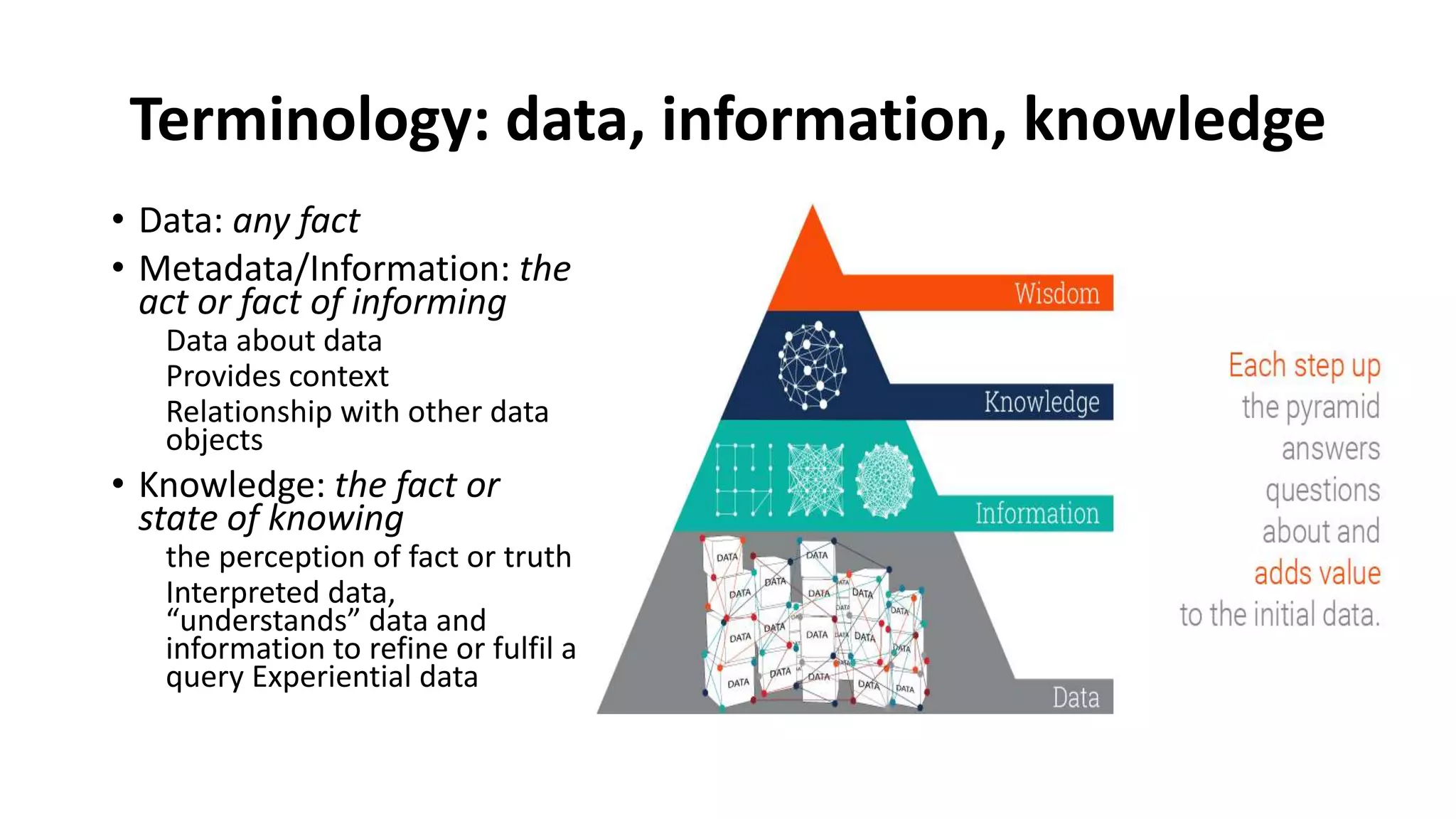
Terminology: data, information, knowledge
• Data: any fact
• Metadata/Information: the
act or fact of informing
Data about data
Provides context
Relationship with other data
objects
• Knowledge: the fact or
state of knowing
the perception of fact or truth
Interpreted data,
“understands” data and
information to refine or fulfil a
query Experiential data
SECI MODEL
Sympathized Knowledge: Shared
mental models and technical
skills
Conceptual Knowledge:
Analogies & metaphors of
products & processes
Systematic Knowledge:
Prototypes or new technologies
Operational Knowledge: Project
management, production
process, new product usage and
policy implementation
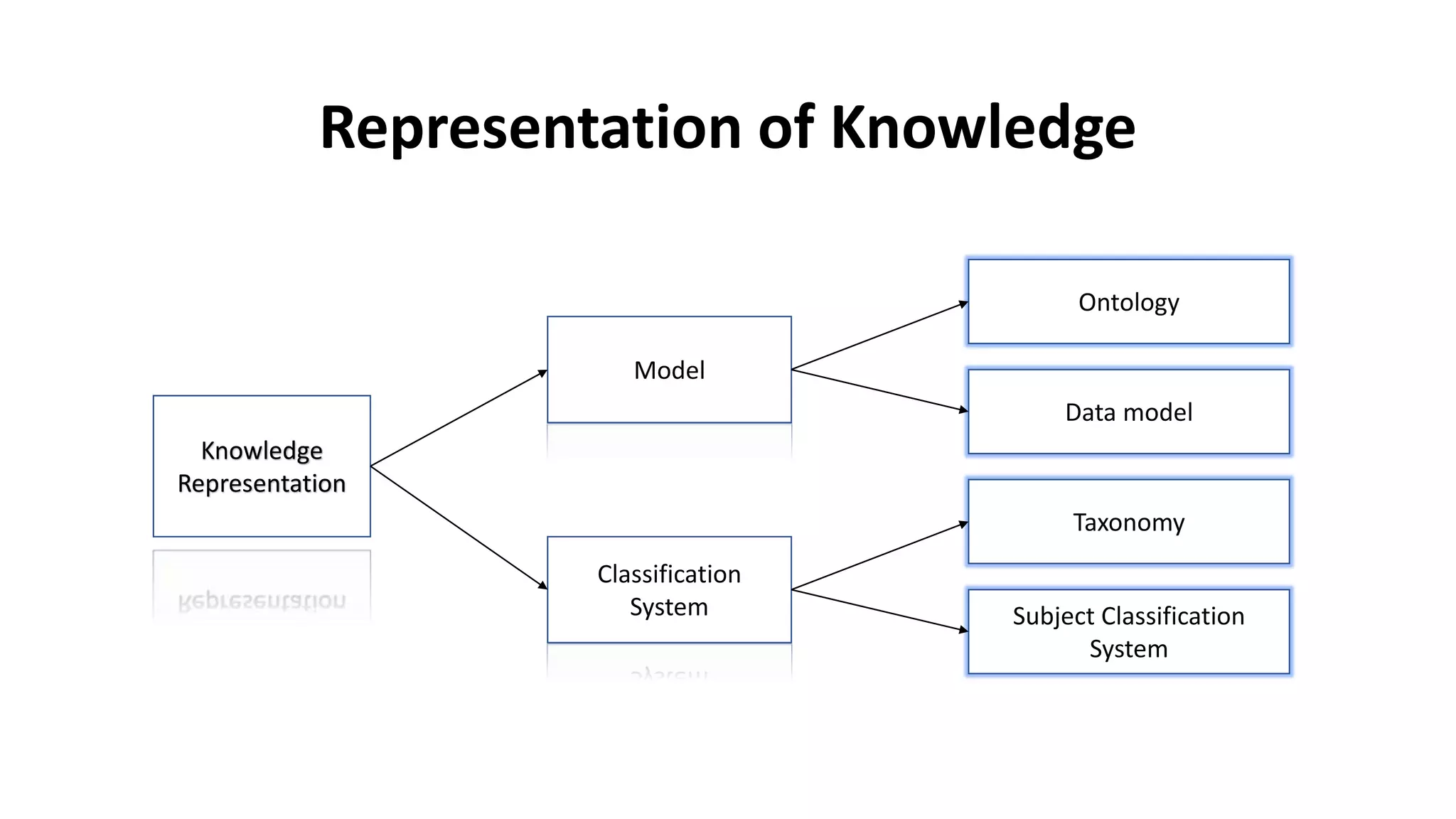
Representation of Knowledge
Knowledge
Representation
Model
Classification
System
Ontology
Data model
Taxonomy
Subject Classification
System
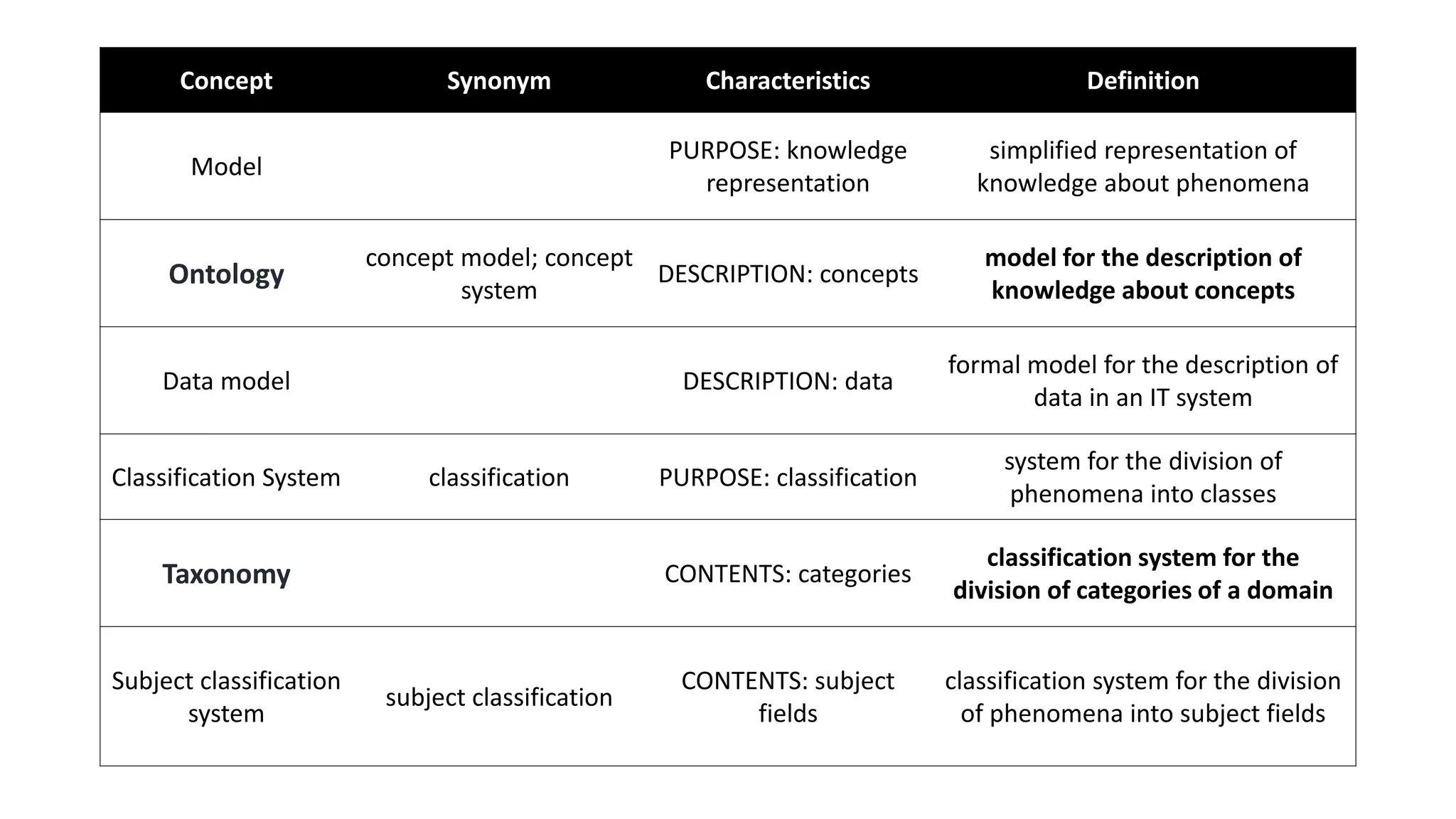
Concept Synonym Characteristics Definition
Model
PURPOSE: knowledge
representation
simplified representation of
knowledge about phenomena
Ontology
concept model; concept
system
DESCRIPTION: concepts
model for the description of
knowledge about concepts
Data model DESCRIPTION: data
formal model for the description of
data in an IT system
Classification System classification PURPOSE: classification
system for the division of
phenomena into classes
Taxonomy CONTENTS: categories
classification system for the
division of categories of a domain
Subject classification
system
subject classification
CONTENTS: subject
fields
classification system for the division
of phenomena into subject fields
Taxonomy Architectures
There are four types of taxonomy
architectures:
•Flat
•Hierarchical
•Faceted
•Network
Flat Taxonomies
• Group content into a
controlled set of categories
• Alphabetical listing of people
is a flat taxonomy
• Lists of countries or states
• Lists of currencies
• Controlled vocabularies
• List of security classification
values
Hierarchical Taxonomies
• Hierarchical taxonomies structure content into
at least two levels
• Hierarchies are bi-directional
• Each direction has meaning
• Moving up the hierarchy means expanding the
category or concept
• Moving down the hierarchy means refining
the category or the concept
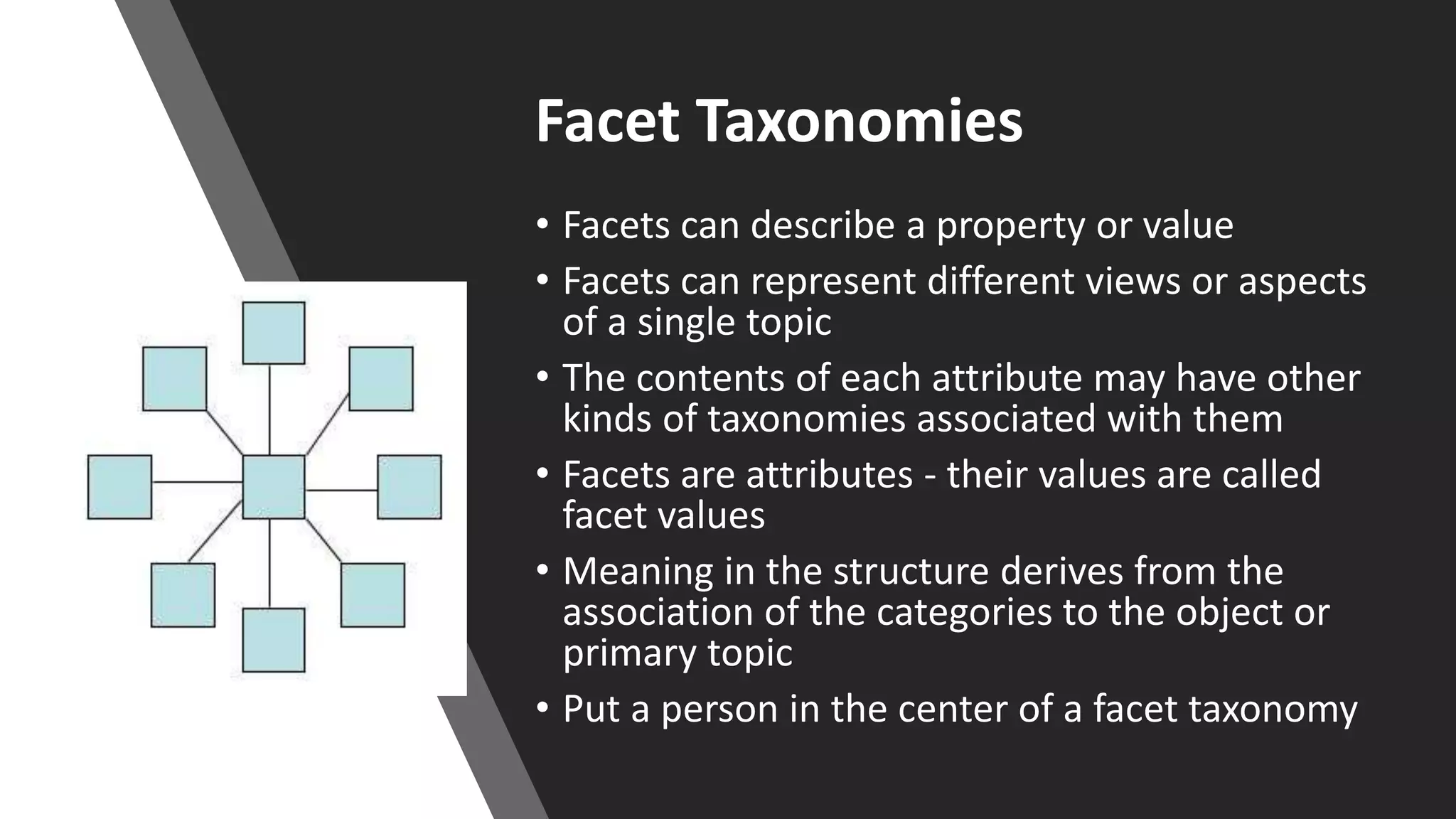
Facet Taxonomies
• Facets can describe a property or value
• Facets can represent different views or aspects
of a single topic
• The contents of each attribute may have other
kinds of taxonomies associated with them
• Facets are attributes - their values are called
facet values
• Meaning in the structure derives from the
association of the categories to the object or
primary topic
• Put a person in the center of a facet taxonomy
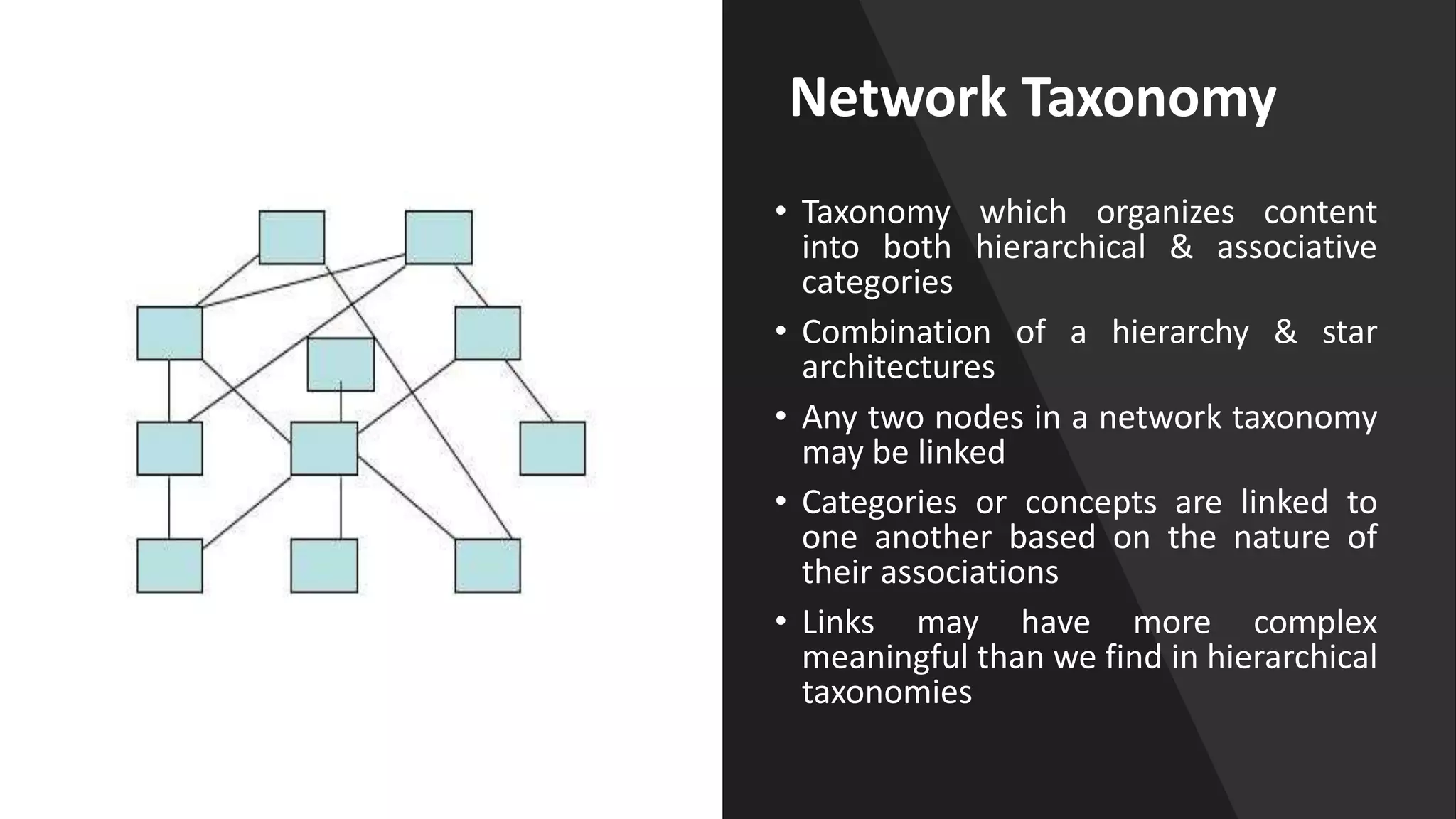
Network Taxonomy
• Taxonomy which organizes content
into both hierarchical & associative
categories
• Combination of a hierarchy & star
architectures
• Any two nodes in a network taxonomy
may be linked
• Categories or concepts are linked to
one another based on the nature of
their associations
• Links may have more complex
meaningful than we find in hierarchical
taxonomies
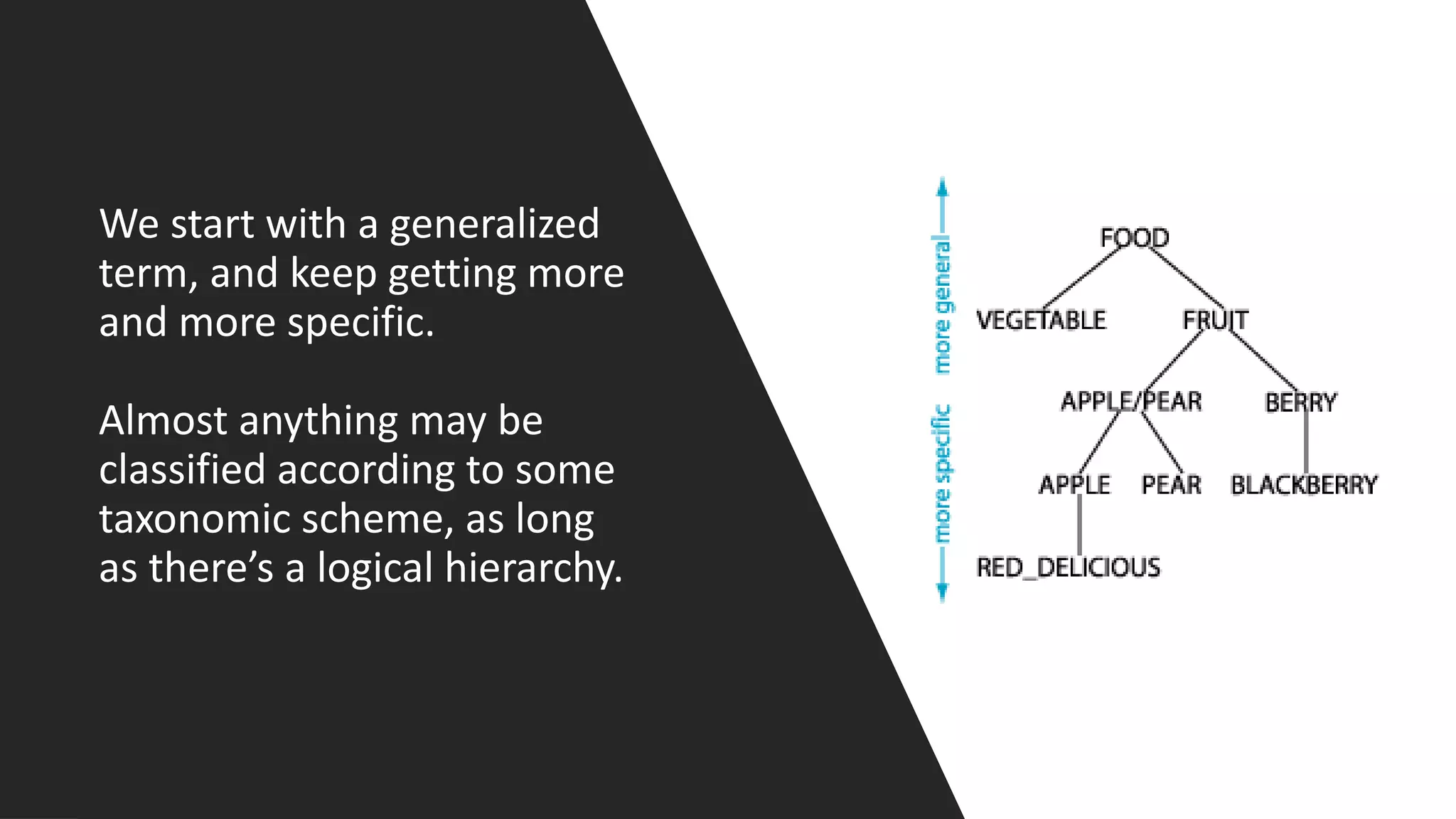
We start with a generalized
term, and keep getting more
and more specific.
Almost anything may be
classified according to some
taxonomic scheme, as long
as there’s a logical hierarchy.
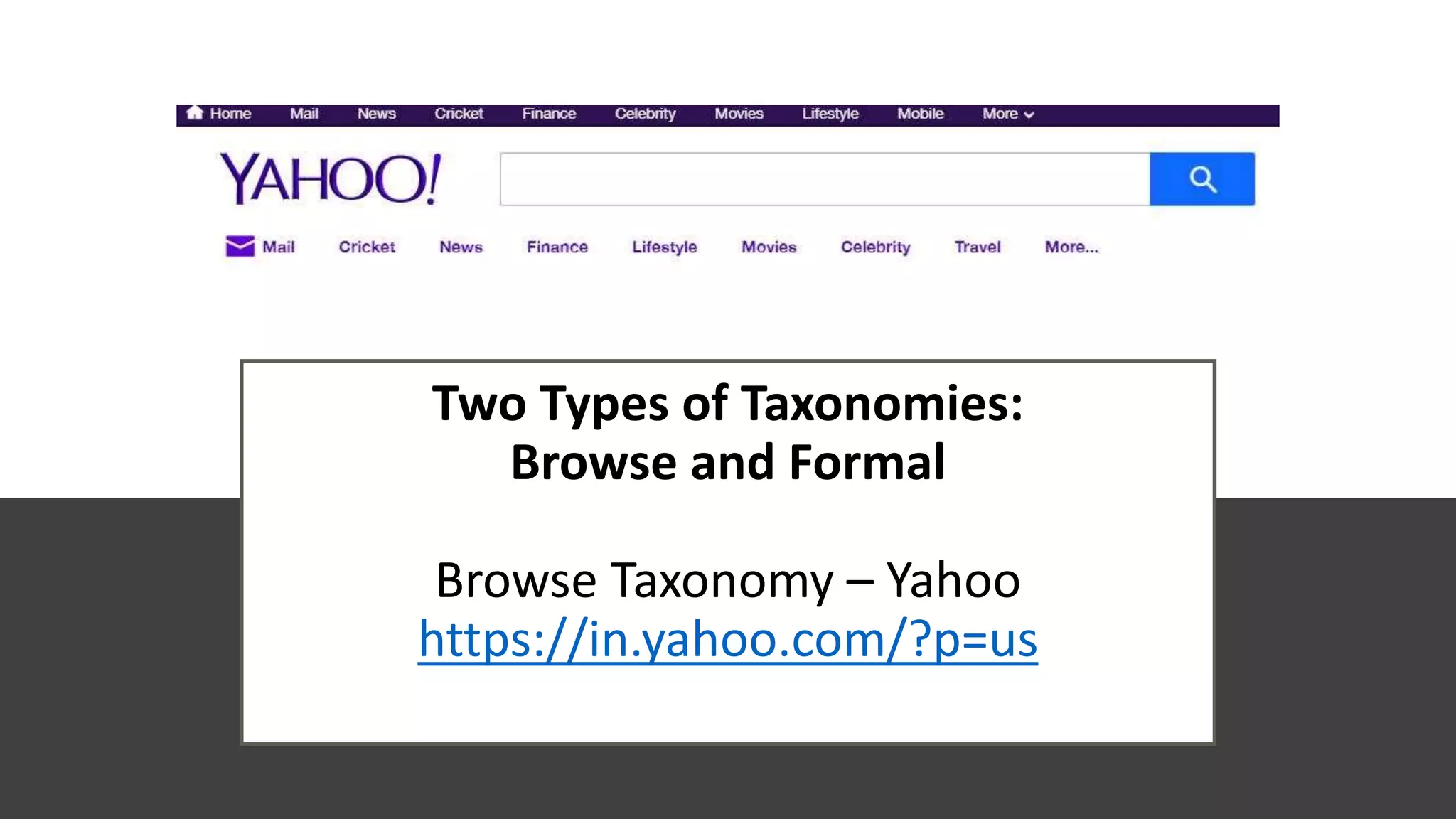
Two Types of Taxonomies:
Browse and Formal
Browse Taxonomy – Yahoo
https://in.yahoo.com/?p=us
Formal Taxonomies
Browse Taxonomies: Strengths and Weaknesses
Strengths
• Browse is better than search
• Context and discovery
• Browse by task, type, etc.
Weaknesses
• Catalogs, alphabetical listings,
Subject matter, functional,
publisher, document type
• Vocabulary and nomenclature
Issues
• Problems with maintenance, new
material
• Little relationship between parts.
• No foundation for standards
Formal Taxonomies: Strengths and Weaknesses
Strengths
• Fixed Resource – little or no
maintenance
• Communication Platform – share
ideas, standards
• Infrastructure Resource
• Controlled vocabulary and
keywords
Weaknesses
• Difficult to develop and
customize
• Don’t reflect users’ perspectives
• Users have to adapt to language
Varieties of Taxonomy/ Text Analytics Software
• Taxonomy Management
• Text Analytics
• Auto-Categorization, Entity Extraction
• Sentiment Analysis
• Software Platforms
• Content Management, Search
• Application Specific
• Business Intelligence
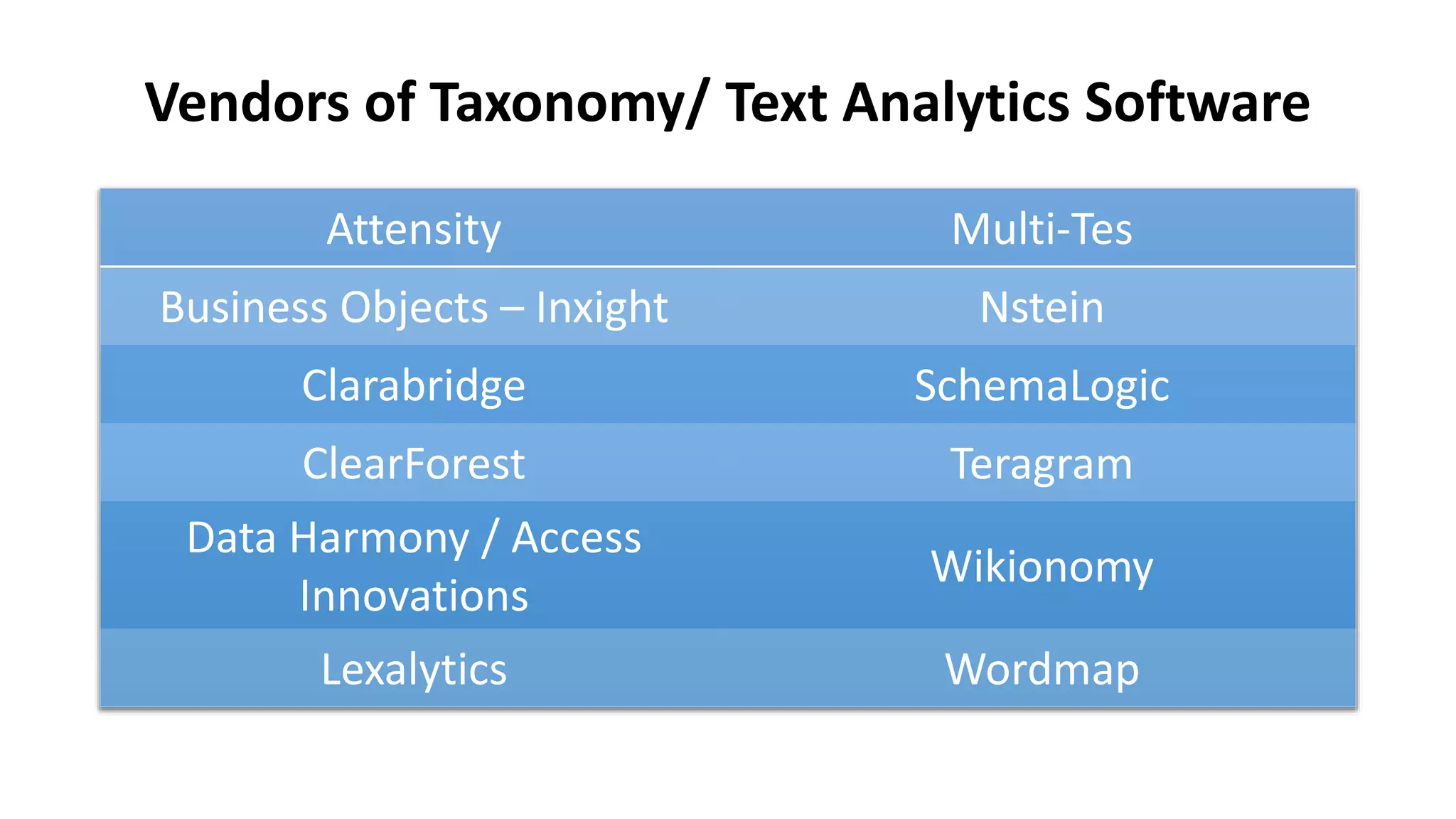
Vendors of Taxonomy/ Text Analytics Software
Attensity Multi-Tes
Business Objects – Inxight Nstein
Clarabridge SchemaLogic
ClearForest Teragram
Data Harmony / Access
Innovations
Wikionomy
Lexalytics Wordmap
Bloom’s Taxonomy
thank you

Taxonomy of Knowledge Management

  • 1.
    Rohit Jangra PhD Scholar Schoolof Library and Information Science Central University of Gujarat Taxonomy of Knowledge
  • 2.
    Introduction • Taxonomy isall about organizing and classifying. • The word “Taxonomy” is derived from two Greek terms : taxis and nomos. • Taxis – the arrangement or ordering of things • Nomos – anything assigned, usage or custom, law or ordinance. • Taxonomy is a subject-based classification that arranges the terms in a controlled vocabulary , and allows related terms to be grouped together and categorized in ways that make it easier to find the correct term to use. • Taxonomy is useful when searching for, or describing, an object.
  • 3.
    Terminology: data, information,knowledge • Data: any fact • Metadata/Information: the act or fact of informing Data about data Provides context Relationship with other data objects • Knowledge: the fact or state of knowing the perception of fact or truth Interpreted data, “understands” data and information to refine or fulfil a query Experiential data
  • 4.
    SECI MODEL Sympathized Knowledge:Shared mental models and technical skills Conceptual Knowledge: Analogies & metaphors of products & processes Systematic Knowledge: Prototypes or new technologies Operational Knowledge: Project management, production process, new product usage and policy implementation
  • 5.
  • 6.
    Concept Synonym CharacteristicsDefinition Model PURPOSE: knowledge representation simplified representation of knowledge about phenomena Ontology concept model; concept system DESCRIPTION: concepts model for the description of knowledge about concepts Data model DESCRIPTION: data formal model for the description of data in an IT system Classification System classification PURPOSE: classification system for the division of phenomena into classes Taxonomy CONTENTS: categories classification system for the division of categories of a domain Subject classification system subject classification CONTENTS: subject fields classification system for the division of phenomena into subject fields
  • 7.
    Taxonomy Architectures There arefour types of taxonomy architectures: •Flat •Hierarchical •Faceted •Network
  • 8.
    Flat Taxonomies • Groupcontent into a controlled set of categories • Alphabetical listing of people is a flat taxonomy • Lists of countries or states • Lists of currencies • Controlled vocabularies • List of security classification values
  • 9.
    Hierarchical Taxonomies • Hierarchicaltaxonomies structure content into at least two levels • Hierarchies are bi-directional • Each direction has meaning • Moving up the hierarchy means expanding the category or concept • Moving down the hierarchy means refining the category or the concept
  • 10.
    Facet Taxonomies • Facetscan describe a property or value • Facets can represent different views or aspects of a single topic • The contents of each attribute may have other kinds of taxonomies associated with them • Facets are attributes - their values are called facet values • Meaning in the structure derives from the association of the categories to the object or primary topic • Put a person in the center of a facet taxonomy
  • 11.
    Network Taxonomy • Taxonomywhich organizes content into both hierarchical & associative categories • Combination of a hierarchy & star architectures • Any two nodes in a network taxonomy may be linked • Categories or concepts are linked to one another based on the nature of their associations • Links may have more complex meaningful than we find in hierarchical taxonomies
  • 12.
    We start witha generalized term, and keep getting more and more specific. Almost anything may be classified according to some taxonomic scheme, as long as there’s a logical hierarchy.
  • 13.
    Two Types ofTaxonomies: Browse and Formal Browse Taxonomy – Yahoo https://in.yahoo.com/?p=us
  • 14.
  • 15.
    Browse Taxonomies: Strengthsand Weaknesses Strengths • Browse is better than search • Context and discovery • Browse by task, type, etc. Weaknesses • Catalogs, alphabetical listings, Subject matter, functional, publisher, document type • Vocabulary and nomenclature Issues • Problems with maintenance, new material • Little relationship between parts. • No foundation for standards
  • 16.
    Formal Taxonomies: Strengthsand Weaknesses Strengths • Fixed Resource – little or no maintenance • Communication Platform – share ideas, standards • Infrastructure Resource • Controlled vocabulary and keywords Weaknesses • Difficult to develop and customize • Don’t reflect users’ perspectives • Users have to adapt to language
  • 17.
    Varieties of Taxonomy/Text Analytics Software • Taxonomy Management • Text Analytics • Auto-Categorization, Entity Extraction • Sentiment Analysis • Software Platforms • Content Management, Search • Application Specific • Business Intelligence
  • 18.
    Vendors of Taxonomy/Text Analytics Software Attensity Multi-Tes Business Objects – Inxight Nstein Clarabridge SchemaLogic ClearForest Teragram Data Harmony / Access Innovations Wikionomy Lexalytics Wordmap
  • 19.
  • 20.

Editor's Notes

  • #5 The SECI model is a well known conceptual model that was first proposed by Nonaka
  • #20 In one sentence, Bloom's Taxonomy is a hierarchical ordering of cognitive skills that can, among countless other uses, help teachers teach and students learn.