Year 11 Revision Powerpoint
Good revision websites
http://princehenrys.co.uk/_files/FEBA8E720731FDC23B5691
60A7E3AB14.pdf
www.bbcgoodfood.com/content/recipes/special
www.fairtrade.org.uk
www.bbc.co.uk/food
https://sites.google.com/site/foodrevision/
www.bbc.co.uk/schools/gcsebitesize/design/foodtech/
www.nutrition.org.uk
Nutrients
Fats
• Saturated fats are usually obtained from animal sources, for example
butter and lard. The exceptions are coconut and palm oils.
• Polyunsaturated fats come from vegetable sources, such as sunflower oil.
Gives energy and vitamins A, D, E and K
• Found in oils, solid fats, fatty meat, cream, cheese and nuts
• Animal fats and some vegetables oils contain saturated fat, which may raise
blood cholesterol levels
• Vegetable fats such as sunflower and soya and those in oily fish are
polyunsaturated and better for the heart
• Gives a rich source of energy that can be converted into fat in the body,
which protects organs and gives heat
Carbohydrates
• Provides energy and fibre
• Found in cereals, vegetables, sugar, rice, pasta, bread and pastries
• If the body receives more energy than it needs, it stores it as fat
• Wholemeal/wholegrain cereals are a richer source of fibre than
white/refined ones
• Vitamins B and E, calcium and iron are also provided by bread
Protein
• Enables the body to grow and repair
• Found in milk, meat, fish, eggs and cheese
• Also in soya, beans, cereals, pulses and nuts
• If more protein is eaten than is needed for growth and repair, the
excess is converted into glycogen in the liver and used as energy
• Animal foods and soya beans are used most efficiently by the body
• Many protein foods also provide iron and B vitamins (especially B12)
• Tofu (soya bean curd), Textured Vegetable Protein (TVP) made from
soya flour, and Quorn (fungus) can all be used to replace animal
proteins
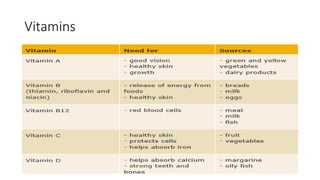
Vitamins
Nutritional Properties
• Starch
• thickens a liquid by forming a suspension such as a sauce
• forms a gel when the suspension is heated, like adding cornflour to a custard powder and milk mix
• Sugar
• flavours by sweetening
• colours by caramelising when heated
• aerates when beaten with a fat such as in a cake mix
• Proteins
• can coagulate which is when a liquid becomes firmer, for example when an egg is heated
• can aerate a mixture, like whisking egg whites in a meringue mix
• Fats
• shortens pastry (makes it more crumbly) by making it less stretchy
• can act as an emulsifying agent to stop two liquids from separating
• moistens a baked mixture such as a cake
Treating foods
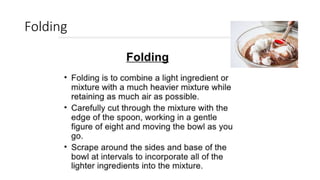
• Aerating incorporates air by sieving, creaming, whisking, beating, folding and
rolling, or rubbing in. Raising agents can be used to make a mixture lighter, for
example, baking power is used in cakes.
• Coagulation is when something thickens from a liquid to a solid. For example, raw
eggs are clear and runny but become white and solid when heated.
• Preserving helps food to last longer through freezing, canning, jam-making, or
pickling. Fats, sugar and oil are used in preserving.
• Tenderising tough meat makes it easier to eat. Lemon juice, vinegar or wine can
be used as a marinade, or meat can be tenderised with mechanical action using a
meat mallet or slow cooking.
• Thickening uses eggs, pulses, cereals and fruit to thicken liquids such as milk, and
heat is usually applied. Egg custard is made like this.
Combining foods
• Binding uses fats, eggs, cereals and flour to bind ingredients. For example, egg is used to bind
together a biscuit mixture.
• Bulking forms the main structure of a food product, such as flour in biscuits and cakes.
• Enrobing means coating a food with another ingredient, for example, dipping fish in beaten egg
and then breadcrumbs.
• Enriching is the addition of an ingredient to improve the quality. Nutrients are sometimes added
to increase nutritional value.
• Fermentation uses yeast to convert carbohydrates into alcohol and carbon dioxide. In bread
making, yeast is added to flour and water causing the dough to rise.
• Flavouring can be savoury, like herbs and spices, or sweet, like sugar or sweeteners. Sugar helps
to soften the sharp taste of grapefruit.
• Shortening uses of oils and fats to reduce the development of gluten in pastry to make the dough
less stretchy.
• Stabilising helps food keep its structure. Eggs and flour are used for stabilising.
• Setting means using ingredients to make foods firm, such as gelatine to set cold desserts.
Finishing Techniques
• Browning uses fats, eggs, sugar, milk, flour or oil, which darken a food
when heated.
• Glazing adds a shiny coating, for example, pastry brushed with beaten
egg before cooking.
• Icing can add colour and texture.
Food structures
• Solution is when one substance is dissolve in another one, for example when sugar is
dissolved in water we get a sugar solution.
• Colloid is a general term for when two substances are mixed together. For example milk
has a colloidal structure, because it is made from microscopic drops of fat dispersed in a
water-based liquid.
• Emulsion is when two unblendable liquids are mixed together, for example, oil and
vinegar. An emulsifier like egg yolk is needed to stop them from separating. Emulsions
are a particular type of colloid. Mayonnaise is an emulsion.
• Foam is when air bubbles are incorporated into a liquid, such as in whipped cream and
meringue
• Gel contains a small amount of a solid in a large amount of liquid. A small amount of
gelatine can set a large amount of liquid.
• Suspension is when a solid is held in a liquid. The solid may sink if the mixture is not
stirred. Flour (solid) is suspended in milk (liquid) when making a cheese sauce.
Additives
• Natural additives occur naturally in foods. They are extracted and put
into other foods. Caramelised sugar is used as colouring in cola.
• Artificial additives do not occur naturally. They are made
synthetically for a certain purposes. For example tartrazine is a
synthetic colouring added to some sweets to make them yellow.
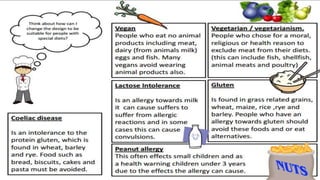
Can you think of
any other
examples?
Uses for additives
• Both natural and artificial additives are used for many different
reasons:
• Preservatives extend the shelf life of a product. Salt is used used in
bacon and sausages.
• Colouring makes food products look more appealing and appetising.
• Flavourings can be used to add or improve the flavour of a food
product. Vanilla flavouring is often added to cakes and biscuits.
• Emulsifiers are used to prevent ingredients from separating. For
example, lecithin, which is found in eggs, is used to stop the
ingredients in mayonnaise from separating
Food acidity
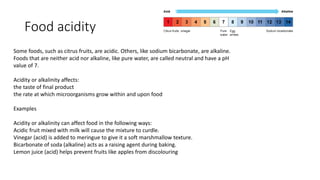
Some foods, such as citrus fruits, are acidic. Others, like sodium bicarbonate, are alkaline.
Foods that are neither acid nor alkaline, like pure water, are called neutral and have a pH
value of 7.
Acidity or alkalinity affects:
the taste of final product
the rate at which microorganisms grow within and upon food
Examples
Acidity or alkalinity can affect food in the following ways:
Acidic fruit mixed with milk will cause the mixture to curdle.
Vinegar (acid) is added to meringue to give it a soft marshmallow texture.
Bicarbonate of soda (alkaline) acts as a raising agent during baking.
Lemon juice (acid) helps prevent fruits like apples from discolouring
Food temperatures
• Chilling
• Dairy produce, cooked foods and raw ingredients should be kept at a
temperature between 0°C and 5°C. This will slow the growth of
microorganisms, but won't stop it.
• Freezing
• Meats, vegetables and ready meals can be frozen. Freezing maintains high
standards of freshness and safety. Freezers store products at -18°C or
below. Freezing does not kill microorganisms, but will keep them dormant
until the food is unfrozen.
• Reheating foods
• Food must be reheated to at least 72°C to avoid the risk of food poisoning.
Leftovers should be disposed of quickly.
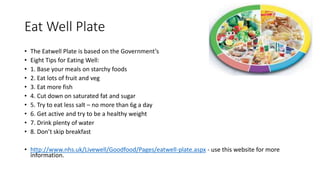
Eat Well Plate
• The Eatwell Plate is based on the Government’s
• Eight Tips for Eating Well:
• 1. Base your meals on starchy foods
• 2. Eat lots of fruit and veg
• 3. Eat more fish
• 4. Cut down on saturated fat and sugar
• 5. Try to eat less salt – no more than 6g a day
• 6. Get active and try to be a healthy weight
• 7. Drink plenty of water
• 8. Don’t skip breakfast
• http://www.nhs.uk/Livewell/Goodfood/Pages/eatwell-plate.aspx - use this website for more
information.
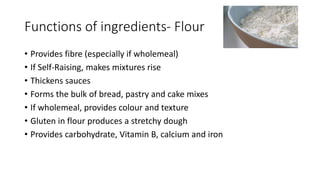
Functions of ingredients- Flour
• Provides fibre (especially if wholemeal)
• If Self-Raising, makes mixtures rise
• Thickens sauces
• Forms the bulk of bread, pastry and cake mixes
• If wholemeal, provides colour and texture
• Gluten in flour produces a stretchy dough
• Provides carbohydrate, Vitamin B, calcium and iron
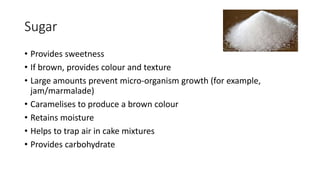
Sugar
• Provides sweetness
• If brown, provides colour and texture
• Large amounts prevent micro-organism growth (for example,
jam/marmalade)
• Caramelises to produce a brown colour
• Retains moisture
• Helps to trap air in cake mixtures
• Provides carbohydrate
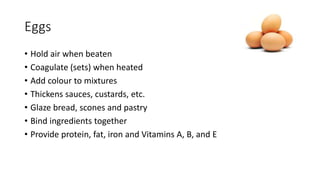
Eggs
• Hold air when beaten
• Coagulate (sets) when heated
• Add colour to mixtures
• Thickens sauces, custards, etc.
• Glaze bread, scones and pastry
• Bind ingredients together
• Provide protein, fat, iron and Vitamins A, B, and E
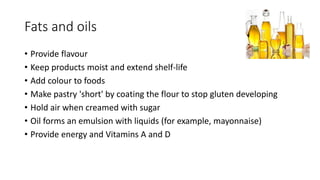
Fats and oils
• Provide flavour
• Keep products moist and extend shelf-life
• Add colour to foods
• Make pastry 'short' by coating the flour to stop gluten developing
• Hold air when creamed with sugar
• Oil forms an emulsion with liquids (for example, mayonnaise)
• Provide energy and Vitamins A and D
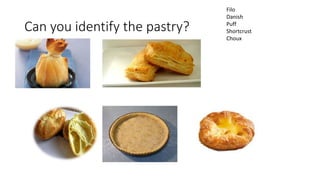
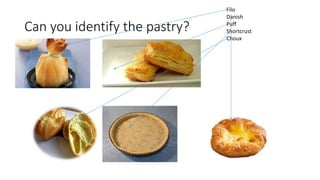
Can you identify the pastry?
Filo
Danish
Puff
Shortcrust
Choux
Can you identify the pastry?
Filo
Danish
Puff
Shortcrust
Choux
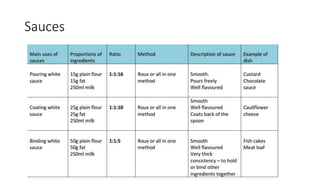
Sauces
Gelatinisation
• Many sauces are thickened by gelatinisation of starch. When mixed with a liquid and heated,
starch thickens the liquid.
• During gelatinisation the following occurs starch particles form a suspension in the liquid ( they
do not dissolve)
• Stirring the liquid keeps the starch particles suspended – if the suspension isn’t stirred they stick
together and sink to the bottom – forming lumps. This will then not cook correctly.
• When the liquid reaches approximately 60°C the starch grains begin to swell as they absorb the
water.
• As heating continues (approx 80°C) the particles break open and release starch. This makes the
mixture thick and viscous. This is gelatinisation.
• Gelatinisation is completed when the liquid reaches 100°C. The liquid now forms a gel.
• On cooling the gel solidifies – it will set to form a mould e.g. Blancmange.
• This is the same for all starch- based sauces. It is important to remember that cornflour and
arrowroot are pure starch where as wheat flour contains a high proportion of starch and also
some protein.
Rouxs
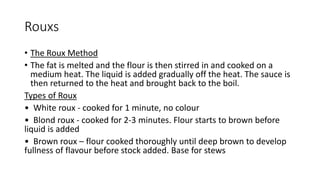
• The Roux Method
• The fat is melted and the flour is then stirred in and cooked on a
medium heat. The liquid is added gradually off the heat. The sauce is
then returned to the heat and brought back to the boil.
Types of Roux
• White roux - cooked for 1 minute, no colour
• Blond roux - cooked for 2-3 minutes. Flour starts to brown before
liquid is added
• Brown roux – flour cooked thoroughly until deep brown to develop
fullness of flavour before stock added. Base for stews
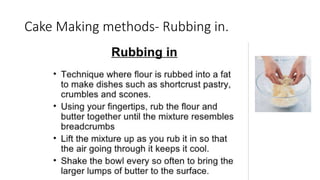
Cake Making methods- Rubbing in.
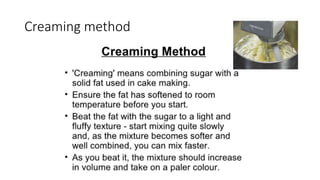
Creaming method
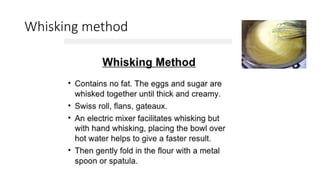
Whisking method
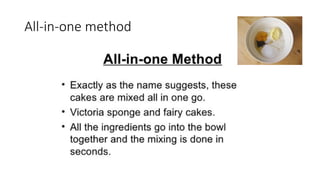
All-in-one method
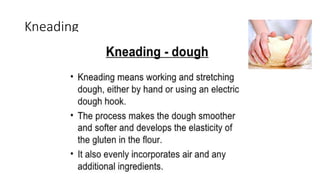
Kneading
Folding
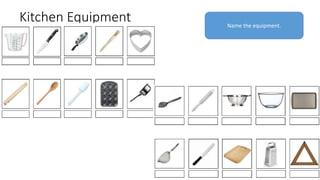
Kitchen Equipment Name the equipment.
Manufacturing methods
• One-off production is when a single product is made, for example a
designer wedding cake. This is classed as a luxury food item.
• Batch production involves making of a set number of identical products.
Typically batch production is used in a bakery, where a certain number of
different types of loaves will be made every morning.
• Mass production is used to make foods on a large scale. The production
line involves repetitive tasks so machines are often used. This saves time
and helps lower the cost of production.
• Continuous-flow production is a high-volume production method where
machines run 24 hours a day. It is often used to produce milk and packet
pizzas.
CAD- Computer Aided Design
• Computers are essential in the development and manufacture of food products.
Computer Aided Design (CAD) helps create, modify and communicate information
efficiently. Computer modelling allows designers to test models and changes without
carrying them out.
• CAD is used for:
• Nutritional analysis software provides nutritional information to help create foods for a
balanced diet
• Simulate changes to inputs and processes so the impact of modifications can be
predicted
• Calculate costs and amounts of ingredients needed for batch production
• Packaging design and advertising decisions using graphics and 3D modelling software
• Sensory profile software is used in testing and can analyse and rank results
• Production flowcharts show where Hazard Analysis Critical Control Points (HACCP)
checks need to be included in the factory processes
Quality control
• Quality control
• Quality assurance (QA) guarantees that food meets a clear, consistent set of standards. At key
stages in production there should be quality control checks so manufacturers are alerted to any
problems. The results of these checks are recorded. Checks can be done by hand or by computer.
• Quality control checks will normally include:
• weight checks to make sure the product is the required weight
• visual checks to make sure it looks the way it should
• temperature checks to make sure it is being kept at an appropriate temperature
• pH checks to make sure the food has the correct acidity/alkalinity
• microbiological checks to make sure bacteria are not at harmful levels
• chemical checks to guard against chemical contamination
• metal checks to guard against contamination by metals (usually at the packing stage, using a
metal detector)
• organoleptic checks to check flavour, texture and aroma by sampling the food product
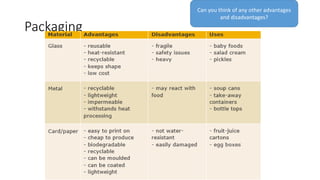
Packaging
Can you think of any other advantages
and disadvantages?
Environmentally friendly packaging
• Environmentally friendly packaging causes less damage to the
environment. There are three types:
• Reusable packaging can be cleaned and re-used. For example, glass
milk bottles are reused.
• Recyclable packaging is made of materials that can be used again,
usually after processing. Recyclable materials include glass, metal,
card and paper.
• Biodegradable packaging will easily break down in the soil or the
atmosphere
Labelling
• These are the items on the label that are required by law.
• manufacturer's name and contact details
• name of the product
• description of the product
• weight (some foods are exempt, for example bread)
• ingredients (listed in descending order of weight)
• cooking/heating instructions
• storage instructions
• shelf life
• place of origin
• allergy information
Labelling
• The following items are not legal requirements, but are nevertheless
good practice and often included on packaging:
• illustration of product
• price
• nutritional values of the product
• customer guarantee
• the batch-code and bar-code numbers
• opening instructions
Sensory Testing
AQA GCSE Design and Technology: Food
Technology © Nelson Thornes 2009
43
Food should appeal to each of our five senses. It should:
look appealing
smell appetising
taste good
have good mouth feel
sound right. For example, biscuits should break with a snap.
What is sensory testing?
AQA GCSE Design and Technology: Food
Technology © Nelson Thornes 2009
44
 To assess the appeal of a new product. This could be carried out in a
test kitchen or by setting up tastings in supermarkets.
 To evaluate an existing product to see if it could be changed or
developed.
 To see if a new product meets its original specification.
Why is sensory testing used in the food industry?
AQA GCSE Design and Technology: Food Technology © Nelson
Thornes 2009
45
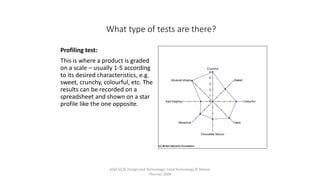
Profiling test:
This is where a product is graded
on a scale – usually 1-5 according
to its desired characteristics, e.g.
sweet, crunchy, colourful, etc. The
results can be recorded on a
spreadsheet and shown on a star
profile like the one opposite.
What type of tests are there?
(C) British Nutrition Foundation
0
1
2
3
4
5
Crunchy
Sweet
Colourful
Hard
Chocolate flavour
Attractive
Iced topping
Unusual shape
AQA GCSE Design and Technology: Food
Technology © Nelson Thornes 2009
46
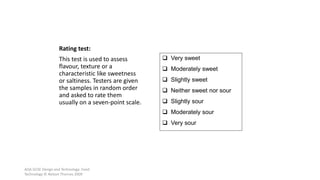
Rating test:
This test is used to assess
flavour, texture or a
characteristic like sweetness
or saltiness. Testers are given
the samples in random order
and asked to rate them
usually on a seven-point scale.
 Very sweet
 Moderately sweet
 Slightly sweet
 Neither sweet nor sour
 Slightly sour
 Moderately sour
 Very sour
AQA GCSE Design and Technology: Food
Technology © Nelson Thornes 2009
47
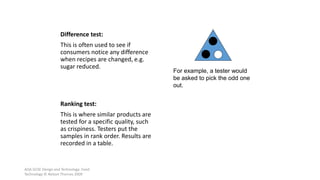
Difference test:
This is often used to see if
consumers notice any difference
when recipes are changed, e.g.
sugar reduced.
Ranking test:
This is where similar products are
tested for a specific quality, such
as crispiness. Testers put the
samples in rank order. Results are
recorded in a table.
For example, a tester would
be asked to pick the odd one
out.
AQA GCSE Design and Technology: Food
Technology © Nelson Thornes 2009
48
 Set up the tables so that the testers are not facing each other. In
school, it is best to use a random sample of testers from all years,
not your friends. If possible, ask about 15–20 students.
 Samples should be the same size, served at the intended
temperature and in plain white dishes.
 Water should be provided to clean the mouth between samples.
 A sheet to record results should be provided with a clear explanation
of what is required.
How to carry out sensory testing in the classroom
AQA GCSE Design and Technology: Food Technology © Nelson
Thornes 2009
49
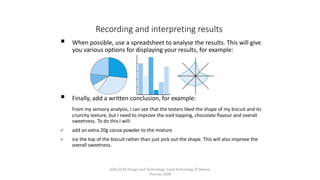
 When possible, use a spreadsheet to analyse the results. This will give
you various options for displaying your results, for example:
 Finally, add a written conclusion, for example:
From my sensory analysis, I can see that the testers liked the shape of my biscuit and its
crunchy texture, but I need to improve the iced topping, chocolate flavour and overall
sweetness. To do this I will:
 add an extra 20g cocoa powder to the mixture
 ice the top of the biscuit rather than just pick out the shape. This will also improve the
overall sweetness.
Recording and interpreting results
How to get full marks on the design question.
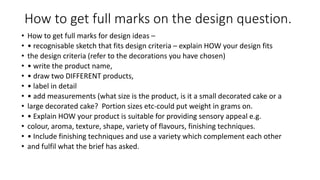
• How to get full marks for design ideas –
• • recognisable sketch that fits design criteria – explain HOW your design fits
• the design criteria (refer to the decorations you have chosen)
• • write the product name,
• • draw two DIFFERENT products,
• • label in detail
• • add measurements (what size is the product, is it a small decorated cake or a
• large decorated cake? Portion sizes etc‐could put weight in grams on.
• • Explain HOW your product is suitable for providing sensory appeal e.g.
• colour, aroma, texture, shape, variety of flavours, finishing techniques.
• • Include finishing techniques and use a variety which complement each other
• and fulfil what the brief has asked.
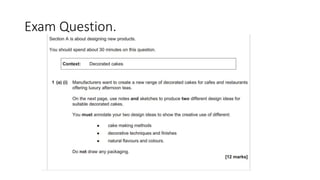
Exam Question.
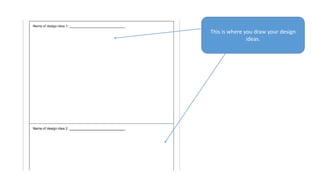
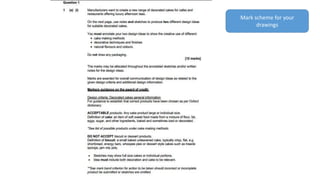
This is where you draw your design
ideas.
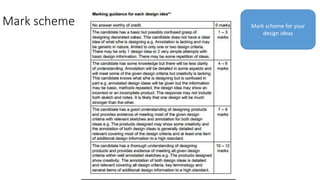
Mark scheme for your
drawings
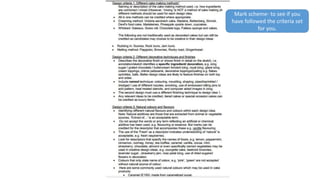
Mark scheme- to see if you
have followed the criteria set
for you.
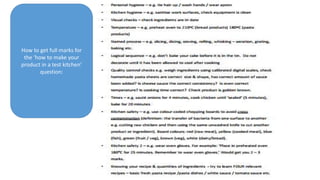
How to get full marks for
the ‘how to make your
product in a test kitchen’
question:
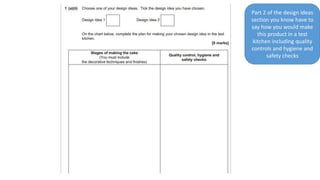
Part 2 of the design ideas
section you know have to
say how you would make
this product in a test
kitchen including quality
controls and hygiene and
safety checks
Mark scheme Mark scheme for your
design ideas
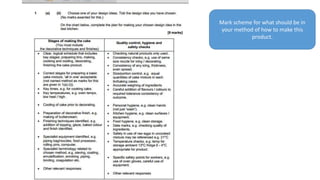
Mark scheme for what should be in
your method of how to make this
product.
GCSE FOOD EXAM TOP TIPS!
• Go into the exam with your design ideas and methods in your head
• Read all of the questions at least twice, if you have to neatly
underline the command words in the question
• NEVER leave a blank- Always try and answer the question
• Use your time wisely- you have 2 hours and 4 sections= 30 minutes
on each section
GOOD LUCK YEAR 11 

Year 11 food tech revision powerpoint

  • 1.
    Year 11 RevisionPowerpoint Good revision websites http://princehenrys.co.uk/_files/FEBA8E720731FDC23B5691 60A7E3AB14.pdf www.bbcgoodfood.com/content/recipes/special www.fairtrade.org.uk www.bbc.co.uk/food https://sites.google.com/site/foodrevision/ www.bbc.co.uk/schools/gcsebitesize/design/foodtech/ www.nutrition.org.uk
  • 2.
  • 3.
    Fats • Saturated fatsare usually obtained from animal sources, for example butter and lard. The exceptions are coconut and palm oils. • Polyunsaturated fats come from vegetable sources, such as sunflower oil. Gives energy and vitamins A, D, E and K • Found in oils, solid fats, fatty meat, cream, cheese and nuts • Animal fats and some vegetables oils contain saturated fat, which may raise blood cholesterol levels • Vegetable fats such as sunflower and soya and those in oily fish are polyunsaturated and better for the heart • Gives a rich source of energy that can be converted into fat in the body, which protects organs and gives heat
  • 4.
    Carbohydrates • Provides energyand fibre • Found in cereals, vegetables, sugar, rice, pasta, bread and pastries • If the body receives more energy than it needs, it stores it as fat • Wholemeal/wholegrain cereals are a richer source of fibre than white/refined ones • Vitamins B and E, calcium and iron are also provided by bread
  • 5.
    Protein • Enables thebody to grow and repair • Found in milk, meat, fish, eggs and cheese • Also in soya, beans, cereals, pulses and nuts • If more protein is eaten than is needed for growth and repair, the excess is converted into glycogen in the liver and used as energy • Animal foods and soya beans are used most efficiently by the body • Many protein foods also provide iron and B vitamins (especially B12) • Tofu (soya bean curd), Textured Vegetable Protein (TVP) made from soya flour, and Quorn (fungus) can all be used to replace animal proteins
  • 6.
  • 7.
    Nutritional Properties • Starch •thickens a liquid by forming a suspension such as a sauce • forms a gel when the suspension is heated, like adding cornflour to a custard powder and milk mix • Sugar • flavours by sweetening • colours by caramelising when heated • aerates when beaten with a fat such as in a cake mix • Proteins • can coagulate which is when a liquid becomes firmer, for example when an egg is heated • can aerate a mixture, like whisking egg whites in a meringue mix • Fats • shortens pastry (makes it more crumbly) by making it less stretchy • can act as an emulsifying agent to stop two liquids from separating • moistens a baked mixture such as a cake
  • 8.
    Treating foods • Aeratingincorporates air by sieving, creaming, whisking, beating, folding and rolling, or rubbing in. Raising agents can be used to make a mixture lighter, for example, baking power is used in cakes. • Coagulation is when something thickens from a liquid to a solid. For example, raw eggs are clear and runny but become white and solid when heated. • Preserving helps food to last longer through freezing, canning, jam-making, or pickling. Fats, sugar and oil are used in preserving. • Tenderising tough meat makes it easier to eat. Lemon juice, vinegar or wine can be used as a marinade, or meat can be tenderised with mechanical action using a meat mallet or slow cooking. • Thickening uses eggs, pulses, cereals and fruit to thicken liquids such as milk, and heat is usually applied. Egg custard is made like this.
  • 9.
    Combining foods • Bindinguses fats, eggs, cereals and flour to bind ingredients. For example, egg is used to bind together a biscuit mixture. • Bulking forms the main structure of a food product, such as flour in biscuits and cakes. • Enrobing means coating a food with another ingredient, for example, dipping fish in beaten egg and then breadcrumbs. • Enriching is the addition of an ingredient to improve the quality. Nutrients are sometimes added to increase nutritional value. • Fermentation uses yeast to convert carbohydrates into alcohol and carbon dioxide. In bread making, yeast is added to flour and water causing the dough to rise. • Flavouring can be savoury, like herbs and spices, or sweet, like sugar or sweeteners. Sugar helps to soften the sharp taste of grapefruit. • Shortening uses of oils and fats to reduce the development of gluten in pastry to make the dough less stretchy. • Stabilising helps food keep its structure. Eggs and flour are used for stabilising. • Setting means using ingredients to make foods firm, such as gelatine to set cold desserts.
  • 10.
    Finishing Techniques • Browninguses fats, eggs, sugar, milk, flour or oil, which darken a food when heated. • Glazing adds a shiny coating, for example, pastry brushed with beaten egg before cooking. • Icing can add colour and texture.
  • 11.
    Food structures • Solutionis when one substance is dissolve in another one, for example when sugar is dissolved in water we get a sugar solution. • Colloid is a general term for when two substances are mixed together. For example milk has a colloidal structure, because it is made from microscopic drops of fat dispersed in a water-based liquid. • Emulsion is when two unblendable liquids are mixed together, for example, oil and vinegar. An emulsifier like egg yolk is needed to stop them from separating. Emulsions are a particular type of colloid. Mayonnaise is an emulsion. • Foam is when air bubbles are incorporated into a liquid, such as in whipped cream and meringue • Gel contains a small amount of a solid in a large amount of liquid. A small amount of gelatine can set a large amount of liquid. • Suspension is when a solid is held in a liquid. The solid may sink if the mixture is not stirred. Flour (solid) is suspended in milk (liquid) when making a cheese sauce.
  • 12.
    Additives • Natural additivesoccur naturally in foods. They are extracted and put into other foods. Caramelised sugar is used as colouring in cola. • Artificial additives do not occur naturally. They are made synthetically for a certain purposes. For example tartrazine is a synthetic colouring added to some sweets to make them yellow. Can you think of any other examples?
  • 13.
    Uses for additives •Both natural and artificial additives are used for many different reasons: • Preservatives extend the shelf life of a product. Salt is used used in bacon and sausages. • Colouring makes food products look more appealing and appetising. • Flavourings can be used to add or improve the flavour of a food product. Vanilla flavouring is often added to cakes and biscuits. • Emulsifiers are used to prevent ingredients from separating. For example, lecithin, which is found in eggs, is used to stop the ingredients in mayonnaise from separating
  • 14.
    Food acidity Some foods,such as citrus fruits, are acidic. Others, like sodium bicarbonate, are alkaline. Foods that are neither acid nor alkaline, like pure water, are called neutral and have a pH value of 7. Acidity or alkalinity affects: the taste of final product the rate at which microorganisms grow within and upon food Examples Acidity or alkalinity can affect food in the following ways: Acidic fruit mixed with milk will cause the mixture to curdle. Vinegar (acid) is added to meringue to give it a soft marshmallow texture. Bicarbonate of soda (alkaline) acts as a raising agent during baking. Lemon juice (acid) helps prevent fruits like apples from discolouring
  • 15.
    Food temperatures • Chilling •Dairy produce, cooked foods and raw ingredients should be kept at a temperature between 0°C and 5°C. This will slow the growth of microorganisms, but won't stop it. • Freezing • Meats, vegetables and ready meals can be frozen. Freezing maintains high standards of freshness and safety. Freezers store products at -18°C or below. Freezing does not kill microorganisms, but will keep them dormant until the food is unfrozen. • Reheating foods • Food must be reheated to at least 72°C to avoid the risk of food poisoning. Leftovers should be disposed of quickly.
  • 16.
    Eat Well Plate •The Eatwell Plate is based on the Government’s • Eight Tips for Eating Well: • 1. Base your meals on starchy foods • 2. Eat lots of fruit and veg • 3. Eat more fish • 4. Cut down on saturated fat and sugar • 5. Try to eat less salt – no more than 6g a day • 6. Get active and try to be a healthy weight • 7. Drink plenty of water • 8. Don’t skip breakfast • http://www.nhs.uk/Livewell/Goodfood/Pages/eatwell-plate.aspx - use this website for more information.
  • 18.
    Functions of ingredients-Flour • Provides fibre (especially if wholemeal) • If Self-Raising, makes mixtures rise • Thickens sauces • Forms the bulk of bread, pastry and cake mixes • If wholemeal, provides colour and texture • Gluten in flour produces a stretchy dough • Provides carbohydrate, Vitamin B, calcium and iron
  • 19.
    Sugar • Provides sweetness •If brown, provides colour and texture • Large amounts prevent micro-organism growth (for example, jam/marmalade) • Caramelises to produce a brown colour • Retains moisture • Helps to trap air in cake mixtures • Provides carbohydrate
  • 20.
    Eggs • Hold airwhen beaten • Coagulate (sets) when heated • Add colour to mixtures • Thickens sauces, custards, etc. • Glaze bread, scones and pastry • Bind ingredients together • Provide protein, fat, iron and Vitamins A, B, and E
  • 21.
    Fats and oils •Provide flavour • Keep products moist and extend shelf-life • Add colour to foods • Make pastry 'short' by coating the flour to stop gluten developing • Hold air when creamed with sugar • Oil forms an emulsion with liquids (for example, mayonnaise) • Provide energy and Vitamins A and D
  • 23.
    Can you identifythe pastry? Filo Danish Puff Shortcrust Choux
  • 24.
    Can you identifythe pastry? Filo Danish Puff Shortcrust Choux
  • 25.
  • 26.
    Gelatinisation • Many saucesare thickened by gelatinisation of starch. When mixed with a liquid and heated, starch thickens the liquid. • During gelatinisation the following occurs starch particles form a suspension in the liquid ( they do not dissolve) • Stirring the liquid keeps the starch particles suspended – if the suspension isn’t stirred they stick together and sink to the bottom – forming lumps. This will then not cook correctly. • When the liquid reaches approximately 60°C the starch grains begin to swell as they absorb the water. • As heating continues (approx 80°C) the particles break open and release starch. This makes the mixture thick and viscous. This is gelatinisation. • Gelatinisation is completed when the liquid reaches 100°C. The liquid now forms a gel. • On cooling the gel solidifies – it will set to form a mould e.g. Blancmange. • This is the same for all starch- based sauces. It is important to remember that cornflour and arrowroot are pure starch where as wheat flour contains a high proportion of starch and also some protein.
  • 27.
    Rouxs • The RouxMethod • The fat is melted and the flour is then stirred in and cooked on a medium heat. The liquid is added gradually off the heat. The sauce is then returned to the heat and brought back to the boil. Types of Roux • White roux - cooked for 1 minute, no colour • Blond roux - cooked for 2-3 minutes. Flour starts to brown before liquid is added • Brown roux – flour cooked thoroughly until deep brown to develop fullness of flavour before stock added. Base for stews
  • 28.
  • 29.
  • 30.
  • 31.
  • 32.
  • 33.
  • 34.
    Kitchen Equipment Namethe equipment.
  • 35.
    Manufacturing methods • One-offproduction is when a single product is made, for example a designer wedding cake. This is classed as a luxury food item. • Batch production involves making of a set number of identical products. Typically batch production is used in a bakery, where a certain number of different types of loaves will be made every morning. • Mass production is used to make foods on a large scale. The production line involves repetitive tasks so machines are often used. This saves time and helps lower the cost of production. • Continuous-flow production is a high-volume production method where machines run 24 hours a day. It is often used to produce milk and packet pizzas.
  • 36.
    CAD- Computer AidedDesign • Computers are essential in the development and manufacture of food products. Computer Aided Design (CAD) helps create, modify and communicate information efficiently. Computer modelling allows designers to test models and changes without carrying them out. • CAD is used for: • Nutritional analysis software provides nutritional information to help create foods for a balanced diet • Simulate changes to inputs and processes so the impact of modifications can be predicted • Calculate costs and amounts of ingredients needed for batch production • Packaging design and advertising decisions using graphics and 3D modelling software • Sensory profile software is used in testing and can analyse and rank results • Production flowcharts show where Hazard Analysis Critical Control Points (HACCP) checks need to be included in the factory processes
  • 37.
    Quality control • Qualitycontrol • Quality assurance (QA) guarantees that food meets a clear, consistent set of standards. At key stages in production there should be quality control checks so manufacturers are alerted to any problems. The results of these checks are recorded. Checks can be done by hand or by computer. • Quality control checks will normally include: • weight checks to make sure the product is the required weight • visual checks to make sure it looks the way it should • temperature checks to make sure it is being kept at an appropriate temperature • pH checks to make sure the food has the correct acidity/alkalinity • microbiological checks to make sure bacteria are not at harmful levels • chemical checks to guard against chemical contamination • metal checks to guard against contamination by metals (usually at the packing stage, using a metal detector) • organoleptic checks to check flavour, texture and aroma by sampling the food product
  • 38.
    Packaging Can you thinkof any other advantages and disadvantages?
  • 39.
    Environmentally friendly packaging •Environmentally friendly packaging causes less damage to the environment. There are three types: • Reusable packaging can be cleaned and re-used. For example, glass milk bottles are reused. • Recyclable packaging is made of materials that can be used again, usually after processing. Recyclable materials include glass, metal, card and paper. • Biodegradable packaging will easily break down in the soil or the atmosphere
  • 40.
    Labelling • These arethe items on the label that are required by law. • manufacturer's name and contact details • name of the product • description of the product • weight (some foods are exempt, for example bread) • ingredients (listed in descending order of weight) • cooking/heating instructions • storage instructions • shelf life • place of origin • allergy information
  • 41.
    Labelling • The followingitems are not legal requirements, but are nevertheless good practice and often included on packaging: • illustration of product • price • nutritional values of the product • customer guarantee • the batch-code and bar-code numbers • opening instructions
  • 42.
  • 43.
    AQA GCSE Designand Technology: Food Technology © Nelson Thornes 2009 43 Food should appeal to each of our five senses. It should: look appealing smell appetising taste good have good mouth feel sound right. For example, biscuits should break with a snap. What is sensory testing?
  • 44.
    AQA GCSE Designand Technology: Food Technology © Nelson Thornes 2009 44  To assess the appeal of a new product. This could be carried out in a test kitchen or by setting up tastings in supermarkets.  To evaluate an existing product to see if it could be changed or developed.  To see if a new product meets its original specification. Why is sensory testing used in the food industry?
  • 45.
    AQA GCSE Designand Technology: Food Technology © Nelson Thornes 2009 45 Profiling test: This is where a product is graded on a scale – usually 1-5 according to its desired characteristics, e.g. sweet, crunchy, colourful, etc. The results can be recorded on a spreadsheet and shown on a star profile like the one opposite. What type of tests are there? (C) British Nutrition Foundation 0 1 2 3 4 5 Crunchy Sweet Colourful Hard Chocolate flavour Attractive Iced topping Unusual shape
  • 46.
    AQA GCSE Designand Technology: Food Technology © Nelson Thornes 2009 46 Rating test: This test is used to assess flavour, texture or a characteristic like sweetness or saltiness. Testers are given the samples in random order and asked to rate them usually on a seven-point scale.  Very sweet  Moderately sweet  Slightly sweet  Neither sweet nor sour  Slightly sour  Moderately sour  Very sour
  • 47.
    AQA GCSE Designand Technology: Food Technology © Nelson Thornes 2009 47 Difference test: This is often used to see if consumers notice any difference when recipes are changed, e.g. sugar reduced. Ranking test: This is where similar products are tested for a specific quality, such as crispiness. Testers put the samples in rank order. Results are recorded in a table. For example, a tester would be asked to pick the odd one out.
  • 48.
    AQA GCSE Designand Technology: Food Technology © Nelson Thornes 2009 48  Set up the tables so that the testers are not facing each other. In school, it is best to use a random sample of testers from all years, not your friends. If possible, ask about 15–20 students.  Samples should be the same size, served at the intended temperature and in plain white dishes.  Water should be provided to clean the mouth between samples.  A sheet to record results should be provided with a clear explanation of what is required. How to carry out sensory testing in the classroom
  • 49.
    AQA GCSE Designand Technology: Food Technology © Nelson Thornes 2009 49  When possible, use a spreadsheet to analyse the results. This will give you various options for displaying your results, for example:  Finally, add a written conclusion, for example: From my sensory analysis, I can see that the testers liked the shape of my biscuit and its crunchy texture, but I need to improve the iced topping, chocolate flavour and overall sweetness. To do this I will:  add an extra 20g cocoa powder to the mixture  ice the top of the biscuit rather than just pick out the shape. This will also improve the overall sweetness. Recording and interpreting results
  • 50.
    How to getfull marks on the design question. • How to get full marks for design ideas – • • recognisable sketch that fits design criteria – explain HOW your design fits • the design criteria (refer to the decorations you have chosen) • • write the product name, • • draw two DIFFERENT products, • • label in detail • • add measurements (what size is the product, is it a small decorated cake or a • large decorated cake? Portion sizes etc‐could put weight in grams on. • • Explain HOW your product is suitable for providing sensory appeal e.g. • colour, aroma, texture, shape, variety of flavours, finishing techniques. • • Include finishing techniques and use a variety which complement each other • and fulfil what the brief has asked.
  • 51.
  • 52.
    This is whereyou draw your design ideas.
  • 53.
    Mark scheme foryour drawings
  • 54.
    Mark scheme- tosee if you have followed the criteria set for you.
  • 55.
    How to getfull marks for the ‘how to make your product in a test kitchen’ question:
  • 56.
    Part 2 ofthe design ideas section you know have to say how you would make this product in a test kitchen including quality controls and hygiene and safety checks
  • 57.
    Mark scheme Markscheme for your design ideas
  • 58.
    Mark scheme forwhat should be in your method of how to make this product.
  • 59.
    GCSE FOOD EXAMTOP TIPS! • Go into the exam with your design ideas and methods in your head • Read all of the questions at least twice, if you have to neatly underline the command words in the question • NEVER leave a blank- Always try and answer the question • Use your time wisely- you have 2 hours and 4 sections= 30 minutes on each section
  • 60.